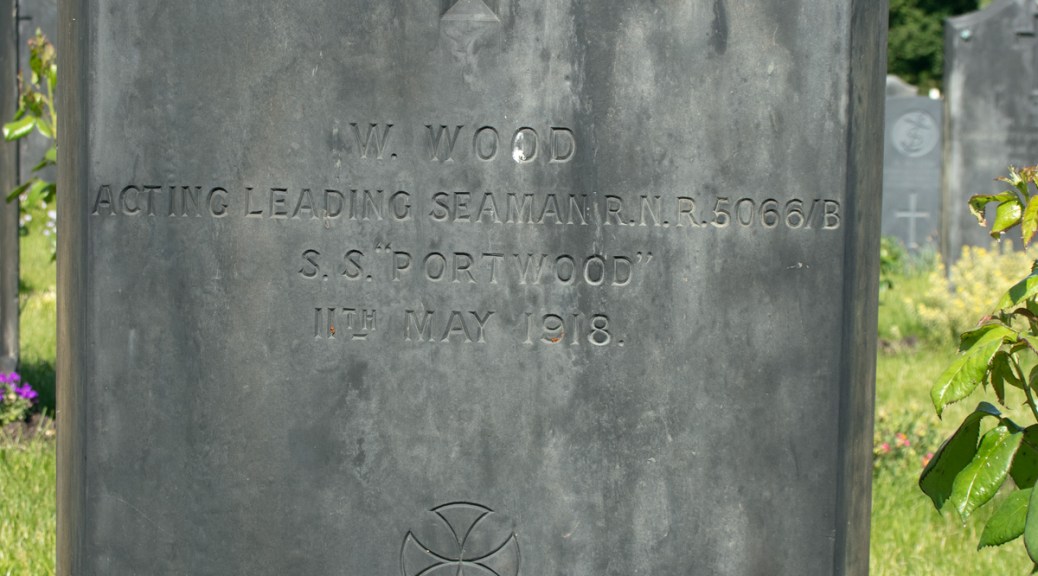
The life of William Wood, who is buried in Woodlands Cemetery in Gillingham, Kent, is a challenge to piece together. His headstone confirms that he held the rank of Acting Leading Seaman in the Royal Naval Reserve, and that he was assigned to SS Portwood at the time of his death.
Full service records for William have long since disappeared, but his pension ledger index card gives his widow as Catherine Rose Wood, of Greenfield Street in Govan, Scotland. It also suggests that the couple did not have any children under full age.
The Royal Navy and Royal Marine War Graves Roll provides William’s date of birth – 28th December 1887 – and goes on to suggest that he was born in London. Sadly, his name is far too common to narrow down census records, and there are no documents relating to his and Catherine’s marriage, so any additional family connections are also lost.
Acting Leading Seaman Wood’s entry on the pension ledger confirms his died of general paralysis of the insane, and his burial in the Gillingham cemetery would suggest that he had passed away in the Royal Naval Hospital in Chatham, Kent. He died on 11th May 1918, at the age of 29 years old.
William Wood was buried in the military section of Woodlands Cemetery, Gillingham, Kent.
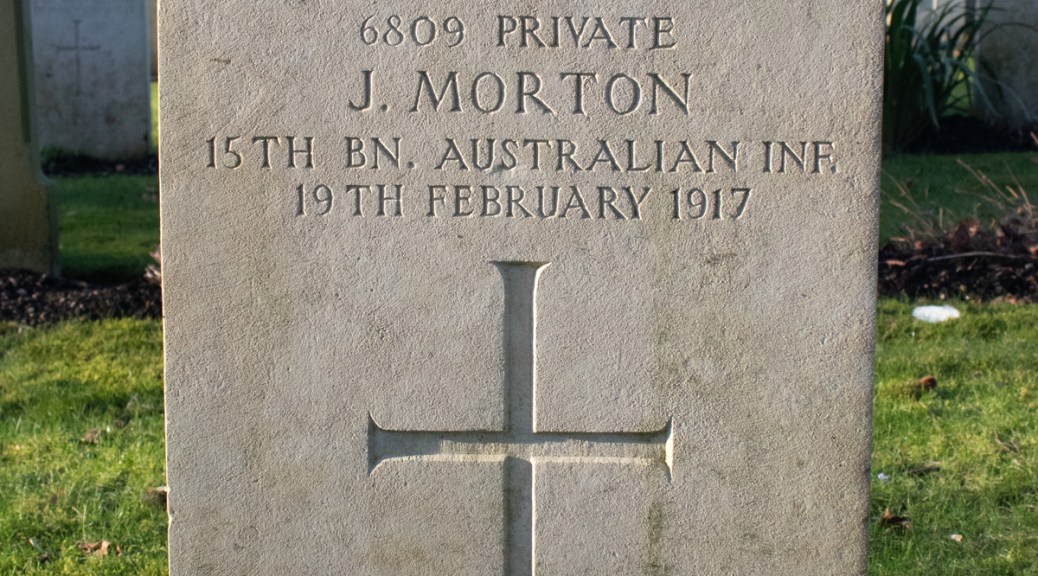
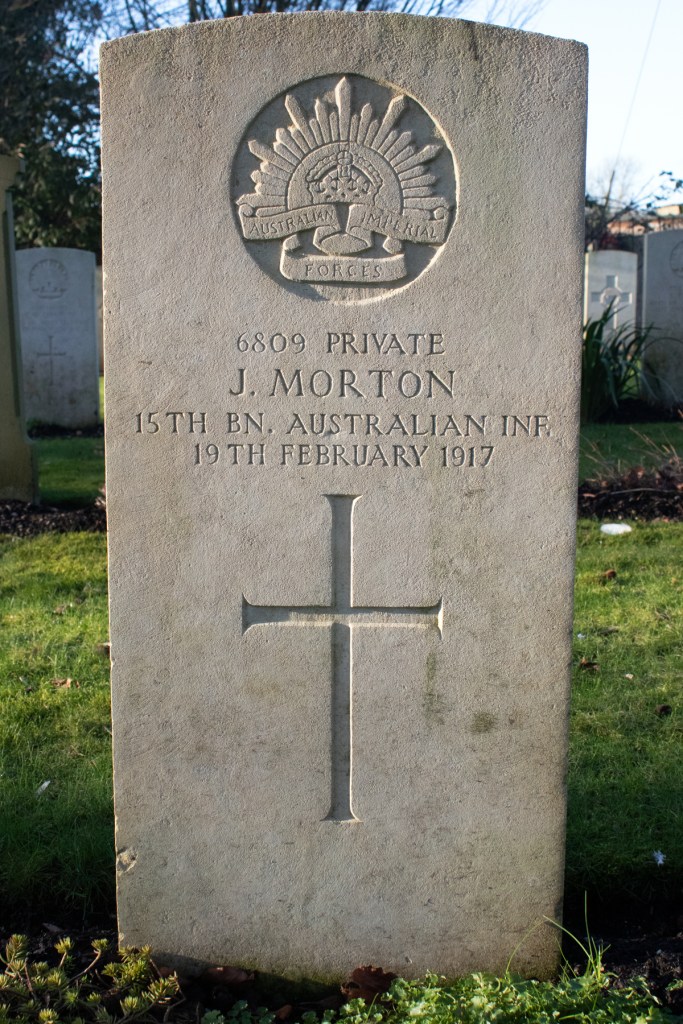
The life of Private John Morton is a challenge to unpick. His entry on the Commonwealth War Graves Commission website confirms that Morton was the name he served under, but that his birth name was John Lessells.
John’s army paperwork gives his age, 20 years old, his place of birth as Dunfermline, Scotland, and provides a next-of-kin, William Morton. John had enlisted on 9th September 1916 in Brisbane, Australia, although no emigration records remain. His service document noted that he was working as farmer, so, like thousands of others, it is likely that John sought a bigger and better life in a land of opportunity.
The medical section of John’s service records confirm something of the man he had become. He was 5ft 3ins (1.6m) tall, and weighed 125lbs (56.7kg). He had brown hair, blue eyes and a medium complexion. Interestingly, it also noted that John had been turned down for military service before because of an “under standard chest”.
Private Morton’s unit set sail for Europe on 17th November 1916. The transport ship – the Kyarra – departed from Brisbane, and arrived in Plymouth, Devon, nearly three months later. During the voyage, he was admonished for disobeying a reasonable order given by a superior order, although what the order was is unclear.
On landing in Britain, John was assigned to the 15th Battalion of the Australian Infantry. His unit was moved to a camp on the outskirts of Codford, Wiltshire, which would become their base of operations. Sadly, the journey from Australia seemed to have taken it out of John. On 14th February 1917, he was admitted to the camp hospital, suffering from a bout of influenza. His condition worsened, and two days later he was moved to a military hospital in nearby Sutton Veny.
Private Morton’s condition was to get the better of him. He passed away from pneumonia on 19th February 1917. He was 20 years of age.
John Morton, or John Lessells, was laid to rest in the graveyard extension to St Mary’s Church in Codford. He was surrounded by colleagues from the ANZAC regiments.
Charles William Comley was born on 10th May 1882 in the Somerset city of Bath. One of sixteen siblings – only seven of whom survived childhood – his parents were Charles and Mary. Charles Sr was a stonemason, and to avoid any confusions with their names, his son quickly became known by his middle name, William.
When he completed his schooling, young William found work with a baker. However he had his sights on bigger and better things, and on 1st August 1899 he enlisted in the Royal Navy. Being too young to formally enlist, he was given the rank of Boy 2nd Class, and was sent to HMS Northampton, a training ship, to start learning the skills he would later rely on.
After jut a couple of months Boy Comley was given his first assignment, on board HMS Curacoa, a cruiser which served as a training ship. He would spend the next six months on board, visiting the Atlantic coastal ports in Madeira, Las Palmas and Cape Verde. By the time William completed his time on Curacoa, he had been promoted to Boy 1st Class.
Returning to Britain, William was sent to HMS Vivid, the Royal Naval Dockyard in Devonport, Devon. He would only be based there for a matter of weeks, but during that time he turned 18, and was now of an age to be inducted into the navy proper. Now given the rank of Ordinary Seaman, his service records show that he was 5ft 3ins (1.6m) tall, with light brown hair, hazel eyes and a dark complexion. He was also noted as having a scar on the first finger of his left hand.
In June 1900, Ordinary Seaman Comley was assigned to the battleship HMS Magnificent, and from this point on, his naval career was set. Over the next sixteen years, he would serve on a total of seven ships, with HMS Vivid remaining his home base in between voyages. His service records continually note his very good character, and, from September 1903, he held the rank of Able Seaman.
When William’s initial twelve-year contract came to an end in the spring of 1912, he immediately re-enlisted. He had grown to 5ft 7.5ins (1.71cm) in height, and his records show that, while retaining his light brown hair and eyes, he now had a light complexion.
War broke out in the summer of 1914, and Able Seaman Comley was assigned to the newly launched HMS Tiger. He would remain part of the battleship’s crew for close to two years, and was involved in the Battle of Dogger Bank in January 1915.
On 3rd April 1916, William was medically disembarked in Scotland, suffering from pneumonia. He was admitted to the Royal Naval Hospital in Queensferry, but his condition turned septic. He passed away on 12th April 1916, a month short of this 34th birthday.
The body of William Charles Comley was taken back to Somerset for burial. He was laid to rest in the city’s majestic Locksbrook Cemetery.
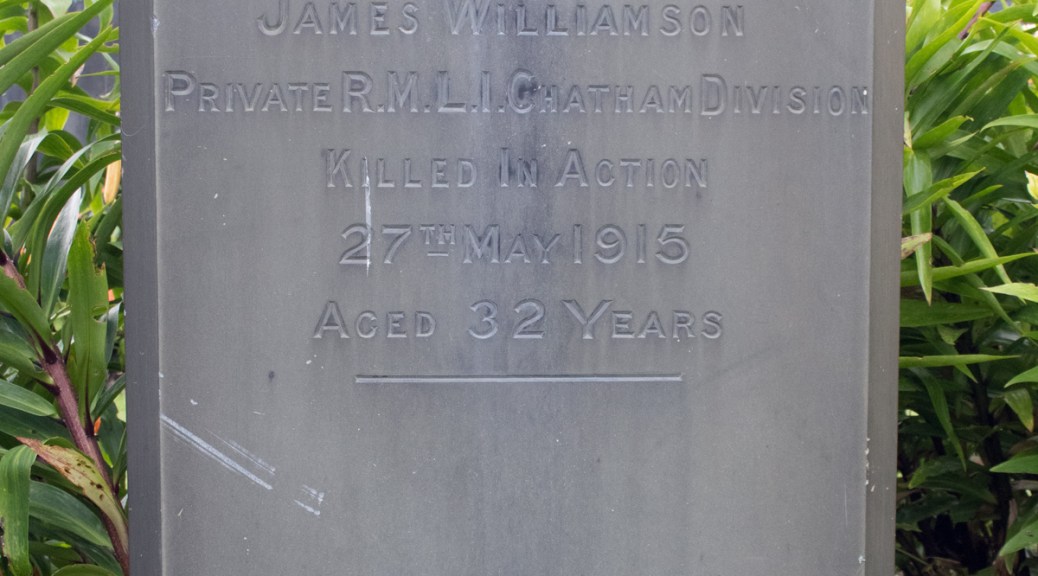
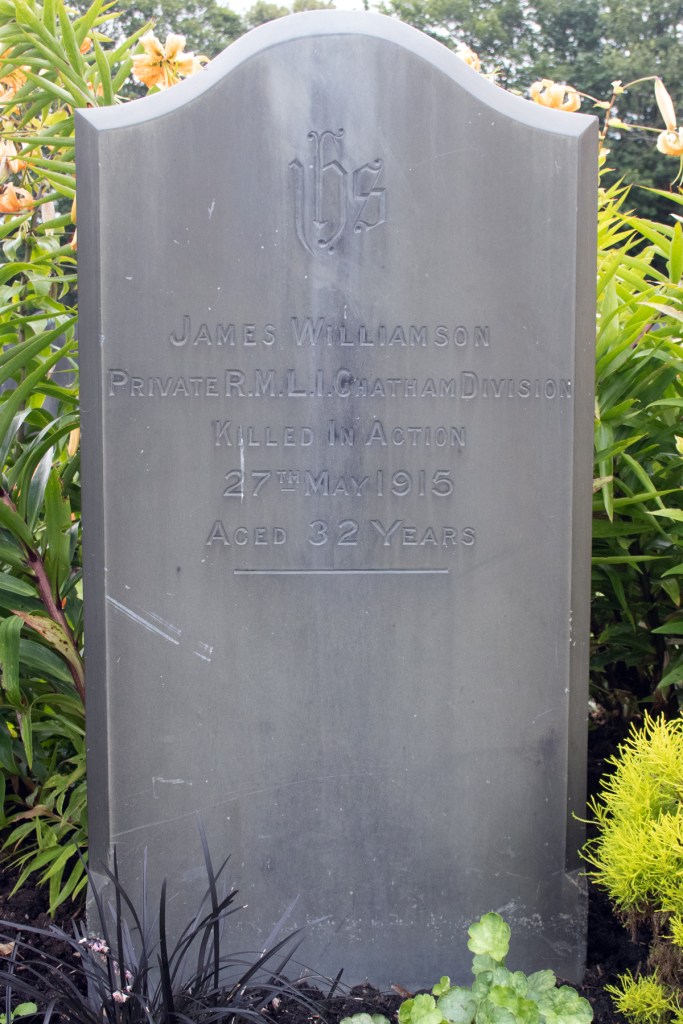
In amongst the rows of naval headstones in the Woodlands Cemetery in Gillingham, Kent, is one dedicated to James Williamson, a Private in the Royal Marine Light Infantry. He was killed in action on 27th May 1915, while attached to the ship HMS Princess Irene, and was 32 years of age when he passed.
There is little specific documentation relating to Private Williamson’s life, but what remains allows us to piece together something of the man he was.
James was born in the Dennistoun area of Glasgow in around 1883, and was one of five children to William and Jane Williamson. When he finished his schooling, he seems to have had a pull to the sea: whether this was because he was following in his father’s footsteps, or because of his home’s proximity to the river and docks is unclear.
By the time of the 1911 census, James was already serving in the Royal Marines. He was based on the cruiser HMS Philomel, which was in the Gulf of Oman on the day the census was taken, and was one of 19 Royal Marines on board our of a total compliment of 244 crew.
There is little more concrete information about Private Williamson’s life. By the spring of 1915, he had been assigned to the HMS Princess Irene, an ocean liner requisitioned during the war and converted into a mine layer. On 27th May, she was moored off Sheerness in Kent, when a series of explosions ripped her apart. More than 270 crewmen were killed: this included the 32-year-old James.
The crew whose bodies were not able to be identified were laid to rest in a communal grave in Woodlands Cemetery: James Williamson was laid to rest nearby, in a burial of his own.
Interestingly, James’ entry on the Royal Navy and Royal Marines War Graves Roll gives his next of kin as a friend, Miss J Malone of 3 Ashview Terrace, Newton Mearns, near Glasgow. There is no other information about her.
Percival Osmond Bean Boyce was born in Calcutta, India, in January 1887. The oldest of seven children, his parents were Edward and Mary. While details of his early life are not readily available, it would seem that Edward had some military connections. He had been born in Calcutta in 1859, while Mary was Welsh. Most of Percival’s siblings had been born in India, although two – Cecil in 1891, and Dorothy in 1896 – had been born in Somerset.
The 1901 census recorded Percival as boarding at Keyford College in Frome, Somerset. His family do not appear on that census return, nor does he appear on any other census document. He went on to study at Bristol Grammar School, Gloucestershire, making the First XI rugby team.
In May 1915, Percival married Florence Cooper. There is little information available about her, but the couple exchanged vows in Paignton, Devon.
Percival seemed to have taken to a life at sea by this point, and was the Chief Officer of the cargo ship SS Indore. On 25th July 1918, she was torpedoed by the German submarine U-62, off the Irish coast. The Indore was beached, and two of the crew were killed. Chief Officer Boyce managed to get the ship re-floated and safely back to shore.
At this point, Percival’s trail goes cold again. He survived the war, but died in Scotland on 27th November 1918, the cause of his passing unknown. He was 30 years of age.
In a traditionally Edwardian obituary, it was noted that “great sympathy is felt for Mr JH Cooper, Chairman of Paignton District Council, in the death of his son-in-law, Mr Percival OB Boyce, master mariner, at Glasgow. Both of Mr Cooper’s daughters are now widows, and he lost a son not long since.” [Western Times: Tuesday 3rd December 1918]
Percival Osmond Bean Boyce was laid to rest in Paignton’s sweeping cemetery.
In the regimented Woodlands Cemetery in Gillingham, Kent, stands the headstone dedicated to Stoker James Clark of the Royal Naval Reserve. The grave marker, and associated documents, confirm James’ age at the time of his passing as 48 years, but gives no details of next of kin or any relatives.
Stoker Clark’s service records are sparse, but confirm a date and place of of birth – 13th December 1867 in Glasgow, Scotland – and his parents’ names, William and Catherine. Sadly, while the document also gives the names of two of James’ siblings – Mary and William – it has not been possible to match these with any census documents from the Glasgow area.
James’ service records state that he joined the Royal Naval Reserve on 1st October 1897. He was 5ft 8.5ins (1.74m) tall, with grey eyes and a fresh complexion. He was also noted as having a number of tattoos on his right arm, including a sunrise and a heart.
Stoker Clark’s time in the Royal Naval Reserve are a bit patchy, but it seems that he was called into full duty in 1914. Over the next couple of years he served on three different ships, each time returning to HMS Pembroke, the Royal Naval Dockyard in Chatham, Kent.
While his overall service seems to have gone well, in July 1915, he deserted. Full details are not evident, but he was captured, and seems to have returned to duty by the end of the month.
The next record for Stoker Clark is that of his passing. His service records state that he “died suddenly at [Royal Naval Barracks] Chatham on 2nd May 1916 (cause of death at present unknown)”. There is no other information about his death, and, while his siblings were informed of his death, it appears they were unable – or unwilling – to bring his body back to Scotland for burial.
Instead, James Clark was laid to rest in Woodlands Cemetery, Gillingham, not far from the dockyard he had called his home.
John Francis Turner was born on 24th March 1899 in the St Ouen region of the Channel Island of Jersey. He was the only surviving child of Francis and Eugenie Turner, his older brother, Francis Jr, having passed away before John was born.
Francis was a farm labourer, but when John finished his schooling, he found work as a carpenter. When war broke out across Europe, he was conscripted to play his part and, on 31st March 1917, he enlisted in the army.
Private Turner was noted as being 5ft 5ins (1.65m) tall and weighing 115lbs (52kg). His medical records show that his vision was defective, but not so bad as to exclude him from service, but he was also found to have flat feet.
John was assigned to the Royal Army Medical Corps, and was sent to Blackpool, Lancashire, where he was attached to the local depot. He spent the next two years in the army, although his time was not without incident.
In December 1917, he was confined to barracks for five days for overstaying his pass by more than eight hours. This seems to have been Private Turner’s only misdemeanour, however, and there is nothing to suggest anything other than good service.
John’s time in the army does not seem to have been limited to home soil, and, in the spring of 1919, he was attached to one of the Russian convoys ferrying aid and supplies overseas. On his return, however, he fell ill, and on 2nd February, he was admitted to hospital in Edinburgh, suffering from pleurisy.
Private Turner was to remain in hospital for the next few months. He slowly recovered, but then contracted meningitis, and, with his body already weakened by illness, this was to prove his undoing. He passed away on 23rd June 1919, aged just 20 years of age.
John Francis Turner’s body was taken back to Jersey for burial. He was laid to rest in the peaceful churchyard of St Ouen’s.
Ernest Roye Hewett was born on 18th April 1898 and was the third of twelve children to Alfred and Ada. Alfred was a coachman and groom and, while both he and Ada were born in Cornwall, it was in Budleigh Salterton, Devon, that the family were born and raised.
When he finished his schooling, Ernest found work as a butcher’s boy, but when sought bigger and better things. His oldest brother, Ralph, had enlisted in the army by the time of the 1911 census and, by that October, his next oldest brother, Leslie, had enlisted in the Royal Navy. Ernest felt a career in the military was his destiny and, on 12th September 1913, he also joined the navy.
As he was under age at this point, he was given the rank of Boy 2nd Class, and sent to HMS Impregnable, the training establishment in Devonport, for his induction. His service records show that he was 5ft 2.5ins (1.59m) tall, with brown hair, hazel eyes and a fresh complexion.
Ernest spent nine months training, moving from Impregnable to HMS Powerful, and gaining a promotion to Boy 1st Class in the process. In June 1914, he was assigned to the cruiser HMS Edgar, remaining on board for six months, by which point war had broken out.
On 18th December 1914, Lance Corporal Ralph Hewett was killed in action, aged just 20 years old. Attached to the 2nd Battalion of the Devonshire Regiment, he was caught in fighting in Northern France, and is commemorated on the Le Touret Memorial.
Ernest, by this point, had been assigned to another ship, the armed merchant cruiser HMS Viknor. Patrolling the seas off Scotland, towards the end of the month, she was tasked with locating and detaining the Norwegian ship Bergensfjord, on board which was a suspected German spy.
The vessel was located and escorted to Kirkwall in the Orkneys, and the suspect and a number of other prisoners, were taken on board the Viknor to be transported to Liverpool. The ship and crew were never to reach their destination. On 13th January 1915, she sank in heavy seas off the Irish Coast: no distress signal was made and all hands were lost.
BODY WASHED ASHORE – Another body has been washed ashore at Pallntoy Port, about six miles from Ballycastle. The body was that of a man of about 5ft 10in. in height. He was dressed in a blue jacket, and wore a service blue webbed belt, on which was the name E. F. Hewett. In the pocket of the trousers was a boatswain’s whistle.
Freeman’s Journal: 24th February 1915
Already in mourning for Ralph, Alfred and Ada were unable to bring 16-year-old Ernest Roye Hewett back home. Instead, he was laid to rest in Ballintoy parish church, County Antrim.
The heartbreak was to continue for the Hewett family. Leslie’s career had gone from strength to strength and, by the time of his older brother’s death, he had been promoted to Able Seaman. In the summer of 1915, he was assigned to the cruiser HMS Europa, remaining aboard for the next year as it patrolled the Mediterranean. In July 1916 he fell ill, having contracted malaria. This was to prove his undoing: he passed away from the condition on 21st July, at 20 years old.
Able Seaman Leslie Hewett was laid to rest in the Mikra British Cemetery in Greece. His parents had now lost their three oldest sons, and had no way to reach their final resting places.
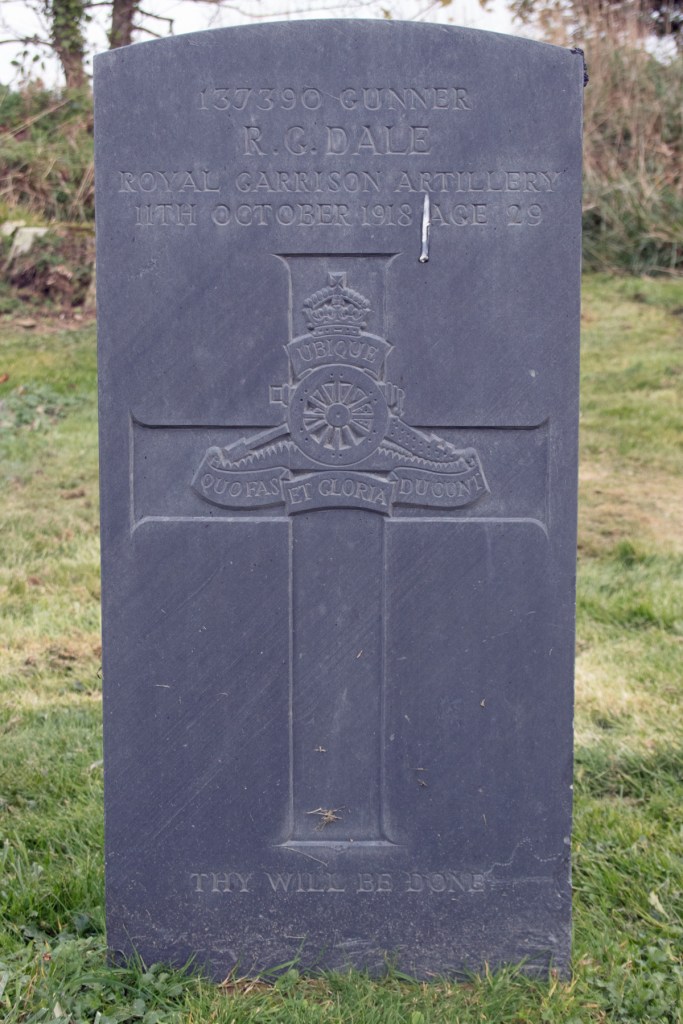
Richard George Dale was born Padstow, Cornwall, in the summer of 1889, the oldest child to Alice Dale. She married Frederick Bryant in March 1894, but and went on to have two children – Frederick and Albert – but, by the time of the 1901 census, her husband has passed away. The document gives Richard’s surname as Bryant, but there is no real indication that he was Frederick’s son.
Alice had been living with her greengrocer parents, but the 1901 census in a small cottage off Lanadwell Street, a couple of door away from them. As a widow at 31 years old, she is noted as being on parochial relief.
Details of Richard’s later life are a challenge to track down. Absent from the 1911 census, it was around that time that he married Agnes MacKintosh. While she was born in Edinburgh, the wedding took place in St Columb, Cornwall.
When war broke out, Richard was working as a farmer. He enlisted the day after hostilities were declared, and joined the Royal Garrison Artillery. Gunner Dale was, according to the records, 5ft 3ins (1.6m) tall, with medium colour hair, blue eyes and a fresh complexion. He had a scar between his eyebrows.
Gunner Dale served for nearly four years, all the time being based on home soil. He suffered from epilepsy, however, and this is what led to his eventual discharged from armed service in March 1918.
Richard returned home, but his health was compromised. He passed away on 11th October 1918, from a combination of influenza and pneumonia. He was 29 years of age.
Richard George Dale was laid to rest in Padstow Cemetery, in sight of his younger brother Albert, who had passed away eleven years before.
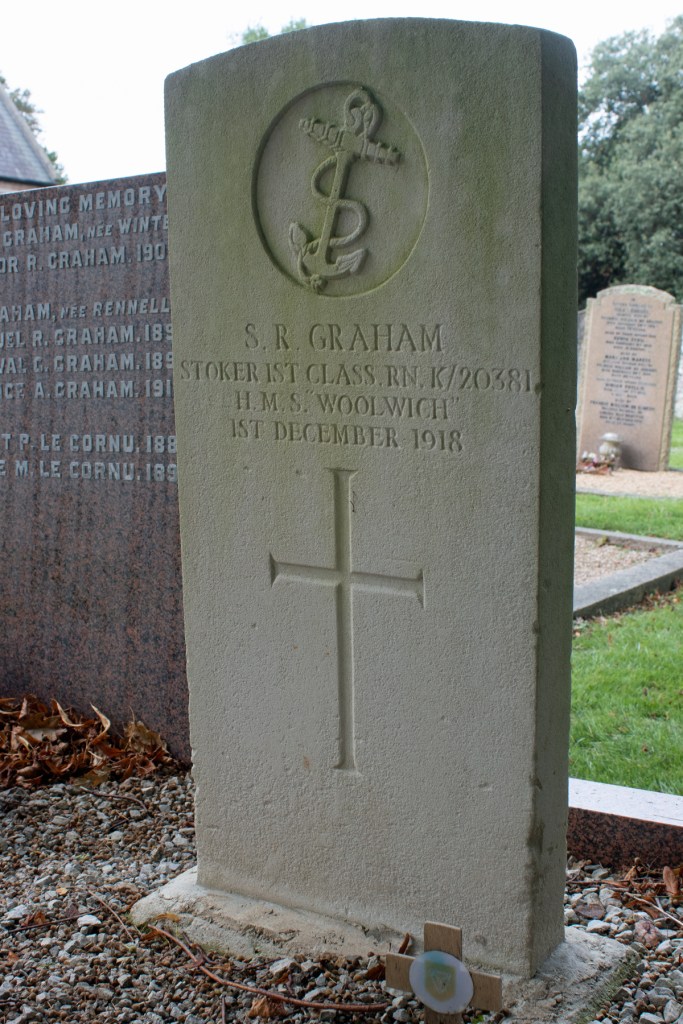
Samuel Robert Graham was born in Cork, Ireland, in 1895. He was one of six children to Samuel and Alice Graham. Samuel was a postman from Liverpool, while Alice had been born in St Helier, Jersey.
Information about Samuel Jr’s early life is scarce: the 1901 census found Alice and the children visiting her mother in Jersey, while he husband is missing from census records. The next return in 1911 recorded Samuel Sr, Alice and three of their children living in the Trinity area of Jersey, but Samuel Jr is missing.
On 9th September 1913, Samuel Jr enlisted in the Royal Navy. He had been working as a blacksmith, and sought a career at sea. His service records show that he was 5ft 5ins (1,65m) tall, with brown hair, hazel eyes and a fresh complexion.
Stoker 2nd Class Graham signed up for a period of twelve years’ service. Based at HMS Victory, the Royal Naval Dockyard in Portsmouth, Hampshire, his first formal posting was on board the cruiser HMS Bristol. He remained on board for nearly two years, and was promoted to Stoker 1st Class in the process.
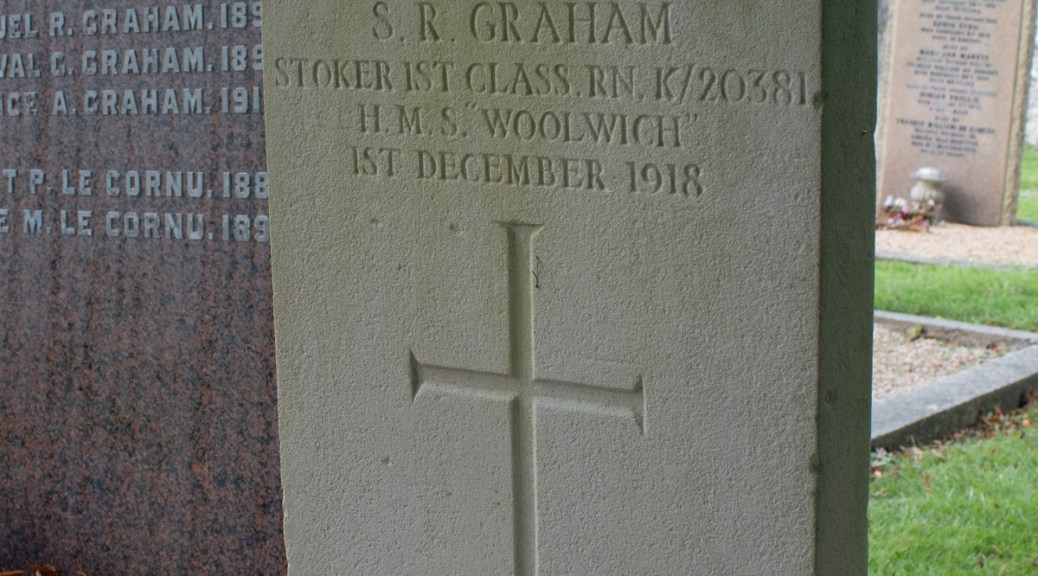
During the First World War, Samuel served on two more ships and, by the end of the conflict, he was based at HMS Columbine, the naval base at Port Edgar on the Firth of Forth, Scotland. He fell ill while barracked there, and was admitted to the Royal Naval Hospital in nearby Queensferry. Whatever Stoker 1st Class Graham’s condition, it was to prove too severe: he passed away on 1st December 1918, at the age of 23 years old.
Samuel Robert Graham’s body was taken back to Jersey for burial. He was laid to rest in Trinity Churchyard, not far from where his family still lived.






 Death and Service