Category Archives: Suffolk

Signalman Philip Files

Signalman Philip Files

Phillip William Turner Files was born on 13th April 1894 in Walmer, Kent. One of eight children, his parents were George and Annie Files. George was a carpenter at a local colliery, but living so close to the sea, his son was inevitably drawn there. On 25th January 1910, Phillip gave up his life as an errand boy and joined the Royal Navy.

Phillip’s service records show that he was 5ft 4ins (1.62m) tall, with dark brown hair, blue eyes and a fresh complexion. He was just 15 years old when he enlisted, and, as he wasn’t of full age, he was given the rank of Boy 2nd Class. He was initially sent to HMS Ganges, the shore-based establishment in Suffolk for his initial training.

Phillip remained at HMS Ganges for the next year, and was promoted to Boy 1st Class on 5th September 1910. The following January he was moved to the Royal Naval Dockyard in Portsmouth, Hampshire, also known as HMS Victory.

Over the next year, with Victory as his base, Boy Files was sent to serve on three ships – the dreadnought battleship HMS Albermarle, and the cruisers HMS Sappho and HMS Philomel. While on board Philomel, Phillip came of age and, because of his technical abilities, was given the rank of Ordinary Signaller – changing to Signalman when the ranks were updated later in 1912.

Phillip remained on Philomel until October 1913 and, after a brief spell back in Portsmouth, he was transferred to the armoured cruiser, the converted RMS Laconia. She was to be Signalman Files’ base for the next year, when, on 9th March 1915, he was transferred again, this time to HMS Princess Irene.

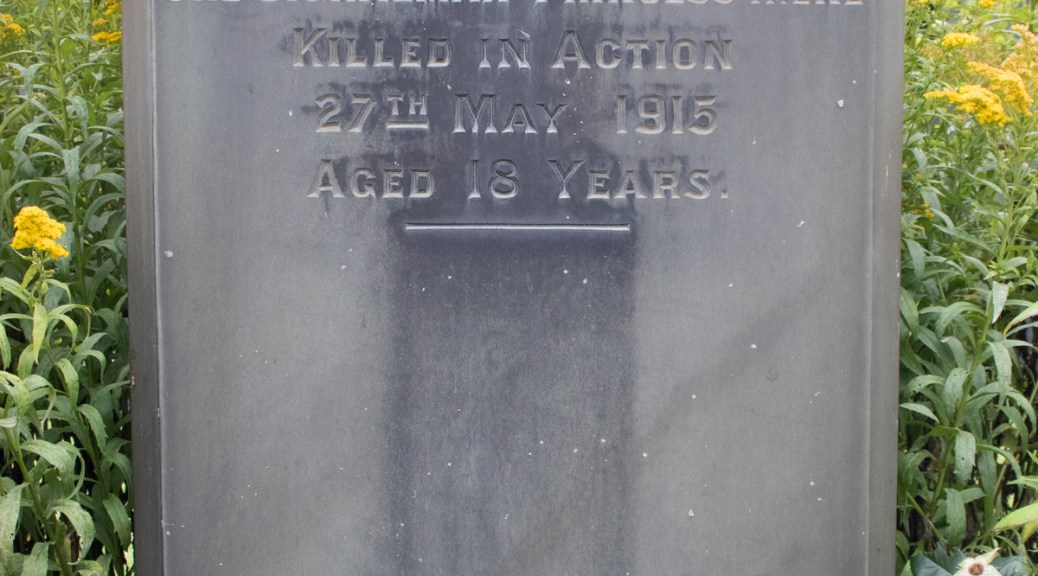
Princess Irene was a converted liner, requisitioned as a minelayer when war broke out. On 27th May 1915, an explosion ripped through the ship, while moored off Sheerness, Kent. Signalman Files was one of the 352 souls killed. He was just 21 years of age.

Phillip William Turner Files was laid to rest in the Woodlands Cemetery in Gillingham, Kent. His body having been identified, he was given his own grave, unlike those who were buried in a mass grave nearby.


Signalman Files’ headstone spells his first name with one L. However, all the other documents relating to Phillip spell it with two.


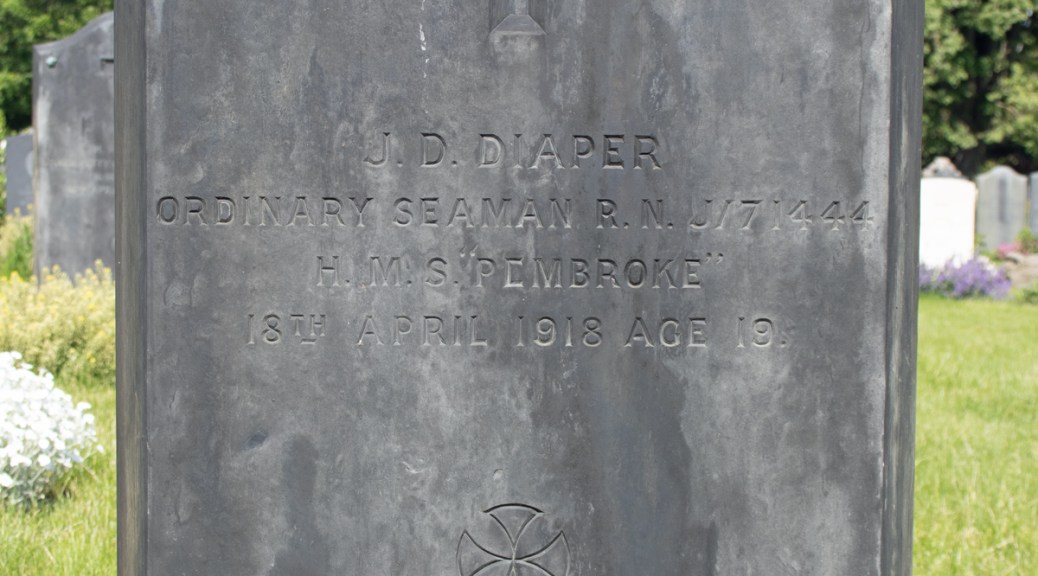
Ordinary Seaman John Diaper

Ordinary Seaman John Diaper

John Dolby Diaper was born in Stowupland, Suffolk, on 1st June 1898. He was the second youngest of ten children to George and Martha, and the older of two sons. George was a cattleman turned gardener, and it seems that John went into farm work when he completed his schooling.

When war broke out, John was called upon to play his part. He enlisted in the Royal Navy on 6th June 1917, joining as an Ordinary Seaman. His service records show that he was 5ft 4.5ins (1.63m) tall, with brown hair, grey eyes and a fair complexion.

Ordinary Seaman Diaper was sent to HMS Pembroke, the Royal Naval Dockyard in Chatham, Kent, for his training. The summer of 1917 was a particularly busy for the base, and temporary accommodation was set up in the Drill Hall; this is where John was billeted.

On the night of 3rd September 1917, Chatham suddenly found itself in the firing line as a wave of German aircraft bombed the town. The Drill Hall received a direct hit, and Ordinary Seaman Diaper was badly injured. He was admitted to the Royal Naval Hospital in the town, and would remain there for some time.

John’s injuries were severe and, although his treatment was ongoing, the impact on his overall health was detrimental. Ultimately, the air raid weakened his system, and his heart gave out. He died on 18th April 1918, more than seven months after the bombing: he was 19 years of age.

John Dolby Diaper was laid to rest in Woodlands Cemetery, Gillingham, alongside those who had given their lives on 3rd September.


Private Edward Brooke-Smith

Private Edward Brooke-Smith

Edward Charles Brooke-Smith was born in Muizenberg, South Africa, on 2nd March 1892. The eighth of nine children, his parents were mariner Alfred Brooke-Smith and his wife, Louisa.

Little further information about Edward’s early life is available. The 1901 census recorded the family as having returned to Britain – where both Alfred and Louisa had been born. The family had set up home in a cottage in Woodbridge, Suffolk, but by the spring of 1911 Edward had moved again, emigrating to Canada to make a life as a farmer.

When war came to Europe, the empire was called upon to fight for peace. Edward, who was working as a merchant in Valcartier, Quebec, by this point quickly stepped up to play his part. He enlisted in the Canadian Expeditionary Force on 17th September 1914 as a Private.

Edward’s service record give an insight into the man he had become. He was noted as being 5ft 11ins (1.8m) tall, with dark brown hair, grey eyes and a dark complexion. Private Brooke-Smith was also noted as having vaccination scars on his left arm, a small scar on his right knee and two moles on the centre of his back.

Details of Edward’s travel back to Europe are lost to time, but he was attached to the 7th Battalion of the Canadian Infantry and, by the spring of 1915, he was in Northern France. In March he had a bout of bronchitis, which was quickly followed by influenza, and he was hospitalised in Rouen.

Private Brooke-Smith returned to his unit in May 1915, but he was dogged by flu for the next couple of months. Sadly, things were not to improve for him.

On 19th August 1915, Edward’s unit was fighting at Wimereux, France, when he was shot. The bullet shattered the top of his right thigh and pelvis, and, after treatment on site, he was evacuated to Britain for further medical support.

Edward was to spend the next sixteen months in hospital. He was initially admitted to the Cambridge Hospital in Aldershot, Hampshire, where his primary treatment took place. In November 1915, he was moved to the Duchess of Connaught Canadian Red Cross Hospital in Taplow, Buckinghamshire for ongoing recuperation.

On 13th March 1916, Private Brooke-Smith was moved to the Auxiliary Hospital in Torquay, Devon. Here further physiotherapy and recuperation took place, before an operation to correct the position of his thigh was undertaken 9th December. Despite the precautions that had been put in place, Edward did not come round from the procedure: he was 24 years of age.

Alfred and Louisa had settled in Paignton by this point – given the year their son had spent in the hospital, it seems likely that they had moved to be nearer to him. Edward Charles Brooke Smith was, therefore, laid to rest in the family plot in the town’s cemetery. When Alfred died nine months later, he was buried alongside his son.


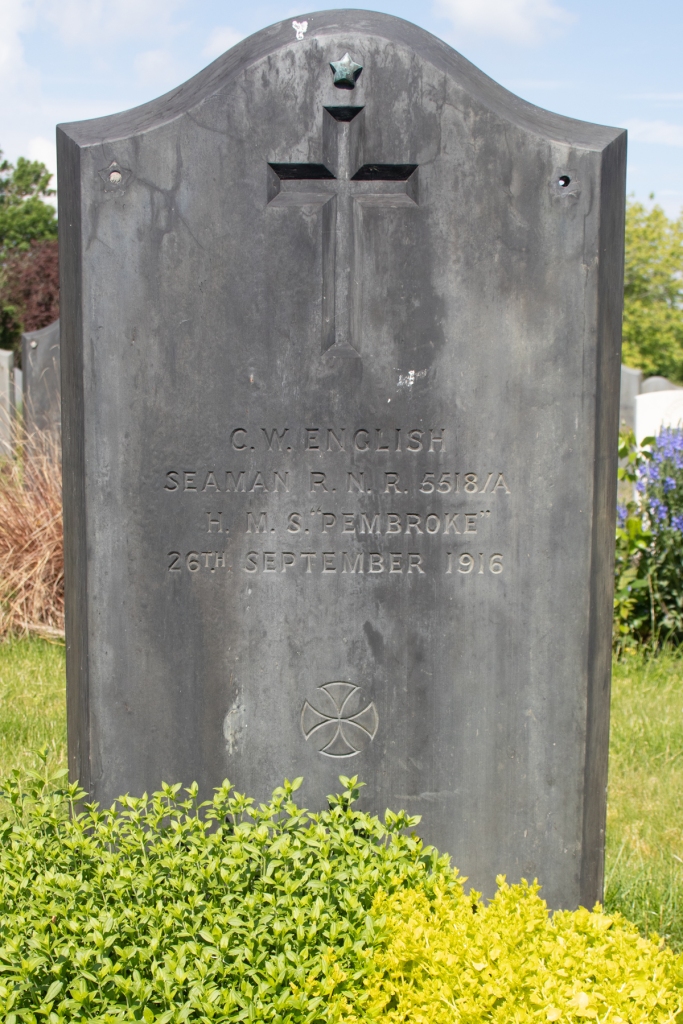
Seaman Charles English

Seaman Charles English

Charles William English was born on 30th August 1895 in the Suffolk town of Southwold. According to his later naval service records, his parents were Ellis and Sarah English, although there is little other information available to back this up.

Charles evidently had a draw to the sea and, when he enlisted in the Royal Naval Reserve on 10th January 1914, he was working as a fisherman. His service records confirm that he was 5ft 9ins (1.75m) tall, with grey eyes and a fresh complexion.

Over the next few years, Seaman English served off the east coast, and was attached to HMS Mantua, a former cruise ship taken over by the Royal Navy to patrol the North Sea. In between trips, Charles made HMS Pembroke, the Royal Naval Dockyard in Chatham, Kent, his home and it was to here that he returned in the autumn of 1916 when he fell ill.

Charles was admitted to the Royal Naval Hospital in the town, tests showing that he was suffering from lymphatic leukaemia. This was to prove fatal, and Seaman English passed away on 26th September 1916, aged just 21 years of age.

It seems likely that Charles William English’s family were unable to foot the bill for bringing their son back to Suffolk. Instead, he was laid to rest in Woodlands Cemetery, Gillingham, not far from the base he had come to call home.


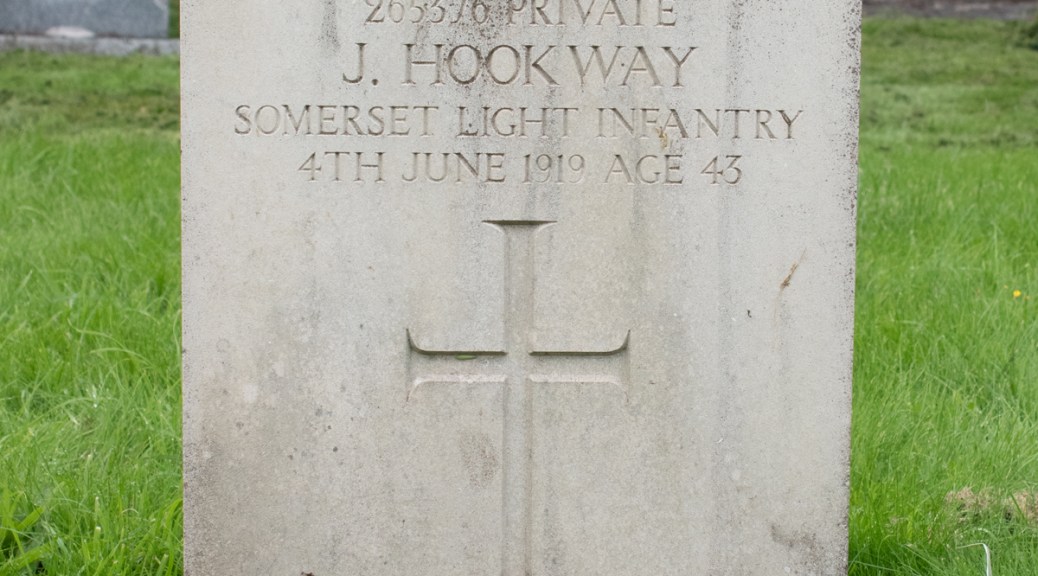
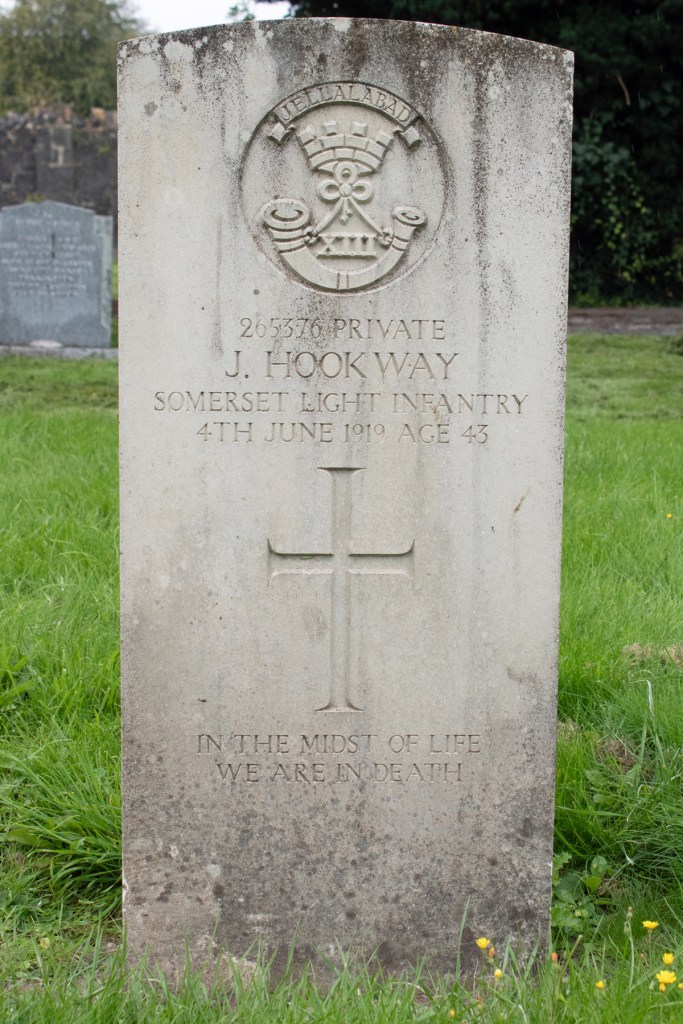
Private John Hookway

Private John Hookway

The early life of John Hookway seems destined to be lost to time. He was born in 1876 or 1877 in Lancashire, and the only surviving 1881 census featuring that name would suggest his parents were James, who was a shoeing smith, and Leah Hookway.

The next census on which John appears is in 1911. This confirms that John had married a widow called Rose Ash the year before. They were living in Huntspill, Somerset, with Rose’s three children – daughters Rose, Violet and Lily – and her sister, Emily. John was employed as an ‘improver in grocery trade’, while Violet, who was 17 years old, was noted as being a ‘servant on the Isle of Wight’. Violet’s sister, Rose, the census recorded, was ‘feebleminded’, while Emily was identified as an ‘imbecile’.

When war broke out, John stepped up to enlist. His age may have excluded him from any compulsion to join up – he was nearly 40 years old when he signed his attestation papers in December 1915. This may suggest that he had served in the army before, hence the absence from the 1891 and 1901 census records.

Private Hookway’s service records noted that he was a grocer, and that he had been born in Devon, although this is at odds with other, earlier, documents. He was 5ft 4ins (1.64m) tall and weighed 137lbs (62.1kg). He was assigned to the Somerset Light Infantry, and he joined the 13th (Home Service) Battalion. As the name suggests, John saw no action overseas, and his time appears to have been split between Somerset and Suffolk.

John’s time in the army was not without issue. In September 1916, he was admitted to a local Volunteer Aid Detachment Hospital with appendicitis, which saw him laid up for more than six weeks. In November 1918, the war having come to an end, Private Hookway was sent to the 2nd Southern General Hospital in Bristol, Gloucestershire, with an aneurysm of the abdominal aorta. This was, understandably, severe enough for him to be discharged from the army, and he was formally stood down on 12th March 1919.

John returned home to be with his family. The next record for him is that of his passing, on 4th June 1919. He was around 43 years of age.

John Hookway was laid to rest in Highbridge Cemetery, Somerset. Rose, who had now been widowed twice in ten years, never remarried. She was laid to rest near her second husband when she passed in 1946.


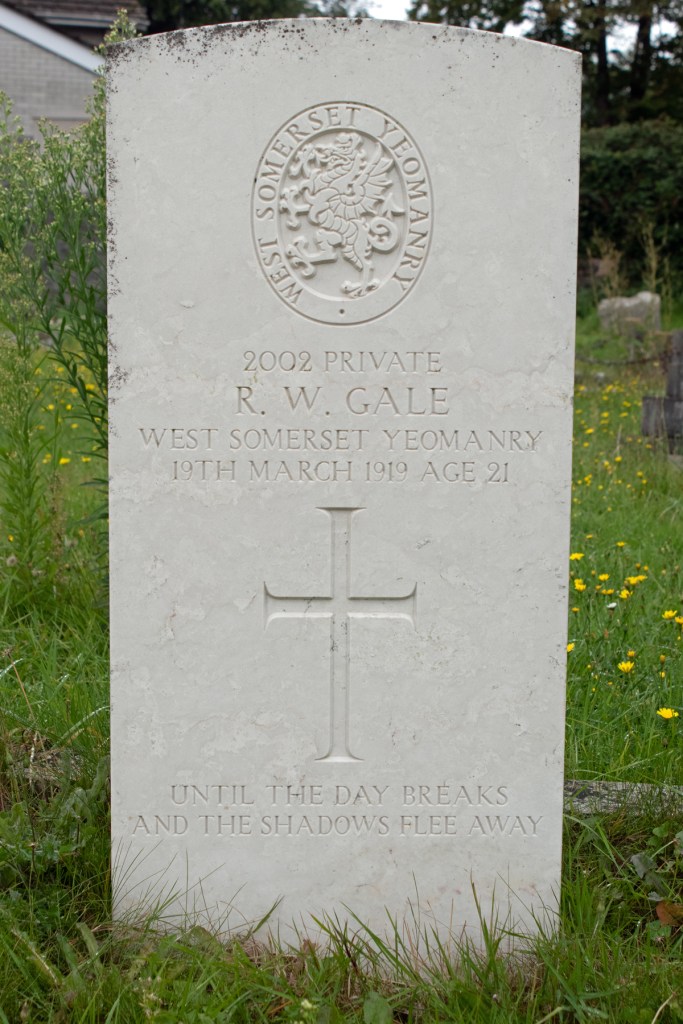
Private Richard Gale

Private Richard Gale

Richard William Gale was born in the autumn of 1897 in the Devon village of Sidbury. The third of six children, he was the son of George and Emma Gale. George was a bricklayer and labourer, and the family had moved to Burnham-on-Sea, Somerset, by the time Richard was ten, as this is where he had found work.

When Richard finished his schooling, he found employment as an errand boy for a school outfitters. By the time oft he 1911 census, there were four wages coming into the Gale household. Besides Richard and his father, his older brother, Frederick was working as a grocer’s apprentice, and his sister, Laura, was a dressmaker.

War was declared in the summer of 1914, and Richard was called upon to play his part. His service records no longer exist, so it is not possible to fully track his time in the army. However, he initially joined the 2nd/1st Battalion of the West Somerset Yeomanry and was sent for training in East Anglia.

As some point, Private Gale transferred to the Labour Corps, and became attached to the 949th Employment Company. Based in the London area, Richard’s duties are unclear, and his troop would have taken on any of a wide range of roles, from cooking and store work, to salvage, traffic control and telephone operating. Whether his previous work at the outfitters came into play is unclear, although Employment Companies were also involved in tailoring, shoemaking and laundry work.

Private Gale survived the conflict, and seems to have been based in the the Nottingham area after the Armistice. By March 1919, he had become unwell and, having contracted pleurisy, he was admitted to the Berridge Road Military Hospital. The condition took its toll on Richard, sadly, and he passed away on 19th March 1919. He was just 21 years of age.

Richard William Gale’s body was taken back to Somerset for burial. He was laid to rest in the cemetery of Burnham-on-Sea, a short walk from where his family lived.


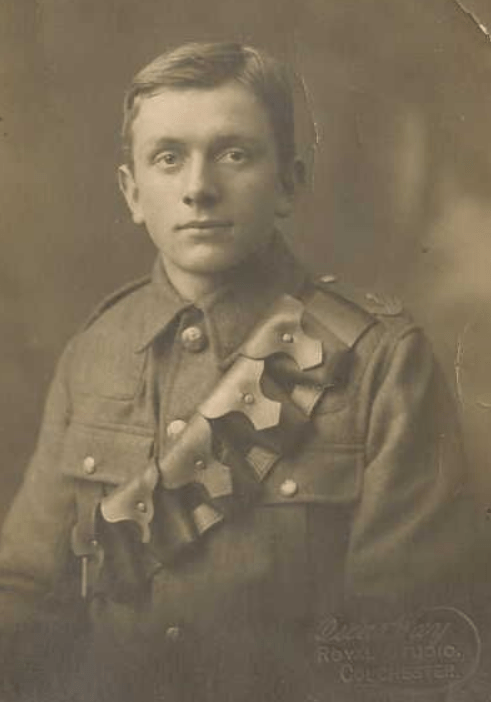
Private Richard Gale
(from findagrave.com)

Petty Officer Thomas Slade

Petty Officer Thomas Slade

Thomas Charles Slade was born in Bristol, Gloucestershire, on 13th March 1880. One of twins, he and his sibling Ernest were two of nine children to Charles and Elizabeth Slade. Not long after the twins were born, the family had moved to Minehead, Somerset, where both Charles, who was a mason and bricklayer, and Elizabeth had hailed from.

Whilst Ernest seemed content to remain in Somerset – going on to become a poultry farmer – Thomas sought a life of adventure. Foregoing his gardening job, he enlisted in the Royal Navy, setting his sights on a life at sea.

Thomas’ service records show that he joined up on 12th November 1895. He stood just 5ft 2ins (1.57cm) tall, with brown hair, blue eyes and a ruddy complexion. As he was to young to formally join up, he was give the rank of Boy 2nd Class, and sent to HMS Impregnable, the shore-based training establishment in Devonport, Devon.

Boy Slade seemed to create a good impression. He was promoted to Boy 1st Class in July 1896, and the follow February was given his first posting, on board the battleship HMS Benbow. This was the ship he was serving on when he turned 18 and, having come of age, he was officially inducted into the navy, and given the rank of Ordinary Seaman.

And so began a glittering career for young Thomas. Over the twelve years of his contract, he served on nine different ships, returning to HMS Vivid – the Royal Naval Dockyard in Devonport – between voyages.

Small in stature, Thomas appears to have been a dedicated young man. His annual reviews noted his character was ‘very good’ every year, and his ability was either ‘very good’, ‘superior’, or ‘excellent’. He was promoted to Able Seaman in September 1898, just eighteen months after becoming an Ordinary Seaman. By June 1906 he rose in rank again, ending his initial term of service as a Leading Seaman.

Thomas was not done with the navy yet, however. He immediately re-enlisted and, over the ensuing years served on a further four vessels. He spent more and more time on board HMS Defiance, the torpedo and mining school ship in Devonport. Whether this was because he was being taught, or was supporting incoming students is unclear, but by September 1912, he had been promoted again.

In November 1915, the now Petty Officer Slade had moved to the depot ship HMS Dido. His new posting supported the Tenth Destroyer Flotilla in the North Sea, patrolling the waters off the East Anglian coast. In February 1917 he moved to another of the support vessels, HMS Sturgeon.

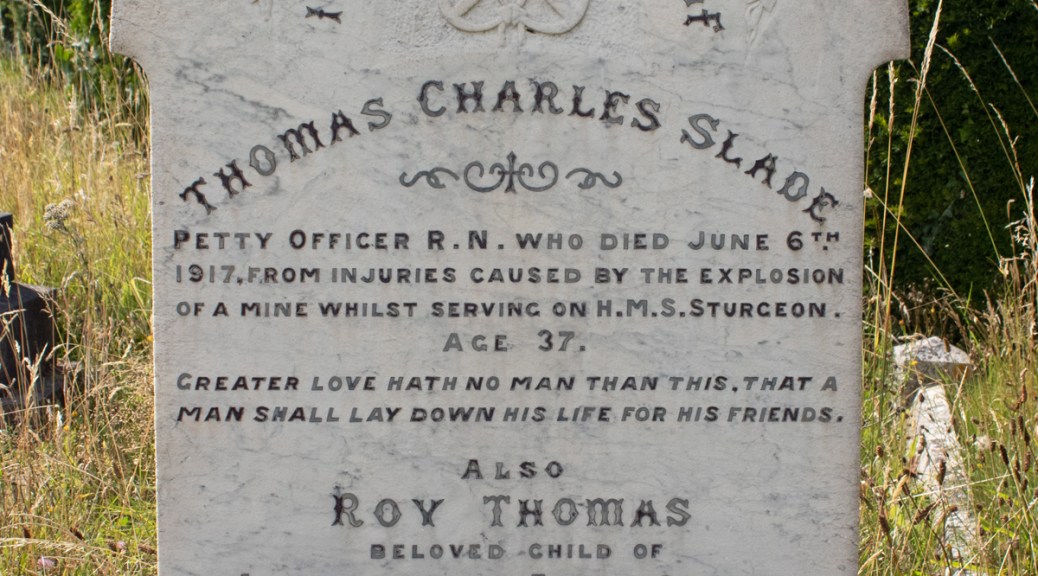
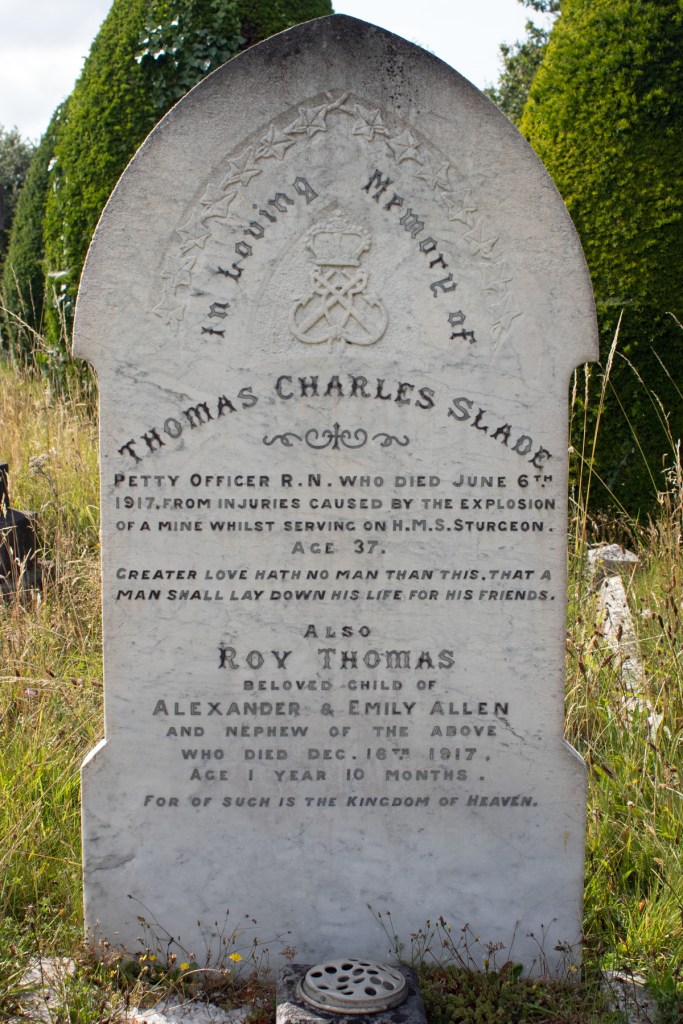
In June 1917, a mine exploded on board, injuring a number of the crew, including Petty Officer Slade. The wounded were transferred to a hospital near Ipswich, and it was here that Thomas was to pass away. The only one of those caught up in the incident to die, he was 37 years of age.

Thomas Charles Slade was brought back to Somerset for burial. He was laid to rest in the sweeping Minehead Cemetery, close to the grave of his mother, Elizabeth, who had passed away nine years before.


Thomas’ headstone also includes an inscription to Roy Thomas Allen, who died six months after him. Roy was the young son of Thomas’ younger sister Emily: an uncle and nephew reunited.


Sapper Frederick Macey

Sapper Frederick Macey

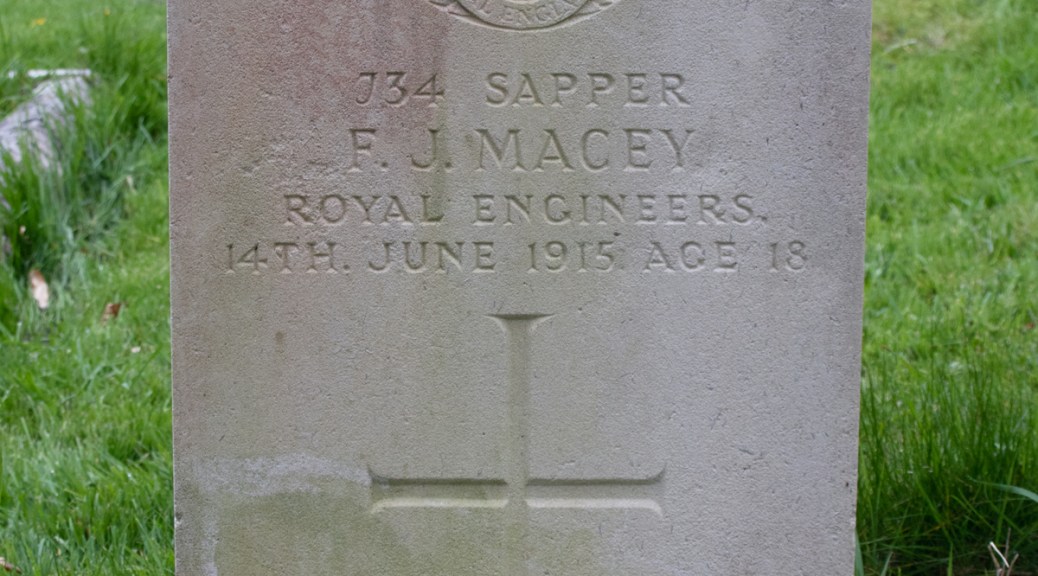
Frederick John Macey was born in the spring of 1897, the fourth of five children to James and Rose. James was a labourer from Hampshire, Rose was born in Ireland, but the children were born and raised in Monkton Combe, Somerset.

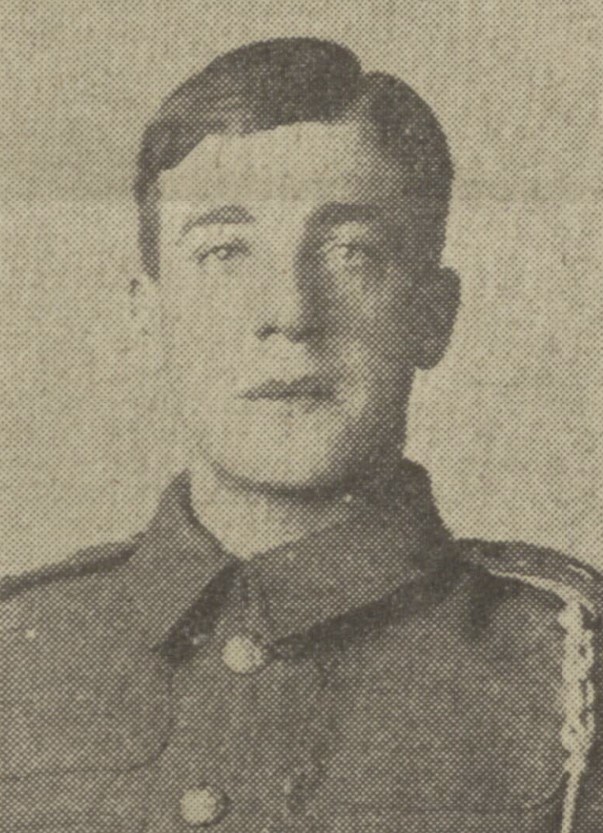
When war broke out, Fred stepped up to play his part. He enlisted in the Royal Engineers, and was assigned to the 503rd Field Company. Full details of his military service are lost to time, so it is not possible to identify whether Sapper Macey served overseas – Malta, where part of the regiment were based – or on home soil – in and around Ipswich, Suffolk.

Wherever he was based, Fred was injured, and he was sent to a military hospital in Guildford, Surrey, for treatment. Sadly, his wounds were to prove too severe, and he passed away on 14th June 1915, aged just 18 years old.

Frederick John Macey’s body was brought back to Somerset for burial. He was laid to rest in the peaceful graveyard of St Michael’s Church, in his home village of Monkton Combe.


Sapper John Macey
(from britishnewpaperarchive.co.uk)

Private Ernest Whatley

Private Ernest Whatley

Ernest James Victor Whatley was born in the spring of 1899, the youngest of three children to George and Clara Whatley. Clara passed away in 1908, and George remarried the following year, to a woman called Sarah. Ernest’s brothers were sixteen years older than him, and so by the time of the 1911 census they had moved out of their father’s home. By that point, Ernest living with his father and stepmother in their house in Bath, Somerset.

Little further information is available about Ernest. With war raging across Europe, he enlisted in the army, but this was not before September 1916, and it is likely that he came of age before joining up.

Private Whatley served in the 1st/7th (Cyclist) Battalion of the Devonshire Regiment, and was based in Suffolk. It is while he was billeted that he was admitted to a hospital in Ipswich, although the cause of his admission is unclear.

Whatever befell Private Whatley, it was to prove his undoing. He passed away in the Ipswich hospital on 9th March 1917, at the tender age of just 18 years old.

Ernest James Victor Whatley’s body was brought back to Somerset for burial. He was laid to rest in St James’ Cemetery, Bath, not far from his mother, Clara.


Able Seaman Jesse Baber

Able Seaman Jesse Baber

Jesse Baber was born on 28th February 1889 and was the youngest of thirteen children to John and Jane Baber. John was a farm labourer from Westcombe in Somerset, and it was in this village that he and Jane raised their family.

Jesse chose not to follow his father and siblings into farm work and instead, on 6th October 1906, he enlisted in the Royal Navy. As he was underage for full service at the time, he was given the rank of Boy 2nd Class and sent to HMS Ganges, a training establishment on the outskirts of Ipswich, Suffolk. His service records confirm that he was 5ft 5.5ins (1.66m) tall at the time of joining. He was also noted as having dark brown hair, grey eyes and a fresh complexion, with a mole on his right cheek being highlighted as a distinguishing mark.

Boy Baber spent six months at HMS Ganges, and was promoted to Boy 1st Class for his commitment. He was then transferred to HMS London, a dreadnaught battleship for a further six months. During his time on board, Jesse came of age, and was formally enrolled in the Royal Navy with the rank of Ordinary Seaman.

Over the next eight years, Jesse served on eleven different vessels, sailing between his British base of HMS Vivid in Devonport and the East Indies. His service seems to have generally been very good – he was promoted to Able Seaman in February 1909 – although he did spend five days in the brig in July 1912 for reasons unrecorded.

When war broke out, the ships that Able Seaman Baber served on patrolled the waters of the Mediterranean. In the summer of 1916, while on board HMS Dartmouth, he contracted malaria. Jesse was admitted to a hospital in Malta, where he remained for six weeks, and was then sent on leave home to recover.

He arrived at Castle Cary [in Somerset] on the evening of the 23rd August, on a visit to his sister, in a very serious condition, being practically in a state of collapse. Medical attention was immediately obtained, but his condition was hopeless, and he lay in an unconscious condition until Friday September 1st, when he expired, death being due to meningitis, following malaria.

[Shepton Mallet Journal: Friday 15th September 1916]

Jesse Baber was 27 years old when he passed away. He was laid to rest in the quiet graveyard of St Mary’s Church in Batcombe, not far from where his mother, who was now 74 years old, was living.