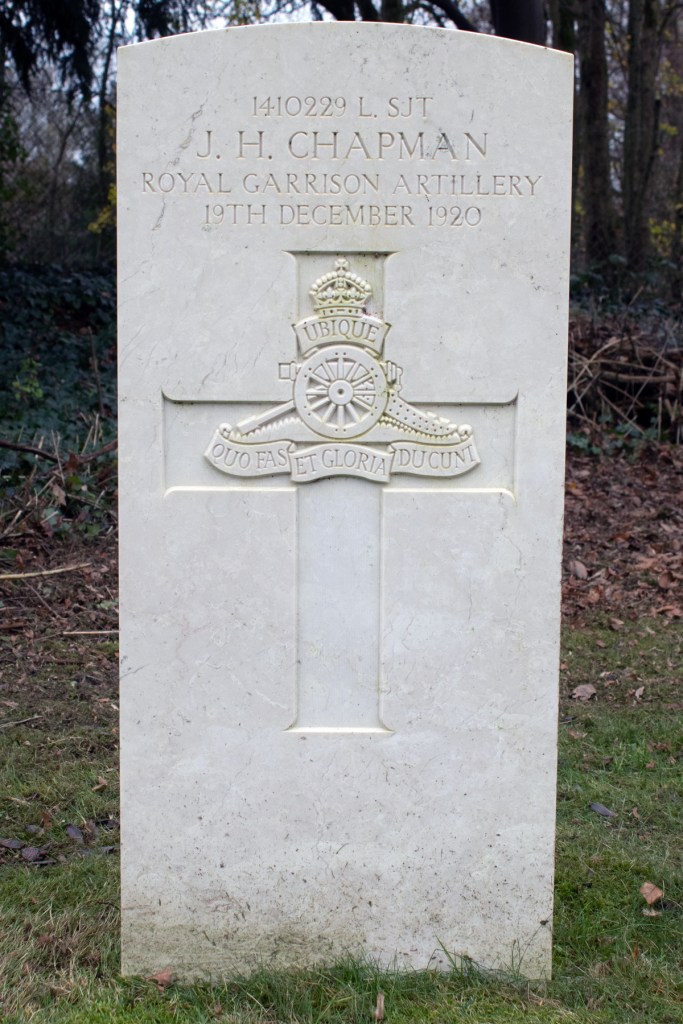
There is little concrete information available on the life of John Henry Chapman. His headstone, in Amesbury Cemetery, Wiltshire, confirms that he was a Lance Serjeant in the Royal Garrison Artillery, and that he died on 19th December 1920.
John’s pension ledger gives his widow’s name, Caroline, date of birth, 25th August 1900, and her address, High Street, New Romney, Kent. It also gives a cause of death for John, who passed away from pneumonia.
The record for Lance Serjeant Chapman’s headstone gives his next of kin as Mrs C Chapman, c/o Mrs Savage, which would suggest that that was Caroline’s maiden name. The Civil Registration Marriage Index records the union of a John H Chapman to someone with the surname of Savage in the summer of 1920: the wedding took place in Richmond, Yorkshire, although there does not appear to be any direct connection between the Lance Serjeant, Caroline and the town.
There are no further clear documents relating to John Henry Chapman. He lies at rest in the peaceful anonymity of Amesbury Cemetery.
Charles Millson was born in Scullcoates, Yorkshire, in the summer of 1897. One of nine children, his parents were called Charles and Eliza. Charles Sr was a general labourer and while still at school, his son found work as a newsboy, hawking papers for a local newsagent.
Sadly, there is little more concrete information about young Charles’ life. When war broke out, he stepped up to enlist, although the exact dates of his service are lost to time. He joined the Royal Field Artillery and, as Driver, was assigned to the 107th Brigade.
By the summer of 1915, Driver Millson was based on Salisbury Plain, near Amesbury, Wiltshire. This is where he was to breathe his last. Charles died on 7th June 1915, through causes unknown: he was just 18 years of age.
It would seem that the Millsons were unable to bring their son back to Yorkshire for burial. Instead Charles was laid to rest in Amesbury Cemetery, not far from where he had passed away.
Samuel Treeby was born in December 1865 in Taunton, Somerset. The third of seven children, his parents were cordwainer Thomas Treeby and his wife, Anna (or Hannah).
When he finished his schooling, Samuel found work as a blacksmith at a collar factory in Taunton. His trade stood him in good stead away from the forge: he volunteered for the Royal Horse Artillery, becoming adept at shoeing the animals.
In 1906, Samuel married Sarah Parker. She was from Enmore, between Bridgwater and Taunton, although the couple married in Cardiff, Glamorgan. The couple settled back in Enmore, where Samuel continued his smithing trade.
War came to Europe in 1914 and, although he was 49 years old, Samuel stepped up to play his part. He was attached to the Royal Army Service Corps and given a rank that echoed his civilian profession, that of Shoeing Smith. His service records show that he was of average height – 5ft 6ins (1.68m) tall – but that he was illiterate: he signed his declaration with a cross.
Samuel spent several months on home soil, before being sent out to France in March 1916. He spent six months overseas, before being shipped back to Britain, suffering from rheumatism. Shoeing Smith Treeby was admitted to the East Leeds War Hospital before being discharged to the regiment’s Remount Depot in Woolwich, Kent.
Samuel returned home to Somerset, but his poor health still dogged him during the winter of 1916/17. He contracted bronchitis, and died of the condition on 27th February 1917, while still based in London. He was 51 years of age.
Samuel’s body was taken back to Somerset for burial. He was laid to rest in the peaceful graveyard of St Michael’s Church in Enmore, not far from where his widow still lived.
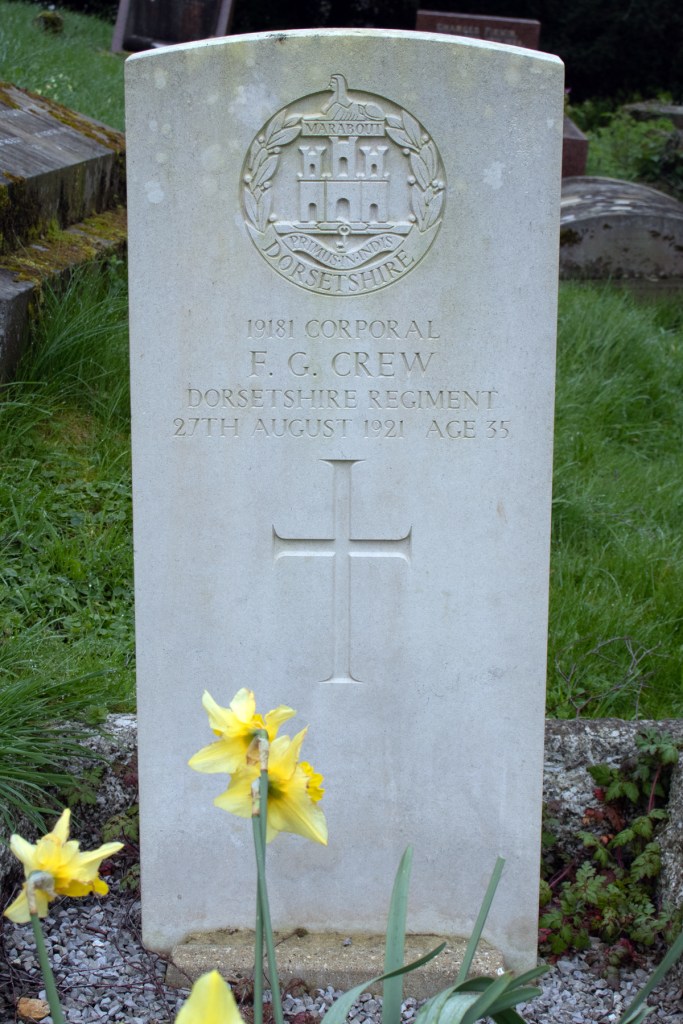
Frank George Crew was born in Twerton, Somerset, on 25th January 1886. The fourth of five children, his parents were nurseryman and market gardener William Crew and his laundress wife, Fanny.
When Frank finished his schooling, he followed his father into the nursery trade, and this is how he was employed when war was declared. He enlisted in the Dorsetshire Regiment on 19th July 1915, and was assigned to the 3rd (Reserve) Battalion. Private Crew’s service records are limited, but his medical report shows that he was 5ft 9ins (1.75m) tall, weighing around 10st (63.5kg).
On 6th October 1918, Frank, who had been promoted to Corporal by this point, was admitted to the Military Hospital in York with a bullet wound to his right forearm. Given that his battalion remained on home soil for the duration of the conflict, it is unclear whether this was an accidental injury at camp, or if he transferred to another troop when he recovered.
Little additional information for Frank remains. He remained in hospital until 8th November 1918 and it is unclear if he continued with his army service once he recovered – although given the Armistice was declared three days later, it is unlikely that he did.
On 11th November itself, Frank married Kate May, a mason’s daughter from Limpley Stoke, to the west of Bath. By this point he recorded his profession as gardener, so it seems his army career was indeed behind him. The couple went on to have a daughter, Peggy, who was born a year later.
William died in 1920, and by the time of the following year’s census, Frank, Kate and Peggy were living with Frank’s now-widowed mother. The extended family had a home on Padleigh Hill, to the south west of Bath city centre, and Frank seemed to be the main breadwinner, working as a labourer for Stothert & Pitts Ltd, a crane company on the River Avon.
Sadly, Frank was only to survive the census by a couple of months. He passed away on 21st August 1921, dying from a combination of influenza and epilepsy. He was 35 years of age.
Frank George Crew was laid to rest in the quiet Englishcombe Churchyard, close to the family home.
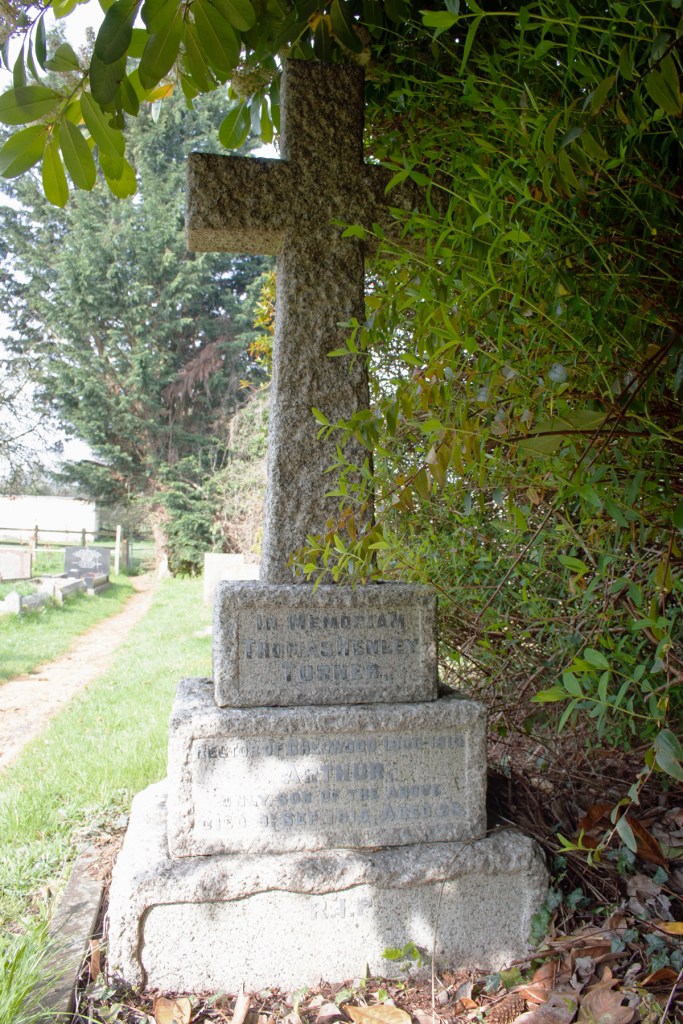
Arthur Turner was born in East Brent, Somerset, in the spring of 1892. The younger of two children to Thomas and Lucinda Turner, his older sister had passed away while Lucinda was pregnant with him. Thomas was a vicar for the Church of England, and baptised both children, although the records suggest that he did not lead his daughter’s funeral service.
In 1900, the Turners had moved on to a new parish, setting up home in the rectory in Chelwood, to the south of Bristol. They settled in well, and Thomas remained vicar of St Leonard’s Church there until the summer of 1914, when he passed away after a short illness, at the age of 64.
Conflict had not long darkened Europe by this point, and Arthur felt compelled to play his part. Full details of his military service are not available, but records suggest that he had enlisted in the Gloucestershire Regiment by March 1915.
Assigned to the 12th (Service) Battalion, Private Turner was sent north for training. Billeted in a camp in Wensleydale, North Yorkshire, Arthur would have moved south to Salisbury Plain with his troop, had he not fallen ill. He was admitted to a hospital in Darlington, in neighbouring County Durham, suffering from typhoid. The condition was to get the better of him, and he passed away on 9th September 1915. He was just 23 years of age.
Arthur Turner was brought back to Somerset for burial. He was laid to rest in the family plot in St Leonard’s Churchyard, Chelwood, alongside his father, Thomas.
Whatever her late husband’s calling, Lucinda’s own faith must have been strong. Having lost her eldest child young, she then stood witness to the burials of her husband and son within eighteen months.
The 1921 census recorded Lucinda living with her sister, Charlotte, in Bromley, Kent. Eighteen years later, the 1939 Register found her back in Somerset, where she was living in Clutton, providing support and companionship to Letty Collinson, a retired kindergarten mistress.
Lucinda passed away in March 1942, at the age of 88 years old. She was brought back to Chelwood, and buried alongside her husband and son, the family reunited at last.
Albert Aven was born on 18th December 1896 in the Somerset hamlet of Rodden. One of eleven children, his parents were Alfred and Elizabeth Aven. Alfred was a farm labourer, and farming was certainly something that his sons went into when they finished school.
When war came to Europe’s shores, however, Albert was keen to play his part. On 29th November 1915, he enlisted in the Royal Navy as a Stoker 2nd Class. His service records show that he was 5ft 5.5ins (1.66m) tall, with brown hair, blue eyes and a fresh complexion.
The record also suggests that he lied about his age, giving his year of birth as 1895. It is likely that Albert would have done this because there was a minimum age requirement, although, as he was already over that minimum age, it wouldn’t have made that much difference anyway.
Stoker 2nd Class Aven’s first posting was to HMS Pembroke, the Royal Naval Dockyard in Chatham, Kent, where he spent a couple of months undergoing training. At the end of January 1916, he was moved to HMS Gibraltar, an old cruiser, which patrolled the waters around the Shetland Isles.
After six months on board, and following a further month in Chatham Dockyard, Stoker Aven was assigned to HMS Test. She was a destroyer that patrolled the waters of the Humber Estuary, and Albert spent the next sixteen month with her. During this time, he was promoted to Stoker 1st Class, but the Test was also to be the last ship he served on.
On 8th November 1918, Stoker 1st Class Aven was ashore at the naval base in Hull, when he fell into a dry dock, dying instantly. Little additional information is available – and indeed contemporary newspapers are silent on the matter – but his service records report “Death caused by accidental fall into dry dock at Hull. Verdict of accidental death returned at inquest.” He was just 21 years of age.
Albert Aven’s body was brought home to Somerset for burial. He was laid to rest in the tranquil graveyard of All Saints’ Church in Rodden.
Algernon Carlyle Graham Spurge was born on 27th August 1891 in Bath, Somerset. The middle of five children, his parents were Algernon and Ida Spurge.
Algernon Sr was a portrait photographer, based in the Twerton area of the city, and this was very much a family business. The 1901 census recorded the Spurges as living in Victoria Road, Bath, with Ida’s brother, Tom Leaman, who was working as a photographic reloader.
Later that year, however, things were to take a turn for the worst. Algernon Sr seems to have been having some business worries and, on the morning of 16th December, he set off for work as usual. His and Ida’s daughter, also called Ida, arrived at the studio to find her father in some distress, a bottle of potassium cyanide – used as part of the photographic process at the time – next to him. He asked Ida to fetch him some water and salt, but when she returned, he declared it was too late, and lost consciousness. A doctor was called, but Algernon passed away shortly after he arrived.
A note was found, which read “My dearest wife, I really cannot stand the worry and anxiety of another day, to say nothing of weeks and perhaps months. Ask Mr Ashman and Mr Withy to be kind enough to help you straighten out matters a little. My best love to you and all my dear ones. AS” [Somerset Guardian and Radstock Observer – Saturday 21 December 1901] Ashman and Withy were family friends, who were also in the photography business.
An inquest was held and a verdict of suicide while temporarily insane was recorded.
The family rallied round, and Algernon’s widow and children moved in with Ida’s widowed mother in Bristol. Algernon’s daughter Ida continued working in photography, and Algernon Jr also took up the business. The 1911 census found him boarding with, and working for, his uncle Tom in Bath.
War was closing in on Europe by this point and, when it was declared, Algernon stepped up to play his part. He enlisted in the Royal Naval Air Service on 4th June 1915 as a Leading Mechanic (Photography). His service records show that he was 5ft 5ins (1.66m) tall, with dark brown hair, brown eyes and a dark complexion.
Algernon was initially assigned to the shore establishment HMS President in London for three years, rising to the rank of Petty Officer Mechanic (Photography). In April 1918, when the Royal Air Force was created he transferred across to HMS Daedalus in Lee-on-Solent, Hampshire, and rising to the rank of Sergeant Mechanic.
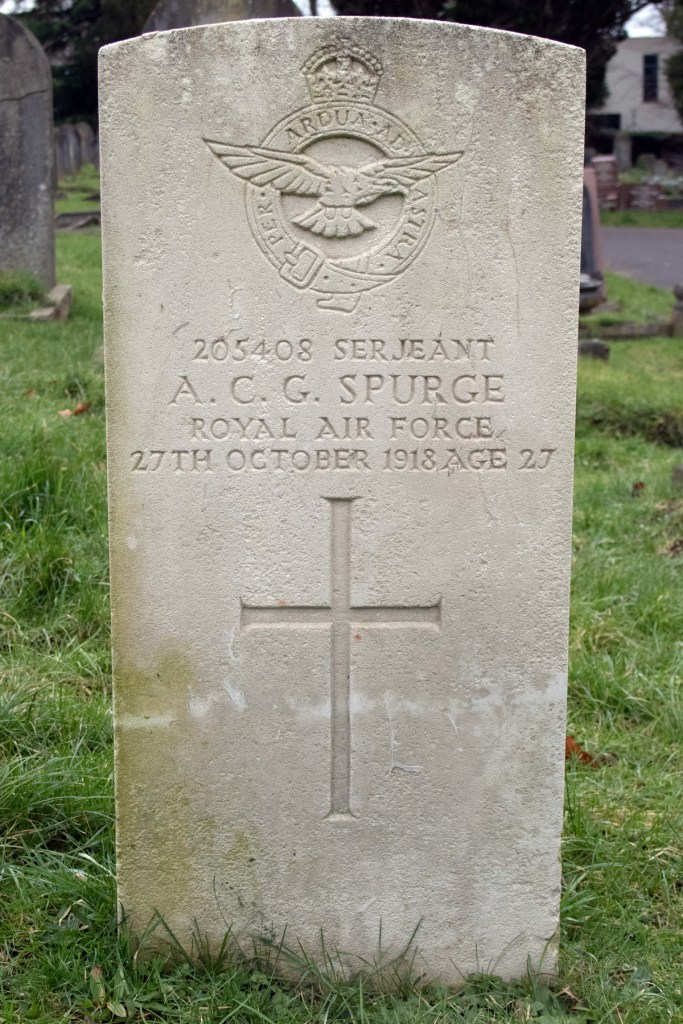
That autumn, with the end of the war in sight, Algernon fell ill. He contracted influenza, and this developed into pneumonia. He was admitted to the Military Hospital in York, but the conditions were to prove too much for his body to take. He died on 27th October 1918, aged just 27 years old.
The body of Algernon Carlyle Graham Spurge was brought back to Somerset for burial. He was laid to rest in St James Cemetery, Bath, not far from his father. When Ida passed away in 1926, she was buried in the same cemetery, father, mother and son reunited once more
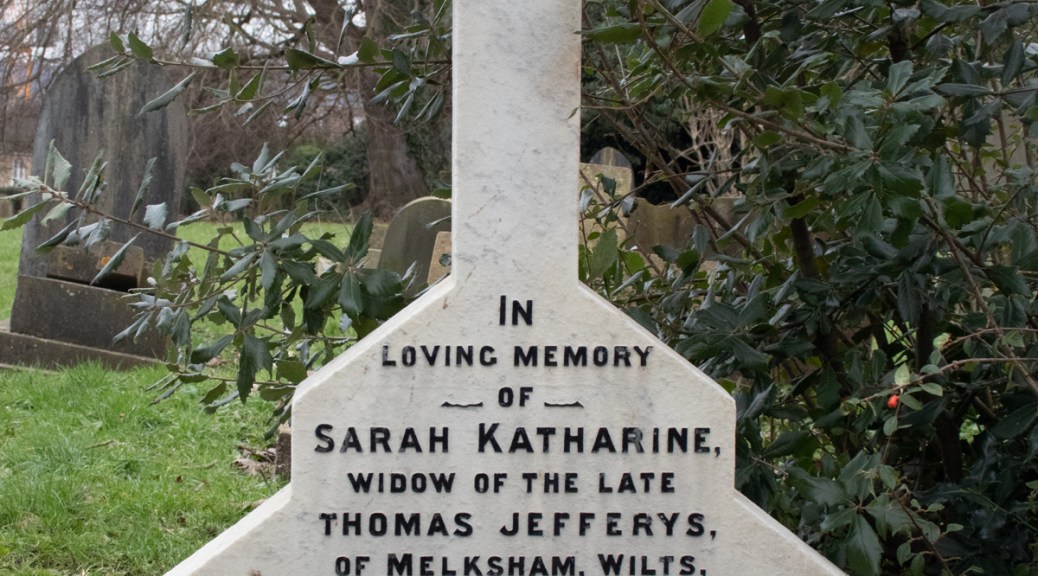
Charles Thomas Claude Jefferys was born on 23rd August 1880 in the small Carmarthenshire town of Laugharne. One of five children, his parents were naturalist Charles Jefferys and his wife Adeline.
Charles’ Jr’s life was to be one of education, and his father’s standing allowed for the best. He studied at Ellesmere College, Shropshire, then attended Durham University and Durham Theological College. By the 1901 census he was passing that education on to others: he was listed as a schoolmaster at Stow Wood College in Hampshire.
By 1908 Charles had returned to Wales, and was living in Monmouth. On 2nd January he married Eva Pride, an estate agent’s daughter from Tetbury, Gloucestershire. The marriage certificate confirms that, by this point, Charles was a clerk in holy orders, on his way to his true calling.
The 1911 census showed what a transient life the church could lead to: Charles and Eva were listed as living in a house in Oswaldkirk, North Yorshire. Their two young children, George and Charles, born in 1909 and 1910 respectively, were living with Eva’s sister, back in Tetbury.
When war came to Europe, Reverend Jefferys must have felt compelled to play his part. He joined the Army Chaplains’ Department, and by May 1916, he found himself in France. His role – providing pastoral care to the troops – would have led him to some of the darkest places of the Front Line. He remained there for the next couple of years, only returning to the family home – now in Chelsea, London – towards the end of the conflict.
Reverend Jefferys had contracted pneumonia, and he had returned from the continent to recuperate. Sadly, the condition was to prove too much, and he succumbed to it on 20th November 1918, at the age of 38.
Charles Thomas Claude Jefferys was taken to Somerset for burial – there were close family connections in the Bath area. He was laid to rest in the family plot, alongside his paternal grandmother in the city’s St James’ Cemetery.
Further tragedy was to strike in June 1925 when Eva also passed away. Details of her death are unclear, but this left George and Charles as orphans in their early teens.
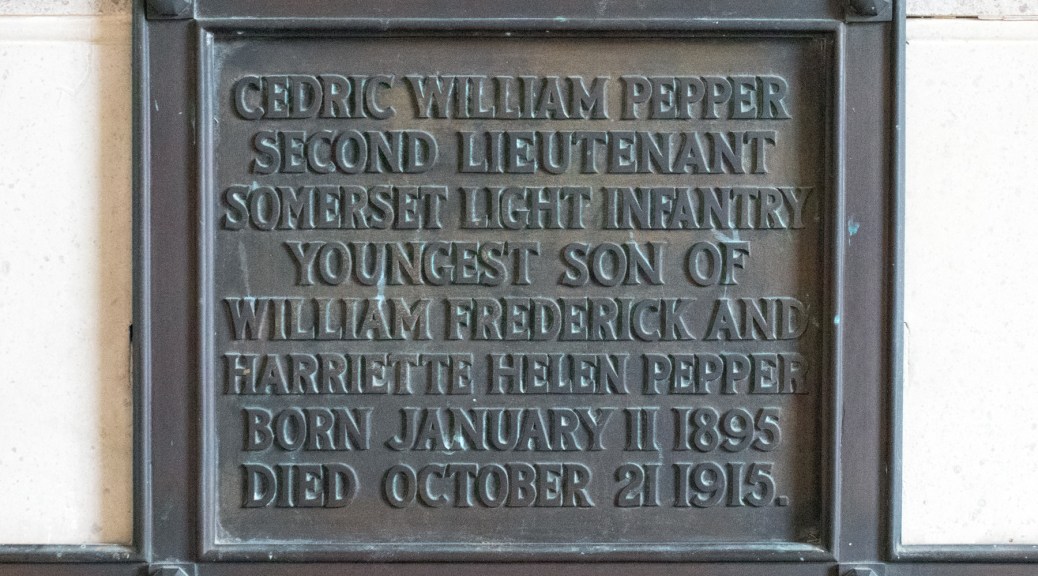
Cedric William Pepper was born in 1895 in South Kirkby, Yorkshire. He was the middle of three children to William and Harriette Pepper. William was a colliery owner from Leeds, and the family lived in some comfort in Rawdon Hill in Wharfdale. The 1901 census records show that they employed a governess, cook, two housemaids, a kitchen maid and a page.
By the time of the next census, in 1911, the Pepper family had moved to Shipton in Oxfordshire, where they lived in the 27-room Shipton Court. Cedric, by this time, was still studying, having been taught at Winchester College, where he lasted only a year, Tonbridge School, and then Worcester College in Oxford.
When war broke out, he had taken time away from his studies, and was working on a ranch in Rhodesia (present-day Zimbabwe). He returned to Britain at the start of the conflict and enlisted in the King’s Royal Rifle Corps. Assigned to the 2nd Battalion, Private Pepper arrived in France in November 1914, and was wounded in his thigh the summer of 1915.
Private Pepper returned to Britain to recuperate and, when he had recovered, he was given a commission in the 3rd Battalion of the Somerset Light Infantry. It was while he was training in Oxfordshire that the now Second Lieutenant Pepper met his end.
The evidence at the inquest… suggested that the death from a bullet wound… was accidental.
Second-Lieutenant William Eric Warburton… stated that early last week Lieutenant Pepper told him he was in some difficulty with a woman, but he did not explain it. Lieutenant Warburton did not think that this caused him to take his life. In his opinion Lieutenant Pepper knew nothing of the working of an automatic pistol he possessed.
The medical evidence was that a bullet entered the centre of the forehead. The doctor said that if the wound was self-inflicted it was quite possible that it was accidental.
The jury returned a verdict of Death from a bullet from an automatic pistol, but that there was no evidence to show how the wound was inflicted.
Central Somerset Gazette: Friday 29th October 1915
Second Lieutenant Pepper died from the bullet wound on 21st October 1915. He was just 20 years of age.
Pepper Family Memorial
Cedric William Pepper’s family were, by this time, living in Redlynch House, near Bruton, Somerset. He was cremated, and his ashes immured in the wall of St Peter’s Church in the hamlet.
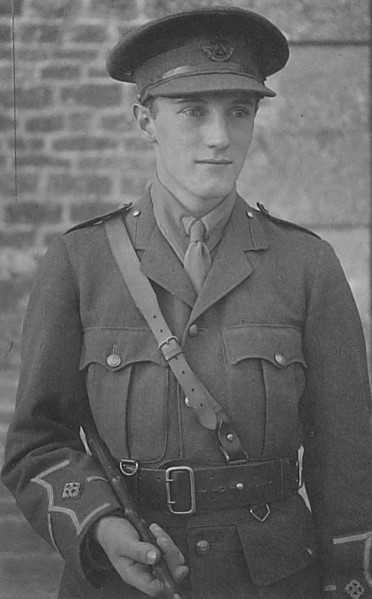
Second Lieutenant Cedric Pepper (from findagrave.com)
In researching Cedric’s life, there is a definite sense of a young man desperately looking to please his father. A successful Yorkshire colliery owner, he may have expected more from his oldest son, a drop out from Winchester College, possibly sent to Southern Africa to find himself. While an immediate return to Britain to serve his country would have been commonplace, the suggestion of difficulty with a woman and the subsequent accident with his gun just adds to the sense of a need for Cedric to not disappoint his father.
William John Lydston Poulett was born on 11th September 1883, in Belsize Park, London. The oldest child to William Poulett, 6th Earl Poulett, and his third wife, Rosa, William Jr was known by the title Viscount Hinton.
When William’s father died in January 1899, a battle ensued for the title of the 7th Earl Poulett. The 6th Earl had married his first wife, Elizabeth, in 1849, separating from her within a couple of months, when he learnt that she was pregnant. The alleged father was Captain William Turnour Granville, and when the 6th Earl died, Elizabeth’s son, another William Poulett, claimed the right to take the title. In July 1903, the judge decreed that William and Rosa’s son held the valid claim, and William John Lydston Poulett succeeded him, becoming the 7th Earl. At this point, he was living in Ayston, Rutland, expanding his education and boarding with a Clerk in Holy Orders.
In 1908, William married Sylvia Storey. She was the daughter of actor and dancer Fred Storey, and was herself an actress and Gaiety girl. Given Earl Poulett’s status, it seems this might not have been the most appropriate of matches, as a contemporary newspaper reported:
Another marriage alliance of the stage with the aristocracy, and one of the most remarkable of them all, was brought about yesterday by a quiet ceremony at St James’ Church, Piccadilly, uniting Earl Poulett and Miss Sylvia Lilian Storey, the well-known comedienne.
Besides contracting parties, there were only one or two persons present, including the family solicitor and Lady Violet Wingfield, sister of the bridegroom [who was also a Gaiety girl]. There were no bridesmaids.
Before the ceremony, some consternation was caused by an untoward event. The wedding ring was dropped, and there were some perturbing moments while a scrambling hunt was made for it on the floor. Finally it was discovered and pounced upon by the verger.
The time and place of the ceremony had been kept quite a secret, and the bride and bridegroom were on their way from London before the news of their marriage became known. The sudden announcement which was then made greatly enhanced the romance of the affair.
The Earl is just twenty-five years of age, and the new Countess is eighteen…
Shields Daily News: Thursday 3rd September 1908
The secret nuptials couple went on to have two children – George and Bridget – and, by the time of the 1911 census, the family were living in some luxury at Hinton House in Hinton St George, Somerset.
William had also had a distinguished military career by this point. In 1903 he received a commission as Second Lieutenant in the 4th Battalion of the Royal Welch Fusiliers, before being transferred to the 4th Highland Light Infantry.
On 26th February 1913, he was recommissioned, as a Second Lieutenant in the Warwickshire Royal Horse Artillery and, when war broke out, he was sent to France. By November 1915, he had been promoted to Captain, but after three years on the Western Front, his health was beginning to suffer.
Captain Poulett was transferred back to Britain, and assigned to the Royal Warwickshire Regiment. By 1918, he was serving as part of the Anti-Aircraft Corps in Middlesbrough, when he contracted pneumonia. This was to take his life, and he breathed his last on 11th July 1918, at the age of just 34 years old.
William John Lydston Poulett, 7th Earl Poulett, was brought back to Somerset for burial. He was laid to rest in the graveyard of St George’s Church in Hinton St George.
Captain William Poulett (from ancestry.co.uk)
William’s death meant that his nine-year-old son, George, inherited his title and his £187,200 estate (worth £8.2m today). The 8th Earl served during the Second World War, working as an engineer at Woolwich Arsenal and becoming an Associate of the Institute of Railway Signal Engineers and the Institute of British Engineers.
George married three times: he divorced his first wife, Oriel, in 1941; outlived his second wife, Olga, who died in 1961; and was survived by his third wife, Margaret, when he passed away in 1973. When he died, with no children, all of his titles became extinct.












 Death and Service