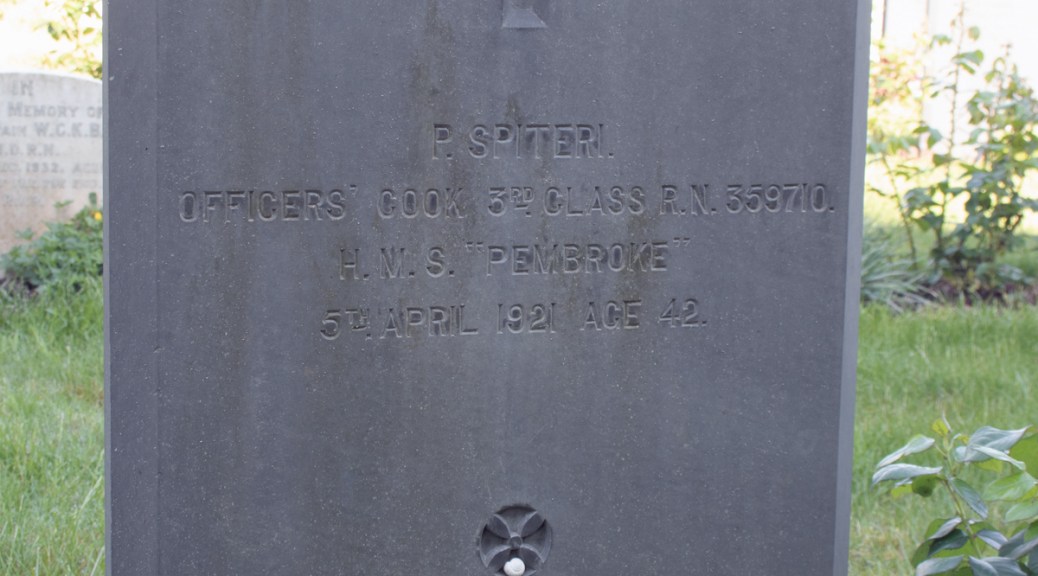
Paolo Spiteri was born in Valetta, Malta, on 25th January 1881, the son of Stephen Spiteri. Sadly there is very little further information on his early life, other than he worked as a cook when he left school.
Paolo saw a life at sea as a good career, and, in August 1901, aged 20, joined the Royal Navy. Over the next twenty years, he travelled the world, serving on more than twenty ships and working his way up from a domestic in the kitchen to an Officer’s Cook 3rd Class.
By 1921, Paolo was based at HMS Pembroke – the shore establishment at the Naval Dockyard in Chatham, Kent – and contracted pneumonia there. Admitted to the Naval Hospital in the town, the condition sadly got the better of him, and he passed away on 5th April 1921. He was 42 years old.
Officer’s Cook Paolo Spiteri was laid to rest in the Woodlands Cemetery, not far from the dockyard at which he was based.
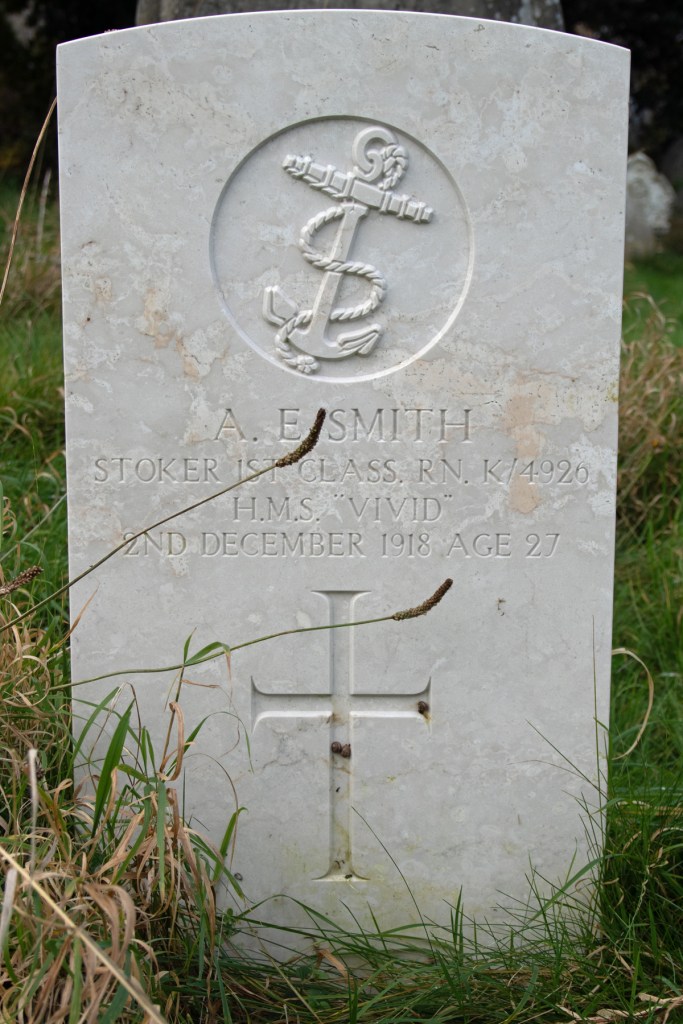
Arthur Edgar Smith was born in the Somerset village of Beckington on 12th January 1890. He was one of eight children to agricultural labourer and cowman George Smith and his wife Hester.
Arthur was after some adventure in his life, and didn’t want to be limited to Somerset. The Royal Navy offered this opportunity, and so, in December 1909, aged 19, he joined the service as a Stoker 2nd Class. His service records confirm that he stood at 5ft 7ins (1.7m) tall, had a fresh complexion, brown hair and hazel eyes. He signed up for the standard 12 years’ service.
After an initial five months’ training at HMS Vivid in Devonport, Stoker Smith was assigned to the battleship HMS Mars. During his two years’ service on board, he was promoted to Stoker 1st Class. In January 1912, he was reassigned, boarding HMS Orion, also a battleship.
Over the next two years, Stoker Smith served on board two further vessels, HMS Hercules and HMS Narcissus. In April 1916, Arthur was transferred back to HMS Vivid, suffering from pulmonary tuberculosis. This ultimately led to him being medically discharged from the Royal Navy, and he left service in June that year.
At this point, Arthur’s trail goes a bit cold. It would seem that his lung condition ultimately got the better of him, and he passed away back at home on 2nd December 1918. He was just 27 years of age.
Arthur Edgar Smith was laid to rest in the Dissenters’ Cemetery on Vallis Road in Frome, where his parents now lived.
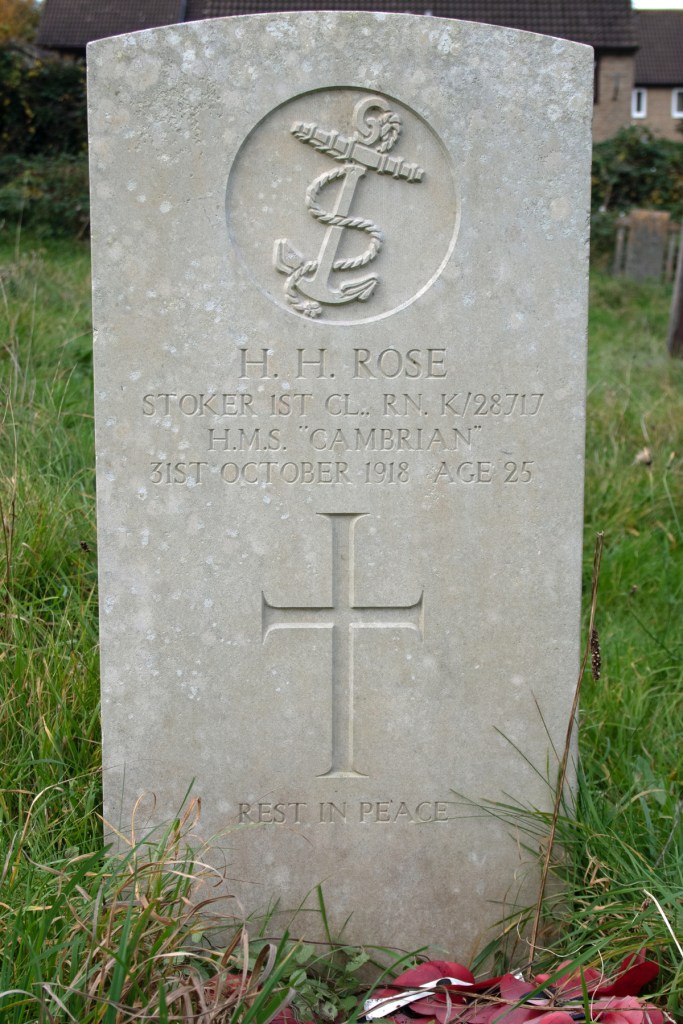
Herbert Hastings Rose was born on 19th August 1893 in the Somerset town of Frome. He was one of four children, all of whom were boys, to Hastings and Emily Rose. Hastings was employed as a labourer, but he died young, passing away in 1900, when Herbert was only seven years old.
Emily was left raising her four boys alone – the youngest of whom was a mere babe-in-arms – and found domestic char work to bring in some money. By 1905, however, local carter Enos Bainton had taken the family under his wing, and the couple married.
The census return six years later found the family living in a small cottage near the centre of Frome. Herbert and his older brother, who were in their late teens by this point, were working with their stepfather, carting coal for a local merchant.
Herbert’s job was to stand him in good stead when hostilities broke out. When the call came in November 1915, he enlisted in the Royal Navy, and was employed as a Stoker 2nd Class. After his initial training on board HMS Vivid – the shore-based establishment in Plymouth – he was assigned to the cruiser HMS Constance. He served on board the ship for two years, gaining a promotion to Stoker 1st Class in the process.
After a month back in Plymouth, Stoker Rose was transferred to HMS Cambrian, another cruiser, on board which he spent three months. He then returned to HMS Vivid. It was during this time that Herbert fell ill. Admitted to hospital in Plymouth with pneumonia, this was to get the better of him; he passed away on 31st October 1918, aged just 25 years old.
Herbert Hastings Rose’s body was brought back to Somerset; he was laid to rest in the Dissenters’ Cemetery in Vallis Road, Frome.
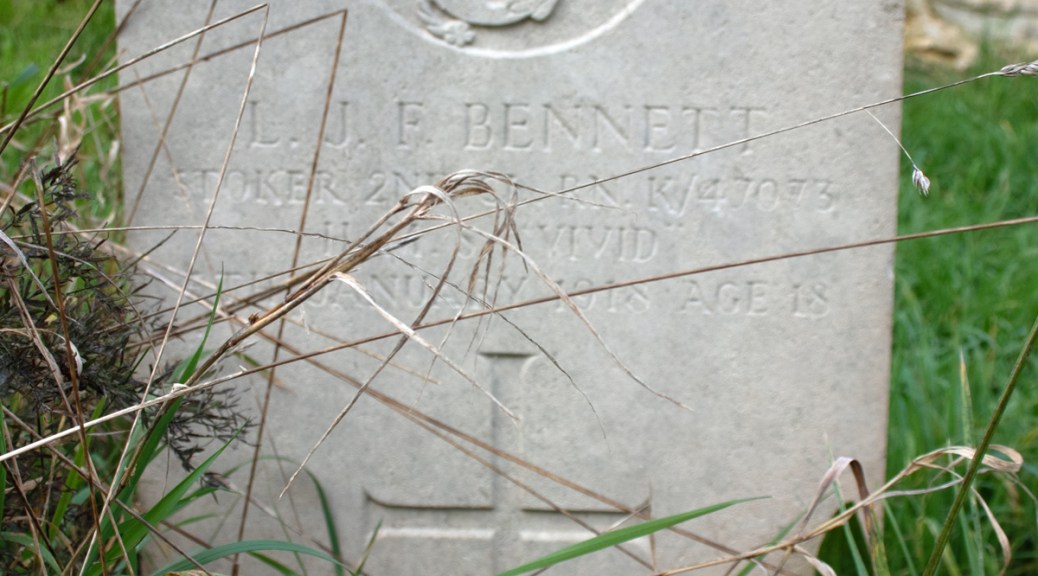
Lionel James Fowler Bennett was born on 2nd September 1899, in the village of Cainscross, near Stroud in Gloucestershire. He was the only child of insurance agent Harry Bennett and his wife Louisa, who was a weaver.
By the time of the 1911 census, the young family had moved to the Somerset town of Frome. Louisa’s widowed mother had lived with the family since Lionel’s birth, and had moved to Somerset with her son-in-law. The family had also, by this time, taken in a boarder, presumably to help pay the rent.
With the move, Harry had also changed jobs, and was working as a power loom tuner, honing and fixing the weaving equipment. Lionel went into a similar role when he left school but, by now, war was imminent and, as soon as he was able to, he enlisted for King and Country.
Harry joined up shortly after his eighteenth birthday, serving as a Stoker in the Royal Navy. He was sent to HMS Vivid in Devonport for training in November 1917, but, sadly, this was to be his undoing.
Barracks were notorious breeding grounds for infections and, within weeks, Stoker Bennett had been admitted to the Naval Hospital in Plymouth, suffering from pneumonia. He passed away on 5th January 1918, aged just eighteen years old and having served for just sixty days.
Brought back to his home in Frome, Lionel James Fowler Bennett was laid to rest in the Vallis Road Burial Ground (also known as the Dissenters’ Cemetery).
Henry Wate was born on 15th June 1897, the youngest of seven children (four of whom survived) to Henry and Norah Wate. Henry Sr was from the East End of London. He raised his family in a three-room tenement in White Horse Alley, just off Cowcross Street, next to the busy Farringdon Station.
By the time of the 1911 census, Henry Sr and Norah had been married for thirty years. The head of the household, Henry was working as a rad dealer, while Norah was a housewife. Of their children, William (the eldest) worked as a labourer for a bike dealer, Annie was a packer in a chocolate factory, Nellie was a waitress and Henry Jr was still at school, though only just. Henry’s niece Julia was also staying with them, and was employed as a fancy leather worker.
When war broke out, Henry Jr was working as a carman, carting goods to and from the nearby railway. When the call came, however, he joined up, enlisting in the Royal Navy as a Stoker 2nd Class. After a couple of months training at HMS Pembroke – the shore establishment at the Naval Dockyard in Chatham – he was assigned to HMS Wallington. This was a trawler, requisitioned by the Royal Navy to act as a boom/balloon vessel, presumably to tether barrage balloons.
In January 1917, Henry received a promotion to Stoker 1st Class. He returned to Chatham six months later. That summer, HMS Pembroke was becoming crowded and he was billeted at the Chatham Drill Hall.
On 3rd September 1917, the building took a direct hit from a German bomber. Stoker Wate, along with 97 others, was killed instantly. He was just 20 years old.
Henry Wate was laid to rest – along with the others who perished that night – in a mass funeral on 6th September 1917 at the nearby Woodlands Cemetery in Gillingham.
Full details of the night raid on Chatham Drill Hall can be found here.
Henry’s older brother William also served in the Great War. Twelve years older than his brother, William joined the Royal West Surrey Regiment in January 1915 as a Private. He was posted to France in July, and ended up serving on the Front Line for nearly four months.
In September 1915, Private Wate fell ill with heart palpitations. Shipped back to England for treatment, he was admitted to the Brook War Hospital in Greenwich, South London. The medical report confirmed that William had had rheumatic fever as a child, and had had an attack of ‘sycope’ (low blood pressure and a loss of consciousness) in 1911. The report concluded that he had heart disease and he was discharged from military service in 1916, as a result of this.
Little is known about Williams post-army life. All that can be confirmed is that he passed away from his heart condition on 23rd November 1918 aged 33. He was buried in St Mary’s Roman Catholic Cemetery in Kensal Green, North London.
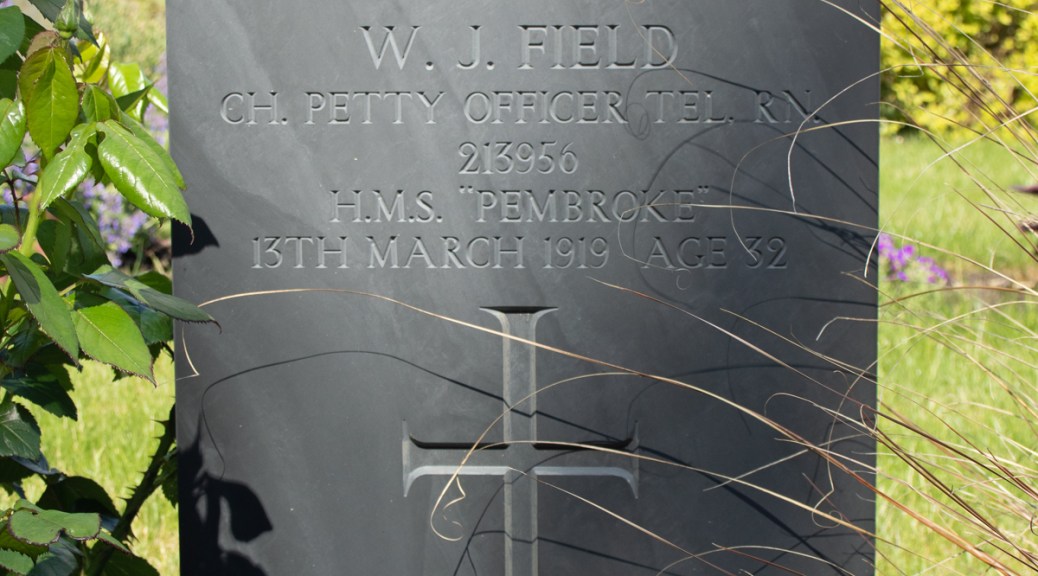
William John Field was born on 8th October 1885 in Boston, Lincolnshire. The eldest of four children, his parents were Charles and Ellen. Charles was a boatman for the coastguard; his job, by the time of the 1891 census, had taken the family to the village of Dawdon on the County Durham coastline.
Given his father’s job, it is not unsurprising that William was destined for a life at sea. As soon as he left school in the spring of 1901, he joined the Royal Navy and was sent to HMS Ganges, the shore-based training establishment in Suffolk. Being underage, he was initially assigned the role of Boy, moving, after a year, to HMS Pembroke, also known as the Naval Dockyard in Chatham, Kent.
By November 1902 Boy Field was moved to HMS Venerable, a ship that was to be his home for the next three years. During this time, William came of age, and was formally enrolled in the Royal Navy as a Signalman. He evidently worked hard on the Venerable, rising through the ranks to Qualified Signalman and Leading Signalman.
In June 1905, William was moved to HMS Leviathan, where he was again promoted, to Second Yeoman of Signals, before again being assigned to Chatham Naval Dockyard six months later.
While based in Kent, William met Nelly Watt, the daughter of a labourer at the dockyard. The couple married in 1906, and went on to have four children.
Over the next few years, the now Petty Officer Telegraphist Field spent an almost equal amount of time at sea and on shore. War was coming and when his initial term of service came to an end in October 1915, he immediately renewed his contract through to the end of the hostilities.
All of William’s time was now spent on land, primarily at HMS Pembroke, but also at HMS Actaeon in Portsmouth, HMS Victory VI at Crystal Palace, London and HMS Bacchante in Aberdeen.
While Chief Petty Officer Telegraphist Field’s naval service records are quite detailed, his passing is anything but. The war over, he moved back to Chatham Dockyard in January 1919. At some point he was admitted to the Royal Naval Hospital in the town, and died from ‘disease’ on 13th March that year. He was just 33 years of age.
William John Field was laid to rest in the Woodlands Cemetery in nearby Gillingham.
A sad aside to the story is that, at the time of he husband’s death, Nellie was pregnant with the couple’s fourth child. John William Field was born on 16th October 1919, destined never to know his father.
William Henry Coughlan was born on 16th November 1891, one of thirteen children to William and Catherine Coughlan. William Sr was a labourer, born and bred in the East End of London, who raised his family in Hackney.
William Jr seemed keen for a way to improve himself and in May 1909, enlisted in the Royal Navy. Initially given the rank of Boy, this was due to his age; on his eighteenth birthday a few months later, he was formally enrolled in the navy as an Ordinary Seaman.
To begin with, he was billeted at HMS Ganges II, the shore-based training ship in Harwich, Suffolk, but within a matter of weeks he was on board a sea-going destroyer, HMS Antrim.
Ordinary Seaman Coughlan was obviously a keen young man; by the time the Great War broke out, he had served on four further ships, as well as another shore base, HMS Pembroke I. He rose through the ranks to Able Seaman and, by 1915, had reached the role of Leading Seaman.
Most of his service was spent upon HMS Agamemnon, initially in the Channel, but was then moved to the Mediterranean. On the night of the 5th May 1916, the ship was moored in the harbour at Thessaloniki (Salonika). A Zeppelin, the LZ55, made a bombing raid, but when the searchlights caught it, the Agamemnon fired on it and hit the aircraft, breaking it in two. It crashed in the swamps around the Vardar river and its crew were captured.
Leading Seaman Coughlan remained on the Agamemnon, before returning to England in November 1917, where he received further training at the Naval Dockyard in Chatham. He was promoted to Petty Officer a couple of months later, and began three years of shore- and ship-based service.
In the summer of 1921, while again based in Chatham, he contracted pneumonia, succumbing to the lung condition in a matter of weeks. Petty Officer Coughlan died on 26th July 1921, aged just 29 years old.
William Henry Coughlan was laid to rest in the Woodlands Cemetery in Gillingham; within walking distance of the naval base that had become his home.
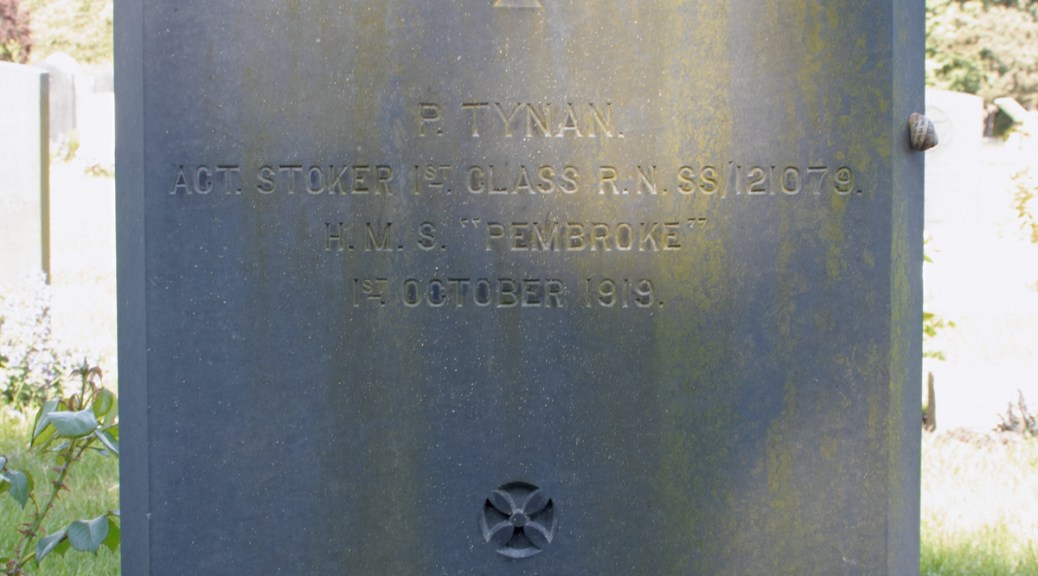
Patrick Tynan was born in Roscrea, Southern Ireland, on 9th June 1893. He was the eldest of four children to John and Anne Tynan, but sadly, there is no further information available for his early years.
Patrick’s story really picks up on 14th December 1915, when he joined the Royal Engineers as a Private. His service record states that he was living in Bangor, Gwynedd, and that he was a stall keeper at a fairground – a subsequent document noted his trade as a showman. He was noted to be 5ft 8ins (1.72m) tall, weighed 151lbs (68.5kg), and had numerous scars on his back.
Private Tynan did not stay in the UK for long. Assigned the new role of Driver, he was attached to the GHQ Signal Company and sailed from Devonport on 30th June 1916, bound for Mesopotamia. Arriving in Margil – the port connected to Basra – he was based here for more than a year, before moving north to Baghdad.
By this time, Patrick had risen to the rank of Lance Corporal, and was obviously a trustworthy member of the company. Towards the end of 1917, he had again been promoted, this time to Corporal.
During his time in modern day Iraq, Patrick was admitted to hospital a handful of times; there is little information on the conditions he suffered, but none appear to have been life threatening, as they were only for short periods. It’s also interesting to find that his service records confirm a month’s leave in May 1918, spent in India.
When the war came to a close, Corporal Tynan was still in the Middle East. Ready to be demobbed, his company moved to India and boarded the SS Chupra in Calcutta on 26th February 1919, bound for home.
Back in the UK, however, Patrick was not ready to give up the formal military life. Having returned to Gillingham in Kent, where the Royal Engineers were based, he initially found work as a tram conductor, but soon signed up for a five year term with the Royal Navy as a stoker.
He was based on HMS Pembroke II, the shore-based establishment at Chatham Dockyard, but sadly, his time in the navy was to be a short one. Admitted to the Royal Naval Hospital in the town with pneumonia, he passed away form the condition on 1st October 1919. He was just 26 years old.
Patrick Tynan was laid to rest in the Woodlands Cemetery in Gillingham. He had a short but full life, something his modest gravestone doesn’t begin to hint at.
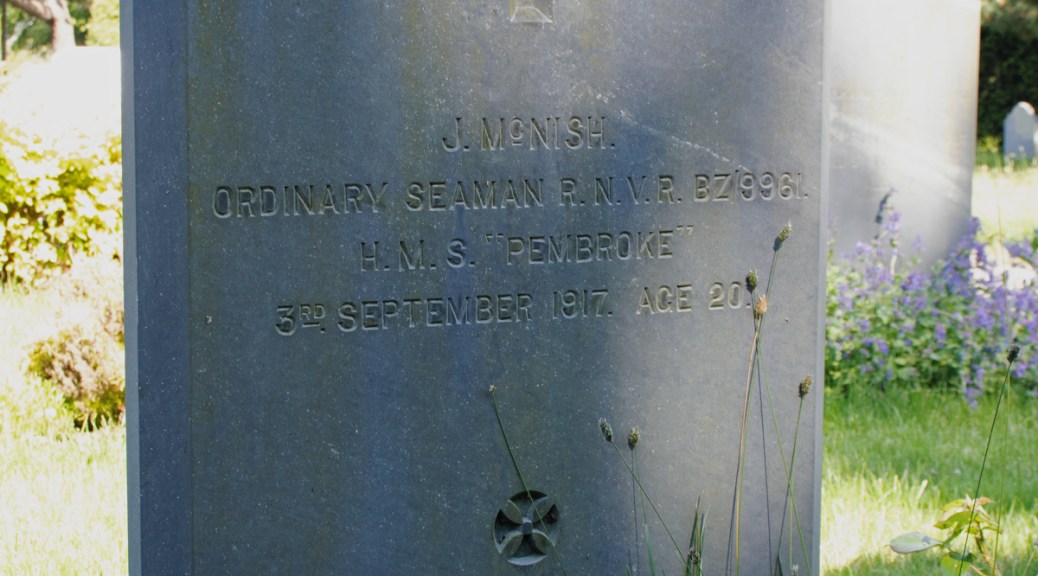
John McNish was born in the Staffordshire city of Wolverhampton on 26th June 1897. The oldest of six children, his parents were railway porter James McNish and his wife Mary Ann.
Sadly there is little documentation to evidence John’s early life. When he left school, he seemed to have joined his father in becoming a porter and, when war broke out, he joined the Royal Navy, given the rank of Ordinary Seaman in the Royal Naval Volunteer Reserve. He was based at HMS Pembroke, the shore-based establishment at Chatham Naval Dockyard in Kent.
In the summer of 1917 HMS Pembroke was becoming crowded and John was billeted at the Chatham Drill Hall. On the night of 3rd September, the building took a direct hit from a German bomber. Ordinary Seaman McNish, along with 97 others, was killed instantly. He was just 20 years old.
John McNish was buried in the nearby Woodlands Cemetery in Gillingham, along with dozens of others who perished that night.
Ordinary Seaman John McNish (from findagrave.com)
Full details of the night raid on Chatham Drill Hall can be found here.
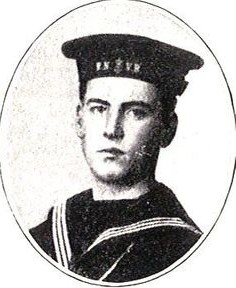
Gerald Sidney Connolly was born in the spring of 1899, one of eleven children to Thomas and Mary Connolly. Thomas was a retired soldier who had been born in Malta, while Mary had come from Portsmouth. The couple had lived in India for a while, but, by the time Gerald was born, had settled in Kildare, Ireland.
Retirement from the armed forces left Thomas needing to financially support his family, and so they made the move to London in 1910. According to the following year’s census, the family had settled in Manor Park, to the east of the city, where Thomas was working as a storekeeper for a local hostelry.
Military service was obviously in young Gerald’s blood and, in April 1916, he gave up work as an errand boy for a life in the Royal Navy. Initially taken on as a servant boy at HMS Pembroke and HMS President – the shore-based establishments in Chatham, Kent – he subsequently served on HMS Shannon, a cruiser that patrolled the North Sea for German warships.
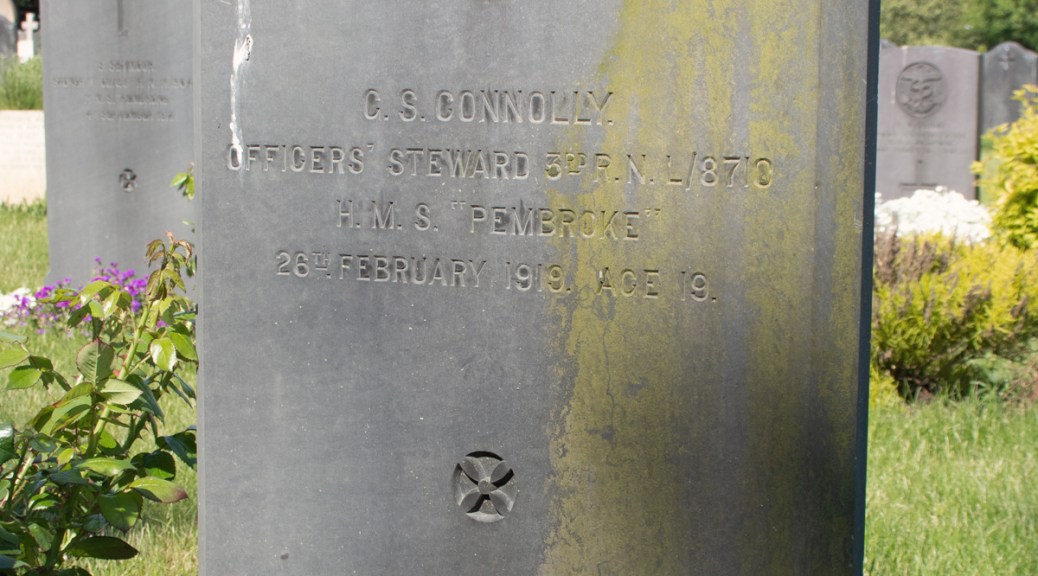
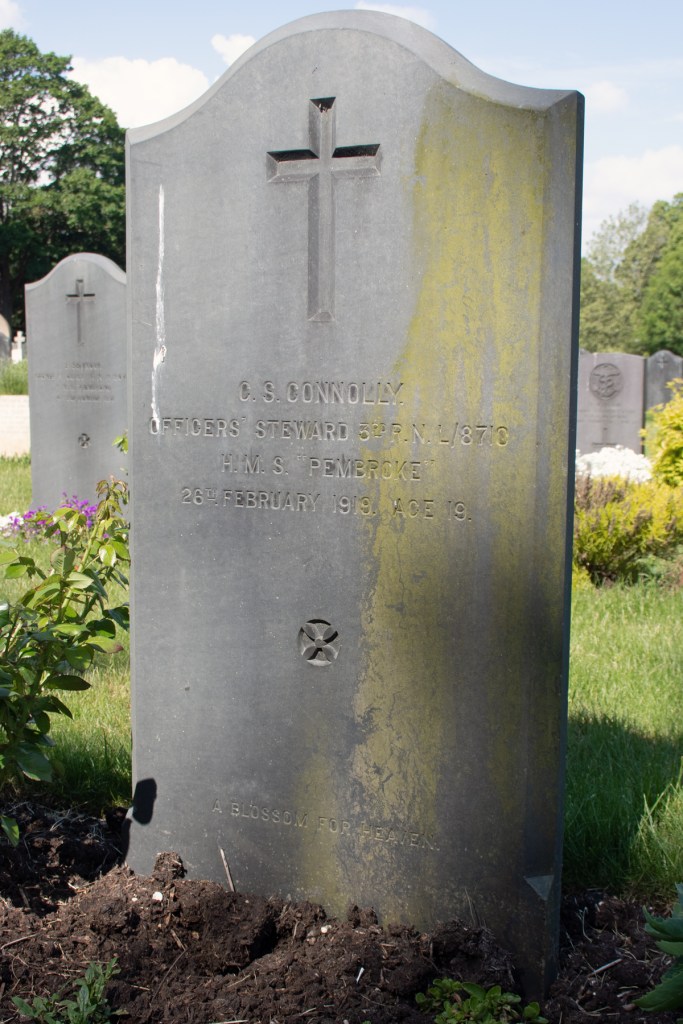
It was while he was aboard the Shannon that Gerald came of age, and was given the rank of Officer’s Steward (3rd Class). During the next few years, he served short periods on five further vessels, before returning to HMS Pembroke in December 1918.
Officer’s Steward Connolly was still serving in Chatham two months later, and he kept himself active. It was while he was making use of the barracks’ swimming baths that an accident befell him. His service record confirmed that he was found drowned in the baths on 26th February 1919 and a subsequent inquest identified that no foul play was to blame. Gerald had ‘accidentally drowned whilst bathing’. He was just 19 years of age.
Gerald Sidney Connolly’s body was laid to rest in the Woodlands Cemetery in Gillingham, Kent, not far from the Naval Dockyard where he was based.









 Death and Service