Category Archives: Somerset Light Infantry

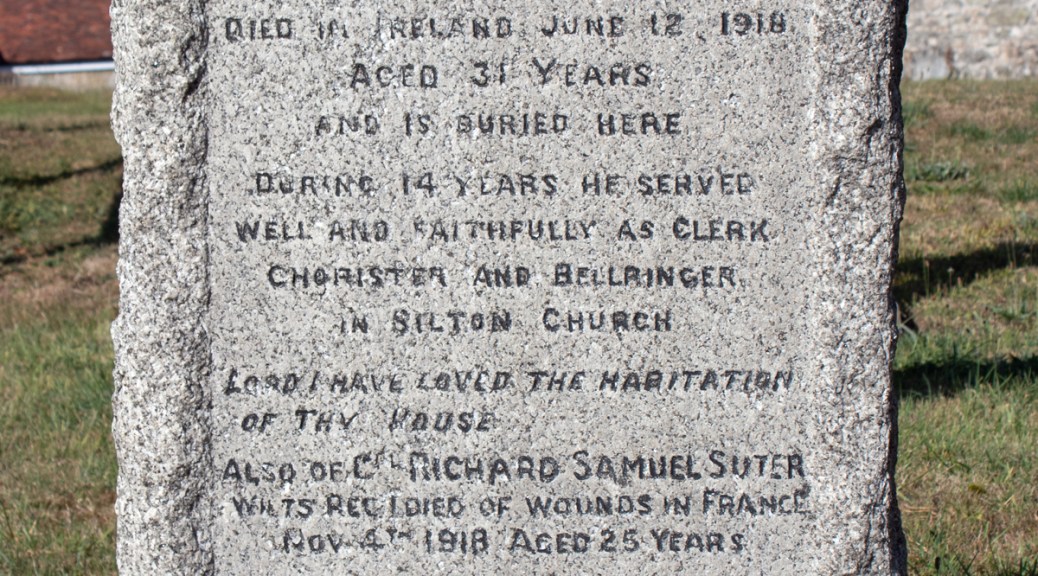
Private William Hasley

Private William Hasley

William George Hasley was born on 14th June 1897. He was the oldest of three children to William and Sarah Hasley. William Sr, a former soldier, worked as a commissionaire, and the family lived at 11 Coach & Horses Yard, St James, Westminster.

Things had changed by 1900, and William Sr was employed as an engineer’s labourer. The family had moved to Dorset, setting up home in the village of Bourton, and their daughter, Susan, was born there at the turn of the century. Susan Sr came from just up the road in Zeals, Wiltshire, and it is likely that she was staying there when her youngest child, Sidney, was born in 1902.

By the time of the 1911 census, the family of five were living at Beach Cottage, Bourton. William Sr was drawing his army pension, but still employed at the engineering foundry; his eldest son, while still at school, was also listed as a news boy, possibly selling the periodicals to villagers.

War came to Europe in the summer of 1914, and William Jr was quick to step up and play his part. Giving up his job as an engineer’s fitter, enlisted on 1st September 1914, and joined the Somerset Light Infantry. His service records show that he stood 5ft 8.5ins (1.74m) tall, and weighed 124lbs (56.3kg). Private Hasley was noted as having brown hair, brown eyes and a sallow complexion. He also had a scar on the tip of the middle finger of his left hand.

Assigned to the 3rd (Reserve) Battalion, Private Hasley’s unit moved to Devonport, Devon, at the start of 1915. It was here that he contracted tuberculosis, which would ultimately lead to his medical discharge from the army in July. He served just 308 days.

At this point, William’s trail goes cold. It is likely that he returned to Bourton, although he had regular check-ups by the army inspection board. He was deemed totally incapacitated by the illness on 3rd January 1917.

William George Hasley’s lung condition would seal his fate. He passed away on 23rd March 1917: he was just 19 years of age. He was laid to rest in Bourton Cemetery.


Private Nicholas Paice

Private Nicholas Paice

Nicholas John Paice was born in the spring of 1867, the second of five children to John and Olive Paice. John was a railway policeman from Aldermaston in Berkshire, but his oldest son, Nicholas, was born in Poole, Dorset where Olive came from.

The Paice family seemed to move to wherever John’s work took him. The 1871 census found them living back in the Berkshire village of Shrivenham, while a decade later they were to be found in Longfleet, to the north of Poole. By this point, John was employed as a groom, and Olive a laundress.

When he completed his schooling, Nicholas found work as a butcher. He had also enlisted in the local militia, joining the 3rd Dorset Regiment. The army life seemed to suit him and, on 12th July 1886, he enlisted in the Rifle Brigade. His service records show that he was 5ft 7ins (1.7m) tall and weighed 148lbs (67.1kg). At 19 years and three months old, he was noted as having a fresh complexion, grey eyes and brown hair. The papers show that he had a scar on his left eyebrow, and tattoos on his forearms and the middle finger of his left hand.

Joining up for a period of twelve years, Private Paice would spend nearly seven of those in India and Burma. His time in the army was not without incident, however. Just three weeks after enlisting he deserted, and remained at loose for nearly a month. When he was captured, he was imprisoned for desertion for four weeks, his term of service extended to reflect the time he was AWOL.

In August 1896, having been back on home soil for just over two years, Nicholas was arrested again. Convicted of ‘begging’, he was confined for a week, before being released back to duty.

On 16th September 1898, Nicholas completed his contract, and was formally discharged from the army.

The next few years are a mystery for Nicholas. He had married Maria Andrews in 1896, and the couple would go on to have eight children, of which five would survive childhood. By the time of the 1911 census – the next document where we can pick him up – Nicholas and the family were living in two rooms at 2 New Corn Street, Bath, Somerset. Nicholas was working as a cattle drover, along with Maria, the household included her daughter Annie, and granddaughter Lily, and John and Maria’s son, Earnest.

When war came to Europe, Nicholas stepped up to play his part. He enlisted in the Somerset Light Infantry on 26th October 1915 but, with his age against him, he was transferred to the 263rd Coy. of the Royal Defence Corps the following April.

It seems that Private Paice’s health was also being impacted and he spend a month in the Red Cross Hospital in Portishead, having contracted influenza. Released to duty on 16th May 1916, just a month later he was re-admitted for three weeks, this time suffering from bronchial catarrh. On 10th September he was admitted to the hospital for a third time. This time it was identified that he had come down with pulmonary tuberculosis, and on 12th October 1916, he was formally discharged on medical grounds.

It is unclear what happened to Nicholas next. His service records suggest that he wasn’t immediately discharged from the Portishead hospital, and it seems likely that he would have returned home to Bath at some point. The next record for him is that of his passing, from tuberculosis, on 20th December 1919. He was 52 years of age.

Nicholas John Paice was laid to rest in the sweeping Locksbrook Cemetery in his adopted home town of Bath, Somerset.


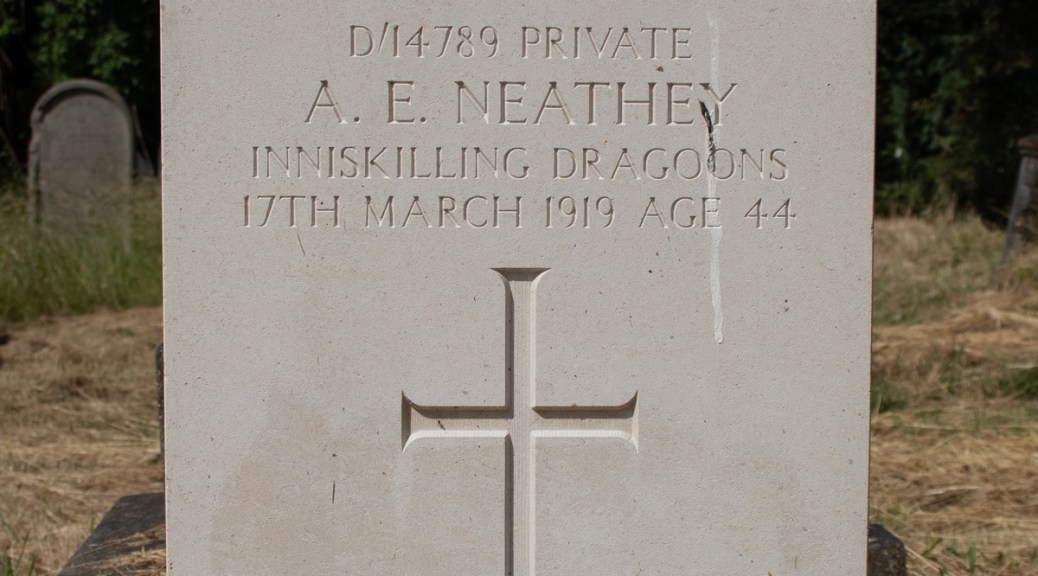
Private Albert Neathey

Private Albert Neathey

Albert Ernest Neathey was born in Bath, Somerset, early in 1875. The third of six children, his parents were John and Rose Neathey. John was a baker and the family lived at 11 Trinity Square. When John died in 1890, Rose and the four youngest children remained there, and by the time of the following year’s census, three of the Neathey siblings were bringing in a wage.

The 1891 document recorded Rose as living on her own means, while Albert, then 16 years of age, was employed as a telegraph messenger. His older sister, Alice, was a dressmaker’s apprentice, while his younger brother, Sidney, was apprenticed to a hairdresser.

The family are missing from the 1901 census, but the following year Albert got married. His new bride, Mary Louisa Slip, was a mason’s daughter, and the couple exchanged vows in Christ Church, Bath, on 18th September. They would go on to have one child, Doris, born in the summer of 1903, but she would only live for a few months, before passing away on 1st November.

Albert was, by this time, working as a postman, and the 1911 census found him and Doris living at 18 Lansdown Road, to the north of the city. Mary was noted as assisting in the business, although her trade was recorded as being general grocery. The couple were sharing their home with Albert’s ten year old nephew, Norman.

When war broke out, it was inevitable that Albert would be called upon to play his part. Full service details are not available, but a later newspaper report sheds light onto not only his army career, but his personal life:

DEATH OF A WELL-KNOWN BATH POSTMAN

The death occurred at the Bath War Hospital… of Mr Albert Ernest Neathey, of 18 Lansdown Road. Mr Neathey, who was only 44 years old, was the second son of the late Mr John Neathey, of Walcot.

When quite young he entered the service of the Bath Post Office as telegraph boy, and rose to be a postman. Altogether he was a postal servant for nearly 30 years. While thus engages he was a member of the Post Office Band, in which he played cornet.

His military career began with the old 1st Volunteer Battalion of the [Somerset Light Infantry], which whom he served six years. After leaving the infantry he joined the North Somerset Yeomanry. At the outbreak of war he was mobilised with the Yeomanry, and from August 1914, to the November of the same year he was stationed with the regiment in different parts of this country. When the regiment was sent to France, he was sent, much against his will, to the Regimental Depot at the Drill Hall, Lower Bristol Road, and remained there as a member of the staff until his death. While there he was promoted to Corporal. His constant wish was to be with his regiment in France, but his state of health would not have allowed him to stand the rigours of a campaign.

On Tuesday last he was not feeling well, but would not give up his work, and it was not until Saturday that he did so. Then he was sent to the War Hospital, where he was detained, and he passed away at 8:30 on Monday morning. The cause of his death was congestion of the lungs following influenza. For twenty years he was a member of the Foresters (Queen of the West Lodge). He was greatly respected by all who knew him. He leaves a widow, but no children.

Bath Chronicle and Weekly Gazette: Saturday 22nd March 1919

As part of his retention on home soil, Albert was transferred across to the 6th Dragoons (Inniskilling) Reserve Regiment. Nothing on the available documents, however, suggest a promotion during his time in Bath. Albert Ernest Neathey died on 17th March 1919: he was laid to rest in the city’s sweeping Lockbrook Cemetery.


Private Sidney Powell

Private Sydney Powell

Sidney Powell was born in the Walcot area of Bath, Somerset, in the spring of 1892. One of five children, his parents were corporation gardener Albert Powell, and his wife, Mary. The family lived at 2 Hedgemead Terrace for at least fifteen years, presumably as it was close to the park where Albert worked.

By the time of the 1911 census, Sidney had completed his schooling, and was employed as a draper’s porter. His was one of four wages being brought into the household: his father was gardening, his younger brother Frank was a law clerk, while his older step-brother, Mary’s son William, also worked as a draper’s porter.

When war came to Europe, Sidney stepped up to play his part. Sadly, details of his service have been lost to the mists of time, but it would appear that he enlisted in the Somerset Light Infantry no later than April 1916. Private Powell soon moved to the Machine Gun Corps, although documents do not confirm whether he spent any time overseas.

In the autumn of 1916, Private Powell was admitted to Birmingham War Hospital, having contracted pneumonia. The condition was to prove his undoing: he died while still admitted on 30th October. He was 24 years of age.

The body of Sidney Powell was taken back to Somerset for burial. He was laid to rest in the majestic grounds of the Bath’s Locksbrook Cemetery.


Private Alfred King

Private Alfred King

Alfred William King was born in the autumn of 1872, the oldest of eight children to Alfred and Caroline King. Alfred Sr was a labourer from Bath, Somerset, and this is where the family were raised.

Times were tough for the King family. The 1891 census recorded most of them living at 89 Avon Street in the city. Alfred Jr, meanwhile, seems to have been an inmate at the Bath Union Workhouse in Lyncombe.

On 24th May 1896, Alfred Jr married Mary Pemberton. She was the daughter of a coachman, in the next street to her in-laws. Both Alfred and his father were, by this point employed as carters, and the new groom was back living in Avon Street. The young couple went on to have two children, Alfred and Dorothy, and made their home in a small terraced house in Avondale Road, Bath.

The 1911 census recorded Alfred as being an army pensioner and night porter. While previous service records no longer exist, his enlistment papers for the First World War suggest he had spent time in both the Somerset Light Infantry and the Royal Garrison Artillery. Certainly, Alfred’s eagerness to serve his country – he joined up on 18th September 1914, at the age of 42 – suggests he had had military service in the past.

Private King’s medical report confirms that he was 5ft 5.5ins (1.66m) tall and weighed 145lbs (65.8kg). He was noted as having grey hair, light brown hair and webbed toes on both feet.

Alfred’s time in the army was to be brief. A later medical report noted that the had a “dilated stomach of old standing. [He was] absolutely unable to retain food unless stomach is washed out twice a week.” He was medically dismissed from the army on 3rd November 1914, after just 45 days.

Alfred’s incapacity for military service may have been what prompted his son, Alfred, to enlist. After time in the Somerset Light Infantry, and a rise to the rank of Lance Corporal, he was to die of wounds in February 1916. His father would live on for just five more years. He passed away on 1st April 1921 at the age of 48 years.

Alfred William King was buried alongside his son in Bath’s majestic Locksbrook Cemetery.


Read about Lance Corporal Alfred Frederick King here.


Lance Corporal Alfred King

Lance Corporal Alfred King

Alfred Frederick King was born at the start of 1897, and was the oldest of two children to Alfred and Mary. Alfred Sr was an army pensioner-turned-carman, and both he and his wife were born in Bath, Somerset. By the time of the 1911 census, the family of four were living at 31 Avondale Road, in the Walcot area of the city.

Alfred Jr had completed his schooling by this point, and was working as an errand boy. War was not far off, however, and it would result in the ultimate sacrifice for the King family.

Alfred Sr enlisted in the Somerset Light Infantry in September 1914, but was deemed not fit for service, as he was suffering from chronic stomach issues. This may have prompted his son to join up, and he did so in October 1915.

Sadly, Alfred Jr’s full service details no longer remain, but from what is left, it is clear that he joined the Somerset Light Infantry, and was assigned to the 8th (Service) Battalion. His unit was sent to France, and he would spend the rest of the year on the Western Front.

Private King was involved in a number of skirmishes in the coming months, and soon gained a promotion to the rank of Lance Corporal. In late January or early February 1916, he was wounded, and medically evacuated to Britain. He was admitted to the East Suffolk Hospital in Ipswich, but his injuries would prove too great: he passed away on 22nd February 1916, at the age of just 19 years old.

Alfred Frederick King’s body was taken back to Somerset for burial. He was laid to rest in the sweeping grounds of Bath’s Locksbrook Cemetery.


Alfred Sr would be buried alongside his son. You can read more about his life here.


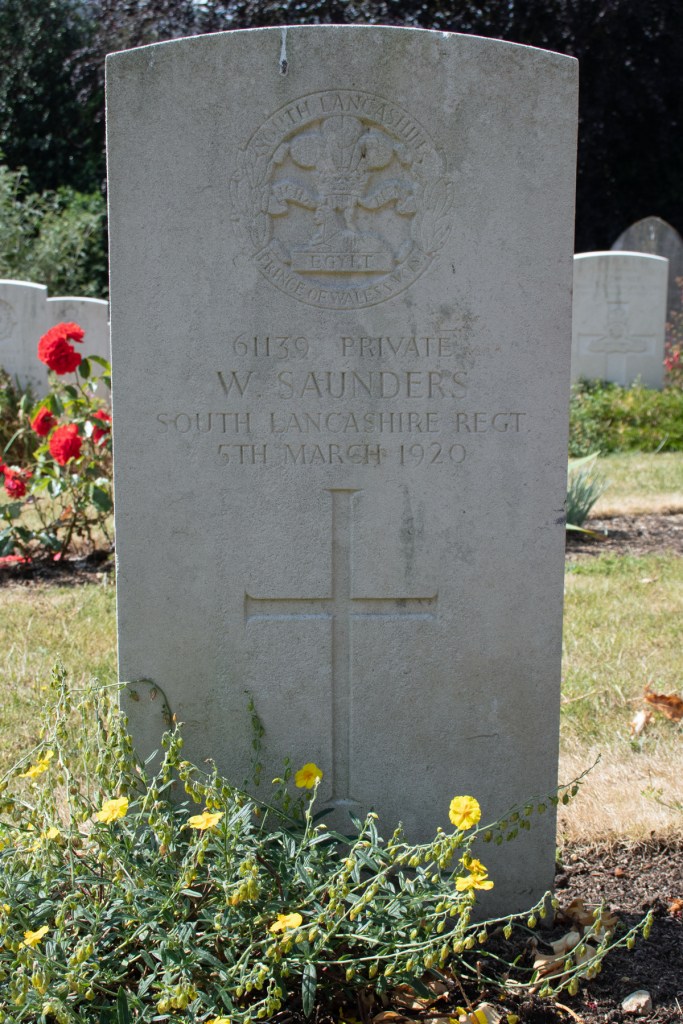
Private Walter Saunders

Private Walter Saunders

There is little concrete information about the life of Walter Saunders, and what details are available come from his limited military documents. These confirm that he was born in December 1862 in Widcombe, near Bath, Somerset.

Walter was unemployed labourer when enlisted in the army in January 1882. He joined the Somerset Light Infantry, and was attached to the 4th Battalion. His service records show that he was just under 5ft 5ins (1.64m) tall, with brown hair, hazel eyes and a fresh complexion. He was also notes as having a scar on his abdomen.

Private Saunders seems to have served in southern Asia, receiving the India medal and Burma 1885-1887 clasp. He then moved to South Africa, and was caught up in the Second Boer War. There is no further information about his initial time in the army.

When his contract came to an end, it would seem that Walter returned to the UK, finding work as a dock labourer in South Wales. When war came to Europe, though, he stepped up once more so serve his country, this time joining the South Lancashire Regiment. He was assigned to the 15th (Transport Workers’) Battalion, which served in the Mersey dockyards.

The next record for Private Saunders comes from June 1917, when he was sent to a medical board. He had been unwell for a while, it seems, and was suffering from arteriosclerosis, or hardened arteries. The medical report confirmed this was a permanent condition, and that he was no longer fit for military service.

At this point, Walter’s trail goes cold. It seems likely that he returned to Somerset, possibly still having family connections there. He passed away on 5th March 1920. He was 57 years of age.

Walter Saunders was was laid to rest in the military section of Bath’s sweeping Locksbrook Cemetery.


Private Frederick Bundy

Private Frederick Bundy

Private Frederick Arthur Bundy, of the 1st Somerset Light Infantry is to be buried in Locksbrook Cemetery tomorrow (Saturday) afternoon with full military honours. He met with a fatal accident in Belfast on Sunday last. In the afternoon when in quarters he was passing from one room to another when a rifle which was bring cleaned by a comrade in the room which he was entering went off. The bullet passed through Private Bundy’s wrist and entered the stomach. He was at once removed to the military hospital, but passed away at midnight, from internal haemorrhage. Deceased, was the son of Mr FA Bundy, of 93 High Street, Upper Weston, and enlisted at the Drill Hall, Bath, in August 1919, when only 15 years of age, being accepted as he was a youth of exceptionally fine stature. At the time of his death he was 16 years and 10 months of age. After a short period of training at Taunton he went with a draft of Somersets to Ireland and was stationed for some time at Carrickfergus Castle, being moved into Belfast when the riots occurred there.

[Bath Chronicle and Weekly Gazette: Saturday 4th December 1920]

Frederick Arthur Bundy was born early in 1904, and was the middle of three children to Frederick and Mary Ann Bundy. Frederick Sr was a labourer from Bath, Somerset, and it was in the Weston area of the city that the family were born and raised.

The 1911 census – the only one Frederick Jr would be recorded on – noted the family as living at 45 High Street, Weston. The household consisted of Frederick Sr, Mary Ann, Frederick Jr, his older sister Sarah, younger brother William and Mary Ann’s daughter from a previous marriage, Annie.

Sadly, due to his young age, there is little additional documentation to build a picture of Frederick Jr’s life. He passed away on 28th November 1920, and was laid to rest in Bath’s Locksbrook Cemetery, not far from the family home.

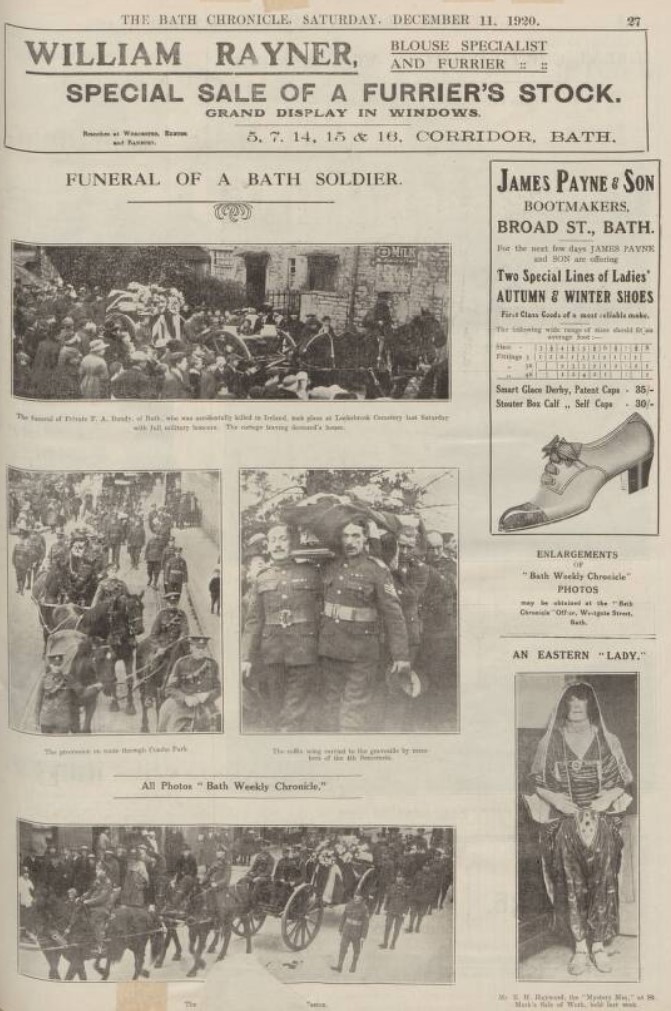
Frederick Arthur Bundy’s funeral was shown in a photo-spread in the Bath Chronicle of 11th December 1920.


Editor’s Note: While Frederick enlisted nine months after the end of the First World War, his acceptance for a Commonwealth War Grave is because his passing being between the qualifying dates and the cause being as a result of his military service.


Private John Sheppard

Private John Sheppard

John Henry Sheppard was born in the autumn of 1889, the older of two children to John and Ellen. John Sr was a general labourer from the Weston area of Bath, Somerset, and when he died, Ellen found work as a laundress to bring in some money.

From the census returns of 1891, 1901 and 1911, it seems that John remained living on Church Street, Bath. The earliest record noted him living with his parents and younger brother, Charles. By 1901, his father had died, and Charles was also noticeable in his absence, so it may be that he had also passed away.

The 1911 census adds a little mystery to the Sheppard line. Although signed off by Ellen, she is not listed as being at the house on the day the return was taken. There are three occupants: John, working as a farm labourer; eight year old Nellie, whose relationship is listed as daughter; and Charles Crane, a 73 year old retired gardener.

On 27th September 1913, John married Elsie Holbrow. The daughter of a gardener, she was working as a domestic servant and he was a groom when the couple exchanged vows. They went on to have a son, Albert, who was born in October 1914.

When war came to Europe, John stepped up to play his part. Full details are lost to time, but it is clear that he had enlisted by the autumn of 1916, initially joining the North Somerset Yeomanry, before transferring across to the Somerset Light Infantry. Private Sheppard was attached to the 1st Battalion and soon found himself on the Western Front.

There is little concrete information about his service, but is appears that he was wounded at Arras in the spring of 1917. He was medically evacuated to Britain for treatment, and was admitted to the 3rd Northern General Hospital in Sheffield, Yorkshire.

Private Sheppard’s wounds were to prove too severe however, and he succumbed to them on 31st May 1917. He was 27 years of age.

John Henry Sheppard’s body was taken back to Somerset for burial. He was laid to rest in the family plot in Bath’s sweeping Locksbrook Cemetery. He was reunited with Elsie when she passed away in December 1949: husband and wife together again after more than three decades.


Private Henry Weakley

Private Harry Weakley

Henry Weakley was born in 1885 in Bath, Somerset. The second of six children, he was the eldest son to James and Fanny. James was a cab driver, and Henry – who was better known as Harry – followed suit, becoming a coachman by the time of the 1901 census.

In 1910, Harry married a woman called Jennie. There is little information available about her, but the following year’s census return found the couple living with his family at 1 Cork Street, Bath, not far from the city’s Royal Crescent. The census had two records for that address, which confirmed the family’s living arrangements. Harry and Jennie had one room, while the rest of the Weakleys – James, Fanny, four of their children and a grandson – took up four rooms.

Harry was still employed as a coachman as this point, but, with war on the horizon, things were to change. Full details of his military service are lost in the mists of time, but it is clear that he enlisted in the Somerset Light Infantry, and that he was assigned to the 3rd (Reserve) Battalion.

Private Weakley’s unit was a territorial battalion and it remained on UK soil throughout the war. Initially based in Devonport, Devon, the 3rd moved to Londonderry, Northern Ireland, in November 1917, and Belfast the following April. Sadly, the little that remain of Harry’s records do not confirm where he served.

Harry was demobbed on 13th May 1919: his pension ledger notes that he had received gun shot wounds to his neck and back, although no further records identify when or how these injuries occurred. He returned home – 5 St George’s Buildings, Upper Bristol Road, Bath – and seems to have settled back into his pre-war life, although his health was still impacted.

Harry passed away at home on 27th March 1921. He was 36 years of age, and had died of heart failure. Despite his wartime injuries, the war office determined that his condition had been contracted after his army service: Jennie was denied a war pension.

Henry “Harry” Weakley was laid to rest in Bath’s sweeping Locksbrook Cemetery, not far from where his widow still lived.