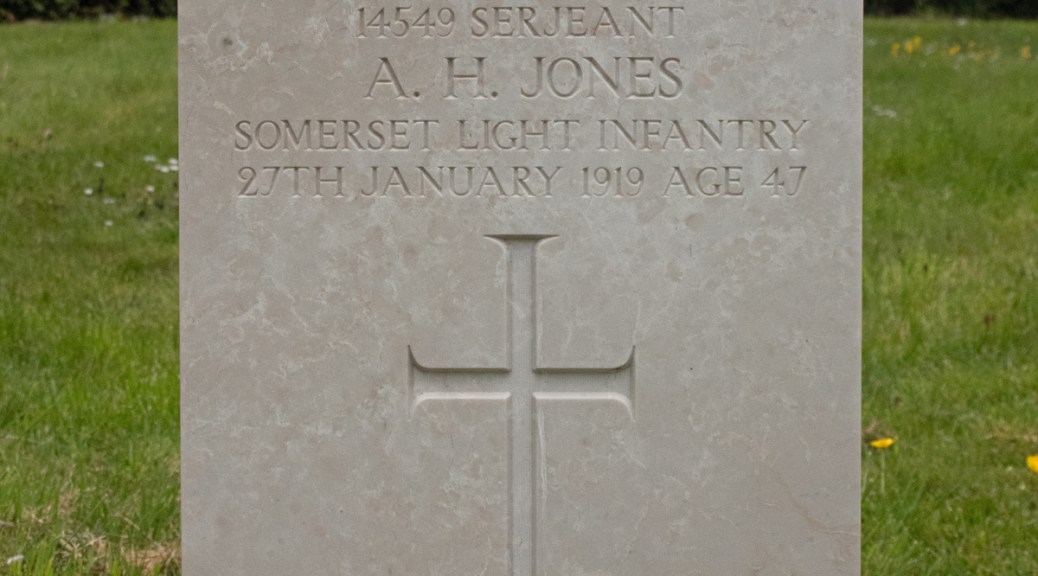
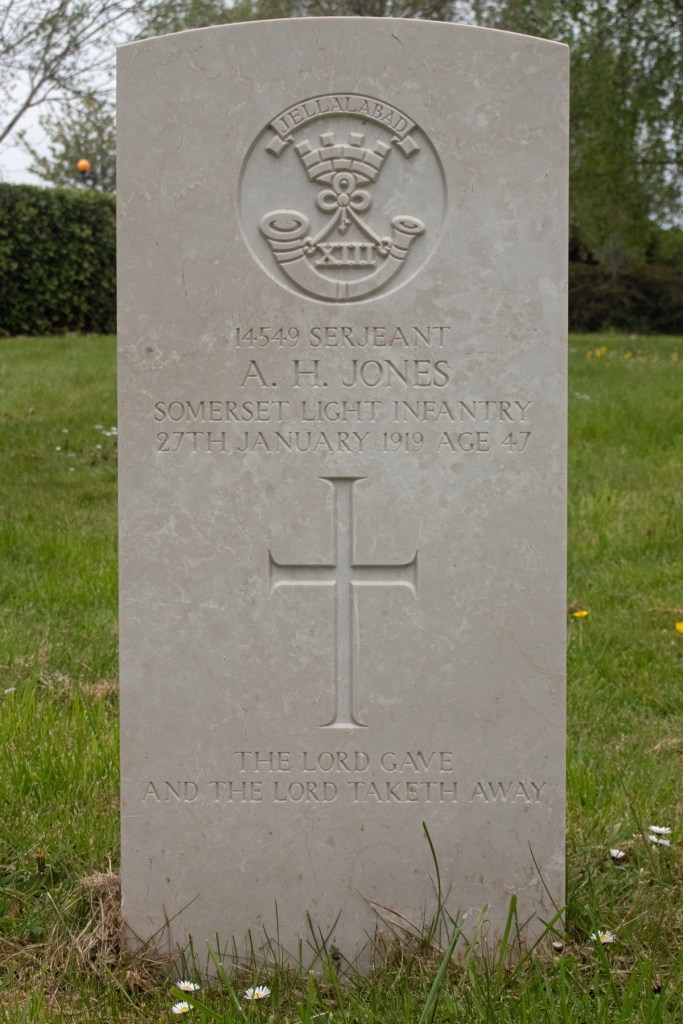
Arthur Henry Jones was born in 1874, the oldest of five children to James and Kate Jones. James worked as a coachman, and travelling seems to have been his thing.
Born in Wiltshire, he met and married Kate in Somerset, and this is where Arthur was born; by 1879, the young family had moved to Hampshire, and within a year they had relocated again, this time to Folkestone in Kent. Three years later, by the time James and Kate’s youngest two children were born, they were back in Wiltshire again, having competed their tour of the south of England.
Sadly, tragedy was to strike the Jones family, when Kate passed away in 1888, at the tender age of 31 years old. James had a family of boys to bring up, however, and he married again, this time to a Miriam Millard. The couple went on to have two children, giving Arthur a half-brother and half-sister.
At this point, Arthur falls off the radar. It may well be that he chose to take up a military career early on – if he was serving overseas, it is possible that the census documentation no longer exists. Twelve years’ service would certainly seem to account for his absence between 1881 and the next time his name appears on records.
These records relate to Arthur’s marriage to Fanny Hill. The couple were married by Banns in May 1906, marrying in Westbury, Wiltshire. They went on to have four children – Arthur, Kathleen, Gladys and Percival – between 1907 and 1911.
Again, at this point, Arthur falls off the radar. His service records no longer exist, but what evidence remains confirms that he enlisted in the Somerset Light Infantry and was assigned to the 7th (Service) Battalion. Initially formed in Taunton, they shipped out to France in July 1915, although there is no documentation to confirm when or if Arthur was involved.
Sadly, the only other reference to Serjeant Jones is his final pension record. This confirms that he succumbed to a combination of influenza and pneumonia on 27th January 1919. He was 44 years old.
Arthur Henry Jones lies at rest in St Mary’s Cemetery in Taunton, Somerset.
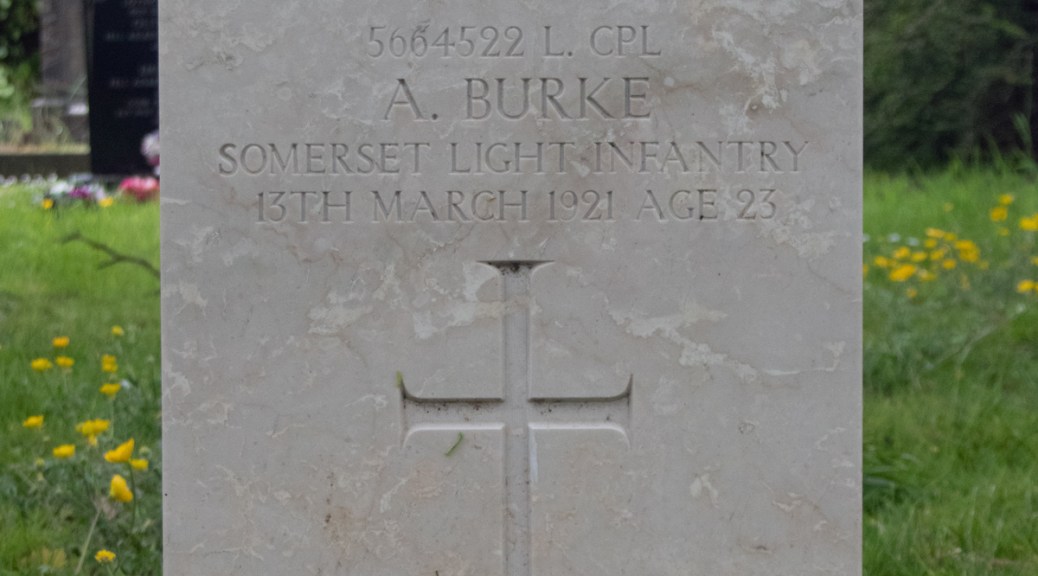
Sometimes, researching war graves can throw a bit of a curve ball, and the things you uncover can make you stop in your tracks. Such is the story surrounding Lance Corporal Albert Burke, and a media report surrounding his death in March 1921.
SCHEME OF VENGEANCE
Taunton Suicide’s Amazing Last Letter
Toll On Young Women
A sensational affair has occurred at Taunton Barracks. On Sunday morning, Albert (or Alfred James) Burke, aged 23, a Lance Corporal in the Somerset Light Infantry, was found to have taken his life by inhaling chloroform, his dead body being found on a bed at the military hospital, where he was employed as an orderly.
On Saturday night, according to the evidence, deceased appeared to be in his usual health and spirits. The next morning, a comrade found his dead body with a chloroform bottle by its side and near his face a large piece of cotton wool which he had evidently used for the purpose of inhaling the poison.
Some light was thrown on the tragedy by a letter addressed to a Taunton young woman, found on his clothing, and which was read at the inquest yesterday.
It was of an extraordinary character, and began “You wish to know what my intentions are in regard to you. Well, in the first place let me tell you I am not, as the coroner who holds the inquest will adjudge me, insane. In fact I don’t think I was ever so rational or level-minded as at the present moment, although I have had a glass or two.
“Well, Beatrice, mine is a rather long and interesting story. I married Louisa Wills some time in 1917, and I think the least said about her the better, but I wish to say this, that I have never knocked across a beast to equal her for violence. I am afraid the people around Brentford, Middlesex, could give you a far better account of her than I can.”
The writer went on to make certain allegations against the woman, and then referred to other towns where, he said, he had ruined girls before coming to Taunton and joining the Somerset Light Infantry. He added that he spent Friday night, when he was supposed to go out with Beatrice, with another girl in the barracks.
He said his father committed suicide owing to a “thing” who called herself a woman, and he (deceased) got a feeling with him that he would like to pay it back on a few girls. In conclusion, Burke expressed his satisfaction at knowing the condition Beatrice was in, and that he had been able to add another to the list of those on whom he wished to have his revenge.
Evidence was given by Alec Treeby, civilian orderly at the Barracks, who found deceased. In reply to the coroner, witness said that he knew the man was keeping company with a girl, but was not aware that there was any trouble about her.
PC Carter stated that the police had made enquiries, and a telephone message had been received that nothing was known of the man or of a wife and family of the name at Brentford…
[The] medical officer at Taunton Barracks said deceased was a steady, hard working man, and, so far as he knew, perfectly sane.
The jury returned a verdict of “suicide while of unsound mind”.
Western Times: Wednesday 16th March 1921
The newspaper report confirms the Lance Corporal’s name as either Albert or Alfred James Burke; the coroner also went on to say that he had also used the aliases of Povery and Pavey. Sadly, research around these names – and that of Louisa Wills – have either led to frustrating dead ends, or to results too vague to concretely connect them to Lance Corporal Burke.
The life and loves of Lance Corporal Burke are destined to remain a mystery. All that can be confirmed is that he took his own life on 13th March 1921; he was 23 years old.
Albert Burke lies at peace in St Mary’s Cemetery in Taunton, Somerset. He was accepted for commemoration as war dead on 27th May 2016 and was afforded a gravestone by the Commonwealth War Graves Commission.
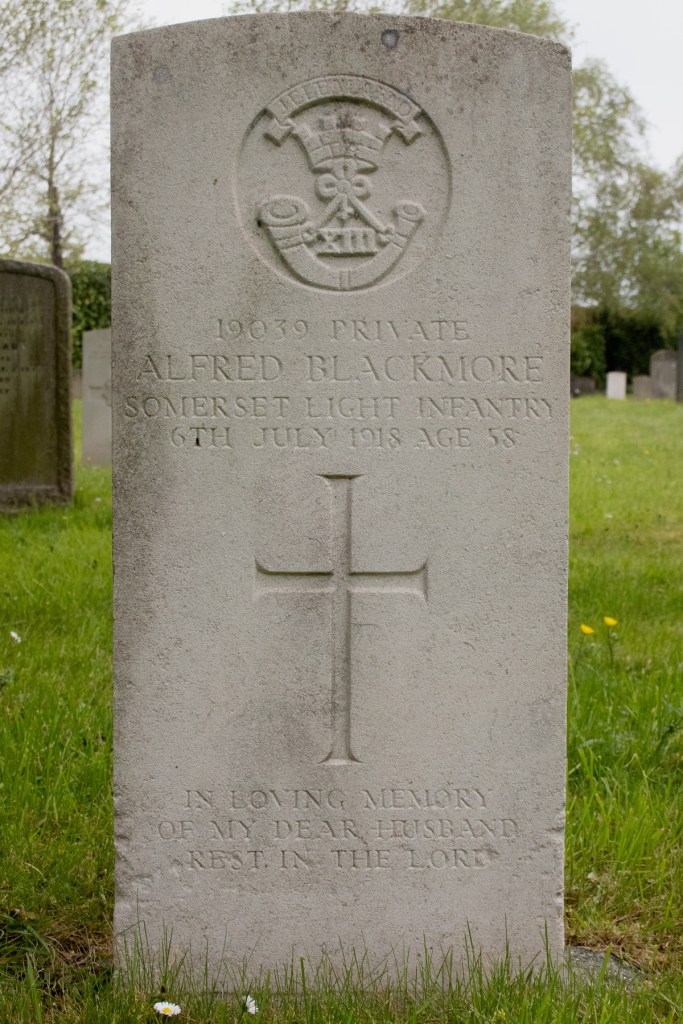
Alfred Blackmore was born on 25th October 1868 in the village of Thurlbear, near Taunton. Documentation varies and names cross over, but it appears that he was one numerous children to farm labourer William Blackmore and his wife, Mary Ann.
Details of Alfred’s early life are a bit hazy – again, in a rural location, names often cross over, so it is a challenge to totally confirm that they relate to the right person. His mother appears to have passed away by the time of the 1881 census, and Alfred was living with his father and three of his siblings and working as a farm hand.
Alfred again disappears off the radar for a while; in July 1894, he married Lucy Charlotte Yard, and the couple went on to have two daughters, Lucy and Beatrice. By 1901, the young family were living in the village of Frampton Cotterell, just to the north of Bristol, and Alfred had found employment as a marine fireman.
Ten years later, Lucy and the girls were still living in Frampton Cotterell, but Alfred was back in Taunton, lodging with a 75-year-old widow called Mary Croker and working as a labourer. This separation may have signalled the beginning of the end for the couple’s marriage.
War broke out, and it is evident that Alfred enlisted as a Private in the Somerset Light Infantry. Sadly, his service records are lost to time, but it appears that he served for at least three years.
The next time Alfred appears in documentation, it is a newspaper report on his passing, under the heading “Taunton Soldier’s Death”.
FOUND DROWNED AT BLACKBROOK
Mr F Foster Barham, coroner for West Somerset, held an inquest at the Blackbrook Inn, Ruishton, on Monday, relative to the death of Alfred Blackmore, aged 49, a private in the Labour Company at Taunton Barracks, whose body was found in the stream at Blackbrook on Saturday morning.
William Cozens, farmer… gave evidence of identification, and stated that on Friday he saw the deceased sitting by the hedge… about 400 yards from where the body was found.
William Richard Radnidge, butcher… stated that on Saturday morning he found the body in the stream dividing Ruishton from Taunton St Mary’s… His cap, belt and cape were on the bank. The deceased was lying face downward, his face and arms being in the mud below the surface.
PC Jenkins stated that at 10:45am on Saturday he received a communication from PC Wathen, in consequence of which he proceeded to Blackbrook, where he found the body lying under a hedge. He searched the body, and on it found a summons, returnable at Taunton on 29th June, for having failed to comply with a maintenance order obtained by his wife, Lucy Blackmore, on 25th September 1915, the sum of £2 13s [approx. £300 today] being due. On the back of the summons was written: “This is what my old cow has done for me.”
There was also the following letter: “When my body is found, don’t you give a farthing to my old cow. What I have got to come give to my brother, Edward Blackmore… Signed A Blackmore.” At the back of the letter was written: “Goodbye to all that I love.”
The deceased had left his lodging at nine a.m. on June 29th to attend the Taunton Police Court, but did not do so.
An officer stated that the deceased’s conduct during the three years he had been in the army had been satisfactory.
The Foreman of the jury said that according to the evidence they found that the deceased met with his death by drowning whilst temporarily insane.
Taunton Courier and Western Advertiser: Wednesday 10th July 1918
Alfred Blackmore took his own life on 6th July 1918. He was 49 years old [the war grave gives a different age].
Alfred lies at peace in St Mary’s Cemetery in Taunton, Somerset.
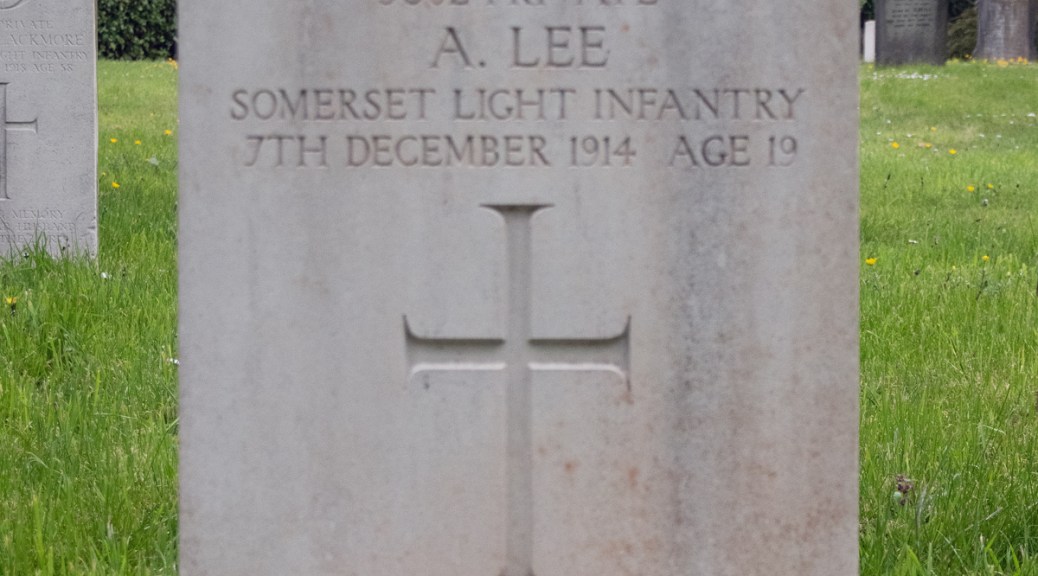
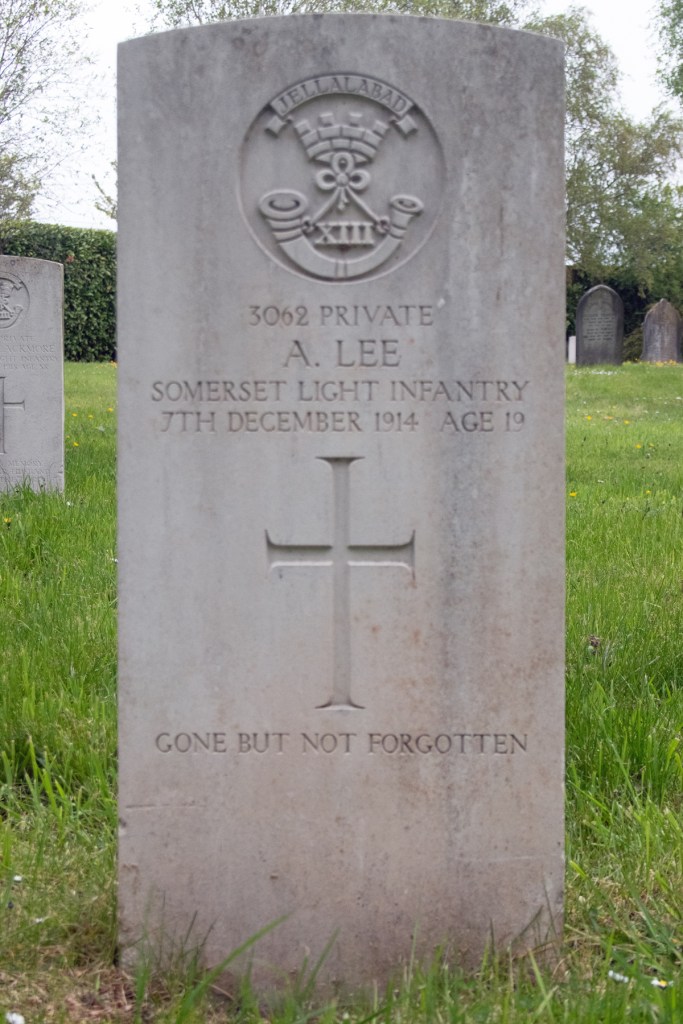
Arthur Henry Lee was born in April 1895, and was one of five children. His parents were Arthur and Hannah (or Annie) Lee, and the family lived in the Chard area of Somerset. Arthur Sr worked as a ‘twist hand’, operating the machines in a lace factory and, when his son left school, he too found work in the same factory.
There is little documented about Arthur’s early life. When war broke out, however, he was quick to enlist, and joined the Somerset Light Infantry as a Private. He was assigned to the 5th (1st Reserve) Battalion, and was stationed at Mansfield House.
Sadly, Private Lee’s military service was not to be a long one. As happened with lots of young men from different parts of the country coming together in large numbers, illness and disease spread quickly in the military encampments,
Arthur was not immune to this and was admitted to the Military Hospital in Taunton with meningitis. He passed away on 7th December 1914, aged just 19 years old.
Arthur Henry Lee lies in St Mary’s Cemetery in Taunton, Somerset.
Henry Thomas Underhill is one of those people whose lives are lost to time. Details of his early life were difficult to track down, but snippets helped unlock some of the mystery.
In late October 1914, a number of Somerset newspapers gave the following report:
Soldier’s Sudden Death
The West Somerset Coroner held an enquiry at Taunton Barracks on Saturday afternoon relative to the death of Private Henry Thomas Underhill, aged 44, of Street, which took place on Wednesday [14th October 1914].
Deceased was talking to Private TF Davis on a landing in the barracks, when he reeled and, throwing up his arms, fell heavily to the ground, his head striking the floor.
Major Stalkartt, RAMC, was at once summoned, but he found that life was extinct. He afterwards made a post mortem examination, which revealed fatty degeneration of the heart, with a fracture of the bae of the skull. The doctor considered that death was due to heart failure, and that the skull was fractured in falling to the ground.
The deceased was accorded a military funeral at St Mary’s Cemetery the same afternoon. He was an old member of the Somerset Light Infantry, which he recently re-joined on account of the war.
Wells Journal: Friday 23rd October 1914
Private Underhill’s pension record confirms that he was married to a woman called Mary Ann and that the couple had had a daughter, Beatrice Kate Lavinia Underhill, who had been born in December 1906. While searching for Henry directly drew too many variables to provide any certainty, his daughter proved the key to unlock his story.
Henry Thomas Underhill was born in the summer of 1860. One of nine children, his parents were William Underhill and his wife Elizabeth, who was also known as Betsy. William worked as a clerk for a button maker, and the family lived in Birmingham, which, at the time, was in Warwickshire.
When he left school, Henry found work as a ‘brass tube drawer’, making the metal tubes, using a die. He found love too, and, on 13th March 1881, aged just 20, he married Emma Howner. The couple went on to have a son, Ernest, in 1889 although, from the documentation about him, it seems likely that he passed away when only a toddler. Further tragedy was to strike Henry, when Emma also died in 1890, aged just 30 years old.
It may have been around this time that Henry found a focus in military service; he does not appear in the 1891 census and the next set of documentation for him dates from 1900.
It’s at this point that Henry married for a second time. Mary Ann Kelly was seventeen years younger than her new husband, and was the daughter of a carpenter from Solihull. Her father, Michael, had died when she was only a teenager, and she lived with her mother, Lavinia, helping to support her.
Henry’s previous experience with metalwork – and probably his time in the military – found him employment making gun components. The 1901 census finds him and Mary living in Yardley, to the east of Birmingham, with Lavinia and Mary’s younger brother William.
This was obviously a suitable and convenient arrangement; the next census, in 1911, shows the family still living together. By this time, Lavinia was still the head of the household, and shared her home with daughter Mary, Henry and four-year-old Beatrice; son William, his wife Ada and their new-born son, William. Making up the household on Census Day was a visitor, Amy.
War was on the horizon, and this is where we return to the initial news report about Private Underhill. It is likely that Henry had re-enlisted – or at least been called back up – as soon as hostilities broke out. Sadly, his service was not to be a long one, as he suffered the fatal heart attack within a couple of months of the start of the war. Private Underhill was 54 years old at the time of his death.
Henry Thomas Underhill’s body was buried in St Mary’s Cemetery in Taunton, Somerset.
Cyril John Rowsell was born in the spring of 1897, one of four children to John and Edith Rowsell. John had been married previously, to a woman called Martha. She had died in 1893, not long after giving birth to the second of their two children – sadly, the child died when little more than a babe in arms. Cyril, therefore, had a half-sibling in his older brother Albert, as well as two full brothers, Richard and George, and a sister, Irene.
Cyril had been born in the Somerset village of Yeovil Marsh, but his father had moved the family to nearby Haselbury Plucknett, where he was the local miller.
John Rowsell was obviously a man of many talents, because, by the 1911 census, he was listed as a dairy manager. By now Cyril was 14 years old, and the family had moved again, this time to the village of Westbury-sub-Mendip, near Wells.
War was on the horizon, and Cyril seemed keen to play his part as early as he could. Full details of his military service are not readily available, but it is evident that he enlisted soon after the conflict began.
Cyril enlisted in the Somerset Light Infantry in 1914 and was assigned to the 1st Battalion as a Private. The Somerset Light Infantry were involved in a number of the fiercest battles on the Western Front, and he seems to have been lucky enough to escape injury until April 1918.
During the Battle of Bethune, Private Rowsell was shot and injured. Initially treated at the scene, he was evacuated to England and admitted to the General Hospital in Birmingham. Sadly, he did not recover from his wounds, and he passed away on 30th April 1918. He was just 21 years of age.
Cyril John Rowsell lies at peace in the graveyard of St Lawrence’s Church in Westbury-sub-Mendip, Somerset.
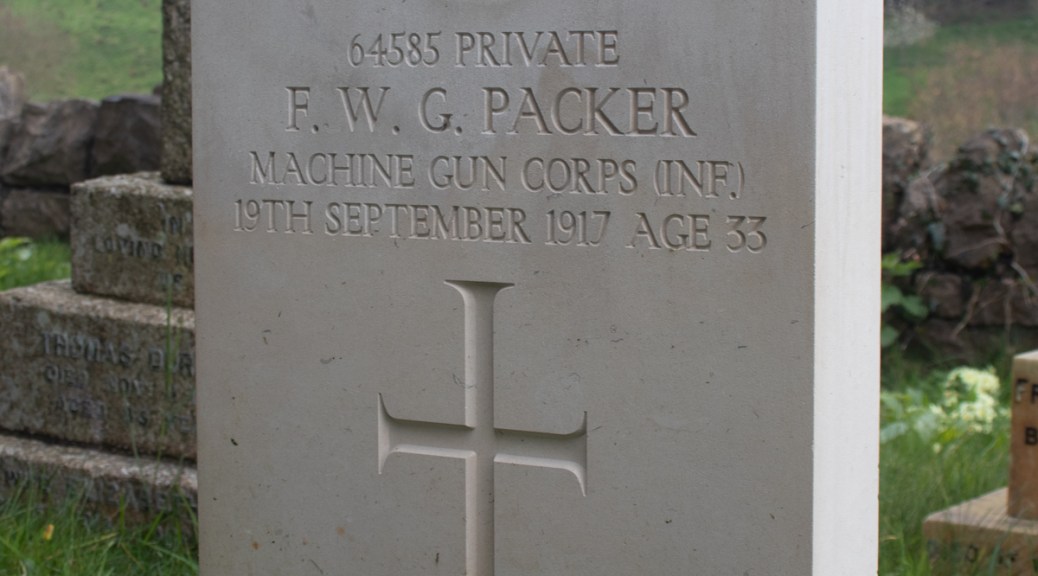
Francis William George Packer was born in Bristol on 28th July 1884. The eldest of three children, he was the son of a grocer, Francis Packer Sr, and his wife, Eliza.
When Francis left school, he followed his father into the grocery business and married Kate Taverner on 1st September 1907. They had one child, a daughter called Dora, in 1909 and, by the time of the census two years later, Francis had moved his young family to Bath.
By the time he was called up, in December 1915, Francis had moved the family again, this time to the sleepy village of Blagdon, in the Somerset Mendips. He formally enlisted in the Machine Gun Corps of the Somerset Light Infantry in July 1916, and was sent to the front in January the following year.
Private Packer’s battalion fought at Arras, and it was here that he was injured. On 1st May 1917, he received a gunshot wound to his right thigh, which fractured his femur. He was initially treated on site, before being shipped back to England, where he was admitted to King George’s Hospital in London.
Sadly, it seems there were complications with his treatment, and Private Packer died from his wounds four months later, on 19th September 1917. He was 33 years old.
Francis William George Packer was brought back to his family in Blagdon, and lies at rest in the churchyard of St Andrew’s there.
The local paper reported on Francis’ funeral, but what struck me is that there seems a glaring omission in the list of those who attended. It was obvious that he wanted a strictly private funeral, but:
The mourners were Mr FE Packer (father), Mr S Emery (brother-in-law), Mr SG Packer (uncle), Mr W Taverner (uncle), Mrs ES Packer (mother), Mrs E Emery (wife’s sister), Amy Parker and Nellie Parker [his sisters-in-law], A Packer (aunt), Dolly Parker, Dolly Flower, Mr J Jones (uncle), Mr CJ Redwood, Mr J Nelson and Mr AH Bleacove.
Western Daily Press: Wednesday 26th September 1917
There is nothing in the report to suggest that Francis’ widow attended the funeral.
Francis’ younger brother, Albert Packer, also fought and died in the First World War. Find his story here.
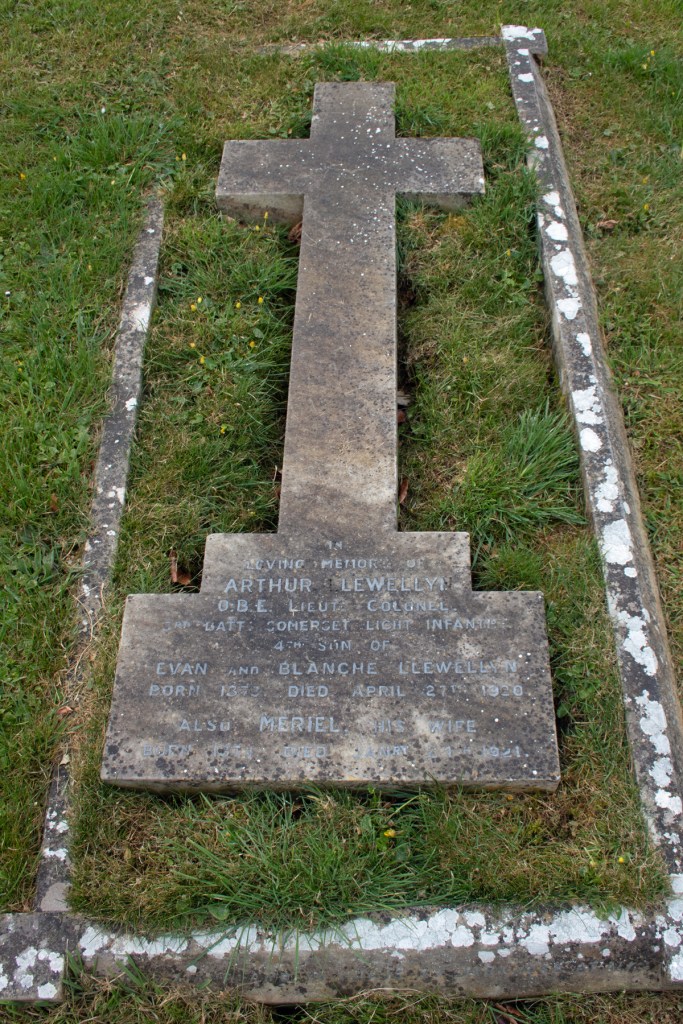
Arthur Llewellyn was born in the summer of 1873, one of four children to Evan and Mary Llewellyn. Originally from Wales, Evan was a Justice of the Peace in the Somerset village of Burrington, and the family lived in the comparative luxury of Langford Court, a mile or so from the village centre.
I use the term ‘comparative luxury’ with some sense of irony; according to the 1881 census, the family had a household staff of eight, including a governess, two nurses, housemaid, cook, kitchen maid, parlour maid and page.
Ambition was obviously what drove Evan; he was an army office, who served in initially in the Somerset Light Infantry. In 1885, he was elected MP for North Somerset, a position he held on and off for nearly twenty years. His military service continued, however, and he led the 2nd (Central African) Battalion, King’s African Rifles in the Boer War.
Comfort ran in the Llewellyn family; according to the 1891 census, Arthur was staying with his maternal aunt, Rose Stewart. She also lived in Somerset, and, at the time the census was drawn up, she was recorded as a widow living on her own means, with her mother, mother-in-law, two nieces and Arthur, her nephew. She was not without help, however, as the house had a retinue of eight staff to support her.
Military life was an obvious draw for Arthur. He enlisted in the Somerset Light Infantry in October 1891 and, within a year, had been promoted to Second Lieutenant.
He had met and married Meriel Byrne, in 1895. The couple’s marriage certificate confirms that he had been promoted to Captain in the militia, and his residence was Buckingham Palace Road, in south west London. They were married in Holy Trinity Church, Brompton, with Meriel’s mother and Arthur’s father acting as witnesses.
The couple went on to have five children, all girls, and they settled into a comfortable life. By 1901, Meriel had set up home in Worcestershire; Arthur does not appear on that year’s census, which suggests that he may too have been fighting in South Africa.
Arthur’s mother Mary passed away in 1906, at the tender age of 39. By 1911, he had been promoted to Lieutenant Colonel in the 3rd Somerset Light Infantry, and was head of his household in Worcestershire. The family was, by this time, complete – Arthur and Meriel and their five children also had help running their home, with two nurses, a cook, parlour maid and housemaid to support them.
Evan passed away months before war was declared, at the age of 67. Lieutenant Colonel Llewellyn felt duty bound to re-enlist, and was given command of the 3rd Reserve Battalion, Somerset Light Infantry. He subsequently served as part of the Army Service Corps in France, before transferring to the Army Labour Corps in Nottingham.
According to the Evening Mail, on 27th April 1920, he “was suddenly seized with illness in the street, and died as he was being conveyed to Nottingham Hospital. He was 46 years of age.”
Arthur was brought back to Burrington in Somerset, where he was buried alongside his parents in Holy Trinity Churchyard.
Sadly, Meriel passed away nine months after her husband; she too is buried in Holy Trinity Churchyard.
Arthur’s estate passed to his brother, Owen, and totalled £12,023 15s 11d (approximately £530,000 in today’s money).
As an aside to Arthur’s illustrious story, another of his brothers is worthy of note. Hoel Llewellyn was two years older than Arthur.
Educated for the Royal Navy, he saw active service on the East Coast of Africa, 1888-90 with despatches. He also served as Artillery Officer and commanded artillery in the Matabele War, where he was recommended for the Victoria Cross. He was promoted Captain in the British South Africa Police, and Justice of the Peace in Matabeleland in1896.
Captain Llewellyn served throughout the South African War; commanding armoured trains north of Mafeking before transferring to the South African Constabulary in 1901. Hoel was eventually created a Companion of the Distinguished Service Order for his service in South Africa.
He was wounded while serving with the Mediterranean Expeditionary Force in the Great War. Hoel was subsequently promoted to the rank of Colonel and appointed Provost-Marshal of Egypt and the British Mediterranean Expeditionary Force.
In 1908, he had been made Chief Constable of Wiltshire, a role he was to hold for 37 years. He was key to pioneering the use of police dogs, and went on to become the oldest serving person to hold the Chief Constable role in the county.
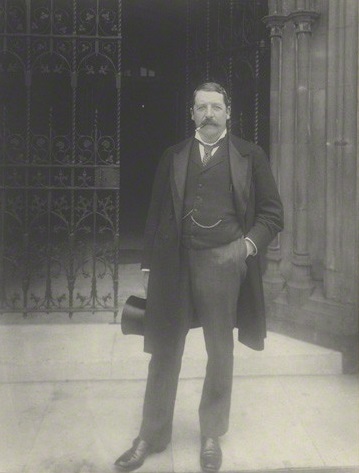
Evan Henry Llewellyn
Another aspect of the Llewellyn family is that Evan was obviously a source of political drive for the family; his great-great-grandson is David Cameron, UK Prime Minister from 2010 to 2016.
Walter James Tottle was born in September 1892, one of fourteen children to Charles and Ellen Tottle from Somerset. Charles was a boatman, and they family lived in Salmon Parade along the riverfront in Bridgwater.
When Walter left school, he became an assistant at a market garden; by the 1911 census, he was living with his parents and eight of his siblings, whose jobs included carpentry and laundering. Walter’s younger brother Henry was listed as a ‘rink boy’, helping with skating at the local ice rink.
Walter’s life beyond this is a bit of a mystery. He enjoyed sports and, before the war had been a regular player for Bridgwater Rugby Football Club. He married a woman called Ruth, although I have been unable to track down who she was or when they couple wed.
When war came, Walter enlisted in the Somerset Light Infantry and, according to contemporary newspaper reports, Corporal Tottle had served on both the Eastern and Western Fronts. He was discharged from the army on 13th February 1919, following a severe attack of influenza, but it appeared to get the better of him. He passed away on 5th May 1919, aged just 26 years old.
Walter James Tottle lies at rest in St John’s Cemetery in his home town of Bridgwater, Somerset.
Walter’s ‘rink boy’ brother Henry also served in the First World War. He had also enrolled in the Somerset Light Infantry and, as a Corporal in the 1/5th Battalion, he was involved in some of the fierce fighting in the Middle East. He was injured, either in Gaza or Jerusalem, but sadly Henry died of his wounds on 22nd November 1917; he was buried in the War Cemetery in Jerusalem.
Sidney John Warren was born in January 1890, one of eleven children to shipwright George Warren and his wife Elizabeth. The family lived in Salmon Parade, on the riverside in Bridgwater, where George would have plied his trade. By the time of the 1911 census, Sidney had found work as a grocer’s assistant, and was living with his parents and the youngest of his brothers, Edward.
While exact details of Private Warren’s military career are not available, documents confirm that he enlisted in the Somerset Light Infantry. Assigned to the 4th Battalion, he was based in India and Mesopotamia during the conflict. No details are available of his time there, but at some point, he transferred to the Labour Corps back in Somerset.
And there Sidney’s trail goes cold. He survived the war, but passed away on 27th November 1918, suffering from pneumonia. He was just 28 years old.
Sidney John Warren lies at rest in the family grave at St John’s Cemetery in his home town of Bridgwater in Somerset.









 Death and Service