William George Masters was born in Padstow, Cornwall, on 15th April 1877. The older of two children, his parents were Samuel and Catherine (or Kate) Masters. Samuel was an agricultural labourer, but his son sought a life at sea.
On 7th November 1894, William enlisted in the Royal Navy. Sent to HMS Northampton, an armoured cruiser repurposed as a training ship, he took on the role of Boy 2nd Class. His service records show that he was 5ft 6.5ins (1.69m) tall, with brown eyes, auburn hair and a freckled complexion. He was noted as having a scar on the third finger of his right hand.
Over the next six months, William showed a remarkable dedication to the job. On 7th February 1895 he was promoted to Boy 1st Class, and, just three months later, he came of age and assumed the rank of Ordinary Seaman.
William’s shore base was to be HMS Vivid, the Royal Naval Dockyard in Devonport, Devon, and he returned here regularly over the twelve years of his service. Ordinary Seaman Masters served on ten ships during this time and, on 1st May 1902, was promoted to Able Seaman.
His time in the navy wasn’t to be without incident, however, and he had two spells in the brig – for three days in July 1897, and ten days in December 1905. His misdemeanours are lost to time, but they did blemish an otherwise clear term of service for William.
William married Laura Oldham in 1905: they would go on to have three children – William Jr, Emily and Katharine. He was stood down to reserve status in April 1907 and, by the time of the next census in 1911, the family were living in Church Street, Padstow. No longer working for the Royal Navy, he was, instead, self-employed as a general labourer.
When war was declared in August 1914, William was called back into action. Assigned to HMS Argonaut, he once again too the rank of Able Seaman. He spent a year on board, patrolling the Atlantic, before the protected cruiser was converted to a hospital ship.
In September 1915, Able Seaman Masters transferred to another cruiser – HMS King Alfred – which served in the Mediterranean. He remained on board until the following summer, by which point his health was beginning to become affected.
William returned to Devonport in August 1916, remaining there for a couple of months. On 4th October, he as medically discharged, suffering from myocarditis, a heart condition.
At this point William’s trail goes cold. He returned to Cornwall, passing away at home on 13th September 1917: he was 40 years of age.
William George Masters was laid to rest in Padstow Cemetery, on the outskirts of the town he called home.
The life Albert Bendell is one of dedication to naval service. Born in Portsmouth on 28th May 1865, his parents were Master at Arms John Bendell and his Jersey-born wife, Eliza.
The family had moved to St Martin, Jersey, by the time of the 1871 census. Given the amount of time her husband spent at sea, it would seem likely that Eliza, who had three young children to raise on her own, wanted to be close to her family.
Albert was keen to follow in his father’s footsteps and, on 6th December 1880 he enlisted in the Royal Navy. Just fifteen years old, his service records show that he was just 5ft 1.5ins (1.56m) tall, with blue eyes, light hair and a fair complexion.
Albert’s dedication to the role was obvious: starting off as Boy 2nd Class, he steadily – and rapidly – rose through the ranks. Over the next twelve years, he served on seven ships and shore bases. He was promoted to Boy 1st Class in September 1891, while serving on the training ship HMS St Vincent.
When he came of age in May 1883, he was given the rank of Ordinary Seaman: within a year he had risen to Able Seaman, and achieved the role of Leading Seaman in January 1888. Just three months later, Petty Officer Bendell was beginning a two-year service on board HMS Fearless.
In April 1893, Albert received a further promotion, and a change in direction within the Royal Navy. He was now a Gunner, a standing officer’s role, permanently attached to HMS Duke of Wellington – returning to the first ship he had been assigned to nine years earlier.
On 17th September 1900, Albert married Amelia Renouf, the daughter of a land proprietor from St Martin, Jersey. The couple wed in St Helier, Albert giving his profession as Warrant Officer. At 37, Amelia was a year older than her new husband: the couple would not go on to have any children.
Albert’s rise through the ranks continued. The 1911 census found him moored in Malta. He was Chief Gunner on HMS Egmont: the importance of his role on board highlighted by the fact that he was the 11th person out of 188 to be recorded on the document.
When war came to Europe, Albert served his King and Country proud. He was promoted to the rank of Lieutenant and, in June 1919, he was awarded the MBE “for valuable services as Officer-in-Charge, Defensively Armed Merchant Ships, Southampton.” [The Edinburgh Gazette, 1st July 1919]
This distinguished life was beginning to take its toll, however, and, on 16th March 1920, after nearly 40 years in naval service, Albert was medically stood down. Suffering from dyspepsia, he returned to Jersey, and his home, La Rosaye, in St Martin.
Albert Bendell’s health was to get the better of him. He passed away on 26th April 1920, at the age of 54 years of age. He was laid to rest in the peaceful graveyard of St Martin’s Church, Jersey.
Amelia remained on the island for the remainder of her life. She passed away on 31st August 1943, at the height of Jersey’s German occupation, at the age of 80 years old. She was laid to rest with Albert, husband and wife reunited after more than 23 years.
Thomas Charles Slade was born in Bristol, Gloucestershire, on 13th March 1880. One of twins, he and his sibling Ernest were two of nine children to Charles and Elizabeth Slade. Not long after the twins were born, the family had moved to Minehead, Somerset, where both Charles, who was a mason and bricklayer, and Elizabeth had hailed from.
Whilst Ernest seemed content to remain in Somerset – going on to become a poultry farmer – Thomas sought a life of adventure. Foregoing his gardening job, he enlisted in the Royal Navy, setting his sights on a life at sea.
Thomas’ service records show that he joined up on 12th November 1895. He stood just 5ft 2ins (1.57cm) tall, with brown hair, blue eyes and a ruddy complexion. As he was to young to formally join up, he was give the rank of Boy 2nd Class, and sent to HMS Impregnable, the shore-based training establishment in Devonport, Devon.
Boy Slade seemed to create a good impression. He was promoted to Boy 1st Class in July 1896, and the follow February was given his first posting, on board the battleship HMS Benbow. This was the ship he was serving on when he turned 18 and, having come of age, he was officially inducted into the navy, and given the rank of Ordinary Seaman.
And so began a glittering career for young Thomas. Over the twelve years of his contract, he served on nine different ships, returning to HMS Vivid – the Royal Naval Dockyard in Devonport – between voyages.
Small in stature, Thomas appears to have been a dedicated young man. His annual reviews noted his character was ‘very good’ every year, and his ability was either ‘very good’, ‘superior’, or ‘excellent’. He was promoted to Able Seaman in September 1898, just eighteen months after becoming an Ordinary Seaman. By June 1906 he rose in rank again, ending his initial term of service as a Leading Seaman.
Thomas was not done with the navy yet, however. He immediately re-enlisted and, over the ensuing years served on a further four vessels. He spent more and more time on board HMS Defiance, the torpedo and mining school ship in Devonport. Whether this was because he was being taught, or was supporting incoming students is unclear, but by September 1912, he had been promoted again.
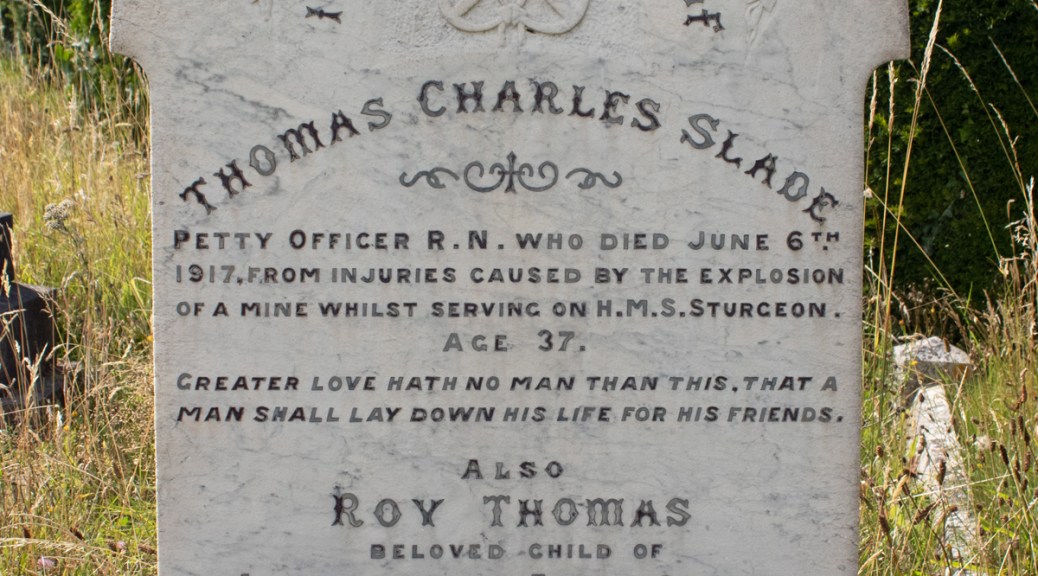
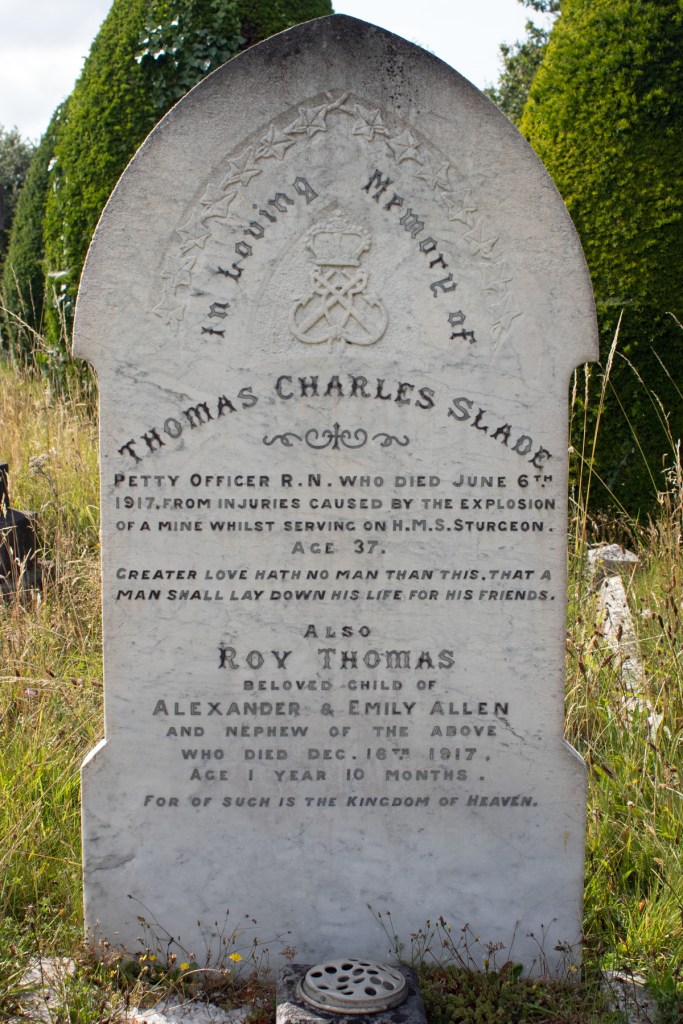
In November 1915, the now Petty Officer Slade had moved to the depot ship HMS Dido. His new posting supported the Tenth Destroyer Flotilla in the North Sea, patrolling the waters off the East Anglian coast. In February 1917 he moved to another of the support vessels, HMS Sturgeon.
In June 1917, a mine exploded on board, injuring a number of the crew, including Petty Officer Slade. The wounded were transferred to a hospital near Ipswich, and it was here that Thomas was to pass away. The only one of those caught up in the incident to die, he was 37 years of age.
Thomas Charles Slade was brought back to Somerset for burial. He was laid to rest in the sweeping Minehead Cemetery, close to the grave of his mother, Elizabeth, who had passed away nine years before.
Thomas’ headstone also includes an inscription to Roy Thomas Allen, who died six months after him. Roy was the young son of Thomas’ younger sister Emily: an uncle and nephew reunited.
Amos William Cornish was born on 16th August 1887 in Dunster, Somerset. One of five children, his parents were George and Elizabeth Cornish. George, who was a brickmaker, died in 1893, and at this point the family relationships seemed to have broken down.
By the time of the 1901 census, Elizabeth had remarried, and was living with her new husband and Amos’ youngest sibling, sister Lily. Two of Amos’ brothers, Walter and George, were living with his maternal grandparents, while Amos himself was one of three hundred inmates at the Horton Kirby Home for Homeless Boys in the Dartford area of Kent.
Amos’ schooling would have finished by the time he was 14 years old, and he quickly sought work that allow him to support himself as a young man with no home to go to. A career in the Royal Navy seemed to provide that regular pay and, on 4th June 1902, he enlisted.
As he was under age, Amos was given the rank of Boy 2nd Class, and sent to the shore-based training ship HMS Impregnable in Devonport, Devon. His service records show that he stood just 5ft 4ins (1.63m) tall, had brown hair, brown eyes and a fresh complexion. He was noted as having a scar in the centre of his forehead, and a tattoo of clasped hands over a heart on his right forearm.
Boy Cornish transferred to another training vessel – HMS Lion – after a month or so, and it was here, in February 1904, that he was promoted to Boy 1st Class.
Over the next eighteen months, Boy Cornish served at two more training bases – HMS Boscawen and HMS Vivid. He was given his first sea-going posting in April 1905, aboard the cruiser HMS Blake. It was on his next assignment, however, that he came into his own.
In May 1905, Amos boarded HMS Carnarvon, an armoured cruiser that had been launched a couple of years before. He was to spend the next two years as part of her crew, gaining the rank of Ordinary Seaman when he came of age in August 1905, and Able Seaman a year later.
When his time on board Carnarvon came to an end, Amos returned to shore, to HMS Pembroke, the Royal Naval Dockyard in Chatham, Kent, which was to be his base on and off for the next eight years. During that time, he served on six more ships, and rose to the rank of Leading Seaman in December 1911. This new rank, however, seemed not to suit Amos, and he reverted back to his previous rank eight months later.
Able Seaman Cornish’s longest posting was on board the cruiser HMS Antrim. He joined her crew in September 1913 and, over the next three-and-a-half years he travelled far and wide. Initially patrolling the North Sea – particularly around the Scottish Isles – Amos was on board for a journey to Arkhangelsk in Russia. The ship then transferred to the Western Atlantic, patrolling around America and the West Indies.
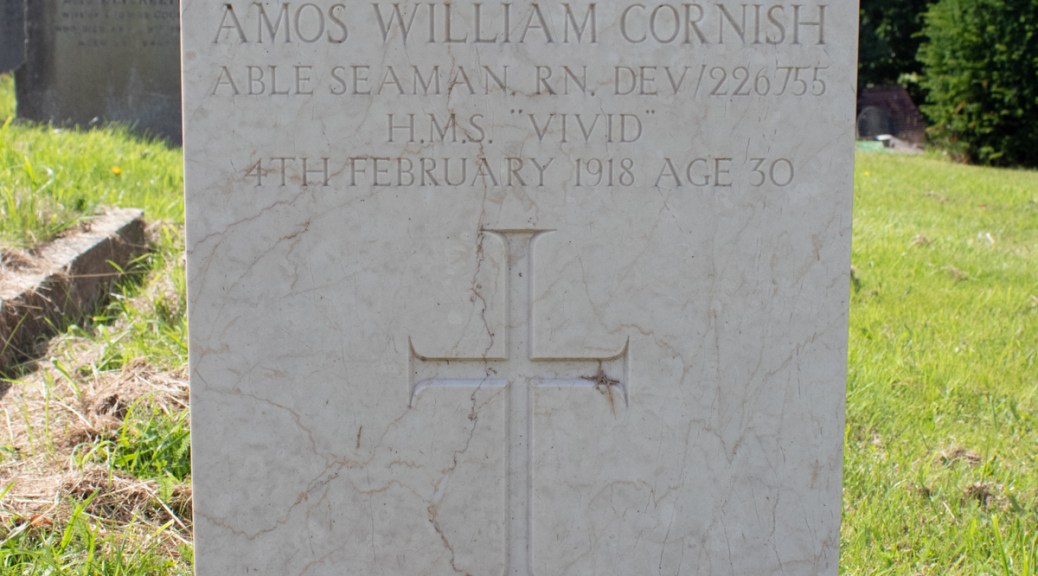
Able Seaman Cornish returned to British shores in April 1917, to be based at HMS Vivid, the Royal Naval Dockyard in Devonport, for the nest nine months. During this time, he became ill and was admitted to the Royal Naval Hospital in Truro with double pneumonia. Tragically, this was something he was not to recover from: Amos passed away on 4th February 1918, at the age of 30 years old.
While somewhat stretched, Amos’ family bond still remained. Elizabeth was living in Minehead by this point, with husband Alfred and their two children. It was to the Somerset town, therefore, that Amos William Cornish’s body was brought. He was laid to rest in the town’s sweeping cemetery.
George’s death in 1893, and Elizabeth’s remarriage a few years later split the family, and Amos’ siblings all followed separate paths.
The oldest of his siblings, Walter, also followed a military path. He joined the Royal Garrison Artillery as a Gunner and, by the time of the census, was based in Gibraltar. On completing his service, he returned to Somerset, marrying Florence Peddle in 1925. The 1939 Register found the couple living with his cousin, Amelia, while he worked as a gardener. Walter died in Weston-super-Mare in 1962, at the age of 74.
Amos’ next sibling, brother Harold, seems to have had a less fortunate time of things. Absent from the 1901 census, he appears in prison records four years later. He was incarcerated for six months’ hard labour in Brecon Prison, having been found guilty of “Gross Indecency with another male person”. Harold was 14 years and three months old at the time. A newspaper report from around this time suggests that the other party was a George Williams, but there is no further information about him. Harold seems to have come out the other side of his experience, however: the 1911 census recorded him as living and working with draper and grocer James Ridler and his family in Dunster, Somerset.
Amos’ third sibling, sister Lily, found work as a servant to bakers Joseph and Minnie Bagley in Minehead. She married painter and decorator William Whitting in 1916 and the couple went on to have a daughter, Kathleen, eight years later. The family settled in Weston-super-Mare, Lily passing away in 1968, at the age of 75.
The youngest of the Cornish siblings was George. He remained living with his maternal grandparents in Dunster, and found work as a printer. In the spring of 1921, he married Clara Govier and, by the time of the 1939 Register, they couple were living in Aylesbury, Buckinghamshire, where George was working as a printer and compositor. He died in 1957, at the age of 62 years old.
Harold Cane was born in Minehead, Somerset, on 10th August 1898. One of nine children, his parents were Henry and Mary Cane. Henry was a stone mason from Minehead, but he was working in Ireland when he met his future wife. The couple married in 1891, only moving back to Somerset the mid-1890s, by which time they had two children, Harold’s oldest siblings.
The 1911 census recorded Henry and Mary living with their children at 3 Church Steps in Minehead, a short row of houses leading to St Michael’s Church. Henry was a mason and his oldest son, also called Henry, has working with him.
Harold, meanwhile, dreamed of a bigger and better life. When he finished his schooling, he joined the Royal Navy, looking for a life of adventure on the high seas. He signed up on 22nd September 1914, just a month after the declaration of war, and was sent to the shore-based training ship, HMS Impregnable, based in Devonport, Devon.
As he was just 16 years of age, Harold was given the rank of Boy 2nd Class. However, his commitment to the role was evident and led to a promotion – to Boy 1st Class – after just three months. In September 1915, Harold as assigned to the dreadnaught battleship HMS Iron Duke, where he served as an Ordinary Seaman. He spent just under a year on board, during which time the Iron Duke was caught up in the Battle of Jutland. She was involved in the sinking of the German destroyer SMS S35, after which she and the rest of the fleet moved on.
Ordinary Seaman Cane remained on board HMS Iron Duke until the summer 1916. He had fallen ill by this point, having contracted tuberculosis. The condition was enough for Harold to be invalided out of the navy, and he was stood down on 9th August 1916.
At this point, Harold’s trail goes cold. It seems that he returned home to Somerset, as this is where he passed away. He died on 14th November 1917, at the age of just 19 years old.
Harold Cane was laid to rest in the peaceful landscape of Minehead Cemetery.
Walter Henry Nipper was born on 21st September 1900 in Bleadon, Somerset. The oldest of four children, his parents were Gilfred and Rose Nipper. Gilfred was an agricultural labourer turned butcher and poultry dealer, and, by the time of the 1911 census, he had set up a retail business in the middle of the village.
Walter turned to farm work when he finished his schooling, but with war raging across Europe, he seems to have been one of the young men desperate not to miss out on the action. On 16th September 1918, just five days before he turned 18, Walter enlisted in the Royal Naval Volunteer Reserve. His service records confirm that he stood just 5ft 1.5ins (1.56m) tall, had black hair, hazel eyes and a fresh complexion. The document also noted that he had a scar on the back of his right hand.
Ordinary Seaman Nipper was sent to HMS Victory VI, the shore-based training vessel in Crystal Palace, Surrey, for his induction. It is likely that, when he left Somerset for the capital, that was the last time his parents saw him. Billeted in cramp barracks, with young men from across the country, Walter fell ill: he passed away on 10th October, just 24 days after joining up. He was barely 18 years of age.
Walter Henry Nipper’s body was brought back to Somerset for burial. He was laid to rest in the tranquil graveyard of St Peter and St Paul’s Church in his home village.
Bertie Baden Clark was born on 5th August 1900 in the hamlet of Dunball, near Puriton in Somerset. The third of seven children, his parents were quarry and cement works labourer George Clark and his wife, Bessie.
When war came to Europe, George stepped up to play his part. Despite being 44 years old, he enlisted in the Royal Army Service Corps on 4th November 1915 and, within a year, was in France. He remained posted at the No. 4 Remount Depot until October 1918.
“On the morning of the 1st October 1918, I left the 26th Squadron 4 Base Remount Depot riding a horse and leading one to exercise about a mile & half from the Squadron while proceeding by the side of the railway line my horse was frightened by the whistle of a railway engine & ran away with me throwing me to the road and stepping on my right ankle.”
Private Clark was initially treated at the No. 2 Canadian General Hospital, but was soon invalided back to Britain and placed on furlough until being formally demobbed from the army early in 1919.
Bertie, meanwhile, could see the excitement of the war passing him by. Determine to play is part before it was too late, he gave up his job as a labourer on 13th July 1918 and enlisted in the Royal Naval Volunteer Reserve.
Given the rank of Ordinary Seaman, his service records confirm that he was 5ft 6in (1.68m) tall (1in, or 2.5cm, taller than his father), with dark brown hair, grey eyes and a fresh complexion. He was noted as having a scar on his right knee.
Bertie was sent to HMS Victory, the Royal Naval Dockyard in Portsmouth, Hampshire, for training. Tragically, this was to be his only posting. He was admitted to the dockyard hospital early in October, suffering from double pneumonia and influenza. The condition was to take his life, and he passed away on 10th October 1918, at the age of just 18 years old.
Bertie Baden Clark’s body was brought back to Somerset for burial. He was laid to rest in the quiet graveyard of St Michael’s Church in Puriton, the funeral attended by his family, including his recently returned father, George.
Herbert Austin Fry was born on 30th January 1889 in the Somerset village of Moorlinch. He was the fifth of ten children and his parents were Joseph and Ellen Fry. Joseph was a farmer, and by the time Herbert was just two years old, the family had moved to Sutton Farm, in nearby Sutton Mallet.
The whole family chipped in to play their part on the farm, and, even before he finished his schooling, this was something that Herbert was also destined to do.
When war came to Europe, Herbert was keen to play his part. He enlisted in the Royal Naval Volunteer Reserve on 7th September 1916 as an Ordinary Seaman. His service records give a hint as to the young man he had become: he was 5ft 11ins (1.8m) tall, with sandy hair, blue eyes and a fair complexion.
Ordinary Seaman Fry was initially sent to HMS Victory – the Royal Naval Dockyard in Portsmouth, Hampshire – for training. Over the next year, he was given two sea-going postings, before returning to HMS President in London in September 1917.
On 31st October, Herbert boarded SS Dunrobin, a merchant ship. Having sailed to Almeria in Spain, she was returning to Britain, with a cargo of iron ore and grapes. On 24th November 1917, while 49 miles (79km) south-west of The Lizard in Cornwall, the Dunrobin was torpedoed by a German submarine. She sunk, and 31 lives – including that of Ordinary Seaman Fry – were lost. Herbert was 28 years of age.
Herbert Austin Fry’s body was recovered and brought back to Somerset for burial. He was laid to rest in the peaceful Sutton Mallet Churchyard.
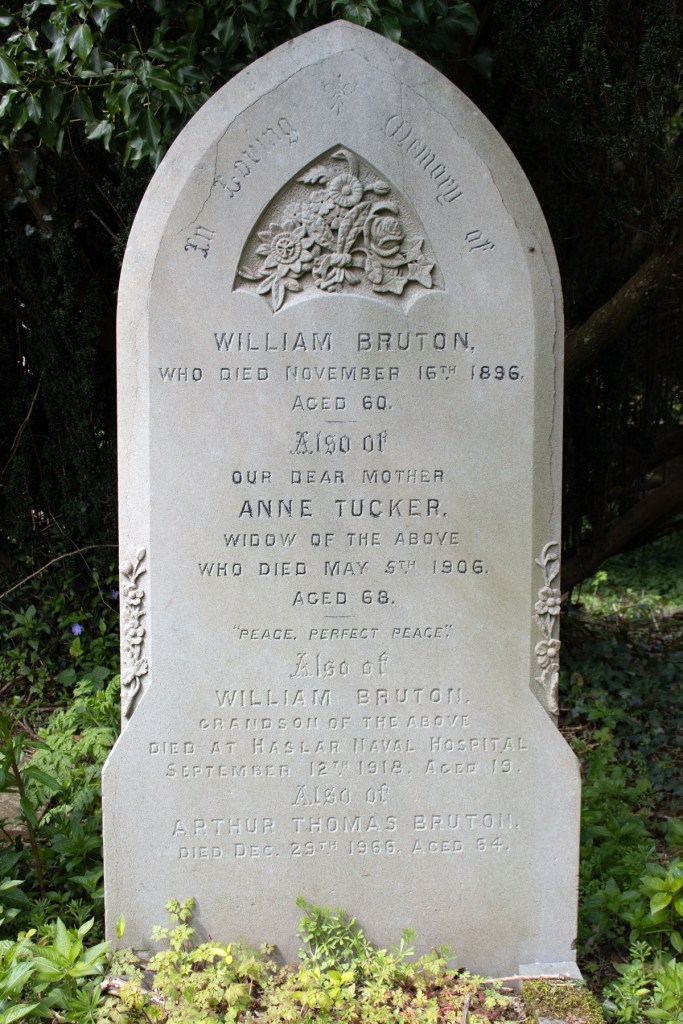
William Bruton was born on 9th August 1899, the oldest of two children to William and Kate Bruton. William Sr was a grocer from Charlcombe to the north of Bath, Somerset, but it was in the Walcot area of Bath itself that the family settled.
Kate died in November 1904, at the age of just 35 years old, and William Sr raised his children on his own. He married a second time, to Edith Elly in 1910, and the couple went on to have a daughter, Mona, the following year.
William Jr – who was known as Willie, to avoid confusion with his father – was still in school at the time of the 1911 census, but when he left a few years later, he found work as an engine cleaner. War had come to Europe by this point, but to begin with Willie was too young to play his part.
He finally got his chance to enlist towards the end of the conflict, and joined the Royal Navy as an Ordinary Seaman on 18th July 1918. His service document record that Willie was 5ft 11ins (1.8m) tall, with brown hair, hazel eyes and a fresh complexion. He was also noted as having a scar on his upper lip.
Ordinary Seaman’s first posting was to be HMS Victory, the Royal Naval Dockyard in Portsmouth, and, tragically, this was also to be his last. Within a matter of weeks he had contracted pneumonia, and he passed away from the condition on 12th September 1918. He was just 19 years of age.
William Bruton was brought back to Somerset for burial. He was laid to rest in the family plot in Lansdown Cemetery, overlooking the city of his birth.
Alfred Henry Collins was born on 22nd August 1886, in the Gloucestershire village of Wotton-under-Edge. One of five children, his parents were cowman and farm labourer Samuel George Collins and his wife, Jane. Samuel’s work took the family south, and by the time of the 1901 census, the Collinses had settled in Whitchurch, near Bristol.
When Alfred finished his schooling, he also found employment labouring on a farm, but he was drawn to a more reliable career and a life at sea. On 9th March 1903, Alfred enlisted in the Royal Navy. His service records show the young man he was becoming. He was 5ft 4ins tall, with brown hair, brown eyes and a fresh complexion.
Alfred was still underage in the navy’s eyes, and so he was given the rank of Boy 2nd Class. He was assigned to HMS Northampton, a training ship, and must have shown some promise, as within three months he had been promoted.
In June 1903, Boy 1st Class Collins was assigned to HMS Victory, the Royal Naval Dockyard in Portsmouth, Hampshire, and his trajectory was still upwards. When he turned seventeen on 22nd August, Alfred was formally enrolled in the Royal Navy, and was given the rank of Ordinary Seaman. However, his training in Portsmouth continued, and by November he had become a Signalman.
In December 1903 he was posted to the cruiser HMS Isis and, over the next decade he served on ten different ships, returning to HMS Vivid, the Royal Naval Dockyard in Devonport, in between voyages. During this time he was promoted to Leading Signalman, and his annual reviews showed him as having a very good character and a superior ability.
With war now brewing across Europe, the role of the navy intensified. When conflict was declared, Leading Signalman Collins was serving on board the cruiser HMS Pomone and, after nine months back at HMS Vivid, possibly in a training role, Alfred was assigned to the newly-refitted battleship HMS Bellerophon, on board which he would serve for more than two years.
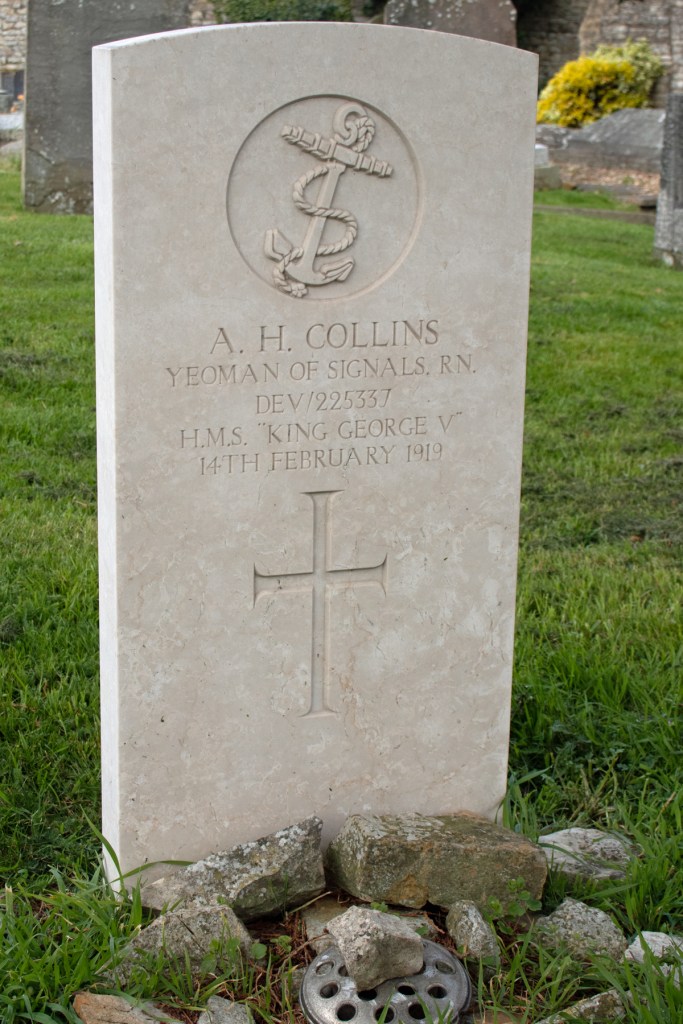
Bellerophon served at the Battle of Jutland, and remained patrolling the southern part of the North Sea for the rest of the war. In July 1917, Alfred was promoted again, to Yeoman of the Signals, and transferred to HMS King George. He remained in the North Sea, but his new ship was there to protect the convoys transporting good between the UK and Norway, so he was based in Scotland.
Yeoman of the Signals Collins survived the war, but in February 1919 he was admitted to the Royal Naval Hospital in Granton, near Edinburgh, suffering from pneumonia. Sadly, the condition was to get the better of him and he died on 14th February 1919, at the age of 32 years old. He had served for just short of sixteen years.
The body of Alfred Henry Collins was brought back to Somerset for burial. He was laid to rest in the graveyard of St Nicholas’ Church in Whitchurch.








 Death and Service