Category Archives: Role

Boatswain Jeremiah Lane

Boatswain Jeremiah Lane

Jeremiah Lane is one of those names that is sadly to be lost to the annuls of time, as there is just not enough information about him readily available to definitively map out his life.

Buried in the Woodlands Cemetery in Gillingham, Kent, his gravestone confirms that he was a Boatswain in the Royal Navy and was serving on HMS Marlborough. He died on 12th February 1919.

Jeremiah’s Pension Ledger Card confirms he left a widow, Mrs BM Lane, but gives no other information. The Navy Medal Roll shows he was awarded the British and Victory Medals and the 1914/15 Star for his service. The Navy Lists show that he attained the rank of Boatswain on 25th October 1918.

There are naval records for a Jeremiah Lane; these show that he was born in Queenstown, Cork, in 1879, and that he joined the Royal Navy in 1898. He had reached the rank of Petty Officer before leaving the service in 1912. The may be the same sailor, but there is nothing to directly link the two.

Sadly, then, the life of this serviceman, who gave his life for peace, is destined to be lost forever.
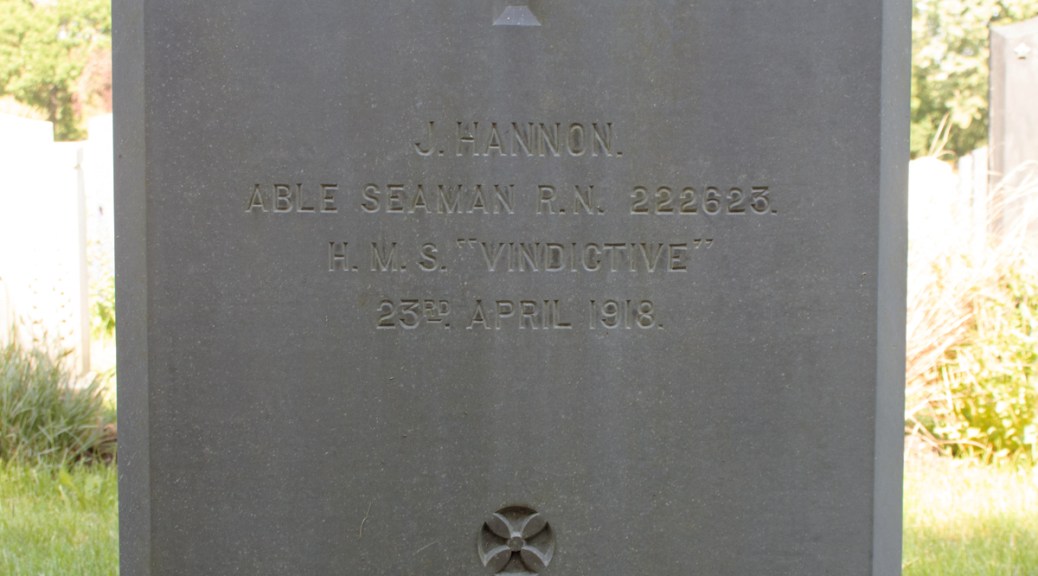

Able Seaman John Hannon

Able Seaman John Hannon

John Hannon (or Hannan) was born on 9th November 1885, in the Cork village of Ladysbridge. He was one of ten children to labourer Michael Hannon and his wife, Kate.

Given his proximity to the coastal port of Cork, it is no surprise that John sought adventure on the high seas. In May 1903, he joined the Royal Navy as a Boy, and served on HMS Black Prince. His enlistment papers gave his height as 5ft 4ins (1.62m), and recorded that he light brown hair, blue eyes and a sallow complexion. He also had a tattoo on each wrist.

As soon as he turned eighteen, on 9th November 1903, he was formally signed up, and given the rank of Ordinary Seaman. Over the next eighteen months, he served on two more ships – HMS Minotaur and the training ship HMS Boscawen – and was promoted to Able Seaman in August 1905.

John’s naval career continued apace up until the Great War. When hostilities broke out, he was assigned to HMS Tiger, and served on the ship at the Battles of Dogger Bank (1915) and Jutland (1916).

At the start of 1918, Able Seaman Hannon was transferred to HMS Hindustan; this was one of the many ships that supported the Zeebrugge Raid on the 23rd April. The plan was to scuttle a number of ships in the entrance to the Zeebrugge Canal in Belgium, thus preventing the German Navy from launching into the North Sea.

Over 1700 men were involved in the raid and heavy fighting left close to 300 sailors dead, with a similar number wounded. Sadly Able Seaman Hannon was one of those to lose their lives in the battle. He was just 32 years old.

John Hannon’s body was brought back to England; he was laid to rest in the Woodlands Cemetery in Gillingham, Kent, close to the Naval Dockyard in Chatham that he had occasionally called home.


Stoker 1st Class James Kilmartin

Stoker 1st Class James Kilmartin

James Kilmartin was born on 24th June 1894, one of four children to James and Mary Kilmartin. James Sr was a farmer from Tobercurry in County Sligo, and this is where he raised his family.

When he left school, James Jr helped his father out on the farm, but by the time he was 22, war was raging in Europe and he received his call-up papers. He joined the Royal Navy as a Stoker 2nd Class on 11th April 1916 and was sent to England for training.

After initially being based at HMS Pembroke – the shore-based establishment at the Naval Dockyard in Chatham – Stoker Kilmartin was assigned to HMS Greenwich. He served on board for nine months, during which time he was promoted to Stoker 1st Class.

James’ next assignment was on board HMS Bacchante, where he spent two years, through the Armistice and beyond. Returning back to HMS Pembroke in February 1919, he fell ill, contracting bronchial pneumonia. Admitted to hospital, the condition sadly got the better of him, and he died on 24th February 1919, aged just 24 years of age.

James Kilmartin was laid to rest in the Woodlands Cemetery, Gillingham, a short walk from the dockyard at which he had been based.


Tragically, less than two weeks after James died, his brother Michael, also passed away, at home in Tobercurry. While I have been unable to locate any specific documentation around military service, it seems likely that he too would have been in some way involved in the conflict.


Stoker 2nd Class William Bonham

Stoker 2nd Class William Bonham

William Bonham was born in Abbeyleix, Queen’s County (now County Laois) on 6th September 1895. One of ten children, his parents were labourer John Bonham and his wife Mary.

Little information about William’s early life is available; when he left school, he found work as a railway porter, but when he was 23, with war having be raging across Europe, he received his enlistment papers.

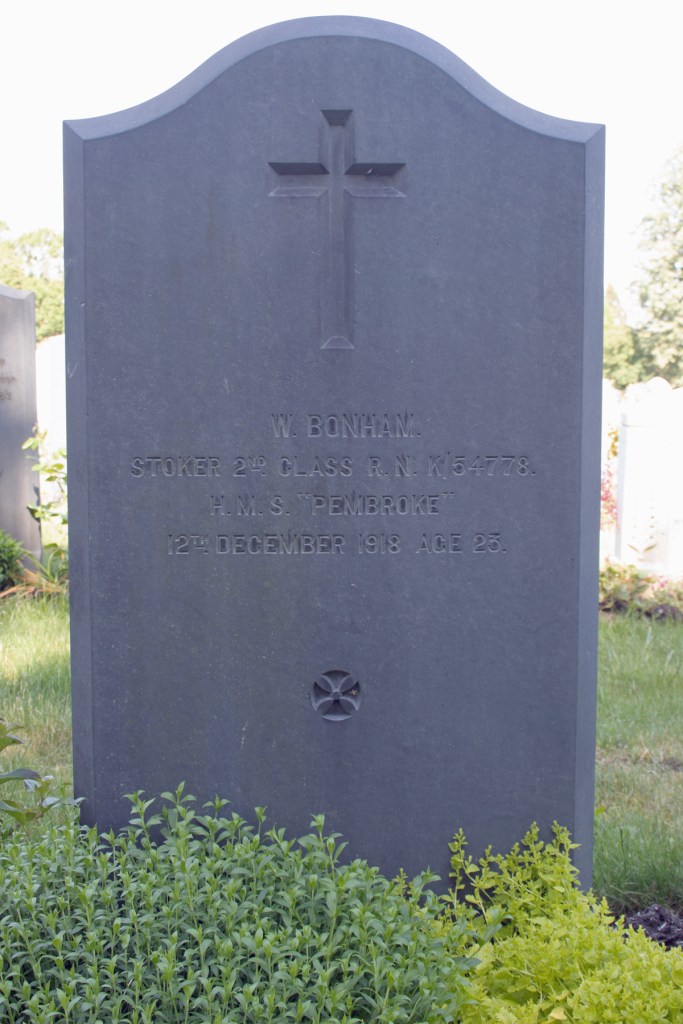
William joined the Royal Navy on 13th October 1918, and set sail for England. Assigned the role of a Stoker, he was sent to HMS Pembroke – the shore-based establishment at the Naval Dockyard in Chatham, Kent – for training. Less than eight weeks later, however, he was dead.

Stoker Bonham had contracted pneumonia that winter, and died at his home in Chatham on 12th December 1918. He was just 23 years old.

William was laid to rest in the Woodlands Cemetery in nearby Gillingham.


Officer’s Cook 3rd Class Paolo Spiteri

Officer’s Cook Paolo Spiteri

Paolo Spiteri was born in Valetta, Malta, on 25th January 1881, the son of Stephen Spiteri. Sadly there is very little further information on his early life, other than he worked as a cook when he left school.

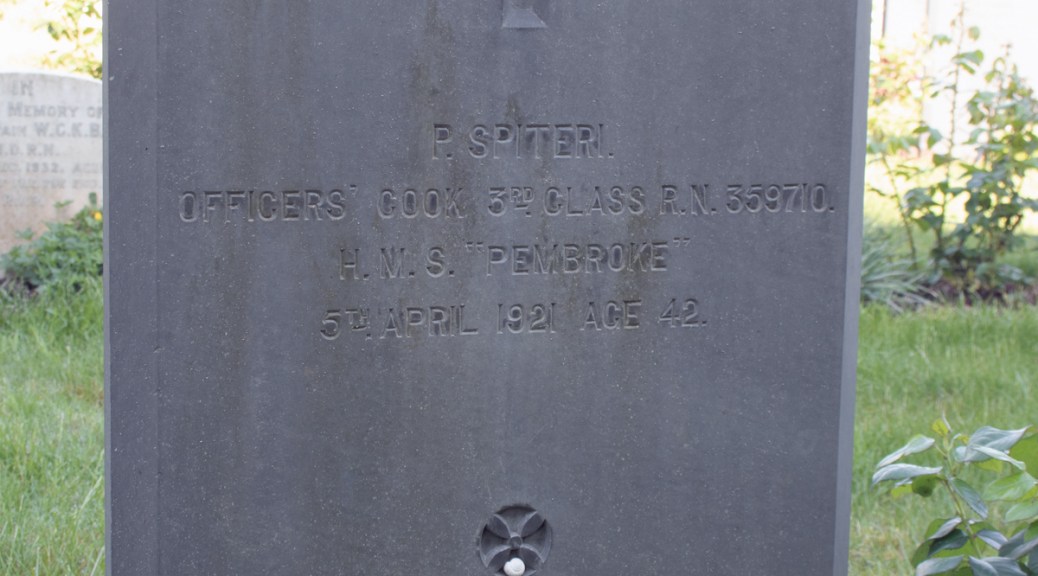
Paolo saw a life at sea as a good career, and, in August 1901, aged 20, joined the Royal Navy. Over the next twenty years, he travelled the world, serving on more than twenty ships and working his way up from a domestic in the kitchen to an Officer’s Cook 3rd Class.

By 1921, Paolo was based at HMS Pembroke – the shore establishment at the Naval Dockyard in Chatham, Kent – and contracted pneumonia there. Admitted to the Naval Hospital in the town, the condition sadly got the better of him, and he passed away on 5th April 1921. He was 42 years old.

Officer’s Cook Paolo Spiteri was laid to rest in the Woodlands Cemetery, not far from the dockyard at which he was based.


Private Percy Coward

Private Percy Coward

Percy Herbert Coward was born in the Wiltshire town of Westbury in the autumn of 1896. He was one of seven children – all boys – to Lily Coward and her weaver husband Charles. Not long after Percy was born, the family moved across the county border to Frome, Somerset, presumably for Charles’ work.

By the time of the 1911 census, the Coward family were living in a five-room end-of-terrace cottage on the outskirts of the town. Charles and Percy were both working as warpers – threading looms – in the cloth industry; two of his brothers were working for a printer in the town. Percy was proving himself an integral part of the community.

[Percy] was very highly esteemed by a large circle of acquaintances… He was a worker with the YMCA and Frome Brotherhood, a member of the band and in other directions showed himself a young man of much promise. He was employed successively at Messrs Houston’s [Woollen Mill] and at the Silk Factory.

Somerset Standard: Friday 26th April 1918

An active member of the town’s territorial force, when the Great War broke out he was mobilised. Initially attached to the Royal Army Medical Corps, he subsequently served with the Royal Army Service Corps and the North Staffordshire Regiment, before obtaining his final transfer to the 42nd Company of the Machine Gun Corps.

During his time in the army, Private Coward would have seen action in some of the fiercest battles of the war – at the Somme, Arras and Ypres. In the spring of 1918, his battalion was involved in the Battles of St Quentin and the Avre, and it was during this last skirmish that he was wounded.

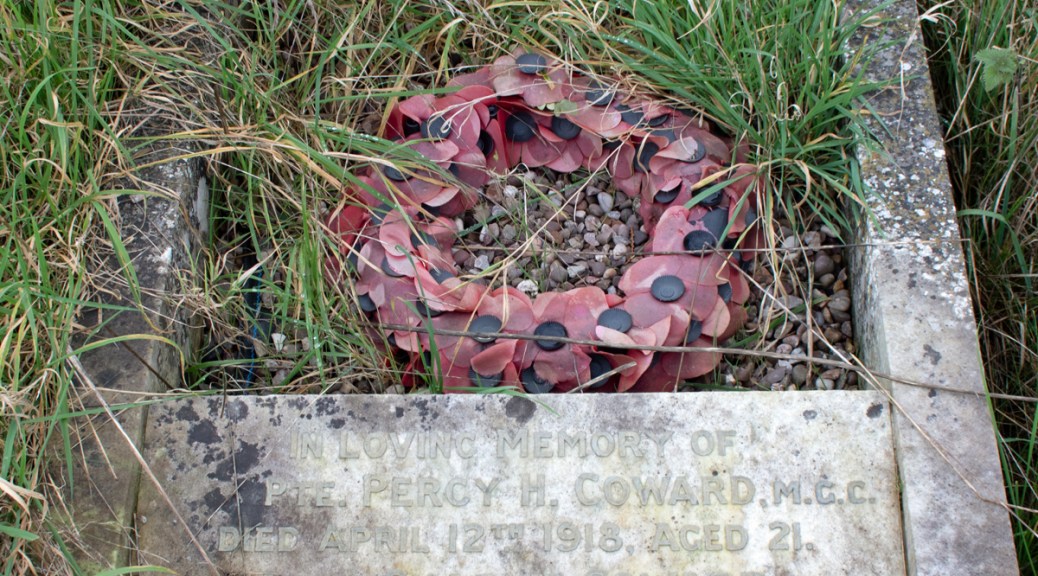
Percy’s injuries were severe enough for him to be medically evacuated back to England and, once there, he was admitted to the Royal Woolwich Hospital in South London. His wounds were to prove too much for him, however, and he passed away at the hospital on 12th April 1918. He was just 21 years of age.

Percy Herbert Coward was brought back to Somerset for burial. He was laid to rest in the Dissenters’ Cemetery, Vallis Road, within walking distance of his family home.


Stoker 1st Class Arthur Smith

Stoker 1st Class Arthur Smith

Arthur Edgar Smith was born in the Somerset village of Beckington on 12th January 1890. He was one of eight children to agricultural labourer and cowman George Smith and his wife Hester.

Arthur was after some adventure in his life, and didn’t want to be limited to Somerset. The Royal Navy offered this opportunity, and so, in December 1909, aged 19, he joined the service as a Stoker 2nd Class. His service records confirm that he stood at 5ft 7ins (1.7m) tall, had a fresh complexion, brown hair and hazel eyes. He signed up for the standard 12 years’ service.

After an initial five months’ training at HMS Vivid in Devonport, Stoker Smith was assigned to the battleship HMS Mars. During his two years’ service on board, he was promoted to Stoker 1st Class. In January 1912, he was reassigned, boarding HMS Orion, also a battleship.

Over the next two years, Stoker Smith served on board two further vessels, HMS Hercules and HMS Narcissus. In April 1916, Arthur was transferred back to HMS Vivid, suffering from pulmonary tuberculosis. This ultimately led to him being medically discharged from the Royal Navy, and he left service in June that year.

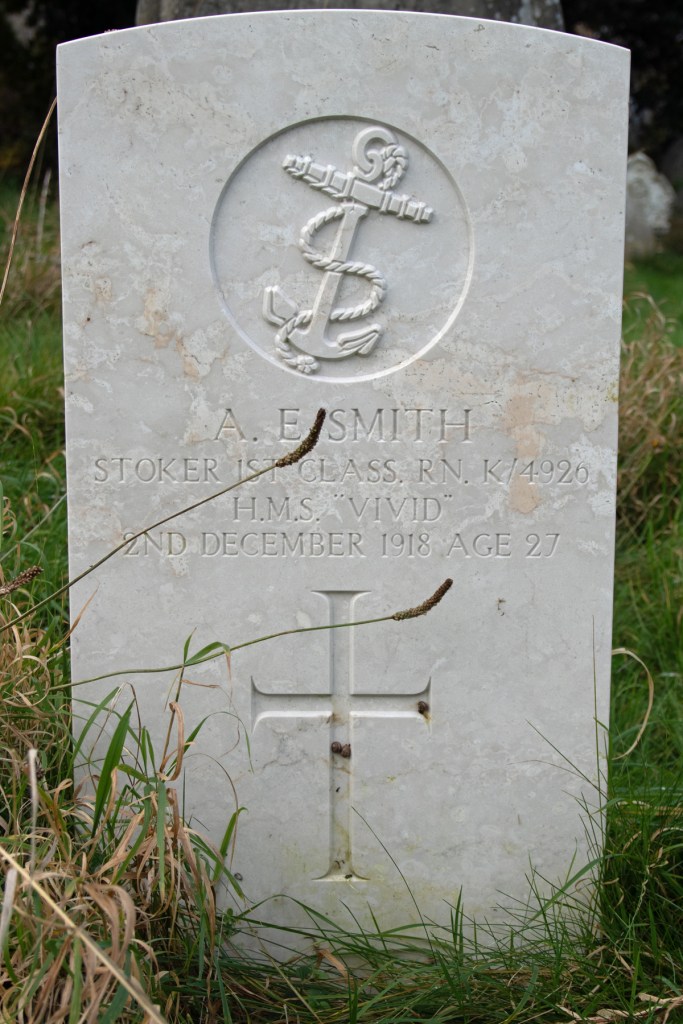
At this point, Arthur’s trail goes a bit cold. It would seem that his lung condition ultimately got the better of him, and he passed away back at home on 2nd December 1918. He was just 27 years of age.

Arthur Edgar Smith was laid to rest in the Dissenters’ Cemetery on Vallis Road in Frome, where his parents now lived.


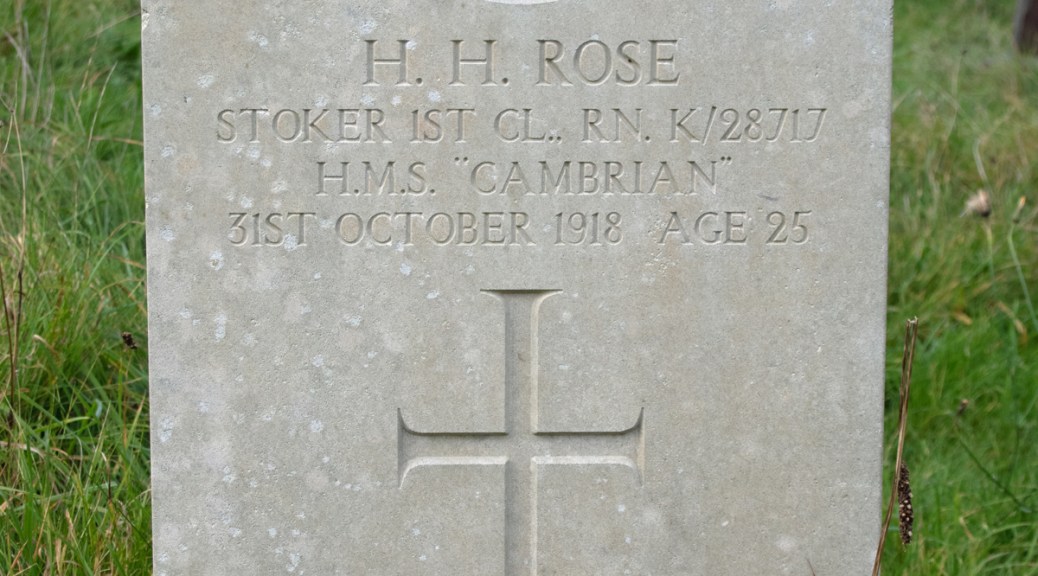
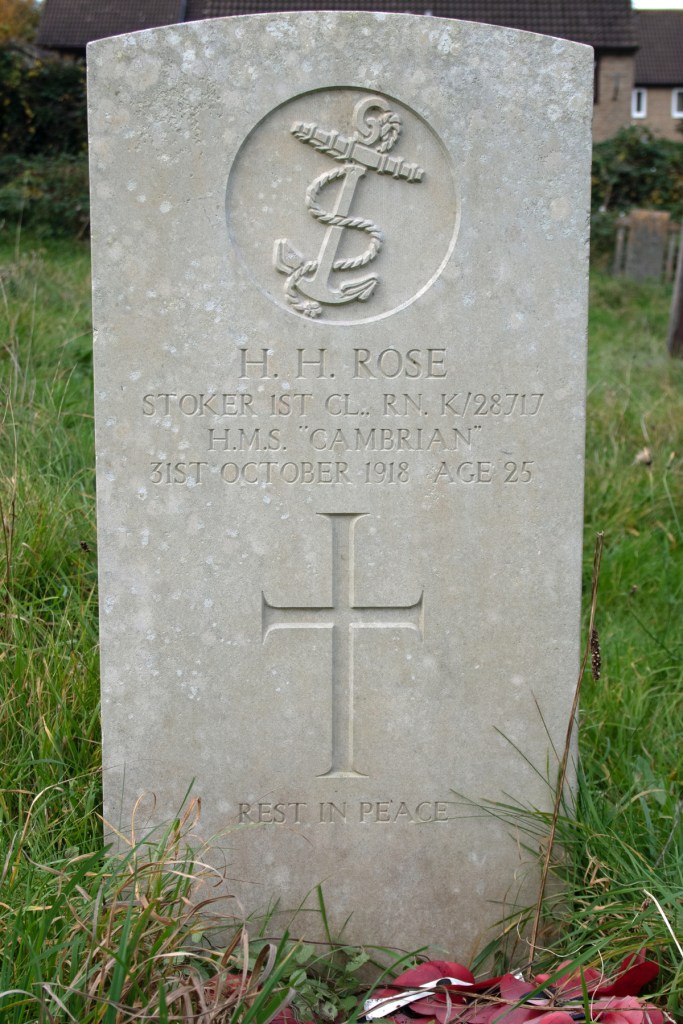
Stoker 1st Class Herbert Rose

Stoker 1st Class Herbert Rose

Herbert Hastings Rose was born on 19th August 1893 in the Somerset town of Frome. He was one of four children, all of whom were boys, to Hastings and Emily Rose. Hastings was employed as a labourer, but he died young, passing away in 1900, when Herbert was only seven years old.

Emily was left raising her four boys alone – the youngest of whom was a mere babe-in-arms – and found domestic char work to bring in some money. By 1905, however, local carter Enos Bainton had taken the family under his wing, and the couple married.

The census return six years later found the family living in a small cottage near the centre of Frome. Herbert and his older brother, who were in their late teens by this point, were working with their stepfather, carting coal for a local merchant.

Herbert’s job was to stand him in good stead when hostilities broke out. When the call came in November 1915, he enlisted in the Royal Navy, and was employed as a Stoker 2nd Class. After his initial training on board HMS Vivid – the shore-based establishment in Plymouth – he was assigned to the cruiser HMS Constance. He served on board the ship for two years, gaining a promotion to Stoker 1st Class in the process.

After a month back in Plymouth, Stoker Rose was transferred to HMS Cambrian, another cruiser, on board which he spent three months. He then returned to HMS Vivid. It was during this time that Herbert fell ill. Admitted to hospital in Plymouth with pneumonia, this was to get the better of him; he passed away on 31st October 1918, aged just 25 years old.

Herbert Hastings Rose’s body was brought back to Somerset; he was laid to rest in the Dissenters’ Cemetery in Vallis Road, Frome.


Quartermaster Serjeant Percy Macey

Quartermaster Serjeant Percy Macey

Percy George Macey was born in Frome, Somerset, in the autumn of 1889. He was the oldest of six children and the only son to Arthur and Susan Macey. Arthur was a general labourer and domestic gardener from Wiltshire, whose family had moved to Somerset in the 1870s.

When he left school, Percy found work at a local foundry, and, by the time of the 1911 census, was listed as a brass fitter. By this point he had met Winifred Rowe, a labourer’s daughter from Wiltshire, who had found work as a servant to a Frome butcher. The couple married at the start of 1913, and went on to have a son – who they called Arthur, after Percy’s recently deceased father – later that year.

War was coming, and Percy joined the Somerset Light Infantry. Full details of his military service are not available, although at some point during the conflict he was promoted to Serjeant and transferred to the Labour Corps under the Devonshire Regiment. He was awarded the Victory and British Medals, but does not appear to have seen any service overseas.

By the end of the war, Percy had risen to the rank of Quartermaster Serjeant. The end of his life is, however, shrouded in a bit of mystery. He passed away on 15th March 1921 in Cheltenham, Gloucestershire; although no cause for his death is evident, it seems likely to have been from an illness of some sort, as there are no contemporary newspaper reports to suggest anything out of the ordinary. He was just 31 years old.

Percy George Macey was brought back to Frome; he was laid to rest in the Dissenters’ Cemetery in Vallis Road.


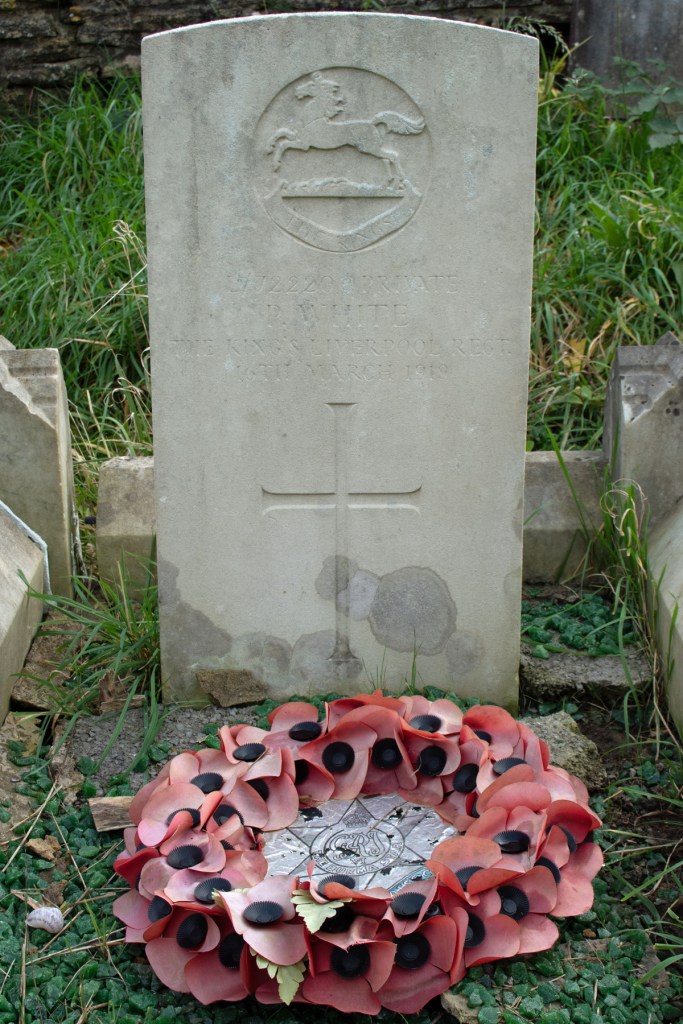
Private Percy White

Private Percy White

Percy White was born in the spring of 1890, the youngest of four children to Frank and Fanny White. Frank was a tailor from Frome, Somerset, and this is where the family were raised and settled for most of Percy’s life.

By the time of the 1911 census, Frank and Fanny had been married for 30 years. Frank was still working as a tailor, while Percy’s three older siblings – all girls – were working as silk weavers and packers. Percy had moved away from the family’s clothing heritage, and had found work as a hairdresser.

War was on the horizon, however, and Percy was called upon to do his duty for King and Country. He was initially assigned as a Private to the King’s (Liverpool Regiment) when he joined up in the autumn of 1914. Full details of his military service are not readily available, but it seems that he served on the Front Line in France, but was invalided out late in 1917.

By that point, he had met Bessie Cundick, who had been born in Wiltshire. They married in Andover in the spring of 1916, when they were both 26 years old.

Back in England, and discharged from the King’s (Liverpool Regiment), Percy was transferred to the Labour Corps and, for the last year of the war had done agricultural work in Cambridgeshire. After the armistice was signed, Frank fell ill and died on 4th February 1919.

Private White attended the funeral at the Vallis Road Cemetery in Frome with his family, before returning to his unit. By this point, however, he had himself fallen ill with influenza, and was admitted to the East General Hospital in Cambridge. The condition was to prove too much, however, and he passed away on 16th March, less than six weeks after his father’s death. He was just 29 years of age.

Percy’s body was brought back to Frome; he too was laid to rest in the Dissenters’ Cemetery in Vallis Road, Frome.