Category Archives: Petty Officer

Petty Officer 1st Class George Fawcett

Petty Officer 1st Class George Fawcett

George Fawcett was born on 3rd February 1873, one of ten children to John and Maria (or Mary). John was a stonemason who raised his family in Essex, and it was in Stratford that George and most of his siblings were born.

When George left school, he was drawn to a life of adventure. He joined the Royal Navy on 5th May 1888, and was first assigned the role of Boy, as he was under age. He was formally enlisted on 3rd February 1891 – his 18th birthday. He had, by this point, been serving on HMS Hotspur for nine months, and was given the rank of Ordinary Seaman. His hard work must have held him in good stead, because he was promoted to Able Seamen just two months later.

Over the course of his initial twelve years’ service, Able Seaman Fawcett served on eight different ships, and continued to rise through the ranks. He mad made Leading Seaman by 1894 and Petty Officer 2nd Class five years later. By the time his first term of service had ended, he had been promoted again, this time to Petty Officer 1st Class.

George voluntarily renewed his service in 1903, and over the next few years, he served on a number of other vessels. His shore base was always HMS Pembroke, though, and his time at sea was interspersed with periods at the Naval Dockyard in Chatham.

Petty Officer Fawcett had been in the Royal Navy for 23 years by the time war was declared. He was still at sea in August 1914, but was transferred to a permanent shore role at the beginning of the following year. He spent three years fulfilling his duties at HMS Pembroke, but fell ill in the spring of 1918.

He was admitted to the Naval Hospital in Chatham with liver disease, and this was a condition he was not to recover from. Petty Officer Fawcett passed away on 12th April 1918, at the age of 45.

George Fawcett’s body was laid to rest in the Woodlands Cemetery, Gillingham, not far from the naval base at which he was based.


Petty Officer William Coughlan

Petty Officer William Coughlan

William Henry Coughlan was born on 16th November 1891, one of thirteen children to William and Catherine Coughlan. William Sr was a labourer, born and bred in the East End of London, who raised his family in Hackney.

William Jr seemed keen for a way to improve himself and in May 1909, enlisted in the Royal Navy. Initially given the rank of Boy, this was due to his age; on his eighteenth birthday a few months later, he was formally enrolled in the navy as an Ordinary Seaman.

To begin with, he was billeted at HMS Ganges II, the shore-based training ship in Harwich, Suffolk, but within a matter of weeks he was on board a sea-going destroyer, HMS Antrim.

Ordinary Seaman Coughlan was obviously a keen young man; by the time the Great War broke out, he had served on four further ships, as well as another shore base, HMS Pembroke I. He rose through the ranks to Able Seaman and, by 1915, had reached the role of Leading Seaman.

Most of his service was spent upon HMS Agamemnon, initially in the Channel, but was then moved to the Mediterranean. On the night of the 5th May 1916, the ship was moored in the harbour at Thessaloniki (Salonika). A Zeppelin, the LZ55, made a bombing raid, but when the searchlights caught it, the Agamemnon fired on it and hit the aircraft, breaking it in two. It crashed in the swamps around the Vardar river and its crew were captured.

Leading Seaman Coughlan remained on the Agamemnon, before returning to England in November 1917, where he received further training at the Naval Dockyard in Chatham. He was promoted to Petty Officer a couple of months later, and began three years of shore- and ship-based service.

In the summer of 1921, while again based in Chatham, he contracted pneumonia, succumbing to the lung condition in a matter of weeks. Petty Officer Coughlan died on 26th July 1921, aged just 29 years old.

William Henry Coughlan was laid to rest in the Woodlands Cemetery in Gillingham; within walking distance of the naval base that had become his home.


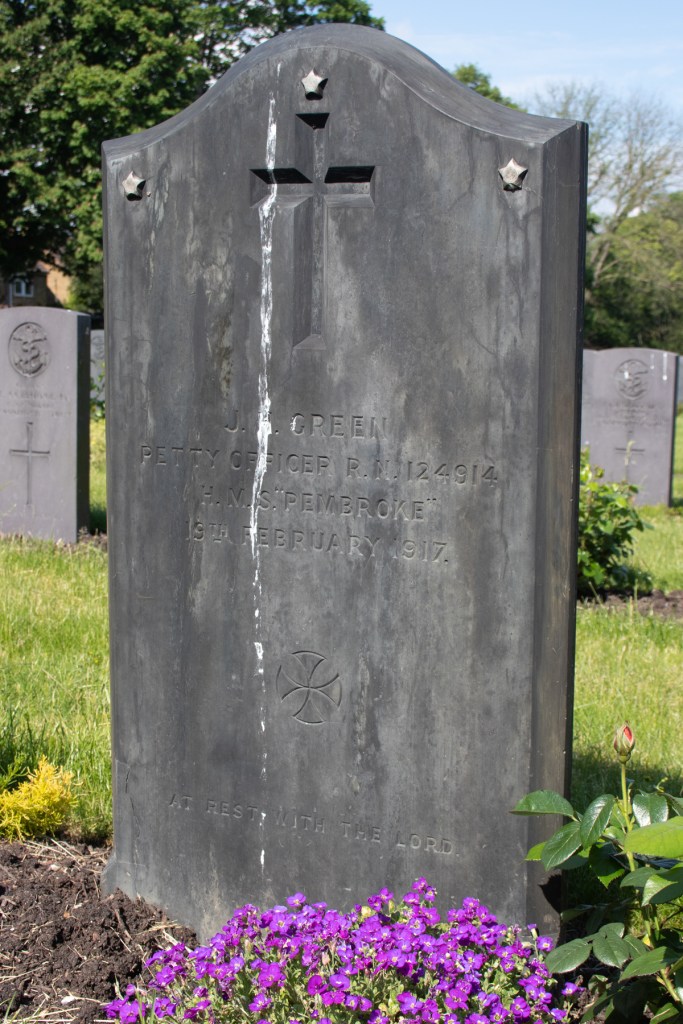
Petty Officer James Green

Petty Officer James Green

James Henry Green was born in Brixham, Devon, on 13th April 1868, the only child to Isaac and Sarah Green. Isaac was the son of a miller from Essex, who found work as a miner in the south west; he sadly died in 1871, when James was just a toddler.

Sarah had been married before she met Isaac; she had had two children, both daughters, with her first husband, William Tozer, so James had two half-sisters. William had died in 1865, and Sarah had gone on to marry James’ father later that year.

The 1881 census found Sarah and the children living in a cottage in the middle of Brixham; she was listed (somewhat uncharitably by current standards) as a mangle woman. She had taken in a couple of lodgers and James – then aged 13 – was listed as a scholar.

James was evidently keen to make a place for himself in the world. In 1885 he enlisted in the Royal Navy, working as a Boy on a number of ships until, on his 18th birthday, he was given the rank of Ordinary Seaman. His naval records show that he had a dark complexion, brown eyes and brown hair and stood as just 5ft 1in (1.55m) tall.

During his initial ten years’ service, James served on nine ships as well as shore-based establishments, working his way up to the rank of Able Seaman. One the initial period of enlistment was up, he extended his time in the navy voluntarily, eventually serving on a further five vessels and reaching the rank of Able Seaman before transferring to the Coastguard in South Shields. James was stood down form active naval duties in January 1908 and transferred to the Royal Naval Reserve, based in Chatham, Kent.

It was while he was in County Durham that he met Edith Hansford (or Handforth), a horse keeper’s daughter from Whitburn. The couple married in the spring of 1901, and settled down in Sculcoates, to the north of Hull.

When war was declared, those in the Royal Naval Reserve were called into immediate action, and James was no exception. Given the rank of Petty Officer, he was initially assigned to HMS Pembroke, the shore establishment in Chatham, before a brief tour on HMS Columbine, and a longer term on the gunboat HMS Britomart.

In July 1916, Petty Officer Green returned to HMS Pembroke; he remained based there for six months, before being admitted to hospital, suffering from phlebitis (an inflammation of the veins in the legs). Sadly, the condition got the better of him; he passed away in the Royal Naval Hospital in Chatham on 19th February 1917, at the age of 48.

James Henry Green was laid to rest in the Woodlands Cemetery in his adopted home town of Gillingham, Kent.


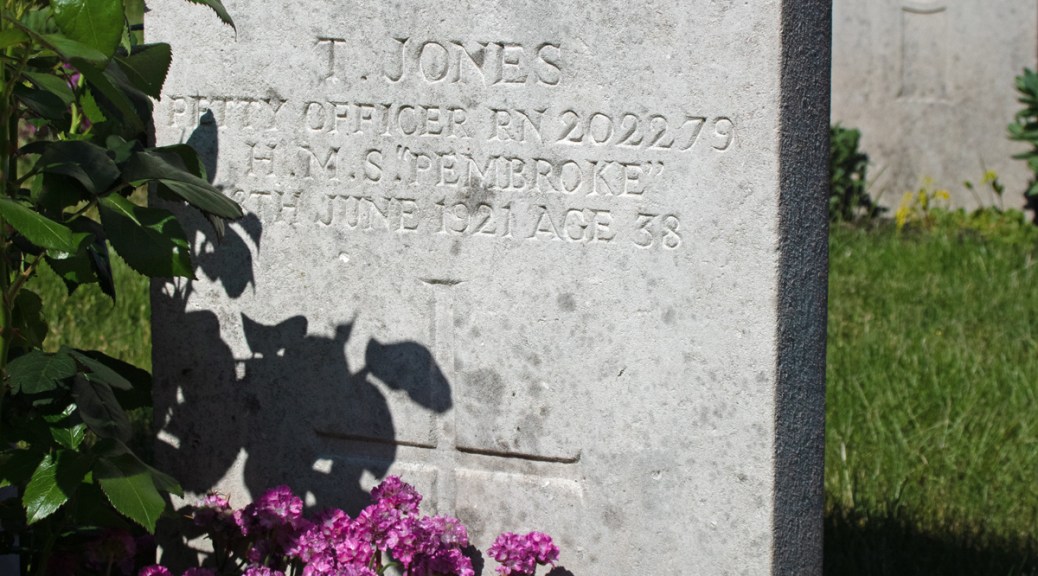
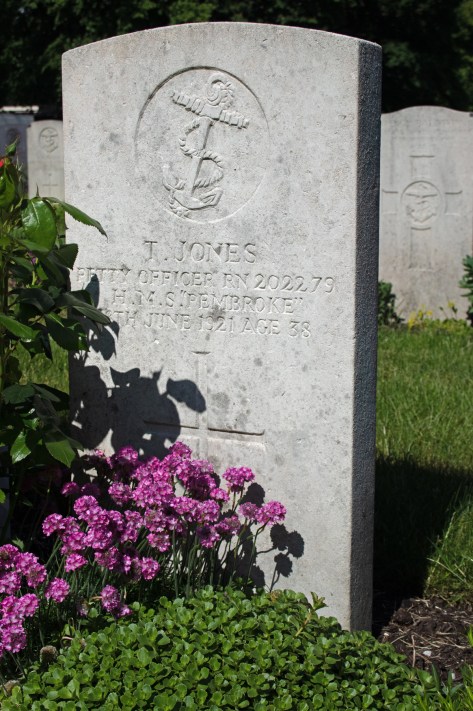
Petty Officer Tom Jones

Petty Office Tom Jones

Thomas Jones (known as Tom) was born in Wednesbury on 7th September 1882 and was the middle of seven children. His father, also called Thomas, was a grocer and, with his mother Mary, they raised their family first in the Staffordshire town and then in Blackpool, Lancashire.

When he left school Tom helped his dad in the shop, primarily dealing with meat. His mind was on greater adventures, however, and in November 1898, he enlisted in the Royal Navy. Due to his age, he was initially given the rank of Boy, but was officially signed up as an Ordinary Seaman on the day after his 18th birthday.

Over the time of his initial twelve years’ service, Tom rose through the ranks, from Able Seaman to Leading Seaman and Petty Officer. In May 1912, however, he was ‘disrated’ back to Able Seaman, but there is no evidence to confirm why this was done. By this time, he had served on nine ships, as well as having time in shore-based establishments, and had completed his twelve years as a mariner.

Meanwhile, in the autumn of 1904, Tom had married Hannah Kennedy, a dockyard labourer’s daughter from Gillingham, Kent. The couple went on to have four children and set up home in the centre of the town, not far from the Naval Dockyard where Tom was sometimes based.

With war in Europe on the horizon, Tom immediately volunteered to continue his duty when he term of service came to an end. Working hard, he soon regained the rank of Leading Seaman and, by April 1915, was back up to Petty Officer once more.

During the remainder of his time in the Royal Navy, Petty Officer Jones served on a further seven vessels. In October 1920, after more than two decades’ service, he was invalided out, having contracted tuberculosis, rendering him unfit to continue.

At this point Tom’s trail goes cold. It seems likely that his lung condition got the better of him; he passed away on 20th June 1921, at the age of 38 years old.

Petty Officer Tom Jones was laid to rest in the Woodlands Cemetery in Gillingham, Kent.


Tom Jones II
Petty Officer Tom Jones
(courtesy of ancestry.co.uk)

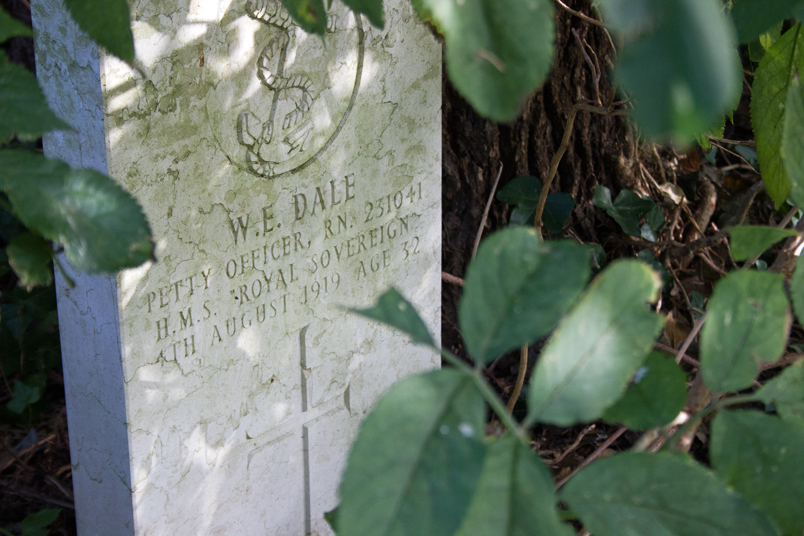
Petty Officer William Dale

Petty Officer William Dale

William Edmund Dale was born in Worthing, West Sussex on 25th November 1886 and was the older of six children. His father, also called William, was a carman, and he and William’s mother, Eliza, brought the family up in the Sussex town.

William Jr seems to have had a number of jobs, working as a draper’s errand boy, a milkman’s assistant and a gardener. He found his true calling at the age of 12, however, when he enlisted in the Royal Navy.

Initially acting as a Boy 2nd Class, over his initial twelve years’ employ he served on eleven vessels, and rose through the ranks to Boy, Ordinary Seaman and Able Seaman.

It was while serving on HMS Blake in 1910, that he married Mary Williams. The couple went on to have two children, William, born in 1910, and Harry, born the following year. The family set up home in Portsmouth, where the sailor was based.

With his initial service complete in 1916, William’s term of duty was extended until the end of hostilities. A promotion to Leading Seaman followed, and he was assigned to HMS Attentive, part of the Dover Patrol guard.

In 1917, William was promoted again, this time to the role of Petty Officer, and was assigned to HMS Royal Sovereign, the Navy’s new battleship. He served on the vessel for the remainder of the way, and through into the summer of 1919.

It was in the last month of his service, that Petty Officer Dale fell ill. He was taken ashore, and sent to the Royal Naval Hospital in Chatham, Kent. He had contracted meningitis, and sadly succumbed to it within days of being admitted. He died on 4th August 1919, at the age of just 32 years old.

William Edmund Dale was brought back to the town of his birth; he lies at rest in a quiet corner of the Broadwater Cemetery in Worthing, West Sussex.


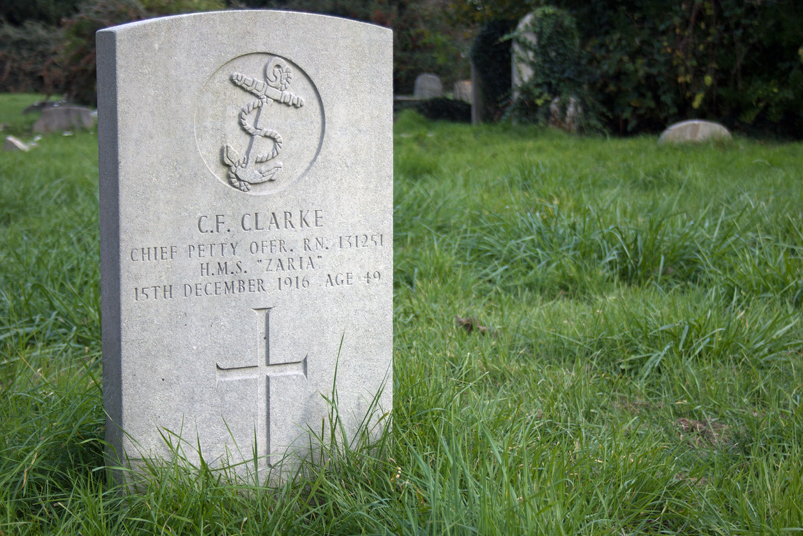
Chief Petty Officer Charles Clarke

Chief Petty Officer Charles Clarke

Charles Frederick Clarke was born on the 14th April 1869 to James and Jane Clarke. James was born in Suffolk, but moved to London, where he found work as a watchman (guarding the city streets at night). Jane was from Essex, and the couple went on to have five children, of whom Charles was the middle child.

Charles was set on a life of adventure, joining the Royal Navy in 1887, for a period of twelve years. During this time, he served on eleven vessels, working his way up through the ranks from Boy to Ordinary Seaman to Able Seaman, Leading Seaman and eventually Petty Officer.

In October 1895, he married Lydia Rogers, a sailor’s daughter from Portsmouth. The couple would go on to have nine children, eventually settling in Sussex.

When his naval service ended in 1899, Charles enlisted again. Within six years, he had achieved the rank of Chief Petty Officer, and in March 1909, after 22 years’ service, retired from active duty. He was obviously well respected, however, and was selected to serve on the staff of the Royal Naval Recruiting Office in Portsmouth. His service records suggest that he resigned from this role on 14th April 1914.

It seems that Chief Petty Office Clarke took on a role on the vessel HMS Zaria. This was a ship that was requisitioned by the Royal Navy, which acted as a patrol ship, guarding the coastal waters around the UK. While details are scant, Charles certainly served on board for a couple of years, and he died on board, from causes undisclosed, on 16th December 1916, at the age of 47 years old.

Brought back to West Sussex, Charles Frederick Clarke was laid to rest in the Broadwater Cemetery in Worthing. This was where Lydia was now living; she was buried in the same grave, when she passed away eight years after her husband.


Stoker Petty Officer John Harriss

Stoker Petty Officer John Harriss

John Thomas Harriss was born on 22nd February 1878, one of seven children to George and Mary. George was a jeweller, who moved the family from London to Weston-Super-Mare when John was three or four years old.

Following in his father’s footsteps was not something John was going to do, and the move to the coast seemed to have sparked an interest in the sea. He enlisted for twelve years’ service in the Royal Navy in March 1900, working as a stoker.

After initial training at HMS Pembroke in Chatham, Kent, Stoker 2nd Class Harriss was assigned to HMS Terpsichore and, over the length of his service, he worked on a further ten vessels. During this time, he was promoted a couple of times, reaching the role of Leading Stoker by 1911, while he was serving aboard HMS Magnificent.

With war imminent, when John completed his period of service, his term was extended until the end of hostilities. He had, by the beginning of 1914, attained the rank of Stoker Petty Officer, and was assigned to HMS Russell.

After the start of the war, this ship was assigned to the Grand Fleet and worked on the Northern Patrol, and in November 1914, she bombarded German-occupied Zeebrugge. The following year, HMS Russell was sent to the Mediterranean to support the Dardanelles Campaign, though she did not see extensive use there.

On 27 April 1916 HMS Russell was sailing off Malta when she struck two mines laid by a German U-boat. Most of her crew survived the sinking, though 125 souls lost their lives. Stoker Petty Office Harriss was one of the survivors; his service records note that he was ‘commended for [the] great coolness shown on the occasion of the loss of HMS Russell’.

Brought back to the UK, John contracted pneumonia, and spent time at home with his family, in Weston-Super-Mare. It was here, sadly, that he was to succumb to the lung condition, and he passed away on 7th June 1916. He was 38 years old.

John Thomas Harriss lies at rest in Milton Cemetery in Weston-Super-Mare.


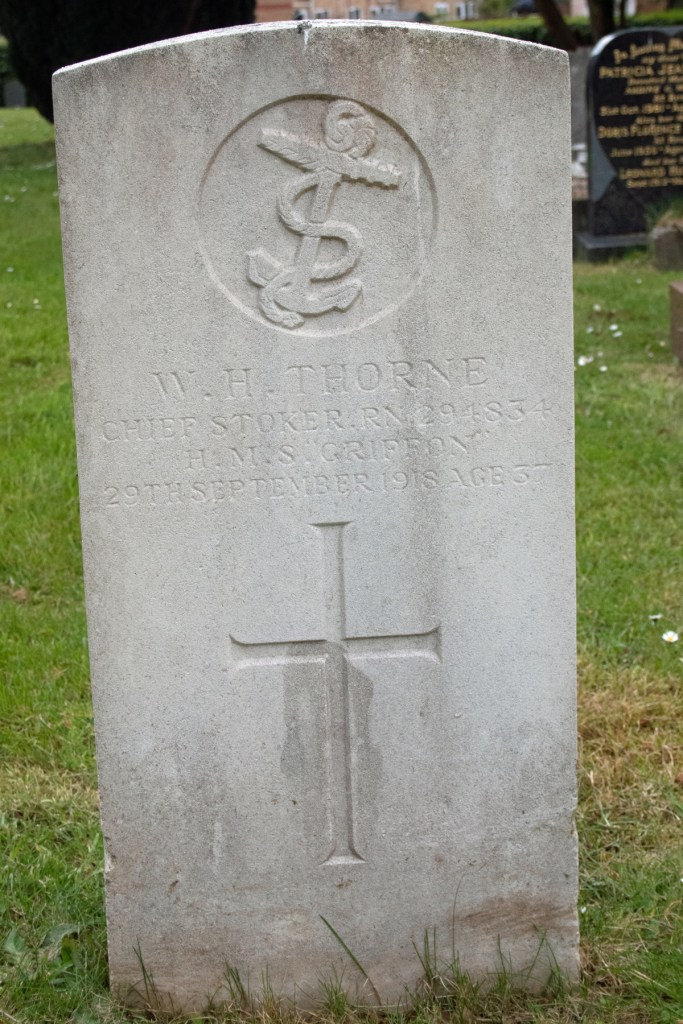
Chief Stoker William Thorne

Chief Stoker William Thorne

William Henry Thorne was born on 28th July 1881 in the Somerset village of Milverton. He was the oldest of five children to farm labourer Henry Thorne and his wife Mary.

William was a young man with a keen sense of adventure. In February 1900, he joined the Royal Navy as a Stoker. After his initial training in Devonport, he was assigned to HMS Thunderer and, after six months, joined HMS Hood, where he spent the next two years.

Over his twelve years of his service, Stoker Thorne served on six further vessels, attaining the rank of Stoker Petty Officer.

In 1907, William had married Mabel Cross, a young woman from Taunton. While her husband was away from England – the marriage certificate gives his address as ‘on the high seas’ – she set up home near the centre of town. The young couple went on to have two children, twins Phyllis and Doris, who were born in 1911.

Back at sea, and Stoker Petty Officer Thorne’s terms of service were extended in 1912, so that he would continue to be a part of the Royal Navy until the cessation of hostilities. He served on a further six vessels and was promoted to Chief Stoker in June 1917.

It was while he was serving on HMS Griffon in the autumn of 1918 that William fell ill. Brought back to shore, he was admitted to the Military Hospital in Taunton. There is nothing to confirm the illness he contracted, but it was one he would succumb to. Chief Stoker Thorne passed away on 29th September. He was 37 years old.

William Henry Thorne lies at peace in the St James Cemetery in his home town of Taunton.


Petty Officer 1st Class Albert Brooks

Petty Officer Albert Brooks

Albert Brooks was born in February 1877 in Cambridge. Sadly, a lot of the documentation for his early life is lost to time, but he enlisted in the Royal Navy in July 1893, at the rank of Boy 2nd Class.

He formally enrolled in naval service in February 1895, initially for a period of twelve years. Beginning as an Ordinary Seaman aboard HMS Thunderer, during his initial time in the navy, he was promoted to Able Seaman and then Petty Officer 2nd Class, while serving on vessels including Hawke, Wildfire, Eclipse and Vernon.

In 1904, Albert married Rosina Wise. A couple of years younger than her new husband, she had been born in Camberwell, South London. The couple had a daughter, Gwendoline, and they set up home in Gillingham, Kent, where Albert was based when not at sea.

War was on the horizon, however, and Petty Officer Brooks’ naval service was extended until the end of the conflict.

Albert was promoted to Petty Officer 1st Class, and continued his service on vessels that included Andromache, London and Hibernia. He transferred to what would be his final ship, HMS Agamemnon, in November 1917.

Petty Officer Brooks served aboard Agamemnon for eighteen months, but it was while stationed at the Naval Dockyard in Chatham that he fell ill. He passed away from aortic disease of the heart – more than likely a heart attack or cardiac arrest – on 31st March 1919. He had just turned 42 years of age.

Albert Brooks lies at rest in the Woodlands Cemetery in Gillingham, Kent.


Petty Officer Stoker James Adams

Petty Office Stoker James Adams

James Adams was born in June 1883, son of Robert and Eliza Adams from Bridgwater in Somerset. Robert was an agricultural labourer; James was one of seven children.

James was keen to get out and see the world. In November 1905 – aged just 12 years old – he enlisted in the Royal Navy as a stoker. After training in Devonport, Plymouth, Stoker Adams served on a number of different vessels, including HMS Victorious, Ramillies, Amphitrite, Monmouth, Andromeda and Halcyon.

By the time war broke out, James has been promoted to Leading Stoker, and was assigned to HMS Cornwall. This was an armoured cruiser that was involved in the Battle of the Falklands in December 1914.

Promoted to Stoker Petty Officer in October 1915, James continued to serve on HMS Cornwall until he was transferred to the brand new ship, HMS Valkyrie. The vessel was involved in offensive sweeps and convoy escorts based out of Harwich.

On 22nd December 1917, the Valkyrie was part of the escort for a convoy travelling to the Netherlands, when she struck a mine. In total, nineteen men were killed, twelve instantly; this included Stoker Petty Officer Adams. He was 34 years old.

James Adams lies at rest in the Wembdon Road Cemetery in his home town of Bridgwater.