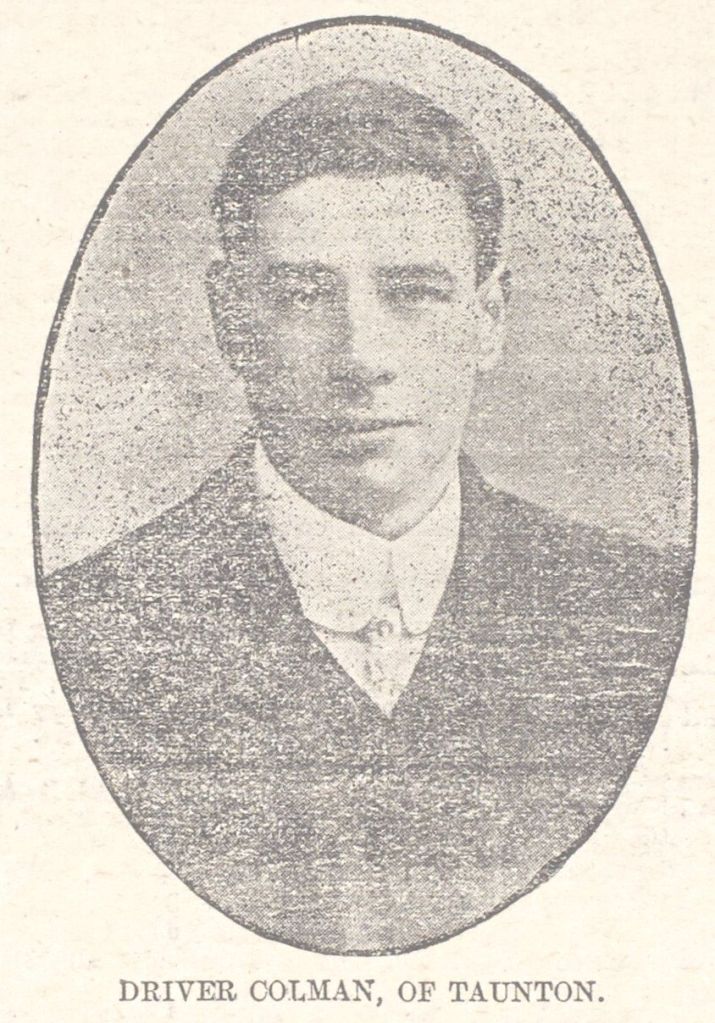
Walter Coleman was born in the spring of 1887, one of seven children to James and Emily Coleman. James was a hairdresser and the family lives in the Somerset town of Taunton.
Walter didn’t follow his father’s trade; instead, after a spell working at a collar factory when he left school, he was soon employed as a groom.
On Christmas Day 1910, he married Kate Norris, and the couple set up in a two-up, two-down in the middle of the town.
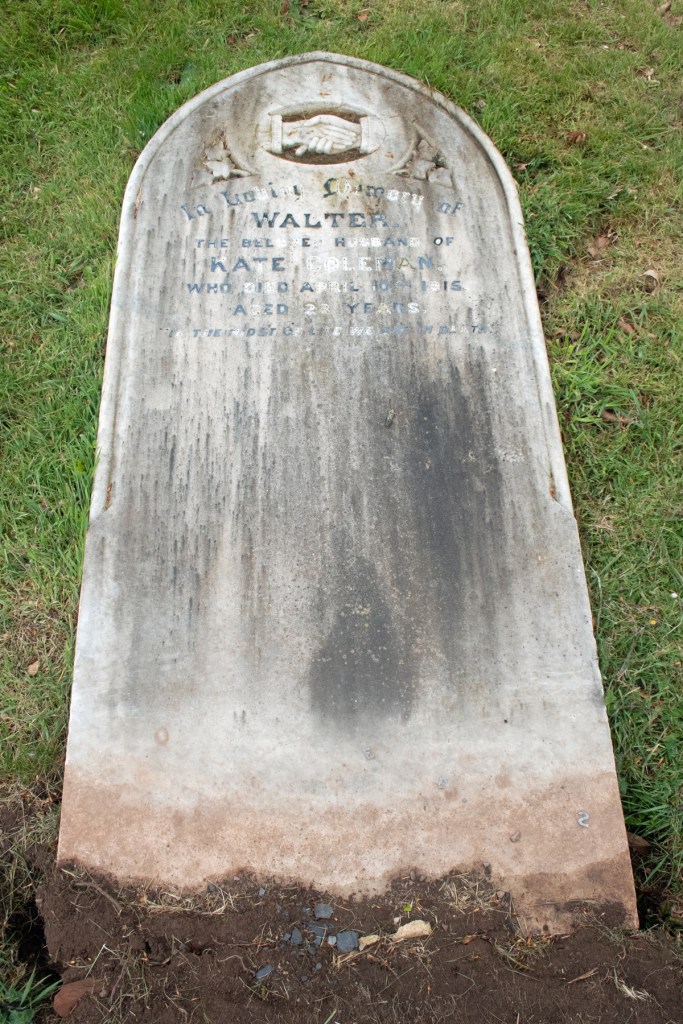
War was on the horizon, however, and when it broke out, Walter signed up straight away. He joined the 72nd Brigade of the Royal Field Artillery as a Driver and trained at the Bulford Camp on Salisbury Plain. It was while he was here on 10th April 1915 that he had an accident and fell off his horse. Sadly, Driver Coleman fractured his skull and died of his injuries that day. He was just 28 years old.
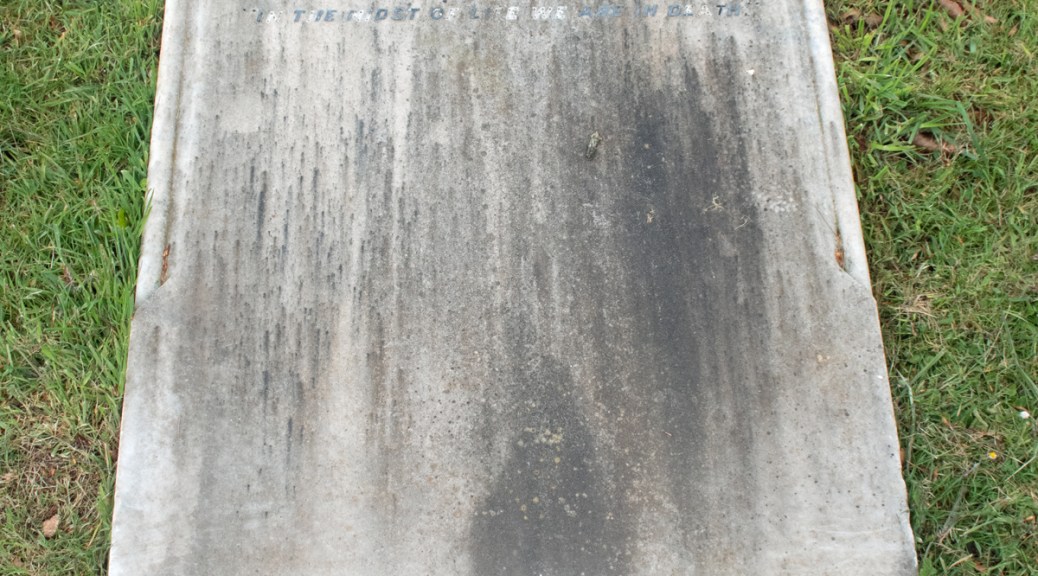
Walter Coleman lies at rest in the St James’ Cemetery in his home town of Taunton.
Walter Coleman (from findagrave.com)
Walter’s older brother Henry James Coleman also served in the Great War. Posted to France as part of the Labour Corps, he died of wounds on 12th April 1918. He was 33 years old, and left behind a widow and four children. He is buried at the Longuenesse Souvenir Cemetery in France.
Henry Matthew Baber was born in the spring of 1859, the second of six children to Henry and Jane Baber. Henry Sr was a cordwainer – or shoemaker – and the family lived in Bristol. Or, at least, most of them did. The 1871 and 1881 censuses show Henry Sr and Jane happily living with their children, but Henry Jr is noticeable in his absence.
In August 1887, Henry married Sarah Jane Hardwidge in the village of Paulton, near Bath. His younger brother Alfred and two of his sisters, Annie and Ellen, all bear witness to the wedding, at which Henry gives his profession as coachman.
The newlyweds settle down in Weston-super-Mare, and go on to have two children, Henry and Kathleen. Sadly, the couple’s happiness was to be cut short, when, in 1891, Kathleen passed away, followed just two years later by Sarah, at the age of just 32 years old.
With a young boy to bring up, Henry sought a new companion and, just over a year after Sarah’s death, he married Alma Quantick, who was fourteen years Henry’s junior. Together, they went on to have six children and, by the time of the 1901 census, the family were living in the Somerset village of Yatton. Henry, by this time, was working as an insurance agent for Prudential, a profession that was to last him through to the start of the First World War.
From the early 1890s, Henry had enlisted in the local Yeomanry. While only a reserve force, he had a short spell in Egypt, fighting at Tel-el-Kibir in 1882. Harry worked his way up through the ranks, eventually attaining the role of Colour Sergeant. He was brought out of reserve status on 4th August 1914, at the age of 55, and was assigned to the 4th Battalion of the Somerset Light Infantry.
There is little else to confirm his military career during the Great War; he was discharged in November 1914, but there is nothing to confirm whether he had seen active service during those four months or not.
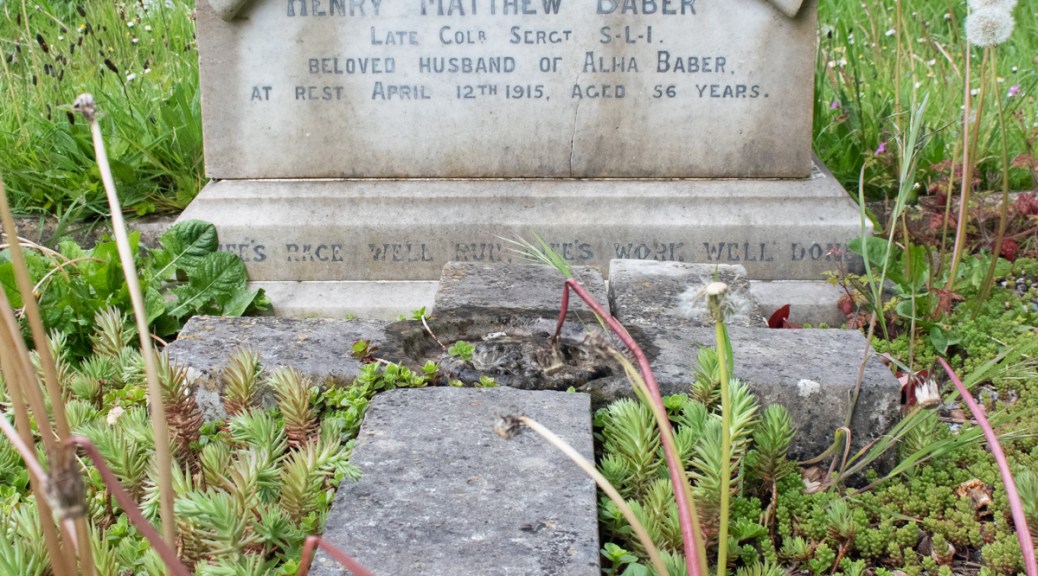
Colour Sergeant Baber’s passing is also shrouded in mystery. He died on 12th April 1915, but the cause of his death is lost to time. He was 56 years old when he died.
Henry Matthew Baber lies at rest in the graveyard of St Mary’s Church in Yatton, Somerset.
Henry and Alma’s eldest son William Albert Baber is also interred in the family grave and, within eighteen months, Alma had lost both her husband and her eldest son. William was 19 years old when war broke out, and his story can be found here.
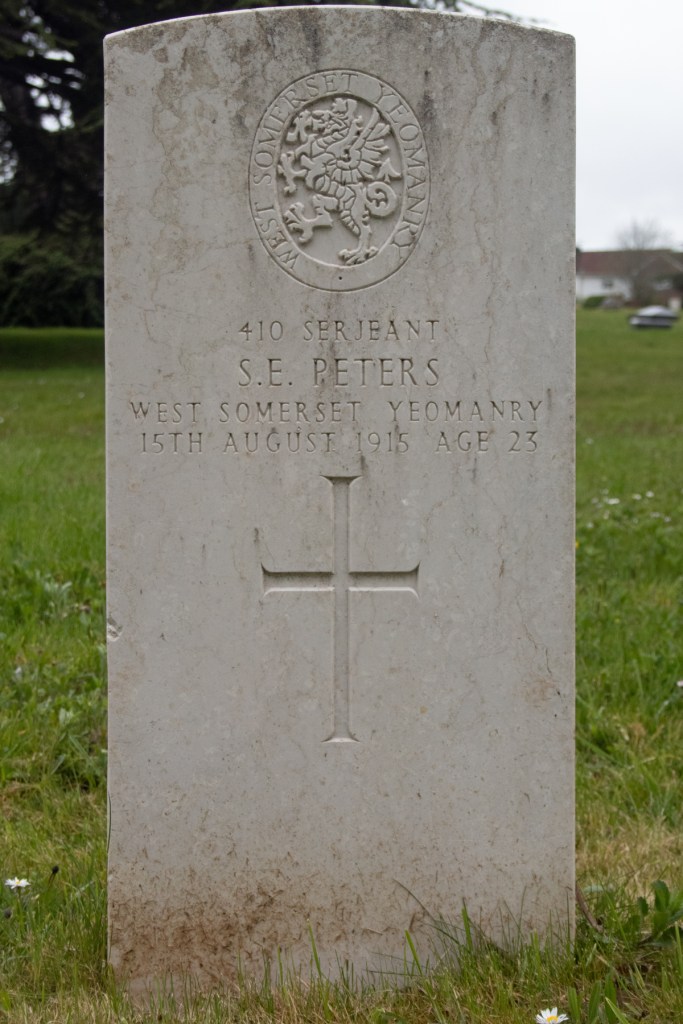
Sydney Edward Peters was born at the end of 1891, the only child to farmers Edward and Annie Peters. The family lived in Bishop’s Hull, near Taunton, where Edward also employed two members of staff to help with the household and his dairy herd.
Sydney went on to manage the neighbouring farm to his father, and looked to be making a living with this. Keen on sport, he went on to captain the village cricket team, and took an interest in physical fitness.
War broke out and Sydney was quick to enlist. Joining the West Somerset Yeomanry, he was assigned to the 1st Battalion. Initially the regiment were based on home turf, and he spent a lot of that time in East Anglia. He must have made a positive commitment to the troop, and was soon promoted to Serjeant.
In the early summer of 1915, he returned to Taunton, to help drill recruits at the Territorial Depot there. A short while after returning to his Essex he fell ill, and before the battalion were due to be shipped overseas, Serjeant Peters went back to Somerset on leave.
By the time he reached home, however, he was severely ill, and very quickly died from what turned out to be blood poisoning. Serjeant Peters was just 23 years old.
Sydney Edward Peters was buried in St Mary’s Cemetery in his home town of Taunton.
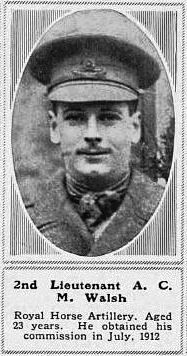
Archibald Charles Mark Walsh was born on 3rd February 1892, the youngest of three children to Henry Alfred Walsh and his wife Ann. Henry had a distinguished military career, and his sons – Archibald and his older brother Theobald – seemed destined to do the same.
Henry’s service took him around the world, and, by the time Archibald was born, the family had settled in Devon. In tracing the family’s life, however, an unusual quirk arises around the turn of the century.
In 1901, the majority of the Walsh family disappear from census records. For someone like Henry, this would not be unusual; his career took him overseas, and it is likely that records were lost or destroyed.
However, Archibald and his sister Gwladys do appear in the records. They are set up in a seafront villa in the Kent town of Hythe, Gwladys is listed as both a school pupil and the head of the household – at the age of 14 – and the two siblings are living there with a governess, Mary Porter.
By the time of the next census, Cadet Walsh had followed his father into the military. He was a student at the Military Academy in Woolwich, and the following year achieved his commission, becoming a Second Lieutenant in the Royal Horse Artillery.
When war broke out, Archibald’s regiment were shipped off to the Western Front. In March 1915, he was caught up in the Battle of Neuve Chapelle, and was badly wounded.
Shipped back to England for treatment, he was admitted to the Hall-Walker Hospital for Officers in Regents Park, London. Sadly, Second Lieutenant Walsh’s injuries were too severe, and he passed away on 18th March 1915. He was just 23 years old.
Brought back to Taunton, near his family home, Archibald Charles Mark Walsh lies at rest in St Mary’s Cemetery.
Ernest Baker’s early life is a bit of a muddle; Born in 1878 in Somerset, it’s a challenge to unpick specific details, as there are two Ernest Bakers, both of whom have parents of the same name – Henry and Sarah – and have siblings with similar names too. Was Ernest’s father, therefore, a thatcher from Meare near Glastonbury or a travelling draper from Taunton.
In fact, it was a newspaper article from April 1915 that helped unlock the confusion.
The Taunton Courier and Western Advertiser confirmed that Ernest’s full name was Ernest Bond Baker, and that his father – who had passed away by the time of Ernest’s death – was from Bishop’s Hull, a village near Taunton.
This would seem to confirm, therefore, that his father was a travelling draper.
Ernest was one of ten children. His father died when he was only fifteen years old, by which time Ernest had left school and found employment as a basket weaver, a trade which was prevalent on the Somerset Moors.
Sarah, a widow at only forty, took in laundry to make ends meet. Of Ernest’s two older brother, one had passed away as a teenager, while the other had gone on to have a wife and family of his own. It was left to Ernest, therefore, to remain at home and support his mother and younger siblings.
Ernest met and married local butcher’s daughter Bessie Glover in 1900, and the couple went on to have seven children. After a spell living in Wiltshire, the young family moved back to Somerset, settling in Bridgwater, where Ernest continued to ply his trade.
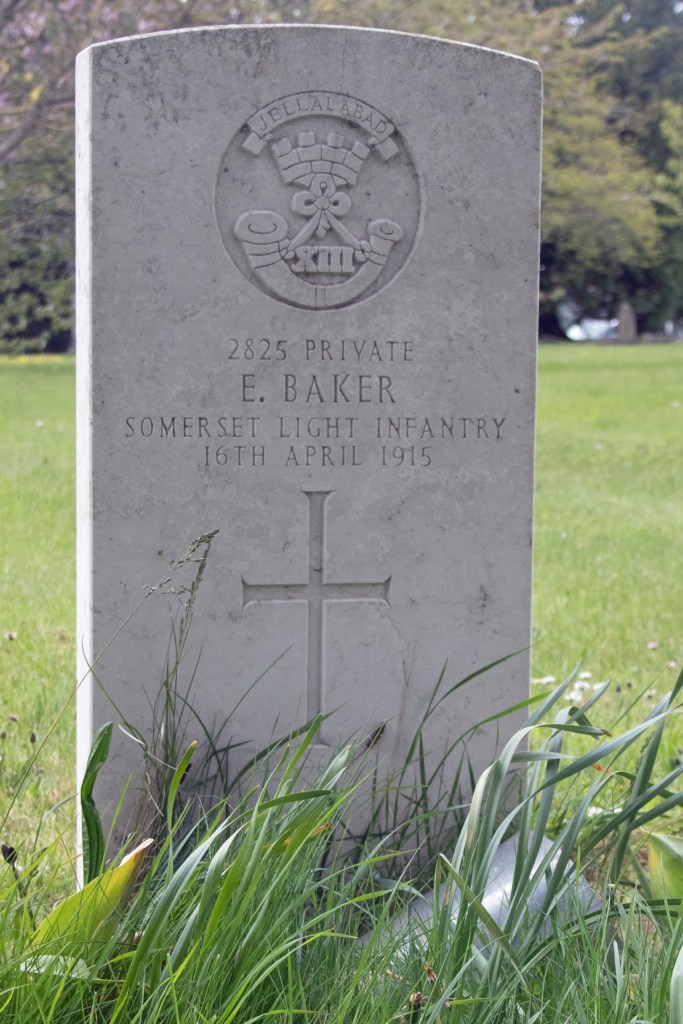
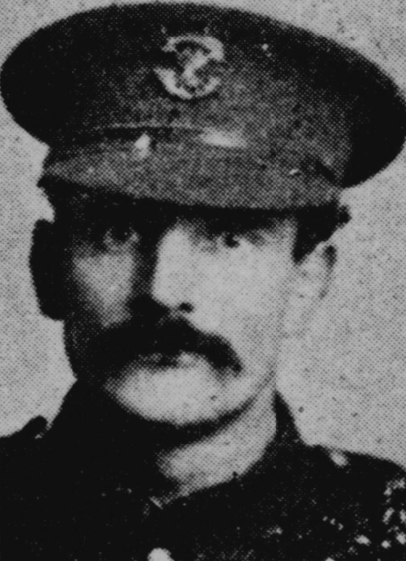
Ernest’s military service records are lost to time; he enlisted in the Somerset Light Infantry, joining the 5th Battalion at some point early in the war (certainly before October 1914). Private Baker’s battalion seems to have been part of a territorial/reserve force, and he was based in his home town of Taunton.
In early April 1915, Ernest fell ill, and was admitted to the Voluntary Aid Detachment Red Cross Hospital in Yeovil, suffering from bronchitis and pneumonia. Sadly, the lung conditions were such that he was succumb to them, and he passed away on 16th April 1915. He was just 36 years old.
Ernest Bond Baker lies at rest in St Mary’s Cemetery in his home town of Taunton, Somerset, the same cemetery where his father and brother were buried.
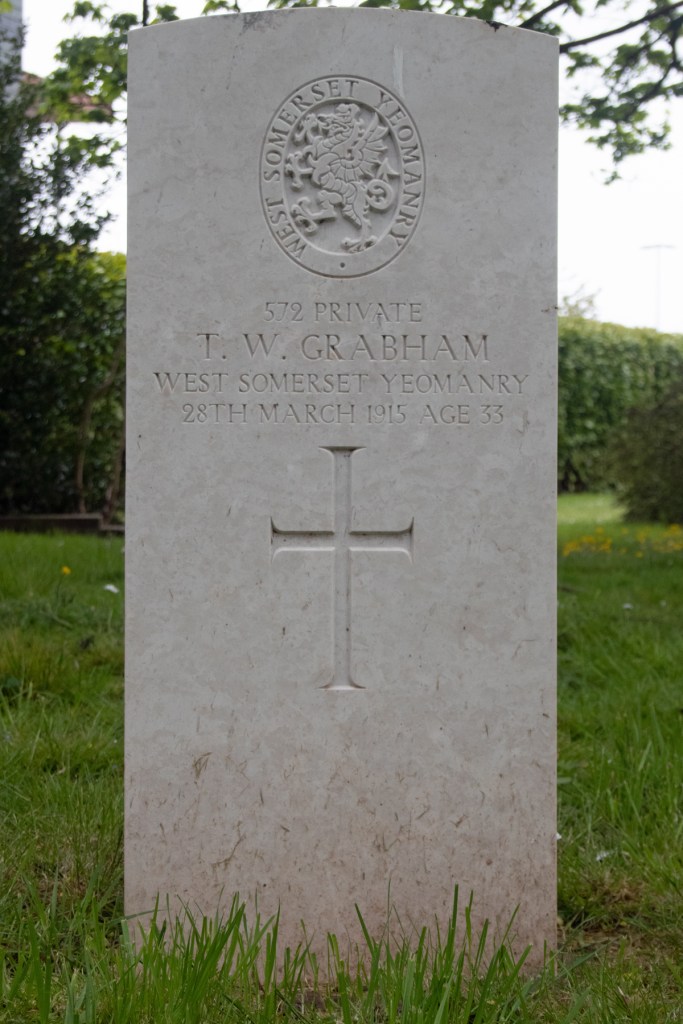
Thomas William Grabham was born in September 1883, one of six children to Thomas Richard Grabham and his wife Emma. Thomas Sr was a labourer and drayman for a brewery and the family lived in Taunton, Somerset.
When Thomas Jr left school, he found work as a grocer’s porter, before he too found work in a brewery, working as a maltster. He married a local woman, Maria Rowsell, and the couple went on to have a son, who they named after Thomas’ father.
Details of Thomas’ military service are sketchy; he enlisted in the West Somerset Yeomanry, but there are no details of when this was.
Sadly, Private Grabham’s period of service was short; his pension records show that he passed away from a perforated gastric ulcer on 28th March 1915. He was just 32 years old.
Thomas William Grabham lies at peace in St Mary’s Cemetery in his home town of Taunton.
Sadly, the tragedy for the young Grabham family was not to end there. Maria, Thomas’ widow, died just five months after her husband.
Young Thomas was just eight years old when his parents died; he seems to have been brought up by a Mrs Kate Barnes, possibly a maternal aunt. Here, however, the family’s trail goes cold.
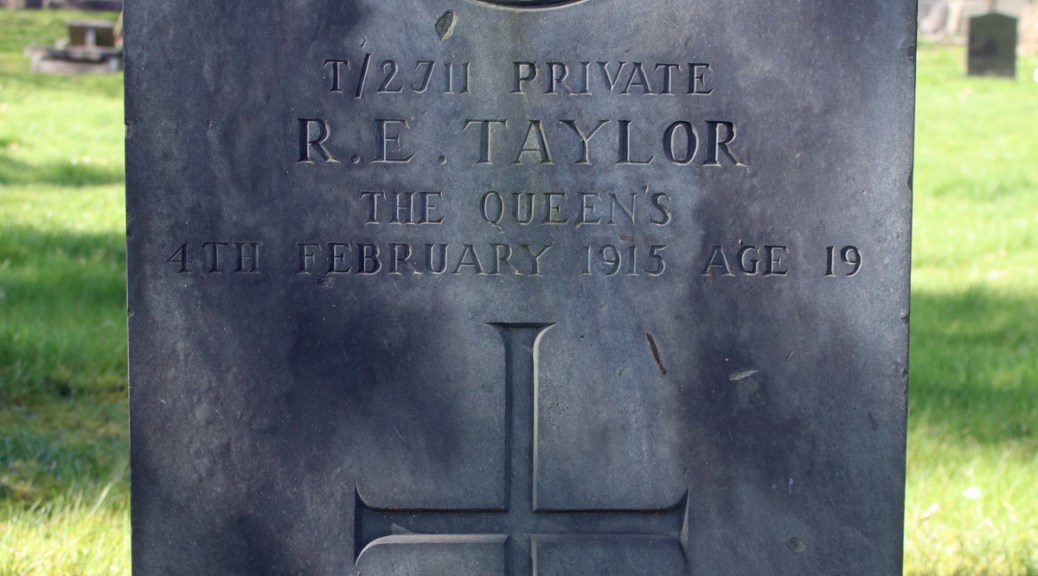
Richard Edmundson Taylor was born in 1895, one of nine children to Frederick and Emma Taylor. Frederick was from Portsmouth, Emma from Blackburn, but the couple had settled their family in Kent, where Frederick worked as an engineer and pattern maker at the Naval Dockyard in Chatham.
When he left school, Richard took work as an apprentice photographer – his older sister Mildred worked as a re-toucher in the same studio. The 1911 census reveals that his eldest sister, Alice, was working as a governess; the family of eleven were living in a small terraced house in Seaview Road, Gillingham – a road that, ironically, had no view of the nearby River Medway or Thames Estuary.
At this point, Richard’s trail goes cold. He enlisted in the Royal West Surrey Regiment – also known as the Queen’s – but there is no documentation to confirm when this was.
Private Taylor’s battalion, the 2/4th, would go on to fight at Gallipoli, but he would not have been involved, and, more than likely, did not see any overseas service. The prefix to his service number (T/2711) may well have indicated he was in training when he passed away, although, again, there is no physical evidence to confirm this.
Nor is there any indication of the cause of Private Taylor’s death. His name does not appear on any contemporary newspaper reports, so it is unlikely that it was due to any misadventure; more probably, he passed away from one of the many communicable diseases that became common in the training camps of the 1910s.
Whatever the cause, Private Taylor died at home on 4th February 1915. He was just 19 years old.
Richard Edmundson Taylor lies at rest in the Woodlands Cemetery in his home town of Gillingham, Kent.
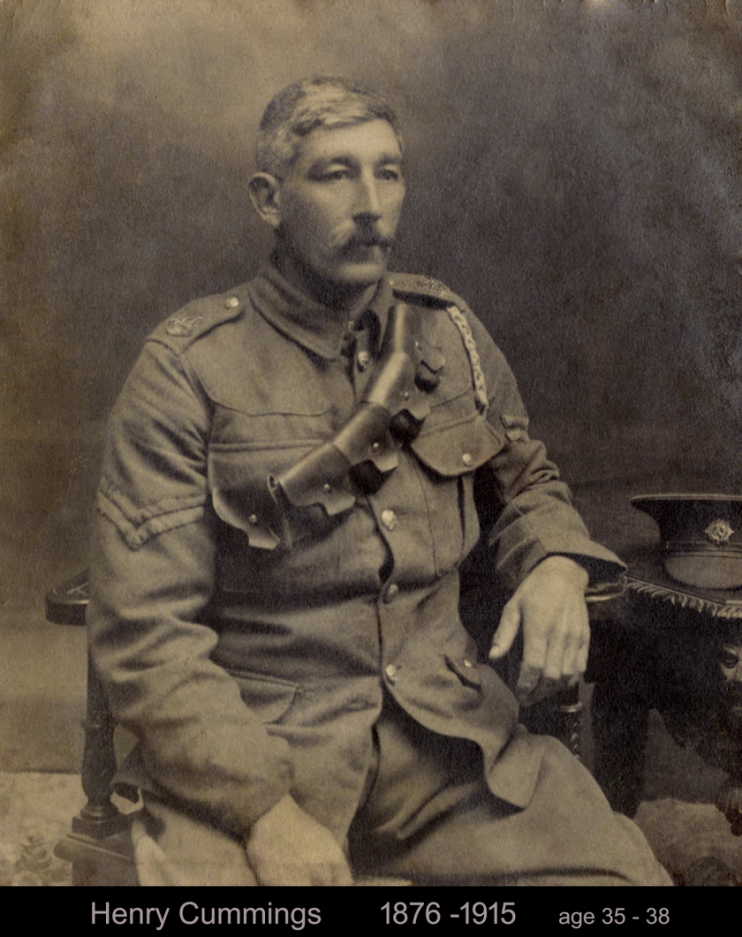
Henry Cummings was born in the village of Wembdon, near Bridgwater in Somerset in 1876. The son of agricultural labourer John and his wife Jane, Henry was one of six children.
When he left school, Henry followed his father into agricultural labouring, as his older siblings had done before him. Jane had died when Henry had just reached his teens, so he continued to live with his widowed father, and was recorded there as late as the 1911 census.
On 4th August 1912, he married Sarah Palmer in Wembdon Parish Church; Henry was 36 by this point, and his new wife was 30. They couple may not have thought they could have children, as they went on to adopt a girl, Edith, who was six years old when they had married.
From a military perspective, it appears that Henry had initially tried to enlist in 1908. Based on his service records, it seems that he was not accepted at that point, but when war broke out, things were a different matter. He joined the Army Service Corps on 6th January 1915, attaining the rank of Sergeant.
Henry’s service was to be cruelly short, at just 85 days. Hospitalised in Rugby, Sergeant Cummings passed away from cerebrospinal meningitis on 6th April 1915. He was 38 years old.
Henry Cummings was brought back to Bridgwater for burial, and lies at rest in the Wembdon Road Cemetery there.
In September 1915, Sarah gave birth to a baby girl, Irene. Henry was never to see his little girl, and, tragically, may not even have known he was to be a father.
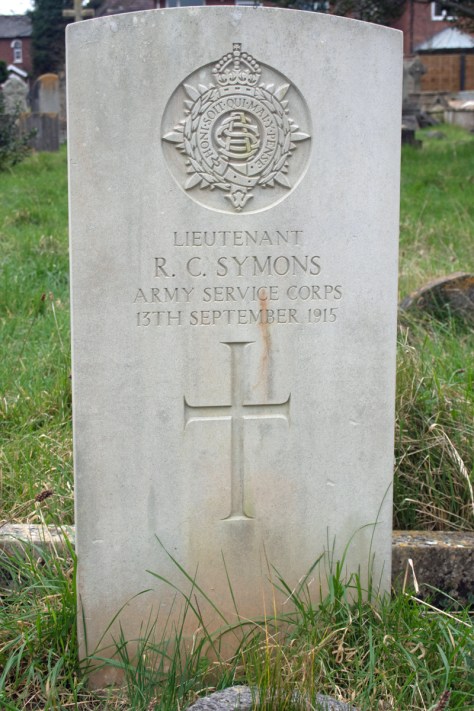
Rudolph Clifford Symons was born in the autumn of 1887, one of ten children to Clifford and Clara Symons. Clifford ran a brick and tile manufacturer’s and later became a town councillor in the family’s home of Bridgwater in Somerset.
By the time of the 1911 census, Rudolph had become the works manager for his father, but war soon beckoned.
Sadly, Rudolph’s full military record has been lost to time, but he enlisted in the Royal Army Service Corps early on in the conflict and was promoted to Lieutenant at the end of September 1914. He was involved in recruiting new soldiers, and it was following one of these meetings that he was involved in an accident.
The local media picked up the story:
On Friday night, while riding through St Jon Street on his motorcycle, to which a side-car was attached, he collided with a horse and light waggon… Lieutenant Symons appears to have been struck by one of the shafts in the region of the heart, and was rendered unconscious. He was at once conveyed to his home, where he was medically attended and was subsequently removed to the nursing home on Friarn Street. On the following day a specialist was called in, and an operation performed, but the injuries were of so severe a character that death ensured on Monday.
Taunton Courier and Western Advertiser: Wednesday 22nd September 1915
The coroner reported that Rudolph had died from an internal haemorrhage and the inquest recorded a verdict of accidental death, and exonerated the waggon driver – a dealer caller Wyatt – from all blame.
Lieutenant Symons was a popular man, a vocalist in the Bridgwater Amateur Operatic Society, and was also heavily involved in the local annual Guy Fawkes celebrations.
He died on 13th September 1915, aged 27 years old, and lies at rest in the Wembdon Road Cemetery in his home town.
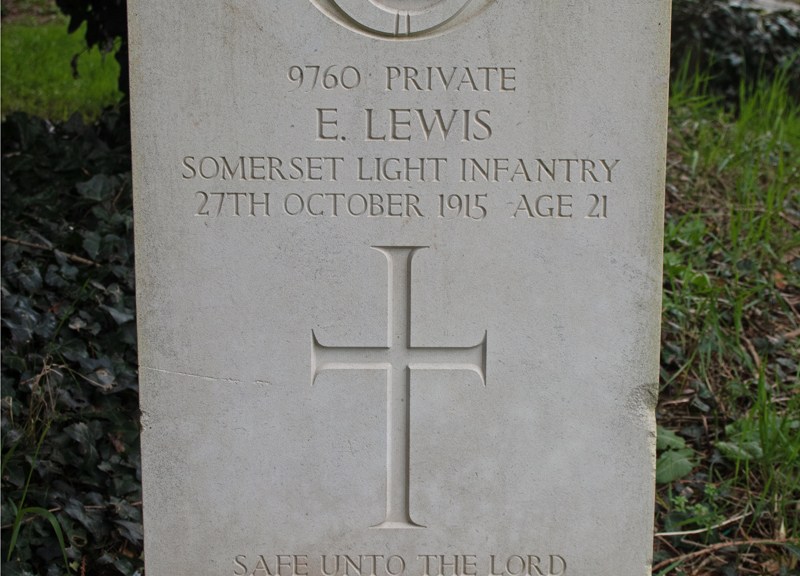
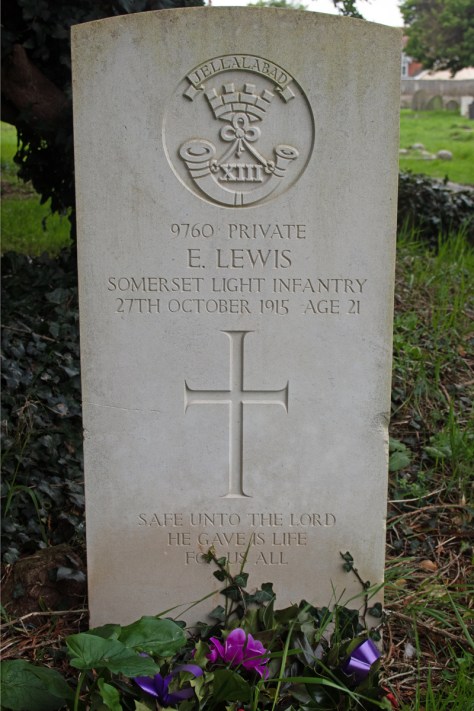
Ernest George Lewis was born in Bridgwater, Somerset, in the spring of 1895, one of fourteen children to labourer Frederick and his wife Harriett Rose. Two of his older brothers went to work for the local brickworks, but Ernest hauled coal to earn a living once he left school.
When war broke out, he was eager to do his part; he enlisted in the Somerset Light Infantry early on, serving as a Private in the 1st Battalion. His troop was to see some of the fiercest fighting in the conflict, including the Battles of Le Cateau, the Marne, the Aisne, Messines within the first six months.
Private Lewis’ troop was also involved in the Second Battle of Ypres in the spring of 1915, but it was later that year that his fate became sealed. At some point he was caught up in a German gas attack; he was evacuated home, but there is no confirmation whether he was hospitalised as a result (although it seems likely).
The gas was to damage his lungs to the extent that he would not recover. There are conflicting reports as to the cause of Private Lewis’ passing, with one source identifying the gas in France, while another put it down to pneumonia and typhoid. (It seems probable that the attack ultimately resulted in Ernest catching pneumonia, although this is not clear.)
Either way, Private Lewis passed away at home on 27th October 1915. He was just 20 years old.
Ernest had eleven brothers, four of whom would have been old enough to be enlisted to fight. Ernest was the only one of the family to perish.
Ernest George Lewis lies at peace in the Wembdon Road Cemetery in his home town of Bridgwater.










 Death and Service