Tag Archives: 1916

Private John Roche

Private John Roche

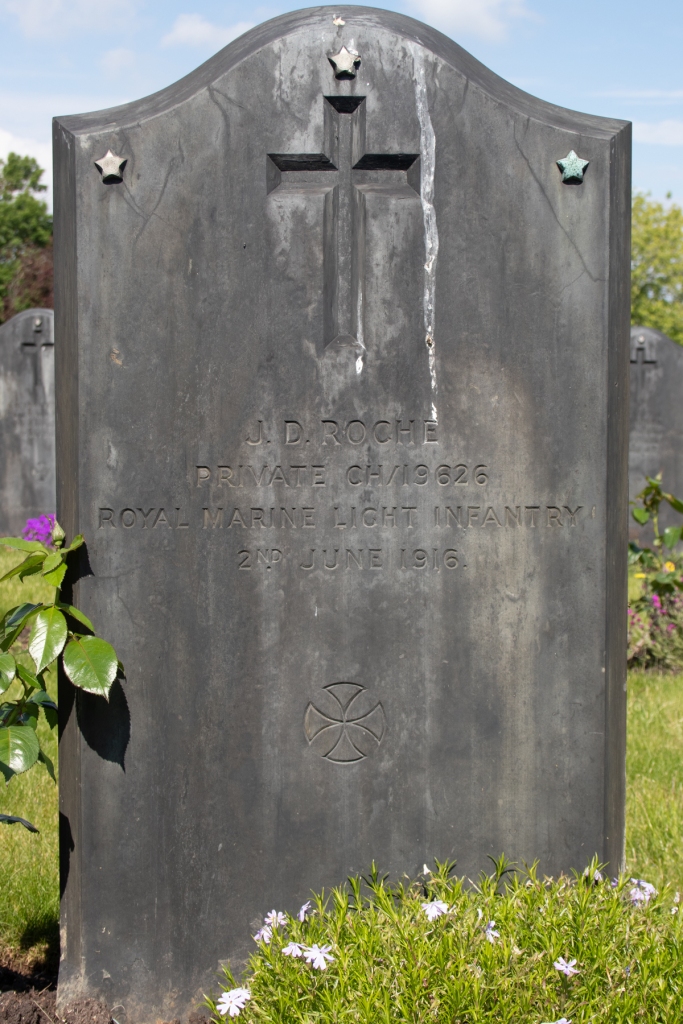
In the middle of the military section of the Woodlands Cemetery in Gillingham, Kent, is a headstone commemorating the life of John David Roche.

Details of John’s life are a challenge to piece together, although a later document gives his next-of-kin as Mrs E Roche of 108 Osnaburgh Street, Regent’s Park, London. There is a baptism record from 1897 for John David Roche, whose mother’s name was given as Lizzie. John’s father is listed as David, and the christening took place in Chelsea. There are no other records or census returns to give any further family background.

John’s time in military service is also hard to determine. That he joined the Royal Marine Light Infantry is clear, although when he enlisted and where he served are sadly lost to time.

Details of Private Roche’s passing are also unclear. He is noted as having died of disease, although the specific cause is not detailed. Given the location of his burial, it seems likely that he passed either at the Royal Naval Dockyard in Chatham, Kent, or at the hospital in the town connected to it.

John David Roche passed away on 2nd June 1916. If the baptism was correct, he was a day short of his 19th birthday.


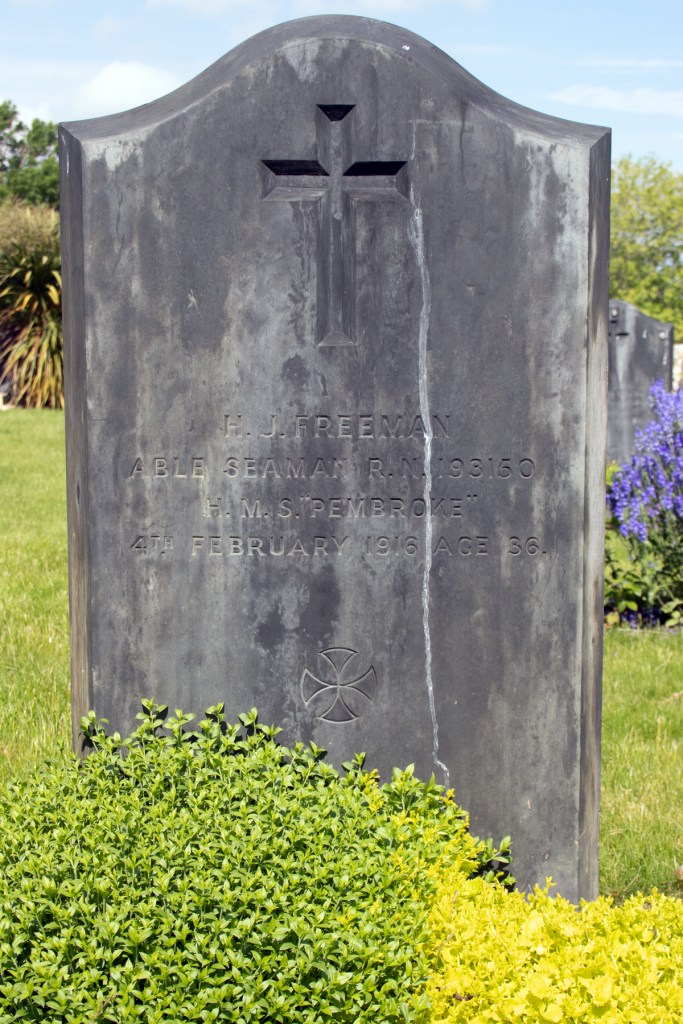
Able Seaman Charles Dorman

Able Seaman Charles Dorman

Charles Columbus Dorman was born on 21st October 1892, and was the middle of three children to James and Margaret Dorman. Charles’ parents both hailed from Belfast, Country Antrim, but the 1901 census records his and his older sister’s birthplace as America. No baptism documents are available and no later information supports this, so, while his unusual middle name may suggest the place of his birth, it seems destined to remain unclear.

When he left school, Charles found work as a printer’s apprentice. He sought more, however, and was drawn to a life at sea. On 29th November 1910, he enlisted in the Royal Navy as an Ordinary Seaman. His service records confirm that he was 5ft 3.5ins (1.61m) tall, with brown hair, hazel eyes and a fresh complexion.

Charles was sent to HMS Pembroke – the Royal Naval Dockyard in Chatham, Kent – for his training. In January 1911, he was assigned to the ill-fated HMS Bulwark, before moving to the battleship HMS Implacable three months later. He would remain on board until the summer of 1914, gaining a promotion to Able Seaman during his three year stint there.

Charles was serving on Implacable when war was declared. At the beginning of September, after a week back in Chatham, was assigned to the sloop HMS Cormorant. After six months aboard, the cruiser HMS Blenheim became his home, and he spent the next month supporting troops who were being sent to Gallipoli.

By this point, Able Seaman Dorman had become unwell. He had contracted the autoimmune disease pemphigus, resulting in blistering to his skin and body. He returned to HMS Pembroke, and was stood down from the service on medical grounds 9th July 1916.

It is unclear whether or not Charles was admitted to hospital for his condition. Either way, he succumbed to the illness on 31st August 1916. He was just 23 years of age.

Charles Columbus Dorman’s family appear to have been unable to bring their boy back to Ireland for burial. Instead, he was laid to rest in Woodlands Cemetery, Gillingham, not far from the Kent naval base he had come to call home.

Seaman Charles English

Seaman Charles English

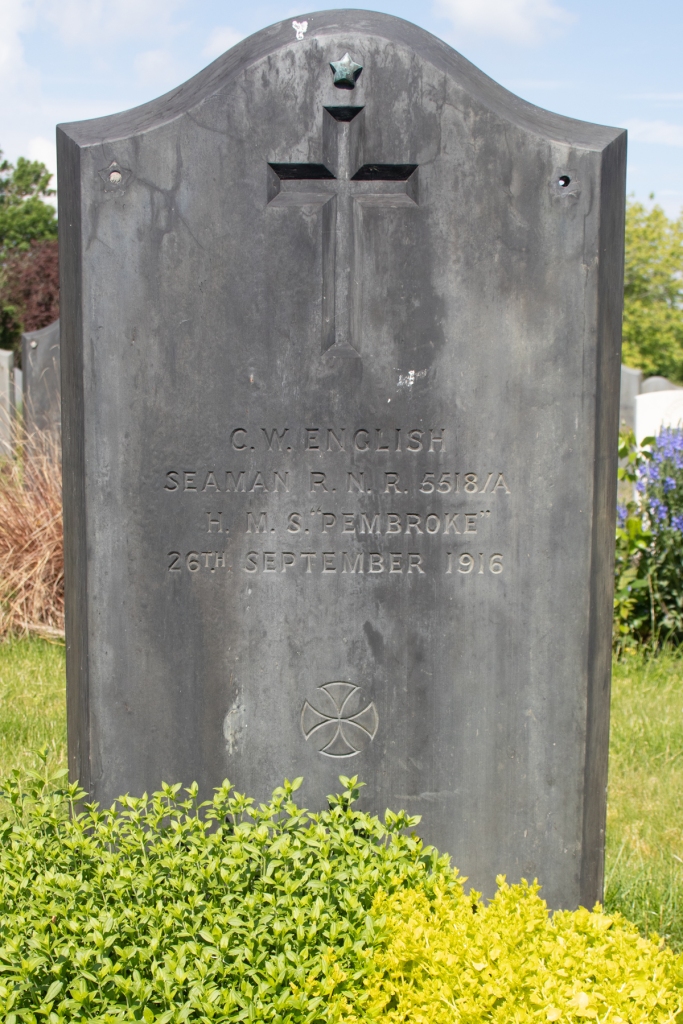
Charles William English was born on 30th August 1895 in the Suffolk town of Southwold. According to his later naval service records, his parents were Ellis and Sarah English, although there is little other information available to back this up.

Charles evidently had a draw to the sea and, when he enlisted in the Royal Naval Reserve on 10th January 1914, he was working as a fisherman. His service records confirm that he was 5ft 9ins (1.75m) tall, with grey eyes and a fresh complexion.

Over the next few years, Seaman English served off the east coast, and was attached to HMS Mantua, a former cruise ship taken over by the Royal Navy to patrol the North Sea. In between trips, Charles made HMS Pembroke, the Royal Naval Dockyard in Chatham, Kent, his home and it was to here that he returned in the autumn of 1916 when he fell ill.

Charles was admitted to the Royal Naval Hospital in the town, tests showing that he was suffering from lymphatic leukaemia. This was to prove fatal, and Seaman English passed away on 26th September 1916, aged just 21 years of age.

It seems likely that Charles William English’s family were unable to foot the bill for bringing their son back to Suffolk. Instead, he was laid to rest in Woodlands Cemetery, Gillingham, not far from the base he had come to call home.


Boy 1st Class Sidney White

Boy 1st Class Sidney White

Sidney James White was born on 9th April 1899 in Bath, Somerset. The second of six children – and the oldest son – his parents were Sidney and Ann White. Sidney Sr was a butcher by trade and, by the time of the 1911 census, the family were living in Walcot Buildings in the city.

Sidney Jr was only 15 years of age when war came to Europe. However, he was still keen to do hit bit and, on 13th October 1915, he gave up his job as a fitter’s mate and enlisted in the Royal Navy. As he was underage, he was given the rank of Boy 2nd Class, his service records showing that he was 5ft 7.5ins (1.61m) tall, with brown hair, blue eyes and a fresh complexion.

Boy 2nd Class White was dispatched to the ship HMS Impregnable for his initial service. Moored in Devon, she was a training vessel, used to school young recruits in the art of seamanship. In May 1916, Sidney was promoted to the rank of Boy 1st Class, but his time in the Royal Navy was to be cut tragically short.

Holed up in cramped billets, disease often ran rife in military barracks, and Sidney was not to be immune. He contracted meningitis, and was admitted to the Royal Naval Hospital in Plymouth. While initially appearing to recover, the condition was to prove too severe, and his young body succumbed on 18th June 1916: he was just 17 years of age.

Sidney James White’s body was brought back to Somerset for burial. He was laid to rest in a shady spot in Bath’s sweeping Locksbrook Cemetery.


Gunner William Woodward

Gunner William Woodward

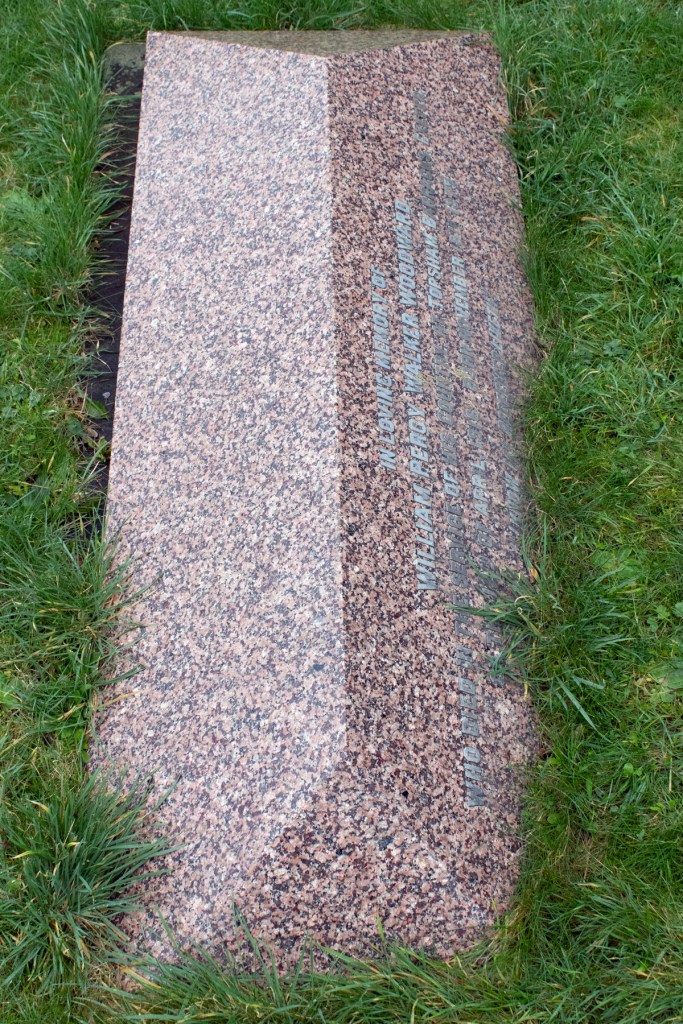
William Percy Walker Woodward was born on 18th November 1879, and was the third of six children to James and Mary Woodward. James was a manufacturer of sanitaryware and had been born in Derbyshire, but it was in Ashby-de-la-Zouch, Leicestershire that he and Mary raised their family.

James passed away in the spring of 1886, leaving Mary to raise the family on her own. His obituary in the local media underlined the business that he had built up: “Mr Woodward succeeded his father and eldest brother to the fire brick business, established by the late Mr John Hunt of Swadlincote, of 1790.In 1856 Mr Woodward added to the above trade that of glazed sewerage pipe and terra cotta earthenware, and in 1873 that of general sanitary appliances, and by industry, perseverance, and foresight developed the same into one of the largest manufactories of the kind in the Midland counties, and became well known throughout the greater part of the kingdom as a leading manufacturer of these goods. He was a large employer of labour, kind and considerate, always manifesting great interest in the welfare of his employees.” [Hinckley News – Saturday 15 May 1886]

Mary was left to raise six children, but, thanks to the business, did not do so without support. The 1891 census found the family living at High Fields in Ashby, with a cook, housemaid, children’s maid and a coachman and his family living next door. William and his siblings were all taught at home by their governess.

By the time of the next census, William seemed to have taken on the running of his late father’s business, along with two of his brothers, James and Harold. Things were to change for the Woodward family, however, as they began to go their separate ways.

The 1911 censes shows a divide: James was living on his own means in Snarestone, Leicestershire, with his young family and household retinue. Harold, meanwhile, had emigrated to Canada with another sibling, younger brother Ernest, where they had both set up as farmers.

Mary had also moved, setting up home in Weston-super-Mare, Somerset. She lived on Clarence Road South with William and her daughter, Lilian. The house – Glencathara – was twelve-roomed property, and they had a live0in cook, Emily Young, supporting them. Notably, William’s employment was listed as ‘none, on account of health’, so the move to the coast may have been brought about for medical reasons.

When war came to Europe in summer of 1914, William stepped up to play his part. His service records have been lost, but he had enlisted in the Royal Field Artillery no earlier than the autumn of 1915. He was attached to the 18th Reserve Battery, and came to be based in Topsham Barracks in Exeter.

Little is known of Gunner Woodward’s time in the army, but it was to be brief. He passed away, through causes unknown, on 13th April 1916, at the age of 36.

It is unclear where Mary was living at this point. The body of William Percy Walker Woodward was taken to Dorset for burial, and he was laid to rest in the peaceful graveyard of St Hippolyte’s Church, in Ryme Intrinseca. Interestingly, the parish records note that William was ‘a personal friend of [the] rector’.


Gunner Kei Marsh

Gunner Kei Marsh

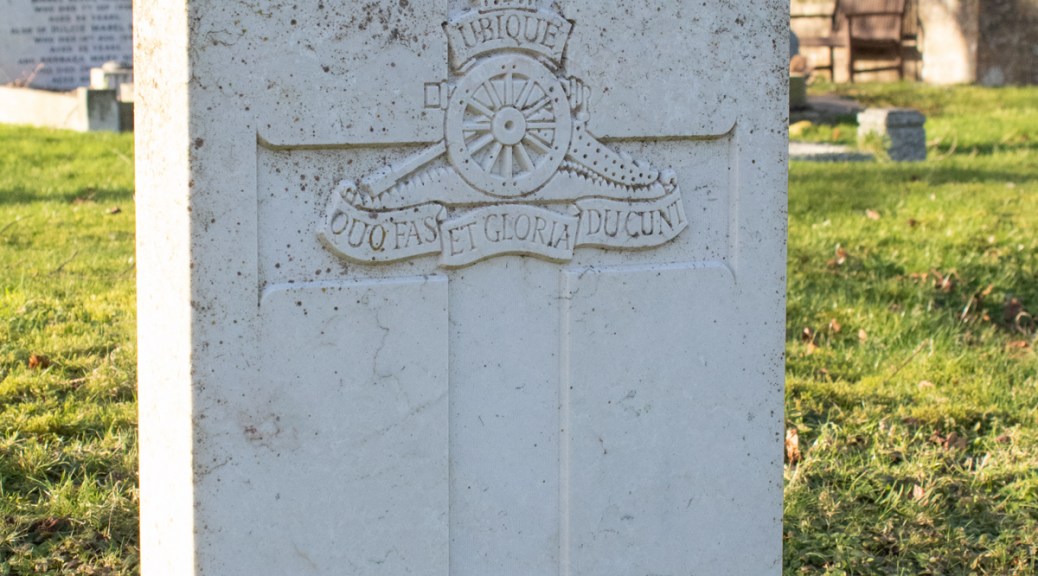
In a corner of the peaceful St Mary’s Churchyard in Codford, Wiltshire, is a headstone dedicated to L/17062 Gunner K Marsh. He served in the Royal Field Artillery, and passed away on 5th January 1916.

Gunner Marsh’s entry in the Army Register of Soldier’s Effects gives his first name – Kei – and that of his widow – Edith. The parish record for his funeral giving an age of 34 years old, and from here it is possible to piece together some of his family’s past.

Kei was born in Burnley, Lancashire, in the autumn of 1882, and was the son of engineer Alfred Marsh. He and Edith married in 1907, and were living with her widowed mother, Sarah, and their three children, John, Sarah and Edith, by the time of the 1911 census. The house – 30 Thorn Street in Burnley – was crowded. Along with the Marshes, Sarah also had her other six children living with her: a total of eight adults and four children sharing four rooms in the small terraced house.

Kei was working as a miner by this point, but had enlisted in the Royal Field Artillery by the summer of 1915. He acted as a Gunner in the 32nd Division Ammunition Column, although it is unclear whether or not he spent any time overseas.

By the end of 1915, Gunner Marsh had been admitted to the military hospital in Codford. The cause of his admission is unclear, but it was to be one that he was to succumb to: he passed away on 5th January 1916. Kei lies at rest in the quiet Wiltshire churchyard.


Gunner Willie Smith

Gunner Willie Smith

In a quiet corner of St Mary’s Churchyard, Codford, Wiltshire, is a headstone dedicated to L/17006 Gunner W Smith of the Royal Field Artillery. His pension ledger confirms that he passed on 14th January 1916 from osteomyelitis, a bone infection, contracted whilst on active service.

The document gives Gunner Smith’s first name – Willie – and that of his widow, Ada, who lived at 157 Gisburne Road, Barnoldswick, Yorkshire. Their only child, Winifred, had been born on 22nd March 1914.

The couple’s marriage certificates are not available, while the 1911 census return shows at least three Willie Smiths in the Barnoldswick area. It is not possible, therefore, to uncover more of his family’s past.

Willie Smith had enlisted in the Royal Field Artillery by the summer of 1915. He acted as a Driver in the 32nd Division Ammunition Column, although it is unclear whether or not he spent any time overseas.

Gunner Smith was based on Salisbury Plain by the winter of 1915. He was admitted to the Military Hospital near Codford with the infection he had contracted, and succumbed to is on 14th January 1916. He was laid to rest in the peaceful country churchyard, the burial records confirming he was 26 years of age.


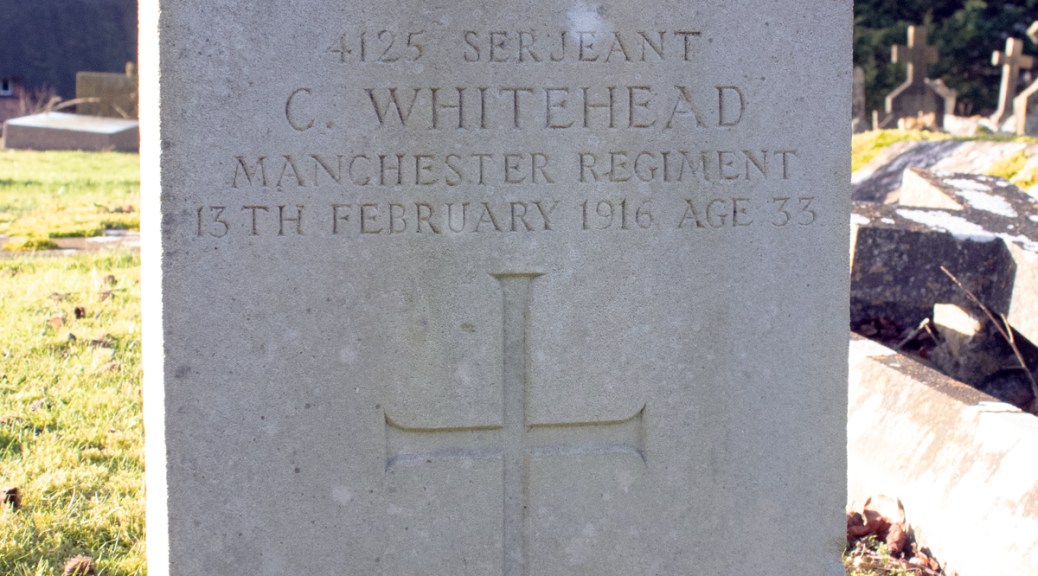
Serjeant Cecil Whitehead

Serjeant Cecil Whitehead

Details of Cecil Whitehead’s early life as lost to time. Born in 1882, he was the son of Henry and Annie Whitehead, from Openshaw in Manchester. There are no census returns for the family, so it is not possible to discover any more of their background.

The Commonwealth War Graves Commission confirm that Cecil wed a woman called Annie Ellis. His pension ledger notes four children: John, Cecil, Annie and Catherine, who died in 1917.

When war broke out, Cecil stepped up to serve his King and Country. He enlisted in the Manchester Regiment, and was assigned to the 3rd/8th Battalion. This was a reserve unit, based on home soil, and there is no evidence that Cecil spent any time overseas.

Cecil rose to the rank of Serjeant, by the winter of 1915, Cecil was billeted near Codford in Wiltshire. It was while he was here that he fell ill, contracting pneumonia. The condition was to prove too much for his body to bear, and he passed away on 13th February 1916, at the age of 33 years old.

Annie appear to have been unable to fund bringing her husband back to Manchester for burial. Instead Cecil Whitehead was laid to rest in the quiet graveyard of St Mary’s Church in Codford.


Private Ernest Carder

Private Ernest Carder

Ernest James Triggs Carder was born early in 1880, the third of ten children to Samuel and Julia. Samuel was a shipwright from Devon and it was in Dartmouth that the family were born and raised.

Ernest – who went by his second name, James – found employment as a groom when he finished his schooling. In the spring of 1907, he married Elizabeth Seward. The couple wed in St Saviour’s Church, Dartmouth, setting up home in Gospel Lane.

James and Elizabeth went on to have three children – Samuel, Edward and Betty. The 1911 census found James working as a grocer’s waggoner, with his youngest brother, Frederick, living with them.

The times were trying for James and Elizabeth: both Samuel and Julia died in 1909; and Edward, their middle child, passed away in September 1911 at the age of just seven months. In the summer of 1915, Betty wad born, and the following April. James was called up to serve his King and Country.

On 14th June 1916, Private Carder was assigned to the Devonshire Regiment, and attached to the 3rd (Reserve) Battalion. The unit would remain on home soil throughout the conflict, but James was not to be part of it for long.

On 29th July 1916, Private Carder was found dead in a lavatory at the Granby Barracks in Devonport, with a razor near him. He had been complaining of eczema on his legs for a while, which made it difficult for him to sleep and had the knock-on effect of causing him headaches. His commanding officer, Corporal Stonelake, said that James “was not too quick, but was a man of good character and tried to do his best… each time he complained of his head he declined to see the doctor.” [Western Morning News: Tuesday 1st August 1916]

Private Carder had willingly enlisted, and appeared not to have any qualms about serving in the army. At the inquest following his death, the jury returned a verdict of taking his life while of unsound mind. He was 36 years of age.

Ernest James Triggs Carder was taken back to Paignton, where Elizabeth and the children were living. He was laid to rest in the town’s cemetery, having found peace at last.


Less than a year later, James’ youngest brother, Frederick, also died. Read more of his life here.

Private William Biddlecombe

Private William Biddlecombe

William Charles Biddlecombe was born in the spring of 1896, and was the third of nine children to Robert and Eliza. Both of his parents came from Hampshire, but their older children – William included – were born and raised in Poole, Dorset. Robert was a police constable there, but moved to the village of Longburton, near Sherborne, in around 1910.

According to the 1911 census, William was two of the household of eight to be employed, having found work as a gardener when he finished his schooling. Storm clouds were brewing across Europe, however, and he would be called upon to play his part.

Full service details have been lost to time, but it is clear that William had joined the Dorset Yeomanry (Queen’s Own) by the summer of 1915. He was attached to the 3rd/1st Battalion. The unit was based on home soil and there is no evidence that Private Biddlecombe saw any action overseas.

At this point, William’s trail goes cold and, in fact, the next record for him is that of his passing: “The funeral took place on Wednesday amid every token of respect and esteem of Trooper W Biddlecombe, of B Squadron (3/1st Dorset QO Yeomanry, son of PC and Mrs Biddlecombe of Westhill Police-station.” [Western Gazette – Friday 18 February 1916]

William Charles Biddlecombe died on 15th February 1916: he was 20 years of age. He was laid to rest in the peaceful graveyard of St James the Great Church in Longburton, close to where his grieving family lived.


William’s was not the only passing that his grieving mother would have to attend to. On 18th December, Robert was on duty, which had taken him into Sherborne. He was suddenly taken ill, and rushed to the town’s Yeatman Hospital, but died the same day. He was laid to rest close to his son in Longburton.


William’s younger brother, Robert, also served during the First World War. As a Private, he was attached to the 8th Battalion of the Somerset Light Infantry, and spent time fighting in Northern France. He was caught up and was killed in the Second Battle of Cambrai. He died on 9th October 1918, and was laid to rest in Naves Communal Cemetery Extension.


The pain for Eliza at having lost her husband and two of her sons in such a short space of time is unimaginable. However, she still had children to support, and so had to keep on going. The 1921 census recorded her as living in Weymouth with her youngest boy, Bertram. She was carrying out home duties, and it is unclear how she was making ends meet. She would remain in Weymouth for the rest of her life, passing away in the autumn of 1937, aged 71.