John McClymont was born in Cowra, New South Wales, Australia, in 1865. Full details of his early life are lost to time, but later documents confirm that his mother was called Sophia.
Most of the information relating to John’s life comes from his army service records. These confirm that he enlisted on 13th September 1915, and that he was assigned to the 8th/20th unit of the 5th Australian Infantry Brigade. He was noted as being a labourer when he joined up, with brown hair, blue eyes and a fresh complexion. The record confirms that he stood 5ft 10ins (1.78m) tall, and weighed 169lbs (76.7kg).
Private McClymont arrived in Egypt in February 1916, and transferred to the 2nd Battalion of the Australian Imperial Force. He was initially based at Tel-el-Kebir camp, close to Cairo. From here on in, he seems to have been beset with poor health, and had numerous hospital admissions for heart ailments and haemorrhoids.
By April 1916, John’s unit had arrived in France, and his commitment to the job was not to go unrewarded. On 13th July 1916, he was appointed to the role of Acting Sergeant, and just three months later, he was reassigned to the 1st Australian Infantry Brigade Headquarters, where he was mustered as a Driver.
He was still battling health issues, however, and, in 18th August 1917, he was admitted to a hospital in Boulogne with heart disease. Within a month, Driver McClymont had been medically evacuated to Britain for treatment, and he was taken to Bath War Hospital in Somerset. It was here that he was diagnosed with diabetes, and, having slipped into a diabetic coma, it was here that he passed away, on 9th October 1917. He was 42 years of age.
With all of his family on the other side of the world, John McClymont was laid to rest in the military section of Bath’s Locksbrook Cemetery.
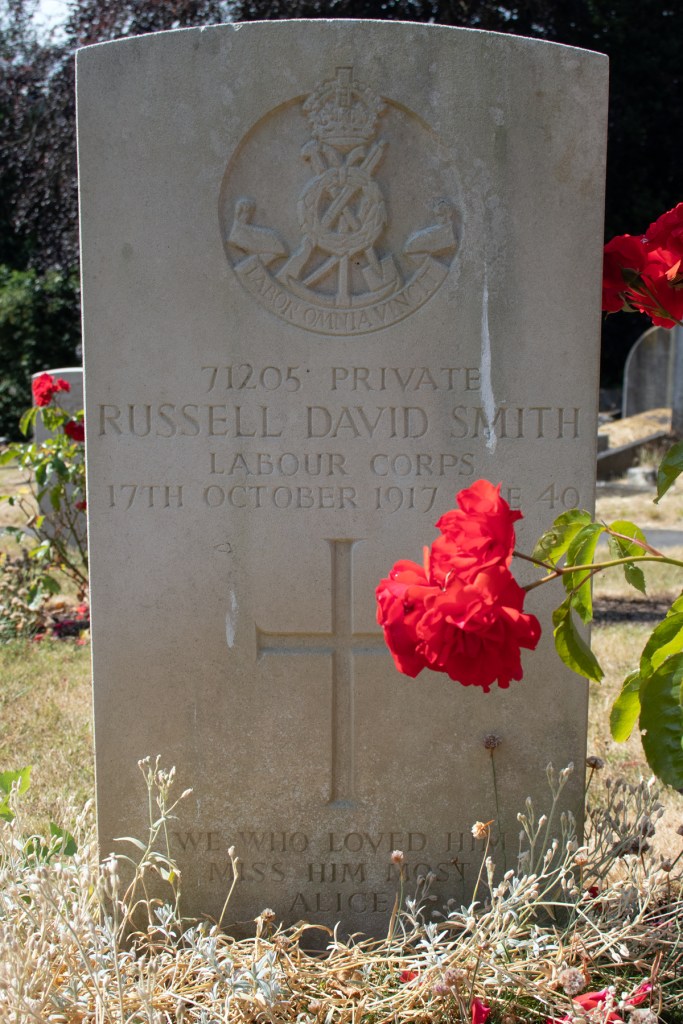
Russell David Smith was born in Shoreditch, London, in the summer of 1877. The second of four children, his parents were tailor Richard Smith and his wife, Emma.
When he finished his schooling, Russell found work as a bookbinder: by the time of the 1901 census, the family had moved to a small terraced house in Cassland Road, Hackney.
On Christmas Day 1902, Russell married Alice Stretch. A year younger than her new husband, she had been born in Islington, and was the youngest child to cabman Edwin Stretch. When the couple married, she was working as a mantle maker’s assistant, making elements for gas lamps.
The newlyweds settled in a cottage in Walthamstow, and went on to have three children. The 1911 census recorded the young family living at 39 Ritchings Avenue: they had taken in a lodger, Alice Carter, to help pay the bills.
War came to Europe in the summer of 1914 and Russell was called upon to play his part. Details of his military service are sketchy, but from the documents available, it is evident that he had enlisted by the summer of 1917 joining the Labour Corps. Private Smith was attached to the 119th Labour Coy. which seems to be been based in Somerset.
It is impossible to trace Russell’s trail any further. The next record for him is that of his passing, on 17th October 1917. The cause of his death is not readily apparent, but he was 40 years old at the time.
Finances seem to have prevented Alice from bringing her husband home. Russell David Smith was, instead, laid to rest in Locksbrook Cemetery, Bath, probably as this might have been the closest burial ground to where he had passed away.
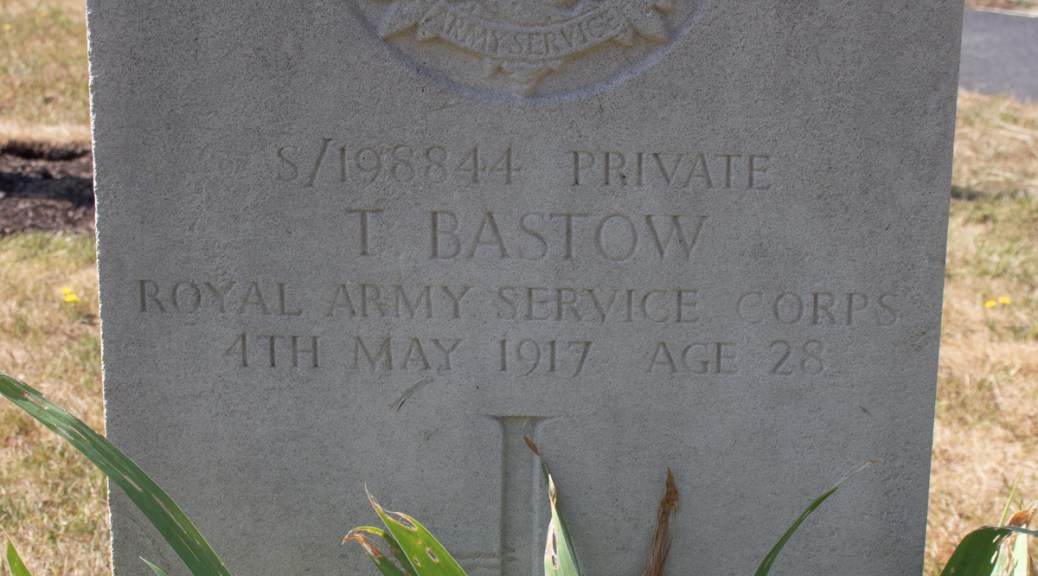
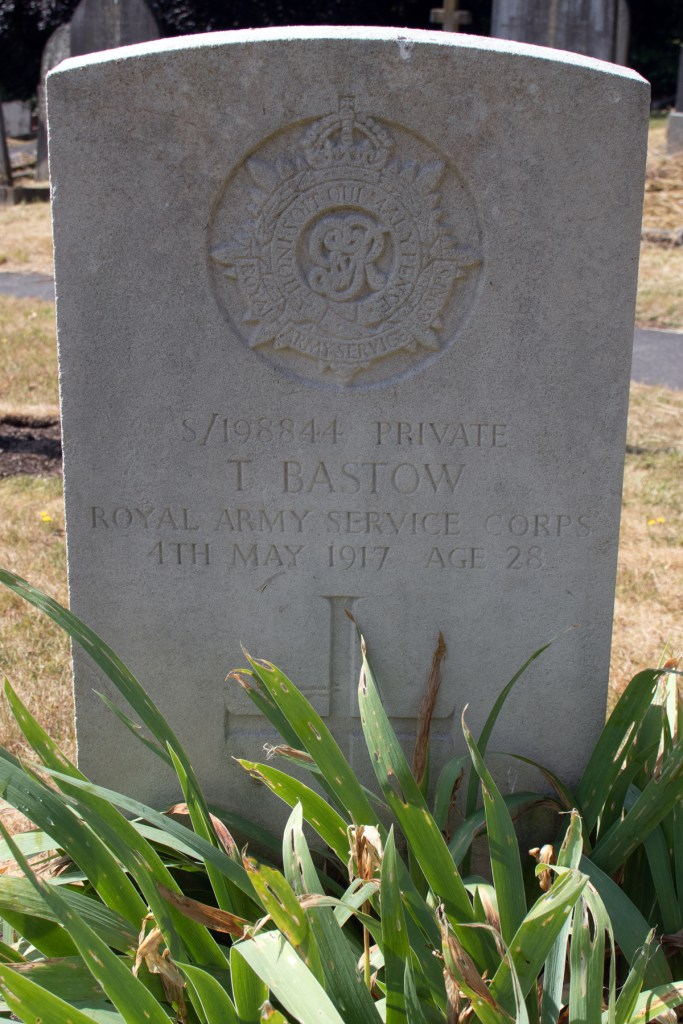
Thomas Bastow was born in the spring of 1889, the youngest of five children to Frederick and Mary Bastow. Frederick was from Weston-super-Mare in Somerset, but had met his Liverpudlian wife in Lancashire, and it was in the North West of England that the Bastow family had been raised. Mary passed away in 1898, when she was jus 40 years of age. Frederick remarried in 1901, Florence Travis becoming the young Thomas’ stepmother.
Frederick was an inspector for a mineral water company, but when Thomas left school, he found work as a clerk for the land registry. In the autumn of 1916, he married Margaret Hughes. Sadly, there is little more information about her, although their wedding was registered in West Derby.
It may have been that Thomas was in the army at this point, or at least on the verge of going. He enlisted in the Royal Army Service Corps, and was attached to one of the supply units. He seems to have been based in Somerset, as this is where he was hospitalised when he came down with appendicitis.
Private Bastow’s condition was to get the better of him: he passed away on 4th May 1917 while admitted to the Bath War Hospital. He was just 28 years of age.
Finances seem to have limited Margaret’s options when it came to her late husband’s funeral. Rather then being taken back to the north wet for burial, Thomas Bastow was instead interred in Bath’s Locksbrook Cemetery.
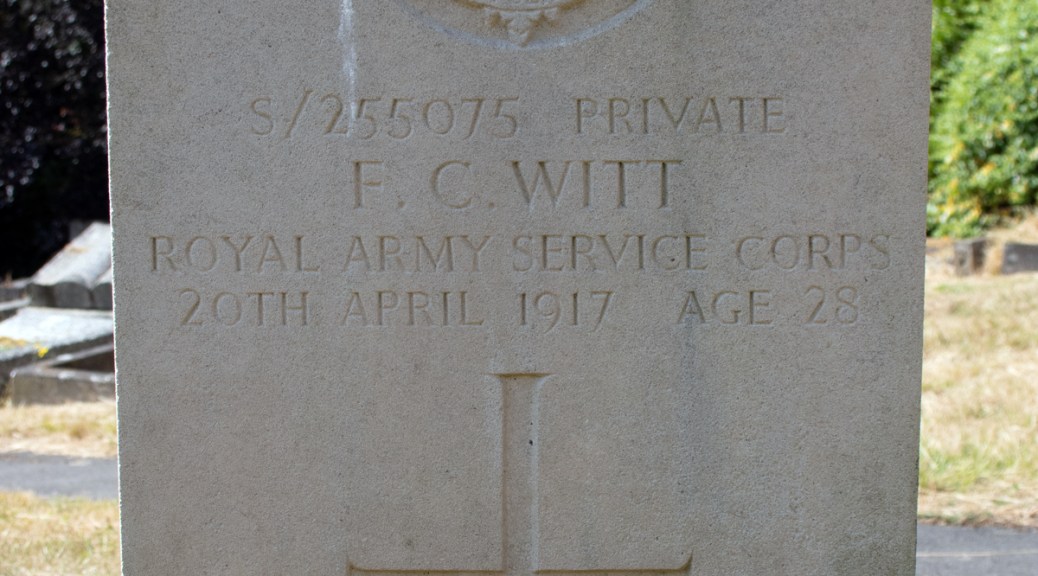
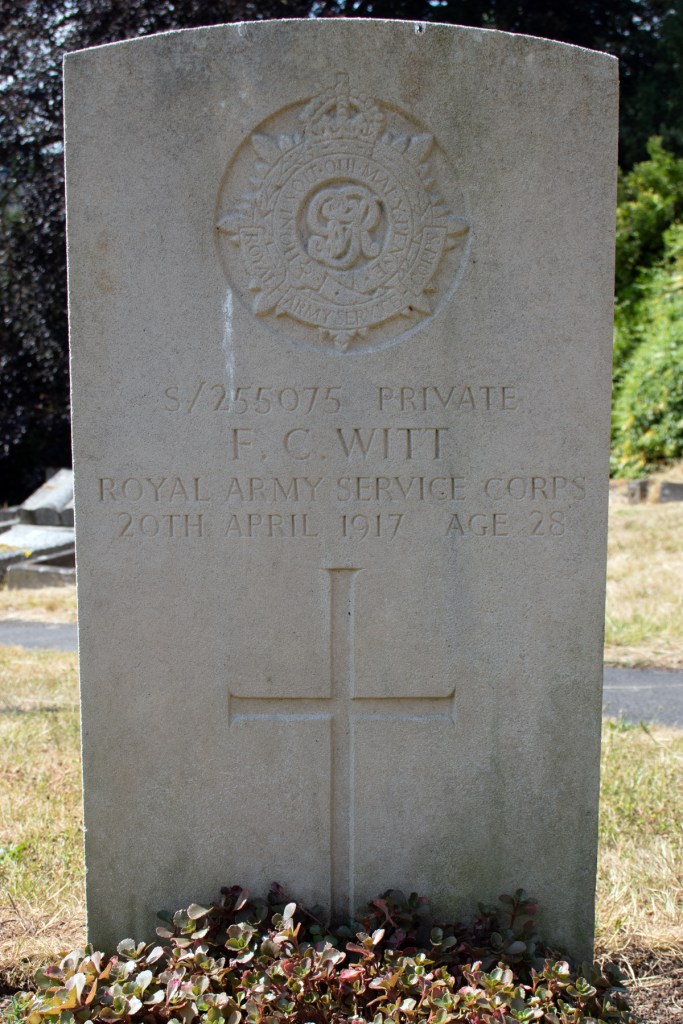
Frederick Charles Witt was born on 19th June 1888 in Amesbury, Wiltshire. The second youngest of eight children, his parents were journeyman baker Richard Witt and his wife, Elizabeth.
By the time of the 1901 census, Richard had set up a bakery in North Tidworth, ten miles north-east of Amesbury, with Frederick’s older brother, Alfred, helping out. This was a line of work that Frederick was also to go into when he completed his schooling: the next census return, in 1911, noted him as being his father’s assistant.
On 26th December 1912, Frederick married a woman called Kate Howard. The marriage took place at St Luke’s Church, Enfield, Middlesex. Kate was living in Enfield at the time, while hew new husband was based in Southampton, Hampshire. How a connection was made between the two is unclear, but the couple settled back in Southampton, and went on to have two children: Ivy and Doris.
When war was declared, Frederick was called upon to play his part. Full details of his service are unclear, but he had joined the Royal Army Service Corps by the start of 1917. Private Witt was attached to the Reserve Supply Personal Depot in Bath, Somerset, but, soon after enlisting, he contracted pneumonia.
Frederick was admitted to the Bath War Hospital in April 1917, but the condition was to prove too severe. He passed away on 20th April, at the age of 28 years old.
Frederick Charles Witt was laid to rest in Bath’s sweeping Locksbrook Cemetery. Interestingly, a newspaper report of his funeral did not mention the attendance – or existence – of Kate or their children; instead his parents seemed to take centre stage.
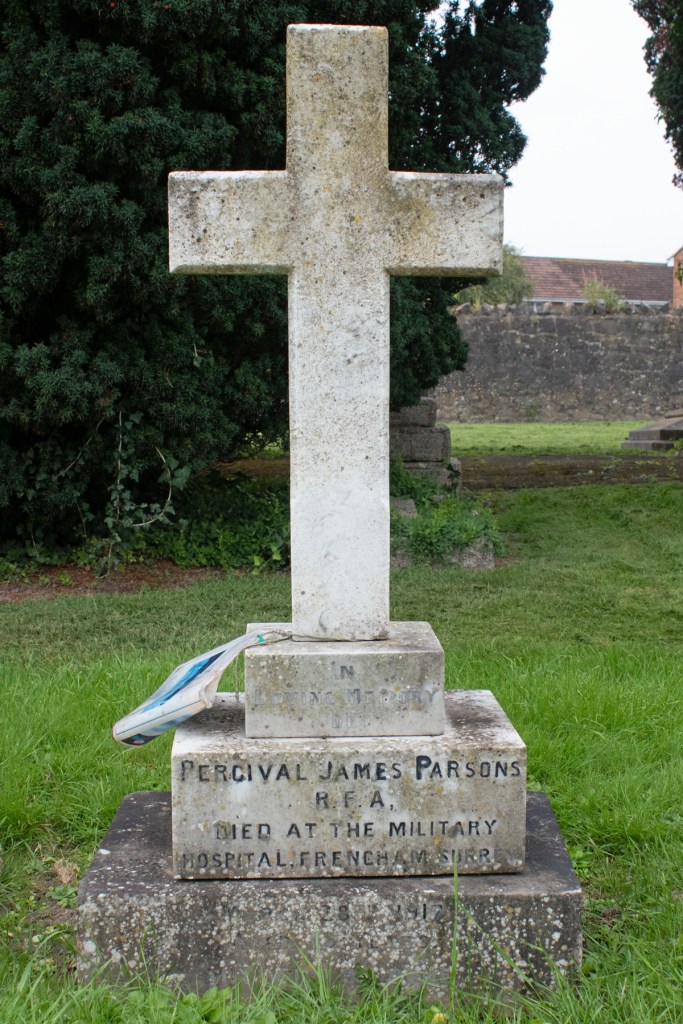
Percival James Parsons was born in the summer of 1898, and was the fourth of eight children to Henry and Emily. Henry was a railway labourer from Chilton Burtle, Somerset, and it was in the neighbouring hamlet of Chilton on Polden (now Chilton Polden) that the family were born and raised.
There is little documented about Percival’s short life. When war came to Europe, he was just 16 years of age. He was keen to play his part, however, probably spurred on by seeing his older brothers or friends step up.
Percival enlisted as soon as he turned 18 years old. He joined the Royal Field Artillery and was sent to Hampshire for training. Gunner Parsons was attached to E Battery of the 7th (Reserve) Brigade, a unit based ultimately in India during the confluct.
Gunner Parsons, however, was not to see service abroad. While he was training, he became unwell, contracting pneumonia. Admitted to the Frensham Hill Military Hospital, he was to succumb to the condition, passing away on 28th March 1917. He was just 18 years of age.
Percival James Parsons’ family had moved to Highbridge by this point, and it was here that Henry and Emily’s boy was taken for burial. He was laid to rest in the town’s cemetery.
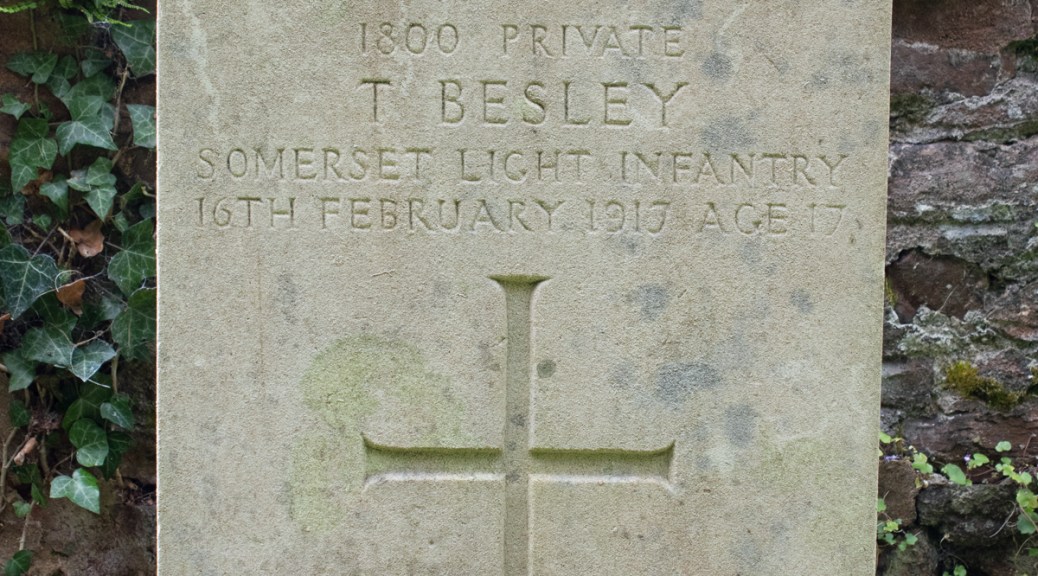
The short life of Thomas Besley is a challenge to unpick. He was born in Bampton, Devon, early in 1896, one of ten children to farm labourer Steven Besley and his wife, Fanny.
Steven’s work took the family around the region, and the 1901 census found the Besleys living on Cordings Farm in Wiveliscombe, Somerset. The document records Thomas as being 5 years of age, sharing the accommodation with his parents and six of his siblings.
The 1911 census records Thomas working as a live-in labourer at Manor Farm in Huish Champflower, a village just three miles outside of Wiveliscombe.
Meanwhile, his family are still recorded as living in Wiveliscombe itself, Steven and Fanny residing with four of their children. Now, however, another Thomas is listed with them: seven years old, he is the only child of their oldest son, William and his late wife, Elizabeth. She had died in 1904, around the same time as young Thomas’ birth, and it would appear that Steven and Fanny adopted their grandson (he is listed on the census as their ‘son’). William went on to marry again, but his new wife, a widow called Hannah, had seven children from her first marriage. The couple would go on to have a son of their own, but it was a crowded house, and so Thomas lived permanently with his grandparents.
The older Thomas Besley signed up almost as soon as war was declared in 1914. While his service records are sparse, he joined the 3rd/5th Battalion of the Somerset Light Infantry.
What can be determined from the records is that Private Besley drowned. His death certificate – which mistakenly records his surname as Beasley – confirms that Thomas’ body was found in the River Tone in Taunton on 16th February 1915, and the cause of death noted as ‘found drowned’.
While research for Besley draws a number of blanks about the circumstances of his death, the misspelled surname featured in a contemporary newspaper report:
On Tuesday afternoon, around four o’clock, MJ Chapman… while passing the Locks at Firepool, Priory, Taunton, observed what appeared to be the body of a man floating in the swirl caused by the overflow of the Locks into the pool. The police were immediately informed… and proceeded to the spot with the ambulance and recovered the body of a man, dressed in khaki uniform. The body had evidently been in the water for a considerable time and was much decomposed. The deceased was subsequently identified as Thomas Beasley, son of Mr Stephen Beasley, of Langley Marsh, Wiveliscombe. He was a private in the 5th Battalion of the Somerset Light Infantry, and was 40 years of age. He had been in ill-health for a considerable period, and latterly had been depressed. He disappeared on January 16th, and despite all enquiries his whereabouts remained a mystery until Tuesday…
[At the inquest] Stephen Beasley, a farm labourer… gave evidence of [Thomas’] identification. He said that his son had lately been ill. Three months ago he was taken from Salisbury Plain to Bristol Hospital, where he remained for about a month. After his discharge from Hospital he went home, where he remained about a fortnight, and for the last two months he had been quartered at Taunton. In this time witness had seen his son twice, but he could not say that he had been well since he came out of Hospital. He was low-spirited, but never told witness that anything troubled him.
Florence Beasley… sister of deceased, said she last saw her brother about a month ago in Taunton. He seemed very strange and low and would not speak unless spoken to first. He seemed to be troubled, and would not shake hands with her when she left him. He seemed to be always ‘studying.’ There was no suicidal tendency in the family…
Captain Burridge stated that deceased was sent to hospital from the Plain about September. About the middle of October he had a wire from Bristol Infirmary informing him that he was dangerously ill and dying. However, he got over that, and he was discharged on October 28th. He was sent for 22 days’ furlough to his home and returned to duty on November 22nd. Ever since that time he had not been in the best of health, but nothing had been noticed of his mental condition. He believed at one time there was a talk of his being discharged as medically unfit. He disappeared on January 16th.
The Coroner asked [how] long deceased had been in the service, and witness answered that he joined on June 1st, 1913. His complaint when removed to Bristol Hospital was double pneumonia.
On the suggestion of the Coroner, the jury returned an open verdict.
Taunton Courier and Western Advertiser: Wednesday 24th February 1915
In addition to the Besley/Beasley surname, the report features a couple more discrepancies. Thomas’ father’s name is given as Stephen, when it was Steven. The deceased is also recorded as being 40 years old when he died, when he was actually half that age.
Thomas Besley was laid to rest in the peaceful graveyard of St Andrew’s Church in Wiveliscombe. It gives his age as 17 years old and the date of his death as 16th February 1917.
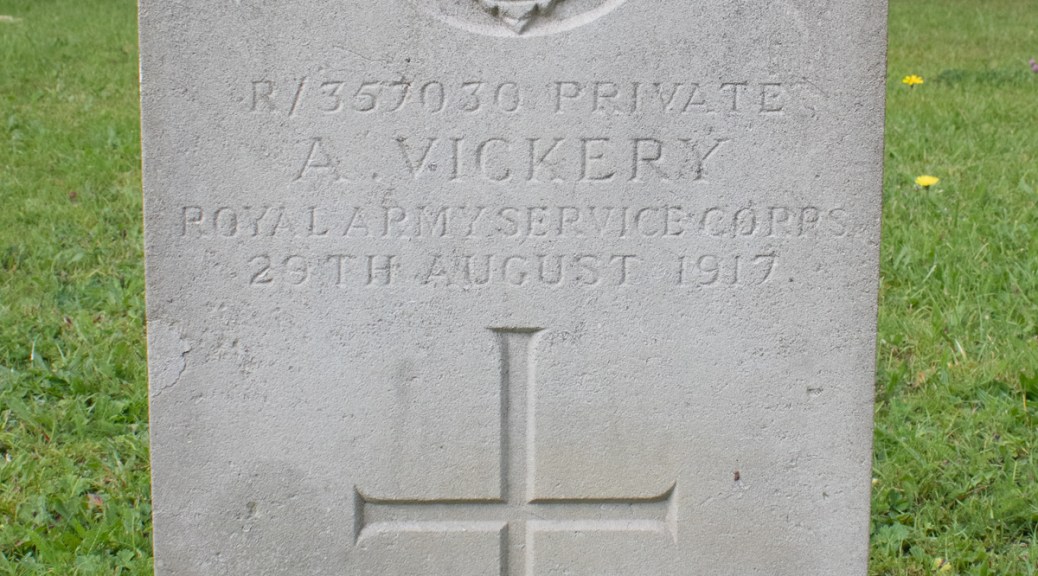
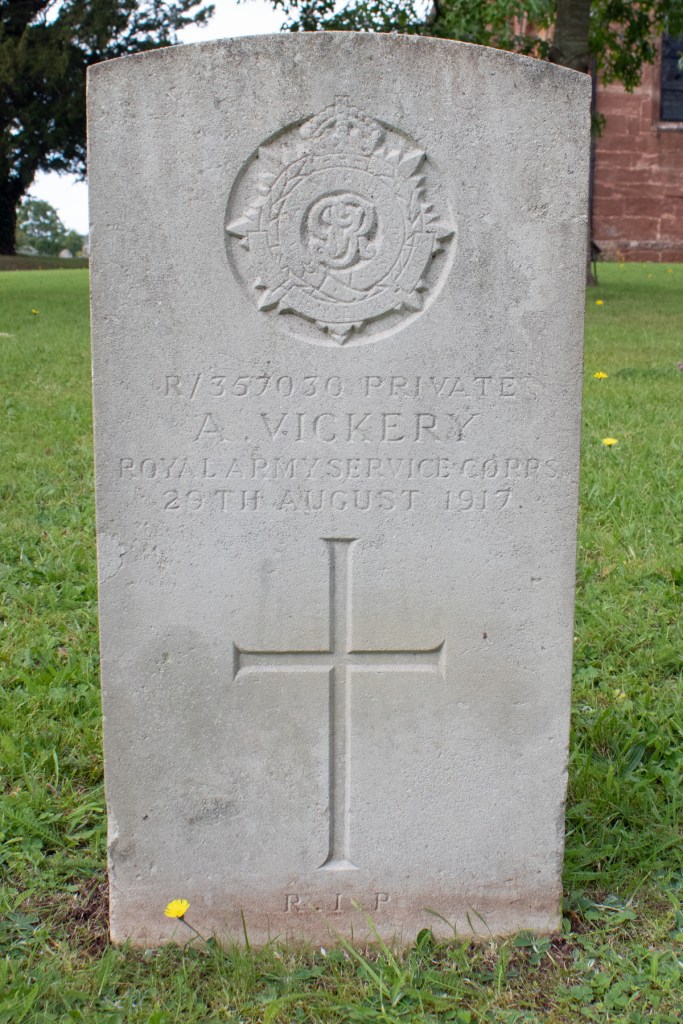
Amos Vickery was born in the autumn of 1886 in Bishops Lydeard, Somerset. He was the youngest of six children to William and Annie Vickery. William was a farm labourer, but when he finished his schooling, his son found work as a groom.
On 23rd February 1909, Amos married Alice Gratton. She was the daughter of a farm labourer from Halse, Somerset, who had taken up domestic duties in Bishops Lydeard. Not long after they were married, Amos took up new employment as publican of the Tynte Arms Inn in Enmore, and this is where he and Alice brought up their two children, Evelyn and William.
Amos’ time as a landlord seems not to have lasted long. By the time war broke out, the family had moved to Wiveliscombe, where he was working as a postman. Amos stepped up to play his part for King and Country, but was initially rejected. There are no longer any documents to confirm why this was the case, but it may have been based on any medical carried out.
Amos was finally accepted for armed service in June 1917, and was assigned to the Royal Army Service Corps. Private Vickery was attached to the Remounts Unit, and seems to have been posted around Bristol, Gloucestershire.
On Monday afternoon last the funeral took place… of the late Private Amos Vickery, ASC, who died somewhat suddenly from paralysis… at No 2 General Hospital, Bristol, at the age of 31, after a few days’ illness.
Taunton Courier and Western Advertiser: Wednesday 12th September 1917
Private Vickery’s service documents gave an official cause of death as hemiplegia and cerebral thrombosis: in effect, a stroke. He had been in the army for just ten weeks.
Amos Vickery was laid to rest in the graveyard of St Mary’s Church, Bishop’s Lydeard.
William Daniel Yandell was born in 1884 in Bishops Lydeard, Somerset. The second of four children, his parents were Samuel and Jane Yandell. Samuel was a farm labourer, and this is work that William and his younger brothers, wins Sam and Walter, also went into.
The 1911 census found William living with Walter, who had found employment as a labourer at Cotford Asylum, not far from the village. The brothers also had a boarder, Samuel Chaffey, a carter, who brought in some more money to the household. Samuel Sr and Jane were all that remained in the family home. Samuel Jr had married three years before, and was living in a small cottage with his wife, Rosina, and their two children. The oldest of the Yandell siblings, Alice, had been married for ten years by the time of the census, and was living with her husband and son in Minehead.
Samuel Sr died in the spring of 1914. By the summer, war had been declared, and the three Yandell brother enlisted to serve their king and heir country.
William, by this point, had found work at the Goodlands Coal Yard and volunteered for the local fire brigade. He did not enlist immediately but joined the Royal Fusiliers in the spring of 1916. Attached to the 3rd Battalion, Private Yandell found himself in France that summer.
On 1st October 1916, he was badly wounded in the right arm and shoulder, and was medically evacuated to the 2nd Western General Hospital in Manchester for treatment. This proved to be long-term support, and on 21st January 1917, he underwent an operation on the injury. Private Yandell was not to come round from the surgery: he passed away the following day at the age of 33 years of age.
William Daniel Yandell was brought back to Somerset for burial. He was laid to rest in the peaceful graveyard of St Mary’s Church in his home village of Bishops Lydeard.
The deepest sympathy is felt for [William’s] widowed mother and relatives, as the widow has another son a prisoner of war in Turkey, who was taken with General Townshend’s force at Kut, and no news has been heard since they were taken prisoner. Another son is somewhere in Salonica, from whom no news has been heard for some weeks past.
Taunton Courier and Western Advertiser: Wednesday 31st January 1917
Walter was the son being held in Turkey. He had joined the Somerset Light Infantry as a Private, and was assigned to the 1st/5th Battalion. His troop was caught up in the Siege of Kut in the spring of 1916. He died on 31st May 1916, soon after being taken prisoner, a fact his mother would not be made away of for at least nine months, based on the newspaper report. Private Walter Yandell is commemorated on the Basra Memorial in Iraq.
Sam Jr was the son who was based in Salonika. Full details of his military service are not available, but later records confirm that he survived the war. By the time of the 1939 England and Wales Register, he was living back in Bishops Lydeard with Rosina, and was working as a Mess Orderly at a military camp. Sam died in January 1951, at the age of 63.
William James Stevens was born in the autumn of 1891, and was the fourth of eight children to William and Emily Stevens. William Sr was a carter on a farm in Stogumber, Somerset, and this is where the family would come to be raised.
William Jr followed his father’s trade when he finished his schooling, but stepped up to serve his King and Country when war was declared. Little information remains about his time in the army, but it is clear that he had enlisted in the Royal Field Artillery by the spring of 1916.
The only other records relating to William are those connected to his passing. He was discharged from the army on medical grounds in November 1916, and was suffering from tuberculosis. He appears to have been admitted to a hospital that winter, and died from the lung condition on 16th February 1917. He was 25 years of age.
William James Stevens was laid to rest in the tranquil surroundings of St Mary’s Churchyard in Stogumber.
Richard George Birch was born on 8th July 1878, in Westminster, Middlesex. One of nine children, his parents were Samuel and Alice Birch. Samuel started work as a messenger for the House of Lords, and went on to be a military cap maker by the time of his son’s baptism.
When he finished his schooling, Richard found employment as a printer and compositor. He married Evelyn Groom in 1906, and the couple went on to have three children: Harry, Doris and Richard Jr.
The 1911 census showed a change in circumstances for the family. They were living in Farnham, Surrey, and their household was made up of Richard, a pregnant Evelyn, Harry, Doris and a servant, Florence. Richard had now left the printing business, as was employed as a comedian.
When war came to Europe in August 1914, Richard stepped up to play his part. Having enlisted by the spring of 1917, he initially joined the East Surrey Regiment, although at some point he made the transfer to the Royal Fusiliers.
Little information remains available about Private Birch’s military life. Attached to the 22nd (Service) Battalion, he seems not to have served overseas. It appears that he either served in Somerset, or was sent there to recuperate following an illness or injury, as he was in Burnham-on-Sea by the autumn of 1917. He passed away in the town on 19th September, the cause of his passing not freely recorded. He was 39 years of age.
Richard George Birch’s body was not taken back to Surrey, possibly because of financial constraints. Instead laid to rest in Burnham Cemetery, Somerset.








 Death and Service