Tag Archives: 1917

Ordinary Seaman Herbert Fry

Ordinary Seaman Herbert Fry

Herbert Austin Fry was born on 30th January 1889 in the Somerset village of Moorlinch. He was the fifth of ten children and his parents were Joseph and Ellen Fry. Joseph was a farmer, and by the time Herbert was just two years old, the family had moved to Sutton Farm, in nearby Sutton Mallet.

The whole family chipped in to play their part on the farm, and, even before he finished his schooling, this was something that Herbert was also destined to do.

When war came to Europe, Herbert was keen to play his part. He enlisted in the Royal Naval Volunteer Reserve on 7th September 1916 as an Ordinary Seaman. His service records give a hint as to the young man he had become: he was 5ft 11ins (1.8m) tall, with sandy hair, blue eyes and a fair complexion.

Ordinary Seaman Fry was initially sent to HMS Victory – the Royal Naval Dockyard in Portsmouth, Hampshire – for training. Over the next year, he was given two sea-going postings, before returning to HMS President in London in September 1917.

On 31st October, Herbert boarded SS Dunrobin, a merchant ship. Having sailed to Almeria in Spain, she was returning to Britain, with a cargo of iron ore and grapes. On 24th November 1917, while 49 miles (79km) south-west of The Lizard in Cornwall, the Dunrobin was torpedoed by a German submarine. She sunk, and 31 lives – including that of Ordinary Seaman Fry – were lost. Herbert was 28 years of age.

Herbert Austin Fry’s body was recovered and brought back to Somerset for burial. He was laid to rest in the peaceful Sutton Mallet Churchyard.

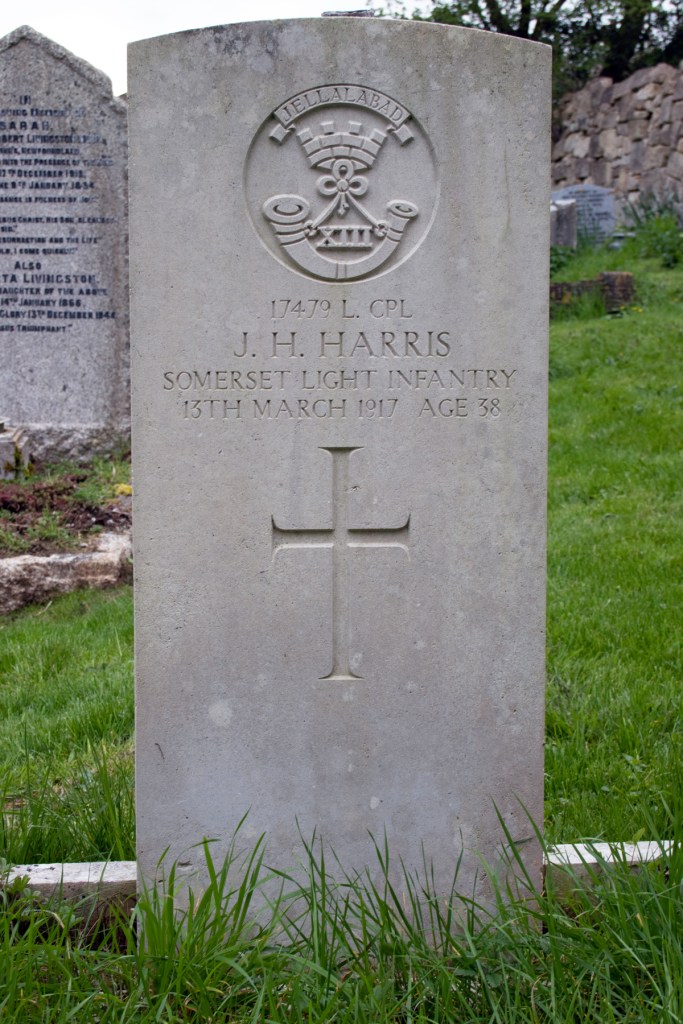
Lance Corporal John Harris

Lance Corporal John Harris

John Henry Harris was born at the turn of 1879, the oldest of eight children to John and Florence Harris. John Sr was a mason’s labourer from Somerset, and his and Florence’s three oldest children were born in Bishop’s Hull, near Taunton. By 1890, however, the family had moved to Monkton Combe, on the outskirts of Bath, presumably to follow John Sr’s work, and this is where they settled.

When John Jr completed his schooling, he followed in his father’s trade and when the 1901 census return was completed, he was employed as a mason’s labourer, while his father had moved into carpentry.

Florence died in April 1901, and six years later, John Sr remarried. His new wife was Ann Gibbs, and the couple went on to have three children, new half-siblings to John Jr.

In the autumn of 1905, John Jr married in Eliza Mundy, a cowman’s daughter from Monkton Combe. The couple settled in a small cottage on Mill Lane, and had a son, Frank, who was born in 1907. By this point, John had found new employment as a gardener to the local vicar, Reverend Pitcairn.

When war came to European shores, John quickly stepped up to enlist. He joined the 7th Battalion of the Somerset Light Infantry and arrived in France in July 1915 after his training.

Private Harris was wounded during the opening weeks of the Battle of the Somme, but recovered and returned to the Front Line. He was promoted to the rank of Lance Corporal, but in March 1917 he was wounded again. “A piece of his steel helmet was driven into his head at the temple, and little hope of his recovery was entertained from the first.” [Bath Chronicle and Weekly Gazette: Saturday 24th March 1917]

Medically evacuated to Britain, Private Harris was admitted to a hospital in Stockport, Cheshire. His “wife (who has been dangerously ill in hospital), Mr John Harris (his father) and a sister proceeded to Stockport, but, unfortunately, did not arrive until shortly after death had occurred.” [Bath Chronicle and Weekly Gazette: Saturday 24th March 1917]

Private Harris passed away on 13th March 1917, at the age of 38 years of age.

John Henry Harris’ body was brought back to Monkton Combe for burial and he was laid to rest in the peaceful graveyard of St Michael’s Church, his funeral being officiated over by his former employer, Reverend Pitcairn.


Eliza went on to marry again, wedding Walter Giggs in 1921. The couple went on to have a daughter, Margery, who was born two years later. Eliza lived on until 1949, when she died at the age of 69 years old. She was also laid to rest in St Michael’s Churchyard.


Private Henry Mitchell

Private Henry Mitchell

Henry Mitchell was born in the summer of 1892, the second of three children – and the only son – to George and Selina Mitchell. George was a gardener from Saltford, Somerset, and this is where he and Selina raised their young family.

By the time of the 1911 census, Henry had finished his schooling, and had followed his father into gardening for work. War was calling at England’s shores, however, and he was soon to take up a post in the army.

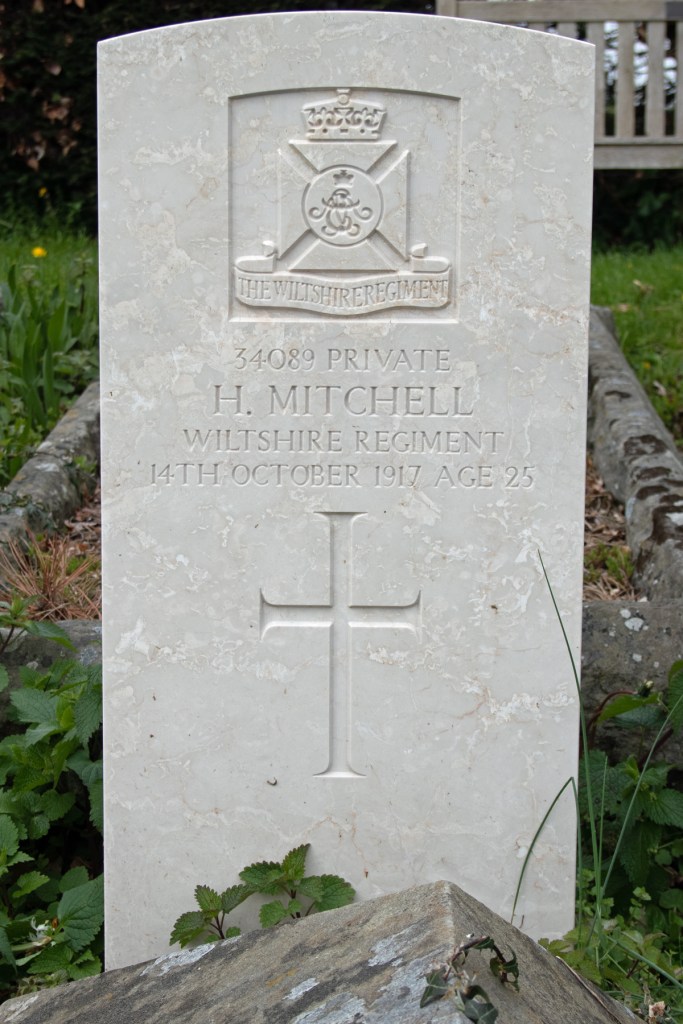
Full details of Henry’s military service are lost to time, but from his gravestone it is clear that he enlisted in the Wiltshire Regiment as a Private. From other documents it is possible to determine that he joined up by April 1917, and that he did not serve overseas. Instead, while his battalion – the 1st – fought at the Somme, Messines and Ypres, Private Mitchell was assigned to the regiment’s depot.

Henry seems to have been based in London, and he was certainly here in the summer of 1917. He was admitted to a hospital in Bethnal Green, and it was here that he breathed his last. He died on 14th October 1917, through causes unknown. He was just 25 years of age.

Henry Mitchell’s body was brought back to Somerset for burial. He was laid to rest in the family plot in the graveyard of the Blessed Mary Church in his home village of Saltford.


Private William Humphrys

Private William Humphrys

William James Humphrys was born early in 1880, the fourth of seven children to Mark and Alice Humphrys. Mark was a gardener from Wellow in Somerset, but it was in nearby Norton St Philip that the family were born and raised.

Alice died in 1904, by which time William was working as a mason’s labourer. By the time of the 1911 census, he was living in the family home on Church Street, with his father and two older sisters, Annie and Mary.

On 17th April 1911, William married Annie Holcombe, a farmer’s daughter from the village. It is likely that they set up home with Mark, but those details are lost to time.

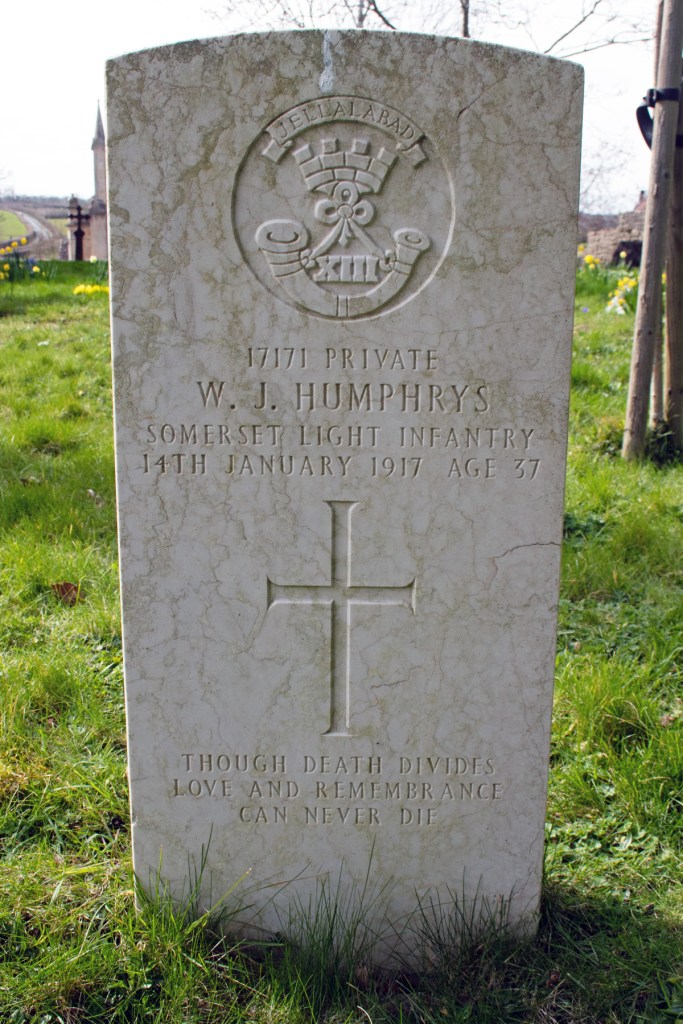
War came to Europe in the summer of 1914, and William was quick to step up and play his part. He enlisted in the Somerset Light Infantry early in 1915, and was assigned to the regiment’s 6th Battalion as a Private.

William arrived in France in June 1915, and over the next eighteen months was caught up in some of the fiercest battles of the war. The 6th Battalion first saw fighting at the Action of Hooge, where it had the misfortune to be the first to be attacked by flamethrower. During 1916, Private Humphrys was firmly ensconced at the Somme, although full details of his service are lost to time.

In fact, the only other concrete information about Private Humphrys is that of his passing, which happed on 14th January 1917 at King George’s Hospital in London. The cause of his death is unknown, but he was 36 years old at the time.

William James Humphrys was brought back to Somerset for burial. He was laid to rest in the quiet graveyard of Saints Philip & James’ Church, Norton St Philip, within sight of his family home.


Stoker 1st Class Francis Doel

Stoker 1st Class Francis Doel

Francis Benjamin John Doel was born in Glastonbury, Somerset, on 26th August 1897. The oldest of five children, his parents were Frederick and Alice Doel. Frederick was a mason’s labourer and, by the time of the 1911 census, the family had set up home in the village of Berkley, on the outskirts of Frome. Intriguingly, the census clearly gives Francis’ middle name as Crossman, although no other record confirms this.

When war broke out, Francis had left school, and was employed as a labourer in a brass foundry. By the start of 1916, however, he stepped up to serve his King and Country, and enlisted in the Royal Navy. His service records give his height as 5ft 3.5ins (1.61m) and note that he had brown hair, grey eyes and a fresh complexion.

Francis was assigned the role of Stoker 2nd Class, and was sent to HMS Vivid – the Royal Naval Dockyard in Devonport – for training. Within a matter of weeks, he was given his first posting, on board the cruiser HMS Dublin, although he only remained there for a month.

After having returned to HMS Vivid for a few weeks, Francis was assigned to another cruiser, HMS Essex. He appears to have been good at his job, and in November 1916 was promoted to Stoker 1st Class.

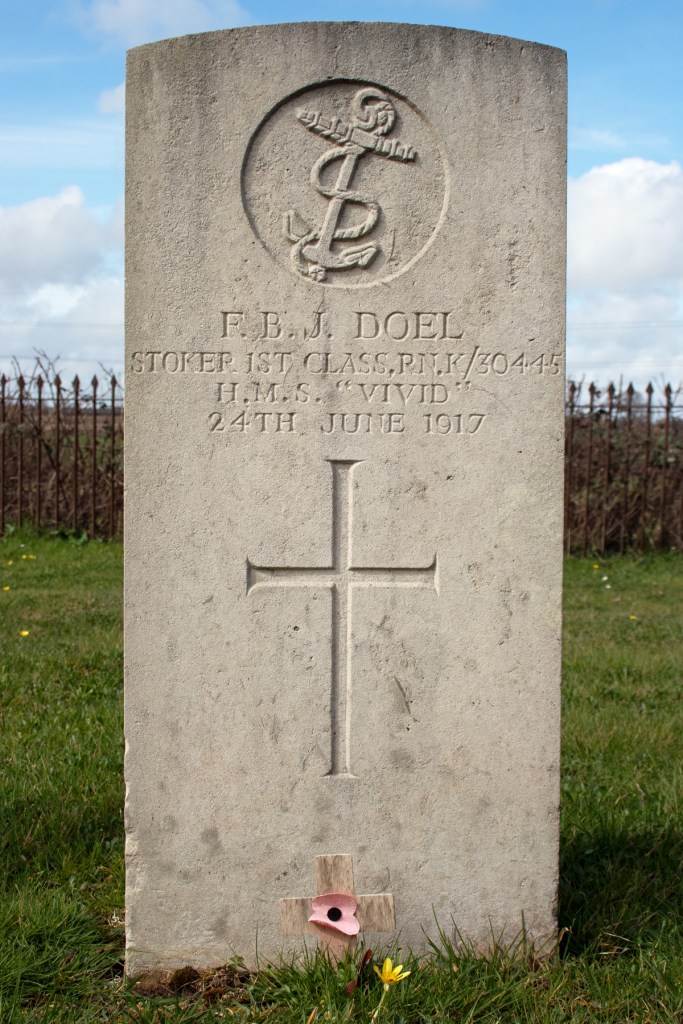
Stoker Doel returned to HMS Vivid in May 1917, preparing for his Leading Stoker exams. They were not to be, however, as on 24th June, he died, having ‘accidentally drowned’. No further information is available on his death, and the newspaper report of his funeral only notes that he “…met his death on Sunday week. His body was landed from his vessel, and was brought home for burial…” [Somerset Standard: Friday 6th July 1917]. He was just 19 years of age.

Francis Benjamin John Doel was brought back to Berkley for burial. He was laid to rest in the village’s church cemetery.


Private William Badman

Private William Badman

William Ewart Badman, whose first names appear interchangeable, was born in the summer of 1888, the older of two children to Francis and Elizabeth Badman. Francis was a builder from Holcombe in Somerset, and this is where the family were born and raised.

Francis died in 1905 and, after William’s sister, Cristabelle moved to Cardiff to take up work as a milliner, he stayed to help support his mother. The 1911 census recorded Elizabeth and William living in Holcombe, where he had found employment as a carpenter.

On 14th November 1915, William married dressmaker Amy Talbot. The couple were living in a terraced house in St Leonard’s Road, Bristol, where he was still finding work as a carpenter.

War had come to Europe by this point, and William was soon to play his part. He enlisted as a Private in the 11th Battalion of the Somerset Light Infantry, in November 1916. Full details of his military service are lost to time, but a local newspaper report give a little information:

Mr Ewart Badman, who… had undergone a slight operation, had passed away.

Somerset Standard: Friday 13th July 1917

No detail of the need for William’s operation are evident, nor does the report expand on his condition any further. His entry in the Army Register of Soldiers’ Effects confirm that he died at the War Hospital in Bath. He passed away on 1st July 1917, at the age of 29 years old.

William Ewart Badman’s body was brought back to Holcombe for burial. He was laid to rest in the graveyard of St Andrew’s Church in the village.


Private Reginald Bainton

Private Reginald Bainton

Reginald Thomas Bainton was born in Bath, Somerset, in the spring of 1889. The second of five children, his parents were bakers and confectioners Thomas and Mary Bainton.

While Reginald’s older brother Robert followed in his father’s trade, the 1911 census recorded that he had followed a different route, and was working as a hairdresser and tobacconist.

On Christmas Day 1913, Reginald married Henrietta Skinner, who was the daughter of a farmer. The couple went on to have a son, Reginald, who was born in July 1916.

War was, by this point, raging across Europe, and Reginald stepped up to play his part for King and Country. He enlisted in the autumn of 1916, and was assigned to the Royal Army Service Corps. Initially stationed in London, he moved to a camp near Reading, Berkshire, in March 1917.

One evening towards the end of that month, tragedy occurred.

[Private Bainton] was missing from his company, and when his service cap was found on the banks of the Thames there were fears that the worst had befallen him. On receipt of the news of his disappearance his wife proceeded to Reading in the hope of getting some information respecting him, and she remained there until the discovery of the body in the Thames on Monday. During the short period he was in the Reading camp, Private Bainton acted as the storekeeper.

At the inquest… the much-decomposed body was identified by [Reginald’s] father, and medical evidence was given that it had probably been in the water for three weeks to it is highly probable that Private Bainton was drowned on the first day he was mussed. There was not the slightest evidence as to how he got into the river, and the jury returned a verdict of “Found drowned”.

Bath Chronicle and Weekly Gazette: Saturday 28th April 1917

The date of Private Bainton’s death was recorded as 23rd April 1917 – the day he was found. He was 27 years of age.

Reginald Thomas Bainton’s body was brought back to Somerset for burial. He was laid to rest in St James’ Cemetery in his home city of Bath.


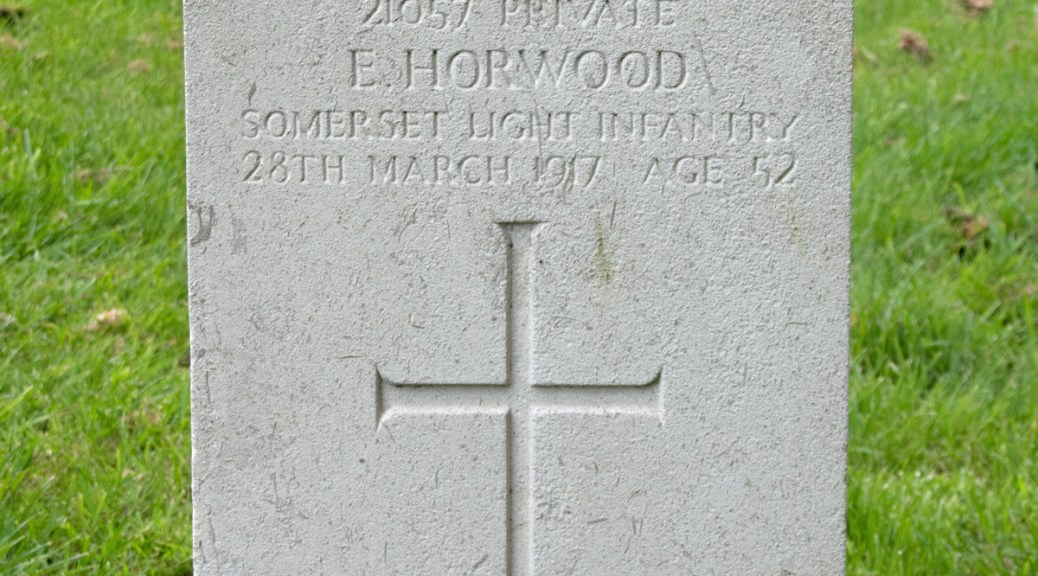
Private Edward Horwood

Private Edward Horwood

Albert Edward Horwood was born in Bath, Somerset, in the spring of 1864. The middle of five children, his parents were Joseph and Agnes Horwood. Joseph was a stone mason and, when Agnes passed away in 1872 he married again, this time to a woman called Elizabeth.

When he left school Albert – who became better known as Edward – found work in a local foundry. Joseph died in 1888, and just two years later, Edward married Emily Wheeler. She was the daughter of labourer from North Bradley, Wiltshire, and it was in the parish church that the couple exchanged vows.

The couple set up home in the Lyncombe area of Bath, and went on to have nine children, all but one of them girls. Edward continued with labouring work for the next twenty years, as his children grew in the family home in Cheltenham Street.

Despite his age, when was broke out in Europe, Edward stepped up to play his part. He enlisted in the Somerset Light Infantry on 6th November 1914, and was assigned to the 4th Battalion. His service records show that he was 44 year of age and 5ft 11ins (1.8m) tall.

Attached to one of the regiment’s supply companies, Private Horwood remained on the Home Front. He remained on active duty for more than eighteen months until, in June 1916, he was medically discharged because of a large ulcer and epithelioma (lesion) on his tongue. Edward’s medical notes suggest that he was offered an operation to remove the potentially malignant growth, but that he had declined.

At this point Edward’s trail goes cold. He returned home, and passed away on 28th March 1917 and, while the cause is not publicly documented, it seems likely to have been related to the growth in his mouth. He was 52 years of age.

Albert Edward Horwood was laid to rest in the St James Cemetery in his home town of Bath.


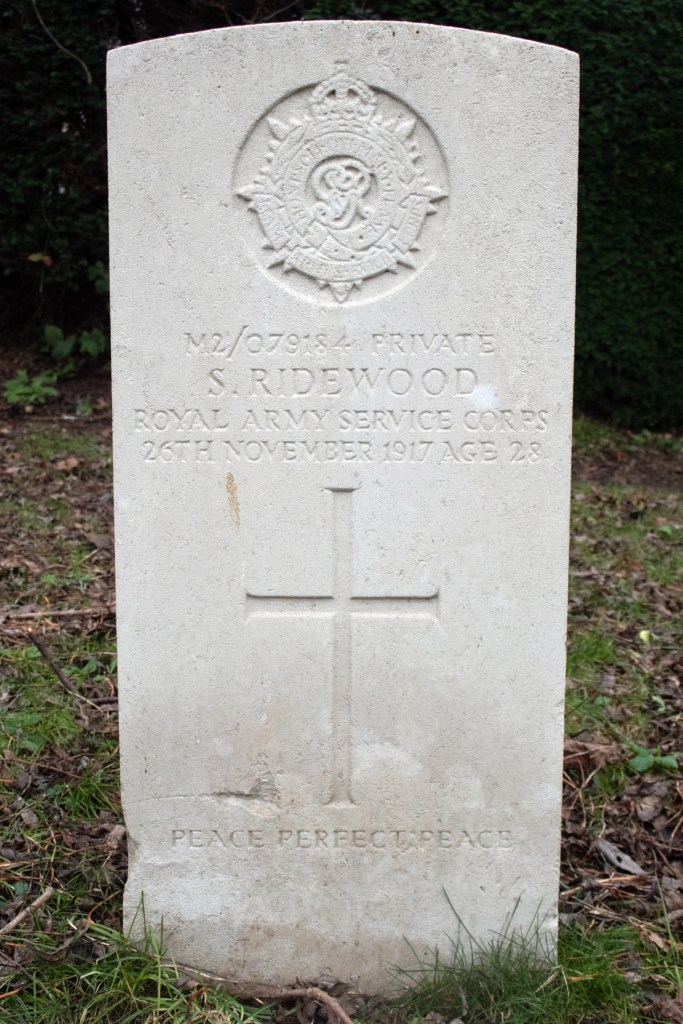
Private Sydney Ridewood

Private Sydney Ridewood

Sydney Ridewood was born in Bath, Somerset, on 31st March 1891, and was one of eleven children. His parents were labourer and sometime butcher James Ridewood and his wife Mary.

When Sydney left school, he found work as a baker, although this seems to have been as piecemeal a job as his father’s.

In January 1910, Sydney married Kathleen Scudamore. She was the daughter of a carpenter from the Twerton area of Bath and had a bit of a chequered background herself.

On 10th June 1896, Kathleen had married Edward Edwards, who was twelve years older than her seventeen years. Their marriage certificate suggested he was a clerk, although the 1901 census – which included their two children, Charles and Percy – recorded him as being a draper’s porter. Beyond that document, there is no record of Kathleen’s husband and, by the time of her marriage to Sydney, she had reverted to her maiden name.

By the time of the 1911 census Sydney and Kathleen were living in central Bath, with their nine-month old daughter, Olive, and Kathleen’s two sons. Kathleen’s widowed father, Edmund, her brother Claude and sister-in-law Nora were also in the household.

The document recorded Sydney as still employed as a journeyman baker, while his wife was a cook for the Post Office. Edmund was working as a carpenter, Claude was a sawyer, Nora a shop assistant and 14-year old Charles was a messenger boy, also for the Post Office. Six pay cheques coming in to support the extended family in the four-roomed house.

An additional member of the Ridewood family came along on 22nd October 1913, when Kathleen gave birth to a second child, Sydney Jr.

War was on the horizon by this point, and, on 20th April 1915, Sydney stepped up to play his part. He enlisted in the Royal Service Corps, and was assigned to the Mechanical Transport Corps. There is little detail about Private Ridewood’s service, although his records show that he was 5ft 3ins (1.6m) tall, with auburn hair, brown eyes and a fresh complexion.

Sydney was sent to France a month after enlisting, and his may role seems to have been that of a driver. He remained on the Western Front for a little over two years, before contracting pleurisy. He was initially treated in France, but soon returned to Britain to recuperate. The lung condition, however, was to get the better of him, and he passed away at home on 26th November 1917, weeks before he was to be medically discharged from service. He was just 28 years of age.

Sydney Ridewood was laid to rest in St James’ Cemetery, a few minutes’ walk from his family home.


Private Ernest Whatley

Private Ernest Whatley

Ernest James Victor Whatley was born in the spring of 1899, the youngest of three children to George and Clara Whatley. Clara passed away in 1908, and George remarried the following year, to a woman called Sarah. Ernest’s brothers were sixteen years older than him, and so by the time of the 1911 census they had moved out of their father’s home. By that point, Ernest living with his father and stepmother in their house in Bath, Somerset.

Little further information is available about Ernest. With war raging across Europe, he enlisted in the army, but this was not before September 1916, and it is likely that he came of age before joining up.

Private Whatley served in the 1st/7th (Cyclist) Battalion of the Devonshire Regiment, and was based in Suffolk. It is while he was billeted that he was admitted to a hospital in Ipswich, although the cause of his admission is unclear.

Whatever befell Private Whatley, it was to prove his undoing. He passed away in the Ipswich hospital on 9th March 1917, at the tender age of just 18 years old.

Ernest James Victor Whatley’s body was brought back to Somerset for burial. He was laid to rest in St James’ Cemetery, Bath, not far from his mother, Clara.