Tag Archives: 1917

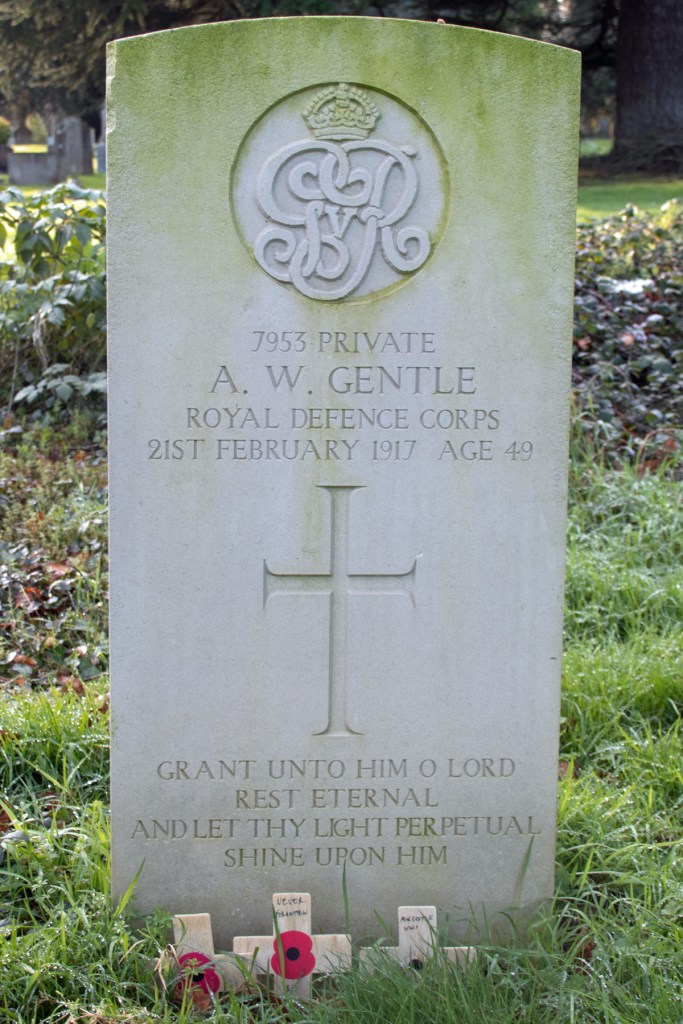
Private Arthur Gentle

Private Arthur Gentle

Arthur William Gentle was born in 1867 in Whitelackington, Somerset. The son of Maria Gillard, his father is not noted, although he was accepted as one of the family when Maria married Richard Gentle in 1873. The couple went on to have eleven children of their own, giving Arthur a large family of siblings.

Richard was an agricultural labourer, and this was a trade into which Arthur followed. On 23rd October 1897, Arthur married Mary Marsh, a labourer’s daughter from South Petherton. The couple tied the knot in her local church, the illiterate Arthur marking his intent with a cross.

The couple set up home just off Silver Street in South Petherton, and went on to have ten children of their own. The 1911 census recorded Arthur still employed as an agricultural labourer, his oldest son following suit, and Mary – who was also known as Polly – raising the family.

War came to Europe, and, despite his age, Arthur felt a need to play a part. While full service records are no longer available, what remains confirms that he had enlisted by the summer of 1916, and had joined the 300th Protection Company of the Royal Defence Corps.

Sadly, Private Gentle’s military career was to end in the same way as so many of his army colleagues. He contracted pneumonia during the winter of 1916, and passed away at home on 21st February 1917. He was 49 years of age.

Arthur William Gentle was laid to rest in the cemetery of his adopted home town, South Petherton.


Arthur’s brother Frank Gentle also fought in the Great War. Assigned to the 1st Battalion of the Somerset Light Infantry, he was caught up in the fighting in the Somme, and was killed on 14th July 1916. He was just 26 years of age.

Private Frank Gentle is commemorated on the Thiepval Memorial in Northern France.

Private George Allen

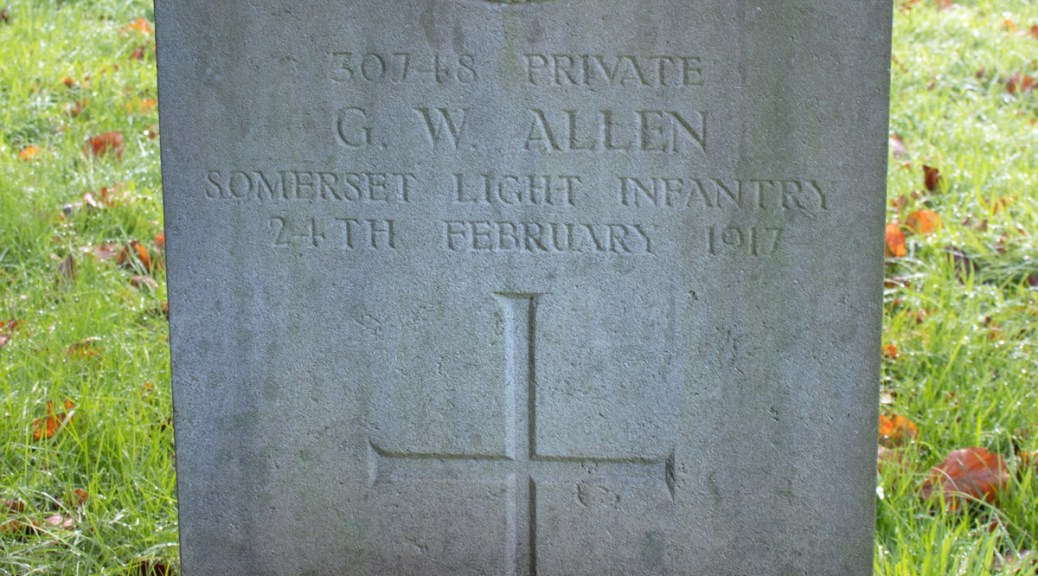
Private George Allen

George William Allen was born in the spring of 1887, in the hamlet of Over Stratton, near South Petherton, Somerset. One of eight children, his parents were farm labourer William Allen and his wife, Martha. When he left school, George also found agricultural work and, by the time of the 1911 census, was the only one of his siblings still living with his parents.

On 12th October 1912, George married Ellen Mary Osborne, a labourer’s daughter from Norton-sub-Hamdon, and it was in her parish church – St Mary’s – that the young couple tied the knot. The couple went on to have a daughter – Dorothy – who was born the following year.

War came to Europe in 1914, and George stepped up to play his part. conscripted towards the end of 1916, he joined the 4th (Reserve) Battalion of the Somerset Light Infantry. Full details of his service are no longer available, but Private Allen appears to have contracted bronchial pneumonia not long after he was called up.

Sadly, the lung condition was to prove unassailable, and Private Allen passed away on 24th February 1917. He was just 30 years of age.

George William Allen was brought back home for burial. He was laid to rest in South Petherton Cemetery, not far from the hamlet of Yeabridge, where his widow and daughter were now living.


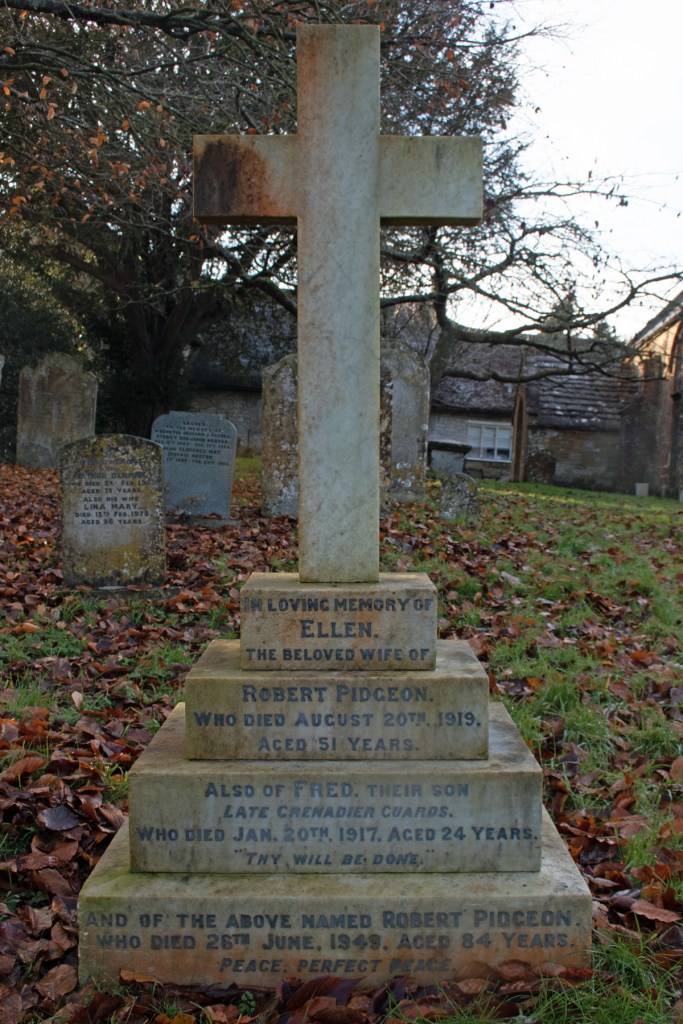
Private Frederick Pidgeon

Private Frederick Pidgeon

Frederick Pidgeon was born on 18th December 1892 in the Somerset village of Lopen. One of four children – and the only son – his parents were Robert and Ellen Pidgeon. Robert was a baker and, by the time of the 1911 census, only Linda – the youngest of Frederick’s siblings – was not helping in the business.

When war broke out, Frederick – who was better known as Fred – wanted to play his part. He enlisted on 7th December 1916, joining the 5th Battalion of the Grenadier Guards. As his was purely a territorial troop, Private Pidgeon was sent to the regimental barracks in Caterham, Surrey, for training.

At a time of tremendous upheaval, with men from all over the country suddenly thrust together in tightly packed barracks, it is no surprise that disease sometimes took hold. Tragically, Fred was not to be immune to this, and, on the 15th January 1917, he was admitted to the camp hospital, having contracted pneumonia.

The lung condition took a swift hold, and, tragically, Private Pidgeon was to succumb just a few days later. He breathed his last on 20th January 1917, at the age of just 24 years old. He had been in the army for just 44 days.

Fred Pidgeon was brought back to Somerset for burial. He was laid to rest in the family plot in the peaceful graveyard of All Saints’ Church, in his home village of Lopen.


Private Frederick Pidgeon

Ellen passed away in August 1919, aged just 54 years old, and was laid to rest alongside her son. Robert died some thirty years later, on 26th June 1949; he too was buried in the family plot, mother, father and son reunited once more.


Private William Julian

Private William Julian

William Julian was born in the spring of 1879, in the Cornish village of St Breock. He was one of five children to agricultural labourer John Julian and his wife Mary. Mary appears to have died when William was young as, by the time of the 1891 census, John was married to an Emily Julian, whose 10-year-old daughter, Fanny Jane Pinch, was also living in the family home.

At this point, it becomes difficult to accurately track young William’s life. The surname Julian is not uncommon in Cornwall at this point, and, while the 1901 census confirms he had moved out of the family home, gives a couple of potential alternatives. The most likely is a William Julian, boarding in St Germans, Cornwall, who working as a waggoner, although it is impossible to categorically connect the census return to this William Julian.

The next census, however, gives more confirmation of William’s location. He was working as a tin miner, and lodging with Richard and Jane Sweet in Withiel, Cornwall.

It is not long after this that he married Maud Brenton. The couple set up home in the hamlet of Burlawn, to the south of Wadebridge, and went on to have four children: William, born in 1912, John, born in 1914, and twins Jeremiah and Samuel, who were born in 1915.

By this point war was raging across Europe, and, while, as a miner William would have been in a protected profession, his time came to step up and serve King and Country. In the spring of 1917, he did just that, joining the Labour Corps as a Private. Little detail of his military service survives, but is is likely that he did his duty on home soil.

Private Julian’s time in the army was not to be a long one, however, and he developed haemoptysis, possibly as a result of a lung condition. This was to lead to his passing; he died on 29th August 1917, at the age of 38 years old.

William Julian was brought back to Cornwall for burial. He was laid to rest in the tranquil graveyard of St Breoke’s Church, the parish in which he was born and lived


Corporal Thomas Teague

Corporal Thomas Teague

Thomas Teague was born in the spring of 1884 in the Cornish town of Tintagel. He was one of ten children to quarryman and road labourer John Teague and his wife, Ellen. When he first left school, Thomas found work as a farm labourer. By the time of the 1911 census, he was still living in the family home, but had found more skilled work as a stone mason.

Much of the rest of Thomas’ life remains a mystery. John passed away in September 1914, and it is clear that, with war now raging across Europe, Thomas stepped up to play his part. He enlisted in the Royal Dublin Fusiliers, and was assigned to the 7th Battalion. The regiment served in Gallipoli, Salonika and Egypt, although it is not possible to identify where Private Teague served.

At some point, potentially because of health reasons, Thomas was transferred to the 655 Home Service Coy of the Labour Corps. Again, exact details of his service are unclear, but he had been promoted to the rank of Corporal, and appears to have been based in Curragh Camp, not far from Kildare, Southern Ireland.

The only other confirmed record relating to Corporal Teague is that of his passing. He died of heart disease in the camp, on the 2nd October 1917. He was 33 years of age.

Thomas Teague’s body was brought back to Cornwall for burial. He was laid to rest in the peaceful graveyard of St Materiana’s Church, overlooking his home village of Tintagel.


Thomas was buried in the family plot, alongside his father. When his mother, Ellen, passed away in 1930, she was reunited with her husband and son.


Private Lot Hayward

Private Lot Hayward

Lot Hayward was born in November 1897 in the Somerset village of West Coker. The seventh of eight children, his parents were Walter and Elizabeth Hayward. Walter was a twine maker at a local factory, but when Lot left school – and after Elizabeth died in 1908 – he found work as a farm labourer.

Lot was seeking bigger and better things in life, however, and on 18th August 1913, he enlisted in the Royal Marine Light Infantry. His service records confirm that he was 5ft 6ins (1.67m) tall, had light brown hair, brown eyes and a pale complexion. It also confirms that he lied about his age – giving his year of birth as 1895 in order to be accepted for service.

Private Hayward joined up at the recruitment depot in Deal, Kent, and, after training there, he was sent to Plymouth in Devon, arriving there in June 1914. Over the next couple of years, he moved between Devon and HMS Victory, the Royal Navy Dockyard in Portsmouth, Hampshire.

When war was declared, Lot also served overseas, fighting at Antwerp, Alexandria and in Turkey. While there in the summer of 1916, he fell ill, contracting pulmonary tuberculosis. He returned to Plymouth, and was admitted to the Royal Naval Hospital in the city.

His lung condition meant that Private Hayward could no longer perform his duties as a soldier. He was medically discharged from the navy on 10th June 1916.

Lot returned home, but his condition grew steadily worse. He eventually succumbed to it, passing away on 18th November 1917, at the tender age of just 20.

Lot Hayward was laid to rest in the graveyard of St Martin’s Church in his home village of West Coker. Reunited with his mother, Lot’s father, Walter, was also laid to rest in the family plot when he passed away in 1920.


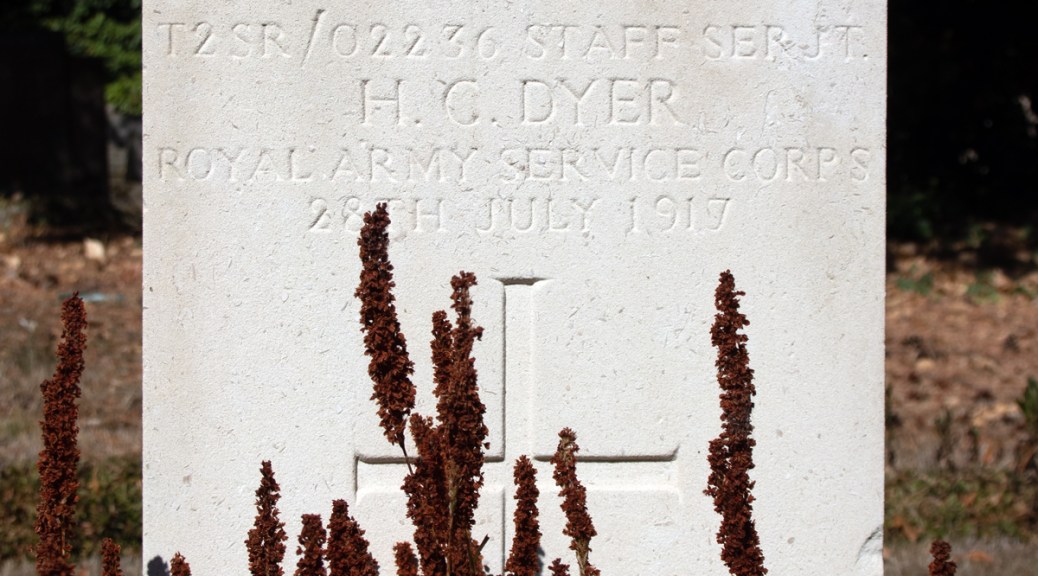
Staff Serjeant Henry Dyer

Staff Serjeant Henry Dyer

Henry Charles Dyer was born in January 1865 in the Devon town of Ivybridge. The oldest of five children, his parents were carpenter James and dressmaker Mary Dyer. When he left school, Henry found work as a cordwainer’s apprentice but, after James died in 1886, he sought out a career that would help support his mother.

Henry enlisted in the Army Service Corps on 10th July 1886 and, by the time of the next census was based at barracks in Woolwich, South London. His service records note that he was 5ft 4.5ins (1.64m) tall and weighed 124lbs (56.25kg). He had a dark hair, grey eyes and a dark complexion. He was also noted as having a tattoo of a cross on his left forearm.

Private Dyer served in the regiment on home soil for more than thirteen years, qualifying as a horse collar maker and saddler during this time and rising through the ranks. He was made a Driver in 1889, Corporal in 1895 and Staff Sergeant in October 1899.

Trouble was afoot on the other side of the world by this time and his promotion was linked to Henry being sent to South Africa. He was there for eighteen months, and was awarded the Queen’s South Africa Medal, as well as clasps for service at Tugela Heights, the Relief of Ladysmith, Laing’s Nek, Transvaal and Orange Free State.

Staff Sergeant Dyer went back to Britain in April 1901, where he remained for a further six years. On 4th July 1907, reached the end of his term of service and having completed 21 years with the Army Service Corps he returned to civilian life.

Henry moved back to Devon, moving back in with his mother and younger brother. Mary had remarried after James passed, but her second husband had also passed away, and so having two of her sons home would have been of comfort to her. The 1911 census records the family as living in three rooms of a house in Grenville Street, Plymouth. They shared the property with the Smith family, a husband, wife and two children. Henry was recorded as an army pensioner (saddler), while his brother Ernest was listed as being a watchmaker, while also in the army reserve.

War was on the horizon again, and, Henry was one of the first to step up when it was declared. He was 49 years old by this point, and so technically exempt from enlisting, but as an army life had served him well before, it must have seemed fit for him to serve King and Country once more.

Staff Sergeant Dyer’s new service records noted that he was formally employed as a saddler, and that he had put on 18lbs (8kg) since he initially signed up.

Henry was based firmly on home soil this time round, and while he was initially based in Aldershot, Hampshire, he seems to have been moved to barracks in Kent. He served for more than two and a half years, but his health seems to have been suffering by this point. At a medical on 24th July 1917, he was deemed to be no longer fit enough for war service and was discharged from the army.

It is likely that this discharge came while he was admitted to the Preston Hall Military Hospital in Aylesford. While Staff Sergeant Dyer’s earlier military service is fairly detailed, his later career is not. What is clear is that, four days after being discharged, he passed away. He was, by this time, 52 years of age.

A lack of funds may have prevented Mary from bringing her son home to Devon. Instead Henry Charles Dyer was laid to rest in the graveyard of St Peter and St Pauls Church in Aylesford, not far from the Kent hospital in which he passed.


Private Harold Wheeler

Private Harold Wheeler

Harold Wheeler was born on 22nd May 1898 in Gloucester. One of nine children, his parents were George and Emma Wheeler. George, who worked as a telegraphist and clerk for the Post Office, was from Rugby, but by the time he and his Swansea-born wife has their second child, they had settled down in Gloucestershire.

There is tragically little information on Harold’s life and it is impossible to know what he did between leaving school and enlisting in the army. War broke out in 1914, and, while too young at the time, he had joined up by early 1917.

Private Wheeler was assigned to the 3rd (Reserve) Battalion of the Gloucestershire Regiment. Based in Kent, he was billeted in Maidstone. The only other record available for him is that of his passing. He had been admitted to the Military Hospital in Aylesford, and died, through causes unknown on 24th June 1917. He had just turned 19 years of age.

Harold Wheeler was laid to rest in the graveyard of the nearby St Peter’s & St Paul’s Church in the Kent village where he had passed.


Saddler Henry Evans

Saddler Henry Evans

Henry Evans was born in Newport, Monmouthshire, in the summer of 1883. Little concrete information remains about his early life, but it is clear that he was boarding with a dock labourer and his family in the town by the time of the 1901 census.

Henry married Margaret Jane Garner in Pontypridd on 14th March 1909. Within a couple of years, the young couple had moved to Llangollen in Denbighshire, and had had two children, Horace and Emlyn. Henry was now working as a saddler.

War was coming to Europe and, in November 1915, Henry enlisted in the Royal Army Service Corps. His previous trade saw him well, as he was assigned to the regiment’s 1st Company with the rank of Saddler. His service records show that he was 5ft 8.5ins (1.74m) tall, had no distinctive marks, and that his was Wesleyan in his beliefs.

After a few weeks on home soil, Saddler Evans was sent to the Western Front, arriving there just before Christmas 1915. For the next year, he worked in France, returning to Britain 366 days after he left for the continent. By this point, however, his health seems to have been suffering, and it was to prove to be the beginning of the end for him.

Saddler Evans was suffering from transverse myelitis, an inflammation of the spinal cord. Symptoms can be wide-ranging, but in Henry they were severe enough to be viewed as a permanent ailment. At the end of May 1917, while admitted to the Queen Alexandra Hospital on Millbank, London, he was recommended for immediate military discharge.

Unfortunately, as is often the way with bureaucracy, the discharge papers went missing. In July 1917, Henry was moved to the Croesnewydd Hospital in Wrexham, and is was here, a month later, that his documents caught up with him. Saddler Evans was finally discharged from military service on 4th August 1917.

Sadly, his army status was not to have any kind of effect on his health: at 9:30am on 17th August Henry passed away while still admitted to the Wrexham hospital. He was just 34 years of age.

Brought back to Llangollen for burial, Henry Evans was laid to rest in a plot in the town’s Fron Cemetery. He was to be reunited with his family in time: Horace died in 1940, Margaret in 1956 and Emlyn in 1963, and all were laid to rest in the same grave.


Lance Corporal Thomas Roberts

Lance Corporal Thomas Roberts

Thomas Roberts was born in Llangollen, Denbighshire, in 1895. One of seven children, his parents were William and Ellen Roberts. William was a butter merchant, and his wife helped in the business.

When Thomas left school, he found work as a greengrocer’s assistant, but when war was declared he saw an opportunity for glory. While full details of his military service are no longer available, it’s clear that he enlisted in the Royal Welch Fusiliers.

Private Roberts was assigned to the 13th (Service) Battalion (1st North Wales) and on 1st December 1915, found himself in France. For the next eighteen months, he was firmly ensconced on the Western Front, and rose to the rank of Lance Corporal for his service.

In April 1917, Thomas was injured in fighting and was medically evacuated to Britain for treatment to his bullet wounds. Admitted to the Edmonton Military Hospital in North London, his injuries were to prove too severe. Lance Corporal Roberts passed away on 22nd April 1917. He was just 21 years of age.

Brought back to Wales for burial, Thomas Roberts was laid to rest in the family plot in Llangollen’s Fron Cemetery.


Thomas was buried along with his brother David, who had passed away in 1912. They were joined by their father William, who died in 1919, and their sister Elizabeth, who passed away in 1945. The family were finally reunited with Ellen, when she died in 1947, at the age of 86.