Tag Archives: 1917

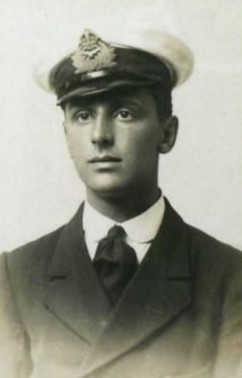
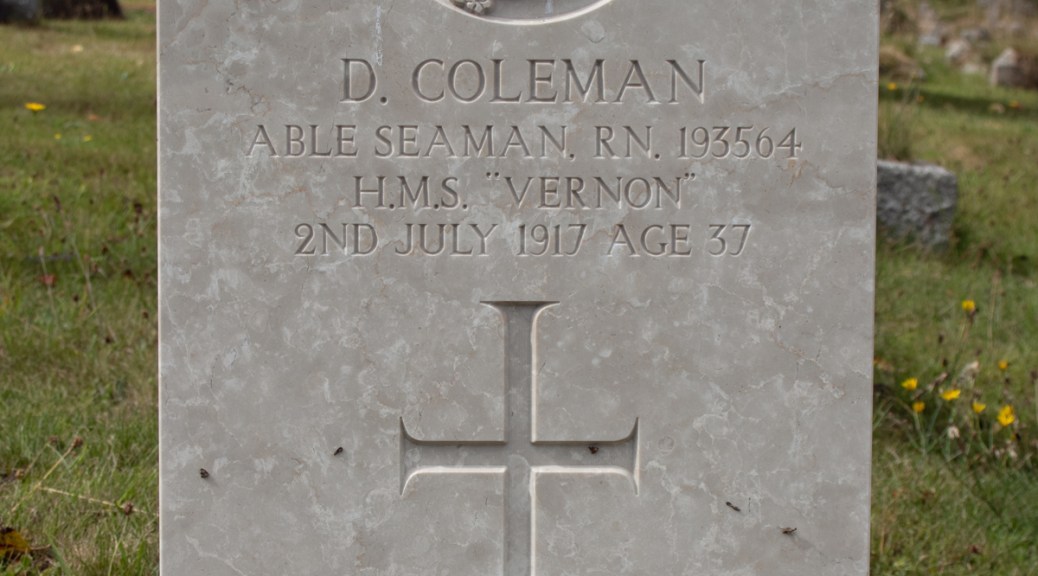
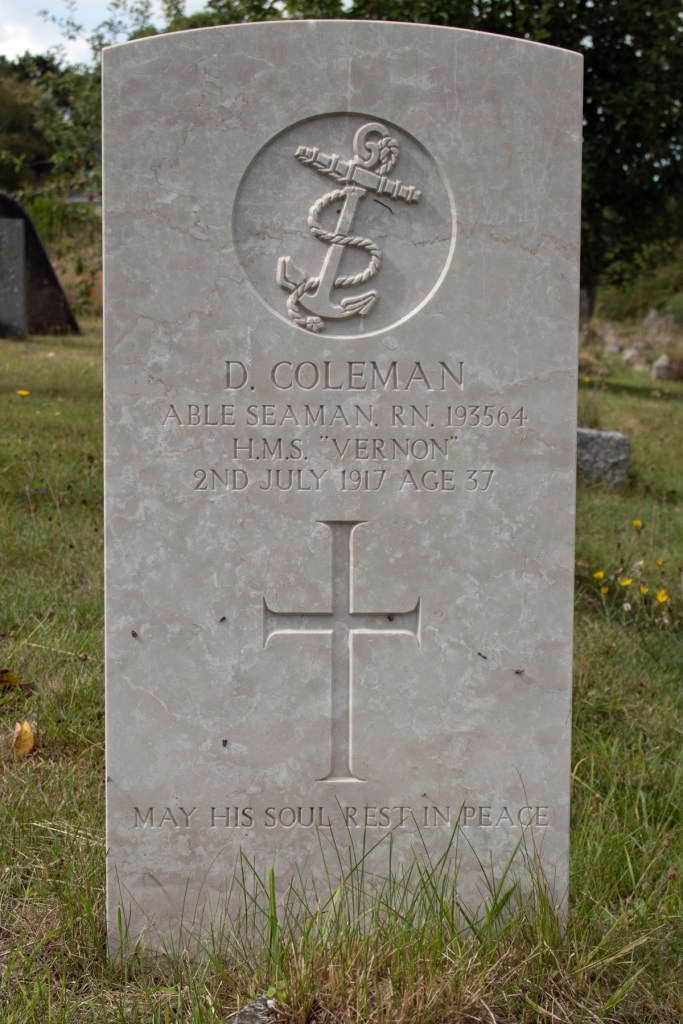
Able Seaman David Coleman

Able Seaman David Coleman

David Coleman was born in the spring of 1880, one of nine children to Jeremiah and Mary Coleman. Jeremiah was a farmer from County Cork, Ireland, and it was in his home village of Killbrittain that the family were raised.

When David left school, he found work as a labourer and mechanic and, in the spring of 1896, he left Ireland for England in search of a bigger and better life for himself.

Things may not have gone quite to plan, however, and, on 17th March 1897, he enlisted in the Royal Navy. He was too young to enrol for full service at this point, however, and so he took on the rank of Boy 2nd Class. He was initially assigned to the training ship HMS Northampton and quickly made Boy 1st Class.

Over the next year, David served on two vessels – HMS Calliope and HMS Doris. When he turned eighteen, he was officially enrolled in the Royal Navy, and given the rank of Ordinary Seaman.

David remained on HMS Doris for nearly four years, and seemed to impress his superiors. By the end of his time on board, he had been promoted again, reaching the rank of Able Seaman.

Over the next nine years, Able Seaman Coleman served on ten different ships, each time returning to HMS Vivid, the Royal Naval Dockyard in Devonport. In March 1910, with his contract complete, he was stood down to reserve status.

The same year, he married Florence Tompkins, who had been born in Newton Abbot, Devon. The couple set up home in Totnes and went on to have three children. David found work as an electrician for the local electric light works.

War was coming to Europe by this point and, in August 1914, Able Seaman Coleman was called back to duty. He served for two years on board the battleship HMS Caesar and, having previously been assigned to HMS Defiance, returned there again. In May 1916, he was assigned to HMS Vernon, one of the shore-based establishments in Portsmouth, Hampshire.

It was while he was in Portsmouth that he fell ill, and was admitted to the town’s Haslar Hospital. Details of his condition are unclear, but he was to succumb to it, passing away on 2nd July 1917, at the age of 37 years old.

David Coleman was brought back to Devon for burial: he was laid to rest in the town’s cemetery, not far from the family home.


Tragedy was to strike the Coleman family again when, early in 1918, both of David and Florence’s younger children – David, aged 5, and Mary, age 2 – passed away. Causes of death are again unclear, but it seems likely to have been one of the lung conditions that would ravage Europe as the war entered its final stage.

Gunner Henry Brewer

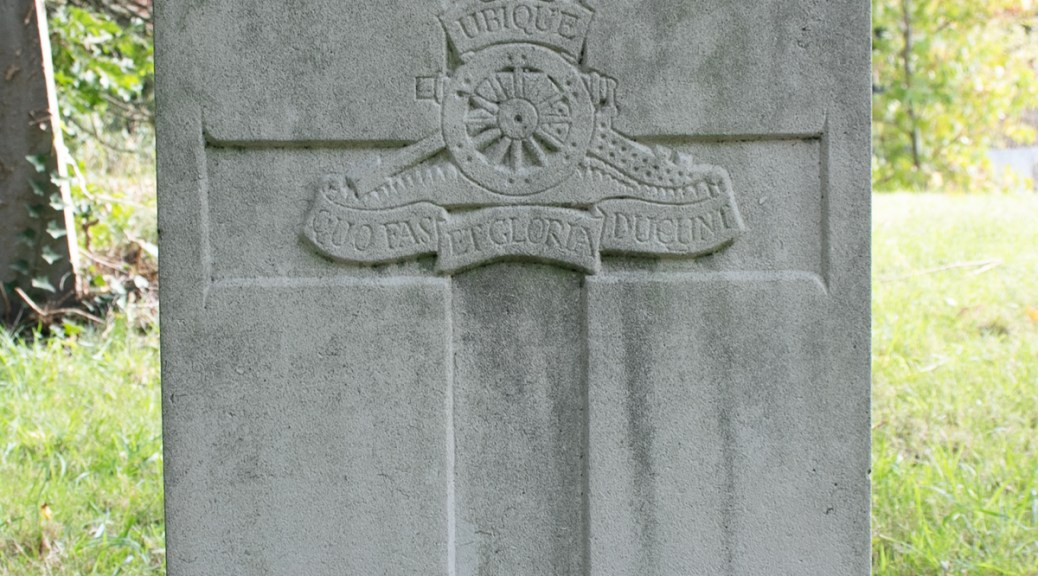
Gunner Henry Brewer

Henry William Brewer was born the spring of 1869 in Bitton, Gloucestershire. His is a common name for the area, and so it is not easy to unpick details of his early life.

On 5th May 1895, Henry married Ann Williams, a carter’s daughter from Keynsham, Somerset. The couple wed in St Thomas’ Church in Widcome, near Bath, and their marriage certificate gives Henry’s trade as a labourer, and his father as Louis Brewer.

The young couple up home in Kingswood, near Bristol, and went on to have three children, Henry, Lucy and Ethel. The 1901 census recorded Henry’s trade as a coal miner and hewer, but noted that he was also a Gunner in the Royal Artillery.

Sadly, Henry’s military records are lost to time, but if he was employed in the army, this would account for the lack of documents relating to his early life. It may be that he had completed his initial term of service by the time he and Ann married, or that he was a volunteer with the Royal Artillery at the time of the census.

Whatever his connection with the army, when war broke out he was called into service. He joined the 30th Company of the Royal Garrison Artillery, and was based in Weymouth, Dorset, as part of Britain’s South Coast defences.

Without military documents, it’s challenging to identify Gunner Brewer’s trail during the war. Sadly, the next documents relate to his passing. He was admitted to a military hospital in Weymouth, suffering from the kidney condition nephritis. This was ultimately to kill him, and he passed away on 28th February 1917, at the age of 48 years old.

Henty William Brewer’s body was brought back to Gloucestershire for burial. He was laid to rest in the graveyard of St Mary’s Church in Bitton.


Flight Lieutenant Richard Bush

Flight Lieutenant Richard Bush

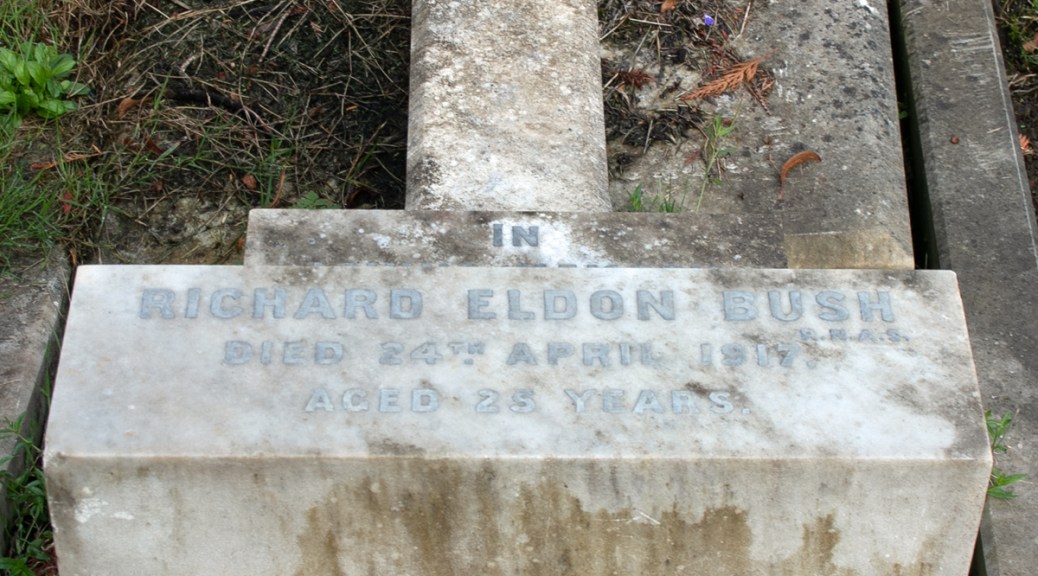
Richard Eldon Bush was born on 16th June 1891 in Keynsham, Somerset. The second of four children (all of whom were boys), his parents were Philip and Maria Bush. Philip was a solicitor, and with that status came opportunity for his children.

The 1911 census recorded the Bush family living in Keynsham with two servants – cook Clara Jones and parlour maid Laura Day. The two older boys – Richard and his older brother, Whittington, were both listed as Cambridge undergraduates, while his two young brothers were boarding at a private school in Repton, Yorkshire.

Richard had aspirations for a good life. In March 1914, he set sail for a life in Canada, looking to take up architecture in the colony. His time overseas wasn’t to be long, though, and, when war broke out in Europe, he returned home.

Full details of Richard’s military service are not available, but he joined the Royal Naval Air Service and, on 20th August 1915, he gained his wings. Richard rose to the rank of Flight Lieutenant, but tragedy was ahead.

On 24th April 1917, he was piloting a scout seaplane around the harbour in Fishguard, Pembrokeshire.

[He] failed to clear some overhead wires, and the seaplane swerved against the cliff with considerable violence, smashing the machine, which the petrol set alight, and crashed to the earth. When liberated from the blazing machine Lieutenant Bush rolled and extinguished his burning clothes.

Somerset Guardian and Radstock Observer: Friday 27th April 1917

Sadly, Flight Lieutenant Bush’s injuries proved too severe. He passed away a couple of days later, on 24th April 1917, at the age of 25 years old.

Brought back to Somerset for burial, Richard Eldon Bush was laid to rest in the cemetery of his home town, Keynsham.


Flight Lieutenant Richard Bush
(from astreetnearyou.org)

The same newspaper report noted that Richard’s brother Graham was an officer in the Royal Flying Corps. He had also been badly injured in a flying accident, but was, according to the report, “flying again now.


Private Robert Cantle

Private Robert Cantle

Robert Cantle’s life is one of hope and of tragedy. There is very little documentation on him, but what there is gives a hint to his life.

The 1911 census recorded him a living on Temple Street in Keynsham, Somerset. The head of the household was 86 year old John Cantle, a retired platelayer for Great Western Railway. His wife, Mary, was 22 years his junior, and they shared the house with their son, stationary cutter Ernest, his wife, Elsie, and their daughter, Madge. Robert was noted as being John and Mary’s adopted son. His age was given as 13, but his place of birth is ‘unknown’.

When war broke out, Robert joined the Wiltshire Regiment. Private Cantle set off for camp in Wiltshire in August 1917, and had been there for just two days when tragedy struck.

There were heavy thunderstorms in the Warminster district on Thursday, and while men of a unit of the Wiltshire Regiment were on the parade ground, three of them were struck by lightning. Pte. Robert Cantle, aged 19 years, whose home is at Keynsham, was killed on the spot, and the other two, Pte. Rowe and Pts Murgatroyd, were severely injured…

Sergeant Major HJ Bennett, of the Wilts Regiment, stated [at the inquest] the deceased lad had only just joined them. About 3pm on Thursday a squad was on the parade ground, when the signal was given to dismiss, as a storm was approaching. Immediately after there was a flash and a crash and it seemed to stagger everybody on the parade ground. Witness was brought to his knees, and when he recovered himself he saw three men, who of whom were struggling, on the ground. Private Cantle was found to be dead, and the other men recovered after being attended by a doctor. The squad consisted of recruits, and none of them were carrying arms.

Major Stocker, medical officer, said the crown of deceased’s cap was ripped off, and the body was burned from head to foot.

The jury returned a verdict of “Death from the effects of lightning.”

Somerset Standard: Friday 17th August 1917

Robert Cantle’s body was brought back to Keynsham for burial: he was laid to rest in the town’s cemetery.


Private George Garrett

Private George Garrett

George Garrett was born in early 1895 in Abbotskerswell, Devon. He was the oldest of five children to George and Annie Garrett. George Sr was a labourer and the family seemed to travel with his work: his and Annie’s younger children were born in Aldershot, Plymouth and London.

When he left school, George Jr found work as an errand boy – the family were back in Devon by this point. War was on the horizon, however, and he would feel compelled to play his part. Full details of his service are not available, but it is known that he enlisted in the Devonshire Regiment, and was assigned to the 2nd Battalion.

Private Garrett arrived in France in December 1915, and was soon entrenched on the Western Front. Hi battalion was caught up in the Battle of the Somme and George was badly injured, having received a gunshot wound to his spine.

Medically evacuated to Britain, his wounds proved too severe for him to return to duty, and he was discharged from the army on 28th December 1916. It is not clear whether he returned home, but it seems likely that he remained in hospital in Exeter. He would never recover from his injuries. He passed away at the hospital on 18th April 1917, at the age of 22 years old.

George Garrett was laid to rest in the graveyard of St Andrew’s Church in Ipplepen, Devon, where his family were, at that point, living.


Private Ernest Bowden

Private Ernest Bowden

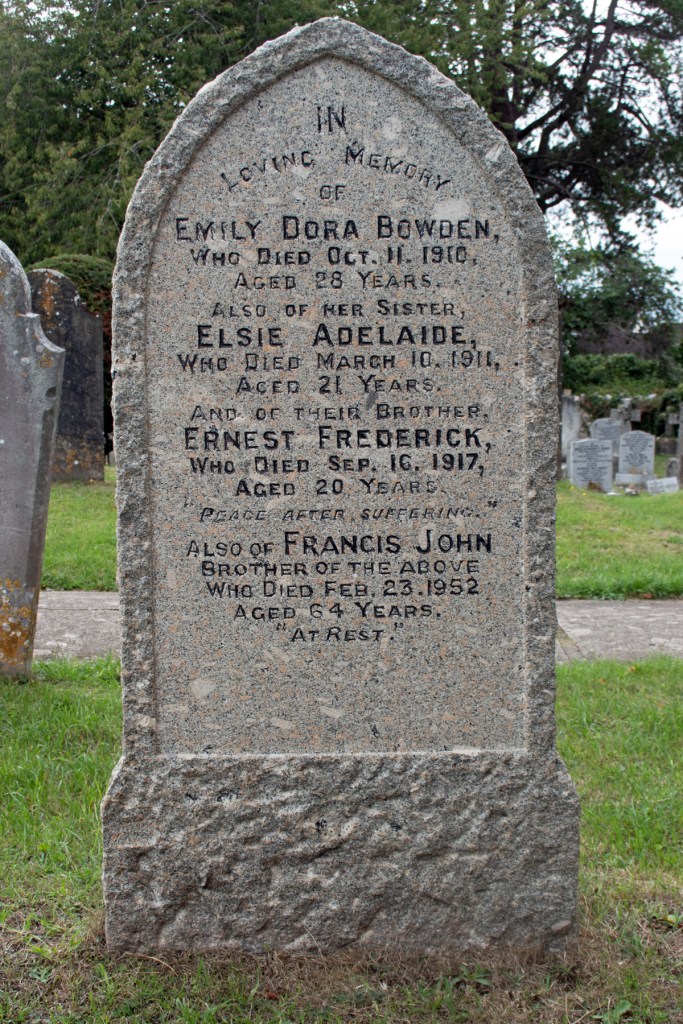
Ernest Frederick Bowden was born on 2nd November 1896 in Ipplepen, Devon. He was one of eleven children – and one of twins – to Frederick and Dora Bowden. Tragically, Dora died when Ernest was just over a year old, leaving Frederick and his older sisters to raise the family as best they could.

When he left school, Ernest found work as a page for a surgeon living in Paignton, before finding other employment as a chauffeur in Bovey Tracey. In his spare time, he was an avid bellringer at his local church.

War was coming to Europe, however, and in November 1915, he enlisted in the Gloucestershire Regiment. His service records noted that he was 19 years of age, and stood just 5ft 1.5ins (1.56m) tall. Assigned to the 14th Battalion, Private Bowden soon found himself on the front line. Arriving in France in July 1916, he spent four months there, during which he contracted tuberculosis and trench foot.

Medically evacuated to Britain for treatment, his conditions proved too severe for him to continue in the army. He was discharged from active service in December 1916.

For some months he had been at the Ivybank Dispensary, Exeter. Complications set in, and he rapidly sank just before reaching his 21st year.

Western Times: Friday 28th September 1917

Ernest Frederick Bowden had passed away on 16th September 1917, aged just 20 years old. He was laid to rest in the family grave at St Andrew’s Church, Ipplepen.


Private Hugh Jones

Private Hugh Jones

Hugh Henry Jones was born in around 1876 in the Welsh village of Llanberis, Gwynedd. He was one of seven children to quarryman John Jones and his wife Mary.

Slate was the big industry in Snowdonia, and Hugh and his brothers all followed his father into the quarries. Labour was plentiful and wages would not have been high, so when the opportunity arose for employment overseas, he seems to have taken it.

Exact details are sketchy, but Hugh emigrated to Australia at some point in the early 1900s. He settled in the city of Goulburn, New South Wales and the experience he had built up back home stood him good stead, as he continued working as a quarryman.

When war broke out in Europe, those in the British colonies were called upon to play their part, and Hugh was among those to serve King and Country. He enlisted on 29th December 1915, joining the 55th Battalion of the Australian Infantry.

Private Jones’ service records show that he was 40 years and six months old, stood 5ft 4ins (1.63m) tall and weighed 130lbs (59kg). He had a dark complexion, blue eyes and black hair. He also appears to have had a denture in his lower jaw.

After initial training, Private Jones set off for Europe at the end of September 1916, arriving in Plymouth six weeks later. Within a matter of weeks he was on the move again, sailing for France, and arriving at Etaples at the start of 1917.

Private Jones was ensconced on the Western Front for the next few months but, as spring came, he was starting to have some health issues. In April he was admitted to a field hospital suffering from dyspepsia (indigestion), which was subsequently diagnosed as gastritis.

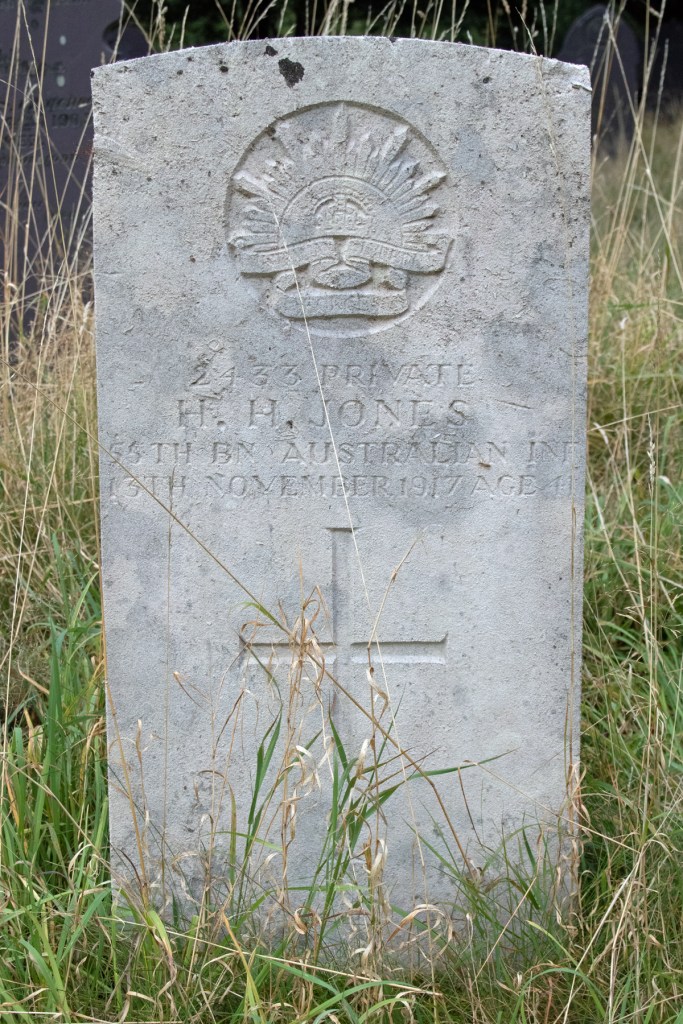
Medically evacuated to Britain for treatment, Hugh spent the next few months being treated in hospitals in Kent, and Dorset, before being admitted to the Royal Infirmary in Liverpool. Sadly, by this point, his condition had been identified as stomach cancer and, while in Liverpool, he passed away. Private Jones breathed his last on 13th November 1917, at the age of 41 years old.

Hugh Henry Jones was brought back to Wales for burial. He was laid to rest in the graveyard of St Peris Church in his home village of Llanberis.


Private Hugh Jones
(from findagrave.com)

Private William Rowlands

Private William Rowlands

William Pierce Rowlands was born the summer of 1891 and was the oldest of three children to Thomas and Ellen Rowlands. Thomas was a slate dresser and quarryman from North Wales, and William was born in Ffestiniog, Gwynedd. By the time his sister Margaret was born, the young family had moved to Llanberis, settling in a small cottage on the outskirts of the village.

When he left school, William found work as a clerk, and this was the work he was carrying out when was broke out. He enlisted on 10th April 1915, joining the 14th (Service) Battalion of the Royal Welch Fusiliers. His service records show that he was 5ft 8ins (1.73m) tall.

Private Rowlands served on home soil for just over seven months, before being sent to France on 30th November 1915. He had been suffering from a cough for a couple of weeks, and this came to a head while he was overseas. He reported sick on 16th December, and was sent back to Britain for treatment a month later.

His condition was identified as pulmonary tuberculosis, aggravated by military service. Private Rowlands was medically discharged from the army on 8th February 1916, and returned home.

At this point, William’s trail goes cold. His condition appears to have worsened, however, and it was from tuberculosis that he was to die. He passed away at home on 18th February 1917, at the age of 25 years old.

William Pierce Rowlands was laid to rest in the quiet graveyard of St Peris Church, in the family home village of Llanberis.


Thomas and Ellen lived until 1932, when the passed away within a couple of months of each other (Thomas in August, Ellen in November). They were reunited with the son, and lie together in the family grave, along with Ellen’s brother, also called William, who had passed away in 1930.


Driver Griffith Williams

Driver Griffith Williams

Griffith Owen Williams was born the autumn of 1876 in Llanberis, Gwynedd. One of nine children, his parents were blacksmith William Williams and his wife, Alice.

Little information remains about Griffith’s teenage years. The 1891 census record that, at 14 years old, he was a scholar, but the next document that can be attributed to him comes fourteen years later.

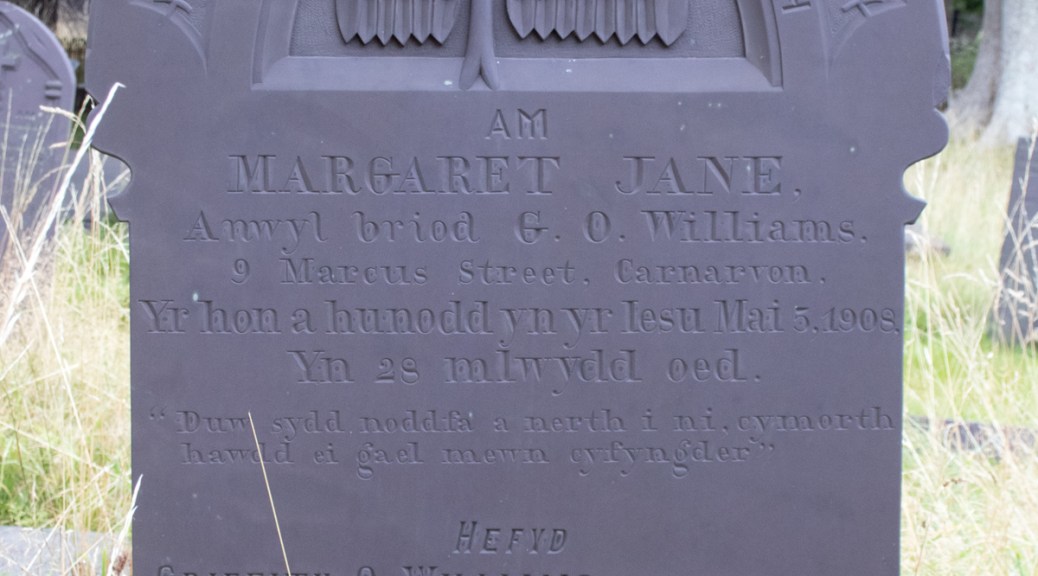
At this point, on 7th March 1905, he married Margaret Jane Williams at the parish church in Llanberis. Margaret was 24 years old, and the daughter of a quarryman: Griffith gave his profession as Post Office official, and he was living in Caernarfon, eight miles away, on the Menai Strait.

The young couple went on to have a daughter, Maggie, in January 1906. Sadly, Margaret died on 5th May 1908, when she was just 27 years of age. While the young family had been living in Caernarfon, she was laid to rest in the graveyard of St Peris Church in Llanberis.

At this point, Griffith’s trail goes cold once more. When war broke out, he enlisted in the Royal Field Artillery, and was assigned as a Driver in the 248th (Howitzer) Brigade. By April 1915, Griffith found himself on the Western Front and, by the next spring he was fighting at the Somme.

During the winter of 1916/17, Driver Williams fell ill. He contracted bronchial pneumonia, and was medically evacuated to Britain to recuperate. Sadly, the condition was to prove too much for his body to take. He passed away on 23rd February 1917, at the age of 46 years old.

Griffith Owen Williams’ was laid to rest with his late wife in St Peris Churchyard, in their home village of Llanberis.


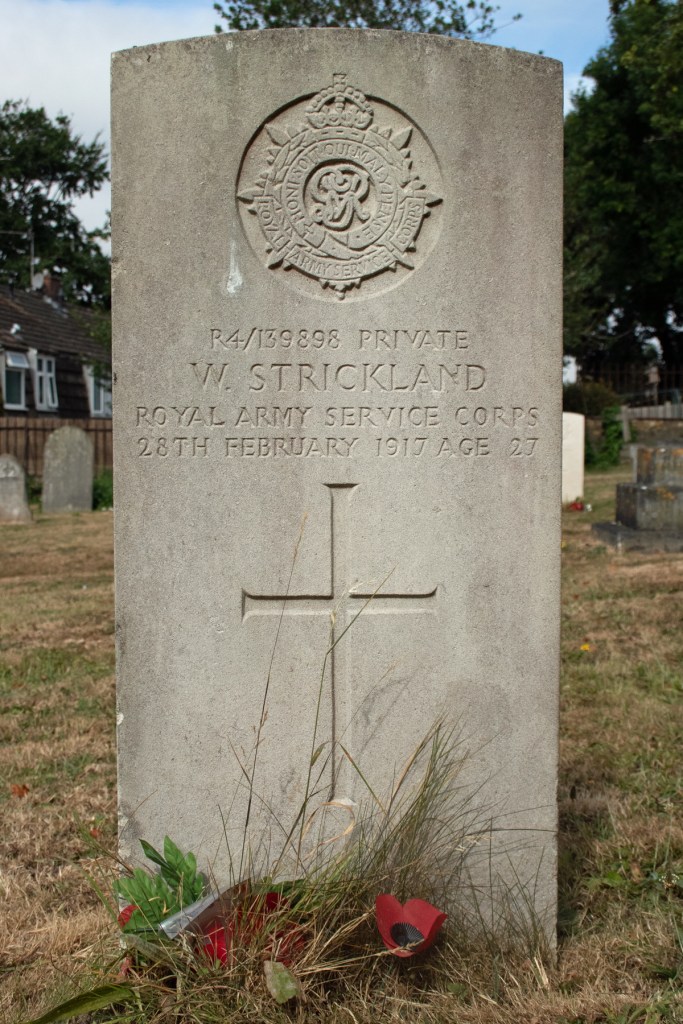
rivate Walter Strickland

Private Walter Strickland

Walter Strickland was born in 1890 in Pitminster, Somerset, the youngest of eight children to William and Sarah Strickland. William was a farm labourer, but his son found employment in the local coal mines on leaving school.

In December 1910, Walter married local woman Eliza Burton. The couple moved with Eliza’s brother and sister-in-law to Monmouthshire, where mining was the primary industry. After a couple of years, the young couple moved back to Somerset and went on to have a son, Wilfred, who was born in 1913. Walter had found other work, by this time, and was employed as a groom.

Storm clouds were brewing over Europe, and Walter enlisted in September 1915. He was assigned to the Royal Army Service Corps and given the rank of Private. His service records show that he was 5ft 6ins (1.67m) in height, and had a 35in (89cm) chest measurement.

Details of Private Strickland’s military service are limited. It seems likely that he was sent overseas, but that cannot be confirmed. By the start of 1917, however, he was back in England, and had been admitted to the Royal Victoria Hospital in Netley, near Southampton. He was suffering from an exophthalmic goitre – also known as Grave’s Disease – which results in heart palpitations, and an enlargement of the thyroid gland.

Sadly, this was an illness to which Private Strickland was to succumb: he passed away in the hospital on 28th February 1917, Eliza by his side. He was just 27 years of age.

Walter Strickland’s body was brought back to Somerset for burial. He was laid to rest in the graveyard of All Saints’ Church in his now home town of Norton Fitzwarren.