Tag Archives: 1917

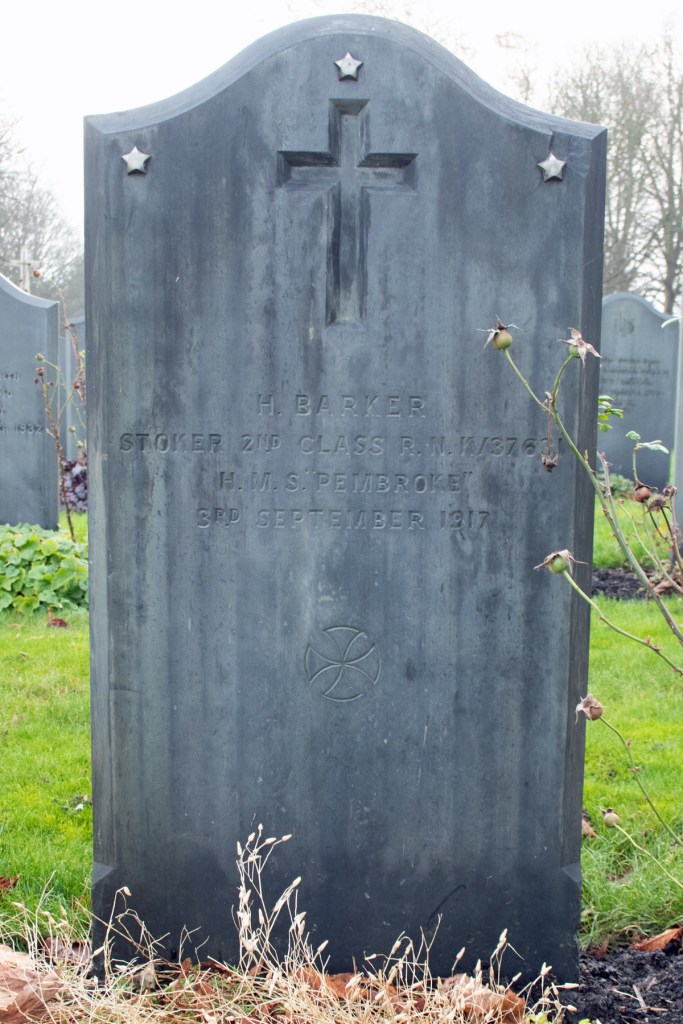
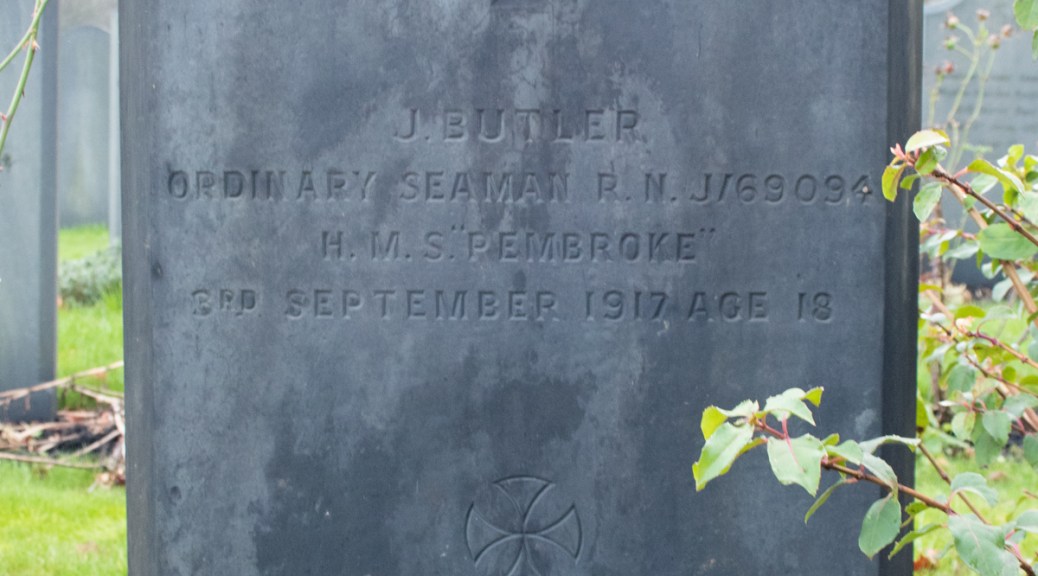
Ordinary Seaman George Butler

Ordinary Seaman George Butler

George Butler was born in Willesden, Middlesex, on 16th January 1899 and was the oldest of three children. His father, George Sr, was a bricklayer, while his mother, Sarah, worked as a laundress to help bring in some extra money.

Sadly, because of his age, there is little concrete information on George Jr’s early life. What can be confirmed is that, on 21st March 1917, having not long turned 18 years of age, and with the Great War well under way, he was keen to play his part for King and Country. He joined the Royal Navy for the duration of the conflict and was given the rank of Ordinary Seaman.

George’s service records show that he was 5ft 10ins (1.78m) tall, had brown hair, grey eyes and a fair complexion. It was also noted that he had a scar on his left leg. The document also confirms that he was employed as a bus washer.

Ordinary Seaman Butler was based at HMS Pembroke, the Royal Naval Dockyard in Chatham, Kent. It was a busy place that summer, and temporary accommodation was needed quickly. Chatham Drill Hall was brought into service, and George found himself billeted there.

On the 3rd September 1917, the German Air Force carried out its first night air raid: Chatham was heavily bombed and the Drill Hall received a direct hit; Ordinary Seaman Butler was among those killed instantly. He was just 18 years of age.

George Butler was laid to rest, alongside the other victims of the Chatham Air Raid, in the Woodlands Cemetery, Gillingham.


George’s headstone gives the incorrect initial, but the location is correct.


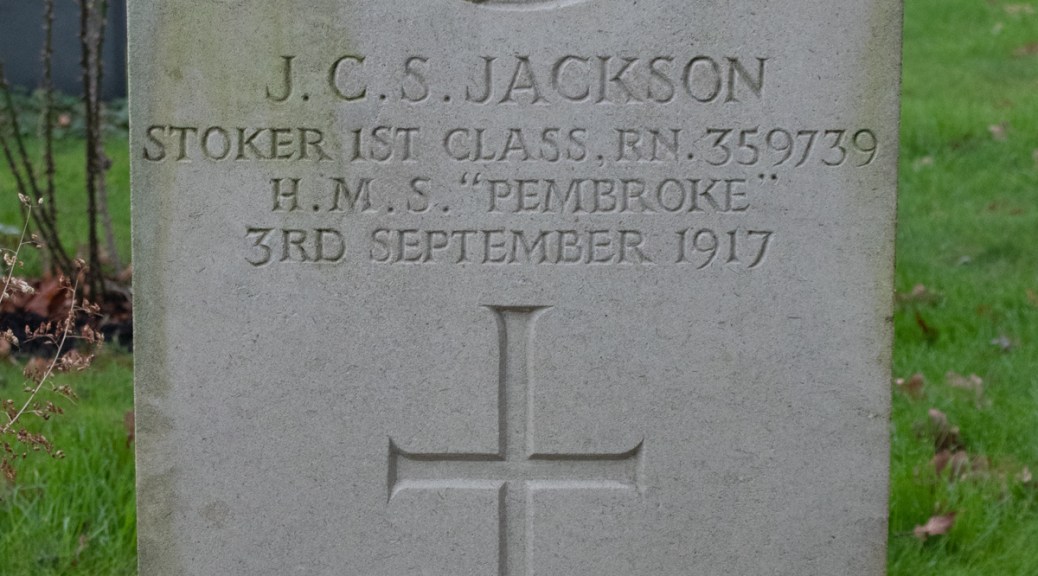
Stoker 1st Class Joseph Jackson

Stoker 1st Class Joseph Jackson

Joseph Charles Sackett Jackson was born in Rotherhithe, Surrey, on 4th May 1884, and was one of seven children. His father – post office worker Joseph Jackson Sr – died in 1895, leaving his mother, Eliza, to raise the family.

She soon married Matthew Newton, a widower himself, and the 1901 census found the couple living in Asylum Road, Peckham with eleven of their children and step-children. Joseph, who was 17 years old by this point, was one of only four of the household to be working, and was employed as a brass turner.

Keen to better himself, Joseph looked to a longer career and, in September 1901, he enlisted in the Royal Navy. His service records show that he was 5ft 3ins (1.6m) tall, had dark brown hair, brown eyes and a fresh complexion.

Initially underage, he served on the home front, Joseph was based at the shore establishments around the country – HMS President (London), HMS Pembroke (Chatham Dockyard, Kent) and HMS Victory (Portsmouth, Hampshire). In 1906, when he turned 23, he formally enlisted in the Royal Navy, and was given the rank of Stoker 2nd Class.

Over the next year, Joseph served on three vessels – HMS Hawke, HMS Dido and HMS Pathfinder – and was promoted to Stoker 1st Class. He continued his work at sea, but returned to HMS Pembroke in between voyages.

In the summer of 1913, Stoker Jackson was assigned to the battleship HMS Dominion, and it was here that he spent the next four years. He was promoted again, to Acting Leading Stoker in July 1915, and full Leading Stoker six months later. The role may not have suited Joseph, however: his service records recorded a drop in his character from Very Good to Fair, and he was demoted to Stoker 1st Class at the end of August 1916.

By the summer of 1917, Joseph was back at Pembroke and, as the dockyard was overcrowded, was billeted in temporary accommodation in the Drill Hall.

On the 3rd September 1917, the first night air raid carried out by the German Air Force bombarded the town, and scored a direct hit on the Drill Hall; Stoker 1st Class Jackson was among those killed instantly. He was 33 years old.

Joseph Charles Sackett Jackson was laid to rest, along with the other victims of the Chatham Air Raid, in the Woodlands Cemetery, Gillingham.


Bombardier Thomas Greenslade

Bombardier Thomas Greenslade

Thomas Greenslade was born in Alcombe, on the outskirts of Dunster in Somerset, in the spring of 1894 and was one of ten children. His parents were Devon-born cab proprietor Richard, and his wife Emma, who passed away in 1905, aged 38 years old.

When he left school, Thomas helped his father with his business; the 1911 census recorded him and his older brother Charles as drivers, his younger two sisters as housekeepers for their father, and his youngest two siblings as still being at school.

Storm clouds were approaching Europe and, in the summer of 1915, Thomas signed up to play his part for King and Country. He joined the Royal Field Artillery, and was assigned as a Bombardier to C Battery of the 74th Brigade. His troop was one of the Howitzer Brigades, and it seems likely that his knowledge of horses stood him in good stead.

Little information on Bombardier Greenslade’s military service survives. His regiment saw conflict at Loos, the 1916 Battles of the Somme and the Third Battle of Ypres, and it is likely that he was involved in these skirmishes.

What can be confirmed is that, by July 1917, Thomas was in the War Hospital in Bristol. The reason for his admission is unclear, but it led to his demise. Bombardier Greenslade passed away on 11th July 1917: he was just 23 years of age.

Thomas Greenslade’s body was brought back to Dunster. He was laid to rest in a quiet corner of the village’s cemetery.


Colour Serjeant Major Frederick Davis

Colour Serjeant Major Frederick Davis

Frederick Davis was born in Street, near Glastonbury, in February 1876. One of four children, his parents were Frank and Ann. Frank was an agricultural labourer, while Ann worked as a shoe binder in the local Clark’s Factory.

By the 1891 census, Frederick had left school, and had also left home, boarding with a farmer in nearby Walton, where he also worked as a labourer on the farm. Ten years later, he was living with his paternal grandmother and his older brother in the village, with both brothers working as labourers.

During this time, it seems that Frederick had his sights on bigger and better things. Full details are not available, although it appears that he enlisted in the Army and served in India and South Africa between at least 1897 and 1902. He was awarded the Distinguished Conduct Medal in 1902 for his actions, although again little information around this survives.

Confirmation of his service overseas at this time appears on Frederick’s later military service records as, in January 1909, he again enlisted in the army. Frederick’s 1909 records show that his next of kin was his wife, Mrs AL Davis, although no marriage documents are apparent. He is also recorded as living in Castle Cary, just to the south of Glastonbury.

This time he was assigned to the 4th Battalion of the Somerset Light Infantry, serving for five years on home soil. During this time, he rose through the ranks from Private to Lance Corporal to Corporal to Sergeant.

When war was declared, the 4th Battalion was sent out to India. Sergeant Davis spent the next eighteen months there, before being moved to the Persian Gulf. He was obviously well thought of as, with the move came a further promotion, this time to Company Sergeant Major.

In June 1917, Frederick returned to England from overseas, and, at the end of his term of service two months later, he was demobbed. He returned home to Somerset, but, within a couple of months, on 2nd October 1917, he passed away. The cause of his death is not recorded, but he was 42 years of age.

Frederick Davis was laid to rest in the peaceful surrounds of the Castle Cary Cemetery.


Air Mechanic Walter Naish

Air Mechanic Walter Naish

Walter Matthias Naish was born in the autumn of 1896, and was one of of five children to agricultural labourer Matthias Naish and his wife, Sarah Ann. Born in Lovington, near Castle Cary, Somerset, this is where the family is recorded as living for the 1901 and 1911 censuses.

When he left school, Walter found work as a cabinet maker; war was on the horizon, however, and he enlisted on 28th February 1916. He was immediately put on reserve, however, and was only mobilised in January 1917, when he was assigned to the Royal Flying Corps as an Air Mechanic.

Tragically, Walter’s military career was not to be a long one. He was admitted to the Connaught Hospital in Aldershot with conditions unknown, and passed away on 3rd March 1917, just 51 days after leaving home. He was just 20 years old.

Walter Matthias Naish’s body was brought back to Somerset for burial. He lies at rest in the Castle Cary Cemetery, not far from his home.


Lieutenant Herbert Marshall

Lieutenant Herbert Marshall

Herbert William Hare Marshall was born in Ambala, India, on 19th August 1890. His father – Herbert Seymour Marshall – was a Colonel in the army, and was serving in India with his wife, Charlotte, when their children – Charlotte (known as Jessie) and Herbert Jr – were born.

The family were back in England by 1898, and had set up home in the Somerset seaside town of Weston-super-Mare. When Herbert Sr passed away that year, Charlotte was set up on a widow’s pension, and this allowed her to send her son to St Peter’s, a private boarding school in the town.

When her son’s schooling was complete, Charlotte took the family off to Canada. They settled in British Colombia, in Revelstoke, a mountain town halfway between Calgary and Vancouver. Here, Herbert found work as a bank clerk, but war came to Europe, and he felt a need to do his bit for King and Country.

Herbert enlisted in the Canadian Expeditionary Force (CEF) in November 1914; his service papers record him as being 5ft 8ins (1.73m) tall, 148lbs (67kg) in weight. He had black eyes, brown hair and a dark complexion – something that he may well have inherited through his mother’s genes.

Shipped to England, by August 1915, Private Marshall had been discharged from the CEF as part of a transfer to the New Army – also known as Kitchener’s Army, the volunteer British Army raised as a direct result of the outbreak of war.

Detailed information about Herbert’s military service is lacking, although it seems that he joined the 17th Battalion of the West Yorkshire Regiment, one of the regiments heavily involved during the Battle of the Somme.

By October 1916, however, the now Lieutenant Marshall had made another move, this time joining the Royal Flying Corps. On the afternoon of 26th August 1917, he was an observer on a flight at Marham, in Norfolk. The pilot, a Lieutenant Challington, was banking the aircraft, when it dived and crashed, killing both men. Lieutenant Marshall had turned 27 years old the week before.

Herbert William Hare Marshall’s body was brought back to his adopted home of Weston-super-Mare. He lies at rest alongside his father in the town’s Milton Road Cemetery.


Rifleman Horace Thompson

Rifleman Horace Thompso

Horace Douglas Thompson was born in Camberwell, East London on 23rd April 1898. He was the oldest of four children – and the only boy – to Horace and Elizabeth Thompson. Horace Sr was a grocer’s packer, originally from the village of Gissing in Norfolk.

Details of Horace Jr’s early life are a little sketchy, but it seems that by some point after the 1911 census, both of his parents had died, and he was fostered by his aunt and uncle – Charlotte and Robert Thompson – who lives in Leytonstone. By this point, he was working as a doctor’s errand boy.

When war broke out, Horace was keen to play his part. He enlisted in the 6th Battalion of the London Regiment – also known as the City of London Rifles – towards the end of 1916. It is unclear whether Rifleman Thompson saw any action overseas, but in April 1917 he was admitted to the Voluntary Aid Detachment Hospital in Newton Abbot, Devon, suffering from acute gastritis, or appendicitis.

Sadly, Rifleman Horace Douglas Thompson was to succumb to the condition – he passed away at the hospital on 16th April 1917. He was laid to rest in Newton Abbot Cemetery; he was days short of his 19th birthday.


Private Thomas Singer

Private Thomas Singer

Thomas – better known as Tom – Singer was born in Frome, Somerset, in the summer of 1876, the youngest of seven children to John and Sophia Singer. John was a labourer on the railway, who sadly passed away when Tom was only three years old. Sophia was left to raise the family on her own, and she did so by taking in washing for other people (the 1891 census has her listed as a pauper, but she still managed to support her children). Sophia also died in 1892, meaning Tom was an orphan by the time he was just 16 years old.

Tom found work as an errand boy when he left school, although he soon moved on to labouring work. After Sophia’s death, he moved in with his brother Walter, who had also recently been widowed, and the money they brought in helped support Walter’s three children and pay for a housekeeper to do so.

On 21st July 1904, Tom married Edith Mary Bugler, a labourer’s daughter from nearby Selwood; the couple went on to have five children. With a growing family to support, Tom found new work as an ostler at the pub in Witham Friary, to the south of Frome.

War was coming to Europe, and Tom was called upon to do his duty. Full details of his service are not available, sadly, but it is clear that he enlisted as a Private in the Somerset Light Infantry at some point before the summer of 1916.

Private Singer was sent to France in November 1916, but fell ill soon afterwards. He was medically evacuated back to England and admitted to hospital, where he underwent an operation. Sadly, he did not recover, and passed away on 14th February 1917, at the age of 40 years old.

Tom Singer was laid to rest in the graveyard of Christ Church in his home town of Frome.


Engineman Thomas Carmichael

Engineman Thomas Carmichael

Thomas Carmichael was born on 19th December 1888, the older of two children to George and Elizabeth – Lizzie – Carmichael. George was an engine fitter from Hull, Yorkshire, and this is where he and Lizzie raised their young family.

Little further information is available for Thomas’ early life. He married a woman called Annie, but no documents remain to confirm when their wedding was. The couple settled in Hull, and went on to have two children, a girl and a boy.

War had his Europe by this point, and Thomas enlisted in the Royal Naval Reserve. He joined the Royal Naval Reserve as an Engineman on 16th May 1916, serving primarily at the shore-based establishments of HMS Pembroke (the Royal Naval Dockyard in Chatham, Kent), HMS Gunner (the Granton Naval Base in Edinburgh) and HMS Vivid (the Naval Dockyard in Devonport).

Engineman Carmichael arrived in Chatham in August 1917. The Dockyard was particularly busy that summer, and the large number of extra servicemen meant that Thomas was billeted in temporary accommodation in Chatham Drill Hall.

On the 3rd September 1917, the first night air raid carried out by the German Air Force bombarded the town, and scored a direct hit on the Drill Hall; Engineman Carmichael was among those killed. He was just 28 years of age.

Thomas Carmichael was laid to rest, along with the other victims of the Chatham Air Raid, in the Woodlands Cemetery, Gillingham. Tragically, the Navy Death Records state that he was Buried as unidentified in one of the following graves: 516, 522, 642, 735, 935, 937 or 948.


Stoker 1st Class William Bullock

Stoker 1st Class William Bullock

William Bullock was born on 25th December 1882, one of nine children to William and Ellen Bullock. William Sr was a fish fryer from London, and this is where he and Ellen brought up their family.

When he left school, William worked as a coster and porter, and, in 1909, he married long time love Amelia Horrigan. The couple went on to have four children: two boys and two girls.

War was closing in on Europe and, on 23rd November 1915, William enlisted. He joined the Royal Navy as a Stoker 2nd Class: his service records state that he stood 5ft 5ins (1.65m) tall, had dark brown hair, hazel eyes and a fresh complexion.

Stoker Bullock’s first posting was HMS Pembroke, the Royal Naval Dockyard at Chatham, Kent. He spent most of his time there, returning to the base after voyages on board HMS Cheerful and HMS Shannon. It was while on board the Shannon that William was promoted to Stoker 1st Class.

In August 1917, William was back at HMS Pembroke. The Dockyard was particularly busy that summer, and the large number of extra servicemen meant that he found himself billeted in temporary accommodation in Chatham Drill Hall.

On the 3rd September 1917, the first night air raid carried out by the German Air Force bombarded the town, and scored a direct hit on the Drill Hall; Stoker 1st Class Bullock was among those killed instantly. He was 34 years old.

William Bullock was laid to rest, along with the other victims of the Chatham Air Raid, in the Woodlands Cemetery, Gillingham. Tragically, the Navy Death records state that he was: Buried as “unidentified” in one of the following graves – 516, 522, 735, 642, 935, 937 or 948.