Tag Archives: 1918

Master Charles Crane

Master Charles Crane

Charles John Crane was born in Canning Town, Essex, on 14th April 1879. One of at least five children, his parents were Charles and Sarah Crane. Charles Sr had been born in Bath, Somerset, but was working in London as a hairdresser when he met his wife, and settled in West Ham. The family lived in rooms at 52 Burnham Street, sharing the house with Sarah’s parents, Daniel and Rebecca King, and siblings.

By the time of the 1891 census, the family set-up had changed. Charles Jr was now living with Daniel and Rebecca at 56 Burnham Street, but his parents and siblings are nowhere to be found. Daniel was a dock labourer, and his job seems to have ignited a passion for the sea that was to direct his grandson’s life.

Charles took to a life at sea, working his way up to the rank of Master, and settling in the Montrose area of Scotland. He married Margaret McIntosh, and they went on to have six children.

When war broke out, Charles was assigned to the SS Innescroone, and served his time on board during the conflict.

FATAL BLOW WHILE WORKING AN ANCHOR.

An inquest was held at the Royal Naval Hospital, Gillingham, into the circumstances attending the death of Charles John Crane, aged thirty-nine, master of the s.s. Innescroone. The deceased met with an accident on the 8th inst. while working the anchor of his vessel, and was removed to the hospital, where he died from the injuries he sustained on 12th inst.

The Coroner (Mr. C. B. Harris) remarked that the deceased’s vessel was at sea, so that it would not be possible to conclude the inquiry that day, as witnesses from the ship would have to be called. Only necessary evidence would be taken, and the inquest would be adjourned. Evidence of identification was given by Mrs Crane, who stated that her husband was conscious when she saw him at the hospital, but he was in too bad a condition to tell her anything about the accident.

Surgeon Percy Gibson, R.N. stated that the deceased was admitted to the hospital from Sheerness, suffering from a blow in the stomach, which he received owing to the winch handle flying back. He was suffering from severe shock. He was operated on the same morning. He had ruptured a small intestine. Peritonitis set in, and he died on Sunday (12th inst.) from rupture of the intestine and general peritonitis. There was a bruise on the abdominal wall just over where the rupture was found, which showed that it was due to the accident.

At the adjourned inquest, the mate (Boynton) gave evidence as to the cause of the mishap. It appeared that the Inniscroone was lying at anchor near the Edinboro’ Channel on the morning of May 8. There was a strong wind blowing either from the north-east or the south-east. It was desired to heave the anchor, but owing to the strong wind the motor failed. In consequence it was intended to use hand power for the purpose. The winch handle was fitted to the winch, but the actual heaving process by hand had not commenced. Owing to a lurch of the ship the grip holding the anchor chain came open, and this sudden strain broke the pivot and part of the frame of the winch’s pawl. As a result the chain started, and many fathoms ran out. In revolving at high speed the winch handle flew off and struck deceased a blow in the stomach, knocking him down. He was attended to by the ship’s doctors, who were called, and admitted to the Sheerness Sickquarters in the afternoon of that day, and removed the next day to the Royal Naval Hospital, Chatham.

The jury found death to be due to peritonitis caused by the accidental blow from the flying winch handle.

The deceased, who belonged to London, had been resident in Montrose for the past sixteen years, and leaves to mourn his loss his widow and a family of six, who reside at 12 Gibson Place. For seven years he sailed on the local ketch Spartan. Full naval honours were given to his burial, which took place on 16th inst. to Gillingham Cemetery, Kent.

[Montrose Standard: Friday 31st May 1918]

Charles John Crane was 39 years of age when he passed away. He was laid to rest in the naval section of Woodlands Cemetery in Gillingham, Kent.


Private Harry Gurd

Private Harry Gurd

Harry John Gurd was born in the Wiltshire parish of Berwick St John in the spring of 1881. He was one of three children to dairyman Ebenezer Gurd and his wife, Elizabeth.

Details of Harry’s early life are fragmented, but by the time of the 1911 census, he had moved to West Sussex, and was working as a gardener. The document confirms that he had married Alice three years before, and that they were living in North End, Findon. By this point, the couple had three children: Alice, Ronald and Walter, and they would go on to have another daughter, Hester, in 1913.

Harry stepped up to play his part when war was declared. Full details of his service have been lost, but it is evident that he enlisted by December 1917 at the latest and, as a Private, joined the Army Veterinary Corps. He was initially attached to the 15th Veterinary Hospital, but transferred across to the Labour Corps, joining the 695th Company.

In the summer of 1918, Private Gurd fell ill. He was admitted to hospital, but his condition – a duodenal ulcer – was to prove fatal. He passed away on 25th June 1918, at the age of 37 years old.

The body of Harry John Gurd was brought back to Sussex for burial. He was laid to rest in the graveyard of St John the Baptist Church, Findon, the village that had become his home. When Alice died in the summer of 1958, she was buried alongside Harry: husband and wife reunited after forty years.


Private Wilfred Bridger

Private Wilfred Bridger

Wilfred Percival Bridger was born on 20th January 1885, the middle of three children to William and Emma. William was a groom from Albourne in Sussex, but, after a spell in Newmarket, the family had settled in Findon near Worthing.

William passed away just two years after Wilfred’s birth, and Emma remarried. The 1891 census found her and her new husband, George Lish, living with William and his siblings in a house on Findon Street.

When he completed his schooling, William found work as a shepherd: the next census return, taken in 1901, found the extended family living at 1 Brazil Cottages, next to the Black Horse Inn in Findon Village. George and Emma now had three children of their own, and Emma’s widowed mother, Martha, completed the household.

Shepherding was not a permanent career option for Wilfred and, on 28th April 1902, he enlisted in the army. He gave his occupation as groom, and his medical report confirmed he was 5ft 7ins (1.7m) tall and 120lbs (54.4kg) in weight. He was noted as having brown hair, grey eyes and a fresh complexion.

The Royal Sussex Regiment would definitely provide Private Bridger with the globe-trotting adventures that he may have wished for. After two years on home soil, his unit – the 2nd Battalion – moved to Malta, where he would spend close to twelve months. In May 1905 he moved to Crete, and from there to India in January 1907.

By the start of 1910 Wilfred had returned to Britain, and he was stood down to reserve status when his contract came to an end that April. He returned to Sussex, and the family home. 1 Brazil Cottages was crowded by this point, with Wilfred sharing the five-roomed house with his mother, stepfather, half-brother, niece. There were also two lodgers, widowed farm labourer Alfred Newman and his son, William.

Things were to change for Wilfred, however. In September 1911 he married Florence Herrington, a carter’s daughter from Henfield, Sussex. When the couple wed, she was working as a servant in a boarding house in Ambrose Place, Worthing. The young couple set up home in Nepcote, near Findon, and went on to have four children – William, Albert, Henry and Lilian.

When war broke out, Wilfred was called upon to play his part again. He re-joined the Royal Sussex Regiment on 31st August 1914, but when his medical was carried out the following March, he was found to have tuberculosis, and deemed not fit for service. After further tests, Private Bridger was medically discharged on 28th May 1915.

At this point, Wilfred’s trail goes cold. He returned to Findon and, it seems this is where he passed away on 13th September 1918. He was 33 years of age.

Wilfred Percival Bridger was laid to rest in the quiet surroundings of Findon’s St John the Baptist Churchyard.


Private Wilfred Bridger
(from ancestry.co.uk)

Private Charles Pratt

Private Charles Pratt

Charles Pratt was born in the West Sussex village of Findon in the autumn of 1899. The oldest of five children – all boys – his parents were farm labourer Charles and his wife, Emily.

Charles Jr was still a schoolboy at the time of the 1911 census. The family were living in the five-roomed cottage called Sheepcombe by now: farm labourer Charles Sr, Emily, Charles Jr, his three younger siblings (youngest boy Albert being born in 1915), and Emily’s brother, farm horseman Daniel Hollingdale.

When war was declared, the oldest Pratt boy was still just fourteen years of age, and too young to enlist. As the fighting raged across the continent, it seems likely that he was disappointed to miss out on the adventure. Full details of his army service have been lost to time but records suggest that he joined up no later than April 1918.

Private Pratt was attached to the 9th (Service) Battalion of the East Surrey Regiment. He was certainly sent to France, and may have been caught up in the Battles of the Somme in 1918. He fought at Cambrai, and this is where he would be injured. Charles’ wounds were bad enough for him to be medically evacuated to Britain, and he was admitted to the 4th Northern General Hospital in Lincoln, Lincolnshire, for treatment.

Sadly, the soldier would succumb to his injuries. He passed away on 27th October 1918, at the age of just 19 years old.

Charles Pratt was taken back to Sussex for burial. He was laid to rest in the graveyard of St John the Baptist Church in Findon, walking distance from his family home.


Charles’ was a family plot: he would be reunited with his parents when the passed away: Charles Sr in 1953 and Emily in 1958.


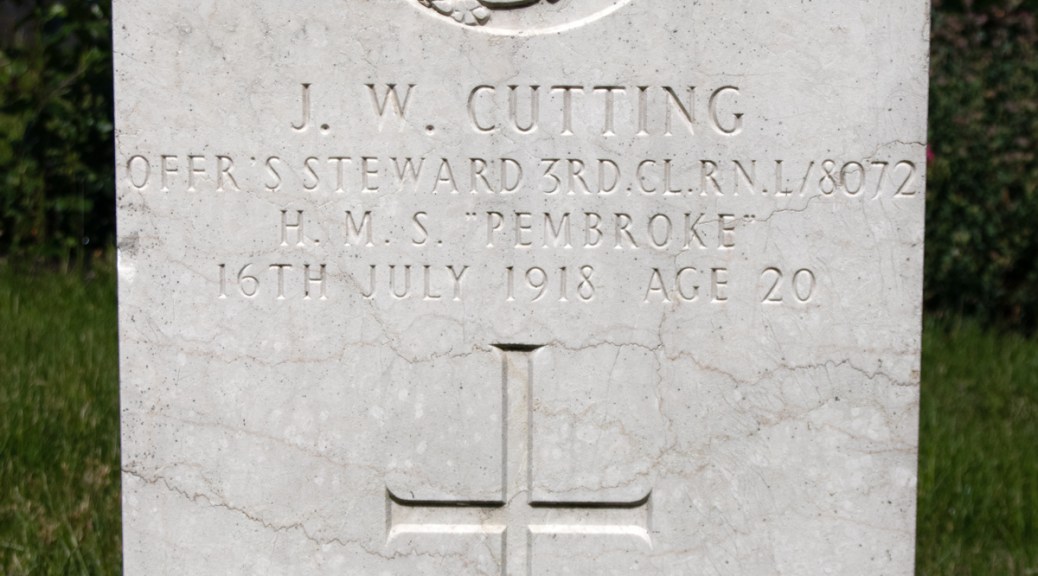
Officer’s Steward 3rd Class Joseph Cutting

Officer’s Steward 3rd Class Joseph Cutting

Joseph William Cutting was born on 10th September 1897 in Stratford, Essex. The middle of three children, his parents were Alfred and Clara. Alfred was a stoker in a carpenter’s workshop, but when he completed his schooling, his son found work as a clerk.

When war broke out, Joseph stepped up to play his part. He enlisted in the Royal Navy on 22nd September 1915, joining as an Officer’s Steward 3rd Class. His service records show that he was 5ft 8ins (1.72m) tall, with dark brown hair, blue eyes and a fresh complexion. He was also noted as having a scar in the middle of his forehead.

Officer’s Steward Cutting was based at HMS Pembroke, the Royal Naval Dockyard in Chatham, Kent, and would continue in his role for the next two and a half years. His annual review recorded a very good character, and moderate to satisfactory ability, which may be why he did not rise above his junior rank.

In the summer of 1918, Joseph was admitted to the Royal Naval Hospital in Chatham, suffering from tuberculosis. The lung condition was to prove his undoing, and he succumbed to it on 16th July 1918. He was just 20 years of age.

Joseph William Cutting was laid to rest in the naval section of Woodlands Cemetery in Gillingham, Kent, not far from the base he had called home for so long.


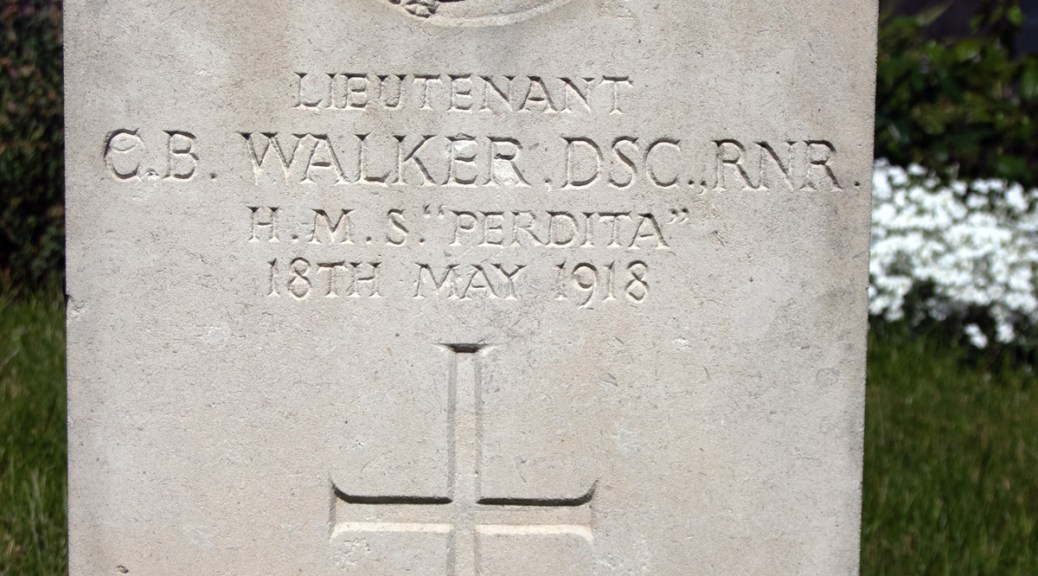
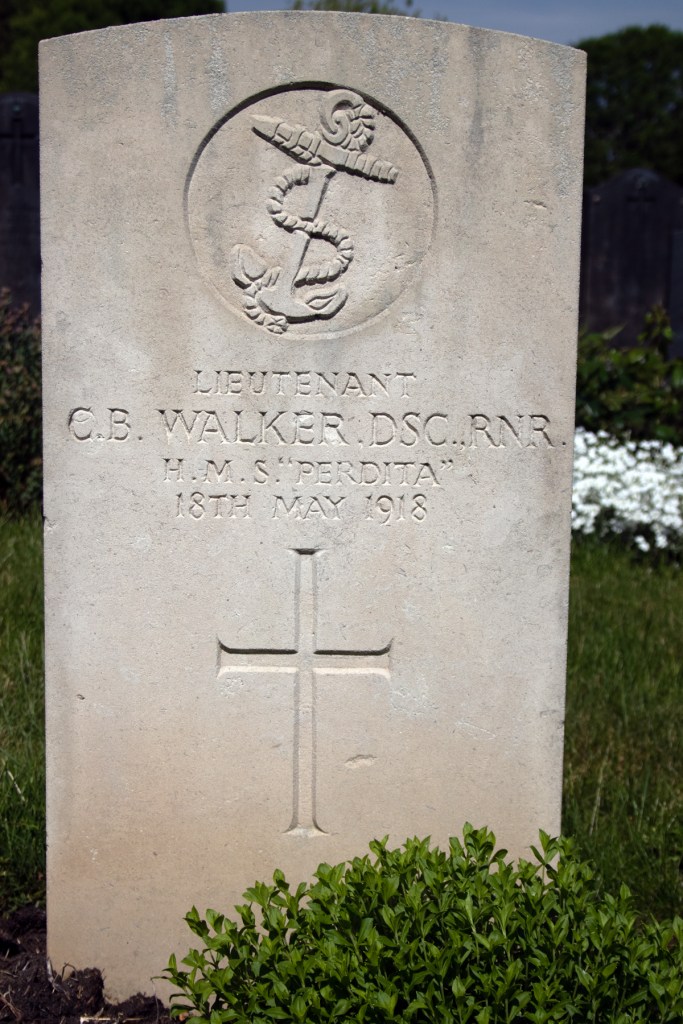
Lieutenant Claude Walker

Lieutenant Claude Walker

“The funeral took place on Wednesday with naval honours of Lieut. Claude Bennett Walker, RNR, whose home is a 23, Overcliffe, Gravesend, and who died at the Royal Naval Hospital, Chatham, on Saturday. His death was a naval casualty, and it was only on Friday, a day before his death, that he was taken to the Chatham Hospital.”

[Kent Messenger & Gravesend Telegraph: Saturday 25th May 1918]

Claude Bennett Walker was born on 6th July 1882 in Deal, Kent. The oldest of five children, his parents were George and Amelia Walker. George was a Trinity pilot, navigating ships off the Kent coast and beyond, and it was only natural that his first born followed in his stead.

Claude set to a life at sea when he completed his schooling. By August 1904, he was a registered Second Mate on board sea-going vessels, and within two years, he was deemed competent to become a First Mate. By 1909 he was certified as a Master of a foreign-going ship. At some point he joined the Royal Naval Reserve, and on 5th July 1912, was given the rank of Sub-Lieutenant.

That autumn, Claude married Gwen Case. The wedding took place in her home town of Melksham, Wiltshire, and the couple would go on to have two children – son Alec in 1913, and daughter Alison three years later.

When war broke out, Claude would be called upon to play his part, serving on the battleship HMS Majestic and the destroyer HMS Recruit early on in the conflict. By the spring of 1915, he was assigned to the minelayer HMS Biarritz, and that October, he was promoted to full Lieutenant.

On 9th March 1917, Claude was given command of the minelayer HMS Perdita. She served in the Mediterranean, and would be caught up in some skirmishes. In October 1917, Lieutenant Walker was awarded the Distinguished Service Cross, and the following April he was mentioned in dispatches.

The Perdita was back in Kent by the spring, by which point Claude had fallen ill. He was admitted to the Royal Naval Hospital in Chatham with cerebrospinal meningitis, and this would be the condition to which he would succumb. He passed away on 18th May 1918, at the age of 35 years of age.

Claude Bennett Walker was laid to rest in the naval section of Woodlands Cemetery, Gillingham, Kent.


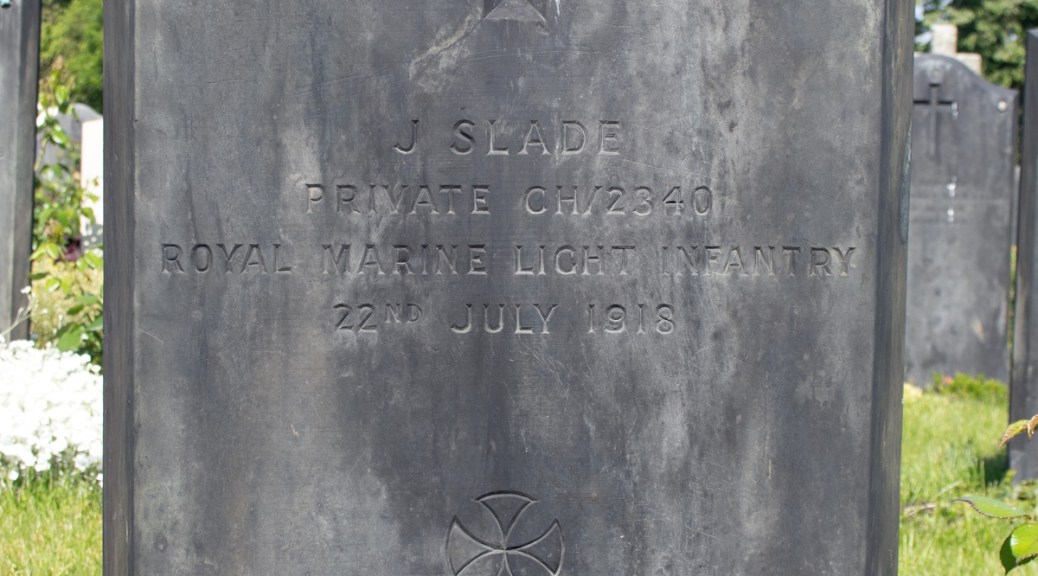
Private John Slade

Private John Slade

John Slade was born in Winchmore Hill, Buckinghamshire, in 1865. One of three children to Edward and Mary, he also had three half-siblings from his mother’s previous marriage. Edward was a hawker, but when he left school, his son sought bigger and better things. By the time of the 1891 census he was recorded as being a Private in the Royal Marine Light Infantry, and was based in Chatham, Kent.

Sadly, Private Slade’s service records have been lost to time, so it is not possible to identify where his role took him. The 1901 census, however, shed some light on his time in the navy. It found him living at 36 Cross Street in Gillingham, Kent, with his wife, Annie, and his adopted daughter, Lillie. They had also taken on three boarders – Frank Hall, Harry Monk and Charles Barwell – all of whom were in the navy as well.

Ten years later on, and thing had changed once more. Still living in Gillingham, it seems that John’s time in the Royal Marine Light Infantry had come to an end. Instead, he was living at 54 James Street and giving his trade as an unemployed labourer. Still noted as being married, there is no sign of either Annie or Lillie: instead John was living with widow Laura Greyson and her two teenage boys, Charles and George.

At this point, John’s trail goes cold. As he was formally granted a Commonwealth War Grave, he must have stepped up to serve his country once more when war broke out in 1914. He would, however, have been getting on in years at this point, so how for long that service continued is anyone’s guess. He passed away from ‘disease’ on 22nd July 1918, at the age of 53 years of age.

John Slade was laid to rest in the military section of Woodlands Cemetery, Gllingham, the town that had been his home for more than three decades.


Stoker 1st Class Thomas Ellis

Stoker 1st Class Thomas Ellis

Thomas Ellis was born in 1896 in St Leonard’s, Sussex. The third of twelve children, his parents were George and Ellen Ellis. George was a general labourer, but when he finished his schooling, Thomas found work as a golf caddy. The 1911 census recorded the Ellis family living in four rooms at 7 Caves Road to the east of the town centre.

There is little additional information about Thomas, sadly. He joined the Royal Navy when war broke out, and was working as a Stoker 1st Class by the closing months of the conflict. He passed away, through causes unknown, on 7th July 1918, at the age of just 23 years old.

Thomas Ellis was laid to rest in the naval section of the Woodlands Cemetery in Gillingham, Kent, not far from the Royal Naval Dockyard in Chatham – HMS Pembroke – at which he was based.


Acting Leading Seaman William Wood

Acting Leading Seaman William Wood

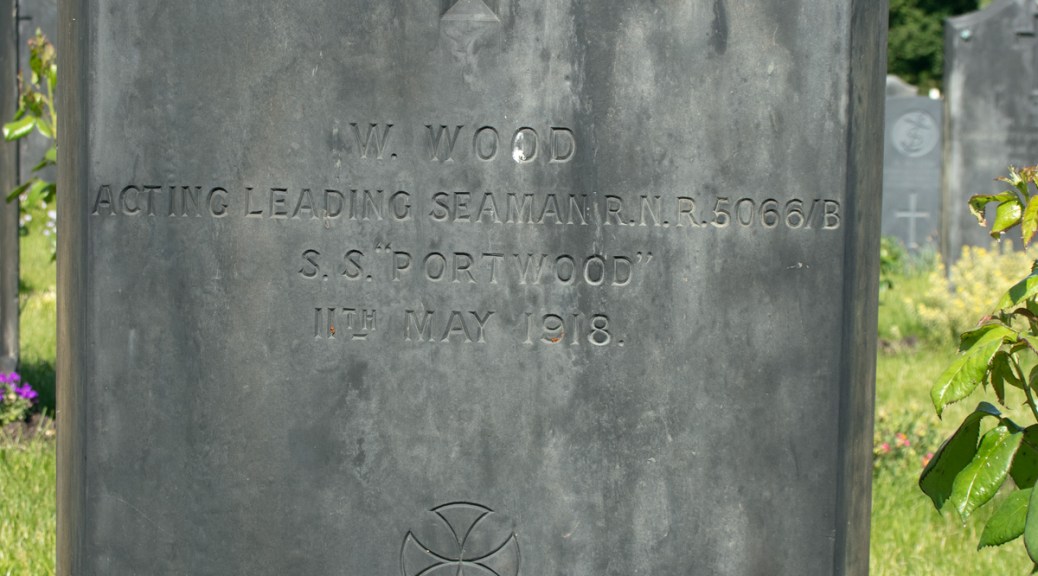
The life of William Wood, who is buried in Woodlands Cemetery in Gillingham, Kent, is a challenge to piece together. His headstone confirms that he held the rank of Acting Leading Seaman in the Royal Naval Reserve, and that he was assigned to SS Portwood at the time of his death.

Full service records for William have long since disappeared, but his pension ledger index card gives his widow as Catherine Rose Wood, of Greenfield Street in Govan, Scotland. It also suggests that the couple did not have any children under full age.

The Royal Navy and Royal Marine War Graves Roll provides William’s date of birth – 28th December 1887 – and goes on to suggest that he was born in London. Sadly, his name is far too common to narrow down census records, and there are no documents relating to his and Catherine’s marriage, so any additional family connections are also lost.

Acting Leading Seaman Wood’s entry on the pension ledger confirms his died of general paralysis of the insane, and his burial in the Gillingham cemetery would suggest that he had passed away in the Royal Naval Hospital in Chatham, Kent. He died on 11th May 1918, at the age of 29 years old.

William Wood was buried in the military section of Woodlands Cemetery, Gillingham, Kent.


Lance Serjeant Ralph Page

Lance Serjeant Ralph Page

Ralph William Page was born in the autumn of 1889, and was the second of five children to William and Elizabeth. William was a brush maker from London, but the family were initially born and brought up in Ottery St Mary, Devon.

By the time of the 1901 census, the family had upped sticks and relocated to Kilmington, near Axminster. Three of the family – William, Elizabeth and Ralph’s older sister Ethel – were all working in bone brush making, William as a maker, and his wife and daughter as drawers.

Ralph initially followed in the family trade, but this was not to be enough for him. He was already volunteering for the Devonshire Regiment, and he took the opportunity to join full-time. He enlisted on 11th September 1907. His service records show that he was exactly 18 years of age, and that he had black hair, brown eyes and a fresh complexion. Ralph stood 5ft 4ins (1.62m) tall and weighed 10st 9lbs (67.6kg).

Private Page initially enlisted for five years on active service. During that time he remained on home soil and, by the autumn of 1911, he was promoted to Lance Corporal. The following spring, he extended his term of service, in advance of being placed on reserve status later in 1912.

Away from army life, romance had also blossomed. On 2nd September 1912, he married Beatrice White at St Mary’s Church in Axminster. She was the daughter of a carpenter, who had also follower her widowed mother into lacemaking. The couple would go on to have three children: Florence, Ralph and Frederick. A fourth child, Peggy, passed away when she was just a matter of weeks old.

When war was declared in the summer of 1914, Ralph was sent with his unit – the 1st Battalion – to France. He saw action at Mons, Messines and Armentières in the next few months alone. In October, Ralph was promoted to Acting Corporal, and just two months later he was made Acting Serjeant.

In March 1915, things seem to have changed for Ralph. He was transferred to a Depot unit on home soil, and reduced in rank to Private. Nothing in his service records suggests any misdemeanour leading to his transfer.

Private Page remined on home soil until the end of 1916. Attached to the 3rd (Reserve) Battalion, he made his way back up through the ranks again, and was a Corporal by the time he was reassigned to the 2nd Battalion and sent off to France once again that December.

Ralph was to be firmly entrenched on the Western Front over the next five months. It was during the German retreat back to the Hindenburg Line in the spring of 1917 that he received the injury that would remove him from the war. On 23rd April, the now Lance Serjeant Page was shot in the abdomen. He was medically evacuated to Britain for treatment, and did slowly recover. Ralph’s need for an abdominal belt meant that he was no longer fit to serve and he was ultimately discharged from the army on 29th November 1917.

Ralph returned home to Devon, but the war had taken its toll on his health. When pandemic spread around the world as the conflict drew to a close, he was to succumb. He passed away from a combination of the influenza and pneumonia on 5th November 1918, at the age of 29 years old.

Ralph William Page was laid to rest in Axminster Cemetery, Devon, not far from where his widow and children lived.