George Wilson Townsend was born in St Pancras, Middlesex on 13th September 1885. The youngest of three children – although his older brother Joseph had died before George was born – his parents were piano maker Samuel Townsend and his wife, Eliza.
When he finished his schooling, George found work as a clerk for a shipping company. In the summer of 1909 he married Ellen Gibbins: the couple went on to have two children, daughters Kathleen (born in 1910) and Elsie (born in 1912).
The 1911 census found the family in a small cottage at 43 Leighton Road, Kentish Town. George was still working as a shipping clerk, while Ellen was look after baby Kathleen.
When war broke out, George was called upon to play his part. He enlisted on 12th May 1917, and joined the Royal Flying Corps as an Air Mechanic 3rd Class. His service records show that he stood 5ft 9.75ins (1.77m) tall.
When the Royal Air Force was formed in April 1918, George was immediately transferred across. Reclassified as a Clerk 3rd Class, he was quickly promoted to Clerk 1st Class, the skills he had learn in civilian life coming to the fore. Attached to 85 Squadron, then 62 Training Squadron, which was based in Gosport, Hampshire.
By the autumn of 1918, George had returned home, although the circumstances for this are unclear. He may have been on leave or recuperating from an illness. Certainly he passed away from pneumonia while at home on 5th October. He had not long turned 33 years of age.
George Wilson Townsend was laid to rest in Highgate Cemetery, not far from where his family still lived.
Ernest James Dean was born in the autumn of 1898 in St Pancras, Middlesex. The older of two children, he was the only son to Ernest and Caroline Dean. Ernest Sr was a bootmaker, and the family lived at 51 Lismore Road.
Ernest Jr found work as a clerk when he completed his schooling. However, when war broke out, he was keen to play his part. He enlisted on 6th February 1917, joining the Royal Flying Corps as an Air Mechanic 3rd Class. His service record shows that he was 5ft 6ins (1.67m) tall, and he must have proven to be a keen student: within four months he had been promoted to Air Mechanic 2nd Class and was being trained as a wireless operator.
When the Royal Air Force was formed on 1st April 1918, Ernest’s transfer was automatic. It is unclear exactly where Air Mechanic Dean served, but he seems to have been based in Kent by that autumn.
In October, Ernest was admitted to the Lees Court Hospital in Faversham, Kent, having come down with pneumonia. The condition, sadly, was to prove fatal: he passed away on 29th October 1918, at the age of just 20 years old.
The body of Ernest James Dean was taken back to Middlesex for burial, and he was laid to rest in the majestic grounds of Highgate Cemetery.
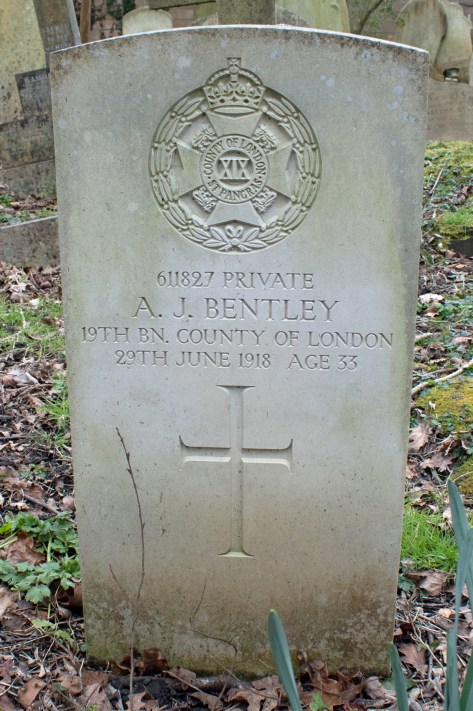
Albert John Bentley was born in St Pancras, Middlesex, in the spring of 1885. The second of six children, his parents were John and Eleanor (also known as Elizabeth) Bentley. John was a piano maker, and the family lived at 27 Hampshire Street in St Pancras.
When his father died in 1910, Albert had already started to follow in his footsteps. The following year’s census recorded him living with his mother and three younger siblings. Employed as an organ builder, his was one of three wages being brought into the household.
Albert stepped up to play his part when war broke out. Full details of his military service have been lost to time, but it is clear that he enlisted in the London Regiment, and was assigned to the 1st/19th (County of London) Battalion (St Pancras).
It is unclear whether or not Private Bentley spent any time overseas. By the summer of 1918, however, he had fallen ill, and was admitted to a military hospital in Shoreham-by-Sea, Sussex. He succumbed to a combination of influenza and pneumonia on 28th June 1918: he was 33 years of age.
The body of Albert John Bentley was taken back to Middlesex for burial. He was laid to rest in the sweeping grounds of Highgate Cemetery.
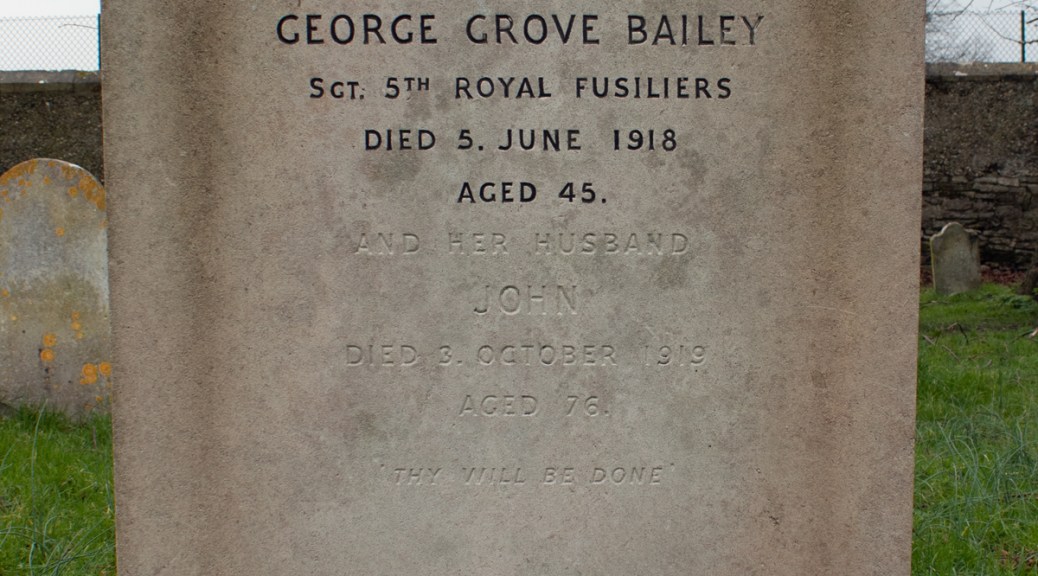
George Grove Bailey was born towards the end of 1873, in the Hampshire town of Lymington. He was the second of two children to John and Emma Bailey. John was a butler, but when Emma died when their youngest boy was just two years old, he seems to have changed career. The 1881 census found the family living at 45 High Street, Lymington, not far from the school and the Church of St Thomas the Apostle.
While he had the support of domestic servant Mary Ann, John was still young and, in 1884, he married again. His new bride was Sarah Woodman, and the couple would go on to have a daughter, Edith, two years later.
George falls off the radar at this point, and it is only from a newspaper report of his funeral in June 1918 that we are able to fill in some of the details:
The funeral took place on Monday afternoon of Sergt. George Bailey, youngest son of Mr John Bailey, of Highfield, Lymington, who passed away in the military hospital at Brighton, following a short illness. The deceased, who was 45 years of age, and was recently married, served in the South African War, and joined up at the commencement of the present war, being for some twelve months in the Fusiliers at the front. He was wounded, and since his return to this country has been acting as sergt.-instructor.
[Hampshire Advertiser: Saturday 15th June 1918]
George’s new wife was Winifred Mary Bailey, but there is little additional information about her. His regiment – the 5th Battalion of the Royal Fusiliers – was based on home soil, and would not have been the unit with which he had served on the Western Front. It’s not possible, therefore, to determine where he fought, or how he was wounded.
George Grove Bailey was buried in the family plot in the graveyard of St Thomas’ Church, Lymington, not far from where his father’s shop had been. John, who had been working as a poor rate collector, died a year after his son, and was laid to rest alongside his wife and youngest child.
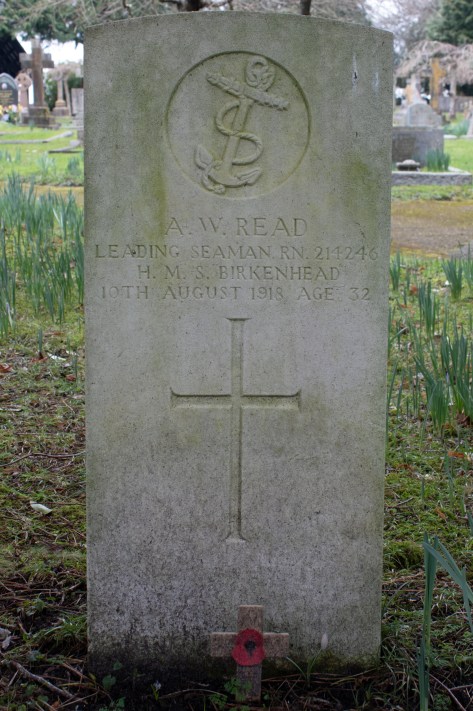
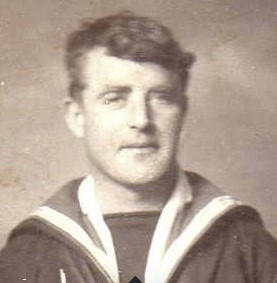
Arthur William Read was born on 5th February 1886 in Lyndhurst, Hampshire. The fourth of nine children, he was one of five sons to James and Mary Read. James a builder’s labourer-turned-yardman, although his son wasn’t to follow in his father’s footsteps.
Instead, Arthur rook on work as a baker’s boy, but this was not enough for him. He sought a career at sea and, on 10th April 1901, he took a job in the Royal Navy. Given the rank of Boy 2nd Class because of his age, he was sent to HMS St Vincent, the shore-based training establishment in Devonport, Devon. Over the next eighteen months he learnt the tools of his trade, and was promoted to Boy 1st Class after just ten months.
On 5th February 1904, Arthur turned 18, and came of age. Now able to formally enlist in the Royal Navy, he took that opportunity, and was given the rank of Ordinary Seaman. His service papers show that he was 5ft 5ins (1.65m) tall, with light brown hair, blue eyes and a fresh complexion.
At this point, Ordinary Seaman Read was serving on board the battleship HMS Irresistible. She would be his home for two years and, just a couple of weeks before changing vessels, he was promoted to Able Seaman.
Arthur would serve up to and during the First World War. He was assigned to a total of seven ships after the Irresistible, returning to what would become his home port, HMS Victory in Portsmouth, Hampshire, in between voyages. His character was regularly noted as being very good, while his ability was repeatedly found to be superior. By 1st October 1915, with war raging across Europe, he was promoted again, to the rank of Leading Seaman.
Away from his seafaring, Arthur had found love. In the last quarter of 1909 he married Alice Philpott. Sadly, details about her have been lost to time, but the couple would go on to have two children – Ivy and Gladys.
When war came to Europe, Arthur’s younger brother Harry stepped up to serve. He enlisted in the Middlesex Regiment, and was assigned to the 12th Battalion. Private Read was caught up in fighting on the Western Front, and was killed in action on 25th April 1916. He is buried in Bronfay Farm Military Cemetery, in Bray-sur-Somme, Picardie.
Leading Seaman Read, meanwhile, was continuing his naval career. From November 1916 he was assigned to the light cruiser HMS Birkenhead. Used to patrol the North Sea, she had come away from the Battle of Jutland unscathed.
As the war entered its closing months, Arthur’s health was becoming impacted. Suffering from diabetes, he was admitted to the Royal Naval Hospital in Edinburgh in summer of 1918. The condition was to better him, however, and he passed away on 10th August: he was 31 years of age.
The body of Arthur William Read was taken back to Hampshire for burial. He was laid to rest in Lyndhurst Cemetery.
After her husband’s death, Alice was left to raise two children under 5 years old. Unable to do this without support, on 8th July 1920, she married Jack White. A Chief Petty Officer in the Royal Navy, it is unclear whether his path had ever crosser her late husband’s. The following year’s census found her and her two daughters living in a house on Clarence Road in Lyndhurst: her husband was away at sea.
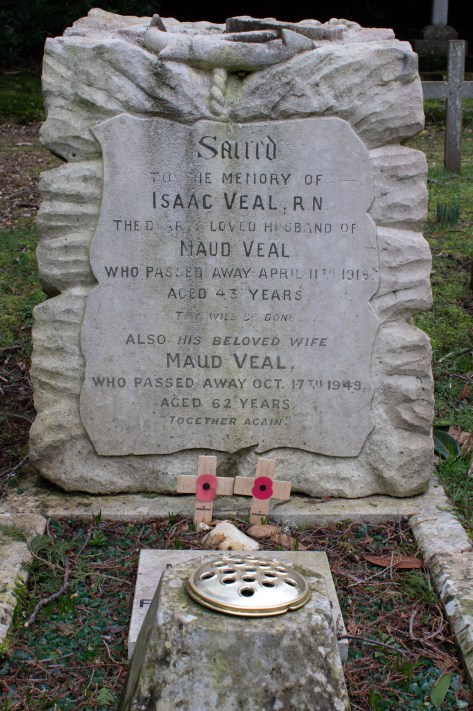
Isaac Veal was born on 18th November 1874, the seventh of eight children to Joseph and Frances Veal. When he was born, his parents were the publicans at the Waterloo Arms in Lyndhurst, Hampshire, and this is the town in which they would raise their family.
Frances died in 1890, and by the following year’s census, Joseph had stepped back from being a landlord, he was living with three of his children on a farm to the north of the town centre. Now employed as a domestic gardener, Isaac was working with him.
Isaac sought bigger and better things, however, and, on 21st December 1891, he enlisted in the Royal Navy. Intriguingly, though, he gave his date of birth as 10th July 1875. Below the age to formally sign up, he was given the rank of Boy 2nd Class, and was sent to HMS St Vincent in Devonport, Devon, for training. He remained on board for the next two years, rising to Boy 1st Class in March 1893.
On 26th August 1893, Isaac was promoted to Ordinary Seaman: this would normally mark a boy’s coming of age, but the date doesn’t match Isaac’s given date of birth, or his actual one. It is likely, therefore, that his true age had become known.
Ordinary Seaman Veal’s service documents confirm that he was 5ft 6ins (1.68m) tall, with auburn hair, brown eyes and a fair complexion. He signed up for a period of twelve years and, during that time, he would serve on a total of eleven ships. Isaac travelled the world, returning to HMS Victory, the Royal Naval Dockyard in Portsmouth, Hampshire, in between voyages.
On 11th March 1895, Isaac was promoted to the rank of Able Seaman, and his annual reviews generally marked him of very good character. From April 1901 he was assigned to the battleship HMS Revenge, and she would remain his home for more than four years. During his time assigned to her his contract came to an end and he immediately re-enlisted.
On 18th October 1909, Isaac married Ethel Maud Astridge, a caretaker’s daughter from Basingstoke, Hampshire. When they wed, Ethel – who was better known by her middle name – was working as a housemaid for a miller in North Stoneham. The couple would go on to have three children – Beatrice, Mary and Florence – and while her husband was away at sea, Ethel lived in their cottage on Queen’s Road in Lyndhurst.
Back at sea, Able Seaman Veal would continue to travel the world. During the second term of his contract with the navy, he was assigned to a further dozen ships. In August 1912, Isaac was assigned to HMS Dolphin, the shore base in Gosport, Hampshire, which was the home of the Royal Navy Submarine Service. Over the next five years he would split his time between Dolphin and HMS Maidstone. The submarine depot ship, which operated out of Harwich, Essex, would be his home for the majority of the First World War. Able Seaman Veal’s commitment to the navy was being recognised, as was his ability, which was recorded as superior in each of his annual reviews from 1911 onwards.
As the conflict entered its closing months, Isaac’s health was becoming impacted. In the spring of 1918, he was admitted to the sick quarters in Shotley – just across the river from Harwich – suffering from pernicious anaemia and rheumyalgia. The combination of conditions would prove fatal: Isaac passed away on 11th April 1918, at the age of 43 years old.
The body of Isaac Veal was taken back to Hampshire for burial. He was laid to rest in Lyndhurst Cemetery, just a few minutes’ walk from his family home. Conveyed to the cemetery in a motor ambulance van, he funeral was supported by a firing party from the local Bombing School Camp, tributes including “a token of respect from the men of the 8th and 9th Submarine Flotillas.” [Hampshire Advertiser – Saturday 20 April 1918]
After the death of her husband, Maud remained living in Myrtle Cottage, the family’s home for the rest of her life. The 1921 census recorded her as being an apartment House Keeper, while the 1939 Register noted that both she and her daughter Florence, were carrying out unpaid domestic duties.
This latter document identifies three boarders to Myrtle Cottage, including Maud’s younger sister Thirza.
Ethel Maud Veal died on 17th October 1949, at the age of 62. She was buried in the family plot in Lyndhurst Cemetery, reunited with her husband Isaac after more than 30 years.
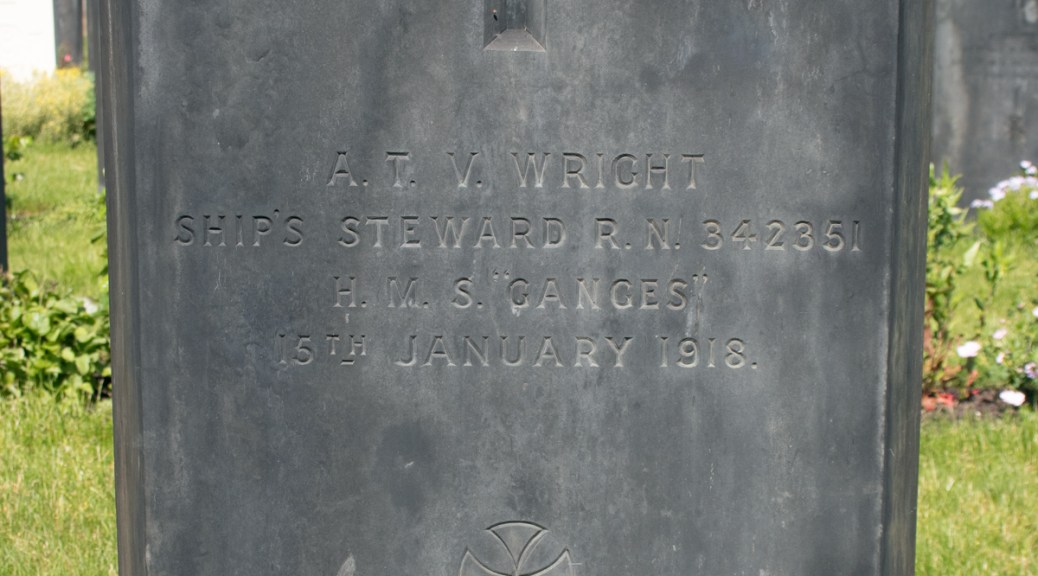
Archibald Thomas Victor Wright was born on 3rd August 1883 in Portsmouth, Hampshire. The second of six children – all boys – his parents were George and Alice Wright. George was a gunner and lieutenant in the Royal Navy, and the seafaring life was an obvious choice for his son to follow as well.
Archibald joined the Royal Navy as a Ship’s Steward Boy on 14th September 1898. Just fifteen years old, he was too young for formally enlist but was sent to HMS Pembroke, the Royal Naval Dockyard in Chatham, Kent, for his training.
Over the next three years, Archibald learnt the tools of his trade. He moved between establishments, from HMS Boscawen in Portland, Dorset, to HMS Excellent back in in Portsmouth. It was while on board the battleship HMS Glory, however, that he came of age, and was formally enlisted in the Royal Navy as a Ship’s Steward Assistant. His service records note that, on turning eighteen, he was 5ft 2in (1.58m) tall, with brown hair, dark brown eyes and a fresh complexion.
Ship’s Steward Assistant Wright’s contract was for twelve years, and during this time he would travel the world. By the summer of 1908 he had served on nine ships, returning to naval bases in Kent and Hampshire between voyages. On 15th June 1908 he was promoted to Acting Ship’s Steward, and just a few weeks later, he got married.
Ellen Osborne was born in Southampton just a month or so after her new husband. The daughter of a house furnisher’s clerk, by the time of the 1901 census she was employed as a boarding school teacher. After the couple married, she moved to Kent to be close to the Royal Naval Dockyard in Chatham (also known as HMS Pembroke), where Archibald would more frequently be based. The 1911 census return found her lodging with Lillie Calcutt at 112 Shakespeare Road in Gillingham, Kent.
Archibald’s career, meanwhile, was continuing apace. On 24th September 1909 he was promoted to Ship’s Steward proper, and in August 1913, when his original term of service came to an end, he quickly renewed it. By now, his service records show that he had had a few tattoos added to his arms: a girl on his right arm, a dragon on his upper left, and two cockerels on his lower left arm. Now 30 years of age, he stood 6ft tall (1.83m) tall, and, intriguingly, his eyes were now recorded as being blue.
Ship’s Steward Wright’s career trajectory does not seem to have been without its hiccups, however. Where his annual review up until 1909 have consistently given his character as very good, from hereon in, it dipped to just good. His ability also began to vary, from very good in 1909, to superior for the following couple of years, to just satisfactory in 1913 and 1915.
Archibald spent the last few years of the war split between HMS Pembroke and HMS Ganges – the training base just outside Ipswich, Suffolk. In January 1918, he was admitted to the Royal Naval Hospital in Chatham, following an epileptic fit. This was to prove fatal, and he passed away on 15th January. He was 34 years of age.
Interestingly, Ship’s Steward Wright’s pension ledger gives a damning insight into his health and mental well-being at the time of his passing. It noted the cause of his death as epilepsy aggravated by alcoholism, adding that the disease was neither contracted on nor aggravated by [active service], but due to his own serious negligence or misconduct.
Archibald Thomas Victor Wright was laid to rest in the military section of Woodlands Cemetery in Gillingham, Kent, not far from the dockyard he had called home.
George Leslie Lewis Carter was born at the start of 1891 in New Cross, Kent. The oldest of three children, his parents were laundry managers William and Isabel Carter.
The Carters’ work seemed to take them across South London and the 1891 census found them living in Hammersmith. George’s two siblings had been born by this point, one in Gravesend, Kent, the other in Richmond, Surrey.
By 1911, William and Isabel had moved the family to Kingston-upon-Thames, Surrey. That year’s census recorded them as living at 142 London Road, which was noted as being a 12-roomed property. The couple were managing a laundry – possibly living in at the laundry itself. George was recorded as being a university student, while his younger brother Lionel was at school. The family also had a housekeeper, Frances Stoke, living with them.
When George finished his studies, he found employment as an Assistant Paymaster with the Royal Naval Reserve. On 15th February 1916, he married Ada Ritchie. She was a merchant’s daughter from Long Ditton, Surrey, and the couple exchanged vows in her local parish church.
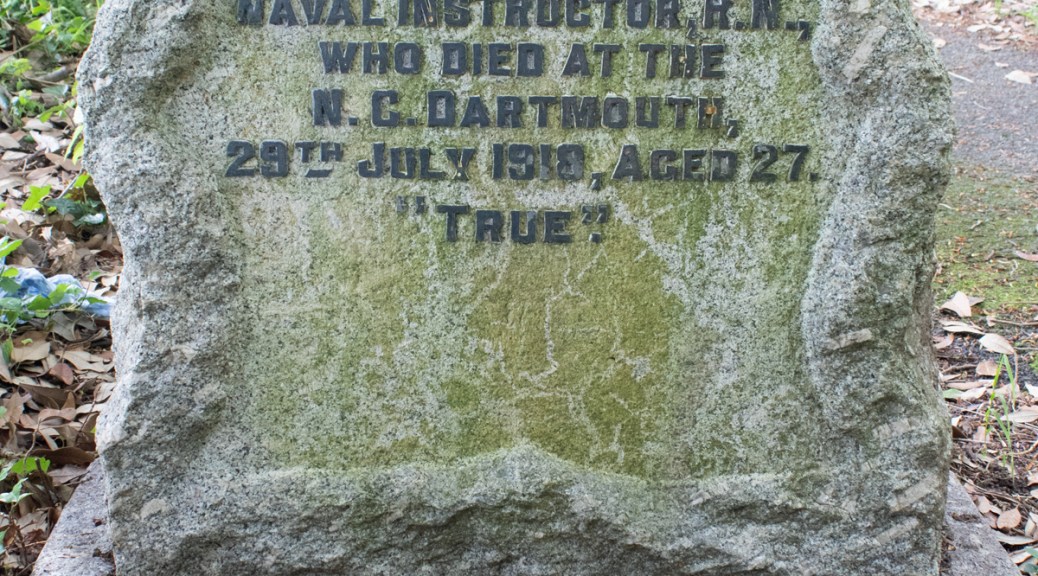
At this point, George’s trail goes cold. He became attached to the Royal Naval College in Dartmouth, Devon – also known as HMS Pomone – and took on the role of Naval Instructor. It is unclear what type of instructing he was doing, but it seems likely to have been connected with the administration or financial part of the Royal Navy.
The funeral of Naval Instructor George Leslie Lewis Carter, Royal Naval College, Dartmouth, who died on Monday from pneumonia following an attack of influenza, took place on Wednesday morning…
The mourners were Mrs Carter (widow), Mrs Carter, Surbiton (mother), Mr Carter (brother), and Mr Jamieson Ritchie, London (brother-in-law)…
[Dartmouth & South Hams Chronicle: Friday 2nd August 1918]
Naval Instructor Carter was 27 years of age when he died on 29th July 1918. The newspaper article’s distinction between Ada and Isabel would suggest that Ada may have been living in Dartmouth at the time as well.
George Leslie Lewis Carter was laid to rest in the graveyard of St Clement’s Church in Dartmouth, Devon.
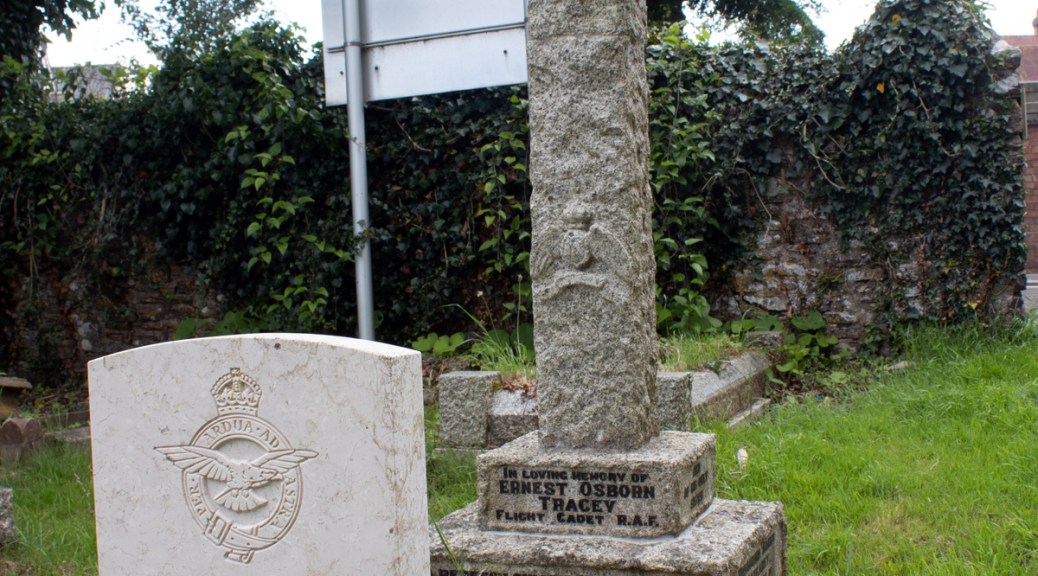
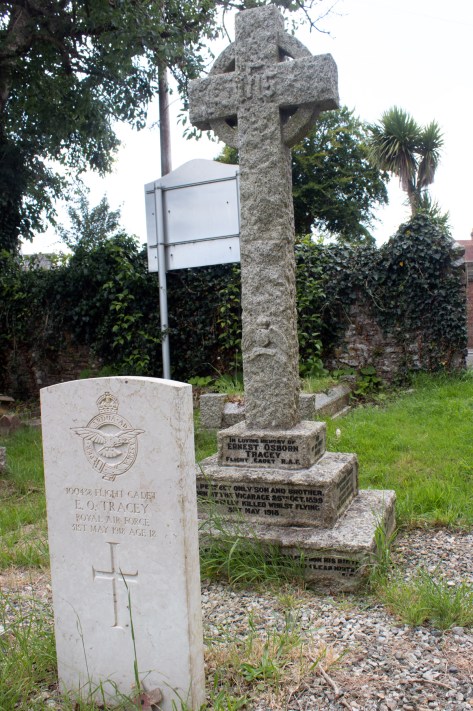
Flt-Cadet Ernest Osborn Tracey, RAF, who died on Friday, the result of injuries sustained through a collision in the air when undergoing his final training, was the only son of Rev. HF and Mrs Tracey, of Dartmouth. He was born in Oct. 1899, at St Saviour’s Vicarage, of which church his father was vicar for 23 years, retiring from the living in 1913 in order to take up clerical duties in New Zealand. Mr Tracey was educated at Blundell’s, where he held a house master’s scholarship. When he left in the middle of last year he was the winner of the Coles’ prize for science; was one of the shooting VIII, of which he had his cap and colours; a member of the Upper Sixth, the OTC, and he had also won the first prize for drawing. On leaving Blundell’s he obtained a cadetship at Woolwich, and was transferred to the RAF.
[Western Morning News: Tuesday 4th June 1918]
Ernest Osborn Tracey was born in Dartmouth, Devon, on 25th October 1899, and was baptised in his father’s church six weeks later. The younger of two children to Reverend Henry and Alice Tracey, he gave up his schooling to enlist in the Royal Flying Corps on 12th November 1917.
When the Royal Air Force was formed the following April, Flight Cadet Tracey automatically transferred across. Training to be a reconnaissance pilot, Ernest would have cut a dashing figure, standing 6ft 1in (1.85m) tall. He was based at Yatesbury Airfield in Wiltshire, and was learning to fly a BE2, twin seater biplane.
At 8:30pm on 31st May, his aircraft collided with another, sending Ernest’s machine spinning into a nosedive. He crashed into the ground and was killed instantly.
The body of Ernest Osborn Tracey was taken back to Devon for burial. He was laid to rest in the graveyard of St Clement’s Church, Dartmouth.
Ernest’s will gave his mother, Alice, as his beneficiary. The newspaper report suggests that Henry had travelled to New Zealand to tend a new flock there, and the Commonwealth War Graves Commission records him as being “Chaplain to the Forces” and Vicar of Dartmouth.
It certainly seems that any time spent in New Zealand was limited. By the time of the 1921 census, Reverend Tracey had found a new posting, in the Staffordshire village of Gentleshaw. The same census return found Alice staying with their daughter, Rosamond, and her family, in Totnes, Devon.
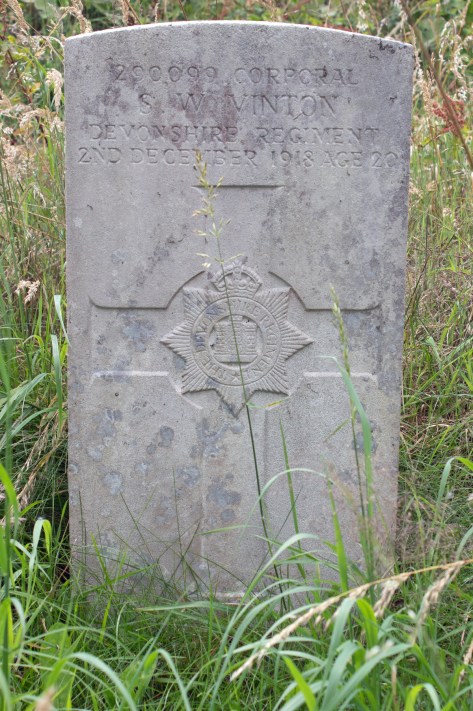
Stanley William Vinton was born on 30th April 1898 in Dartmouth, Devon. The second of eight children, his parents were William and Kate. William was an outfitter’s assistant, and by the time of the 1911 census, the family of ten were living in a four-roomed cottage on South Ford Road.
When he finished his schooling, Stanley was apprenticed to a shipwright. Away from work, he volunteered with the Dartmouth Cadet Company, and was drawn towards an army career. On 25th May 1914, he enlisted, joining the 7th (Cyclist) Battalion of the Devonshire Regiment. His service records show that he gave his age as 17 years and four months old. He was 5ft 6.5ins (1.69m) tall, and weighed 154lbs (69.9kg). Private Vinton was of good physical development and had good eyesight.
Stanley was formally mobilised on 5th August 1914. He remained on home soil for the next three years, primarily because soldiers were unable to fight on the Western Front until they turned 19 years of age. During this time, he appears to have impressed his superiors: in July 1916 he was promoted to Lance Corporal, and just four months later he rose to full Corporal.
In July 1917, Stanley’s chance to see some action arrived, when he was posted to the 2nd Battalion, and sent overseas. This move came with a caveat, however, and he reverted to the rank of Private. It was a challenging time for the regiment, and Stanley quickly found himself in the thick of it at Passchendaele.
On 30th November 1917, after four months on the Western Front, Private Vinton’s luck came to end. Caught up in the fighting, he was wounded in his left thigh by shrapnel and the fingers of his left hand by a gun shot wound. He was medically evacuated to Britain for treatment, and admitted to the Edinburgh War Hospital in Bangour.
Thankfully, the injury to Stanley’s hand was minimal, but his leg took longer to heal, and he remained in hospital for more than two months. When he was discharged, Private Vinton was transferred to the regiment’s command depot in Sutton Coldfield. In March 1918, he was promoted to Corporal, but his injured leg was still causing him discomfort. In the end, he was reassigned to a munitions works in Lowestoft, Suffolk, and this is where he would spend the remainder of the year.
Stanley’s constitution was weakened by this point, and that winter, he contracted influenza. The condition was to prove fatal, and he passed away on 2nd December 1918. He was just 20 years of age.
The body of Stanley William Vinton was taken back to Devon for burial. He was laid to rest in the graveyard of St Clement’s Church, Dartmouth, high above the town’s centre, but within walking distance of his grieving family’s home.









 Death and Service