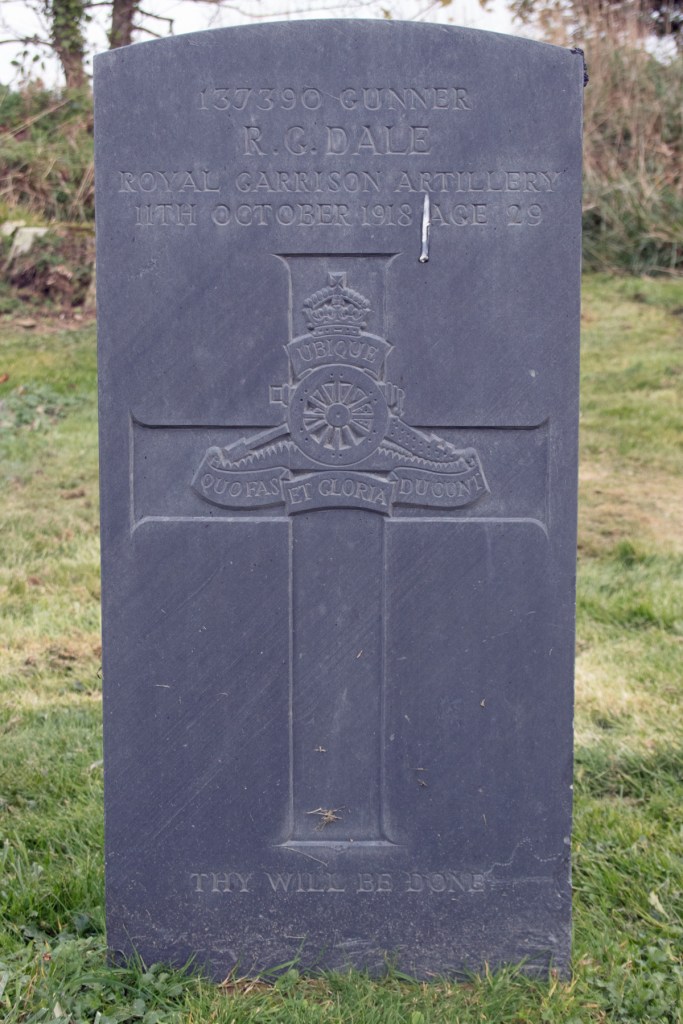
Richard George Dale was born Padstow, Cornwall, in the summer of 1889, the oldest child to Alice Dale. She married Frederick Bryant in March 1894, but and went on to have two children – Frederick and Albert – but, by the time of the 1901 census, her husband has passed away. The document gives Richard’s surname as Bryant, but there is no real indication that he was Frederick’s son.
Alice had been living with her greengrocer parents, but the 1901 census in a small cottage off Lanadwell Street, a couple of door away from them. As a widow at 31 years old, she is noted as being on parochial relief.
Details of Richard’s later life are a challenge to track down. Absent from the 1911 census, it was around that time that he married Agnes MacKintosh. While she was born in Edinburgh, the wedding took place in St Columb, Cornwall.
When war broke out, Richard was working as a farmer. He enlisted the day after hostilities were declared, and joined the Royal Garrison Artillery. Gunner Dale was, according to the records, 5ft 3ins (1.6m) tall, with medium colour hair, blue eyes and a fresh complexion. He had a scar between his eyebrows.
Gunner Dale served for nearly four years, all the time being based on home soil. He suffered from epilepsy, however, and this is what led to his eventual discharged from armed service in March 1918.
Richard returned home, but his health was compromised. He passed away on 11th October 1918, from a combination of influenza and pneumonia. He was 29 years of age.
Richard George Dale was laid to rest in Padstow Cemetery, in sight of his younger brother Albert, who had passed away eleven years before.
The funeral of Mr Henry Hutchings, the Zulu war veteran, who died suddenly at Lower Weston on Tuesday, took place on Saturday afternoon…
The principal mourners were: Mrs Hutchings (widow), Sergt. Hutchings (son)(who wore the Mons ribbon and a Zulu war medal), Mr AE Adams (step-son), Mrs A Hutchings (daughter-in-law), Mr David Adams (step-son), and Mrs Emily Pickworth (step-daughter).
In order to attend the funeral Mr AE Adams had returned from France, where he has been carrying out work for a local firm.
Bath Chronicle and Weekly Gazette: Saturday 16th February 1918
Tracking down Henry Hutchings’ early life is a bit of a challenge, but working backwards through census records sheds some light onto his later years.
The Commonwealth War Graves Commission record states “Hutchings, Pte. Henry, 14475. Royal Defence Corps. 5th Feb., 1918. Age 59. Husband of Theresa Hutchings… Served in the Zulu War (1877-79) with Army Service Corps.”
The 1911 census recorded Henry and Theresa living in Shepherd’s Bush, Hammersmith. The document confirms they had been married for less than a year and, unusually, suggests both were twice married. Henry had been born in Notting Hill, and was employed as a smith’s hammerman. Theresa was born in Byfleet, Surrey, and the couple were living with Henry’s son, Henry Jr, and Theresa’s daughter, Alice.
Turn the clock back ten years, and the 1901 census tells a more confused story. Henry was living in Edmonton, Middlesex, where he was employed as a general labourer. Theresa is noted as being his wife – in contrast to the later census return – and the couple were living in Gilpin Crescent with Henry’s sons – Henry Jr, Edward and Sidney – and Theresa’s two children – Alice and Albert.
Going back a further ten years leads to a dead end. Neither Henry nor Theresa are readily identifiable on the 1891 census, even though both should have had their older children by that point.
An 1877 military record confirms Henry’s earlier time in the army. It was in July of that year that he enlisted, joining the Army Service Corps. At 18 years of age, he had been working as a carman, but a dedicated career is what he sought out. His record confirms he was 5ft 4ins (1.63m tall, with brown hair, blue eyes and a fresh complexion. Henry lists his next of kin as brother Robert Hutchings, although, again further family details are lost in the mists of time.
Private Hutchings spent twelve years in the army. After eighteen months on home soil, he was dispatched to South Africa, as the later newspaper report suggests, and spent a year overseas. He returned home in March 1880, and was stood down to reserve status until the end of his contract in July 1889.
The documentation uncovers details of Henry’s second period of time in the military. He enlisted in the Royal Defence Corps in September 1915, and was based at Alexandra Palace in London. His time there was limited, however, as he began to show signs of heart disease. By the following summer, Private Hutchings suffered from breathlessness and chest pains, to the point where he was medically discharged from service on 21st August 1916.
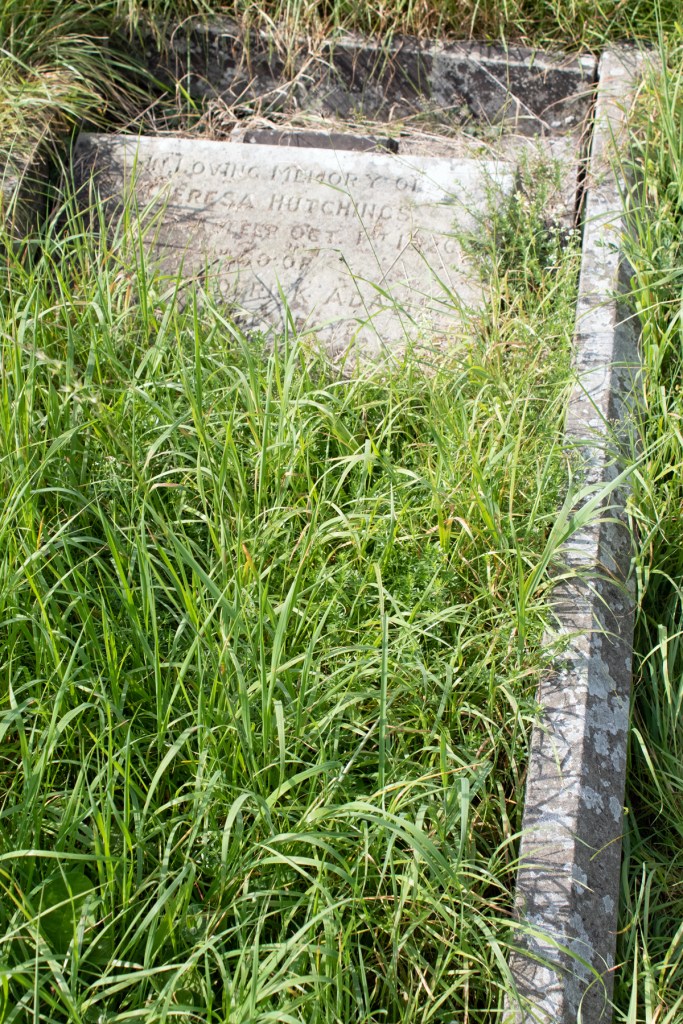
Henry and Theresa had moved to Somerset by January 1917, presumably for the cleaner air that their home in Bath would provide. This was not to be enough, however. Henry died a little over a year later, at the age of 59 years old.
Henry Hutchings was laid to rest in the sweeping grounds of Locksbrook Cemetery, Bath. He was to be reunited with Theresa when she passed away in 1926.
William Kennedy Blundell early life seems anything but ordinary. Born in Cardiff, Glamorgan, in the summer of 1890, he was the only child to bank clerk Edmund Blundell and his wife, Annie. Edmund was born in Staplegrove, Somerset, while Annie had grown up in Lahore, India.
The 1891 census found William living with his maternal grandparents James and Edith Kennedy in the Walcot area of Bath, while his parents were firmly based in Cardiff. Edmund died the following year, so it is possible that he was placed out of the way while Annie tended to her husband (along with her sister-in-law and a domestic servant).
By the time of the next census return, Annie and William were reunited, and were living in Avenue Road, Wimborne Minster, Dorset. Anne was living off her own means, and had a servant, Emily Chaffey, to hep look after the home.
Both Annie and her son disappear from the 1911 census. It is likely that William had embarked on a military career by this point, and may have been serving overseas. Sadly, his trail goes cold, but scraps of later information help identify some of what became of him.
By the outbreak of the First World War, he was serving in the Bedfordshire Regiment. He was based in Egypt from January 1916, and rose to the rank of Captain by the end of the conflict. By 1918, he was attached to the 12th (Transport Workers) Battalion, and was back in Britain.
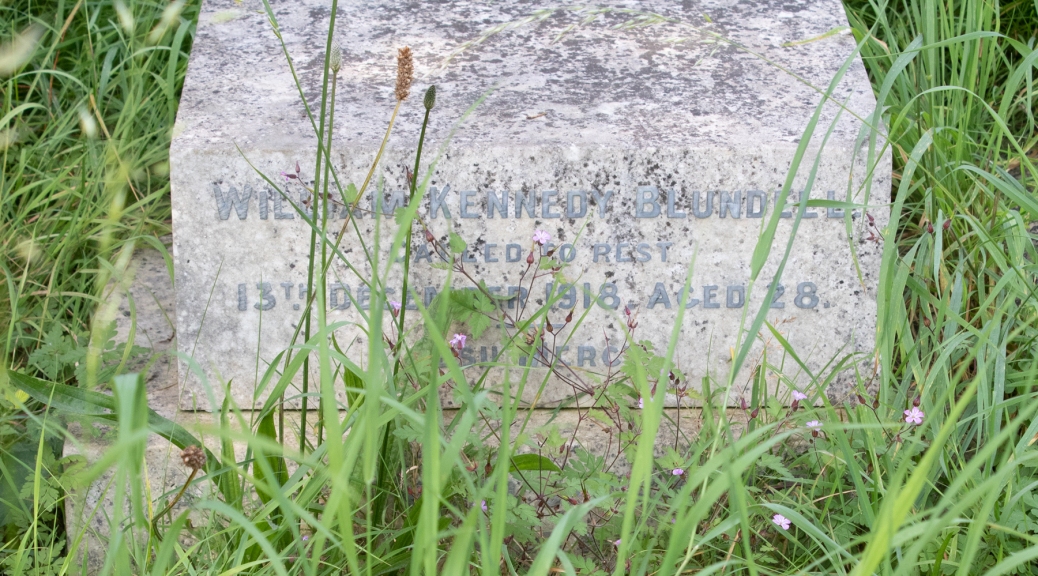
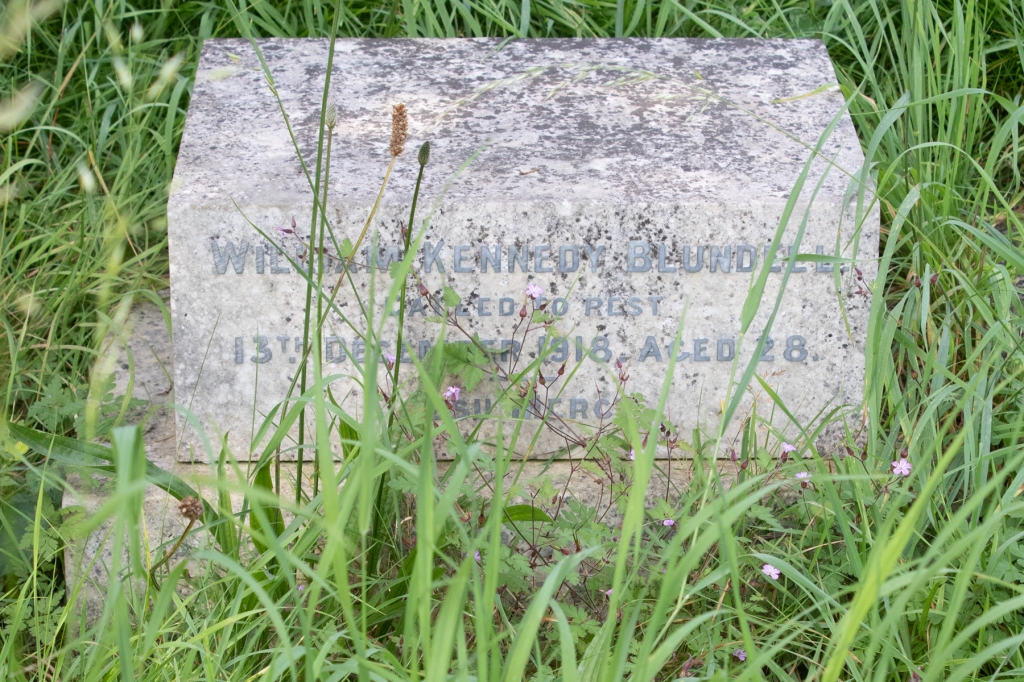
Captain Blundell was in Sussex by the time of the armistice, and it was here that he fell ill, contracting pneumonia. He was admitted to the General Eastern Hospital in Brighton, but the condition was to prove too severe. He passed away on 13th December 1918, at the age of 28 years old.
William Kennedy Blundell’s body was taken back to Somerset for burial. He was laid to rest in the sweeping grounds of Locksbrook Cemetery in Bath.
Arthur Edward Naile was born in the summer of 1888, the youngest of ten children to James and Mary Naile. Both of his parents were born in Bath, Somerset, and this is where they raised their growing family.
The Nailes lived in the Camden area of the city, consecutive census returns showing different addresses, as the children grew and then left home. In 1891, they lived at 11 Malvern Buildings, a small terraced house on a steep hill. Ten years later, they had moved to 3 George’s Road, to another terraced cottage close to their old home. By 1911, only Arthur was still living at home, which was now the four-roomed terrace at 51 Brooklyn Road, in the more built up Larkhall area no the northern outskirts of the city.
During all of this time, James had worked as a printer’s compositor. By 1911 he was 64 years of age, and was employed by a newspaper in the area. Arthur, meanwhile, was working as a grocer’s assistant.
On 9th August 1914, he married soldier’s daughter Bessie Brine. She was working as a dressmaker, and lodging with Charles and Eleanor Richman, in a small cottage in Dover Place. Their marriage certificate shows that Arthur was living three doors down, so it is likely she caught his eye not long after he moved in. They went on to have a son, Leslie, in November 1916.
War was raging across Europe by this point, and Arthur had stepped up to serve his country. He joined the Royal Engineers as a Sapper, but there is little concrete information about his time in the army. He was awarded the Silver War Badge, which was given to men medically discharged from military service during the conflict, which would suggest that he was badly wounded at some point. He died in a hospital in Hastings, East Sussex, an annexe of which was dedicated to personnel who had been blinded during the war.
Sapper Arthur Edward Naile passed away from a combination of influenza and diabetes on 31st October 1918: he was 30 years of age. His body was taken back to Somerset for burial, and he lies at rest in a peaceful corner of Bath’s sweeping Locksbrook Cemetery.
After Arthur’s death, Bessie was left to bring up their young son. In the autumn of 1923, she married again, to John Forman, and not long afterwards the three of them emigrated to Australia, in search of a better life. They settled in Bunbury, Western Australia, and went on to have two children, Ron and Nan.
When war broke out again, Leslie was old enough to step up, and joined the Royal Australian Air Force. By 1943, he found himself as a Flight Sergeant in Waltham, Lincolnshire. He had joined 100 Squadron of Bomber Command and, on the night of 25th June 1943, was piloting a Lancaster over the Netherlands. His plane was hit and destroyed, killing all those on board. Father and son both lost to war, Flight Sergeant Naile was just 26 years of age when he passed. He was buried in Westbeemster, and commemorated on memorials in Runnymede, Surrey, and Canberra, Australia.
Bessie lived on until her early 70s. She died on 8th December 1960, and is buried in the family plot in Bunbury Cemetery.
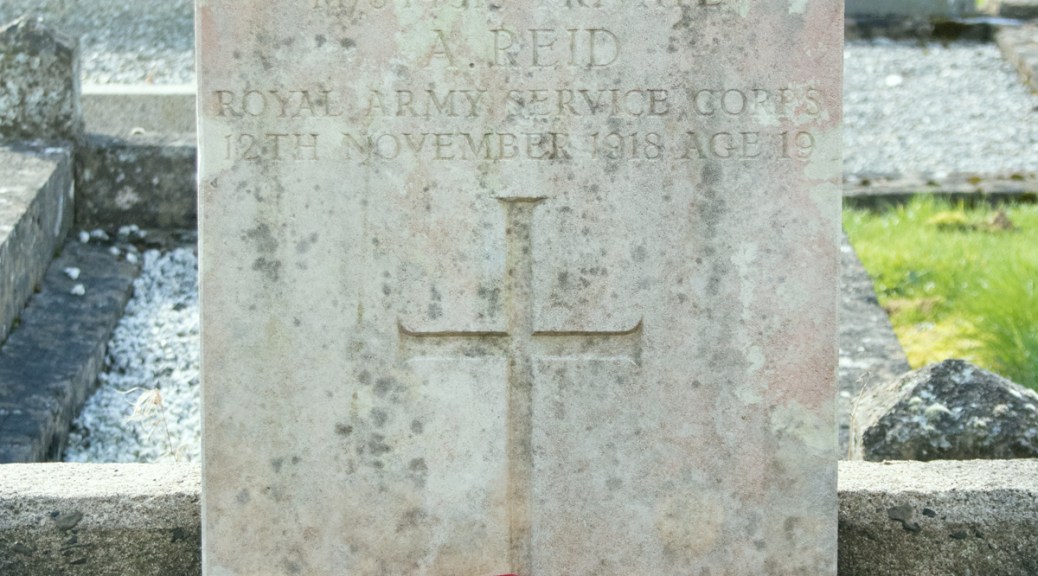
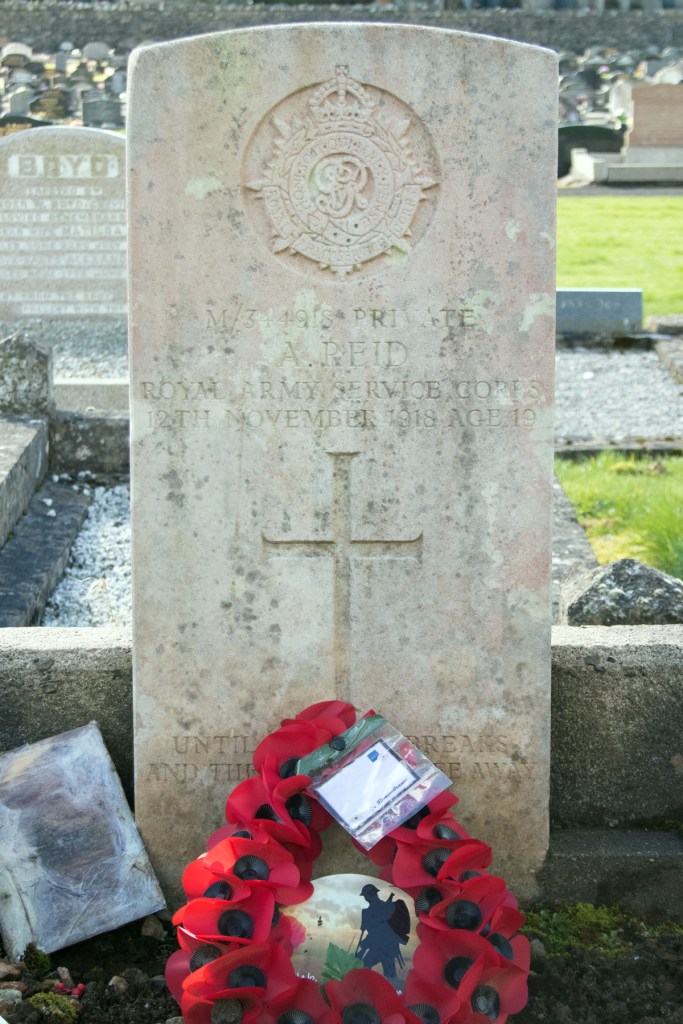
Alexander Reid was born in Ballymena, County Antrim, in the autumn of 1898. Information about his early life is a challenge to pin down, as there were a number of boys with the same name growing up in the area at the time. However, his parents were John and Margaret – or Maggie – Reid.
When Alexander finished his schooling, he found employment as a mill hand. However, when war broke out, he received the call to play his part and, on 13th October 1917, he enlisted in the Army Service Corps. His service records show that he was 5ft 7.5ins (1.71m) tall and weighed 138lbs (62.6kg). He was noted as having a tattoo of his initials on his left thumb, and that his right knee was stiff and swollen from an old injury.
Private Reid was sent to England to serve. He was attached to the Mechanical Transport Depot at Grove Park, Kent. Barracked in an old workhouse that had been taken over for army use, he remained there until the spring of 1918.
Alexander had contracted tuberculosis and was medically discharged from service because of the contagious disease. He returned home to Ballymena, but the condition worsened. He passed away at home on 12th November 1918, aged just 19 years old.
Alexander Reid was laid to rest in Ballymena New Cemetery, County Antrim, a twenty-minute walk from where his grieving family lived, in the centre of the town.
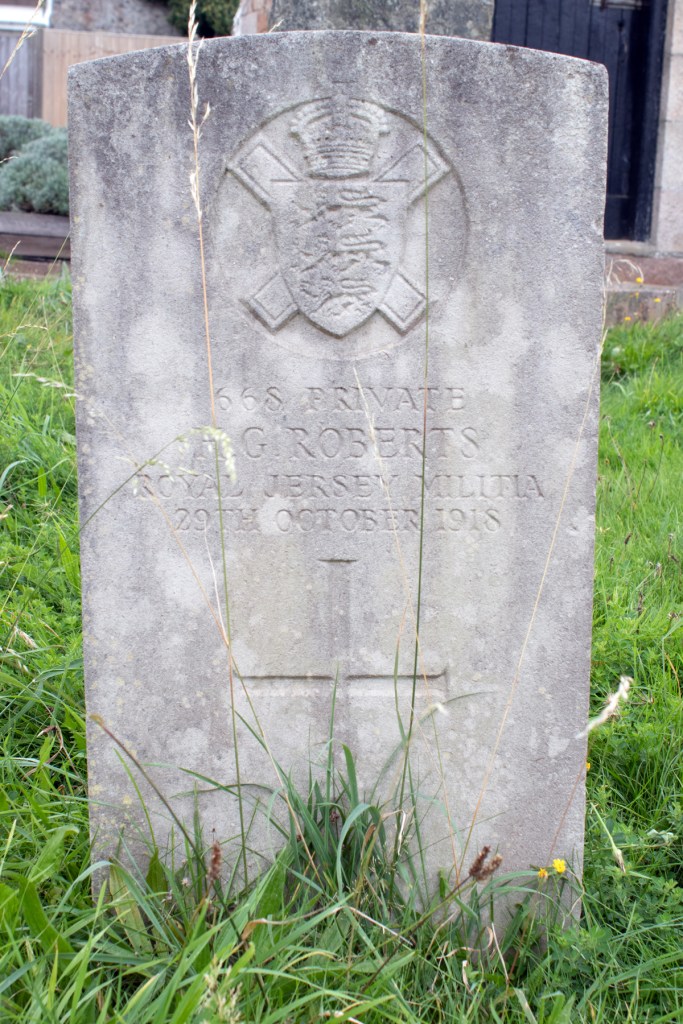
The life of Henry George Roberts is destined to remain shrouded in mystery.
His entry in the Commonwealth War Graves Commission records reads: “ROBERTS, Pte. HG, 668, Royal Jersey Garrison Bn. Channel Islands Militia. 29th Oct, 1918. In North-West corner [St Martin Churchyard]”, but there are no details of his next-of-kin.
No related military records are available for him, and, without Henry’s age an online search identifies too many results to be of any practical use.
Private Roberts lies at rest in the peaceful churchyard, his life lost in the mists of time.
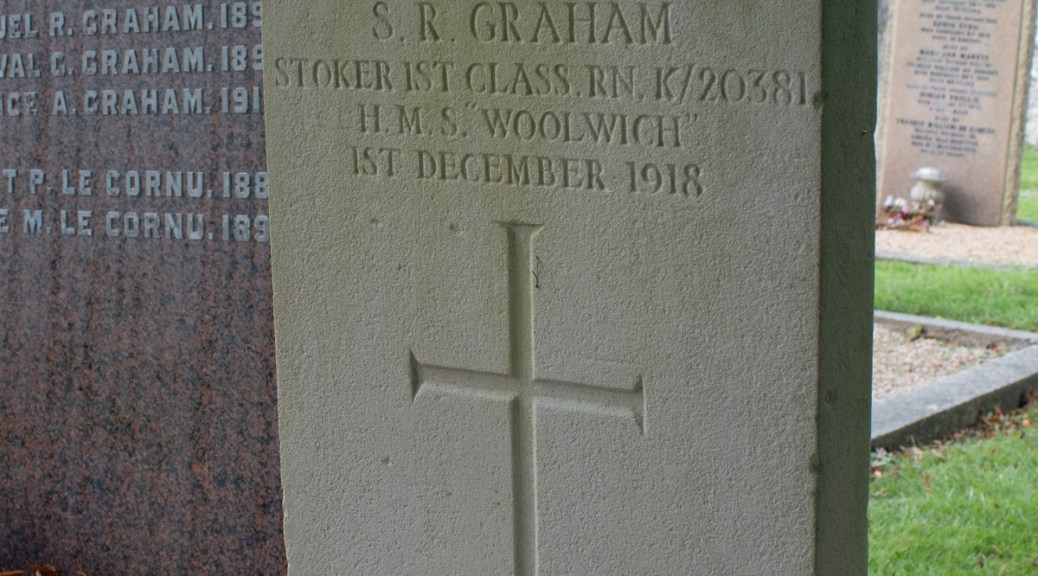
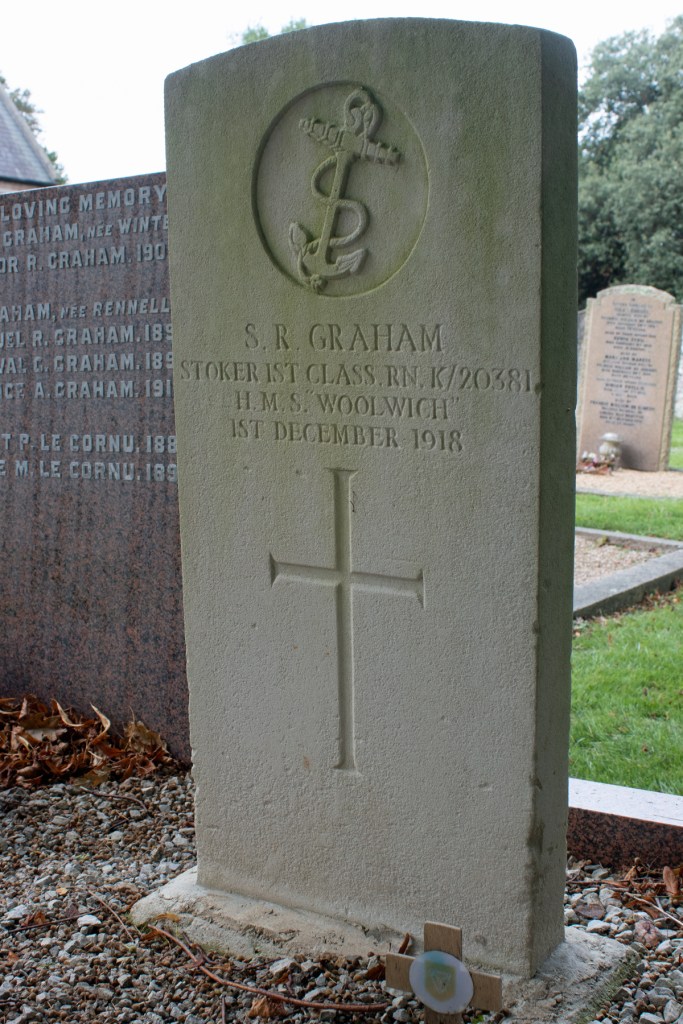
Samuel Robert Graham was born in Cork, Ireland, in 1895. He was one of six children to Samuel and Alice Graham. Samuel was a postman from Liverpool, while Alice had been born in St Helier, Jersey.
Information about Samuel Jr’s early life is scarce: the 1901 census found Alice and the children visiting her mother in Jersey, while he husband is missing from census records. The next return in 1911 recorded Samuel Sr, Alice and three of their children living in the Trinity area of Jersey, but Samuel Jr is missing.
On 9th September 1913, Samuel Jr enlisted in the Royal Navy. He had been working as a blacksmith, and sought a career at sea. His service records show that he was 5ft 5ins (1,65m) tall, with brown hair, hazel eyes and a fresh complexion.
Stoker 2nd Class Graham signed up for a period of twelve years’ service. Based at HMS Victory, the Royal Naval Dockyard in Portsmouth, Hampshire, his first formal posting was on board the cruiser HMS Bristol. He remained on board for nearly two years, and was promoted to Stoker 1st Class in the process.
During the First World War, Samuel served on two more ships and, by the end of the conflict, he was based at HMS Columbine, the naval base at Port Edgar on the Firth of Forth, Scotland. He fell ill while barracked there, and was admitted to the Royal Naval Hospital in nearby Queensferry. Whatever Stoker 1st Class Graham’s condition, it was to prove too severe: he passed away on 1st December 1918, at the age of 23 years old.
Samuel Robert Graham’s body was taken back to Jersey for burial. He was laid to rest in Trinity Churchyard, not far from where his family still lived.
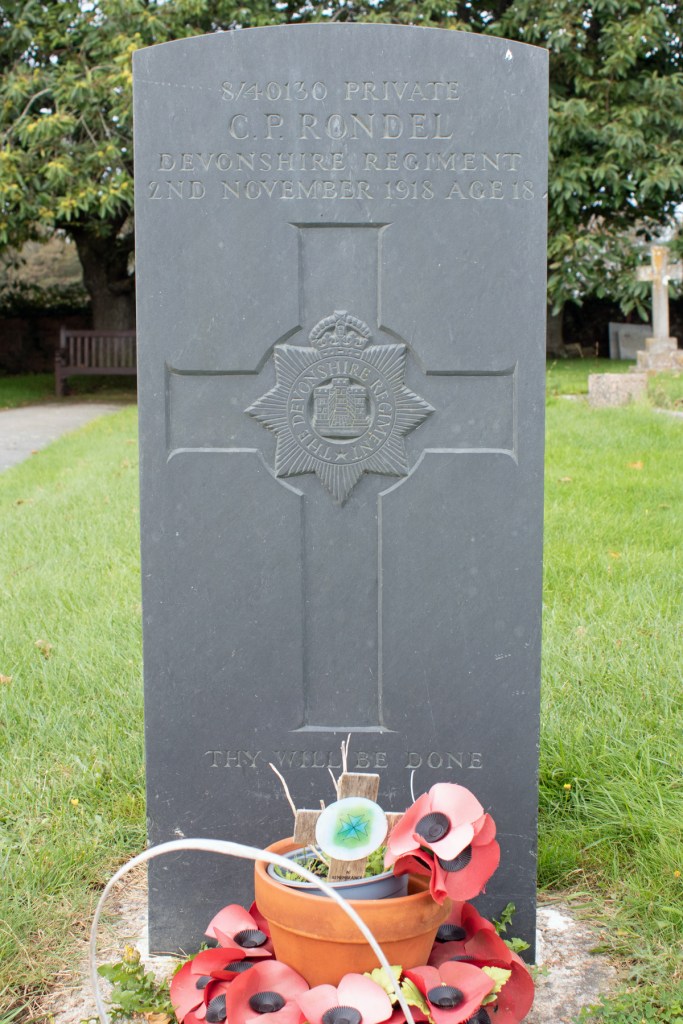
Clarence Philip Rondel was born in 1900 in St Lawrence, Jersey. One of twelve sibling, nine of whom survived childhood, his parents were John and Louisa Rondel. John was a farmer and by the time of the 1911 census, the family had moved to St John’s to take up a new post, a lot of the family pitching in to help out.
When war came to European shores, Clarence was keen to play his part. Too young to enlist when hostilities were declared, it was not until the spring of 1918 that he was able to join up. Private Rondel was assigned to the 53rd (Young Soldier) Battalion of the Devonshire Regiment.
Clarence was sent to England for training, and was based at the Rollestone Camp on Salisbury Plain, Wiltshire. The barracks were breeding grounds for illness and disease, and Private Rondel was not to be immune. He contracted pneumonia, and was admitted to the camp’s hospital. The condition got the better of him, and he passed away on 2nd November 1918: he was just 18 years of age.
The body of Clarence Philip Rondel was taken back to Jersey for burial. He was laid to rest in St John’s New Cemetery, not far from where his family still lived.
John Leslie Mably was born on 21st May 1899, the only son to Elizabeth Janie Mably. Elizabeth lived with her widowed mother and two older brothers, in the Cornish parish of St Minver.
There is scant information available for John’s short life. The 1911 census showed that he was still at school, and when war broke out, he enlisted in the Royal Engineers, although the date for this happened is unclear. Sapper Mably was assigned to the 69th Division Signal Company, but records do not confirm whether he served overseas or on home soil.
At some point later in the conflict, John was in Yorkshire, as he was admitted to the general hospital in Sheffield. Again, details are sketchy, and it is not possible to identify if he was based in the area, or medically evacuated there from overseas. Either way, it was in the hospital that he breathed his last, passing away on 15th August 1918, at the age of just 19 years old.
John Leslie Mably’s body was taken back to Cornwall for burial. He was laid to rest in the picturesque setting of St Michael’s Churchyard in the village of Rock.
Angus MacIver was born in 1887 in the isolated hamlet of Geshader (Geisiadar), on the Isle of Lewis, Scotland. His parents were Murdo and Marion MacIver, and he was one of seven children.
Detail of Angus’ early life are a challenge to uncover. It would seem that he worked with boats when he completed whatever schooling he undertook. Given Geshader’s proximity to the coast, it is likely that Murdo was a fisherman, and that his three sons – Angus included – followed suit.
By the time war broke out in 1914, Angus had joined the Canadian Merchant Navy. He held the rank of Sailor: records suggest that he would have been an Able Seaman, had he been in the Royal Navy.
In the spring of 1918, Sailor MacIver was serving on board the SS Tagona, a Canadian steamer, ferrying goods across the Atlantic. The ship was en route for Glasgow, having sailed from Bilbao, Spain, and, on 16th May she was passing close to the North Cornish coast. Five miles (8km) from Trevose Head, Tagona was torpedoed by the German submarine U-55, and sank. Eight crew members, including Angus, drowned. He was 31 years of age.
The body of Sailor Angus McIver washed ashore in the Camel Estuary: the remains were identifiable, but his family were unable to bring him back to Lewis. Instead, he was laid to rest in the peaceful graveyard of St Menefreda’s Church in St Minver, Cornwall.









 Death and Service