Tag Archives: 1918

Private Arthur Thomas

Private Arthur Thomas

Arthur Reuben Thomas was born in Banwell, Somerset, on 27th September 1899. The older of two children, his parents were blacksmith Edwin Thomas and his wife, Mary.

Little information about Arthur’s life is documented. At the time of the 1911 census he was still a schoolboy, and it is likely that he helped his father out in the smithy when he finished his education.

By this point war was raging across Europe, and it is likely that young Arthur was keen not to miss out. Details of any military service are lost to time, but it seems possible that he joined up as soon as his age allowed.

Private Thomas was assigned to the 53rd (Young Soldier) Battalion of the Hampshire Regiment, and sent to Rollestone Camp on Salisbury Plain, Wiltshire, for training.

Sadly, Arthur’s time in the army seems to have been a short one. He was admitted to a camp hospital in nearby Tidworth, suffering simply from ‘disease’, and it was from this that he passed away on 6th January 1918. He was just eighteen years of age.

Arthur Reuben Thomas’ body was brought back to Somerset for burial. He was laid to rest in the quiet graveyard of St Andrew’s Church in his home village of Banwell.


Private William Solomon

Private William Solomon

William John Solomon was born on 26th June 1891 in the Somerset village of Huntspill. One of nine children, his parents were mason and bricklayer Roland Solomon and his wife, Annie.

When he finished his schooling, William found work as a farm labourer, but, sadly, there is little else documented about his life. When war broke out, he enlisted in the Somerset Light Infantry. Details are unclear, but he served with the 8th Battalion on the Western Front and the 1st/5th Battalion in Egypt.

By 1918, William was back on home soil, but had fallen ill. His condition is not confirmed, but he passed away from it on 16th October 1918, at the age of 27 years old.

William John Solomon was laid to rest in the peaceful graveyard of St Peter’s in his home village.


Ordinary Seaman Bertie Clark

Ordinary Seaman Bertie Clark

Bertie Baden Clark was born on 5th August 1900 in the hamlet of Dunball, near Puriton in Somerset. The third of seven children, his parents were quarry and cement works labourer George Clark and his wife, Bessie.

When war came to Europe, George stepped up to play his part. Despite being 44 years old, he enlisted in the Royal Army Service Corps on 4th November 1915 and, within a year, was in France. He remained posted at the No. 4 Remount Depot until October 1918.

“On the morning of the 1st October 1918, I left the 26th Squadron 4 Base Remount Depot riding a horse and leading one to exercise about a mile & half from the Squadron while proceeding by the side of the railway line my horse was frightened by the whistle of a railway engine & ran away with me throwing me to the road and stepping on my right ankle.”

Private Clark was initially treated at the No. 2 Canadian General Hospital, but was soon invalided back to Britain and placed on furlough until being formally demobbed from the army early in 1919.

Bertie, meanwhile, could see the excitement of the war passing him by. Determine to play is part before it was too late, he gave up his job as a labourer on 13th July 1918 and enlisted in the Royal Naval Volunteer Reserve.

Given the rank of Ordinary Seaman, his service records confirm that he was 5ft 6in (1.68m) tall (1in, or 2.5cm, taller than his father), with dark brown hair, grey eyes and a fresh complexion. He was noted as having a scar on his right knee.

Bertie was sent to HMS Victory, the Royal Naval Dockyard in Portsmouth, Hampshire, for training. Tragically, this was to be his only posting. He was admitted to the dockyard hospital early in October, suffering from double pneumonia and influenza. The condition was to take his life, and he passed away on 10th October 1918, at the age of just 18 years old.

Bertie Baden Clark’s body was brought back to Somerset for burial. He was laid to rest in the quiet graveyard of St Michael’s Church in Puriton, the funeral attended by his family, including his recently returned father, George.


Rifleman Walter Radford

Rifleman Walter Radford

Walter Samuel Radford was born in the summer of 1899, the oldest of eight children to William and Florence Radford. William was a farm labourer from Churchstanton, Somerset, but by the time Walter was born, the family had moved to Chedzoy, near Bridgwater.

Chedzoy was also where William’s parents lived, and the two families’ cottages were just three doors apart. Oddly, even though he was the oldest child, Walter was raised by his grandparents, Frank and Anna, and is recorded as living with them in both the 1901 and 1911 censuses.

Walter was just 15 years old when war came to Europe, and so was too young to enlist. He bided his time, though, and had joined up by the summer of 1918. He was assigned to the 1st Battalion of the Royal Irish Rifles, and was sent to the Western Front in the closing months of the conflict.

Caught up in the final advance in Flanders, Rifleman Radford was injured, possibly during the action of Ooteghem. He was medically evacuated to Britain for treatment, but died of his injuries while admitted to a hospital in London. He passed away on 26th November 1918, aged just 19 years old.

Walter Samuel Radford was brought back to Somerset for burial. He was laid to rest in the peaceful graveyard of St Mary’s Church in Chedzoy.


Interestingly, while Walter’s pension ledger gave his father, William, as the recipient, the Army Register of Soldiers’ Effects noted his grandmother, Anna, as the recipient of his belongings.


Major Cyril Wilson

Major Cyril Wilson

Cyril Spencer Wilson was born on 12th July 1883 in Charlcombe, Somerset. The youngest of three children, his parents were John and Edith Wilson. John was a solicitor who went on to become President of the Bath Law Society and, because of his standing, Cyril and his siblings had a comfortable upbringing: all three censuses covering his life – in 1891, 1901 and 1911 – all show the family living in a large villa in Charlcombe, with a cook and a housemaid to support them.

[Cyril] was educated at Bath College and Lancing College, and then studied engineering at Bristol University. He then became an articled pupil at the Great Western Railway Works at Swindon. Very interested in, and a keen supporter of, the Territorial movement, he was a Captain of the [Royal Engineers] Wilts Fortress Engineers when war broke out.

Bath Chronicle and Weekly Gazette: Saturday 2nd November 1918

Cyril had begun work for the Great Western Railway in July 1902, and became attached to the Institute of Civil Engineers the following January.

Captain Wilson formally enlisted when war was declared, and was soon sent to France. “He was awarded the Military Cross early in the summer of 1917, after being twice mentioned in despatches for excellent work.[Bath Chronicle and Weekly Gazette: Saturday 2nd November 1918]

Cyril was promoted to Major soon after this, and would go on to serve in France for more than a year more. In February 1918 he married Amy Pounds, the daughter of a bank clerk from East London and the couple exchanged vows in the city.

Major Wilson returned to France, but contracted dysentery that summer. He returned to Britain to recuperate, but came down with pneumonia, and this was to take his life. He died on 27th October 1918, aged 35 years old.

Cyril Spencer Wilson’s body was brought back to Somerset for burial. He was laid to rest in the family plot in St Mary’s Churchyard, Charlcombe.


Major Cyril Wilson
(from ancestry.co.uk)

Ordinary Seaman William Bruton

Ordinary Seaman William Bruton

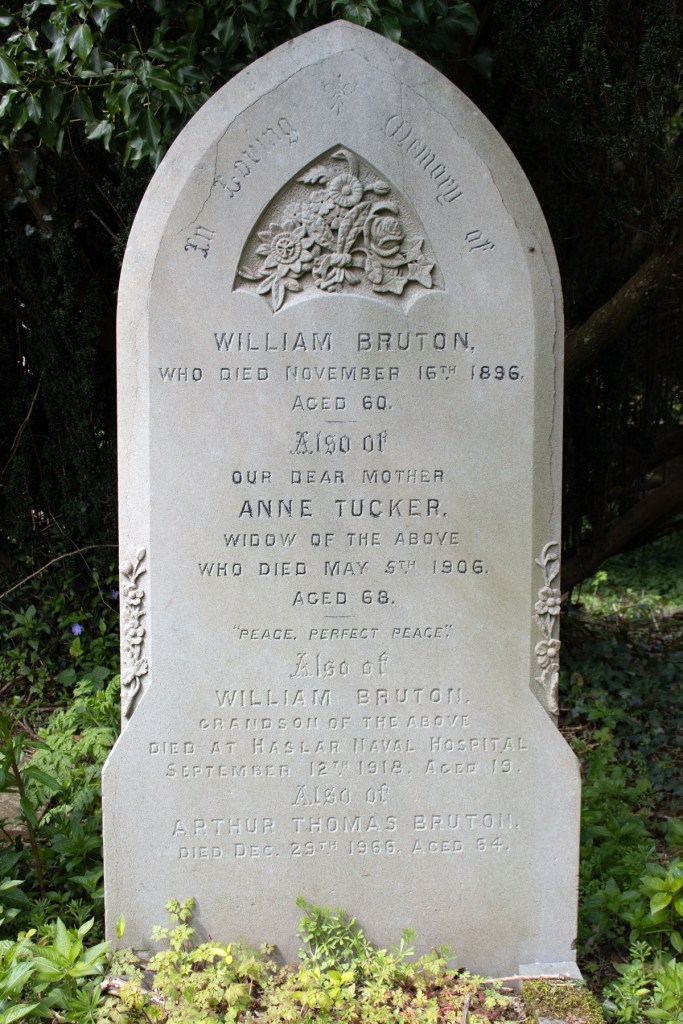
William Bruton was born on 9th August 1899, the oldest of two children to William and Kate Bruton. William Sr was a grocer from Charlcombe to the north of Bath, Somerset, but it was in the Walcot area of Bath itself that the family settled.

Kate died in November 1904, at the age of just 35 years old, and William Sr raised his children on his own. He married a second time, to Edith Elly in 1910, and the couple went on to have a daughter, Mona, the following year.

William Jr – who was known as Willie, to avoid confusion with his father – was still in school at the time of the 1911 census, but when he left a few years later, he found work as an engine cleaner. War had come to Europe by this point, but to begin with Willie was too young to play his part.

He finally got his chance to enlist towards the end of the conflict, and joined the Royal Navy as an Ordinary Seaman on 18th July 1918. His service document record that Willie was 5ft 11ins (1.8m) tall, with brown hair, hazel eyes and a fresh complexion. He was also noted as having a scar on his upper lip.

Ordinary Seaman’s first posting was to be HMS Victory, the Royal Naval Dockyard in Portsmouth, and, tragically, this was also to be his last. Within a matter of weeks he had contracted pneumonia, and he passed away from the condition on 12th September 1918. He was just 19 years of age.

William Bruton was brought back to Somerset for burial. He was laid to rest in the family plot in Lansdown Cemetery, overlooking the city of his birth.


Lieutenant Colonel Charles Holroyd-Smyth

Lieutenant Colonel Charles Holroyd-Smyth

Charles Edward Ridley Holroyd-Smyth was born in Ballynatray, Co. Waterford, Ireland, on 16th August 1882. The seventh of nine children, his parents were John and Harriette Holroyd-Smyth. John was a colonel in the army and, while from a a renowned family, there is actually little documented about Charles’ early life.

Given his father’s military career, it seemed natural for Charles to follow suit. His service records are tantalisingly elusive, but he certainly served in South Africa during the Second Boer War at the turn of the century.

When war broke out, Charles took up the rank of Captain in the 3rd Dragoon Guards (Prince of Wales’ Own). He set sail for France on 1st November 1914, and he found himself in the very thick of the fighting, where his battalion fought at Ypres, Loos and Arras. His conduct during the war earned him both the Distinguished Service Order and a Military Cross.

On 29th October 1916, Charles married Norah Layard, the daughter of another army officer, who had been born in Ceylon. Charles was soon back in France, however, and was promoted to Lieutenant-Colonel, and given command of the 15th Battalion of the Durham Light Infantry.

Over the course of 1918, Lieutenant-Colonel Holroyd-Smyth led his troop in the Battles of Bapaume, Messines, Kemmel and Aisne. However, it was during the Battle of Epehy that he was badly wounded. Initially treated on sight, he was quickly evacuated back to Britain for further treatment.

Lieutenant-Colonel Holroyd-Smyth was admitted to the Royal Victoria Hospital in Netley, Southampton, but his wounds were to prove too severe. He passed away on 23rd September 1918, at the age of just 36 years of age.

The body of Charles Edward Ridley Holroyd-Smyth was brought back to Somerset, where Norah was living. His funeral, at St Stephen’s Church, in Bath, was marked with some ceremony, and he was laid to rest in Lansdown Cemetery, overlooking the city.


(from ancestry.co.uk)

Charles’ death came just nine days after the passing of his mother, back in Waterford. He and Norah didn’t have any children, although tragically a newspaper report from July 1918 did note a birth: “On the 3rd July, at East Hayes House, Bath, the wife of Lieutenant-Colonel CE Holroyd-Smyth MC, a son (stillborn).” [Bath Chronicle and Weekly Gazette: Saturday 13th July 1918]


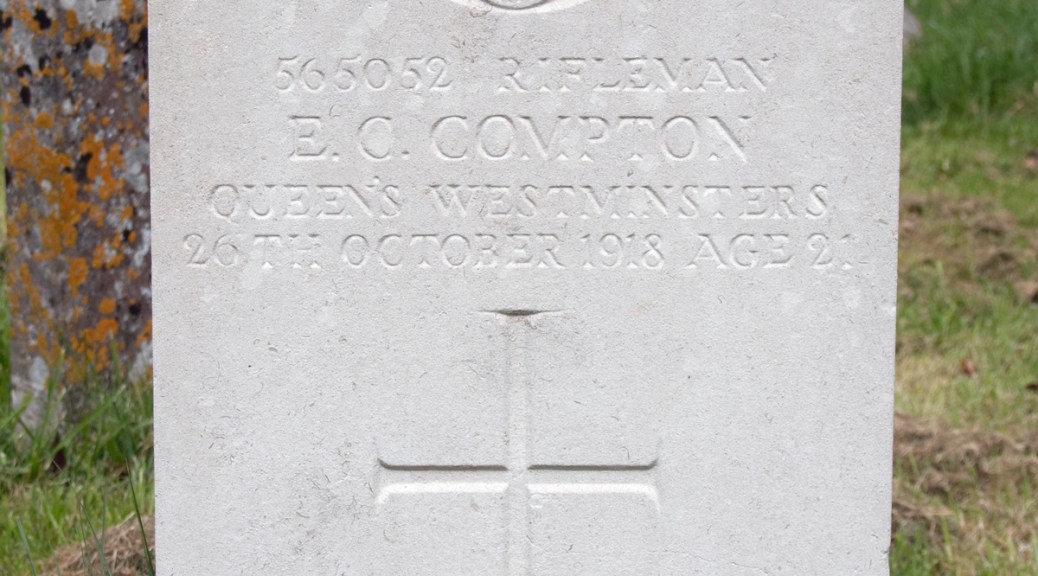
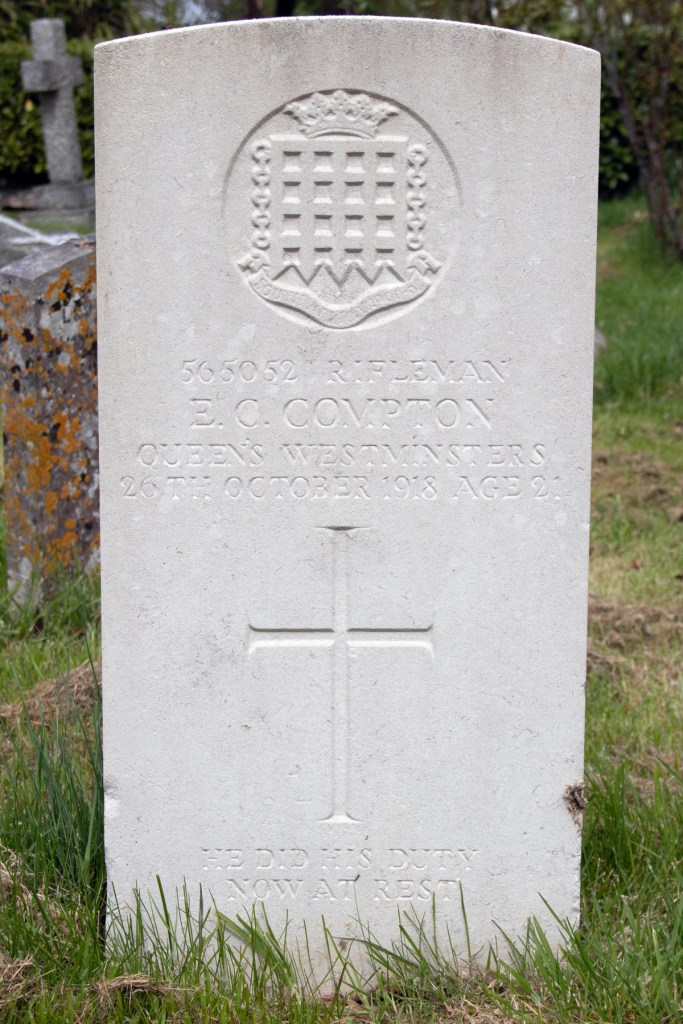
Rifleman Edward Compton

Rifleman Edward Compton

Edward Charles Compton was born in Islington, Middlesex on 4th July 1897, the only child to Charles and Ada Compton. Charles was an agent for the Prudential Insurance company, and the family lived on Devonshire Road, with Charles’ aunt, Mary.

When he finished his schooling, on 7th July 1911, Edward found work as a clerk for the North African Mission. When war came to European shores, he was eager to serve his King and Country. He enlisted on 10th September 1914, and was assigned to the 11th (Reserve) Battalion of the London Regiment.

Rifleman Compton’s service records confirm that he was 5ft 8ins (1.73m) tall, with good vision and physical development. He wasn’t formally mobilised until the summer of 1916 and, after training, he was transferred to the 16th (County of London) Battalion, also known as the Queen’s Westminster Rifles. He was sent to France on 19th December 1916.

Edward would have been involved in the German retreat to the Hindenburg Line in the spring of 1917, and the First and Third Battles of the Scarpe in April and May. At the end of July he returned to Britain and, while the reason for this is unclear, it seems that his health was suffering.

On 24th September 1917, Rifleman Compton was medically discharged from the army, after three years and fifteen days’ service. The cause for this isn’t documented, but there is no evidence that he was wounded, so it is likely to have been an illness of some description.

Edward returned to Islington and on 20th October 1918, he married Emily Backholer. She was a farmer’s daughter from Paignton, Devon, and was registered as living there when the couple’s banns were read during October.

Tragically, Edward and Emily’s marriage was not to be a long one: he died in Kelston, near Bath, Somerset, on 26th October 1918, less than a week after his wedding. He was just 21 years of age.

Edward Charles Compton was laid to rest in the graveyard of St Nicholas’ Church in Kelston, Somerset.


Private Henry Barnes

Private Henry Barnes

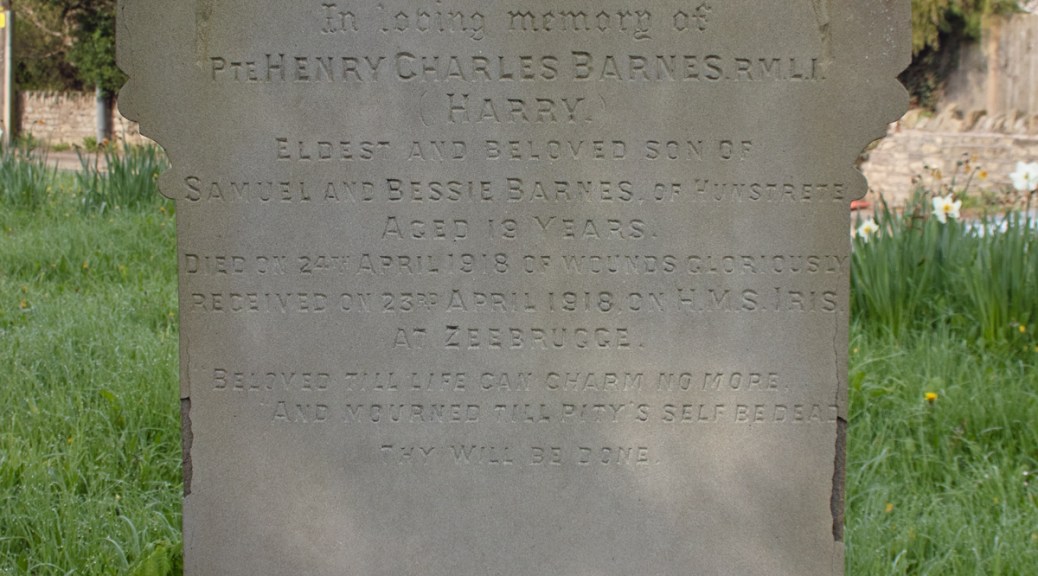
Hunstrete, Pensford was plunged into sorrow, not unmixed with pride, when is became known that one of its lads Pte. HC Barnes, RMLI… had played a hero’s part in the now famous Zebrugge raid, where he was severely wounded in the head and shoulder, from which wounds he subsequently succumbed in Chatham Naval Hospital. Before joining up at the age of 17 years and two months he was employed to look after the famous poultry of Mr HLF Popham, of Hunstrete House, taking all the honours at the Crystal Palace during one show. He was first sent to Salonika but was invalided home with malaria and was on board the Iris during the raid. The deceased lad, who was 19, was brought home and his body laid to rest at St Peter’s, Marksbury.

Somerset Guardian and Radstock Observer: Friday 10th May 1918

Henry Charles Barnes was born on 5th December 1898 in the Somerset village of Hunstrete. Also known as Harry, he was the oldest of six children to coal hewer Samuel Barnes and his wife Elizabeth, who was better known as Bessie.

After his recovery from malaria, Private Barnes was assigned to HMS Iris, a Mersey ferry requisitioned by the Royal Navy for support in the planned raid on Zeebrugge.

On 23 April 1918, Iris was towed across the English Channel to Zeebrugge by HMS Vindictive; she was carrying a couple of platoons of the 4th Battalion of the Royal Marines as a raiding party. When the Vindictive neared Zeebrugge she cast the ferry aside. Iris tried to pull up to the breakwater under heavy fire in order to off-load the raiding parties which were on board. She sustained heavy fire and a shell burst through the deck into an area where the marines were preparing to land. Forty-nine men were killed, while others, including Harry, were badly injured.

Medically evacuated to Britain, Private Barnes was admitted to the Royal Naval Hospital in Chatham, Kent, but his injuries were too severe, and he died on the day after the raid.

Henry Charles Barnes was laid to rest in the graveyard of St Peter’s church in Marksbury, the parish church for the family’s home in neighbouring Hunstrete.


Sapper Arthur Coward

Sapper Arthur Coward

Arthur Coward was born in the village of Faulkland, near Radstock, Somerset, on 6th November 1888. One of twelve siblings, of which only five survived childhood, his parents were Henry and Mercy Coward.

Henry was an agricultural labourer, who was 62 years of age when Arthur was born. By the time Arthur had finished his schooling, the family had moved west, to Writhlington, and he took up work in the local colliery.

Arthur was a keen motorcyclist, and when war came to Europe, he enlisted in the Royal Engineers. Working as a dispatch rider, Sapper Coward was assigned to the 34th Division Signal Company, and soon found himself in France.

Arthur returned home for a fortnight’s leave on 22nd October 1918. “He should have returned to France again on the 4th [November] but had a few days previously contracted influenza and this was followed by double pneumonia. Everything possible was done for him, but despite a robust constitution he gradually sank and died peaceful a few hours before the public learnt that the war in which he had taken part was ended.” [Somerset Guardian and Radstock Observer: Friday 15th November 1918]

Sapper Coward had died on 11th November 1918, having celebrated his thirtieth birthday just five days previously. His father, Henry, had lost another child, at the age of 91.

Arthur Coward was laid to rest in the tranquil Writhlington Cemetery.