Tag Archives: 1918

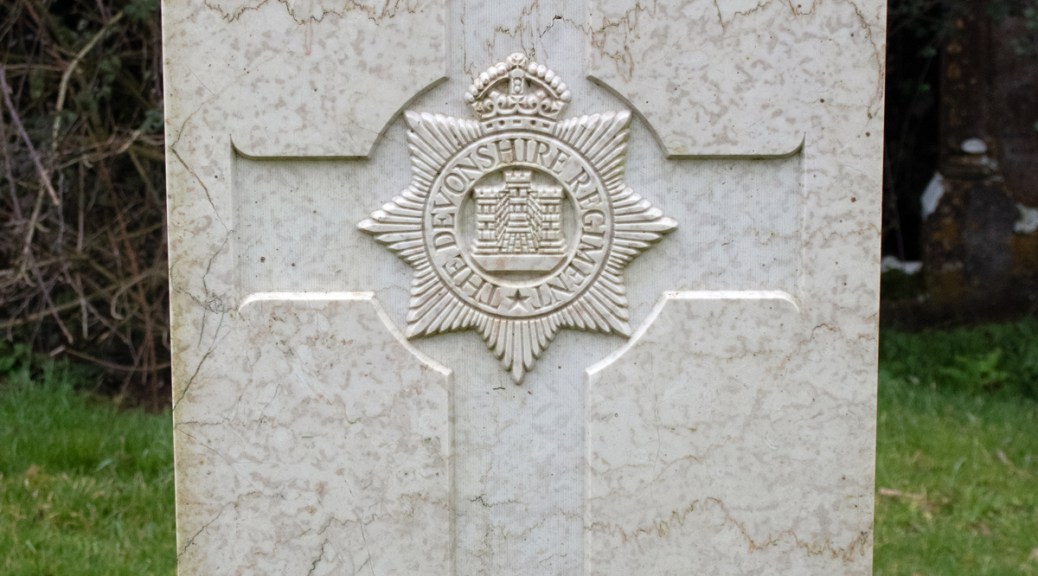
Private Frederick Coward

Private Frederick Coward

Frederick John Coward was born in the Somerset village of Cucklington, in September 1900. The youngest of eight children, his parents were farm labourer Frank Coward and his wife, Agnes.

It is likely that Frederick followed in his father’s footsteps when he left school, labouring on a farm. He was only thirteen when war broke out in the summer of 1914, and over the next few years, he probably watched with envy as his older peers – and older brothers – went off to serve their King and Country.

While full details are no longer available, Frederick probably enlisted as soon as he turned eighteen. He joined the Devonshire Regiment as a Private and was attached to the 53rd (Young Soldier) Battalion. He was sent off to Wiltshire and billeted at the Rollestone Camp, to the north of Stonehenge.

Army and naval barracks were crowded places, and brought together boys and men from all over the country in a way that had never happened before. The cramped nature of the billets meant that disease would run rampant and, once it took hold, it could prove fatal. Sadly, young Frederick was not to be immune from this: he was admitted to the camp hospital, and passed away from ‘disease’ on 6th October 1918. He was just 18 years of age.

The body of Frederick John Coward was brought back to Somerset for burial. He was laid to rest in the picturesque graveyard of St Lawrence’s Church in his home village of Cucklington.


The loss of her youngest boy seems to have proved too much for Agnes to bear. She died the following spring, at the age of 55 years old.


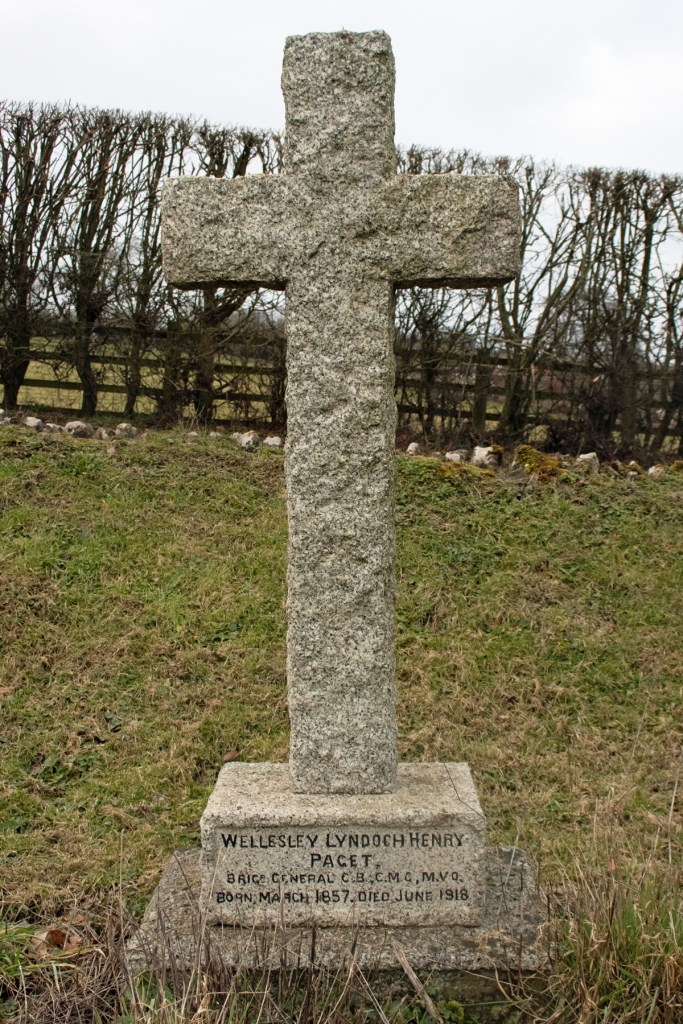
Brigadier General Wellesley Paget

Brigadier General Wellesley Paget

Wellesley Lyndoch Henry Paget was born on 2nd March 1858 in Belgaum, India. The sixth of nine children – all boys – his parents were Leopold and Georgina Paget. Leopold was a Colonel in the Royal Artillery, and Wellesley was always destined to follow a military career.

The young Wellesley was schooled at Wellington College, Sandhurst and, went straight into the army: the 1881 census records him as being a Lieutenant in the Royal Artillery, based at the barracks in Newcastle-upon-Tyne. While a baptism record confirms the location of his birth, Wellesley may have been prone to embellishment – the census record suggests he was born on board the ship HMS Charlotte, off Goa in the East Indies.

On 29th February 1888, Wellesley married Isabelle Swire, a merchant’s daughter from Liverpool. The couple made their vows in All Saints’ Church, Leighton Buzzard, presumably not far from where Lieutenant Paget was then based. The couple went on to have two children, Leo and Mary.

[Wellesley] became Adjutant of the Royal Horse Artillery in 1895… He served in the South African War, where he commanded the 2nd Brigade Division, Royal Field Artillery, and took part in the relief of Ladysmith and operations in Natal and in the Transvaal. He took command of the A Battery (the Chestnut Troop), Royal Horse Artillery, in 1900 and went on service with them in the North-East Transvaal. He was mentioned three times in dispatches for his services in South Africa, was promoted Brevet-Lieutenant-Colonel, and received the Queen’s Medal with six clasps.

Somerset Standard: Friday 21st June 1918

The now Major Paget returned to Britain, and set up home with Isabelle in Dorchester, Dorset. They lived comfortably in a villa in Cornwall Road, and had four servants – a nurse, a cook and two housemaids – to tend their needs.

Leo was sent away to school, and followed his father – and grandfather – into the army. He joined the Rifle Brigade, while his family moved to pastures new. By 1911, Wellesley and Isabelle had moved to Ireland, settling in the village of Ballyellis, near Mallow in County Cork. Again, the family had a retinue of staff, including a teacher for Mary, a cook, a kitchen maid, parlour maid and two housemaids.

Despite being in his fifties when war was declared in 1914, Wellesley stepped up again to play his part. With the rank of Brigadier General, he was again mentioned twice in dispatches for his actions, and was awarded the Companion of the Order of Bath in 1914, and made Companion of the Most Distinguished Order of Saint Michael and Saint George in the King’s Birthday Honours the following year.

By 1916, Wellesley seems to have taken a step back from military life. The Pagets moved to Somerset, setting up home in North Cheriton, near Wincanton. The Brigadier General kept himself busy, however, and, in 1917, was appointed Agricultural Commissioner for Somerset.

At this point, Wellesley Lyndoch Henry Paget’s trail goes cold. He passed away at his home on 11th June 1918, at the age of 60 years old. He was laid to rest in the North Cheriton Cemetery, not far from where his widow still lived.


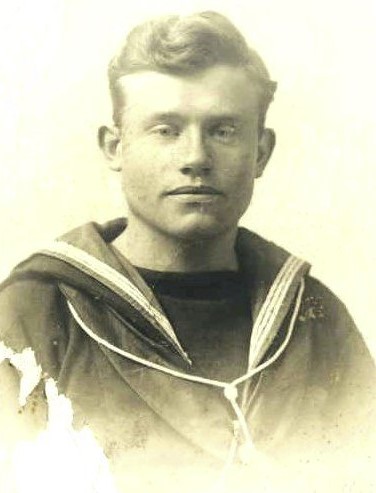
Boy 2nd Class Henry Butcher

Boy 2nd Class Henry Butcher

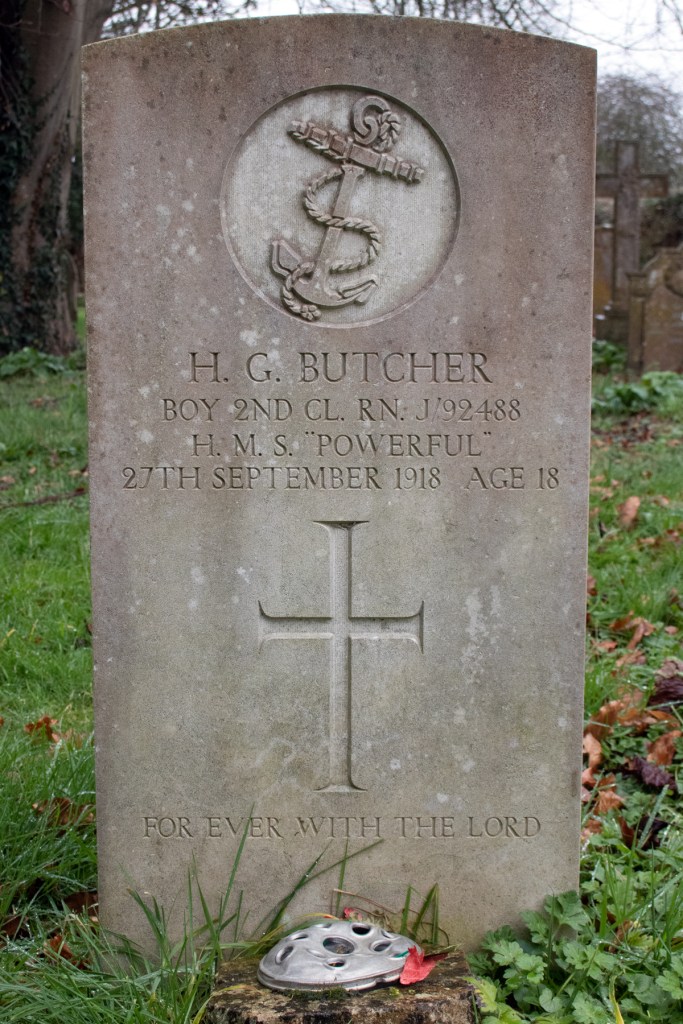
Henry George Butcher was born on 29th September 1900, the middle of five children to Henry and Sarah Butcher. Henry Sr was a labourer in a nursery and the family were born and raised in his and Sarah’s home village of Merriott, Somerset.

Henry Jr followed his father into agricultural labouring when he finished school. When war was declared, he was too young to enlist and, seeing his older friends head off to glory, he must have been desperate to play a part before it was all over.

Henry’s chance finally came when, on 2nd September 1918, he joined the Royal Navy. His service records show that he was 5ft 2.5in (1.59m) tall, had brown hair, blue eyes and a fresh complexion. As he was under-age when he enlisted, he was given the rank of Boy 2nd Class, and sent off to HMS Powerful, a training ship in Devonport.

Naval and army barracks were crowded places, and brought together boys and men from all over the country in a way that had never happened before. The cramped nature of the billets meant that disease would run rampant once it took hold, and it could prove fatal. In the last week of September 1918, seventeen boys from HMS Powerful died from a combination of influenza and pneumonia and, on Friday 27th, Boy 2nd Class Butcher was to join that list. He was two days from his eighteenth birthday, and had been in the Royal Navy for just 25 days.

Henry George Butcher’s body was brought back to Somerset for burial. He was laid to rest in the graveyard of All Saints’ Church in his home village of Merriott.


Private Harry Lawrence

Private Harry Lawrence

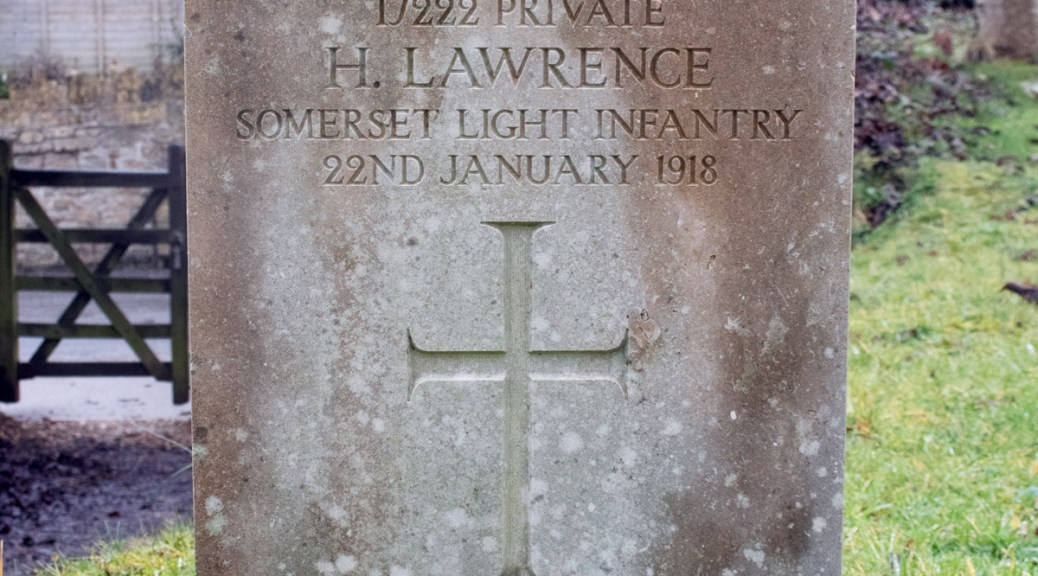
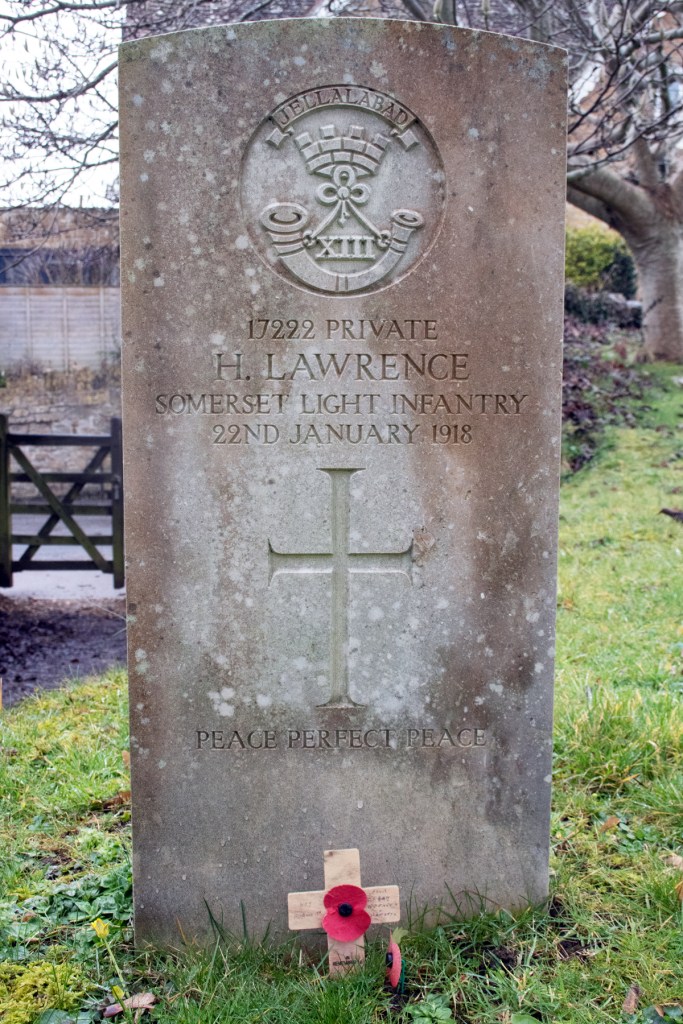
Harry Lawrence was born on 21st March 1895 in the Somerset village of Merriott, and was one of seven children to Samuel and Rose Lawrence. Samuel was a farm labourer, and, when he left school, this is work that Harry also took up.

When war was declared, Harry stepped forward to play his part. He had enlisted in the Somerset Light Infantry by the summer of 1917 and, while his full service records are no longer available, he definitely spent time on the Front Line in France.

Private Lawrence’s troop – the 6th (Service) Battalion – was involved in some of the fiercest fighting of the war, at the Somme, Arras and Ypres. At some point he was injured, and medically evacuated back to Britain for treatment.

He had been under medical treatment for some time in St George’s Hospital, London. Unfavourable symptoms, resulting from concussion of the brain, set in, which terminated fatally, and death this added one more name to the already long list of the Roll of Honour of [Merriott].

Western Chronicle: Friday 8th February 1918

Harry Lawrence died in St George’s Hospital on 22nd January 1918. He was just 22 years of age. His body was brought back to Somerset for burial, and was laid to rest in the quiet graveyard of All Saints’ Church in his home village.


Private John Sherrin

Private John Sherrin

John Sherrin was born in Langport, Somerset, in the summer of 1874. The youngest of three children, his parents were Arthur and Elizabeth Sherrin. Arthur was a cowman and farmer, and John was to follow him into agricultural labouring when he left school.

Arthur took the family where the work was: by the time of the 1891 census, they were living in Broadchalke, a village to the west of Salisbury, Wiltshire. Ten years later, the census notes Arthur and Elizabeth living in Dorset, while John was in Swindon, Wiltshire, working on a farm as a butter churner.

John’s father died in 1906, and Elizabeth went to live with her daughter’s family in Devon. The same year, John returned to Somerset, where he married Bessie Kingsbury. She was a labourer’s daughter from Henstridge, who was working as a domestic servant. The couple went on to have four children – Marleen, Arthur, Albert and Grace.

John’s dairy work kept the family moving, and, according to the 1911 census, the Sherrins were living in a five-room cottage in Sturminster Marshall, Dorset.

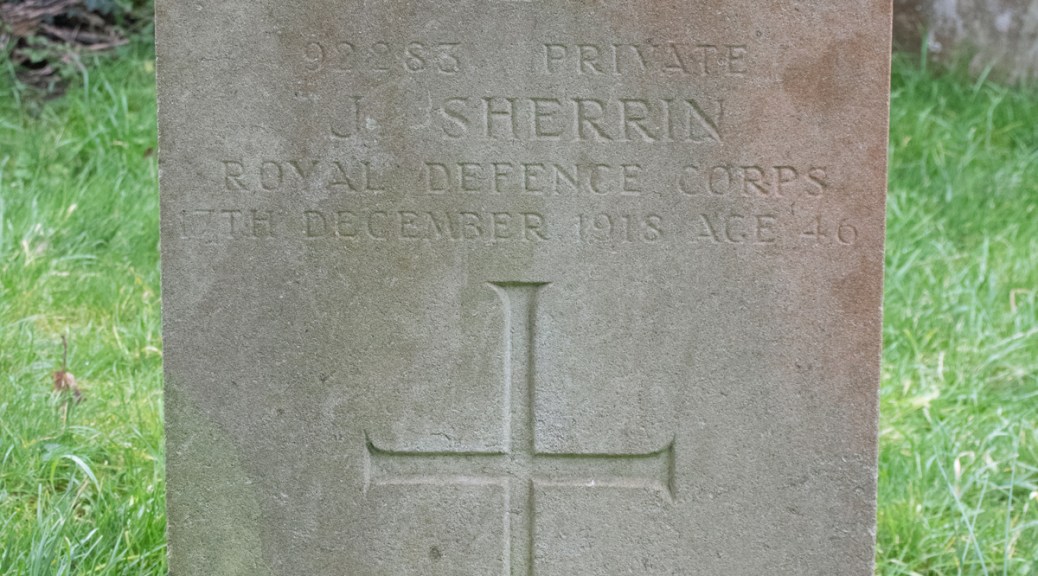
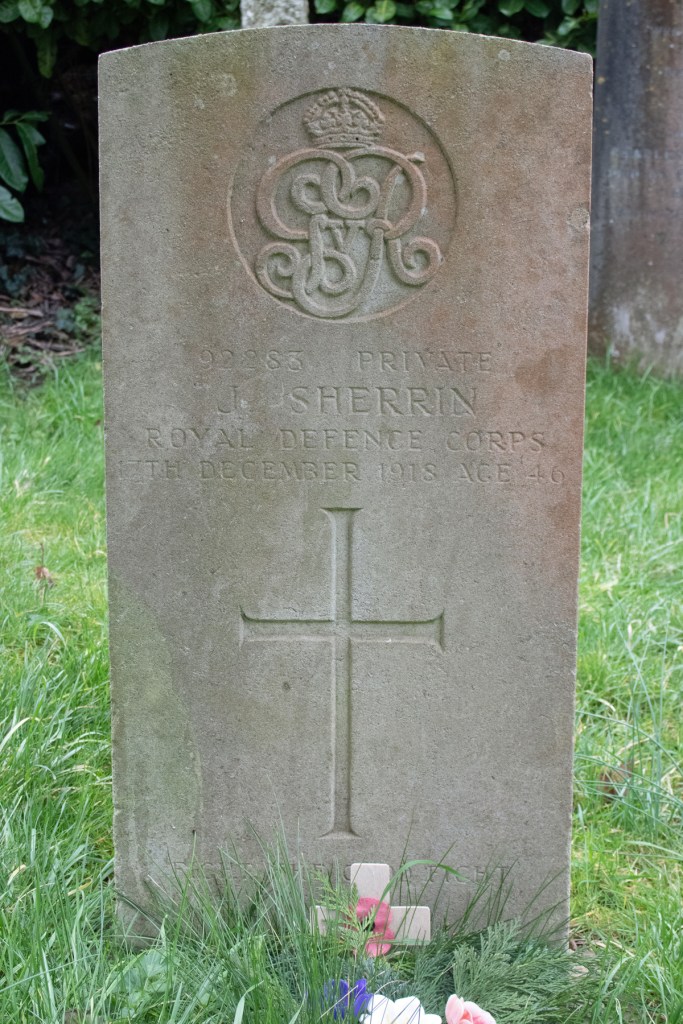
When war came to Europe, John had turned 39 years old. He did not initially enlist – presumably because of his farm work – and it seems that he was only conscripted in the closing months of the conflict. He was called up to the Royal Defence Corps during the summer of 1918, and was assigned to 254 Company.

Private Sherrin was sent to an army camp in Tidworth, Wiltshire, and it was here that he served through the Armistice. He was waiting to be demobbed in December 1918, when he was admitted to the camp’s hospital. Details of his condition are unclear, but it was in the hospital that he passed away on 17th December 1918. He was 44 years of age.

While her late husband was serving, Bessie had returned to her family in Henstridge, and it was there that John’s body was brought. He was laid to rest in the graveyard of St Nicholas’ Church in the village.


Private Herbert Burgess

Private Herbert Burgess

Herbert John Burgess was born in the spring of 1883 in the Somerset village of Henstridge. He was the only child to Stephen and Sarah Burgess. Stephen was a farm labourer and, by the time of the 1901 census, the family had moved to nearby North Cadbury, where Herbert had also found farm work.

At this point, Herbert’s trail goes cold. None of the Burgesses appear on the 1911 census and, when war broke out, while documents confirm that Herbert enlisted, further details are limited.

Private Burgess joined the Devonshire Regiment, and was assigned to the 12th (Labour) Battalion. The troop was sent to France in June 1916, although it is unclear whether Herbert also went abroad. The next available record for him is that of his passing. He died on 10th February 1918, although, again, the cause and location of his passing is unknown. He was 35 years of age.

Wherever and however Herbert John Burgess died, he was brought back to Somerset for burial. He lies in a quiet corner of the graveyard of St Nicholas’ Church in his home village, Henstridge.


Private Leon Frenette

Private Leon Frenette

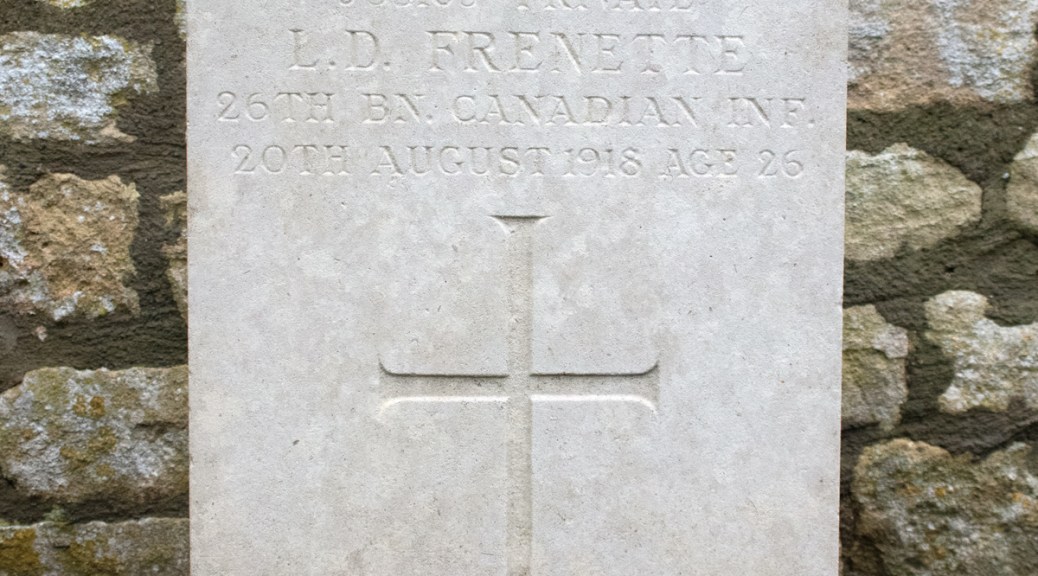
Leon D Frenette was born on 2nd June 1893, in the coastal village of Petit Rocher, New Brunswick, Canada and was the son of Denis and Sarah Frenette.

Leon’s early life is difficult to piece together – the 1901 Canadian census records five Frenette families living in the same neighbourhood, but of the two whose head is given as Denis, neither has a son by that name (although one has a son called Joseph Leon).

When war came to the distant European shores, Leon was working as a school teacher in Bathurst, a town 12 miles (20km) to the south of Petit Rocher. He stood up to play his part for King and Empire, though, having served in a local militia for a while.

Leon joined the Canadian Expeditionary Force as a Private. His service records give his height as 5ft 4ins (1.63m), his weight as 130lbs (59kg) and stated that he had a medium complexion, with brown eyes and black hair. In the section of the records that noted distinguishing marks, the medical officer had identified two small brown birthmarks on his left buttock.

Private Frenette arrived in England on board the SS Corsican on 5th November 1916. Assigned to the 132nd Battalion of the Canadian Infantry, he was based at a military camp near Bramshott, Hampshire. The influx of overseas soldiers would have been a bit of a shock to the locals, but Leon appears to have been up to the challenge. Within a matter of weeks, he was admitted to the camp hospital, suffering from a bout of gonorrhoea.

By the end of the year, Private Frenette had been transferred to the 104th Battalion, and moved to Witley Camp in Surrey. His ailment seems to have returned a couple of times, and he was admitted to the camp’s medical facility in January and March 1917.

By the autumn of 1917, Leon had been transferred again, this time to the 26th Battalion. The troop was based on the south coast at Shoreham, West Sussex, and it was from here, on 16th November 1917, that Private Frenette was finally sent to France.

Leon would have arrived at an already battle-scarred Western Front. Over the next year, he was involved in fighting at Cambrai and Arras. His time was not without incident, and he forfeited a day’s pay on 20th March 1918, for “contravention of full dress order, i.e. being without a belt.”

The 26th Battalion’s next offensive was at Amiens, and it was here, on 12th August 1918, that Private Frenette was badly wounded with a gun shot wound to his right arm. Initially treated on site, he was medically evacuated to England for further treatment.

Leon was first admitted to a hospital back in Bramshott, but then transferred to Bath War Hospital in Somerset. His medical report confirms that he was first seen there at 4:30pm on 20th March, and a compound fracture of his humerus. He haemorrhaged and died of shock at 11:45pm that day. He was just 25 years of age.

With family on the other side of the Atlantic, it was not going to be possible for Private Leon Frenette to be taken home for burial. Instead he was laid to rest in the Roman Catholic Cemetery of the city in which he had passed away, Bath.


Soldaat Armand Luchies

Soldaat Armand Luchies

Armand Joseph Marie Luchies was born in Antwerp, Belgium, on 3rd October 1888. Little accessible information is available for his early life, but when war broke out he joined the Belgian Army as a Soldier.

There is no confirmation of how Soldaat Luchies came to be in the UK – it seems likely that he was either injured or became unwell and was evacuated across the English Channel for treatment. Whatever happened, he passed away in Bath, Somerset – probably at the city’s War Hospital – on 9th August 1918. He was 29 years of age.

Armand Joseph Marie Luchies was laid to rest in the Roman Catholic Cemetery in on the outskirts of the city in which he died. The inscription on his headstone reads “Wie spreekt van dood leeft hij niet eeuwig in ons hart.” (“Whoever speaks of death does not live forever in our hearts.”)


Private William Stringer

Private William Stringer

William Stringer was born in Warlingham, Surrey, on 4th December 1885, and was one of nine children to Stephen and Jane Stringer. Stephen was a carter, but is seems that William wanted an escape.

On 18th April 1901, he enlisted in the Royal Navy and, because of his age, he was granted the rank of Boy 2nd Class. He was initially sent to HMS Impregnable, the school ship, and remained there for just over a year, during which his hard work paid off and he was promoted to Boy 1st Class.

His basic training complete, and after a short stint at HMS Vivid, the Royal Naval Dockyard at Devonport, he was assigned to HMS Collingwood. Over the next couple of years, William served on a couple more vessels and, in 1903, when he came of age, he was formally inducted into the navy, and given the rank of Ordinary Seaman.

William’s service records show that he was 5ft 4ins (1.63m) tall, had auburn hair, brown eyes and a fresh complexion. For distinguishing marks, he was noted as having two dots on his left forearm and scars on his legs.

Now that he was tied to a twelve year contract, Ordinary Seaman Stringer’s seems to have viewed his life in a different light. His ‘very good’ conduct quickly changed to ‘fair’ and, at the end of 1904, he spent two separate stints in the cells, presumably because of his attitude or behaviour.

This shock to the system seems to have been what William needed, however, as in 1905, he took to the new role, and his ratings improved once more. Over the next couple of years, he served on HMS Montagu and HMS Diamond, returning to Devonport in between voyages. In January 1907 he was promoted again, this time to Able Seaman, but, as with the previous promotion, things began to go downhill again.

In March, he spent two weeks in Diamond’s brig, a punishment that was repeated in September. The following month Able Seaman Stringer’s service records not his character as ‘indifferent’ and, the following month he was discharged from the Royal Navy, having refused to work for 42 days.

It was while he was serving on board HMS Diamond that William met Lena Cropp, who was presumably working in one of the ports on the South Coast. She was the daughter of labourer Jesse Cropp and his wife, Philadelphia. When Jesse died in 1897, Philadelphia married bricklayer James Smith, who had boarded with the family for a number of years.

William and Lena had a son, Joseph, on Christmas Day 1907. Now removed from the Navy, William moved his young family back to Surrey, where he found work as a cowman, and Lena took in laundry to bring in an extra income. The couple went on to marry in 1911, and went on to have two further children – Elsie, who was born in 1912, but who died when just a toddler; and Gladys, who was born in the summer of 1918.

When war closed in on Europe, something of a sense of duty must have pulled on William. He enlisted in the summer of 1915, joining the East Surrey Regiment. He seems to have quickly transferred across to the Labour Corps, and arrived in France on 15th July.

It is unclear for how long Private Stringer served in France, but at some point he returned to Britain. In October 1918, he was admitted to the War Hospital in Bath, suffering from stomach problems. His health was to prove his undoing, and he passed away from a biliary calculi peritonitis on 8th October 1918, at the age of 34 years of age.

Finances may have been tight for Lena, as William was buried in the city where he died, rather than being brought back to Surrey, where she was living. Because of this, it is unlikely that he ever met his daughter, who had been born just two months before.

William Stringer was laid to rest in the Roman Catholic Cemetery in Bath.


William’s Pension Ledger notes Lena as his widow, but only mentions one child – Joseph – as a dependent. The document also records him as an illegitimate stepchild, as he had been born a couple of years before the couple married.

The record notes that it, while Joseph’s legitimacy meant he was not eligible for a share of his William’s pension, it had been decided that the basic rate should be provided while he remained in Lena’s care.


Serjeant George Collins

Serjeant George Collins

Details of the lives of those who fell during the Great War can be limited by the documentation that is available more than a century later. Based on what remains, the life of George Collins would have been technical and sparse.

From the formal documents that remain, it is possible to determine that he was born in Bath, Somerset, in 1870 or 1871, and his father was farmer Oliver Collins.

George married Florence Lydyard on 25th January 1896 at the parish church in Bathampton. George was listed as a cellarman, while Florence was noted as being the daughter of George Lydyard, an agent.

The 1901 census found the couple living at the Liberal Club in Bath, which they were both managing. The couple had had a son, George Jr, who was born in 1898, and were employing a servant to help with the daily chores.

The 1911 census shows that George had left the club behind, and was employed as a gymnastic instructor. He and Florence now had four children: Mona, who was 14 (and who didn’t appear on the previous census); George; and twins Marjorie and Dorothy, who were born on 5th July 1904.

The limited military documentation confirms that George enlisted in the North Somerset Yeomanry by October 1917. He was assigned to the 2nd/1st Battalion, which was a mounted division that became a cyclist unit. The troop was based on home soil throughout the war and, depending on when he joined, George could have served anywhere from Northumberland to East Anglia or Southern Ireland.

These details, while uncovering something of George’s life, remain as clinical as the engraving on his headstone. With Serjeant Collins, it is a newspaper article on his passing that adds humanity to his life:

Many friends in Bath will regret to hear that Sergeant George Collins died on Saturday at the Bath War Hospital, where he had been an inmate for seven weeks, suffering acutely from gastritis. Deceased, who was a Bathonian by birth, when a youth joined the Welsh Regiment, and served for seven years in the 1st Battalion… He returned to Bath 21 years ago, and became a drill and physical instructor to several schools… whilst he also instructed evening classes at Guinea Lane and St Mary’s Church House. Being a Reservist he was called upon for the South African War, and Sergeant Collins rejoined his old regiment in 1899. He was wounded and invalided home… When he recovered from his wounds, Sergeant Collins resumed his work as an instructor at schools, and continued to act in that capacity until 1915. Though 44 years of age and not liable for military service, he very patriotically rejoined; he entered the North Somerset Yeomanry and became a drill instructor. He had not been abroad in this war, but had served in several places with the 2/1st NSY. The fatal illness became very pronounced in January when on leave, and he was not able to rejoin his unit. Sergeant Collins was a fine boxer, and became middle-weight champion of the Army when serving with the 1st Welsh. His experience as a trainer was often in request locally, and he had acted in that capacity to the most successful Avon Rowing Club crews. Deceased leaves a widow, one son, and three daughters. His only boy, Sapper George Collins, Wessex [Royal Engineers], has been serving at Salonika since 1915.

Bath Chronicle and Weekly Gazette: Saturday 13 April 1918

Beyond the staid, formal documents is a life well lived. Serjeant George Collins was 47 or 48 years old when he passed on 5th April 1918; the army record noted the cause of his death as a cerebral haemorrhage. His body was laid to rest in the graveyard of St Mary the Virgin Church, Bathwick, overlooking the city he loved.