Tag Archives: 1918

Private Herbert Matthews

Private Herbert Matthews

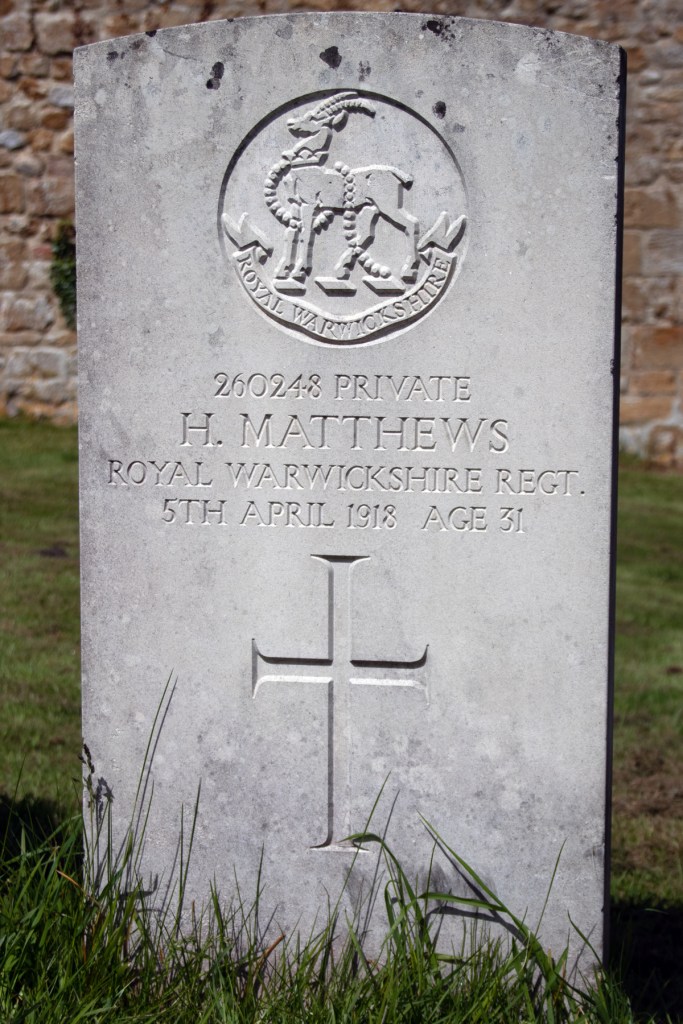
Herbert George Matthews was born in the autumn of 1886 in the Somerset village of Chillington. He was the oldest of two children to George and Elizabeth (known as Rosa) Matthews, and was baptised in the village church on Christmas Day that year.

George was a farm labourer, and this is work into which Herbert also followed. Rosa passed away in December 1910, leaving George a widow after 26 years of marriage.

War came to Europe in 1914, and Herbert signed up to play his part for King and Country. Full details of his service are not available, but he initially enlisted in the Somerset Light Infantry. He soon transferred across to the Royal Warwickshire Regiment (although the date of this is unclear) and was assigned to the 2nd/6th Battalion.

Private Matthews’ troop spent the war on the Western Front, and was involved at Fromelles, Ancre, Ypres and Cambrai. In the spring of 1918, he was caught up in the Battle of St Quentin – part of that year’s battles on the Somme. He was wounded, and medically evacuated to England, where he was admitted to the University War Hospital in Southampton.

Sadly, Private Matthews’ wounds proved too severe; he passed away from his injuries on 5th April 1918, at the age of 31 years old.

Herbert George Matthews was laid to rest in Chillington Cemetery, not far from where his mother was buried, and within walking distance of where his father still lived.

Private Howard Richards

Private Howard Richards

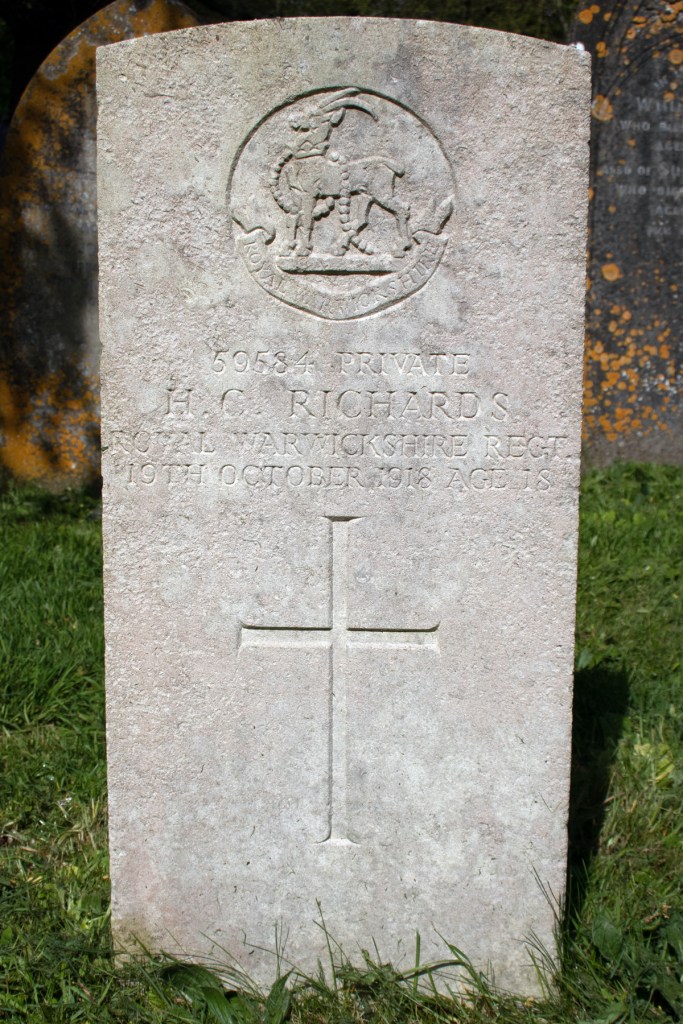
Howard Charles Richards was born in the summer of 1900, the youngest of seven children to George and Henrietta Richards. George was a sewing machine salesman from Combe St Nicholas in Somerset, and this was where the family were raised.

Howard was too young to join up when war was declared, but it seems to have been important to him. He enlisted in the 5th Battalion of the Royal Warwickshire Regiment soon after his eighteenth birthday and was sent for training.

Tragically, Private Richards’ time in the army was to be a short one. The next record for him confirms that he was admitted to the 1st Northern General Hospital in Newcastle-upon-Tyne, and that he passed away on 19th October 1918. The cause of his passing is not recorded, but he was just 18 years of age.

Howard Charles Richards’ body was brought back to Somerset for burial. He lies at rest in the graveyard of St Nicholas’ Church in his home town.


Private Leslie Vines

Private Leslie Vines

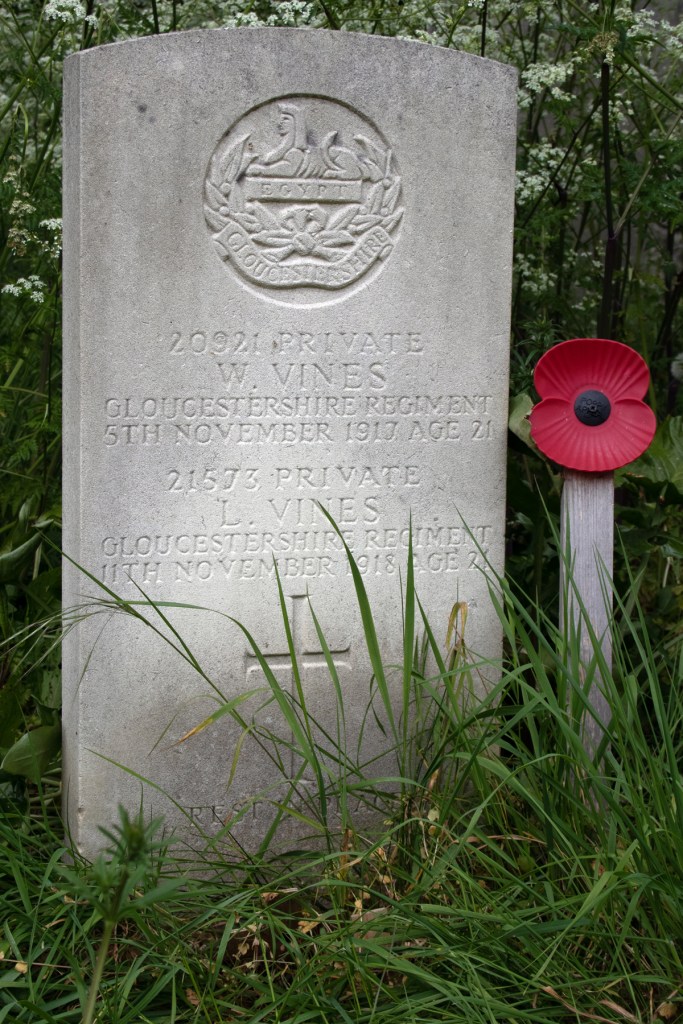
Leslie Vines was born on 16th September 1898, and was one of seventeen children to John and Emma. John was an elastic web maker or braider from Stroud, Gloucestershire, and it was in nearby Wotton-under-Edge that he and Emma raised their growing family.

Braiding and weaving ran in the family: the 1911 census recorded six of the Vines’ children who were over school age were employed in the local mill. When he finished school, Leslie also found work there.

When war came to Europe, Leslie was eager to play his part. He enlisted in the Gloucestershire Regiment on 18th June 1915, just a month after his older brother, Wilfred, had joined up. His service records confirm that he was 5ft 2ins (1.57m) tall: Keen as he was to follow his older brothers into glory, he gave his age as 19 (two years older than he actually was) in order to be accepted for duty.

Private Vines’ eagerness, however, was to be thwarted. On 29th June, less than two weeks after joining up, he was discharged from service. Details are scant, but this seems to have been on the basis that, following his medical examination, he was considered to be unfit for duty.

At this point, Leslie’s trail goes cold and the next available record is that for his death on Armistice Day, 11th November 1918. He was just 20 years of age. While the cause of his passing is not readily available, it was not reported on in any of the contemporary newspapers, so is likely to have been of natural causes.

Leslie Vines was laid to rest alongside his brother, Private Wilfred Vines, in the graveyard of St Mary the Virgin Church in his home town, Wotton-under-Edge.


Private Nathaniel Haydon

Private Nathaniel Haydon

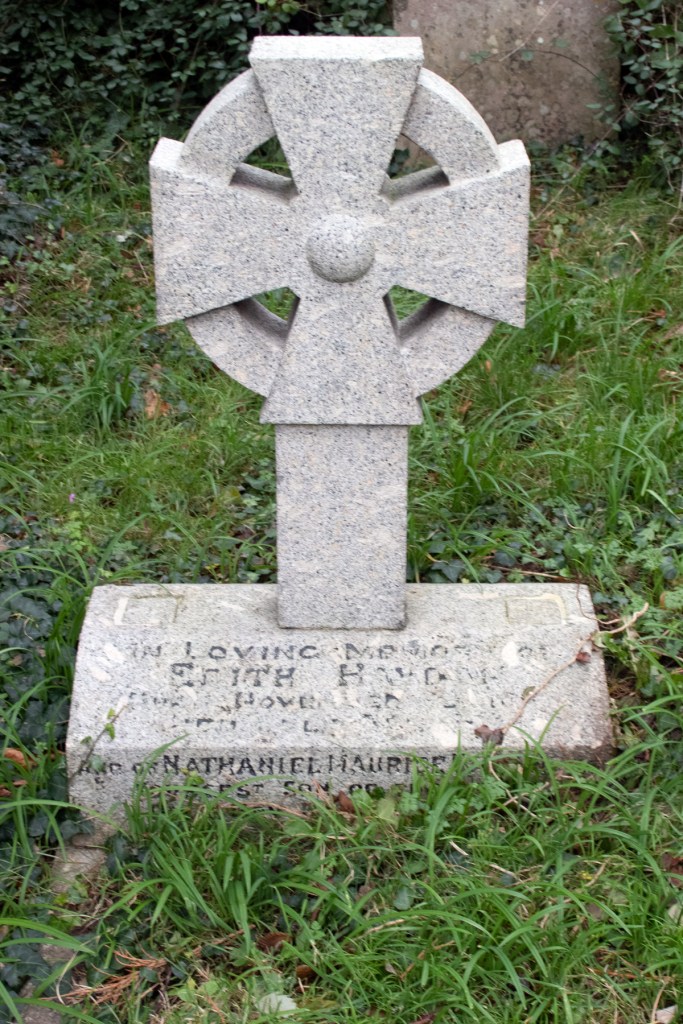
Nathaniel Maurice Haydon was born on 26th May 1900, and was the youngest of four children to Edgar and Edith Haydon. Edgar was a surgeon from Bovey Tracey, Devon, but the family were born and raised in Newton Abbot.

Edgar’s work gave them a comfortable lifestyle: the 1901 census shows the family had four live-in servants. Edith passed away from cancer in July 1903, when her youngest was only a toddler. Edgar married again – to a Gertrude Godwin, fourteen years his junior – four years later; given his role in the community, this is likely to have provided the family with a level of stability.

By the time of the 1911 census, Nathaniel and his older brother Frank were recorded as boarders in a private school in the town, while Edgar and Gertrude were listed at the family home with two domestics.

War was coming to Europe, but Nathaniel was initially young to become involved. Spurred on when his oldest brother, Edgar, was killed at the Somme in July 1916, he applied to join the Inns of Court Officer Training Corps in the summer of 1918. He was accepted, and sent off to Hemel Hempstead, Hertfordshire, for training that September.

Sadly, it was Private Haydon’s eagerness to emulate his brother that led to his undoing. While at the camp, he contracted pneumonia, and passed away on 1st November 1918, aged just 18 years old.

Nathaniel Maurice Haydon’s body was brought back to Devon for burial. He was laid to rest in the family plot in the graveyard of St Mary’s Church, Wolborough, Newton Abbot.


Reserve Nursing Sister Annette Prevost

Reserve Nursing Sister Annette Prevost

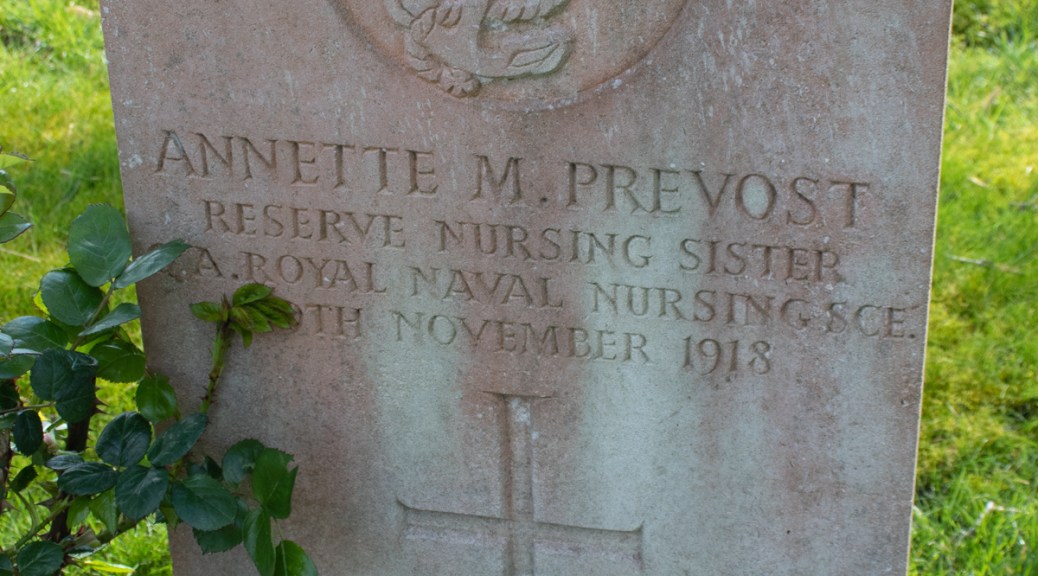
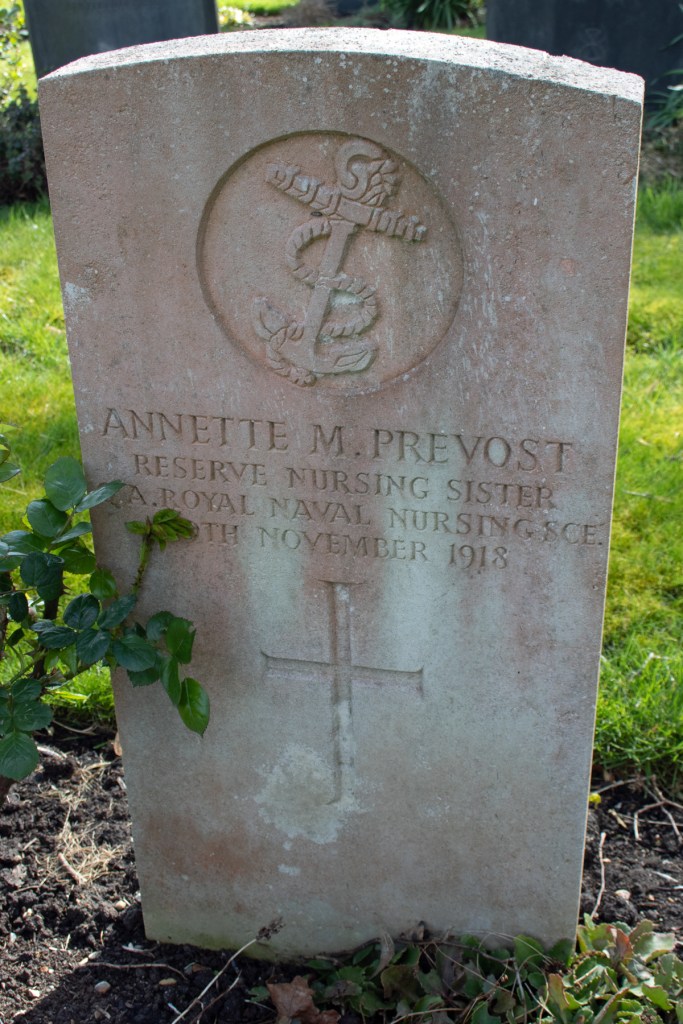
Annette Maud Prevost was born on 27th August 1892 in Bombay, India. Her parents were Cumbria-born Francis Prevost and his wife, Maud, who came from Somerset, and she was their only child.

It is unclear why the Provosts were in India, although Annette’s paternal grandfather was a Major in the army and her maternal grandfather was a clerk in holy orders (as per Maud’s baptism record). It is likely, therefore that her grandparents’ work took her parents overseas, which is how Francis and Maud ended up meeting.

Full details of Annette’s life are not readily available. She does not feature on any surviving census records, but it appears that the family returned to England in the early 1910s.

War was on the horizon, of course, and the tragedy of Edwardian culture is that women’s roles in the conflict were under-documented. What is clear, however, is that Annette wanted to play her part and she enlisted in the Queen Alexandra’s Royal Naval Nursing Service as a Nursing Sister, and was based at Chatham, in Kent.

During the conflict, she would have treated servicemen from the nearby Royal Naval Dockyard, as well as from the Royal Engineers Barracks. As the conflict progressed towards its end, an increasing number of cases would have been for pneumonia and tuberculosis, and, in the autumn of 1918, Annette contracted influenza. She developed sepsis, and died of heart failure on 19th November, a week after the Armistice was declared. She was just 26 years of age.

Annette Maud Prevost was laid to rest in the Woodlands Cemetery, Gillingham, not far from the Naval Hospital in which she served and died.


Leading Telegraphist Ernest Webber

Leading Telegraphist Ernest Webber

Ernest Webber was born on 19th April 1897 in Newton Abbot, Devon, although there is little further documented about his early life

The 1911 census records Ernest as being at the Scattered Home in Newton Abbot. This was, in fact, the Greenaway Home for Boys, part of the town’s Union Workhouse. It was run by a Mrs Louise Foote, had 22 ‘inmates’ and was located on the Highweek Road.

The following year, however, Ernest found a way to better himself, enlisting in the Royal Navy. His service records confirm that he joined up on 9th October 1912 and gave a physical description of him: he was 5ft 5ins (1.65m) tall, had fair hair, blue eyes and a fresh complexion. He was also noted as having a scar on his left index finger.

As he was below the age for full service, he was given the rank of Boy, and was sent to HMS Ganges, the naval base in Ipswich, Suffolk, and HMS Impregnable, a training ship, for his initial instruction. Some talent seems to have been unearthed as he was soon promoted to Boy Telegraphist.

In August 1913, Ernest was assigned to the battleship HMS Conqueror. He spent nearly two years on board and, during that time, came of age. Now formally inducted into the service, he was given the rank of Ordinary Telegraphist, before being promoted again – to the full role of Telegraphist – in April 1915.

Two months later Telegraphist Webber was transferred to HMS Phaeton; over the next year, he spent time on two further vessels, before being assigned to HMS Victorious in April 1916. With this assignment came a further promotion: Ernest was now a Leading Telegraphist.

In the summer of 1917, Ernest moved again, this time to HMS Vivid, the Royal Naval Dockyard in Devonport. At this point, however, he had fallen ill, and was medically discharged from duty on 5th September 1917, having contracted tuberculosis.

At this point, Ernest’s trail goes cold. He returned to Newton Abbot, but the events of the next year are lost to time. All that can be confirmed is that he passed away, presumably of his lung condition, on 11th December 1918. He was just 21 years of age.

Ernest Webber was laid to rest in the graveyard of All Saints Church in Highweek, near Newton Abbot.


Lieutenant Alan Lloyd

Lieutenant Alan Lloyd

Alan Edward Lloyd was born in around 1899, the second of five children – all boys – to William and Edith Lloyd. Both of his parents were Welsh, and his older brother was born in Cardiff. Railway clerk William moved around the country with work, however, and Alan was born in Lydney, Gloucestershire, his younger brother in Paddington, London, and his two youngest siblings were born in Windsor, Berkshire.

There is little information about Alan’s early life; what is clear is that, by the autumn of 1918, he had been in the army, reaching the rank of Lieutenant. He transferred across to the newly formed Royal Air Force and, in December that year was training as a Flight Cadet at Shotwick Airfield near Chester.

On the 4th December, Alan was flying his Sopwith Camel, when he got into a flat spin; the aircraft crashed and Alan was killed. He was just 19 years old.

Alan Edward Lloyd was brought to Devon – where his family were now living – for burial. He was laid to rest in the graveyard of All Saints Church in Highweek, near Newton Abbot.


Lieutenant Alan Lloyd
(from ancestry.co.uk)

Private Arthur King

Private Arthur King

Arthur Thomas Rendell King was born early in 1896, the oldest of six children to Thomas and Bessie King. Engine driver Thomas had been born in London, but, after marrying his wife the year before Arthur was born, he settled in Highweek near Newton Abbot, Devon.

When he left school, Arthur followed his father in working for Great Western Railways, working as a carriage cleaner at the town’s depot. War was on the horizon, however, and he enlisted in the Devonshire Regiment shortly after conflict was declared.

Private King was assigned to the 1st/5th Battalion and sailed for India in October 1914, arriving in Karachi a month later. After nearly three years, his regiment moved again, this time to Egypt, in advance of action in the Middle East.

Involved in the Battle of Nebi Samwil in November 1917, Arthur was badly wounded – and initially recorded as missing, presumed dead. However, he was found, and evacuated to England. Tragically, within hours of being admitted to a hospital on home soil on 31st January 1918, Private King died of his injuries. He had just turned 22 years of age.

Arthur Thomas Rendell King’s body was brought back to Devon for burial. He was laid to rest in the family grave in the graveyard of All Saints Church, Highweek.


Private Arthur King
(from findagrave.com)

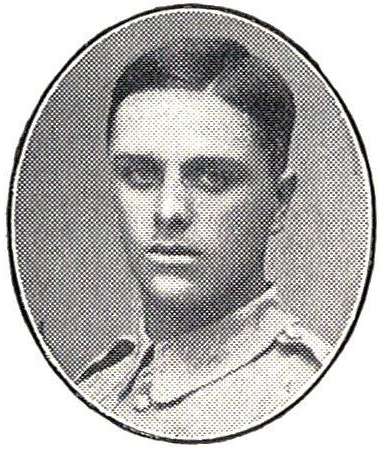
Second Lieutenant George Woodland

Second Lieutenant George Woodland

George Henry Woodland was born on 9th June 1899, and was one of six children – three boys and three girls – to Mark and Ada Woodland. Mark was a hewer in a coalmine in Radstock, Somerset, and this is where the family were raised.

George – who was better known as Harry – was still at school when war broke out. He had been taught at the Church of England School in his home town, before winning a scholarship to Shepton Mallet Grammar School. Having passed his exams there, he was taken on as a member of staff at his former school, before joining the army in June 1917 when he turned eighteen.

Initially joining the Infantry Training Reserve, Harry was subsequently transferred to the Royal Air Force. After training in Yorkshire for five months, he was transferred to the 52nd Training Depot Station at Cramlington Airfield in Northumberland.

Second Lieutenant Woodland returned home on leave in October 1918. This was the first time that he and his two brothers had been together since war had been declared – one had been serving in France, the other had been injured and was recuperating at a hospital in Bristol. Harry returned to Northumberland on 14th October.

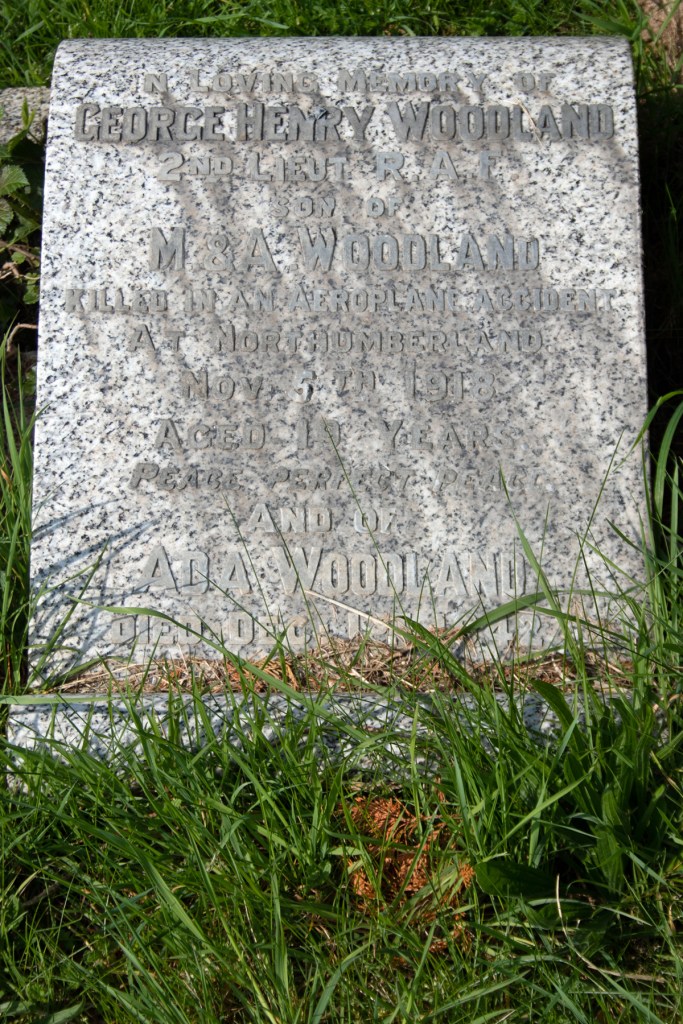
On 5th November 1918, Harry was flying at the Cramlington base; shortly after take off, while carrying out a flat turn at a height of about 100ft, his aircraft stalled and nosedived, catching fire on impact. Tragically, Second Lieutenant Woodland and his passenger – Air Mechanic Ryder – were burnt to death. Harry was just 19 years of age.

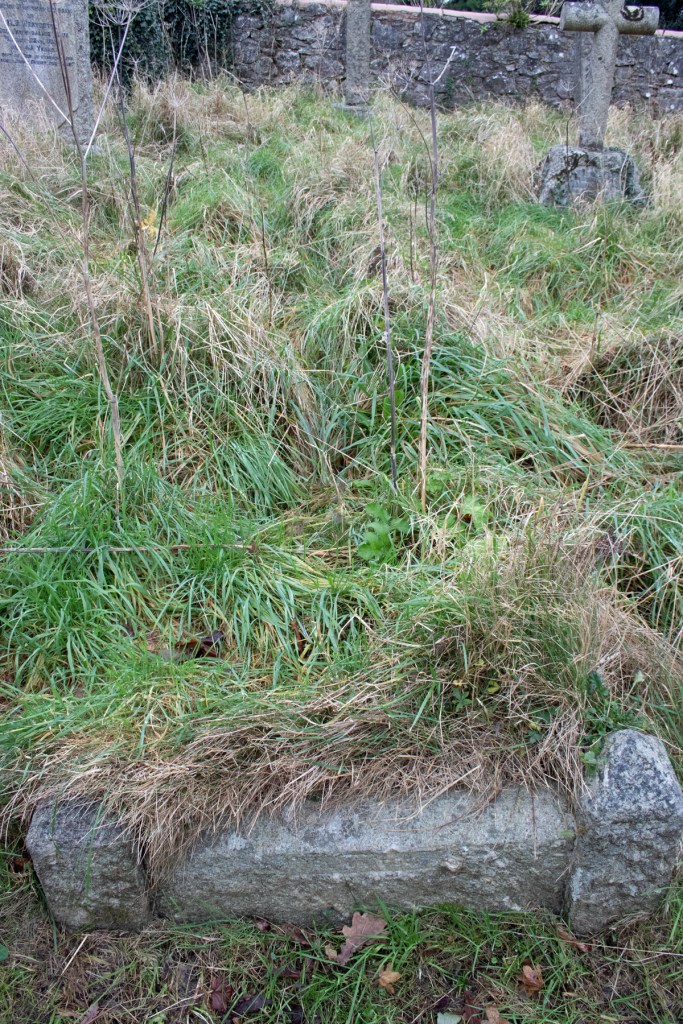
George Henry “Harry” Woodland was brought back to Somerset for burial. He was laid to rest in the family plot in the graveyard of St Nicholas’ Church in his home town of Radstock.


Second Lieutenant George Woodland
(from britishnewspaperarchive.co.uk)

Serjeant Frederick Flint

Serjeant Frederick Flint

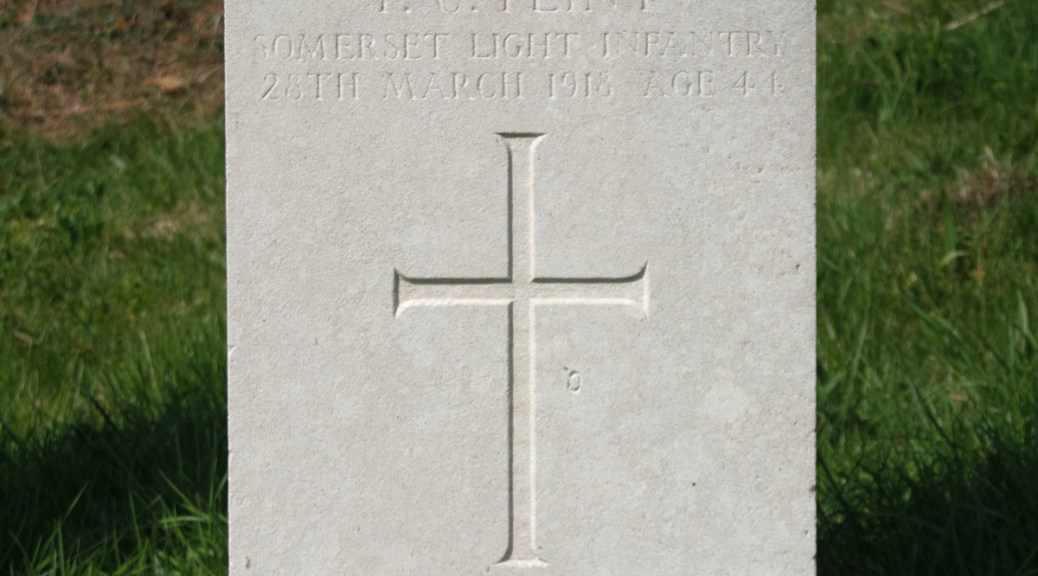
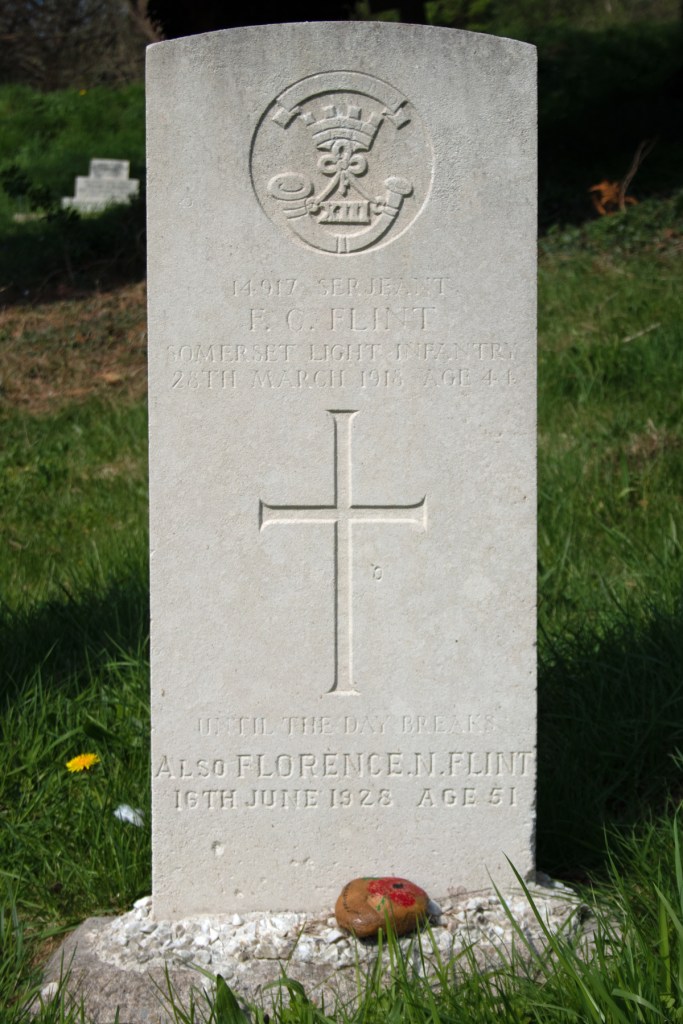
Frederick Charles Flint was born in the summer of 1872 in Bath, Somerset. He was the oldest of seven children to tailor Frederick Flint and his wife, Mary Ann.

Tailoring, however, was not a career that Frederick Jr wanted to follow and, in November 1890, he enlisted in the 7th Battalion of the Somerset Light Infantry. Over his twelve years’ service, he was posted to India and South Africa, gaining clasps for the Punjab Frontier 1897-1898, Relief of Ladysmith, Tugela Heights, Orange Free State, Cape Colony, Transvaal, South Africa 1901 and 1902 and the King’s South Africa Medal.

He returned to England in 1902, when he found employment as a postman back in Bath. He met Florence Novena Fishlock and the couple married at St Michael’s Church in Bath on 5th February 1905, before moving to nearby Radstock.

Frederick remained with the Post Office until the outbreak of war, when he again enlisted for duty, re-joining the Somerset Light Infantry. While he did not serve overseas, Serjeant Flint took on a training and mentoring role on Salisbury Plain. Suffering from tuberculosis, he was formally discharged from the army on medical ground in August 1915, and returned home.

The next few years proved challenging for Frederick, as his illness left him incapacitated. He was nursed through by Florence, but eventually his body could take no more. He succumbed to the condition on 28th March 1918, at the age of 45 years old.

Frederick Charles Flint was laid to rest in the graveyard of St Nicholas’ Church in Radstock. Florence passed away ten years after her husband; she was laid to rest in the same plot in the summer of 1928.


Serjeant Frederick Flint (from findagrave.com)