In a quiet corner of a cemetery in Somerset stands a gravestone to Private HJ Cowles. It confirms that he passed away on 26th April 1920, and that he was in the Bedfordshire Regiment during the First World War.
Little additional information on HJ Cowles is available. One document, the Medal Roll Index Card, confirms his first name as Henry, and that he had initially joined the Somerset Light Infantry. He was awarded the British Medal for his war service.
Cowles is a fairly common name in the Somerset area, and, without any additional information – date of birth, familial connections – it is impossible to narrow down the name on the gravestone to a specific Henry Cowles from the area or beyond.
There is also nothing in any contemporary newspapers to suggest that Private Cowles’ passing was anything out of the ordinary.
Sadly, therefore, he remains a name lost to history. Henry J Cowles, whoever he was, and however he died, lies at rest in the Milton Cemetery in Weston-super-Mare, Somerset.
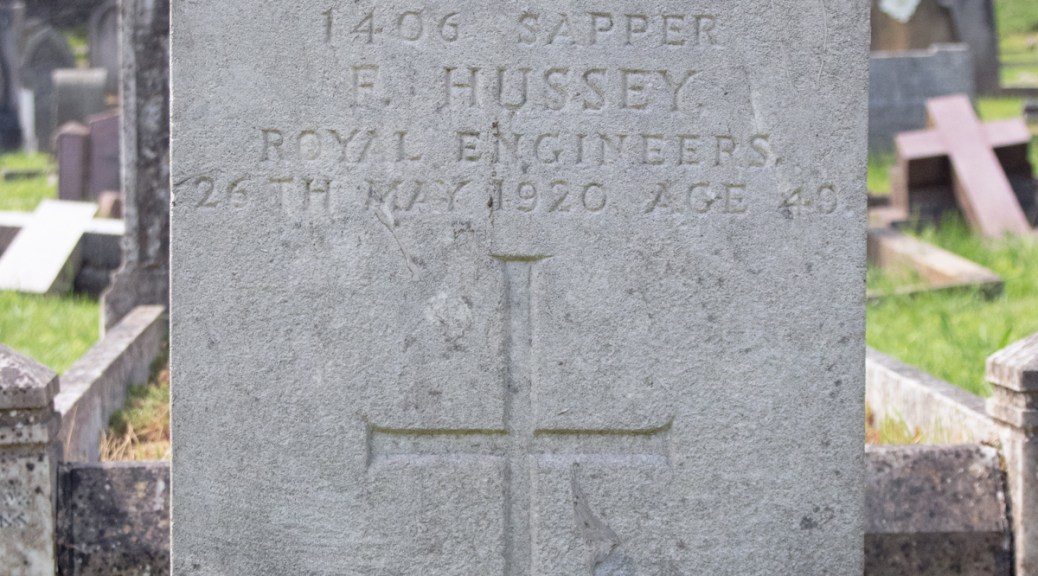
Frank Hussey was born in the autumn of 1870, one of eight children to William and Ann Hussey. William was a mason, and raised his family in Weston-super-Mare in his home county of Somerset. When he left school, Frank found employment as a general labourer, initially in Somerset, but then in South Wales with his older brother Samuel.
By 1889, Frank has moved back to Somerset, where he married Elizabeth Webber in December. Work was obviously more available in South Wales, however, as the couple moved back to Glamorgan, and had their first four children – Beatrice, William, Edith and Hubert – there.
The turn of the century saw the Hussey family return to Somerset. Frank, by now, was working as a bricklayer, and they settled in a small house near the centre of Weston. Life continued on, with building work helping to support the family. Frank and Elizabeth had two more children – James and Marion – and, by the time of the 1911 census, the couple were living with their five youngest children in a two-up-two-down house on the then outskirts of the town.
Storm clouds were gathering over in Europe, and Frank was more than willing to do his bit for King and country. Having already been a volunteer with the Royal Engineers, he formally enlisted with the regiment on 5th May 1915.
Sapper Hussey was assigned to the 2nd (Wessex) Field Company, which was a territorial force. He was mobilised for fourteen months, before being discharged from the army as he was no longer physically fit for war service. Unfortunately, his military records give no further indication as to his ailment or condition.
Frank’s trail goes cold for a few years. Released from service in July 1916, the next identifiable record is from four years later. This confirms that he died from tuberculosis on 26th May 1920, aged 49 years old. Given the debilitating effect of the condition, it seems likely that Sapper Hussey contracted it during the war, and this is what had led to his dismissal.
Frank Hussey had died at home, and it was in the Milton Cemetery in Weston-super-Mare that he was laid to rest.
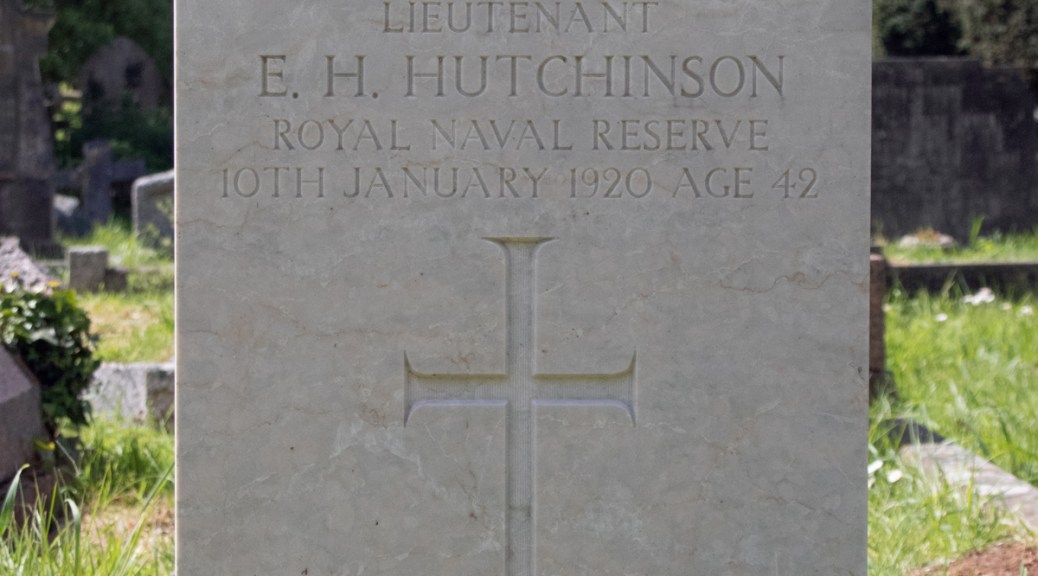
Ernest Henry Hutchinson was born in January 1878, one of four children to Dorothy Hutchinson, from Blyth, Northumberland. Details of Ernest’s father are sketchy and, by the time of the 1891 census, Dorothy seems to have been widowed and remarried, as her surname was now Alexander.
By this time Ernest was at school, and boarding with his aunt and uncle, but his siblings were all living with Dorothy and listed as ‘step-children’. Dorothy gave her employment as ‘housewife; husband at sea’, and it seems that this was likely her first husband’s job and, in fact, it would turn out to be her eldest son’s as well.
Ernest disappears from the census records for a while, but had readily taken to a life at sea. Over the next few years, he became certified as a Second Mate of a Foreign-Going Ship (1897), First Mate of a Foreign-Going Ship (1899) and Master of a Foreign-Going Ship (1904).
When war broke out, Ernest was seconded into the Merchant Navy. Sadly, his military records no longer exist, but during his time he attained the rank of Lieutenant. Ernest survived the war, and was retained as part of the Royal Naval Reserve, while continuing with his own sailing work.
At some point, Ernest married a woman called Emma Jane; documentation on the couple is scarce, so the date of the marriage is lost to time. The couple settled, however, in Weston-super-Mare, Somerset, but do not appear to have had any children.
Ernest’s maritime career continued after the war. One of his commissions was as First Mate aboard the SS Treveal. This was a new vessel in 1919, making its maiden voyage from Glasgow to the Middle East. It then sailed on to Calcutta, and was on its way back to Dundee by the beginning of 1920.
A local Cornish newspaper took up the story.
The terrible toll of 36 lives were levied by the wreck of the St Ives steamer Treveal, off the Dorset Coast on Saturday morning. The crew totalled 43, only seven surviving.
The Treveal, 5,200 tons, one of the Hain fleet of steamers, was caught by a fierce gale during Friday night and was firmly wedged on the Kimmeridge Ledge, near St Alban’s Head.
A Portland tug and Swanage lifeboat came to her assistance, but were unable to lend any practical aid, and on Saturday morning the Treveal was abandoned in favour of the ship’s boats. The latter were soon capsized and only seven of the crew succeeded in reaching the shore.
West Briton and Cornwall Advertiser: Monday 12th January 1920.
The report went into much more detail about the tragedy, including “a warm tribute to the vicar of a parish nearby, the Revd. Pearce, who stood up to his neck helping to pull the men in. The vicar tried for an hour to resuscitate the First Mate [Ernest Hutchinson], but without success.“
Another newspaper gave further information about Ernest’s funeral, and the impact of the shipwreck on his widow.
There was a simple but affecting scene in Weston-super-Mare Cemetery on Saturday afternoon, when the body of Chief Officer EH Hutchinson, one of the 35 victims in the wreck of the SS Treveal… was laid to rest.
It will be recollected that… the first tidings of his tragic fate reached the widow… through the columns of a Sunday newspaper. Only on the previous morning she had received a letter notifying the date on which the Treveal was due to reach Dundee – whither the major portion of her cargo has been consigned from Calcutta – asking him to meet her there.
Western Daily Press: Monday 19th January 1920
Ernest Henry Hutchinson drowned at the age of 42 years old. He was buried in the Milton Cemetery in his adopted home town of Weston-super-Mare in Somerset.
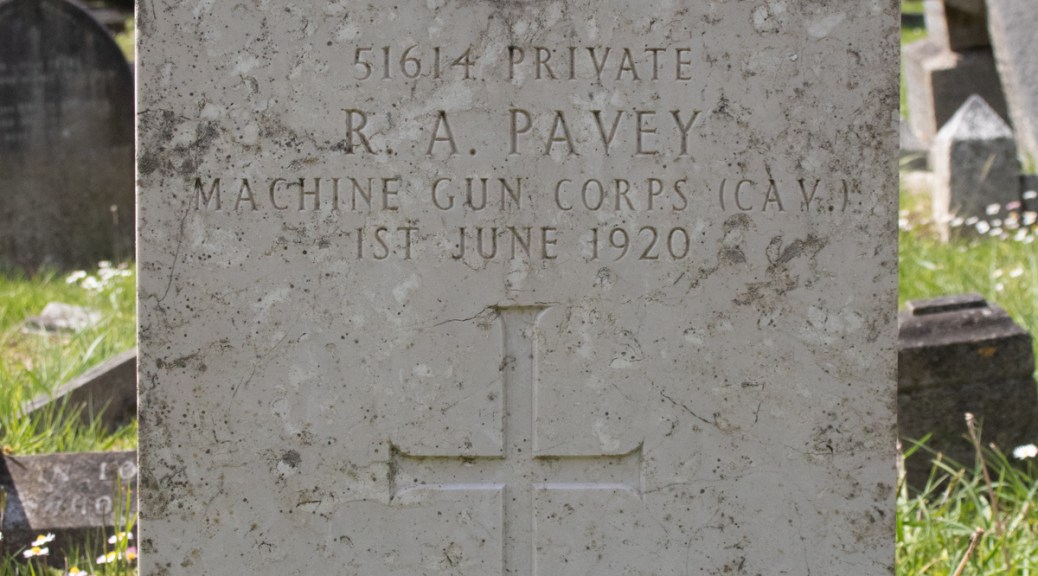
Roland Adams Pavey was born in the summer of 1891, the youngest of three children to Anthony Pavey and his wife, Mary. Anthony was a painter, and both he and his wife were born in the Somerset town of Cheddar. Their life took them travelling, though, with their first child, Edward being born in Cheddar, while their middle child, Ada, was born in Oxford, and Roland born in Bath .
Anthony passed away in 1910, leaving Roland living with his widowed mother, earning a living as a draper’s clerk. War was coming, however, and new opportunities lie in store.
Roland enlisted in the army in January 1915. Initially joining the North Somerset Yeomanry, he soon transferred across to the Cavalry Division of the Machine Gun Corps. Sadly, Private Pavey’s military records are lost to time, but he definitely saw action on the Western Front, gaining the Victory and British Medals and the 1915 Star for his efforts.
The next record for Roland comes in the form of a newspaper article from South Wales.
SAD CASE OF NANTYGLO GIRL
Behind the untimely death of Mr Roland A Pavey, a popular young ex-Service man, and secretary of the Weston-super-Mare Federation of Discharged Soldiers and Sailors, lies a pathetic story of the double bereavement of a pretty Welsh girl, Miss Dorothy Morgan of Nantyglo.
Prior to the war, Miss Morgan was engaged to a compatriot of her own, who answered his country’s call and, like so many thousands of others, made the great sacrifice. Time rolled on and the old wound was eventually healed. Then Miss Morgan went on a visit to Weston last year, and there met young Roland Pavey, just demobilised from the Army.
A mutual attraction soon ripened into affection, and the couple became engaged, and they were to have been married towards the end of the present month, but Fate intervened.
Pavey’s long war service impaired his constitution, though how seriously was probably not realised until the damage was done. Returning from a Whitsuntide visit to Exeter, Mr Pavey was so ill that he was compelled to take to his bed. He rapidly became worse, and though his fiancée was hurriedly summoned, he passed away before she arrived at Weston.
Thus, within a short time, Miss Morgan has been twice bereaved as a result of the war.
Merthyr Express: Saturday 12th June 1920
Roland Adams Pavey was just 29 years old when he died. He was laid to rest in the Milton Cemetery in Weston-super-Mare, where his mother then lived.
Sadly, Dorothy Morgan is too common a name in South Wales to confirm much more information on her life. We are unlikely ever to discover if she ever found a lasting love.
Herbert George Spiller was born in 1881, the second of four children to George and Emily Spiller. George was a timber merchant and ironmonger, born in Taunton, Somerset, who raised his family in his home town.
When Herbert left school, he found work as a clerk in a solicitor’s office, and this was the trade he followed, eventually becoming a solicitor in his own right.
In March 1907, he married Winifred Lewis, an outfitter’s daughter, and the couple soon emigrated, arriving in Perth, Australia, later that year. They had two children in Australia; a son, who sadly passed as a babe in arms, and a daughter. Within three years, however, the Spillers were back living in England again and went on to have four further children, three of whom survived infancy.
War had arrived, and Herbert enlisted on 11th December 1915, but was initially placed as a reserve. He was finally called to do his duty for King and country on 6th September 1917 and joined the 28th Battalion of the London Regiment. After initial training, Private Spiller was sent out to the Front, arriving in France in April 1918.
Herbert was back on home soil after three months, suffering from albuminaria (a disease of the kidneys) and served in territorial depots until he was demobbed in December 1918.
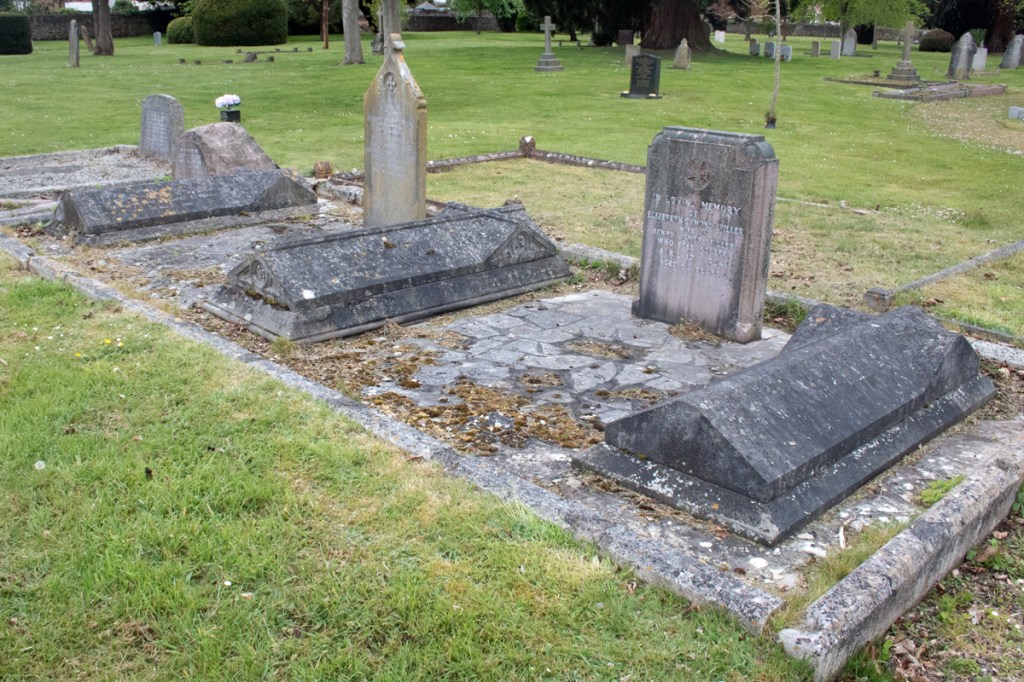
At this point, Herbert disappears from the records. It seems likely that his illness was the cause of his passing, but this cannot be confirmed. Either way, Herbert George Spiller died on 7th May 1920, at the age of 39 years old. He lies at rest in the St James Cemetery in his home town of Taunton, Somerset.
Please note: While Private Spiller was afforded a Commonwealth War Grave, his exact burial location is not identifiable. The image at the top of this post, therefore, is of the other family graves in the cemetery.
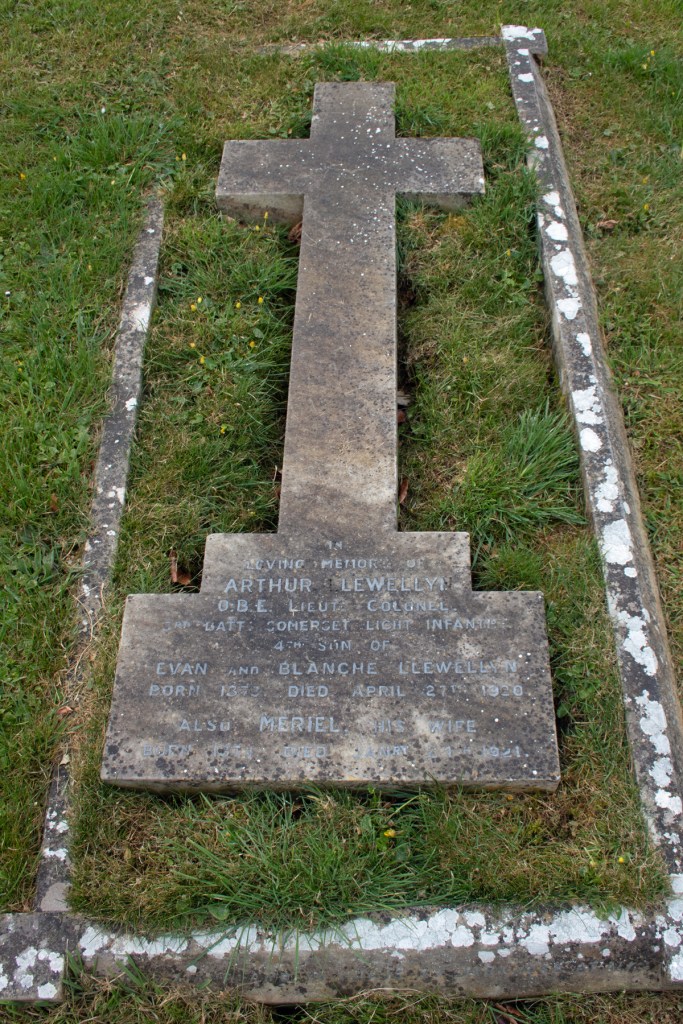
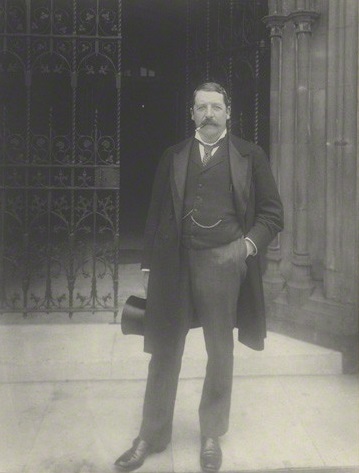
Arthur Llewellyn was born in the summer of 1873, one of four children to Evan and Mary Llewellyn. Originally from Wales, Evan was a Justice of the Peace in the Somerset village of Burrington, and the family lived in the comparative luxury of Langford Court, a mile or so from the village centre.
I use the term ‘comparative luxury’ with some sense of irony; according to the 1881 census, the family had a household staff of eight, including a governess, two nurses, housemaid, cook, kitchen maid, parlour maid and page.
Ambition was obviously what drove Evan; he was an army office, who served in initially in the Somerset Light Infantry. In 1885, he was elected MP for North Somerset, a position he held on and off for nearly twenty years. His military service continued, however, and he led the 2nd (Central African) Battalion, King’s African Rifles in the Boer War.
Comfort ran in the Llewellyn family; according to the 1891 census, Arthur was staying with his maternal aunt, Rose Stewart. She also lived in Somerset, and, at the time the census was drawn up, she was recorded as a widow living on her own means, with her mother, mother-in-law, two nieces and Arthur, her nephew. She was not without help, however, as the house had a retinue of eight staff to support her.
Military life was an obvious draw for Arthur. He enlisted in the Somerset Light Infantry in October 1891 and, within a year, had been promoted to Second Lieutenant.
He had met and married Meriel Byrne, in 1895. The couple’s marriage certificate confirms that he had been promoted to Captain in the militia, and his residence was Buckingham Palace Road, in south west London. They were married in Holy Trinity Church, Brompton, with Meriel’s mother and Arthur’s father acting as witnesses.
The couple went on to have five children, all girls, and they settled into a comfortable life. By 1901, Meriel had set up home in Worcestershire; Arthur does not appear on that year’s census, which suggests that he may too have been fighting in South Africa.
Arthur’s mother Mary passed away in 1906, at the tender age of 39. By 1911, he had been promoted to Lieutenant Colonel in the 3rd Somerset Light Infantry, and was head of his household in Worcestershire. The family was, by this time, complete – Arthur and Meriel and their five children also had help running their home, with two nurses, a cook, parlour maid and housemaid to support them.
Evan passed away months before war was declared, at the age of 67. Lieutenant Colonel Llewellyn felt duty bound to re-enlist, and was given command of the 3rd Reserve Battalion, Somerset Light Infantry. He subsequently served as part of the Army Service Corps in France, before transferring to the Army Labour Corps in Nottingham.
According to the Evening Mail, on 27th April 1920, he “was suddenly seized with illness in the street, and died as he was being conveyed to Nottingham Hospital. He was 46 years of age.”
Arthur was brought back to Burrington in Somerset, where he was buried alongside his parents in Holy Trinity Churchyard.
Sadly, Meriel passed away nine months after her husband; she too is buried in Holy Trinity Churchyard.
Arthur’s estate passed to his brother, Owen, and totalled £12,023 15s 11d (approximately £530,000 in today’s money).
As an aside to Arthur’s illustrious story, another of his brothers is worthy of note. Hoel Llewellyn was two years older than Arthur.
Educated for the Royal Navy, he saw active service on the East Coast of Africa, 1888-90 with despatches. He also served as Artillery Officer and commanded artillery in the Matabele War, where he was recommended for the Victoria Cross. He was promoted Captain in the British South Africa Police, and Justice of the Peace in Matabeleland in1896.
Captain Llewellyn served throughout the South African War; commanding armoured trains north of Mafeking before transferring to the South African Constabulary in 1901. Hoel was eventually created a Companion of the Distinguished Service Order for his service in South Africa.
He was wounded while serving with the Mediterranean Expeditionary Force in the Great War. Hoel was subsequently promoted to the rank of Colonel and appointed Provost-Marshal of Egypt and the British Mediterranean Expeditionary Force.
In 1908, he had been made Chief Constable of Wiltshire, a role he was to hold for 37 years. He was key to pioneering the use of police dogs, and went on to become the oldest serving person to hold the Chief Constable role in the county.
Evan Henry Llewellyn
Another aspect of the Llewellyn family is that Evan was obviously a source of political drive for the family; his great-great-grandson is David Cameron, UK Prime Minister from 2010 to 2016.
David Charles was born towards the end of 1893 and was one of eight children. His parents – David Sr and Elizabeth Charles – both came from Wales, and moved their young family to Kent in 1891. David Sr worked at a torpedo factory, and the move may have been determined by employment at the Naval Dockyard in Chatham, Kent.
When he left school, David Jr found work at an ironmonger’s, but storm clouds were forming over Europe, and he was soon called up on to do his duty for King and country.
David Jr enlisted in July 1915, joining the 23rd Reserve Battalion. He transferred to the Machine Gun Corps in February 1917 and was posted to the Western Front a month later.
Private Charles was wounded in action on 7th October 1917, although the injury did not prevent him from returning to duty after three weeks’ rest. He was readmitted to hospital on 23rd November, eventually being transferred home on a hospital ship before Christmas.
On 11th January 1918, Private Charles was transferred to No. 5 Battalion in Grantham, where he was promoted to Acting Lance Corporal within a couple of months. Sickness dogged him, however, and he was eventually discharged from military service for medical reasons on 7th August 1920.
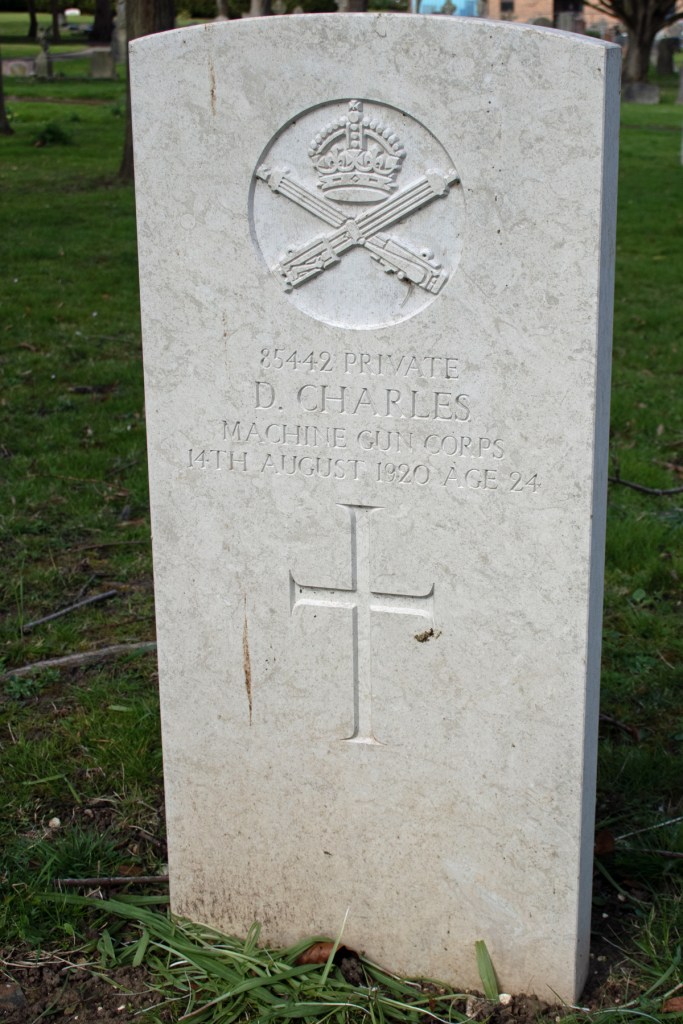
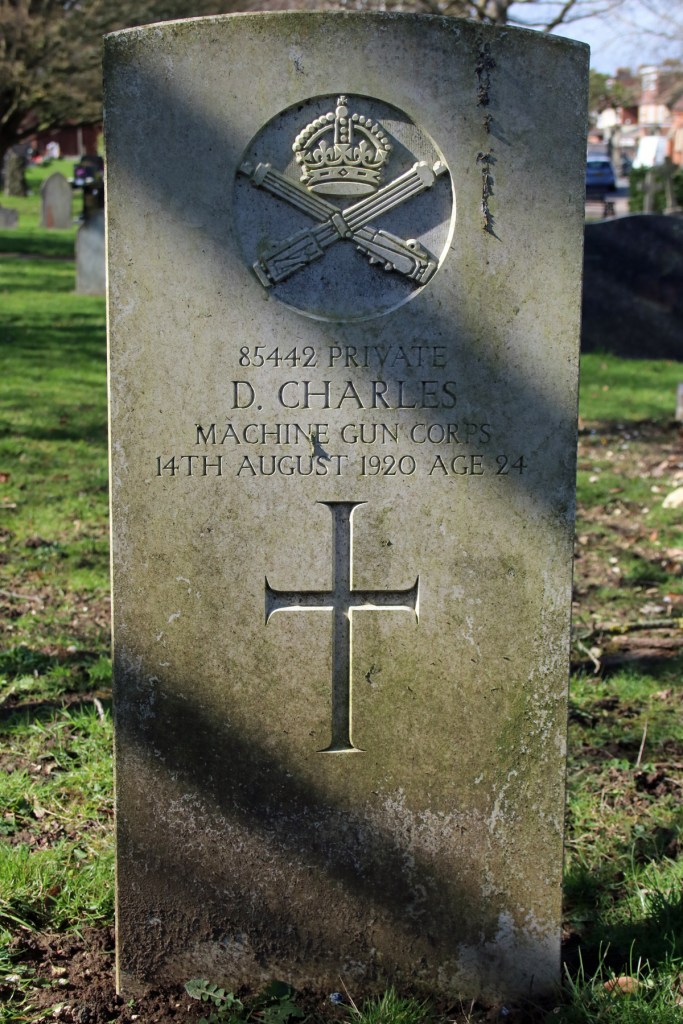
By this time, David had been admitted to Fort Pitt Hospital in Chatham with endocarditis – enlarged heart – and this is where he sadly passed away from the condition just a week after being discharged from the army. He died on 14th August 1920, at the age of 27 years old.
David Charles lies at rest in the Woodlands Cemetery in Gillingham, Kant.
David seems not to have been originally commemorated by the Commonwealth War Graves Commission. I can find no record of why this might have been the case, but this was eventually rectified 10th February 2016, and his name was immediately added to the United Kingdom Book of Remembrance.
The United Kingdom Book of Remembrance commemorates United Kingdom casualties of the two World Wars who were not formerly recorded by the Commonwealth War Graves Commission. The men and women remembered on it are recent additions to the list of war dead and are presently commemorated solely by their database record and register entry.
The register is maintained at the Commonwealth War Graves Commission’s Head Office, Maidenhead, and the names remain recorded there until such time as The Commission has investigated the grave location details.
David’s grave was identified and a headstone now placed in its rightful position.
Christopher William Thomas Faulkner was born in 1881, one of five children to William and Harriet Faulkner. There is little information about Christopher’s early life, but the 1891 census shows him living with his mother and siblings in the St George’s Barracks in St Martin in the Fields in central London. William is not listed, so it can only be assumed that he was away on duty when the census was completed.
Christopher attended the military school; his record confirms that he was born on 17th June 1881, and spent four months at the school when he was ten years old. William is listed as a Sergeant and the family were living at the St George’s Barracks, which were located in the site now occupied by the National Portrait Gallery.
The military life was indelibly in Christopher’s life by this point. Whilst the records are sparse, he had certainly enlisted by the time he was 25. On Boxing Day 1904 he married a woman called Essie Brant, the daughter of a tailor from Croydon.
On the marriage certificate, Christopher was listed as a Lance Corporal in the Royal Marine Light Infantry and was based at the barracks in Chatham, Kent.
The young couple went on to have four children together and, by 1911, Essie was living in Gillingham, not far from the naval base in Chatham. The majority of Christopher’s career was served here, although when war broke out, he also saw conflict overseas.
By 1916, he was promoted to Sergeant and was assigned to HMS Dominion, which patrolled the North Sea. Ill health must have taken hold, however, and by the end of 1917, Sergeant Faulkner was reassigned to Chatham, before being medically discharged at the beginning of the following year.
Sadly, there is no record of the cause of his release from duty, but it appears to have been something to which he would eventually succumb. The next record is of Sergeant Faulkner’s death, on 5th January 1920, at the age of 39 years old.
Christopher William Thomas Faulkner lies at rest in the Woodlands Cemetery in Gillingham, Kent.
Christopher’s grave also acts as a memorial to his son.
Leslie Albert Gerald Faulkner was born on 9th June 1910. On leaving school, he sought military service like his father, and enlisted in the Royal Navy for a period of twelve years’ service.
Unusually, details of his service appear to end after just three years, in January 1929. However, later records confirm that he continued to serve at HMS Pembroke, the on-shore vessel in Chatham, through to the Second World War, achieving the rank of Chief Petty Officer.
Chief Perry Officer Faulkner’s military records did thrown up some further information, though. Surprisingly, his death records give specific details of the cause of his passing, stating that it was a “rupture of the liver due to secondary neoplasm of the liver, due to primary seminoma of testis”. In effect, Leslie had suffered testicular cancer, which then spread to his liver.
Leslie Albert Gerald Faulkner died on 28th November 1945, at the age of just 35 years old. He was buried in the same grave as his father, in Woodlands Cemetery, Gillingham.
Charles Frederick Caleb Miller was born on 12th December 1887 in Gillingham, Kent. His parents were Charles and Harriet Miller, and he had two younger siblings, Mabel and Harriet.
Tragically, Charles Jr’s mother died when he was only three years old; his father went on to marry again – to his widow’s younger sister, Jane – and the couple had two further children – Jane and Beatrice – who were Charles Jr’s half-sisters.
Charles Sr worked as a ship’s rigger in the Military Dockyard in Chatham, and naval life obviously caught his son’s eye. In 1903, having left school, he enlisted in the Royal Navy, started as a ‘boy artificer’, working in the engine and boiler rooms of ships.
His initial service was for twelve years, and he worked on a number of vessels, as well as being assigned to HMS Pembroke, the shore base in Chatham. He worked his way through the ranks to Engine Room Artificer 2nd Class by 1915.
In June of that year, Charles married Ellen Holden. the daughter of a dairyman from Chelsea. The couple went on to have a daughter, Joan, who was born in 1918. At the time of their wedding, Charles was based on HMS Lance, and his military service was to continue.
His period of service extended until the end of the war, Charles served on a number of other vessels, including HMS Surprise, Blenheim and Prince George and rose to Chief Engine Room Artificer 2nd Class.
It was while he was assigned to HMS Ganges in January 1920 that he became unwell, however. He had contracted bronchial pneumonia, and died of a combination of that and heart failure on 9th February 1920. He was 32 years old.
Charles Frederick Caleb Miller lies at rest in Woodlands Cemetery in his home town of Gillingham, Kent.
Occasionally I have found that some people are destined to remain hidden. No matter how much research you try and do, details stay lost, and the name on a gravestone will remain just that.
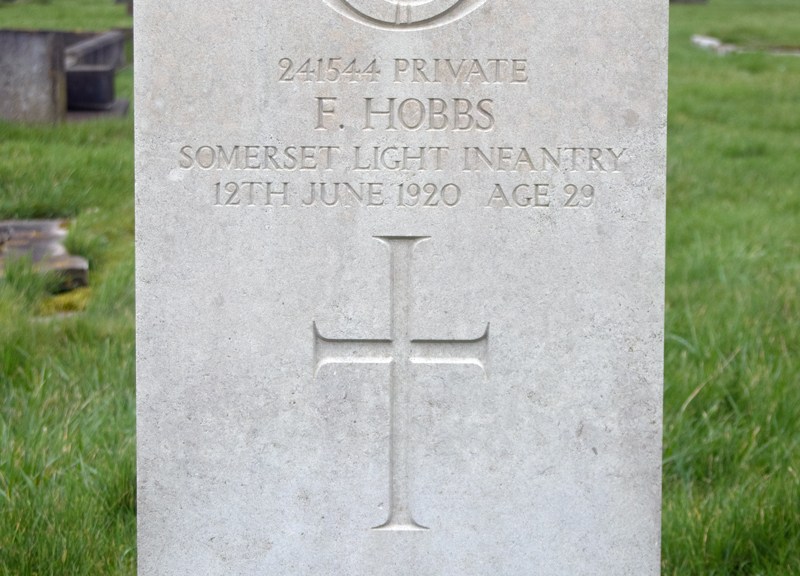
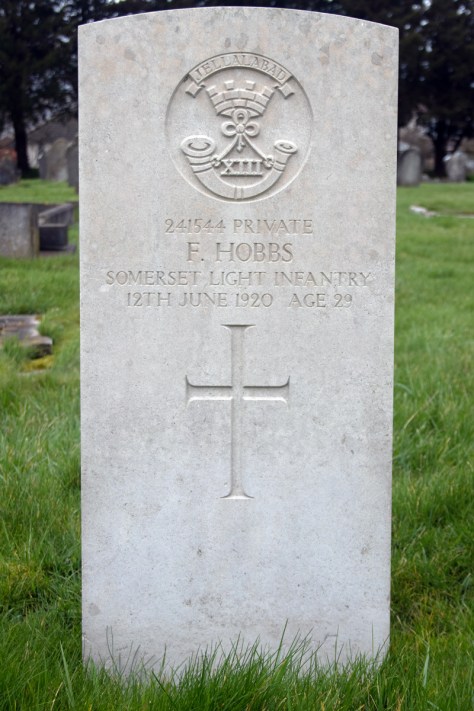
Private Fred Hobbs is one of those people.
He was born in around 1891; he enlisted in the 1st/5th Battalion of the Somerset Light Infantry. Private Hobbs’ service records are not available, but he was awarded the Victory and British Medals for his actions.
His pension record gives Mrs Ellen Louisa Hobbs as his next of kin; there is no confirmation of whether this was his mother or his wife – research has uncovered nothing to identify either.
Private Hobbs does not appear in the contemporary media – this would seem to suggest nothing out of the ordinary about his passing.
All we know for certain is that Fred Hobbs passed away on 12th June 1920, aged 29 years old. He lies at rest in St John’s Cemetery in Bridgwater, Somerset.












 Death and Service