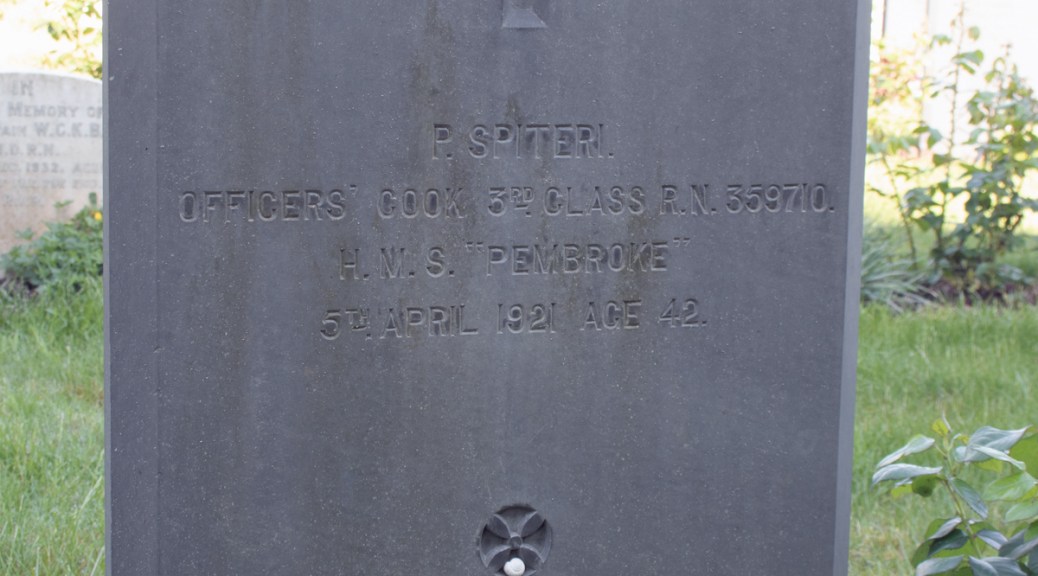
Paolo Spiteri was born in Valetta, Malta, on 25th January 1881, the son of Stephen Spiteri. Sadly there is very little further information on his early life, other than he worked as a cook when he left school.
Paolo saw a life at sea as a good career, and, in August 1901, aged 20, joined the Royal Navy. Over the next twenty years, he travelled the world, serving on more than twenty ships and working his way up from a domestic in the kitchen to an Officer’s Cook 3rd Class.
By 1921, Paolo was based at HMS Pembroke – the shore establishment at the Naval Dockyard in Chatham, Kent – and contracted pneumonia there. Admitted to the Naval Hospital in the town, the condition sadly got the better of him, and he passed away on 5th April 1921. He was 42 years old.
Officer’s Cook Paolo Spiteri was laid to rest in the Woodlands Cemetery, not far from the dockyard at which he was based.
Percy George Macey was born in Frome, Somerset, in the autumn of 1889. He was the oldest of six children and the only son to Arthur and Susan Macey. Arthur was a general labourer and domestic gardener from Wiltshire, whose family had moved to Somerset in the 1870s.
When he left school, Percy found work at a local foundry, and, by the time of the 1911 census, was listed as a brass fitter. By this point he had met Winifred Rowe, a labourer’s daughter from Wiltshire, who had found work as a servant to a Frome butcher. The couple married at the start of 1913, and went on to have a son – who they called Arthur, after Percy’s recently deceased father – later that year.
War was coming, and Percy joined the Somerset Light Infantry. Full details of his military service are not available, although at some point during the conflict he was promoted to Serjeant and transferred to the Labour Corps under the Devonshire Regiment. He was awarded the Victory and British Medals, but does not appear to have seen any service overseas.
By the end of the war, Percy had risen to the rank of Quartermaster Serjeant. The end of his life is, however, shrouded in a bit of mystery. He passed away on 15th March 1921 in Cheltenham, Gloucestershire; although no cause for his death is evident, it seems likely to have been from an illness of some sort, as there are no contemporary newspaper reports to suggest anything out of the ordinary. He was just 31 years old.
Percy George Macey was brought back to Frome; he was laid to rest in the Dissenters’ Cemetery in Vallis Road.
William Henry Coughlan was born on 16th November 1891, one of thirteen children to William and Catherine Coughlan. William Sr was a labourer, born and bred in the East End of London, who raised his family in Hackney.
William Jr seemed keen for a way to improve himself and in May 1909, enlisted in the Royal Navy. Initially given the rank of Boy, this was due to his age; on his eighteenth birthday a few months later, he was formally enrolled in the navy as an Ordinary Seaman.
To begin with, he was billeted at HMS Ganges II, the shore-based training ship in Harwich, Suffolk, but within a matter of weeks he was on board a sea-going destroyer, HMS Antrim.
Ordinary Seaman Coughlan was obviously a keen young man; by the time the Great War broke out, he had served on four further ships, as well as another shore base, HMS Pembroke I. He rose through the ranks to Able Seaman and, by 1915, had reached the role of Leading Seaman.
Most of his service was spent upon HMS Agamemnon, initially in the Channel, but was then moved to the Mediterranean. On the night of the 5th May 1916, the ship was moored in the harbour at Thessaloniki (Salonika). A Zeppelin, the LZ55, made a bombing raid, but when the searchlights caught it, the Agamemnon fired on it and hit the aircraft, breaking it in two. It crashed in the swamps around the Vardar river and its crew were captured.
Leading Seaman Coughlan remained on the Agamemnon, before returning to England in November 1917, where he received further training at the Naval Dockyard in Chatham. He was promoted to Petty Officer a couple of months later, and began three years of shore- and ship-based service.
In the summer of 1921, while again based in Chatham, he contracted pneumonia, succumbing to the lung condition in a matter of weeks. Petty Officer Coughlan died on 26th July 1921, aged just 29 years old.
William Henry Coughlan was laid to rest in the Woodlands Cemetery in Gillingham; within walking distance of the naval base that had become his home.
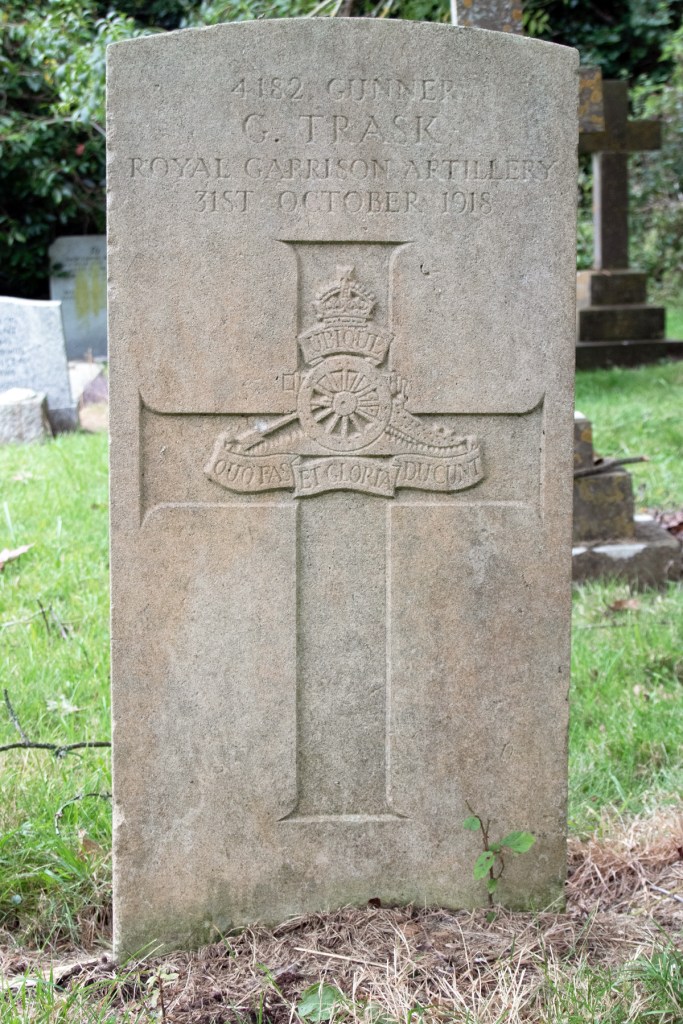
George Trask was born on 22nd December 1875 and was the oldest of nine children. His parents were Absolam and Sarah Jane Trask, although it seems that the couple did not actually marry until after their first three children had been born. Absolam was an agricultural labourer and the family lived in his and Sarah’s home village of East Coker, near Yeovil in Somerset.
George was destined for a life of adventure; in May 1894, aged just 18, he enlisted in the army, joining the Royal Artillery as a Gunner. His medical examination sheds some light on his physique. He stood 5ft 7ins (1.70m) tall and weighed in at 144lbs (65.3kg). He had a fair complexion, hazel eyes and light brown hair.
Oddly, in the section on distinguishing marks – recorded to help identification should the soldier be killed – the medic only highlighted a ‘small mole midway between pubes and umbilicus’: it seems unlikely that this was the only distinguishing mark that could have been highlighted.
Gunner Trask’s initial service was spent in England. He served four-and-a-half years on the home front, before being shipped to Malta. After six months on the island, he was moved to Crete for a few months, before returning to Malta in September 1899.
George completed his initial term of seven years’ service, and elected to remain to complete a full twelve years of enlistment. As part of this, he was transferred to the Caribbean, spending two years stationed in Bermuda, before moving on to St Lucia for a further two years. By December 1905, Gunner Trask was back home in England, and it was on home soil that he remained.
Back in Somerset, George extended his term of service for another four years. Settled in his home village, he married Elizabeth Garrett on 27th December 1908; the couple would go on to have three children: Ethel (born in 1910), Lilian (1911) and George Jr (1916).
Gunner Trask’s military service continued apace. Reassigned to the Royal Garrison Artillery, he was posted in Portsmouth up until the outbreak of the war. He was awarded a third Good Conduct Medal in addition to the ones he had received in 1900 and 1904.
At this point, details of George’s military service become a little hazy. He achieved 21 years’ military service on 29th May 1915 and was awarded a further Good Conduct Medal. At this point, with the war raging, his period of duty was extended again, until the end of the conflict.
At some point during this time, he was assigned to the Royal Artillery’s School of Experimental Gunnery in Shoeburyness Essex. Sadly, there is nothing to confirm his exact role there, although, given that he was in his 40s by this point, it is likely that he acted as more of a mentor.
And it is here that the story comes to an end. Gunner Trask is noted as passing away in the Military Hospital in Shoeburyness on 31st October 1918, though there is nothing to confirm the cause of his death. He was 43 years of age.
George Trask’s body was brought back to Somerset for burial. Having travelled the world with the army, he was laid to rest in the graveyard of St Mary’s Church in his home village of East Chinnock.
George’s son George was to follow his father into military service.
Working as a press operator for a plastics company, he married Gwendoline Harper in Southend, Essex in April 1940. There is no record of whether he had enlisted at this point, but is seems likely that he had.
When the Second World War broke out, he joined the 4th Battalion of the Suffolk Regiment. After initially helping in the defence of England following the British Army’s evacuation from Dunkirk, late in 1941, he was sent first to Egypt, then to Singapore to help strengthen the garrison there.
Early the following year, the 4th and 5th Battalions fought in the defence of Singapore, before the island surrendered to the Japanese Army. At this point, Lance Corporal Trask found himself a prisoner of war.
The prisoners were put to work building the Burma railway, and suffered great hardship at the hands of their captors. Many succumbed to illness, and George was amongst them, dying from beriberi on 18th December 1943. He was just 27 years old.
George Reginald Trask was laid to rest in the Chungkai Cemetery in Thailand, 100km west of Bangkok.
Arthur William Langdon was born on 23rd December 1882, the son of Rose Langdon, from the Somerset village of Chiselborough. While Arthur’s father is lost to time, Rose married Frederick Hockey in 1886, and the couple went on to have three children – half-siblings to Arthur.
Arthur was destined for a life of adventure, and in 1902, at the age of 19, enlisted as a Rifleman in the King’s Royal Rifles, a career that was to last more than a decade.
On 13th April 1903, Arthur married Florence Beatrice Druce, who was also from Chiselborough. Noticeably absent from the marriage certificate was the name of the groom’s father; he was simply marked as ‘unknown’. The newlyweds would go on to have a son, also called Arthur, the following year.
Rifleman Langdon was soon destined for service overseas, however. After 18 months in South Africa, he returned to England for a year. He was sent to India for four years; it is likely that Florence went with him, or at least that Arthur returned home on leave during this time, as two further children – Henry and Reginald – were born in 1907 and the summer of 1910 respectively.
Arthur returned to England in February 1910, and remained on reserve home service – supplementing his income by working as a gardener – until the outbreak of the First World War. During this time he and Florence had two further children, Frederick, born in 1912, and Ivy, born just a month before war broke out.
With the start of the conflict, Rifleman Langdon was send to France as part of the British Expeditionary Force. After five months on the Western Front, he had a brief respite back in England, before being shipped back to France in May 1915, and on to Salonika in the Balkans that November.
Rifleman Langdon did not stay in Greece for long, however. Within a couple of months he was back in England and on 14th April 1916, he was discharged from the army on medical grounds. Sadly, details of the cause of his exit from the army are not detailed.
Arthur was not one to rest on his laurels, however, and continued work as a gardener and labourer. Military life wasn’t far away, though, and in June 1918, he enlisted again, this time joining the Royal Air Force as a Private.
Initially based at Long Sutton, Arthur moved to Edinburgh Castle in March 1919. Full details of his time there are lost, but he remained in Scotland until being demobbed at the end of April 1920.
Details of Arthur’s life back on civvy street are not available. All that can be confirmed is that he passed away on 28th February 1921, at the age of 38 years old. Arthur William Langdon was laid to rest in the graveyard of St Margaret’s Church in the Somerset village of Middle Chinnock, where his widow now lived.
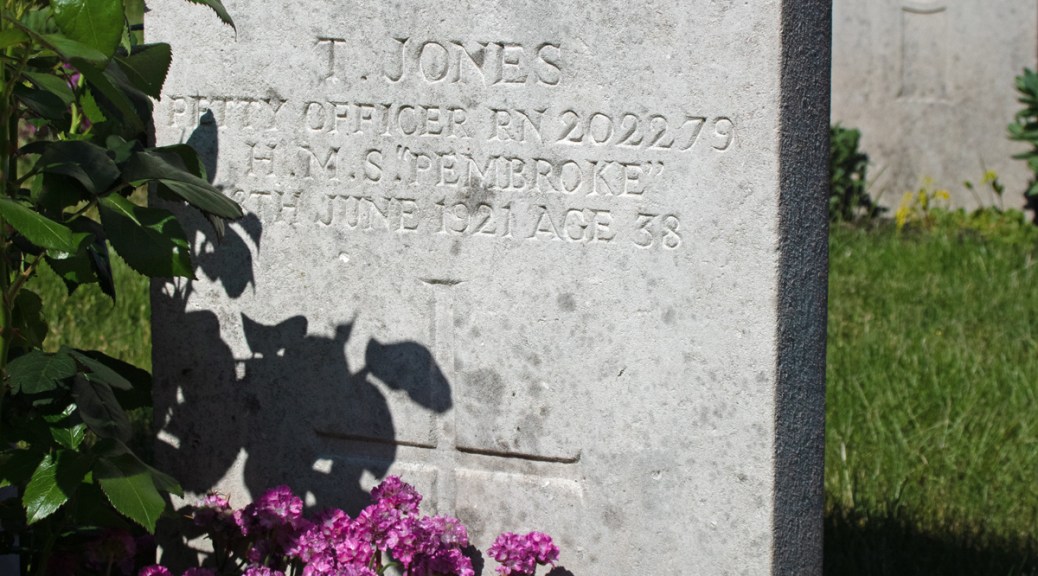
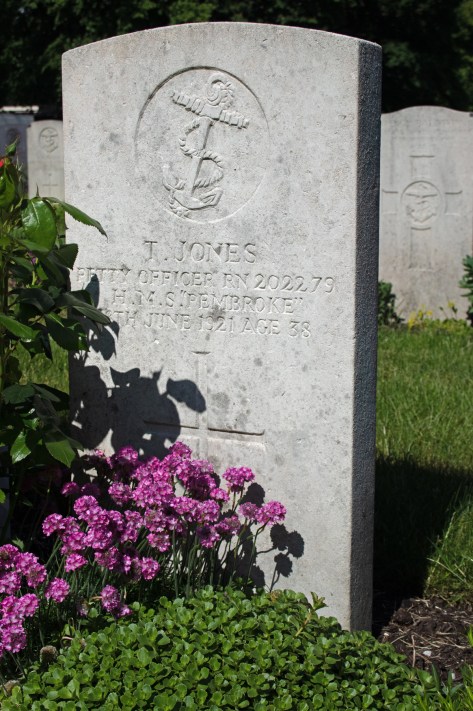
Thomas Jones (known as Tom) was born in Wednesbury on 7th September 1882 and was the middle of seven children. His father, also called Thomas, was a grocer and, with his mother Mary, they raised their family first in the Staffordshire town and then in Blackpool, Lancashire.
When he left school Tom helped his dad in the shop, primarily dealing with meat. His mind was on greater adventures, however, and in November 1898, he enlisted in the Royal Navy. Due to his age, he was initially given the rank of Boy, but was officially signed up as an Ordinary Seaman on the day after his 18th birthday.
Over the time of his initial twelve years’ service, Tom rose through the ranks, from Able Seaman to Leading Seaman and Petty Officer. In May 1912, however, he was ‘disrated’ back to Able Seaman, but there is no evidence to confirm why this was done. By this time, he had served on nine ships, as well as having time in shore-based establishments, and had completed his twelve years as a mariner.
Meanwhile, in the autumn of 1904, Tom had married Hannah Kennedy, a dockyard labourer’s daughter from Gillingham, Kent. The couple went on to have four children and set up home in the centre of the town, not far from the Naval Dockyard where Tom was sometimes based.
With war in Europe on the horizon, Tom immediately volunteered to continue his duty when he term of service came to an end. Working hard, he soon regained the rank of Leading Seaman and, by April 1915, was back up to Petty Officer once more.
During the remainder of his time in the Royal Navy, Petty Officer Jones served on a further seven vessels. In October 1920, after more than two decades’ service, he was invalided out, having contracted tuberculosis, rendering him unfit to continue.
At this point Tom’s trail goes cold. It seems likely that his lung condition got the better of him; he passed away on 20th June 1921, at the age of 38 years old.
Petty Officer Tom Jones was laid to rest in the Woodlands Cemetery in Gillingham, Kent.
Petty Officer Tom Jones (courtesy of ancestry.co.uk)
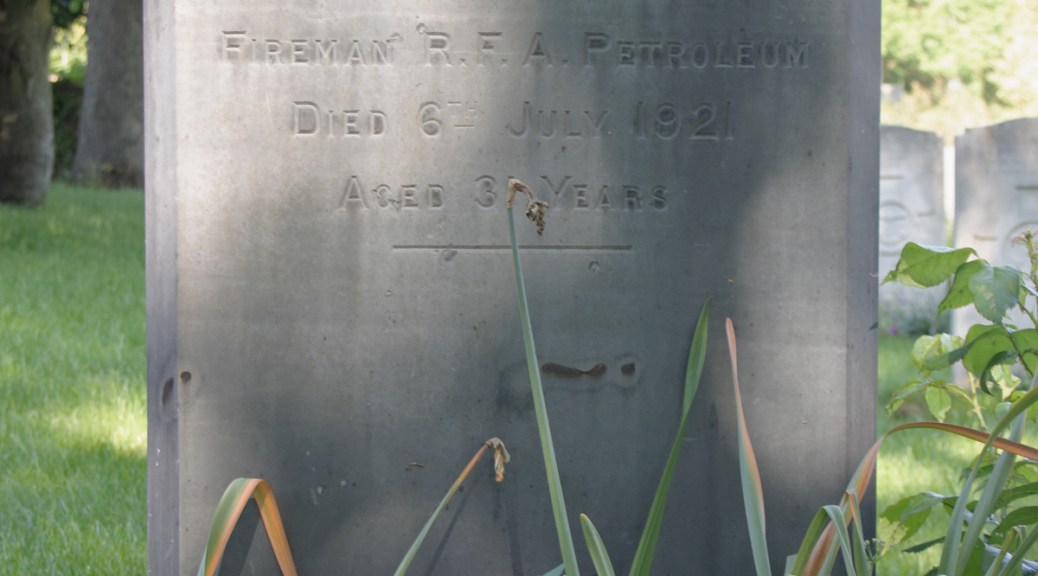
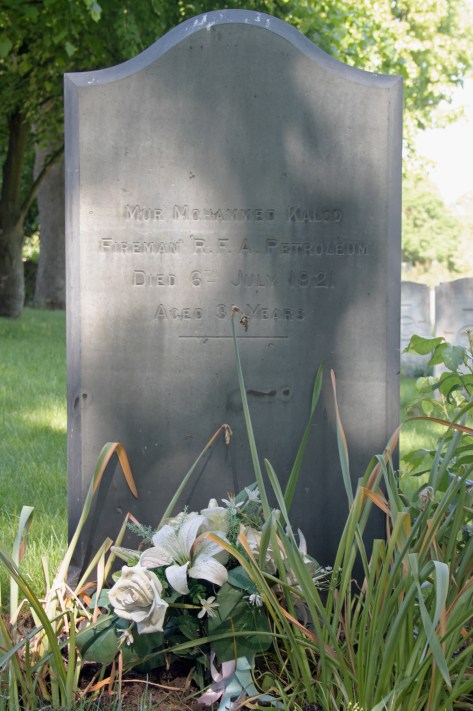
Sadly, there is extremely limited information on the man commemorated no this gravestone.
Nier Mohammed Kaloo (or, alternatively, Mur Muhammed Kaloo), was born in around 1890. He joined the Royal Navy and, by the end of the war at the latest, he had been transferred to the Royal Auxiliary Fleet as a Fireman.
His ship, the SS Petroleum, acted as a tanker for other naval vessels. In the immediate aftermath of the war, she travelled between Portsmouth and Copenhagen, but soon took on longer trips, to Hong Kong and the Far East.
It was after returning from Singapore in the first half of 1921 that Fireman Kaloo died, although the cause of his passing is lost to time. He was 31 years old. The ship having moored at the Naval Dockyard in Chatham, Kent, he was laid to rest in the Woodlands Cemetery in nearby Gillingham.
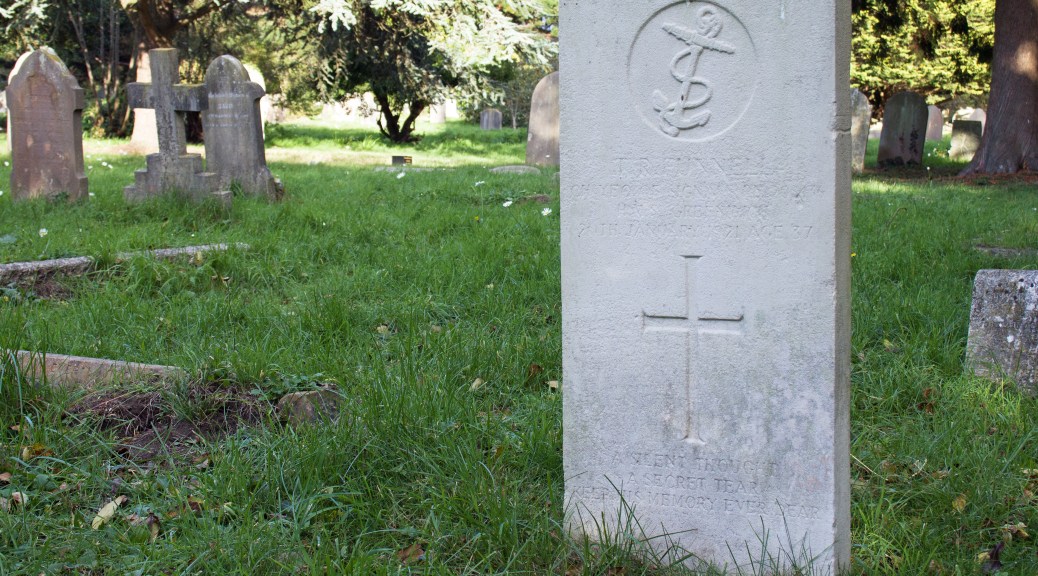
Thomas Richard Funnell was born on 7th May 1883 and was the second of five children. His father John was a cab driver, his mother Jane a laundress, and the family lived in Worthing, West Sussex. The small terraced house was close to both the central station and the one serving West Worthing, which would have given John plenty of opportunity for customers.
Thomas had a definite sense of adventure and helping his dad after he finished school was never going to be enough. He enlisted in the Royal Navy and, after an initial six months at the rank of Boy, he came of age, and began his training as a signalman.
Over the twelve years of his service, Thomas served on thirteen vessels, including the shore-based training ships. He rose through the signal ranks, eventually becoming Yeoman of Signals.
He ended his engagement in May 1913 although, with war on the horizon, this was extended to the completion of hostilities. His naval service continued through the war, and he rose to the rank of Chief Yeoman of Signals in August 1915, while aboard HMS Dido.
Away from his life at sea, Thomas met and married Frances McGregor, the daughter of a coastguard from Hampshire. They went on to have two children: Gurtrude was born in 1915, Nora in 1921. While her husband was at sea, Frances set up home in Portsmouth, where she raised the family.
When the war came to a close, Thomas was moved to shore-based vessels where, presumably, he used his years of experience to help train and develop others. In September 1920, he was assigned to HMS Greenwich. Sadly, his time there was short, on 20th January 1921, Thomas collapsed. Admitted to the Haslar Hospital in Portsmouth with a cerebral abscess he passed away. He was 37 years of age.
Rather than being buried close to his widow and family, Thomas’ body was brought back to his home town of Worthing for burial. He lies at ret in the Broadwater Cemetery to the north of the town centre.
Sometimes research into the names of the fallen runs into obstacles. There are graves I have researched that have brought up very little information, either because the soldier concerned is too young to have a lot of documentation about them, or because information on them has subsequently been lost.
On other occasions, it is the sheer wealth of documentation that proves to be the stumbling block. Such is the case with William Frederick Holden, buried in the Broadwater Cemetery in Worthing, West Sussex.
The grave itself gives some information: he was a Private in the Royal Sussex Regiment, with a service number of 8298970, and died on 16th February 1921, at the age of 26. The Commonwealth War Graves Commission archives give some further information: his father was Frederick Charles Holden, and his stepmother was Elena.
The Find A Grave website adds a little further information – he was born in Sidlesham, near Chichester in West Sussex. The site suggests, however, that he was born in 1897, which would suggest he was 23 or 24 when he died.
Researching on Ancestry throws up a wealth of other information, which begins to make it more of a challenge to identify the correct details. Both William and Frederick were common names in the late Victorian era, and Holden was a familiar Sussex name, and had many spelling variations.
Searching for William’s service number on sites like Fold3 does not provide any results, so that does not provide an opportunity to narrow down the information. Nor is there any record of his passing or burial in contemporary newspapers.
To add to the confusion, when I dug a little deeper, it seems that William’s birth name was, in fact, Frederick William Holden, and he was known by his middle name to avoid confusion with his father. His mother was Fanny Warrington (née Walker), and he seems to have had one sister, Annie. Fanny seems to have passed away in 1903, and Frederick Sr went on to marry Louisa.
So, like a patchwork, vague details of William’s life are pieced together. But huge gaps still remain. Private Holden was assigned to the 4th Battalion of the Royal Sussex Regiment, which fought at Gallipoli and served in Egypt and France before the war was done. However, there is no evidence that William fought abroad.
Sadly, William’s passing is lost to time as well. We know when he died, but there is nothing to confirm a cause of death. Given when it was, it seems likely to have been as a result of one of the invasive lung conditions that ravaged Europe after the First World War. But he could just as easily have succumbed to the ongoing effects of wounds received during fighting. Given the lack of supporting documentation, we are unlikely ever to know.
William Frederick Holden lies at rest in Worthing’s Broadwater Cemetery.
Hubert Stephen Buck was born on 18th October 1887, in Stepney, East London. His father, Edgar Buck, started to use his grandmother’s maiden name – Campbell – from the 1880s, and, by 1901, the family had formally changed their name.
At the time of his marriage to Hubert’s mother Alexandra Stephen in 1885, Edgar was working as a ostrich feather manufacturer. The couple went on to have six children, all boys, of which Hubert was the second oldest.
By the time of the 1901 census, Edgar and Alexandra has moved the family south of the river, from Mile End to Lambeth. By now, Hubert’s father was working as a musician, but there is little further information about his trade.
The next census – from 1911 – found the family living in Lewisham. Edgar was now listed as a band leader, while Hubert, who was the oldest child still living at home, gave his profession as musician, presumably in his father’s band.
War was imminent and, while Hubert was definitely involved, there is little specific information about his military service. He enlisted in the Irish Guards, and was assigned the role of Bandsman.
In August 1917, Hubert married Alice Johnson in Sutton, Surrey. He listed his profession as Musician in HM Irish Guards, so must have enlisted before that point. Interestingly, the same document identifies Edgar’s profession as Bandmaster in the 1st City of London Regiment, so it seems he also enlisted.
The marriage certificate shows Alice was two years older then her new husband, and that she was the daughter of warehouseman Alfred Johnson, who had, by that point, passed away.
Bandsman Campbell survived the war, but there is no indication as to whether he served abroad, or was part of a territorial force. He and Alice moved to Worthing in West Sussex, but there is no confirmation on when the move took place. The 1921 census, taken in June of that year, records the couple as living at 151 Lyndhurst Road in Worthing, where he was noted as being a totally disabled pensioner. There is little further information about him, other than the fact that he died on 4th August 1921, at the age of 35.
Hubert Stephen Campbell was laid to rest in the Broadwater Cemetery in Worthing.
While Hubert’s trail went cold, there is further information on Alice. An advert in the Worthing Gazette offers musical training by her:
Musical Training on Modern Methods
Pianoforte (Matthay), Voice Production, Singing, Theory, Harmony, Aural Culture, Musical Appreciation, and Art of Teaching.
Thorough preparation for all Examinations, Elementary to Diploma Grades, Special Courses for Teachers for the study of the Matthay system and the Art of Teaching.
MADAME ALICE CAMPBELL (Member of the Musical Councils of the London and East London Musical Festivals. Registered Teacher: Teachers’ Registration Council.
Worthing Gazette: Wednesday 31st August 1921
Digging a little deeper, and there are similar advertisements in the newspaper from late 1917, through to at least the 1930s, by which time, Alice was running the Worthing School of Music.
The advert suggests a couple of points. It certainly suggests that a love of music is what brought Hubert and Alice together in the first place. There was a definite musical connection in the household, initially driven by Hubert’s father, and continued with his widow.
Given that the advert above is dated a matter of weeks after Hubert’s death, it also seems likely that his passing was not unexpected. There is nothing in the local media relating to his death, and, with regular students to teach, Alice obviously felt is unnecessary to take any significant time away from her work in grief. It is supposition on my part, but it would suggest that Hubert died from a chronic condition, possibly one of the lung diseases that were rife across Europe in the aftermath of the Great War.
The last advert for the Worthing School of Music ran on 12th September 1934. Beyond that date – when Alice would have been 49 – there is no further clear record of her or the school.








 Death and Service