William Michael Shanly was born in Hampstead, Middlesex, in the summer of 1892. The fourth of eight children, of whom three died in infancy, he was the eldest son to Michael and Mathilde Shanly. Michael was the owner of a coffee and refreshment company.
The Shanly family lived at 78 Sumatra Road, Hampstead, but by the time he was nine years old, William had been sent to Sussex, and was boarding at the Xavarians Brothers School in Uckfield.
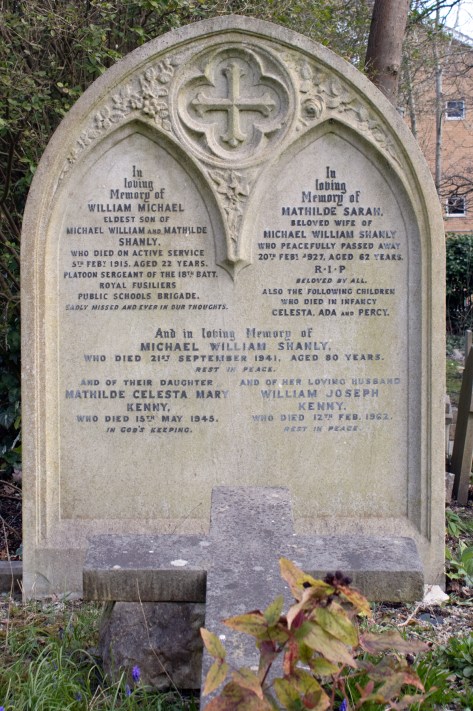
There is little further information available about William’s life. His epitaph on the family headstone suggests that he died on active service and was a Platoon Sergeant of the 18th Battalion of the Royal Fusiliers. His unit was also known as the 1st Public Schools, although exactly what role he held is unclear. His entry on the Commonwealth War Graves Commission Grave Index suggests that he was attached to the 15th (Reserve) Battalion, but his military records no longer exists, so it isn’t possible to confirm either way.
Serjeant Shanly died on 5th February 1915, aged 22 years of age. He had had an operation for appendicitis five days earlier, but had succumbed to peritonitis.
William Michael Shanly was laid to rest in the family plot in Highgate Cemetery, not far from where his grieving family were living.
Horace Ralph Welch was born in Mere, Wiltshire, in the autumn of 1884. The middle of seven children, his parents were John and Ellen Welch. John was a silk drier, and the family lived in Water Street, close to the town centre.
John died in 1895, and Ellen was left to bring up the family on her own. Her older children found work, and Horace was employed by John Runtz, stock broker and Justice of the Peace. The family lived at 131 Lordship Road, Stoke Newington and employed two live-in servants other than Horace, who worked as a page.
On 11th November 1916, Horace married Beatrice Batchelor. Born in Watford, Hertfordshire, she was the daughter of an engine driver and, at the point she exchanged vows, she was working as an assistant in a boot shop. Horace was now employed as a butler, and the couple set up home in Watford. They went on to have a daughter, Eileen, in the summer of 1917.
By this point, Horace has stepped up to play his part in the conflict that was raging across Europe. He enlisted on 12th December 1916 – just four weeks after marrying Beatrice – and was initially assigned to the Kent Cycle Corps.
Private Welch would spend the best part of two years on home soil, before being shipped off to France in April 1918. By now he had been transferred to the Queen’s Own (Royal West Kent Regiment).
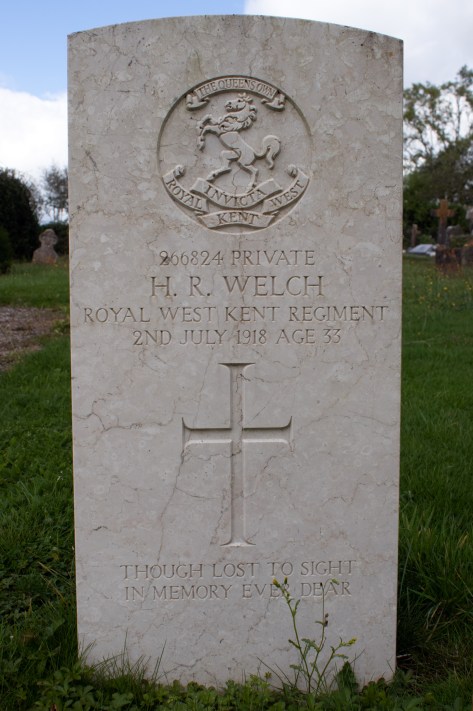
Horace was only overseas for a matter of a fortnight, before he became unwell. Medically evacuated to Britain for treatment, he was admitted to the Voluntary Aid Detachment Hospital in his home town, Mere. Suffering from appendicitis, he was operated on, but died from peritonitis soon afterwards. Private Welch passed away on 2nd July 1918: he was 33 years of age.
Horace Ralph Welch was laid to rest in Mere Cemetery, on the outskirts of the town.
Reginald Payne was born on 27th January 1898 in Milverton, Somerset. He was the third of five children – and the oldest son – to Thomas and Mary Payne. Thomas was a dairyman, and both he and Mary were from Devon: the family moved back to the county after Reginald was born, and, by the time of the 1911 census, they had settled in the village of Halberton.
Reginald, at this point, was still in school, and there is little information about his life. When war broke out, he volunteered to serve his country, but, with no military records remaining, the only point of reference for him is a newspaper report of his funeral.
Quite a gloom was cast over Halberton when it became known that Pte. Reginald Payne, eldest son of Mr & Mrs T Payne, of Brimery Dairy, had passed away at the Military Hospital, Devonport. Deceased, who enlisted in 1916 in the Hussars, and was attached to the 1st City of London Yeomanry, proceeded to Egypt, and whilst there he underwent two operations for appendicitis. He returned to England after recovering, and was sent to Ireland, where he had a return of the old trouble, and was again operated on four times, and then sent to Devonport, where he passed away.
[Western Times: Friday 6th February 1920]
Reginald Payne was a day over 22 years of age when he passed away. He was taken back to Halberton for burial, and was laid to rest in the peaceful St Andrew’s Churchyard.
Much of the life of William F Lloyd is destined to remain lost to time.
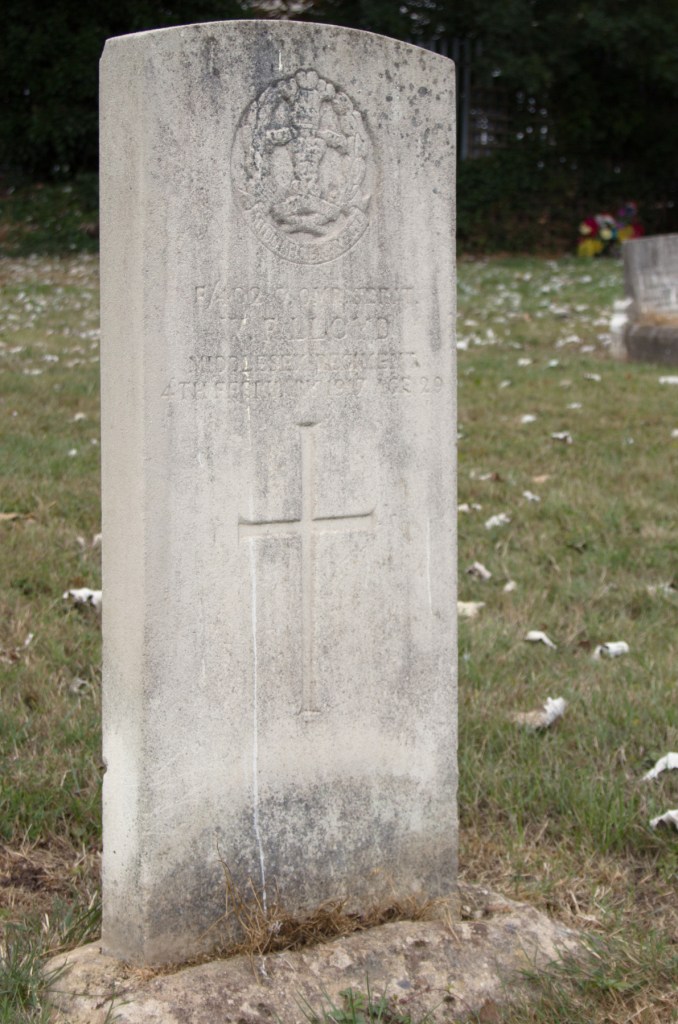
Buried in Streatham Park Cemetery, Surrey, his entry on the Commonwealth War Graves Commission register states that he was a Quartermaster Sergeant in the Middlesex Regiment, and had transferred to the 101st Training Reserve Battalion. It also confirms that he was the son of Mrs Annie Shane, of 24 Paulet Road, Camberwell.
The only document relating to William’s military service – his Pension Ledger record – adds a bit more detail. It records that he died from appendicitis on 4th February 1917. He was 29 years old when he passed. This document gives his mother’s name as Mrs Annie Lloyd, so it would seem that she re-married at some point after his passing.
There do not appear to be any potential census records for William, certainly not for a William F Lloyd, although to achieve the rank of Quartermaster Sergeant by age that he did would suggest he had enlisted prior to the First World War. It may be, therefore, that he was overseas at the time the census returns were taken.
Sadly, there is little more information that can be uncovered. William F Lloyd retained his anonymity after death, and he lies at rest in the large grounds of Streatham Park Cemetery.
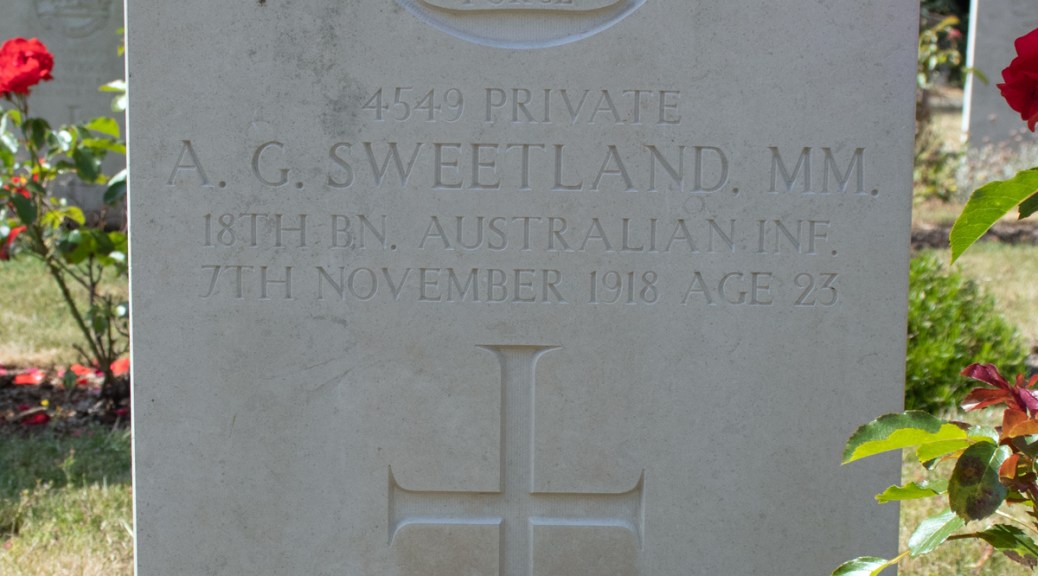
Albert Graham Sweetland was born on 6th January 1895 in Kensington, Middlesex. The oldest of seven children, his parents were mechanical engineer Albert Sweetland and his wife, Edith.
A work ethic was instilled into Albert Jr from an early age. By the time of the 1911 census, he had been sent to Truro, Cornwall, where he worked as a servant to the Faull family, tending to their poultry.
Albert was set on developing a life for himself and, in the next few years, he emigrated to Australia. He settled in the town of Liverpool, now a suburb of Sydney, and found work as a station hand. War was on the horizon, however, and people of the empire were called upon to serve their King.
Albert enlisted on 22nd January 1916, joining the 18th Battalion of the Australian Infantry. His service records tell a little about the man he was becoming. He was 5ft 7ins (1.7m) tall, and weighed 143lbs (64.9kg), with fair hair, blue eyes and a fair complexion. The document also notes that he was a Methodist, and that he had tried to enlist in the British army before emigrating, but that a slight defect in his right eye had prevented him.
Private Sweetland set sail for Europe on 9th April 1916. His unit sailed via Suez, reaching Folkestone, Kent, that November. His time back in Britain was to be brief, however: within a matter of days he was in Etaples, France.
Albert was thrown into the thick of things. On 5th May 1917, he was wounded while fighting at Arras. He was shot in the legs, and medically evacuated to Britain for treatment and recuperation. He was to remain on home soil for the next year, before returning to his unit in June 1918.
On 3rd October 1918, Private Sweetland was injured during the Battle of the Beaurevoir Line. His unit’s push forward was initially successful, but ultimately failed to capture the the village. The German forces attacked with gas, and Albert was caught up in it, receiving a gun shot wound to his back.
By the time Beaurevoir was in Australian hands three days later, more than 430 Allied soldiers had been killed. Albert was awarded the Military Medal for his bravery during the battle.
Private Sweetland was medically evacuated to Britain once more, and was admitted to Bath War Hospital for treatment. This time, however, he was not to be as luck as he had been eighteen months previously. He died on 7th November 1918, from a combination of appendicitis, pneumonia and heart failure. He was just 23 years of age.
Albert Graham Sweetland was laid to rest in the military section of Bath’s Locksbrook Cemetery, not far from the facility where he had passed. His parents and his sister Winifred attended the funeral.
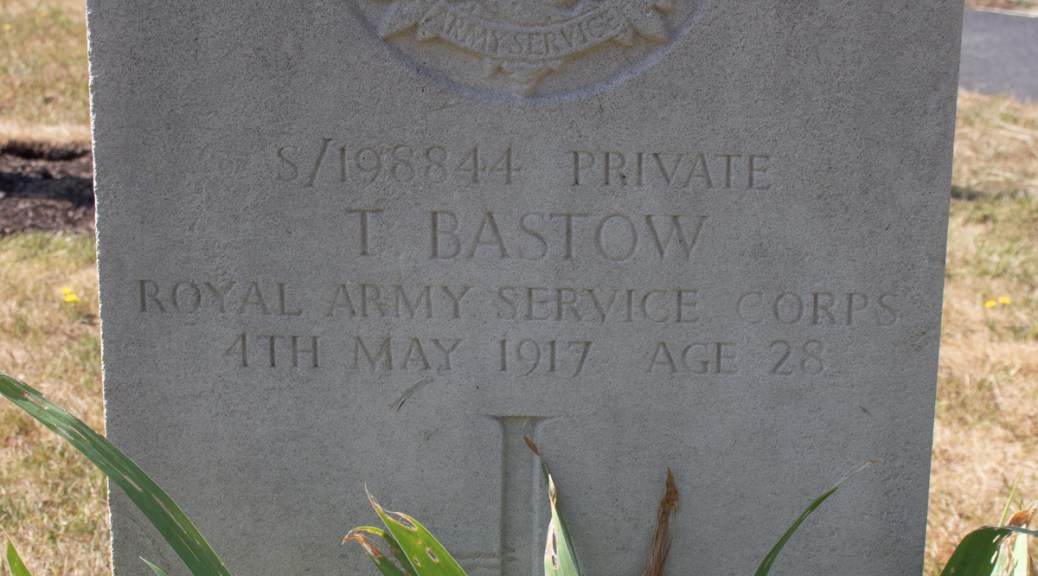
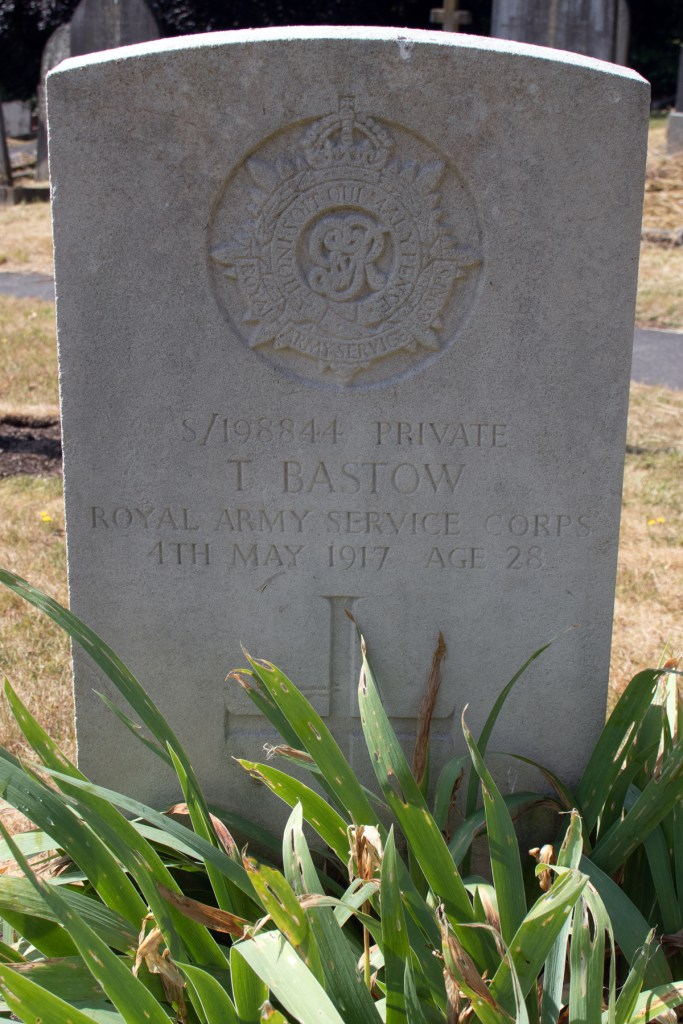
Thomas Bastow was born in the spring of 1889, the youngest of five children to Frederick and Mary Bastow. Frederick was from Weston-super-Mare in Somerset, but had met his Liverpudlian wife in Lancashire, and it was in the North West of England that the Bastow family had been raised. Mary passed away in 1898, when she was jus 40 years of age. Frederick remarried in 1901, Florence Travis becoming the young Thomas’ stepmother.
Frederick was an inspector for a mineral water company, but when Thomas left school, he found work as a clerk for the land registry. In the autumn of 1916, he married Margaret Hughes. Sadly, there is little more information about her, although their wedding was registered in West Derby.
It may have been that Thomas was in the army at this point, or at least on the verge of going. He enlisted in the Royal Army Service Corps, and was attached to one of the supply units. He seems to have been based in Somerset, as this is where he was hospitalised when he came down with appendicitis.
Private Bastow’s condition was to get the better of him: he passed away on 4th May 1917 while admitted to the Bath War Hospital. He was just 28 years of age.
Finances seem to have limited Margaret’s options when it came to her late husband’s funeral. Rather then being taken back to the north wet for burial, Thomas Bastow was instead interred in Bath’s Locksbrook Cemetery.
John Phippen Dyer was born in the spring of 1896, and was the oldest of four children. His parents, John and Fanny Dyer, were from Somerset and it was in the town of Highbridge that they raised their family.
John Sr worked as a coach body maker for the railways, and his eldest boy joined him as an apprentice when he finished his schooling. When war broke out, however, John Jr was keen to be seen to be playing his part.
John Jr enlisted in Taunton on 15th November 1915, joining the Wessex Division of the Royal Engineers. His service records confirm that he was 5ft 7.5ins (1.71m) tall and of god physical development. He was sent off to Essex for training, but came down with influenza the following January.
Sapper Dyer was admitted to hospital in Great Bentley, spending a fortnight there. He was released back to his unit, but his health continued to suffer. He had had bouts of rheumatism going back to 1911, and, by the spring of 1916, this had recurred, and was recorded as possible rheumatic appendicitis.
John’s condition led to him being declared permanently unfit for was service: he was discharged from the army on 30th March 1916, having served for just four-and-a-half months.
John Jr returned to Somerset, but at this point his trail goes cold. The next record for him is that of his passing, on 26th May 1919. He was just 23 years of age.
John Phippen Dyer was lair to rest in the cemetery of his home town, Highbridge, Somerset.
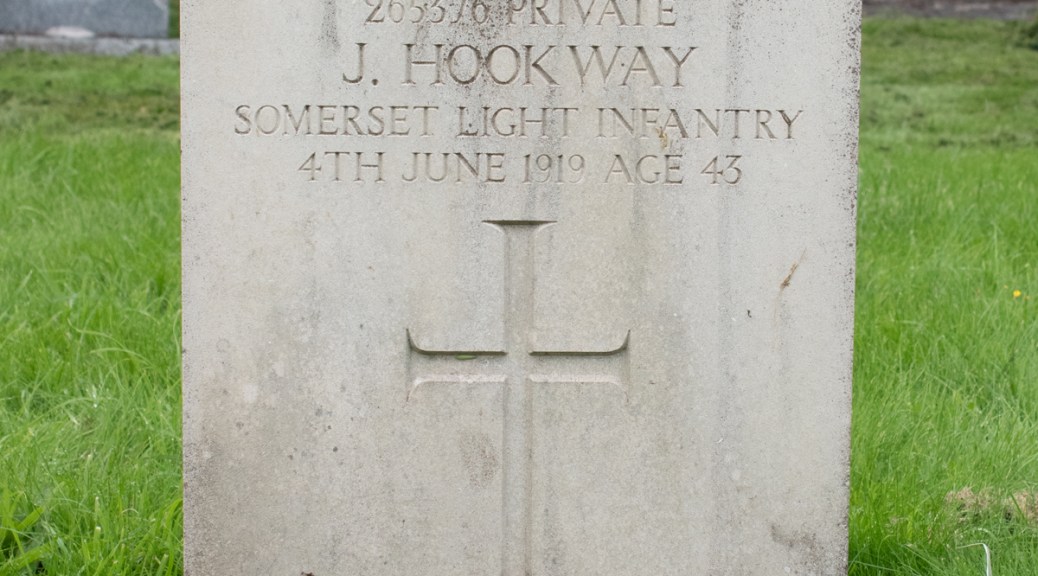
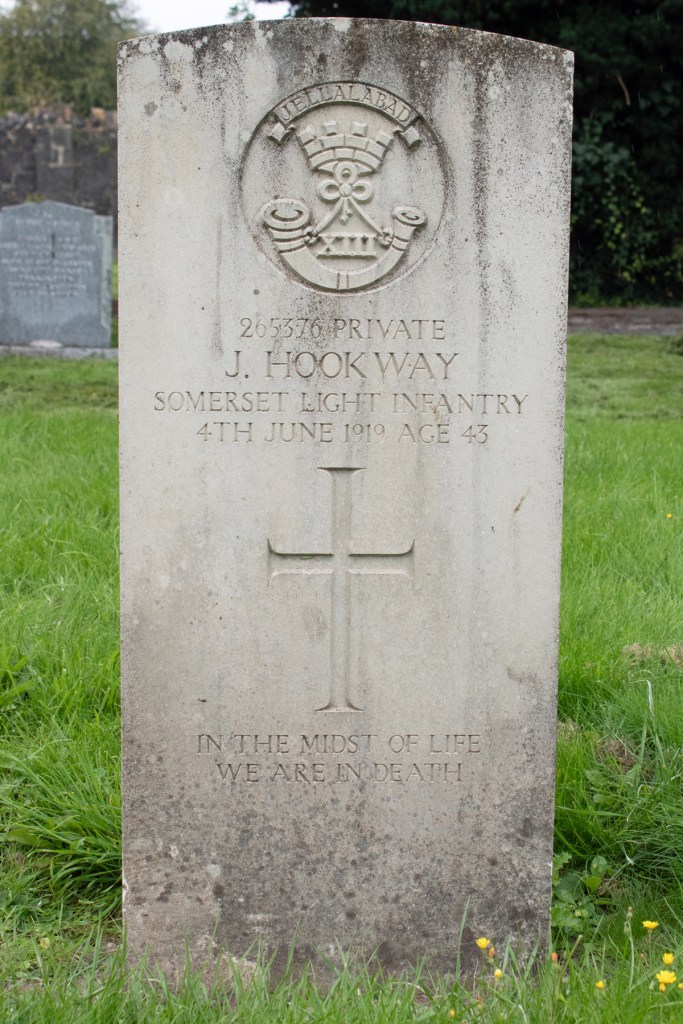
The early life of John Hookway seems destined to be lost to time. He was born in 1876 or 1877 in Lancashire, and the only surviving 1881 census featuring that name would suggest his parents were James, who was a shoeing smith, and Leah Hookway.
The next census on which John appears is in 1911. This confirms that John had married a widow called Rose Ash the year before. They were living in Huntspill, Somerset, with Rose’s three children – daughters Rose, Violet and Lily – and her sister, Emily. John was employed as an ‘improver in grocery trade’, while Violet, who was 17 years old, was noted as being a ‘servant on the Isle of Wight’. Violet’s sister, Rose, the census recorded, was ‘feebleminded’, while Emily was identified as an ‘imbecile’.
When war broke out, John stepped up to enlist. His age may have excluded him from any compulsion to join up – he was nearly 40 years old when he signed his attestation papers in December 1915. This may suggest that he had served in the army before, hence the absence from the 1891 and 1901 census records.
Private Hookway’s service records noted that he was a grocer, and that he had been born in Devon, although this is at odds with other, earlier, documents. He was 5ft 4ins (1.64m) tall and weighed 137lbs (62.1kg). He was assigned to the Somerset Light Infantry, and he joined the 13th (Home Service) Battalion. As the name suggests, John saw no action overseas, and his time appears to have been split between Somerset and Suffolk.
John’s time in the army was not without issue. In September 1916, he was admitted to a local Volunteer Aid Detachment Hospital with appendicitis, which saw him laid up for more than six weeks. In November 1918, the war having come to an end, Private Hookway was sent to the 2nd Southern General Hospital in Bristol, Gloucestershire, with an aneurysm of the abdominal aorta. This was, understandably, severe enough for him to be discharged from the army, and he was formally stood down on 12th March 1919.
John returned home to be with his family. The next record for him is that of his passing, on 4th June 1919. He was around 43 years of age.
John Hookway was laid to rest in Highbridge Cemetery, Somerset. Rose, who had now been widowed twice in ten years, never remarried. She was laid to rest near her second husband when she passed in 1946.
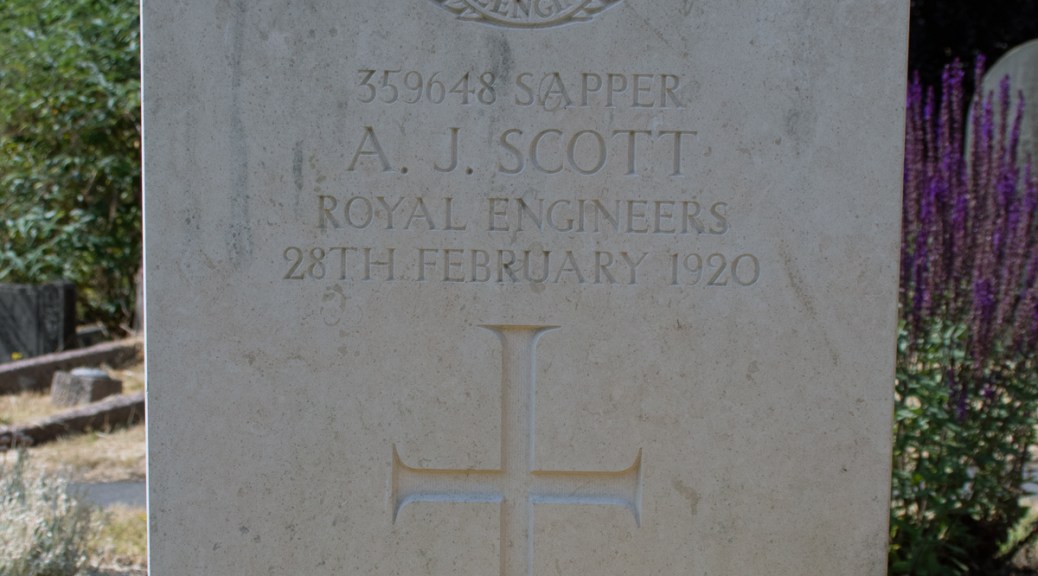
Abraham James Scott was born in Bathford, Somerset, in the spring of 1893. He was one of fourteen children to Abraham and Lucy Scott, and became known as James, to avoid any confusion with his father. Abraham was a shepherd, who travelled where work took him: both he and Lucy were from Wiltshire, but had moved to Somerset by the end of the 1880s. When James was just a babe-in-arms, the family had relocated to Gloucestershire, but by the time of the 1901 census, they were back in Wiltshire once more.
Abraham Sr died in 1910, at the age of just 41 years old. The following year’s census found the now widowed Lucy living in North Wraxhall, Wiltshire, with eight of her children. Abraham Jr is absent, and, indeed, does not appear on any of the 1911 censuses.
Lucy needed options and, on Christmas Day 1912, she married carter William Amblin in the village church. Abraham was, by this time, living in Bath and working as a carter.
When war came to Europe, Abraham felt the need to step up and play his part and, on 15th December 1915, he enlisted in the army. His service records show that he was 5ft 5ins (1.65m) tall and weighed 132lbs (59.9kg). He had a vaccination mark on his left arm which, according to the document’s section on ‘distinctive marks’, has a tendency to rupture.
Private Scott was mobilised in March 1916, and was assigned to the 1st/5th Gloucestershire Regiment. He soon found himself on the Western Front, and, having transferred to the 1st/4th Battalion, served at the Somme.
Abraham was in for a chequered time in Northern France. On 26th August 1916, he was injured when he received a gunshot wound to his scalp. He was admitted to the 1st Canadian General Hospital in Etaples, the moved to Rouen to recuperate. Private Scott rejoined his unit on 21st October 1916.
Just weeks later, however, Abraham was back in a hospital in Rouen, having fractured his ankle. After a couple of weeks in the 1st Australian General Hospital, the injury was deemed severe enough for him to be evacuated back to Britain for recuperation, and he was posted to Ballyvonare Camp in County Cork. Abraham returned to his unit in France in September 1917, nine months after his ankle injury.
On 1st March 1918, Abraham transferred to the Royal Engineers where, as a Sapper, he was attached to the Depot in Rouen. He remained there for more than a year, during which time he was admitted to hospital once more, this time with trench fever. Little additional information is available about this spell in hospital, other than that Lucy had written to the regiment thanking them for informing her of her son’s illness, and confirming a new address for her.
Sapper Scott’s health continued to suffer, however. In May 1919, he was admitted to a camp hospital, suffering from appendicitis. He was operated on, and medically evacuated to Britain for further treatment and recuperation. Abraham was admitted to the Bath War Hospital on 25th July 1919, and remained there for four months.
Abraham’s health seemed to improve, albeit slowly, and he was moved to the Pension’s Hospital in Bath on 27th November. The head wound, broken ankle and bout of trench fever appear to have taken their toll on his body which, by this point, seems to have been too weak to recover. On 28th February 1920, two months after being transferred to the Pension’s Hospital, he passed away there from a combination of appendicitis and pelvic cellulitis. He was just 26 years of age.
Abraham James Scott’s body did not have to travel far after this point. He was laid to rest in the sprawling Locksbrook Cemetery in his adopted home city of Bath.
Cecil St John Harris was the son of Reverend Percy and Constance Harris. Born in Kilver, Staffordshire, on 13th July 1891, he was one of nine children, although, by the time of the 1911 census, four of them had passed away. The Harris family had, by this point, moved from Staffordshire, to Devon, to Cornwall, and had settled in Staplegrove, Somerset, where Percy had become the rector at St John’s Church.
According to the census record, Cecil was studying engineering. He was keen at sports, being a keen member of the village’s cricket club. When war broke out, he enlisted in the West Somerset Yeomanry, but soon took a commission as a Second Lieutenant in the Somerset Light Infantry.
Cecil’s troop, the 3rd/5th Battalion remained on home soil, and he was based in Somerset for the duration of his time in the army. This was not to be for a long time, however, as, in the summer of 1915, he fell ill with appendicitis. He underwent an operation, and made a slow recovery, before relapsing. He passed away on 10th September 1915, aged just 24 years old.
Cecil St John Harris was laid to rest in the north east corner of St John’s Churchyard, Staplegrove, where his father was still the vicar. His grave is now lost to time, but Second Lieutenant Harris is commemorated on a special memorial, close to the entrance of the building.










 Death and Service