Tag Archives: Captain

Lieutenant Colonel Charles Holroyd-Smyth

Lieutenant Colonel Charles Holroyd-Smyth

Charles Edward Ridley Holroyd-Smyth was born in Ballynatray, Co. Waterford, Ireland, on 16th August 1882. The seventh of nine children, his parents were John and Harriette Holroyd-Smyth. John was a colonel in the army and, while from a a renowned family, there is actually little documented about Charles’ early life.

Given his father’s military career, it seemed natural for Charles to follow suit. His service records are tantalisingly elusive, but he certainly served in South Africa during the Second Boer War at the turn of the century.

When war broke out, Charles took up the rank of Captain in the 3rd Dragoon Guards (Prince of Wales’ Own). He set sail for France on 1st November 1914, and he found himself in the very thick of the fighting, where his battalion fought at Ypres, Loos and Arras. His conduct during the war earned him both the Distinguished Service Order and a Military Cross.

On 29th October 1916, Charles married Norah Layard, the daughter of another army officer, who had been born in Ceylon. Charles was soon back in France, however, and was promoted to Lieutenant-Colonel, and given command of the 15th Battalion of the Durham Light Infantry.

Over the course of 1918, Lieutenant-Colonel Holroyd-Smyth led his troop in the Battles of Bapaume, Messines, Kemmel and Aisne. However, it was during the Battle of Epehy that he was badly wounded. Initially treated on sight, he was quickly evacuated back to Britain for further treatment.

Lieutenant-Colonel Holroyd-Smyth was admitted to the Royal Victoria Hospital in Netley, Southampton, but his wounds were to prove too severe. He passed away on 23rd September 1918, at the age of just 36 years of age.

The body of Charles Edward Ridley Holroyd-Smyth was brought back to Somerset, where Norah was living. His funeral, at St Stephen’s Church, in Bath, was marked with some ceremony, and he was laid to rest in Lansdown Cemetery, overlooking the city.


(from ancestry.co.uk)

Charles’ death came just nine days after the passing of his mother, back in Waterford. He and Norah didn’t have any children, although tragically a newspaper report from July 1918 did note a birth: “On the 3rd July, at East Hayes House, Bath, the wife of Lieutenant-Colonel CE Holroyd-Smyth MC, a son (stillborn).” [Bath Chronicle and Weekly Gazette: Saturday 13th July 1918]
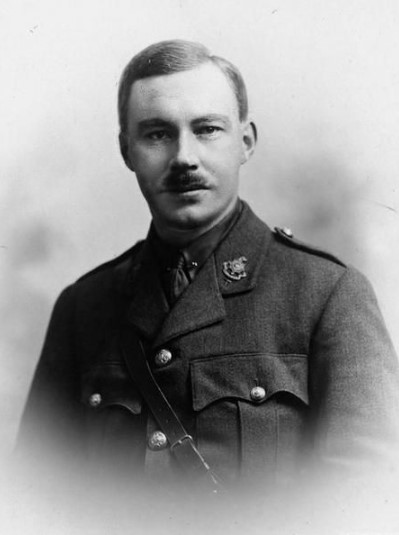
Captain Fritz Bartelt

Captain Fritz Bartelt

Friedrich Wilhelm Bartelt was born on 23rd September 1887 in the Somerset village of Corston. He was the younger of two children to Friedrich and Rosanna Bartelt. Born in Prussia, Friedrich Sr was an import and export merchant of oil and chemicals, who had become a magistrate and chemical manufacturer by the time of the 1901 census.

Friedrich Jr – who was also known as William or Fritz, to avoid confusion with his father – had the upbringing to be expected for the son of a prominent businessman.

He was educated first at St Christopher’s, Bath… and afterwards at Bath College, which he entered in September, 1900, and left in December, 1904. He was prominent in sport and as in the school Rugby Fifteen in 1903 and 1904, and a member of the Cricket Eleven in the summers of 1903 and 1904, and was in the second rowing four in 1904. He subsequently studied chemistry… at Bristol University College, and after a time he became a director in the company of which his father is chairman.

Somerset Guardian and Radstock Observer: Friday 15th September 1916

Fritz enlisted in the Somerset Light Infantry not long after finishing his studies, becoming a Lieutenant in H Company of the Volunteer Battalion, before taking command of G Company. Possibly because other pressures took priority, he stood down from his role in 1911.

On 2nd June 1910, Fritz had married Gertrude Isgar, a gentleman’s daughter from Bathwick, near Bath. The couple went on to have two children, both boys.

[Fritz] was a churchwarden of Corston, and always took a keen interest in all parochial matters, and his loss is very keenly felt in the village. Always kind and genial to all alike, he won the hearts of all with whom he came in contact. His readiness to help, his careful attention to the needs of those around him, and his kindly words and acts will dwell long in the memory of many in Corston.

Somerset Guardian and Radstock Observer: Friday 15th September 1916

When war was declared in 1914, Fritz stepped up to play his part, and was given the commission of Captain in the 2nd/4th Battalion of his old regiment, the Somerset Light Infantry.

On December 1, 1915, he sailed for India, when he took charge of his company, and was afterwards given an important post, being appointed in command of his station at Barrackpore [Barrackpur].

Somerset Guardian and Radstock Observer: Friday 15th September 1916

Captain Bartelt fell ill in the summer of 1916, and was admitted to a hospital in neighbouring Kolkata. While his condition is not reported on, he seemed to have been improving, but his health then took a downward turn, and he passed away while still admitted, on 11th September 1916. He was 28 years of age.

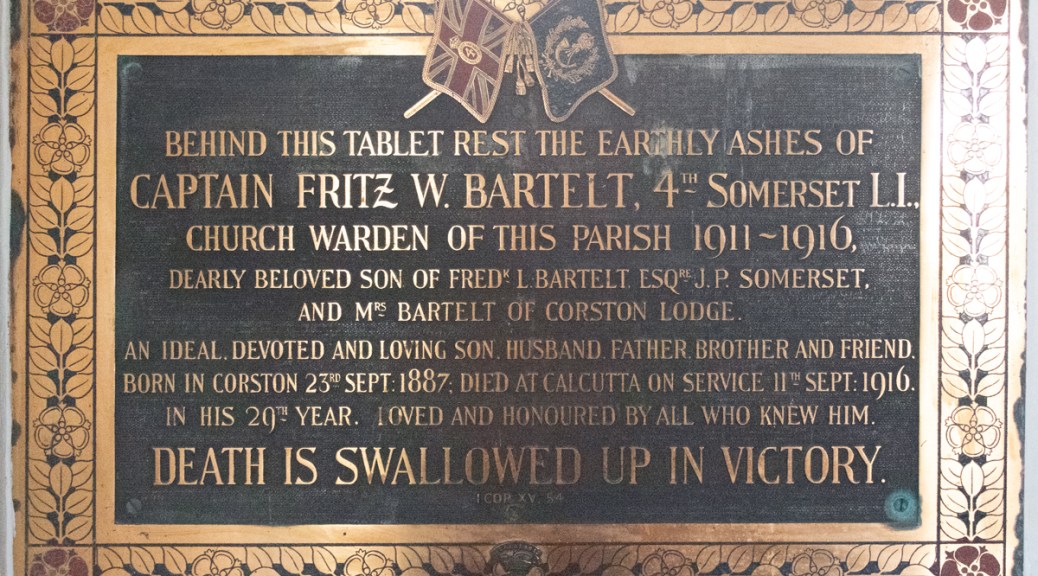
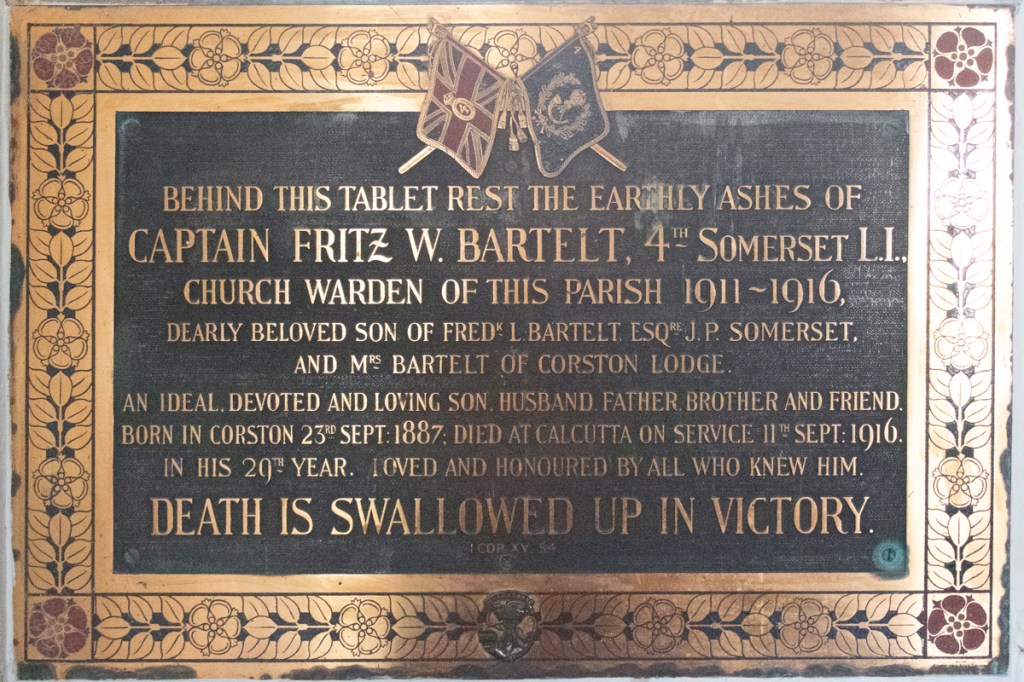
Fritz William Bartelt’s body was cremated in India. His ashes were returned to England, and were interred in All Saints’ Church in his home parish, Corston, where a plaque and a stained glass window are dedicated to his memory.


Captain Fritz Bartelt
(from ancestry.co.uk)

Second Lieutenant Charles Hales

Second Lieutenant Charles Hales

Charles Edward Hoare Hales was born in Bournemouth, Dorset, in the summer of 1886. The fourth of five children, his parents were Arthur Hales – a Major General in the Royal Inniskilling Fusiliers – and his wife, Maria.

Arthur’s career stood the family in good stead: the 1891 census records the Hales living in a house in Crystal Palace Park, South London, with five servants supporting their – and their two visitors’ – every need. Arthur also believed in education for this two sons: Charles was dispatched to Hartwood House School in Hartley Wintney, Hampshire.

Arthur died in 1904 and at this point the Hales family disappears – there is no record for Maria or her five children in any of the 1911 census returns.

When war came to Europe, Charles and his older brother Arthur, stepped up to play their part. Both joined the Wiltshire Regiment, both being attached to the 1st Battalion. Sadly, neither of the brothers’ service records remain, so it is difficult to piece together their military careers.

Arthur achieved the rank of Captain, gained a Military Cross for his dedication and service. He was caught up in the Battle of Albert – one of the phases of the fighting at The Somme – in 1916. He was initially reported killed in action, then, to the elation of Maria, this was changed to missing. Tragically, he was subsequently confirmed as dead, having passed away on 6th July 1916, aged 34 years of age. He is commemorated on the Thiepval memorial in Northern France.

A further tragedy was to strike the Hales family the following year, when Charles, who had risen to the rank of Second Lieutenant, also passed away.

The internment took place in Bathwick Cemetery on Monday, of Mr Chas. Edward Hoare Hales, 2nd-Lieutenant Wiltshire Regiment, who died on Thursday, after a long illness contracted on active service. He was the last surviving son of the late Major-General A Hales, Royal Inniskilling Fusiliers, Commandant of the Straits Settlements, and of Mrs Hales… The young officer, whose body was brought from Buxton, was buried in the same grave where rest the remains of his father, who died in April 1904.

Bath Chronicle and Weekly Gazette: Saturday 1st December 1917

Details of Charles’ illness, from which he passed on 22nd November 1917, are unclear. He was 31 years old when he died. He left his estate – which amounted to £6524 18s 1d (the equivalent of £579,000 in today’s money) to his youngest sister, Sophia.


Maria Hales passed away in 1924, at the age of 74. She was buried in the family ploy, reunited with husband and younger son once more.


Second Lieutenant Charles Hales
(from findagrave.com)

Captain Arthur Hales
(from findagrave.com)

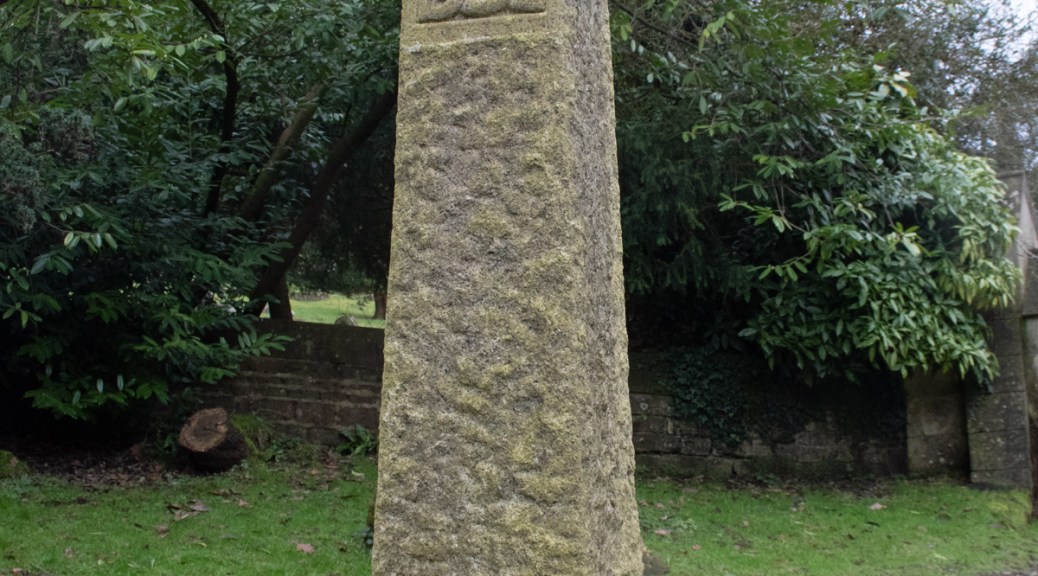
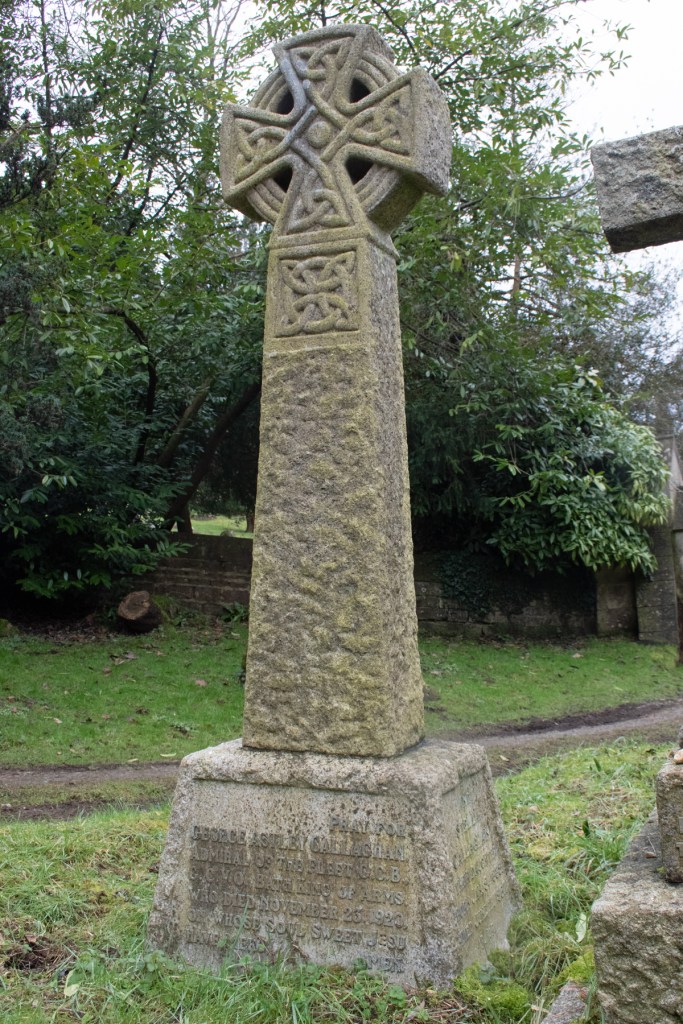
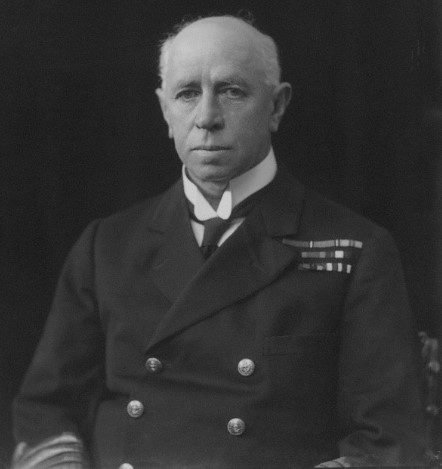
Admiral of the Fleet Sir George Callaghan

Admiral of the Fleet Sir George Callaghan

George Astley Callaghan was born in London on 21st December 1852, the third of six children to Frederic and Georgiana Callaghan. Frederic was born in Ireland and was the son of MP and landowner Daniel Callaghan. He built a career for himself as a magistrate and set up home in Bath, Somerset with Cheltenham-born Georgiana.

The family had means and the 1861 census records them living at a five-storey Georgian house in Catharine Place, Bath, with five live-in servants: a butler, cook, housemaid, nursemaid and nurse.

George enlisted in the Royal Navy in January 1866, and was assigned to the training ship HMS Britannia. From here, his career was to prove meteoric. He was promoted to the rank of Midshipman in October 1867 and by 1870 he was serving in the East Indies. On 15th April 1872 he gained the rank of Sub-Lieutenant, and was promoted to full Lieutenant exactly three years later.

In 1877, Lieutenant Callaghan received a commendation for saving the lives of sailor whose boat had capsized in the Irrawaddy River. George was assigned to HMS Excellent, a gunnery school, in 1880, and formally joined the staff there in 1882. Back on the open seas by 1885, he was promoted to Commander on 31st December 1887 and given control of the battleship HMS Bellerophon. By 1894, George had been promoted again, to the rank of Captain, and took on the additional duties of naval advisor to the War Office.

As the new century dawned, George was mentioned in dispatches for his support during the Boxer Rebellion. Further commands followed, including HMS Edgar and HMS Caesar, both in 1901. He was made Captain of Portsmouth Dockyard and then naval aide-de-camp to the King in 1904. By the following year, he was given the rank of Rear Admiral, became Second-in-Command of the Channel Fleet in 1906, Second-in-Command of the Mediterranean Fleet in 1908. In December that year he was awarded Knight Commander of the Royal Victorian Order for the aid he provided to survivors of the Messina earthquake.

In April 1910, George was knighted and promoted to Vice Admiral, and within eighteen months he was made Commander-in-Chief of the Home Fleet, gaining the rank of Admiral in November 1911.

During this time of military promotion, George had also had his own family. On 2nd February 1876, he had married Edith Grosvenor in St Andrew’s Church, Walcot, Bath. The couple went on to have four children: Dorothy, Cyril, Noël and Stella.

A naval officer’s wife was destined to be a lonely life, and the census records seem to reflect this. In 1881, Edith and Dorothy were visiting a curate and his family in Wiltshire. Ten years later, Edith and her four children were living at the family home in Bathwick, with one visitor and three servants. The 1901 census found Edith, Cyril (who was now a midshipman himself) and Noël living in Devonport with a cook and two other servants. By 1911, Edith had moved again. She was 54 by this point, and based at a house in Havant, Hampshire, with a cook and two maids. All of this time, of course, George was away at sea, performing his duties.

George, by this point, had spent years preparing for the war he knew was coming. However, in July 1914, the First Lord of the Admiralty, Winston Churchill, commanded Sir John Jellicoe to relieve George of his position as Commander-in-Chief of the Home Fleet. Whether Churchill believed that Sir Callaghan was now too old to successfully carry out the duties the advancing conflict would impose upon him is unclear. It must have disappointed the 62-year-old George, however.

His work continued, however: he was appointed First an Principal Naval Aide-de-Camp to the King in September 1914, and became Commander-in-Chief of The Nore in three months later. He was promoted again, to Admiral of the Fleet, in April 1917, but subsequently retired less than a year later.

George’s life over the next couple of years goes a little quiet. Indeed it is only in November 1920 that further information is available.

The death occurred in London yesterday afternoon of Admiral of the Fleet Sir George Callaghan KCB. He had been ill for some months, and the immediate cause of death was an affection of the heart.

The Scotsman: Wednesday 24th November 1920

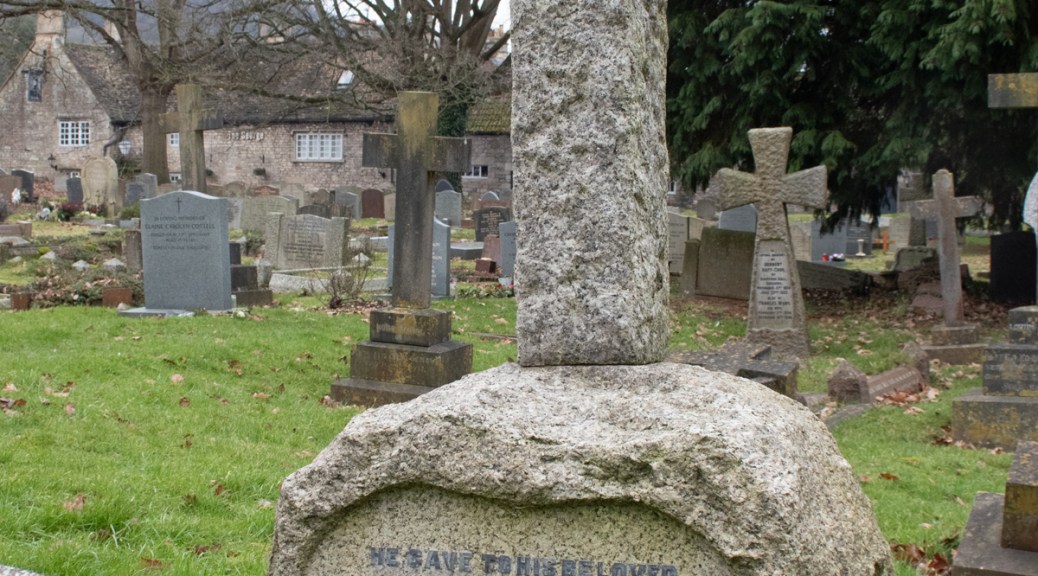
Sir George’s passing at his London home was reported in most of the press, highlighting his military achievements and decorations. His funeral was held at Westminster Abbey, and he was then laid to rest in the graveyard of St Mary’s Church in Bathwick, not far from his and Edith’s main home.


Sir George Callaghan

Major Richard Jordan

Major Richard Jordan

Richard Avary Arthur Young Jordan was born on 24th May 1866 in Cashel, Tipperary, Ireland. His father, Richard Jordan, died a week after his son’s birth, leaving his mother, Annabella, to raise him.

The 1871 census records mother and son living in Woolwich, London, with Annabella’s widowed mother, Grace. They were obviously a well-connected family, with Grace living as an annuitant, or pensioner, one son a Surgeon Major in the army and another as a Colonel in a different regiment. Annabella herself was recorded as a landowner, and the family had support with a cook and housemaid living in.

Surrounded by army servicemen as he was, it is no surprise that a military career called to Richard. He enlisted on 10th November 1886, joining the King’s Shropshire Light Infantry as a Lieutenant. Assigned to the 1st Battalion, his service records confirm that he had attended Burney’s Gosport School – a military academy – and was 5ft 7.5ins (1.71m) tall.

Richard was sent to Egypt just before Christmas that year, and over the next five years, he served both there and in Malta. On 11th May 1889 he attained the rank of Captain and, in December 1891 he was sent further afield, to Hong Kong.

After three years in the Far East, returned to Britain, and spent the majority of 1895 back on home soil. His travels were not at an end, however, and by the end of the year, Captain Jordan found himself in India. He spent three-and-a-half years in the sub continent, returning to the UK in May 1899.

At this point, details of Richard’s life get a little sketchy. He seems to have settled in Pembroke Dock, South Wales, and, on 18th April 1904, he married Ella Mary Caroline Grove. She was eight years his junior, and the daughter of a late Lieutenant in the Highland Light Infantry. The couple married at St George’s Church, Hanover Square, London.

Richard’s trail goes gold again, for a couple of years. He retired from the army on 8th August 1906, after nearly twenty years’ service. By the time of the 1911 census, he and Ella had set up home in Heywood House, on the outskirts of Tenby, Pembrokeshire, with two servants – Beatrice and Edith – as two live-in staff.

War came to Europe in the summer of 1914, and Richard seemed to keen to play his part once again. He enlisted again in August 1915, and was assigned the rank of Major in his former regiment. While it is not possible to determine Major Jordan’s complete service at this time, he definitely arrived in France the following month. If he remained in France, it is likely that he saw fighting at the Somme in 1916, Cambrai in 1917 and at Lys and on the Hindenburg Line in 1918.

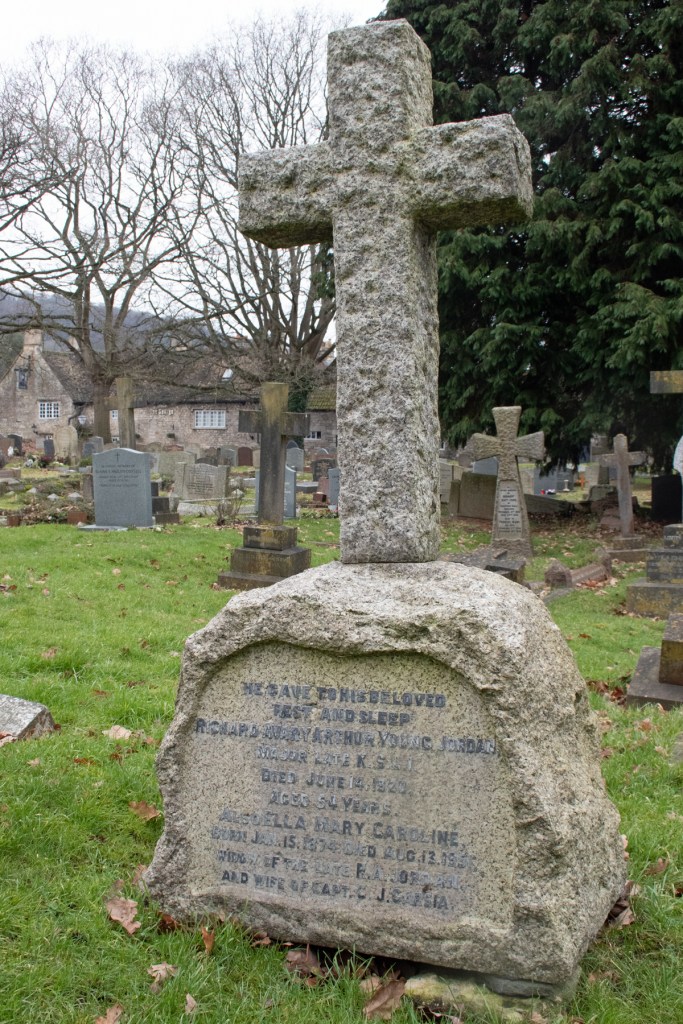
Again, Major Jordan’s post-war life remains tantalisingly elusive. By the summer of 1920, he and Ella were living at Holcombe Lodge in Bathampton, on the outskirts of Bath. It was here on 14th June, that Richard passed away. He was 54 years of age.

Despite all his travelling, it seems that Ella was comfortable living in Bathampton, and this is where she laid her late husband to rest. Richard Avary Arthur Young Jordan was buried in the graveyard of St Nicholas’ Church in the village.


The widowed Ella married again, to Captain Clare Garsia, on 9th October 1921. She remained in Bathampton, and lived to the age of 77, passing away on 13th August 1951. She was laid to rest in the same plot as her late husband.

When Captain Garsia died the following year, he was also buried in St Nicholas’ Churchyard, in a neighbouring plot to his beloved Ella.


Captain William Poulett

Captain William Poulett

William John Lydston Poulett was born on 11th September 1883, in Belsize Park, London. The oldest child to William Poulett, 6th Earl Poulett, and his third wife, Rosa, William Jr was known by the title Viscount Hinton.

When William’s father died in January 1899, a battle ensued for the title of the 7th Earl Poulett. The 6th Earl had married his first wife, Elizabeth, in 1849, separating from her within a couple of months, when he learnt that she was pregnant. The alleged father was Captain William Turnour Granville, and when the 6th Earl died, Elizabeth’s son, another William Poulett, claimed the right to take the title. In July 1903, the judge decreed that William and Rosa’s son held the valid claim, and William John Lydston Poulett succeeded him, becoming the 7th Earl. At this point, he was living in Ayston, Rutland, expanding his education and boarding with a Clerk in Holy Orders.

In 1908, William married Sylvia Storey. She was the daughter of actor and dancer Fred Storey, and was herself an actress and Gaiety girl. Given Earl Poulett’s status, it seems this might not have been the most appropriate of matches, as a contemporary newspaper reported:

Another marriage alliance of the stage with the aristocracy, and one of the most remarkable of them all, was brought about yesterday by a quiet ceremony at St James’ Church, Piccadilly, uniting Earl Poulett and Miss Sylvia Lilian Storey, the well-known comedienne.

Besides contracting parties, there were only one or two persons present, including the family solicitor and Lady Violet Wingfield, sister of the bridegroom [who was also a Gaiety girl]. There were no bridesmaids.

Before the ceremony, some consternation was caused by an untoward event. The wedding ring was dropped, and there were some perturbing moments while a scrambling hunt was made for it on the floor. Finally it was discovered and pounced upon by the verger.

The time and place of the ceremony had been kept quite a secret, and the bride and bridegroom were on their way from London before the news of their marriage became known. The sudden announcement which was then made greatly enhanced the romance of the affair.

The Earl is just twenty-five years of age, and the new Countess is eighteen…

Shields Daily News: Thursday 3rd September 1908

The secret nuptials couple went on to have two children – George and Bridget – and, by the time of the 1911 census, the family were living in some luxury at Hinton House in Hinton St George, Somerset.

William had also had a distinguished military career by this point. In 1903 he received a commission as Second Lieutenant in the 4th Battalion of the Royal Welch Fusiliers, before being transferred to the 4th Highland Light Infantry.

On 26th February 1913, he was recommissioned, as a Second Lieutenant in the Warwickshire Royal Horse Artillery and, when war broke out, he was sent to France. By November 1915, he had been promoted to Captain, but after three years on the Western Front, his health was beginning to suffer.

Captain Poulett was transferred back to Britain, and assigned to the Royal Warwickshire Regiment. By 1918, he was serving as part of the Anti-Aircraft Corps in Middlesbrough, when he contracted pneumonia. This was to take his life, and he breathed his last on 11th July 1918, at the age of just 34 years old.

William John Lydston Poulett, 7th Earl Poulett, was brought back to Somerset for burial. He was laid to rest in the graveyard of St George’s Church in Hinton St George.


Captain William Poulett
(from ancestry.co.uk)

William’s death meant that his nine-year-old son, George, inherited his title and his £187,200 estate (worth £8.2m today). The 8th Earl served during the Second World War, working as an engineer at Woolwich Arsenal and becoming an Associate of the Institute of Railway Signal Engineers and the Institute of British Engineers.

George married three times: he divorced his first wife, Oriel, in 1941; outlived his second wife, Olga, who died in 1961; and was survived by his third wife, Margaret, when he passed away in 1973. When he died, with no children, all of his titles became extinct.


Reverend George Sweet

Reverend George Sweet

George Charles Walrond Sweet was born on 4th December 1889, the oldest of three children to Reverend Charles Sweet and his wife Maud. A Church of England vicar, Charles moved around with his work, and, when George was born, he was based in Winterborne Kingston in Devon.

George was sent away to school, and, by the time of the 1901 census, Charles and the family had moved to Milton Lilbourne in Wiltshire, to tend the local flock.

After school, George studied at Oxford, then followed in his father’s footsteps by taking holy orders, and was soon appointed rector of Symondsbury, Dorset.

When war broke out, his calling was to serve in the Royal Army Chaplain’s Department. Details of his time during the conflict are unclear, although by the spring of 1919, he was attached to the headquarters of the Army of the Rhine.

It was here that he met Phyllis Squire Hickson, who was serving as a Nurse in the Queen Mary’s Auxiliary Army Corps. The couple fell in love and, in June 1919 they returned to England to marry. The wedding occurred on 6th August 1919, and the newlyweds set off on honeymoon the following day.

On his honeymoon tour, the Revd. George C Walrond Sweet… was drowned on Thursday evening in the Cherwell at Oxford, in the presence of his wife.

Mr and Mrs Sweet engaged a punt at Tims’s boathouse and went for a trip on the river. On returning about seven o’clock, when within 300 yards of the boathouse, the punt pole was embedded in the mud and, in attempting to dislodge it the pole broke.

Mr Sweet fell on the side of the boat and then over-balanced into the river. His wife tried to reach him, but without success, and then jumped into a second punt and from that into another boat, but failed to reach him, and he disappeared. The body was not recovered until a quarter of an hour had elapsed, and life was then extinct.

Mr Sweet, who was an MA of Keble College, was only married on Wednesday at St James’s Church, West Hampstead…

[Phyllis’ father] Mr William Hickson… said his daughter became engaged to Mr Sweet in France. He did not meet him until last Tuesday. They came to England to be married. Mr Sweet met with a bicycle accident some years ago and [he] understood from his daughter that her husband was unable to swim or take any active exercise, but while he had been in France his health had much improved.

It was stated [at the inquest] that Mr and Mrs Sweet had been married only one day when the accident occurred and Dr Brooks, a university coroner, said that the tragedy was one of the saddest that had ever come under his notice.

Taunton Courier and Western Advertiser: Wednesday 13th August 1919

The inquest confirmed that the punt pole had broken about 2.5ft (0.76m) from the top. When George was dragged from the river, artificial respiration was carried out for around 50 minutes, but proved unsuccessful. The inquest returned a verdict of accidental death. George was just 29 years of age.

Reverend George Charles Walrond Sweet’s body was brought to Somerset for burial. He was laid to rest in the graveyard of Holy Cross Church in Sampford Arundel, more than likely because he or his father had been vicars there.


This was the second tragedy to befall the Sweet family. George’s younger brother, Leonard, had been schooled in Sherborne, then at the Military College in Sandhurst. He joined the 1st Battalion of the Hampshire Regiment as Second Lieutenant on 5th February 1913, and was promoted to full Lieutenant in September 1914, and Captain in October 1915.

Captain Sweet was then attached to the 29th Squadron of the Royal Flying Corps, and gained his wings at the British Flying School in Le Crotoy, France, in August 1915. On 22nd June 1916, he was on patrol duty over the British lines, when he was involved in a skirmish, and his plane crashed, killing him instantly. He was just 23 years of age.

Captain Leonard Sweet was laid to rest at the Lijssenthoek Military Cemetery in Poperinge, near Ypres.

Captain Leonard Sweet
(from findagrave.com)

Phyllis Sweet never remarried. By the time of the 1939 England and Wales Register, she was living in Bridport, Dorset, and working as a political organiser and speaker. She passed away in August 1944 in Cannock, Staffordshire, at the age of 63 years old.


Captain Roden Chatterton

Captain Roden Chatterton

Roden Latham Chatterton was born on 13th July 1895, in Budin, Bengal, India. He was the only child to George and Ella Chatterton. George was a Lieutenant Colonel in the army, and had married Ella in India, where he was based.

The family had returned to England by the time of the 1911 census, but then moved permanently to Ireland. When war broke out, Roden joined up, enlisting in the 1st Battalion of the Leinster Regiment with the rank of Lieutenant. Full details of Roden’s military service are not available, but he arrived in France in January 1915 and, stayed there for the best part of two years.

In December 1917, the now Captain Chatterton transferred to the Royal Flying Corps. Based in Kent, he learnt to fly, and was close to gaining his wings, when an accident befell him in March 1918.

About 5:30pm on March 27th, [Captain Chatterton] was about 1.500 feet up, was trying to land near an aerodrome, and the wind was very rough. He shut off the engine and tried a left hand turn when the machine stalled and came down in a spin nose down and crashed to the ground. Several [people] went to his assistance. He was in great pain and made no remarks. He had been strapped in, but the belt had broken. The wind was from the south south-west. He came own into the wind and was trying to turn head into it when the machine got into a spin. It was not an ideal day for flying. Another machine… was flying with the deceased, and that landed all right. There was no collision in the air. When [he] turned he had not got the nose down far enough to keep up the engine speed and, in the witness’ opinion it was through an error of judgment on his part that the machine crashed. Had there been more space he would have got out of the spin. There was nothing wrong with the machine, but it was a type that was very difficult to handle in rough weather.

Whitstable Times and Herne Bay Herald: Saturday 6th April 1918

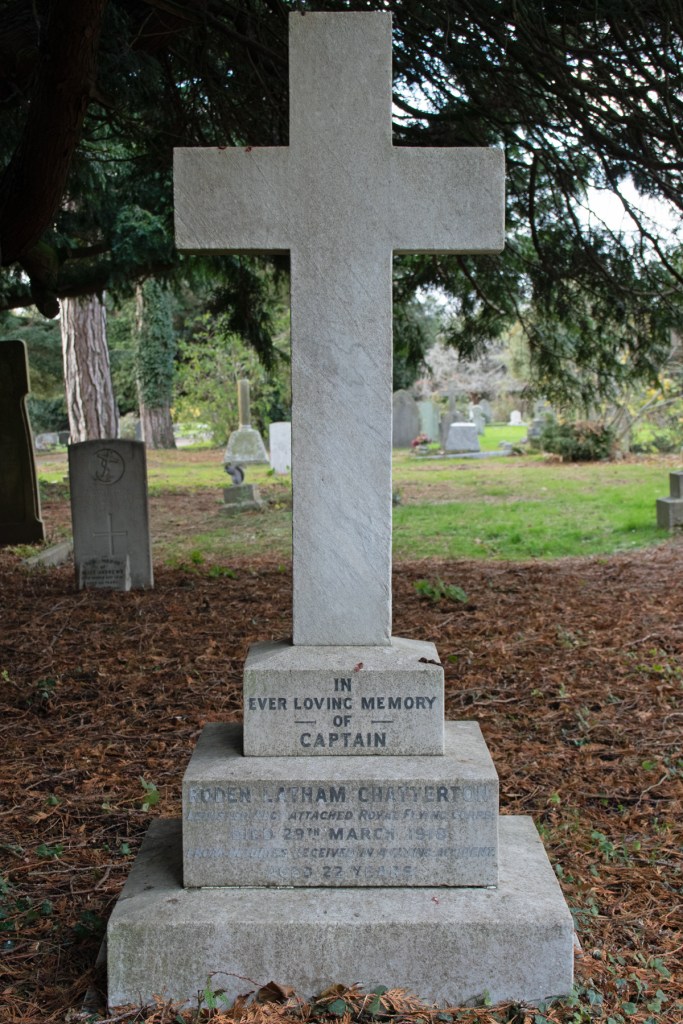
Captain Chatterton was taken to the Lees Court Military Hospital south of Faversham for treatment, but died of his injuries on 29th March 1918. He was 22 years of age.

Roden Latham Chatterton was laid to rest in a quiet corner of the Borough Cemetery in Faversham.


Captain Edward Wakeford

Captain Edward Wakeford

Edward Francis Wakeford was born in Rottingdean, near Brighton, Sussex, in February 1881. He was the younger of two children to curate William Wakeford and his wife, Eliza.

The family home was always a busy one; the 1881 census records one visitor, four boarders and a servant. Ten years later, confirms one boarder and two servants.

By 1901, William had taken up a post in St Peter’s Church, Henfield. This seems to have been a step up: helping look after the family and a visitor were four servants – a gardener, a cook, a housemaid and a kitchenmaid.

In March 1907, Edward married Annie West Thornton; she was the daughter of a well-to-do family – the census records show that her father, William West Thornton, lived by private means, while Annie was sent to Surrey to attend a boarding school.

Edward and Annie couple set up home on the Sussex coast, and, when William passed away in 1912, were soon also living by private means. They went on to have three children: two girls, Olive and Iris, and a boy, who they named William after both of their fathers.

War was coming to Europe by this point. While full details of Edwards military service are not available, he appears to have given a commission in the Royal Sussex Regiment. Initially serving as a Lieutenant, but October 1914, he was promoted to Captain.

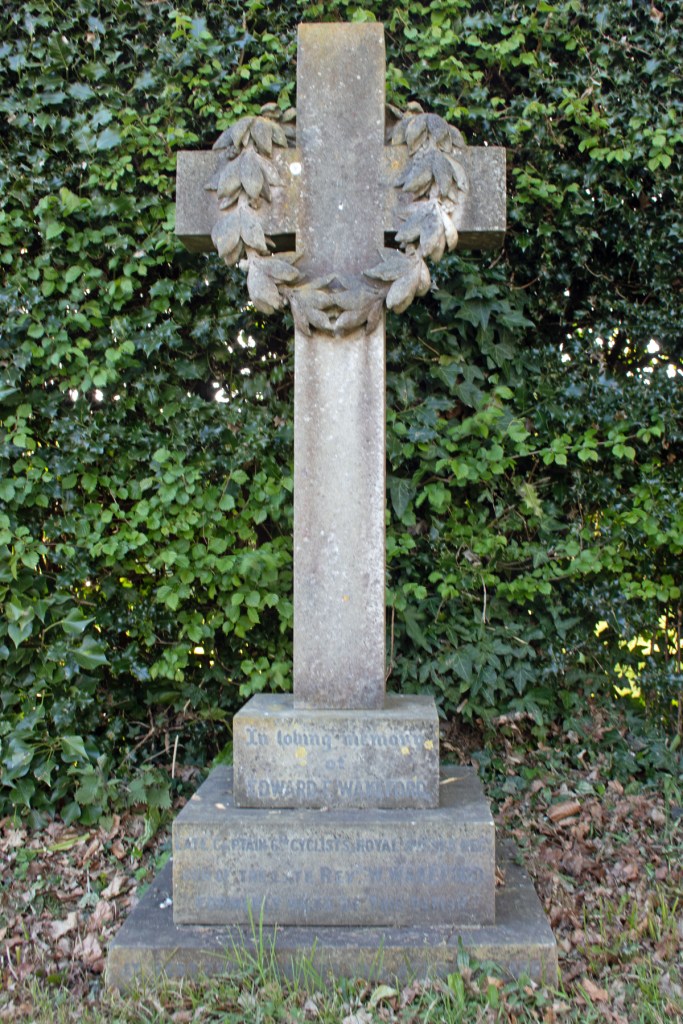
Edward was assigned to the 6th (Cyclist) Battalion, and served in East Anglia. It seems that he fell ill while there, and was admitted to the Norfolk and Norwich Military Hospital, suffering with appendicitis. Sadly the condition proved too much, and Captain Wakeford passed away following the operation. He died on 23rd February 1915, not long after his 34th birthday.

Edward Francis Wakeford’s body was brought back to Sussex. He was laid to rest in Henfield Cemetery, not far from the church where his father had served for so long.


Captain Edward Wakeford
(from findagrave.com)

The now widowed Annie wed again, marrying Reverend John Gurney in October 1917. Tragedy was to strike again, though, when she passed away just a year later, on 20th October 1918. She was laid to rest Henfield Cemetery, in the plot next to her late husband, Edward.

John Gurney went on to live a full live. He never married again, and settled in Buxted, near Uckfield. He passed away in November 1956, at the age of 76 years old. He was also laid to rest in Henfield Cemetery, where he was buried in the same plot as Annie.

Edward and Annie’s children also went on to have full lives, despite the early loss of their parents.

Olive never married, and passed away in Nottingham in 1986, aged 78 years old.

Iris married in Liverpool in 1934, and went on to have two children. When the marriage failed in the 1940s, she got wed again in 1949. She passed away in Cheltenham in 1965, at the age of 54.

William got married in 1940, at which point he was serving as a Lieutenant in the 1st King’s Shropshire Light Infantry. He saw action in Italy towards the end of the war, and was awarded a Military Cross for his service. When peace came to Europe again, he and his wife settled into a normal life, before emigrating to Australia. William passed away in May 1967, at the age of 54 years old.


Captain William Rowell

Captain William Rowell

William Cecil Rowell was born on 29th November 1892 in Wolborough, Newton Abbot, Devon. He was the youngest of three children to architectural surveyor Spencer Rowell and his wife, Annie.

The 1911 census recorded that William had left the family home to study to be a civil servant, and was boarding with a family in Fulham, London. His studies complete, he was driven by a need to serve his country and, on 22nd January 1913, aged just 20 years old, he enlisted in the Loyal North Lancashire Regiment.

Full details of his service are not available, but it is clear that he was committed to his purpose. He was promoted to Second Lieutenant soon after enlisting, rose to full Lieutenant in November 1914, and Captain a year later. It’s not possible to pinpoint where he served, he was wounded twice and, after his second recovery, he made a transfer to the Royal Flying Corps (later moving to the new Royal Air Force when it was founded in 1918).

Captain Rowell was based at Bekesbourne Airfield in Kent. He qualified as a pilot with 50 Squadron in October 1918, but was injured when, on the 12th November, his Sopwith Camel collided with the hanger. William was admitted to the Military Hospital in nearby Canterbury, but the injuries to his leg proved too severe for it to be saved, and he underwent an amputation in January 1919.

Tragically, while the initial prognosis was good, within a few weeks sepsis set in; Captain Rowell passed away on 22nd May 1919, aged just 26 years old.

William Cecil Rowell’s body was brought back to Devon for burial. He was laid to rest in the family plot in the graveyard of St Mary’s Church in Wolborough.