William Ephraim Stitch was born in Biddisham, Somerset, on 6th August 1879. The oldest of seven children, his parents were James and Mary Stitch. James was a farmer, and this was a trade into which William followed.
The 1901 census found William boarding with a farmer in nearby Badgworth. His employer was George Burrow, who had a live-in housekeeper, Ellen Norris. Ten years later, William was boarding with another family in the village – Benjamin and Bertha Wall and their two children – and, at 32 years old, he was still employed as a farm labourer.
When war came to Europe, William stepped up to play his part for King and Country. He enlisted in the Royal Army Service Corps on 3rd December 1915, and was assigned to the 530th Horse Transport Company. His service records note that he was 5ft 4ins (1.63m) tall and weighed 126lbs (57.2kg).
Driver Stitch was based in Northumberland, and remained on home soil throughout his time in the army. He returned to Somerset a couple of times, most noticeably in September 1917, when he married Bertha Wall, who he had been boarding with according to the 1911 census. There is no evidence of the passing of Bertha’s husband, Benjamin, but William’s service records note that he classed Bertha’s two children as his own.
Driver Stitch went back to Somerset on leave over Christmas 1917, arriving back in Blyth, Northumberland, on 28th December. He was billeted at Link View Villa in the town, and looked after the horses stabled there.
William was last seen in the Orderly Room that evening, by a Corporal John Kearton, his senior officer who was based in the same digs. He disappeared, and, despite a lengthy search, it was only on 1st February 1918 that his body was found in the brickyard pond, close to where the horses were stabled.
At the subsequent inquest, the doctor who carried out the postmortem confirmed that there was no sign of violence. Corporal Kearton suggested that, as William was getting water from the pond, he might have slipped into the water accidentally. With no evidence of any deliberate intention to end his life, the jury returned a verdict of drowning, but that there was no evidence to show how Driver Stitch had gotten into the water. William was recorded as having died on 28th December 1918, at the age of 39 years of age.
The body of William Ephraim Stitch was brought back to Somerset for burial. He was laid to rest in the quiet graveyard of St Congar’s Church in Badgworth.
Albert John Stokes was born in the autumn of 1878, the fourth of seven children to John and Mary Ann Stokes. John was a cord winder from Puriton in Somerset, and it was in the village, in the house next to his parents, that he and Mary Ann raised their young family.
By the 1890s, John had turned his hand to boot making. When he finished his schooling, however, Albert found more manual work, and by the time he got married in 1903, he was working as a quarry labourer.
Albert’s wife was Minnie Nichols, a cooper’s daughter, who lived just up the road from the Stokes family. They married in Bridgwater Registry Office on Christmas Eve 1903. The newlyweds set up home in a small cottage in Puriton, and went on to have six children, although only four survived childhood.
When war came to Europe, Albert was one of the first to join up. He enlisted on 7th December 1914, and was assigned to the Royal Field Artillery as a Driver. His service records give an insight into the man he had become: he was 5ft 7ins (1.7m) tall, weighed in at 136lbs (61.7kg) and was of good physical development.
Driver Stokes spent the next eight months on home soil. He was sent to France on 21st July 1915, and was involved in the fighting at Loos. It was here, that he developed a persistent cough and, by October, he was back on home soil. That winter Albert contracted influenza, which then developed into haemoptysis.
While Driver Stokes did recover, he was admitted to the Voluntary Aid Detachment Hospital in Bishops Stortford in May 1916, having come down with influenza once more. He was transferred to the 1st Eastern General Hospital in Cambridge for a medical assessment, and this led to an eventual discharge from the army in August.
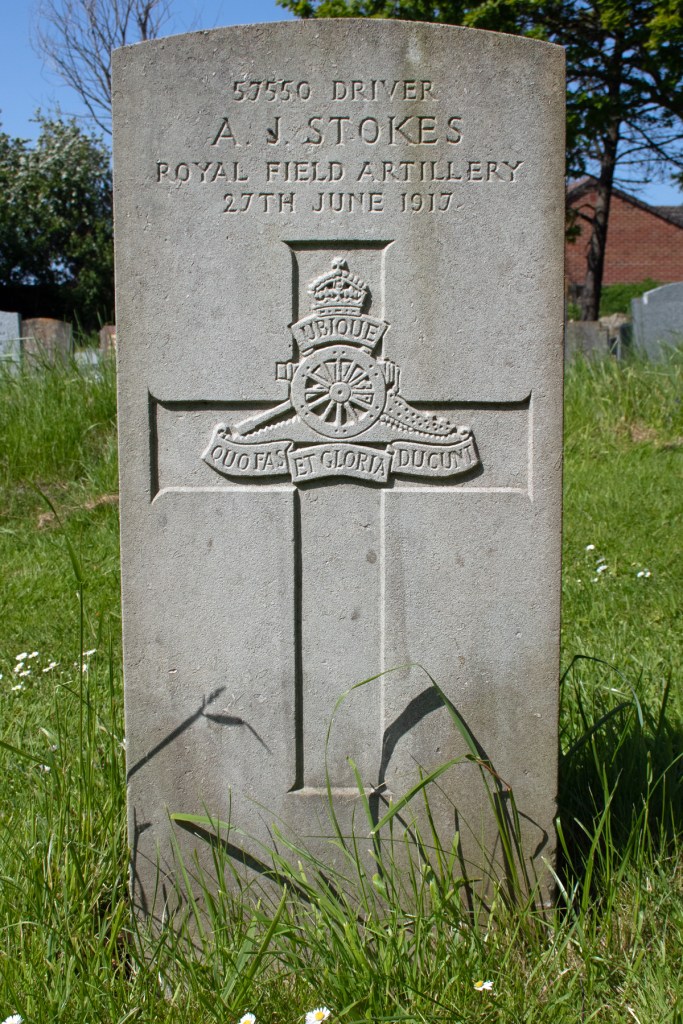
Albert returned to Somerset after leaving the Royal Field Artillery, although his trail does go cold. He was at home when he passed away on 27th June 1917, at the age of 39 years old. The cause of his passing is not recorded, but it is likely to have been as a result of a repeat of the conditions that had led to him leaving the military.
Albert John Stokes was laid to rest in the peaceful graveyard of St Michael’s Church in his home village of Puriton.
Frederick Chilcott was born in Bridgwater, Somerset, early in 1867. He was the fifth of thirteen children to labourer and kiln worker Henry Chilcott and his wife, Ellen.
When he finished his schooling, Frederick also found labouring work. He wanted bigger and better things, however, and the opportunity for a career in the army offered him just that. On 14th January 1888 he enlisted in the Royal Artillery. His service records confirm he was 5ft 6ins (1.68m) tall, and weighed 119lbs (54kg). He was noted as having dark brown hair, dark hazel eyes and a fresh complexion. He also had a scar on his forehead and a tattooed dot on his right forearm.
Frederick was initially given the rank of Driver and was assigned to the regiment’s 3rd Brigade Depot. He was sent to India in February 1889, and remained there until November the following year, when his troop returned to Britain.
Back on home soil Frederick’s role changed and he was given the rank of Gunner. On 1st January 1892, he was promoted to Acting Bombardier, but, on his own request, he reverted to his previous rank just three months later. On 15th January 1895, Gunner Chilcott was stood down to reserve status, having completed seven years’ service.
On 16th April 1895, Frederick married Eliza Stockham. She was a labourer’s daughter from the village of Puriton, to the north of Bridgwater, and it was here that the couple settled. Living in a small cottage, they went on to have six children between 1898 and 1911.
Frederick’s time in the army, however, wasn’t quite done. With the Second Boer War breaking out, he was recalled to the now Royal Field Artillery in January 1900. Sent to South Africa, Gunner Chilcott remained overseas for a year and was recognised for his commitment in the campaign.
Frederick returned to Britain on 3rd January 1901, and was finally stood down from the army in March that year, having fulfilled his twelve years’ contract. He returned home to Puriton, his service records noting that his character was ‘very good’.
The 1911 census found Frederick employed as a labourer in the local cement works. He and Eliza living in a small cottage in Puriton with four of the children (their oldest son was with Eliza’s parents, while she was pregnant with their youngest).
Conflict was knocking on England’s shore by this point, and when conflict broke out, Frederick appears to have stepped up to play his part once more. He was 47 years old when war was declared and, as such, would not have been required to enlist. Full details of his service are no longer available, but he had certainly joined the Army Veterinary Corps by the summer of 1917.
Private Chilcott is likely to have remained on home soil, but towards the end of his service was based in Curragh, County Kildare, Ireland. It was while here, on 23rd December 1917, that he suffered an aneurysm, passing away in the town’s military hospital as a result. He was 50 years of age.
Frederick Chilcott’s body was brought back to Somerset for burial. He was laid to rest in the quiet graveyard of St Michael’s Church in his home village, Puriton.
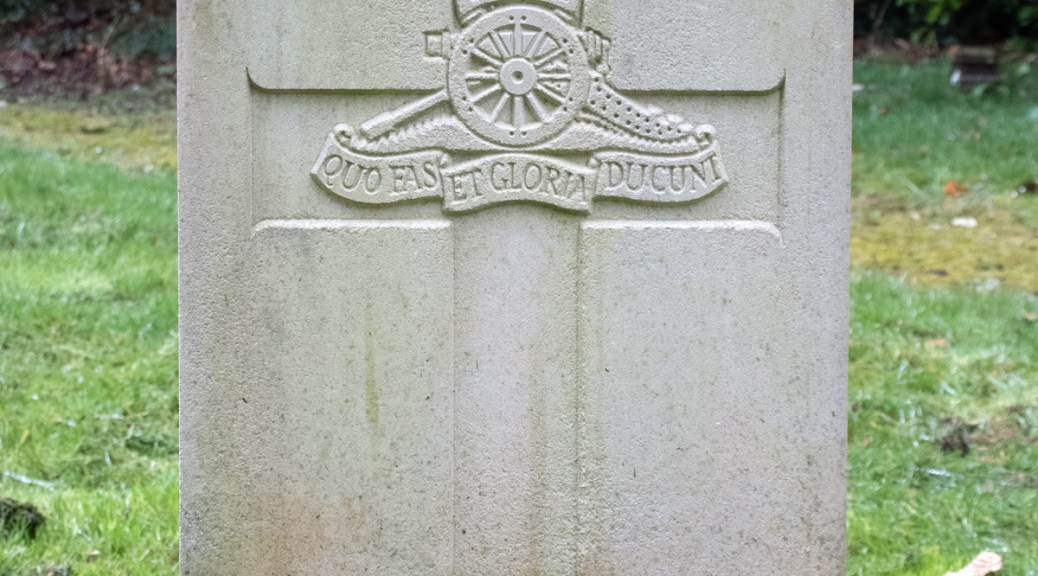
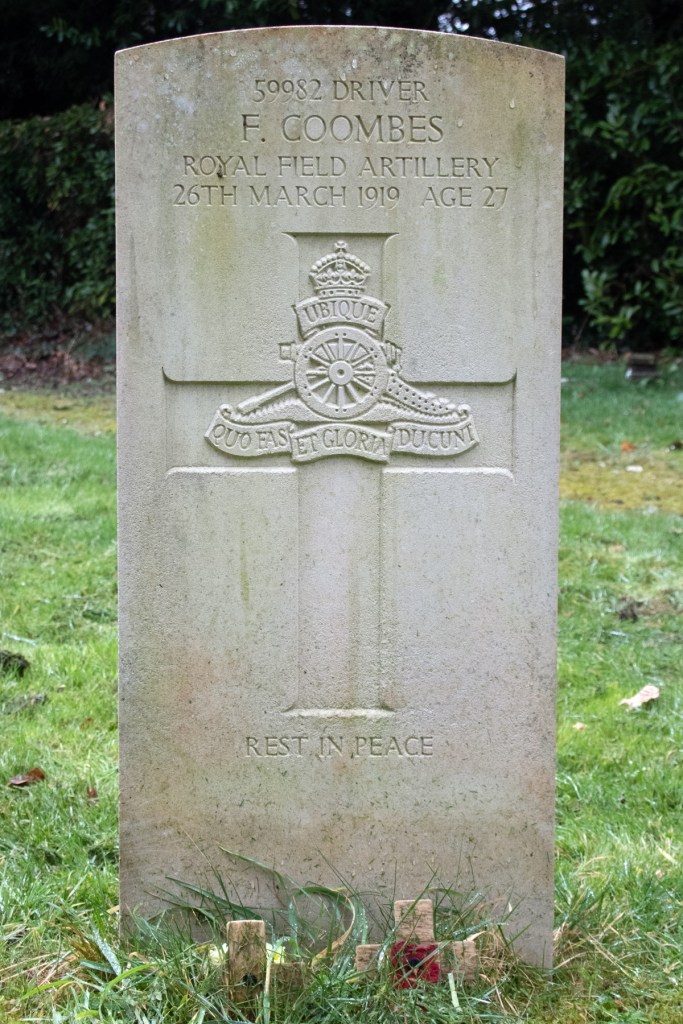
Frederick Walter Coombes was born in 5th July 1891 in Chard, Somerset. He was the oldest of eight children and his parents were mason’s labourer Walter Coombes and his wife, Sarah.
The family moved to nearby Crewkerne and, when he left school, Frederick found work as a weaver. He quickly realised, however, that he needed a career, and the the military could offer one. On 18th October 1909, he enlisted in the the Royal Field Artillery, signing up for three years with the regiment, followed by nine years on reserve.
Frederick’s service record confirms the man he had become. His medical examination gave his height as 5ft 6ins (1.68m) and his weight as 139lbs (63kg). He was noted as having brown hair, hazel eyes and a fresh complexion. He was also recorded as having a tattoo of a man’s head on the back of his right wrist and a small scar on his left hip.
After a year on home soil, Driver Coombes was sent to South Africa. He was to spend a little over two years in the country, the 1911 census recording him at the Roberts Heights Barracks in Transvaal, as part of the 98th Battery.
When his initial three year contract came to an end, Frederick was placed on reserve status and returned home. His trail goes cold for a couple of years, but when war was declared in 1914, he was immediately brought back into active service.
By the middle of August 1914, Driver Coombes was on the Western Front in France. Within a matter of weeks he was caught up in the Retreat from Mons, and was gassed in the process.
He soon recovered and, in December 1915 his troop was moved to Mesopotamia, modern-day Iraq. Within a month, Frederick fell ill again, having contracted malaria. He was treated at the base and, eventually remained in the Middle East for a year.
By December 1916 Frederick was on the move again, this time to India. His lungs had had a battering by this point, however, and he fell ill once more, this time having developed tuberculosis. Initially treated in India, by February 1917 he had been medically evacuated back to Britain. The condition was seen as unlikely to improve, and he was eventually discharged from the army as being no longer fit enough to serve.
Driver Coombes’ medical report confirmed that the condition was fully the result of his army service, and treatment at a sanatorium was recommended. His last day with the Royal Field Artillery was 7th May 1917: his career had lasted 7 years 202 days.
Again, Frederick’s trail goes cold at this point. It seems likely that he would have returned to Somerset and would possibly had been admitted to a medical facility for treatment and recuperation. The next record for him is that of his death, which happened at home on 26th March 1919. He was just 27 years of age.
Frederick Walter Coombes was laid to rest in Crewkerne’s Townsend Cemetery.
Albert Edward Taylor was born in the autumn of 1887 and was the fifth of eight children to John and Mary Taylor. John was a mason and both he and Mary came from Crewkerne, Somerset, which is where they raised their family.
Albert worked as an errand boy when he left school, but he sought a career and, enlisted in the Army Service Corps in July 1904. He lied about his age to join up, suggesting he was nearly 22, where he was actually just 17 years of age.
Driver Taylor’s service records confirm that he was 5ft 3ins (1.6m) tall and weighed 115lbs (52.2kg). He was noted as having brown hair, blue eyes and a fresh complexion. He had a mole between his shoulder and the back of his neck, and his religion was recorded as Baptist.
Albert’s contract was for two years’ service, followed by ten years in the Army Reserve. While a military career was what he sought, he seems to have had a disregard for rules, and regularly had run ins with authority, as his Regimental Defaulter Sheet testifies.
On 19th December 1904, while based in Woolwich, Surrey, he was absent without a pass from 6am until 12:15am on 30th December. He was confined to barracks for eight days.
The following year, Driver Taylor had moved to Bordon in Hampshire. On 28th November 1905, he was absent without a pass, from midnight until 8:30am on 1st December. He was again confined to barracks, this time for ten days.
A third offence came on 29th May 1906, by which time Albert had moved to Aldershot, Hampshire. He was found in neglect of duty ‘in allowing dirty pudding cloths to be deposited in the cupboards of the cookhouse’ and being ‘absent from work from 1:30pm till found in his barrack room at 9:20pm.’ For these, he was confined to barracks again, this time for eight days.
Within a matter of weeks, he was found in neglect of duty again, having broken out ‘of barracks after tattoo and remaining absent till apprehended by the Military Police at about 10:50pm’ and being ‘drunk and improperly dressed.’ This time the punishment was more severe and he was detained in prison for 96 hours.
Unsurprisingly, Albert’s military career didn’t go much further than this. When his two-year contract came to an end, he returned to Somerset and found employment as a mason.
In July 1910, Albert married Mabel Wallbridge, the daughter of a carman, also from Crewkerne. The couple set up home on the outskirts of the town, and went on to have a son, Frederick, who was born later that year.
The 1911 census found the young family living in a cottage in Lye Water, with Albert listing himself as a ‘mason (army pensioner)’. While the military reference may have been added with a sense of pride, irony or bloody mindedness, Albert was not to fully leave his army career behind. When war came to Europe in 1914, he was still within his reserve status, and was called up to play his part.
Private Taylor was to leave his family behind: son Frederick had now been joined by daughters Kathleen and Joyce, and Mabel pregnant with another daughter, Rosaline, who was born in January 1915. Albert was assigned to the 1st Battalion of the Somerset Light Infantry and, in contrast to his previous tenure on the Home Front, he soon found himself in the thick of things.
Albert’s regiment was involved in some of the fiercest opening skirmishes of the First World War, and he would have been caught up on the Battles of Le Cateau, the Marne, the Aisne and Armentières. By the spring of 1915, the battalion was entrenched at Ypres, and it was here during the Battle of St. Julien that Private Taylor was injured.
Albert has received a gun shot wound to the left side of his skull and was medically evacuated to Britain for treatment. He was admitted to the Beechfield House Hospital in Southampton, but his wounds proved too severe, and he passed away on 14th May 1915, at the age of 27 years old.
The funeral of Private Albert Edward Taylor, of the Somerset Light Infantry… who died from wounds received at the Front, took place with military honours at the Cemetery [in Crewkerne] on Tuesday afternoon, and attracted a large attendance. As a mark of respect to the memory of the deceased soldier blinds were drawn at the private and business houses en route to the Cemetery, while the flag erected outside the Victoria Hall for the children’s Empire-day celebration was lowered to half-mast.
Rev. J Street (Unitarian Minister)… spoke of the painful circumstances and the heroic conduct of the deceased, who had sacrificed his life for others. Although death was attended with pain and sorrow, yet in after years deceased’s children would look back with pride to the part their father took in the present war.
Taunton Courier and Western Advertiser: Wednesday 26th May 1915
Albert Edward Taylor was laid to rest in the cemetery of his home town, Crewkerne.
Private Albert Taylor (from findagrave.com)
Albert’s headstone gives his initials as AC Taylor. They should be AE Taylor.
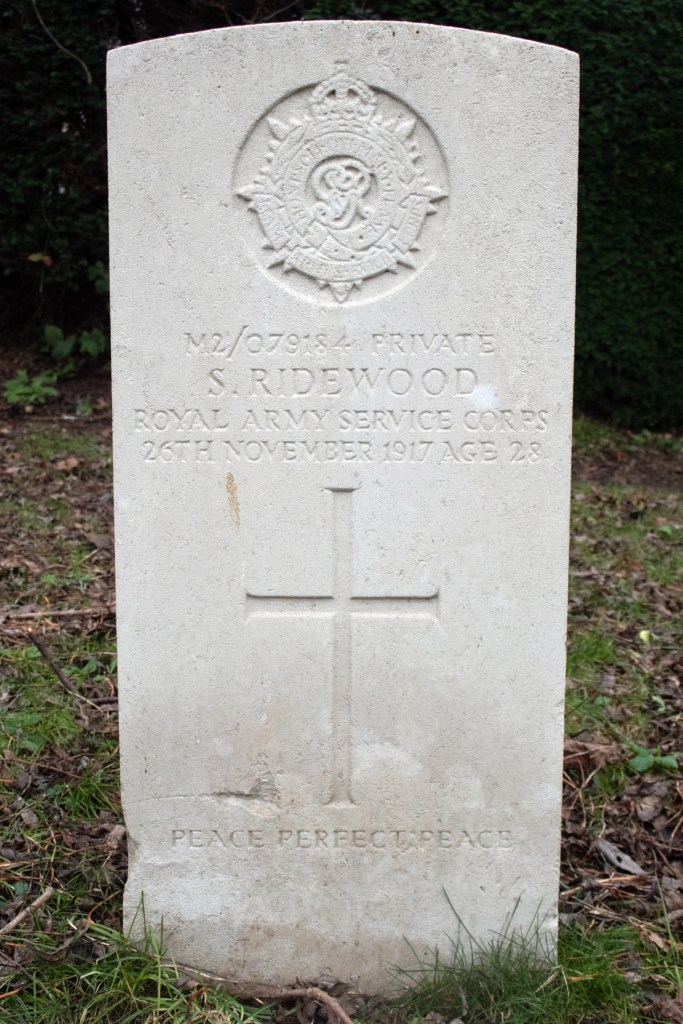
Sydney Ridewood was born in Bath, Somerset, on 31st March 1891, and was one of eleven children. His parents were labourer and sometime butcher James Ridewood and his wife Mary.
When Sydney left school, he found work as a baker, although this seems to have been as piecemeal a job as his father’s.
In January 1910, Sydney married Kathleen Scudamore. She was the daughter of a carpenter from the Twerton area of Bath and had a bit of a chequered background herself.
On 10th June 1896, Kathleen had married Edward Edwards, who was twelve years older than her seventeen years. Their marriage certificate suggested he was a clerk, although the 1901 census – which included their two children, Charles and Percy – recorded him as being a draper’s porter. Beyond that document, there is no record of Kathleen’s husband and, by the time of her marriage to Sydney, she had reverted to her maiden name.
By the time of the 1911 census Sydney and Kathleen were living in central Bath, with their nine-month old daughter, Olive, and Kathleen’s two sons. Kathleen’s widowed father, Edmund, her brother Claude and sister-in-law Nora were also in the household.
The document recorded Sydney as still employed as a journeyman baker, while his wife was a cook for the Post Office. Edmund was working as a carpenter, Claude was a sawyer, Nora a shop assistant and 14-year old Charles was a messenger boy, also for the Post Office. Six pay cheques coming in to support the extended family in the four-roomed house.
An additional member of the Ridewood family came along on 22nd October 1913, when Kathleen gave birth to a second child, Sydney Jr.
War was on the horizon by this point, and, on 20th April 1915, Sydney stepped up to play his part. He enlisted in the Royal Service Corps, and was assigned to the Mechanical Transport Corps. There is little detail about Private Ridewood’s service, although his records show that he was 5ft 3ins (1.6m) tall, with auburn hair, brown eyes and a fresh complexion.
Sydney was sent to France a month after enlisting, and his may role seems to have been that of a driver. He remained on the Western Front for a little over two years, before contracting pleurisy. He was initially treated in France, but soon returned to Britain to recuperate. The lung condition, however, was to get the better of him, and he passed away at home on 26th November 1917, weeks before he was to be medically discharged from service. He was just 28 years of age.
Sydney Ridewood was laid to rest in St James’ Cemetery, a few minutes’ walk from his family home.
Frederick Charles Harold Parsons was born in 1889, the older of two children to George and Ann Parsons. George was a general labourer from Drayton in Somerset, and this is where he and Ann raised their young family.
Ann’s mother, Elizabeth, was a constant presence in the family’s lives, moving in with them when her own husband, William, died. The 1911 census found a packed family home, with George, Ann, Frederick, Elizabeth, Ann’s widowed brother Joseph and her nephew Robert all living under the same roof.
Frederick – who was known by the nickname Chall – was working as a grocer’s assistant by this point, but when war broke out, he was quick to step up and serve his King and Country. He enlisted on 2nd September 1914, joining the Royal Field Artillery as a Driver. His service records note that he was 5ft 6ins (1.68m) tall and weighed 116lbs (52.6kg). He had dark hair, brown eyes and a dark complexion, and had a scar below his left eye.
For the first ten months of Driver Parsons’ service, he remained on home soil. He was finally sent to France in the summer of 1915 and spent nearly two-and-a-half years overseas. Towards the end of that time, he began to have issues with his kidneys, and was posted back to the UK for treatment.
Initially admitted to Milton Hospital in Portsmouth, Chall was then moved to the VAD Hospital in Ryde on the Isle of Wight. He was initially diagnosed as having kidney stones, but was subsequently found to have enlarged kidneys. He was placed on furlough in May 1918, before being medically discharged from service at the end of August.
At this point, Chall’s trail goes cold. He appears to have returned home to Drayton, as it was in nearby Langport that his death was subsequently registered. He died on 11th December 1918, at the age of just 29 years old.
Frederick Charles Parsons was laid to rest in the family plot in St Catherine’s Churchyard, Drayton.
Much of Matthew Alexander MacRae’s life is destined to remain a mystery. He was born in Scotland in 1892, and was the second of three children to Thomas and Christiana MacRae. The family had moved to Birmingham – where Thomas had found work as a garment dyer – by the time of the 1901 census.
When war came to Europe, Matthew enlisted in the Royal Engineers. Nothing of his service records survives, but it is clear that he had joined as a Driver by the summer of 1918.
The next evidence for Driver MacRae is that of his passing, on 18th February 1919, at the age of 27 years. No cause of death is evident, although there is nothing in contemporary newspapers to suggest anything other than natural causes.
Two documents add a little more mystery to Matthew’s legacy. The Army Register of Soldiers’ Effects notes his father, Thomas, as the beneficiary of his estate. The Dependents’ Pension, however, suggests that an Emily MacRae, was to be provided with support. This was not Matthew’s sister, and Emily’s address – Cross Street in Bath, not far from where Driver MacRae was buried – would suggest that she was his widow, although there are no marriage records to corroborate this.
Matthew Alexander MacRae was laid to rest in the Roman Catholic Cemetery in Bath, Somerset.
Theophilus Walter Burdock was born on 18th June 1871 in Whitminster, Gloucestershire. One of nine children, his parents were painter and decorator Nathaniel Burdock and his wife, Mary.
While he found labouring work when he left school, Theophilus – who went by his middle name, Walter – decided that he wanted bigger and better things and, on 30th December 1889, he enlisted in the Royal Artillery. His service records show that he was 5ft 5ins (1.65m) tall and weighed 115lbs (52kg). The document also records that he has a tattoo of a man, star and crown on his left forearm.
Initially assigned to the 1st Depot 2nd Battery as a Driver, over the next couple of years Walter made solid progress within the regiment. By September 1892, he was promoted to Gunner, within a couple of years he was raised to Bombardier, and by April 1895 he had made the rank of Corporal.
By his last formal year in the ranks, things seemed to take a different turn. On 9th March 1896, Corporal Burdock received a contusion to his face. He was formally transferred to the Army Reserve when his contract of service ended in December 1896, but within eighteen months he re-enlisted.
At this point, however, Corporal Burdock’s conduct began to race downhill. In August 1898 he was tried for an undisclosed reason, and his rank was reduced to Bombardier. Within a couple of months, he was tried for a second crime, and reduced in rank again, back to Gunner.
For a time Walter kept his nose clean, and, in February 1900, he was promoted back to the rank of Bombardier. This was to be only a fleeting move, however, as he reverted back to Gunner less than two months later.
Over the next couple of years, Walter generally kept his head down. On 30th April 1901 he was injured by a kick in the eye, although, again, details are tantalisingly scarce. By April 1902, his contract came to an end and this time he was stood down and formally demobbed.
Civilian life seemed to be something to which Walter was not to be destined. He enlisted again almost immediately, joining the Imperial Yeomanry in May 1902. He lasted less than a year with the regiment, however, having served ten months in South Africa.
In January 1904, was recalled to the Royal Artillery for further service in South Africa. His medical report showed the man he had become in the fifteen years since he had first joined up: he was now 5ft 7ins (1.7m) tall, and weighed 141lbs (64kg).
Private Burdock served six months on home soil, but in July 1904, he was sent to South Africa, having never actually seen any overseas service before. He returned to Britain in September 1905, and was discharged from service, specifically so that he could re-enlist with the Royal Artillery and complete his fourteen years’ service with them.
Gunner Burdock remained with the Royal Artillery until February 1906, presumably as he had finished his fourteen years. Interestingly, his discharge papers noted his conduct as ‘indifferent’.
Walter’s trail goes at this point. His mother, Annie, passed away in Gloucestershire in the spring of 1908. His father, Nathaniel, died Bristol in 1912. The next evidence for their son comes in September 1914, in attestation papers for the Canadian Expeditionary Force.
Walter was, by this point, living in Victoria, British Colombia, and working as a lumberjack. He had been unable to completely leave his army days behind him, and his service records give his year of birth as 1876, five years younger than he actually was at the time.
Those service records give similar physical characteristics to his 1904 papers, and confirm the presence of some additional tattoos: a butterfly and pair of hands with the words true love.
Walter was assigned to the Royal Canadian Horse Artillery, and given the rank of Gunner. He arrived back in Britain in October 1914, but his previous indifference seems to have recurred. He was imprisoned for a week from 21st October for having been absent without leave, and was found to be absent again at reveille on the morning of 30th October.
Yesterday afternoon the body of a man was found floating in the Avon just below Bathampton Weirs, and close to the entrance to the back-water on the Batheaston side of the river.
The body was floating face downwards some yards from the bank, and only the top of the head was visible.
The body was recovered shortly before five o’clock. It appeared to be that of a middle-aged man of medium height. The trousers had something of the appearance of a mechanic’s overall and deceased was wearing a sleeve vest.
The conjecture naturally arises whether the body is that of the missing Canadian soldier Burdock, whose clothes were discovered on the bank at Batheaston on Saturday, October 31st, and of whom nothing has been heard since. Burdock was a member of the Canadian contingent now in training on Salisbury Plain. It is known that the missing soldier had several tattoo marks on his arms… so the question will not long remain in doubt when the body has been brought to the bank.
Bath Chronicle and Weekly Gazette: Saturday 14th November 1914
The body did indeed turn out to be that of Gunner Burdock. An inquest reached a verdict of suicide while temporarily insane. He was 43 years of age.
Theophilus Walter Burdock was laid to rest in the graveyard of St John the Baptist Church in Batheaston. Interestingly, while his next of kin was identified as his brother Frederick Burdock, Walter’s service records add a further dimension to his passing:
A maple tree has since been planted at the head of the grave by Miss Henderson, The Hill, Batheaston, who took a great interest in the case. Miss Henderson also sent a beautiful wreath when deceased was buried.
George Edward Brown was born on 26th June 1898 in South Petherton, Somerset. An only child, his parents were Escourt and Alice Brown. Originally a millstone dresser, by the time of the 1911 census, Escourt had turned his hand to farm work, while Alice made shirts and did housekeeping to bring in a little more money for the family.
George was only 16 years old when war broke out, but he was keen to play his part as soon as he was able to. In the spring of 1917, he enlisted in the Royal Field Artillery, and was assigned to the 105th Company.
Little information remains of Gunner Brown’s military service, but it is evident that he did his training in Norfolk. While here, he came down with appendicitis, and was admitted to the Norfolk War Hospital in Norwich. He was operated on, but sadly died following the procedure. He passed away on 29th June 1917, having just turned 19 years of age.
George Edward Brown’s body was brought back to Somerset for burial. He was laid to rest in the family grave in South Petherton Cemetery. He was reunited with his parents, when they passed away, Escourt in 1924 and Alice some time later.