Tag Archives: Egypt

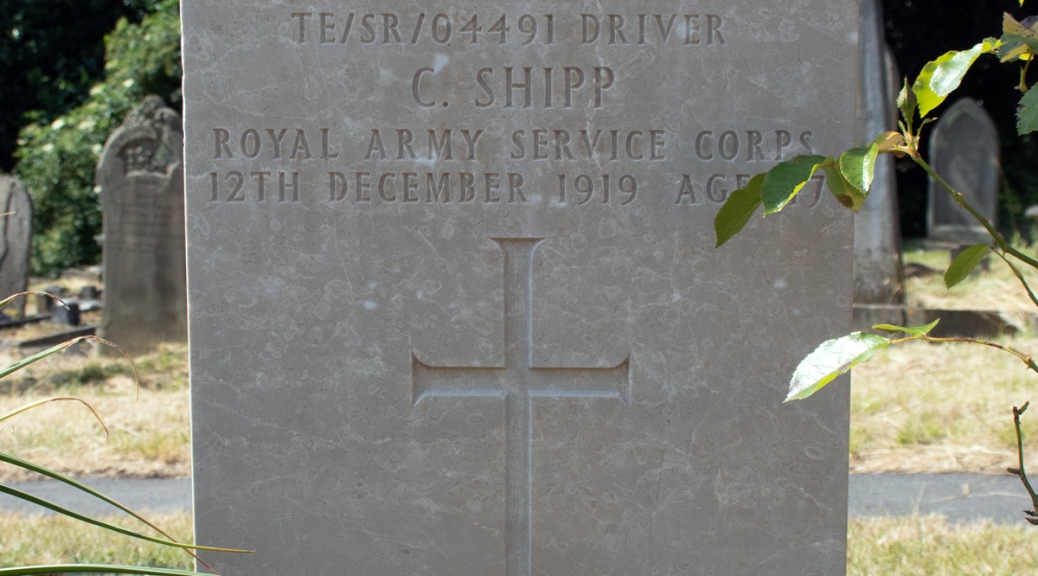
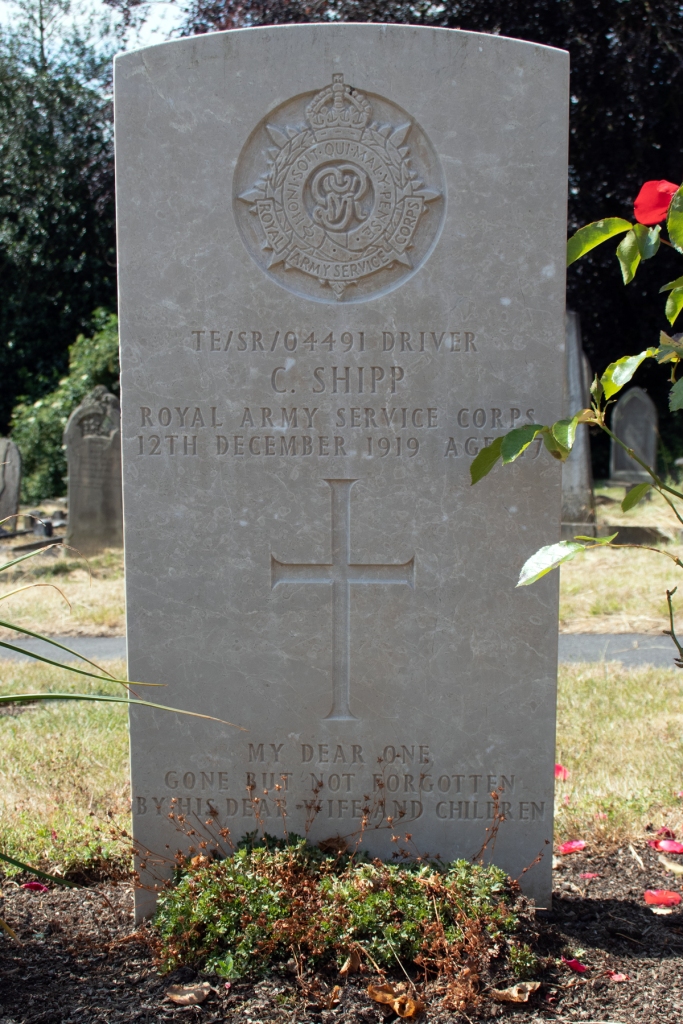
Driver Charles Shipp

Driver Charles Shipp

The early life of Charles Shipp is a challenge to unpick. Born Charles Morgan in Bath, Somerset, in 1872, his father was also called Charles. He found work as a labourer when he finished school.

Charles sought a life of adventure, however, and on 7th January 1890, he enlisted in the army, joining the South Wales Borderers. Private Morgan’s service records show that he was 5ft 5.5ins (1.66m) tall and weighed 116lbs (52.6kg). He had brown hair, grey eyes and a fresh complexion, with tattoos of crossed flags, a crown and VR on his left forearm.

Private Morgan spent three years on home soil, and is recorded as being based in North Camp Barracks in Farnborough, Hampshire, in the 1891 census. His battalion was sent to Egypt in December 1892 and spent the next three years overseas, moving to Gibraltar in the spring of 1895. The only details available for his time abroad relate to a couple of hospital admissions – for a fever in Cairo in August 1894, and for gonorrhoea in Gibraltar in the autumn of 1895. He returned to Britain at the end of November that year.

Charles appears to have been based in South Wales when he returned home and, on 20th December 1896, he married Lottie Walters in Llandough Parish Church. Interestingly, while the new bride’s father’s details are recorded – naval pensioner James Walters – Charles’ have been intentionally left blank. This is also the first document on which his surname is recorded as Shipp, so there seems to have been a deliberate distancing from his family at this point.

Charles was still committed to his military career. He served on home soil until January 1897, when he was placed on reserve, having completed seven years’ service. This respite was not to be for long, however, as he was recalled on three years later, and sent to South Africa, to fight in the Second Boer War.

Private Shipp, as he was now known, served in South Africa for more than two years, and was awarded the Johannesburg, Cape Colony, 1901 and 1902 clasps. In August 1902, he returned to Britain, and was formally stood down from army service.

Charles and Lottie moved to Bath, and set up home in a small cottage in Locksbrook Road. They went on to have seven children, all of them girls and, by the time of the 1911 census, Charles was working as a carter for the local gas works. His heart seems always to have been with his military career, however, and, when war broke out in 1915, he saw this as an opportunity to play his part once more.

On 25th October 1915, Charles enlisted in the Royal Army Service Corps as a Driver. His was not to be a war fought on home turf, and within a month, he was in the Mediterranean, potentially back in Egypt again. In April 1916, his battalion moved to Salonika, and he spent the next three years in Northern Greece.

Charles contracted malaria in the autumn of 1917, and this resulted in a hospital admission for just over two months. He returned to his unit, but spent another couple of months in a Macedonian hospital the following year when the condition recurred.

Driver Shipp survived the war, and returned to Britain in April 1919. His health was again suffering, and he was formally discharged from the army on medical grounds on 29th April.

At this point, Charles’ trail goes cold. He returned home to Lottie and their daughters, but there is nothing to account for the the last eight months of his life. He passed away on 12th December 1919, at the age of 47 years of age.

Charles Shipp was laid to rest in Bath’s majestic Locksbrook Cemetery, not far from where his family lived.


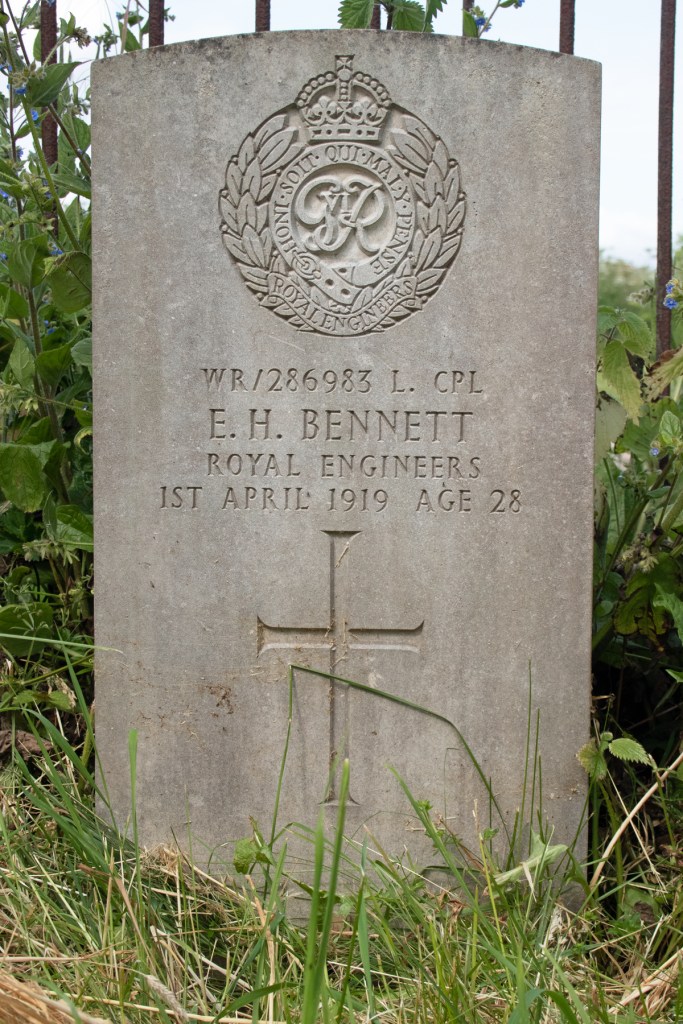
Lance Corporal Ernest Bennett

Lance Corporal Ernest Bennett

Ernest Harry Bennett was born in the summer of 1890, he third of ten children to Harry and Caroline – or Carrie – Bennett. Harry was a journeyman mason from the Devon village of Chagford, and this is where the Bennett family were raised.

When he finished his education, Ernest found work as a general labourer, and it this work that likely took him across the border to Somerset. He found work as a platelayer for the Great Western Railway in Taunton, and settled in Rowbarton, to the north west of the town.

On 28th September 1912, Ernest married Gertrude Alice Bennett in her local parish church, St George’s in Ruishton. A few months later, the couple had a son, Frederick, and almost exactly two years later, a daughter, Gladys, was born.

By this point, war was raging across Europe, and in July 1915, Ernest received the notice to enlist. Assigned to the Royal Engineers, he was attached to the 53rd Railway Company, probably to make use of his civilian trade. By the end of 1915, Ernest found himself in Egypt, and remained there for the rest of the war.

In July 1918, the now Lance Corporal Bennett was posted to the Railway Operating Division, but continued his service in North Africa. On 8th March 1919, he sailed from Port Said, heading back to Britain to be demobbed.

Returning to Somerset, Ernest fell ill, contracting pneumonia, probably on the journey home. He was admitted to the Taunton Military Hospital, but passed away from the condition just ten days after reaching England’s shores, on 1st April 1919. He was just 28 years of age.

The body of Ernest Harry Bennett was laid to rest in the graveyard extension to St George’s Church in Ruishton, not far from where his widow and children lived.


Major Montgomerie Boyle

Major Montgomerie Boyle

Montgomerie Boyle was born on 20th March 1859 in Hendon, London. The youngest of three children, his parents were John and Jane Boyle. John was a barrister, and the family lived in some comfort – the 1861 census found them living in a house in Harrow, Middlesex, with four live-in servants and a groom.

[Montgomerie] joined the South Notts Yeomanry 22 years ago. Subsequently he obtained an appointment at Weston-super-Mare, under the Somerset Territorial Force Association, and did much useful work in co-ordinating the Army Service Corps in the county.

Taunton Courier and Western Advertiser: Wednesday 2nd April 1919

In the spring of 1891, Montgomerie married Constance Smith. She was a banker’s daughter from Nottingham, and the couple tied the knot in Basford, now a suburb of the larger city. They went on to have a daughter, Marion, who was born the following year.

By the 1901 census, the young family had moved to Timsbury, Somerset. Montgomerie was recorded as living on his own means, and the family had a retinue of servants to support them. A decade later, they had moved into the manor house in Staple Fitzpaine, Somerset. Montgomerie was now listed as a Captain in the Army Service Corps.

Storm clouds were gathering over the continent and, when war broke out, Captain Boyle was called back into active service.

…he was stationed with his Regiment on the East Coast for twelve months, and then went to France, where he remained for six months. He was re-called for service with the Mechanical Transport Section of the Army Service Corps in German East Africa, contracted malaria at the end of fifteen months and was invalided home. On his recovery he was despatched to the Egyptian front, and was with the British troops in Jerusalem. He became ill while there, and, on going down to the base at Cairo, was for a month in the Citadel Hospital, where he was treated for a malignant disease. By slow stages, first in a hospital ship, then in a Red Cross train through France, he was conveyed to [Le] Havre. Here, curiously enough, the doctor in charge of the hospital ship upon which he was placed happened to be… an old friend and medical attendant. Major Boyle landed at Southampton, and went immediately to the 3rd London General Hospital at Wandsworth [Surrey], where he was examined by an eminent specialist. His condition was serious but on Monday week last he arrived at his old home, where, despite the devoted care of his wife and daughter, he passed away quietly.

Taunton Courier and Western Advertiser: Wednesday 2nd April 1919

Major Montgomerie Boyle passed away on 27th March 1919, a week after his sixtieth birthday. He was laid to rest in the quiet graveyard of St Peter’s Church, on the outskirts of the grounds of the manor house the Boyles had made their home ten years before.

When Constance died ten years later, at the age of 70 years old, she was laid to rest in the family plot, reunited with her late husband once more.


Major Montgomerie Boyle
(from findagrave.com)

Private William Solomon

Private William Solomon

William John Solomon was born on 26th June 1891 in the Somerset village of Huntspill. One of nine children, his parents were mason and bricklayer Roland Solomon and his wife, Annie.

When he finished his schooling, William found work as a farm labourer, but, sadly, there is little else documented about his life. When war broke out, he enlisted in the Somerset Light Infantry. Details are unclear, but he served with the 8th Battalion on the Western Front and the 1st/5th Battalion in Egypt.

By 1918, William was back on home soil, but had fallen ill. His condition is not confirmed, but he passed away from it on 16th October 1918, at the age of 27 years old.

William John Solomon was laid to rest in the peaceful graveyard of St Peter’s in his home village.


Corporal John Parker

Corporal John Parker

John Burge Parker was born in the spring of 1887, the second of eight children to George and Ann Parker. The family were raised in Huntspill, Somerset, where George was employed as a labourer in the local railway works.

When he finished his schooling, John found work on a farm and this is how he was employed when, on 30th April 1907, he married Alice Jane Grove in the parish church in Pawlett. The sleepiness of the area is underlined by the fact that this was both the only wedding to take part in the church that year, and for more than a year. John and Alice went on to have three children, Audrey, who was born in 1907, Elsie, who came along two years later, and Clifford, born in 1915.

With a growing family to support, John sought out more of a career. Indeed, by the time of the 1911 census, he was employed as a police constable, and the Parkers had moved to Bristol. When war came to Europe, however, John stepped up to play his part.

John enlisted on 17th November 1915, joining the Railway Troops Depot of the Royal Engineers. His service records show the kind of figure he must have cut in the police, and he was noted as being 6ft 1in (1.85m) tall, weighing 176lbs (79.8kg). Initially give the rank of Private, he was promoted to Lance Corporal in May 1916, just four months after being officially mobilised.

In October 1916, Lance Corporal Parker’s troop set sail from Southampton, their final destination being Alexandria in Egypt. He spent more than two years in North Africa, wand was promoted to full Corporal during this time.

John returned to Britain early in 1919. In February, John was visiting his brother in Highbridge, Somerset, and, on the evening of the 6th, he left to visit his father in Huntspill. He set off to Highbridge Station first, with the intention of checking the train times to return to Bristol, but that was the last time he was seen alive.

A painful sensation was created in Highbridge and neighbourhood… when it became known than on the previous evening.. the mutilated body of a soldier was found on the Great Western Railway metals, about a quarter of a mile below the Highbridge Station… The body was subsequently identified as that of John Parker… a corporal in the Royal Engineers, whose home it at Bristol and who leaves a wife and three children.

Central Somerset Gazette: Friday 14th February 1919

Nothing untoward was confirmed in the accident that killed John on the night of the 6th February 1919, and at the inquest the jury reached the conclusion that he had died through a tragic accident. He was 32 years of age.

The newspaper report gave more insight into the character of Corporal Parker: “He was a splendid specimen of manhood, standing over 6ft, and of proportionately fine physique… [He] was of a most genial temperament [and] was held in the highest respect both in the Highbridge district and at Bristol.”

The body of John Burge Parker was laid to rest in the quiet graveyard of St Peter’s Church in his home village of Huntspill.


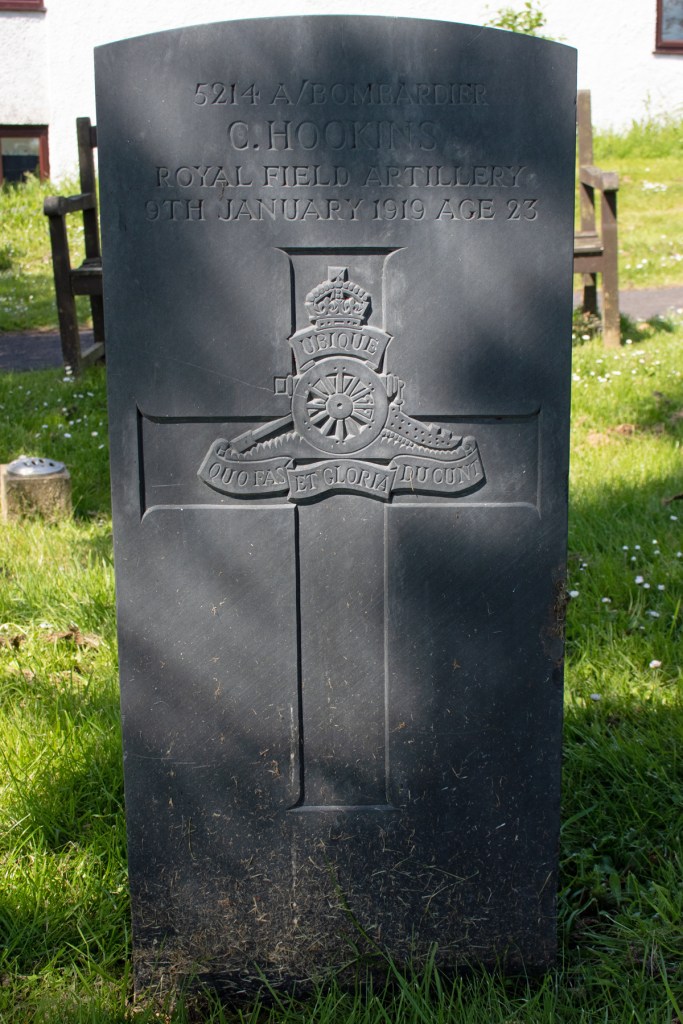
Bombardier Charles Hookins

Bombardier Charles Hookins

Charles Hookins was born on 15th October 1895 in Pawlett, Somerset. The eighth of nine children, his parents were William and Susan Hookins. William was a labourer in a brickyard, but when he finished his schooling, Charles went to work on his cousin’s farm in neighbouring Huntspill.

Farming was not what Charles had in his mind as a career, however, and on 7th April 1913, he joined the Great Western Railway. Initially employed as an engine cleaner, he was sent to work at the Duffryn Yard, South Wales. He soon moved on again, however, and by October 1913, he was living in Tondu, to the north of Bridgend, where he worked as an engine fireman.

War came to Europe in 1914, and, within weeks of hostilities being declared, Charles volunteered for service. He enlisted on 1st September 1914 in Bridgend, joining the Royal Field Artillery. His service records confirm that he was 19 years of age, stood 5ft 7.5ins (1.71m) tall, and weighed 135lbs (61.2kg). He was noted as having brown eyes, brown hair and a fresh complexion.

Gunner Hookins spent most of the next year on home soil training and became attached to the 57th Brigade. On 2nd August 1915 he set off for the Mediterranean, his troop unusually making their way across mainland France, rather than sailing around Spain and Portugal. They left European shores from Marseille on 7th August, and arrived at Suvla Bay on the Gallipoli peninsula just nine days later.

The 57th Brigade remained at Gallipoli for the next five months, and during this time, in November 1915, the now Acting Bombardier Hookins spent a week in the local field ambulance, through causes unknown.

Charles’ health seemed to be suffering by this point. On 17th January 1916, he was moved to Alexandria, Egypt, where he spent another week admitted to a field hospital. After a couple of months’ grace, he was transferred back to France, again disembarking at Marseille. After another week’s admission to hospital, he was invalided back to England, eventually arriving back home at the end of April.

Acting Bombardier Hookins had contracted pulmonary tuberculosis, and the risk to others, as well as his own health, led to him being discharged from military service on 15th July 1916, having served for just under two years.

Charles’ trail goes cold at this point. He returned home, but his medical condition was ultimately to get the better of him. He passed away on 9th January 1919, at the age of just 23 years old.

Charles Hookins was laid to rest in the quiet graveyard of St John the Baptist Church in his home village of Pawlett, Somerset.


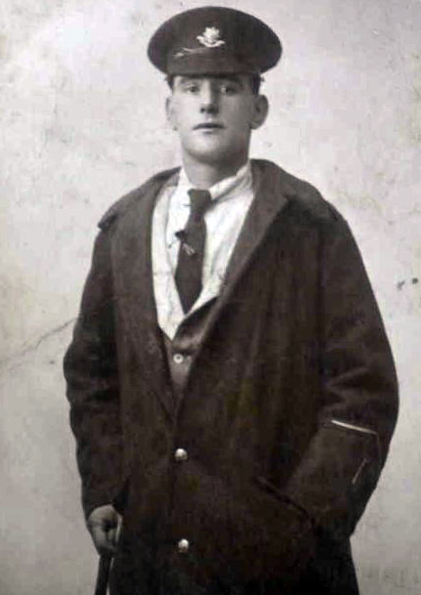
Bombardier Charles Hookins
(from ancestry.co.uk)

Lance Corporal Alfred Sowden

Lance Corporal Alfred Sowden

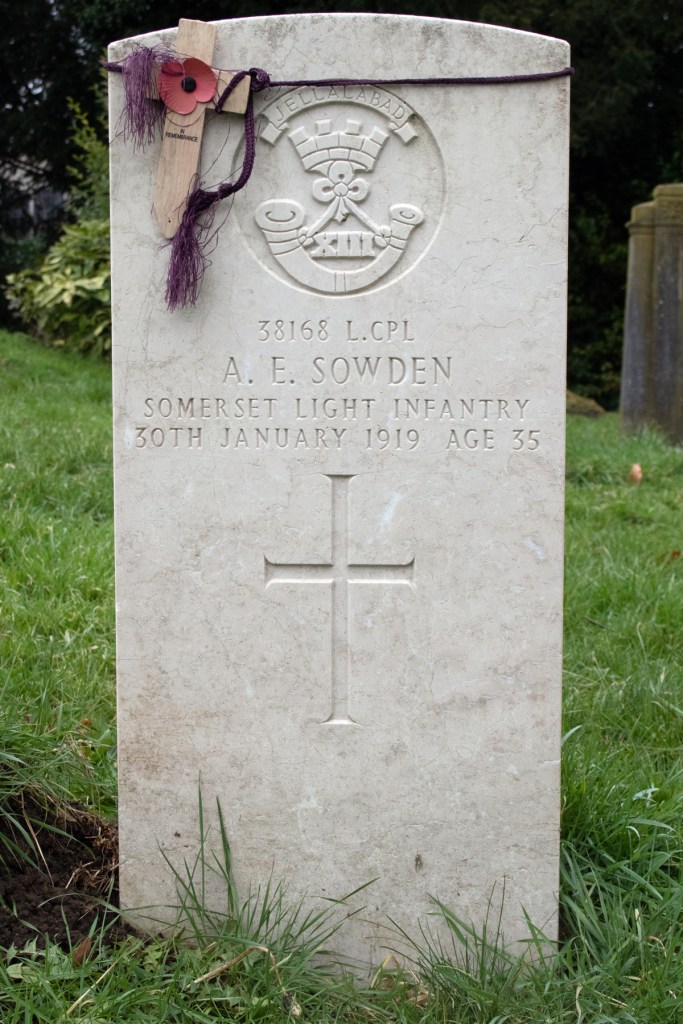
Alfred Edward Sowden was born in the autumn of 1883, in Bath, Somerset. He was the youngest of seven children to Robert and Mary Sowden. Robert had died by the time of the 1891 census, and Mary turned to charring to bring in money for the family.

In the summer of 1904, Alfred married Harriet Sumsion, a baker’s daughter also from Bath. The couple set up home in a small cottage on the main road to Bristol, and had a son, William, who was born the following year. Alfred was working as a house painter by this point, and the young family had a lodger, William Gabb, who was a local chef.

When war came to Britain’s shores, Alfred stepped up to play his part. He may have had some previous military experience, because he joined the Somerset Light Infantry as a Lance Corporal. Assigned to the 2nd/4th Battalion, by August 1915, he was on his way to India. His troop remained there for two years, before moving to Egypt in the autumn of 1917, then on to France the following June.

With the end of the conflict, the Empire’s forces were slowly demobbed. While he was waiting to be stood down, Lance Corporal Sowden fell ill. He developed influenza and septic pneumonia, and the combination was to prove fatal. He passed away on 30th January 1919, at the age of 35 years old.

Alfred Edward Sowden’s body was brought back to Bath for burial, where he was laid to rest in the city’s St James’ Cemetery.


Alfred’s widow had had a tragic few years. Her father, Walter, had passed away in February 1916, and her mother died just three months after Alfred.

Harriet never remarried after her husband’s passing. She remained in the family home for the rest of her life and, by the time of the 1939 Register, had a boarder, billiard marker James Jones. She was close to family, however, as her brother William lived just three doors away.

Harriet died in September 1941 at the age of just 56. She was laid to rest near her husband, reunited after 22 years.


Serjeant Major Frederick Pearce

Serjeant Major Frederick Pearce

Frederick Charles Pearce was born in the spring of 1873 in the Gloucestershire town of Thornbury. The youngest of six children, his parents were Thomas and Elizabeth Pearce. Thomas was an agricultural labourer and, when he finished school, Frederick found work as a ‘rural messenger’.

This was only a step towards the career that Frederick sought, however, and on 12th July 1892, he enlisted in the Gloucestershire Regiment a a Private. His service records show that he was 5ft 5ins (1.65m) tall and weighed 128lbs (58kg). He was noted as having a fresh complexion, blue eyes and brown hair.

Private Pearce spent twelve years in the army, serving in Malta, Egypt, India and Ceylon (Sri Lanka). He had two stints in South Africa, including the 1899-1900 campaign, during which he was wounded in his chest in the battle at Farquhar’s Farm.

By the time he was discharged on 11th July 1904, he had risen through the ranks to Sergeant, his service records noting that his conduct had been “very good” (in capitals and underlined).

Thomas had died in 1896, and Frederick’s widowed brother William moved back in with his mother to help support her. Frederick also returned to Gloucestershire and, on 30th March 1905, he married Mary Rugman in the parish church in Olveston. The couple may have been childhood sweethearts, as the Pearces and Rugmans were Thornbury neighbours.

The marriage certificate noted Frederick as a groom, and it is likely that he was able to turn his hand to any role after his army career. The couple had a son Leslie, who was born in 1909, and, with the new responsibility of fatherhood, Frederick sought a more permanent career.

The 1911 census found the family living in Somerset, where Frederick was employed as a gardener at the Kingswood Reformatory School. This was a boarding school on an estate to the north of Bath, set in 57 acres of grounds, and again it seems likely that his military career stood him in good stead for such a prestigious role.

When war came to Europe, Frederick felt the pull of his military career once more. While his age did not compel it, on 20th November 1914, he re-enlisted in the Gloucester Regiment. He was enlisted with his previous rank, but within a year has been promoted to Acting Colour Sergeant.

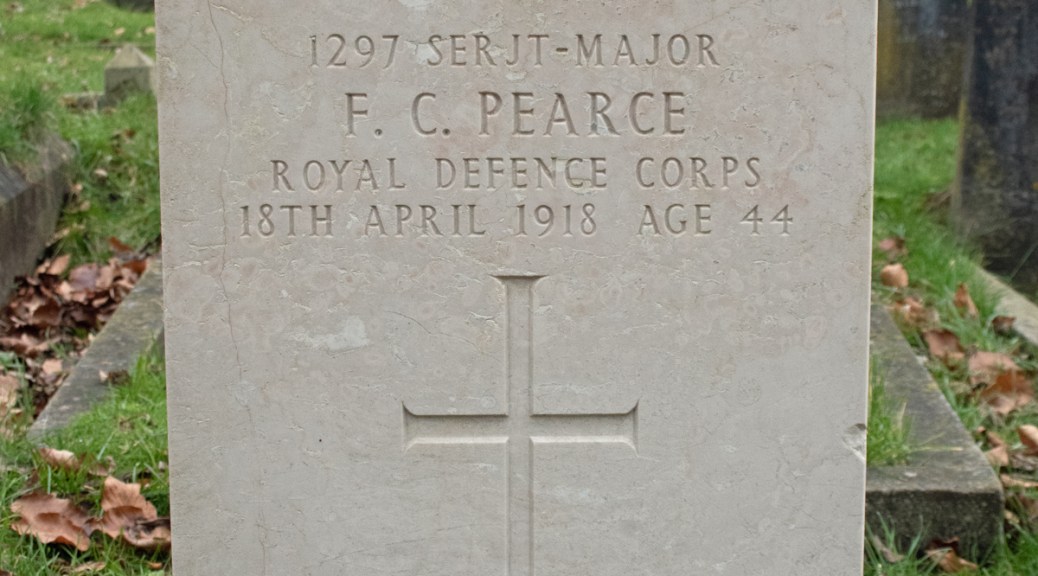
In the spring of 1916, the Royal Defence Corps was formed, and, given his experience and age, Frederick was transferred across to the new regiment. Colour Sergeant Pearce was based in London and, over the next eighteen months served in four troops: 109, 149 and 150 Protection Companies and the 10th City of London Volunteers’ Regiment.

Frederick’s age and the demands of his role were beginning to take their toll by this point, and by the end of 1917, he had developed nephritis, or inflamed kidneys. The condition was severe enough to warrant his discharge from service, and the now Sergeant Major Pearce’s military career came to an end on 17th January 1918.

Frederick returned home to Bath, to the bosom of his family. He and Mary three children by this point, Violet and Freddie being two younger siblings to Leslie. Tragically for the Pearces, however, the family life was not to to last for long: Frederick’s condition was to get the better of him just three months later. He passed away on 18th April 1918, at the age of 44 years old.

Frederick Charles Pearce was laid to rest in St James’ Cemetery in Bath; a man of duty resting at last.


Tragedy was to strike again for poor Mary, when just six months later her youngest child, Freddie, also passed away. Details of his death are vague, but he was buried with his father, the two Fredericks reunited too soon.


Able Seaman William Green

Able Seaman William Green

William Charles Green was born on 27th December 1897, one of five children – and the only son – to William and Mary Green. The family’s backstory is a bit hard to decipher.

William Sr was born in the Bath Union Workhouse in 1869 and the only details of his parentage comes in his marriage certificate, which suggests that his father was also called William Green, who was deceased. The same document records the groom as being a miner, and that he and Mary were living in Widcombe, Bath.

The Greens do not appear on the 1901 census – or at least that census record for them is lost to time. The next census return, in 1911, does have the family recorded as living in three room in St George’s Place, Widcombe. This particular census was the first to put the onus on the resident to complete the form, and, in William Green Sr’s case, this has led to a handful of anomalies in the record.

William Sr notes his trade as “going out with commercial travellers and hotel work also”. He confirms that he was “Somerset-born”, but suggests that Mary was born in “South Wells” (a spelling error, which should be South Wales), even though her birth and marriage certificate confirm she came from Bath.

The Greens certainly spent some time in Wales – their eldest daughter was born in Merthyr Tydfil, while William Sr was working as a miner there. By the time of William Jr’s birth, however, the family seem to have returned to England – he is recorded as coming from Bath.

William was 13 years old at the time of the 1911 census, and still at school. When he left education, he found work at a fishmonger, but with war closing in on Europe by this point, he was keen to serve his King and Country.

On 7th May 1915, William enlisted in the Royal Navy and, as he was just under age, he was given the rank of Boy 2nd Class. His service records note that he was 5ft 1in (1.55m) tall, with brown hair, blue eyes and a fresh complexion. Intriguingly the records give the place of his birth as Aberdare, Glamorganshire, but whether it is this document or the 1911 census that is incorrect is impossible to confirm.

Boy Green was initially sent to HMS Impregnable, the training establishment based in Devonport, Devon. He spent four months there and, on the day he was promoted to Boy 1st Class, he was assigned to HMS Defiance, the navy’s Torpedo School, off the Plymouth coast. In October 1915 he was assigned to HMS Fox, and remained on board for the next three years.

Fox was a cruiser that patrolled the seas from the East Indies to Egypt and the Red Sea. While on board, William came of age, and was formally enrolled in the Royal Navy as an Ordinary Seaman. With a character that was classed very good, even if his ability was noted as satisfactory, within eighteen months he was promoted again, to Able Seaman.

In August 1918, William was assigned to HMS Mantis, a river gunboat that patrolled the Tigris around Baghdad. He remained on board until the end of the year, when he was assigned to HMS Vivid, the Royal Naval Dockyard in Plymouth.

Over the next fifteen months, Able Seaman Green’s time was split between Plymouth and HMS Columbine, the naval base at Port Edgar on the Firth of Forth. It was when he was back in Devon, early in 1920, however, that he fell ill.

Able Seaman Green had contracted influenza, which had developed into pneumonia, and it was the combination of lung conditions that was to ultimately take his life. He passed away at the naval base on 5th March 1920, at the age of just 22 years old.

William Charles Green’s body was brought back to Somerset for burial. He was laid to rest in St James Cemetery, Bath, to be reunited with his parents when William Sr died in 1938 and Mary passed away in 1959.


Major Richard Jordan

Major Richard Jordan

Richard Avary Arthur Young Jordan was born on 24th May 1866 in Cashel, Tipperary, Ireland. His father, Richard Jordan, died a week after his son’s birth, leaving his mother, Annabella, to raise him.

The 1871 census records mother and son living in Woolwich, London, with Annabella’s widowed mother, Grace. They were obviously a well-connected family, with Grace living as an annuitant, or pensioner, one son a Surgeon Major in the army and another as a Colonel in a different regiment. Annabella herself was recorded as a landowner, and the family had support with a cook and housemaid living in.

Surrounded by army servicemen as he was, it is no surprise that a military career called to Richard. He enlisted on 10th November 1886, joining the King’s Shropshire Light Infantry as a Lieutenant. Assigned to the 1st Battalion, his service records confirm that he had attended Burney’s Gosport School – a military academy – and was 5ft 7.5ins (1.71m) tall.

Richard was sent to Egypt just before Christmas that year, and over the next five years, he served both there and in Malta. On 11th May 1889 he attained the rank of Captain and, in December 1891 he was sent further afield, to Hong Kong.

After three years in the Far East, returned to Britain, and spent the majority of 1895 back on home soil. His travels were not at an end, however, and by the end of the year, Captain Jordan found himself in India. He spent three-and-a-half years in the sub continent, returning to the UK in May 1899.

At this point, details of Richard’s life get a little sketchy. He seems to have settled in Pembroke Dock, South Wales, and, on 18th April 1904, he married Ella Mary Caroline Grove. She was eight years his junior, and the daughter of a late Lieutenant in the Highland Light Infantry. The couple married at St George’s Church, Hanover Square, London.

Richard’s trail goes gold again, for a couple of years. He retired from the army on 8th August 1906, after nearly twenty years’ service. By the time of the 1911 census, he and Ella had set up home in Heywood House, on the outskirts of Tenby, Pembrokeshire, with two servants – Beatrice and Edith – as two live-in staff.

War came to Europe in the summer of 1914, and Richard seemed to keen to play his part once again. He enlisted again in August 1915, and was assigned the rank of Major in his former regiment. While it is not possible to determine Major Jordan’s complete service at this time, he definitely arrived in France the following month. If he remained in France, it is likely that he saw fighting at the Somme in 1916, Cambrai in 1917 and at Lys and on the Hindenburg Line in 1918.

Again, Major Jordan’s post-war life remains tantalisingly elusive. By the summer of 1920, he and Ella were living at Holcombe Lodge in Bathampton, on the outskirts of Bath. It was here on 14th June, that Richard passed away. He was 54 years of age.

Despite all his travelling, it seems that Ella was comfortable living in Bathampton, and this is where she laid her late husband to rest. Richard Avary Arthur Young Jordan was buried in the graveyard of St Nicholas’ Church in the village.


The widowed Ella married again, to Captain Clare Garsia, on 9th October 1921. She remained in Bathampton, and lived to the age of 77, passing away on 13th August 1951. She was laid to rest in the same plot as her late husband.

When Captain Garsia died the following year, he was also buried in St Nicholas’ Churchyard, in a neighbouring plot to his beloved Ella.