Tag Archives: empyema

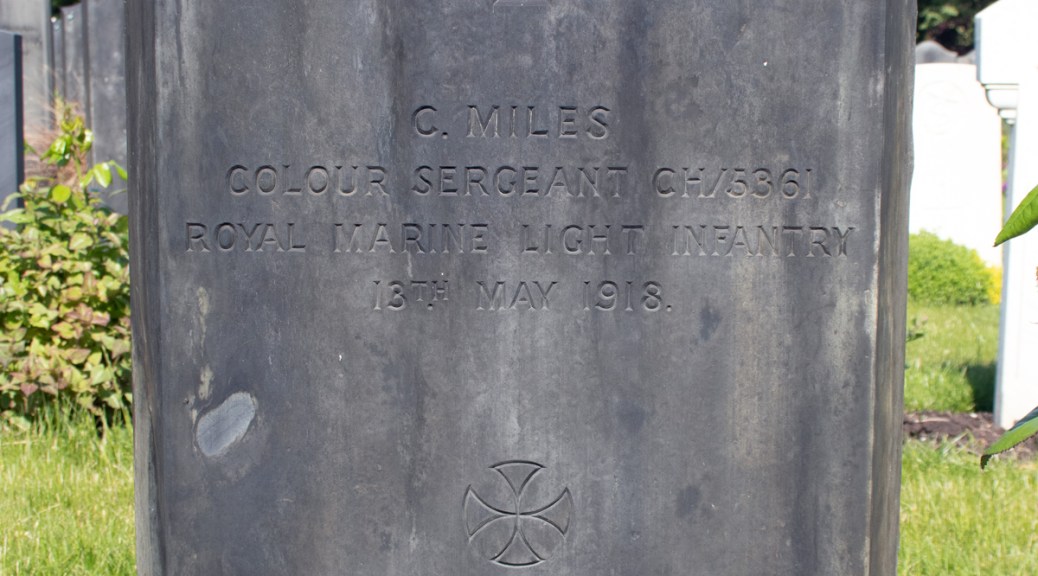
Colour Sergeant Charles Miles

Colour Sergeant Charles Miles

The early life of Charles Miles, whose body lies at rest in the Woodlands Cemetery in Gillingham, Kent, is a challenge to unpick, and the starting point is the last document relating to him.

His military Pension Ledger confirms that he died on 13th May 1918, from empyema, a bacterial infection affecting the lungs. The document cites his next-of-kin as Miss Hilda Miles, of 15 St John’s Road in Gillingham. She is noted as being the guardian of two children – Ada, born in 1905, and George, born the following year – because their mother, Charles’ wife, had passed away on 30th May 1912.

An online search for Ada and George gives an entry in the 1911 census. This finds them as the youngest two of six children to Charles and Elizabeth Miles. The document also gives a clue about their future guardian, Hilda: she is their older sister.

The Miles family were living at 45 Commercial Street in Whitechapel, East London. Charles, at 39, was recorded as a Royal Marines Pensioner and schoolkeeper. His wife, Elizabeth, was assisting with this role, and the couple had two other surviving children, Charles Jr and Walter.

While it is still difficult to piece together Charles’ childhood, his Royal Marine service records do shed a little light onto it. Born in Hampstead on 23rd November 1871, he was working as an ironmonger’s assistant when he enlisted. He joined up on 23rd August 1889, the document showing that he was 5ft 6ins (1.68m) tall, with brown hair, grey eyes and a fresh complexion. He also had a tattoo on his right forearm.

Private Miles had joined up in London but, as with most Royal Marine recruits, he was sent to the base in Walmer, Kent, for his initial training. In the spring of 1890 he moved to the Royal Naval Dockyard in Chatham, Kent, and this would become his regular port for the remainder of his service.

Charles’ service proved to be a committed one. Over the next decade he would serve on five ships, and would rise through the ranks. In October 1894 he was promoted to Lance Corporal, making full Corporal less than a year later. On 1st January 1899 he was promoted to Sergeant, and by the start of 1908, he held the rank of Colour Sergeant. Formally stood down to reserve status on 22nd November 1910, he was noted as having a very good character.

Away from the service, there is no record for Charles and Elizabeth’s marriage. She had been born in Sheerness, Kent, and was a year younger than her husband. It is likely that they were married by 1897, as this is when their oldest child was born. The 1901 census recorded them living on Manor Street in Gillingham, but, once Charles had been stood down, the school keeper’s position in the East End came up.

When war broke out, Charles was called upon to play his part once more. He returned to Chatham, leaving his younger children in Hilda’s care. By September 1914 he had moved to HMS Victory, the Royal Naval Dockyard in Portsmouth, Hampshire, and he would remain there for the next eighteen months. His shore base and naval experience suggest that, at 43 years of age, his was more of a training or mentoring role, although there is nothing in his records to confirm this.

In February 1916, Colour Sergeant Miles returned once more to Chatham, and the naval base there would be his home for the next few years. He was admitted to the Royal Naval Hospital in the spring of 1918, and passed away from the infection on 13th May 1918. He was 46 years old.

Charles Miles was laid to rest in Woodlands Cemetery, Gillingham.


After their father’s death, the Miles siblings found their own way in life.

By the time of the 1921 census, Ada, now 16 years old, was working as a domestic servant for Henry Chapman, a ship’s surveyor, and his family. They were living at 73 Milton Street in Fleetwood, a short stroll from the Lancashire coast.

Hilda, into whose care Charles had given his youngest children, was now 22 years of age. She had married William Swift, a pattern maker for the Admiralty, in the summer of 1918. They would not have any children, and the 1921 census found the couple living at 15 Milner Road, Gillingham. She too was just a short walk from the shoreline, but was also within walking distance from the cemetery in which her father had been buried.


Stoker Louis Theobold

Stoker Louis Theobold

Louis Theobald was born on 27th January 1898 in Soho, Middlesex. There is little information available about his early life, and the only document that can be directly connected to him is his military service records.

Louis enlisted in the Royal Navy on 7th September 1915. He had been working as a miner at the time, and the document gives an insight into the man he was. He stood 5ft 5ins (1.65m) tall, had brown hair, brown eyes and a fresh complexion. The service records also confirm that he had a tattoo on his right arm.

Stoker 2nd Class Theobald was sent to HMS Pembroke, the Royal Naval Dockyard in Chatham, Kent, for his training. He spent three months there, before being given his first posting, on board the minesweeper HMS Alyssum. He remained on board for three months, before transferring to the cruiser HMS Wallington in February 1916.

Louis’ health was starting to be impacted by this point: he had developed bronchitis, probably exacerbated by heat and dust of the confined engine room he worked in. By April 1916 he was transferred back to HMS Pembroke, and within two months, he was medically discharged from service.

Stoker 2nd Class Theobald had been admitted to the Royal Naval Hospital in Chatham by this point, and his health began to deteriorate. He passed away from a combination of bronchitis and empyema on 15th September 1916: he was just eighteen years of age.

Louis Theobald was laid to rest in the Roman Catholic section of the Woodlands Cemetery in Gillingham, Kent, not far from the dockyard where he had been based.


Stoker James Hurley

Stoker James Hurley

James Hurley was born in Timoleague, County Cork, Ireland, on 1st August 1894. His was not an uncommon name so full details of his early life are a challenge to unpick. However, later records confirm that his father was also called James Hurley, and when he finished his schooling, he found work as a farm labourer.

When war broke out in Europe, James Jr was quick to step up and play his part. He enlisted in the Royal Navy on 12th January 1915, and took the role of Stoker 2nd Class. His service records show that he was 5ft 5.5ins (1.66m) tall, with dark brown hair, grey eyes and a fresh complexion.

Stoker 2nd Class Hurley was sent to HMS Pembroke, the Royal Naval Dockyard in Chatham, Kent, for his training. However, his time there was to be tragically brief. He was admitted to the Welcome Hospital when he contracted pneumonia and empyema, but the condition was to prove too severe. He passed away on 6th February 1915, at the age of just 20 years old. He had been in the Royal Navy for just 25 days.

James Hurley’s parents were unable to bring him back to Ireland for burial. Instead, he was laid to rest in the Roman Catholic section of the Woodlands Cemetery in Gillingham, not far from the dockyard in which he had so briefly served.


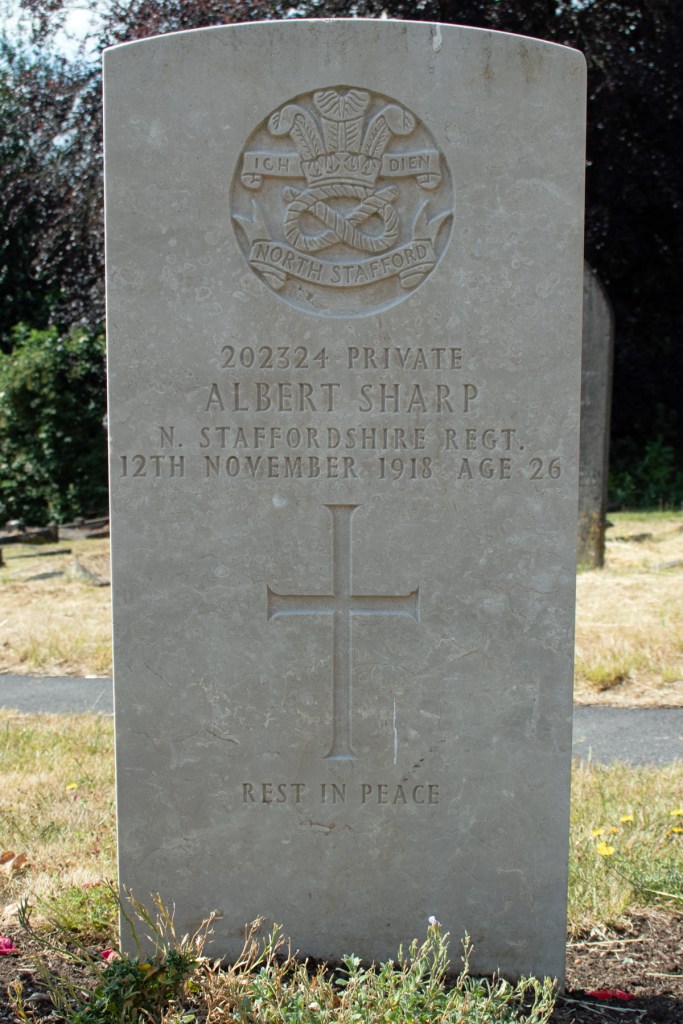
Private Albert Sharp

Private Albert Sharp

Albert Sharp was born in Rugeley, Staffordshire, in the summer of 1894. One of six children, his parents were George, who was a house painter, and Janet Sharp. When he left school, Albert found work as a bricklayer’s labourer, but, when war was declared, he sought a new adventure.

Albert enlisted in the army on 21st February 1916. Assigned to the North Staffordshire Regiment, he was initially attached to the 5th Battalion. His medical records show that Private Sharp was 5ft 6ins (1.6m) tall, and weighed 122lbs (553kg).

By November 1916, Albert found himself in France. Unusually, his life over the next couple of years is pretty well documented. His battalion saw action at the Hindenburg Line, the Third Battles of Ypres, Cambrai and the Third Battles of the Somme, but Private Sharp’s service records shed more light onto his life than simply where he fought.

Albert seems to have been a bit of a character, and this got him into trouble on more than one occasion. On 9th November 1916, he was confined to barracks for two days, for having untidy bedding and no towel on his bed. The following day, he was punished with another two days’ confinement for not attending his battalion’s role call.

On 18th December 1916, Private Sharp found himself in trouble again. This time, he was confined to barracks for five days for appearing dirty on parade, and committing a nuisance. Four days later, Albert was admitted to the camp hospital for reasons that are unclear. He returned to his unit just under a week later.

At the end of February 1917, Private Sharp transferred to the 31st Light Railway Operating Company of the Royal Engineers. He remained with the battalion for just under a year, although again his time there was not without incident. On 31st August 1917, Albert was confined to barracks for seven days for being absent from parade. The same punishment was meted out for the same offence on 8th January 1918.

Later that month, Private Sharp re-joined the North Staffordshire Regiment, and was this time attached to the 9th Battalion. He remained on the Western Front and was caught up in some of the fiercest fighting of the closing months of the conflict.

On 12th May 1918, Albert was caught up in a gas attack. Seriously injured, he was medically evacuated to Britain for treatment and admitted to the Bath War Hospital on 29th May. The next six months saw a slow and steady decline in his health. He passed away at 5:45am on 12th November 1918, the day after the Armistice was signed, from a combination of pneumonia and emphysema that was directly attributable to his injuries in France. Albert was 24 years of age.

It seems likely that Albert’s family were unable to pay for his body to be taken back to Staffordshire for burial. His service records give only his mother, Janet, as a next of kin, so it would seem that George had passed away by the time Albert enlisted. For some reason, however, while the British Register of Army Effects note that Private Sharp has effects to the value of £39 10s (£2250 in today’s money), this amount does not appear to have been paid. Janet passed away in the early 1920s, and Albert’s brother continued to try and obtain this gratuity on her behalf, but seems to have been unsuccessful.

Albert’s family did get his belongings when he died, however, which came to a postal order for 2s (around £3 today), 50 French centimes, a leather purse, two combs, two jack knives, a razor, a shaving brush, a toothbrush, two briar pipes and a pouch of tobacco, a nickel cigarette case, a text book, a wallet containing his pay book, his cap badge and six letters.

Unable to afford to bring Albert Sharp’s body back to his home town, he was, instead, laid to rest in the sweeping vista of Bath’s Locksbrook Cemetery, not far from the hospital in which he had breathed his last.


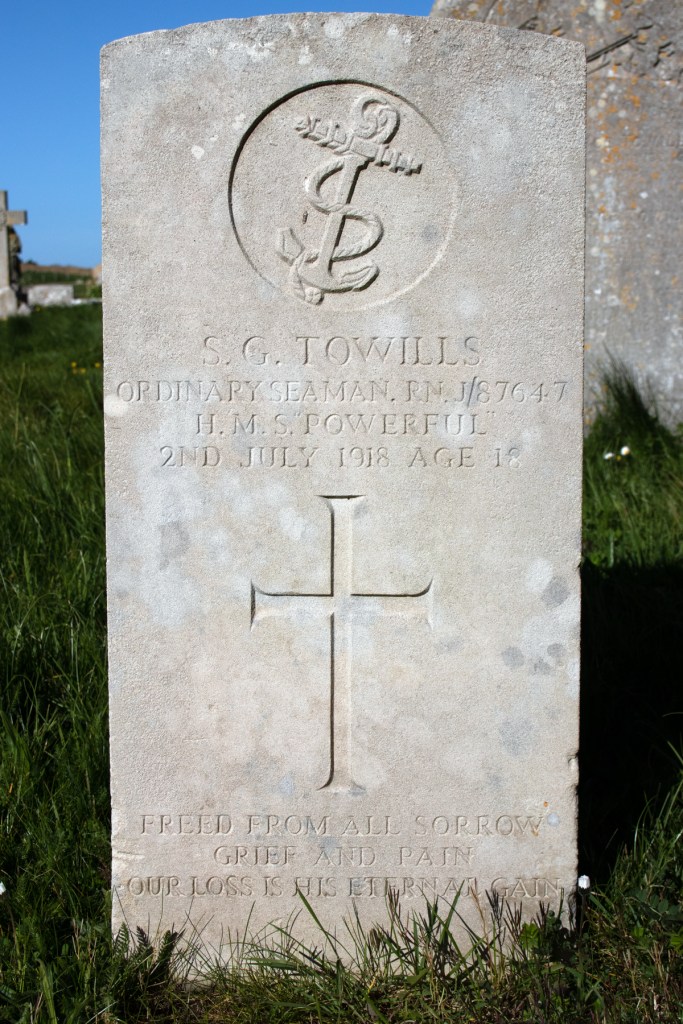
Ordinary Seaman Sidney Towills

Ordinary Seaman Sidney Towills

Sidney George Towills was born in Soho, London, on 14th May 1900. He was the youngest of two children to Henry and Maria Towills. Both had been born in Dorset, but Henry had found work as a constable for the Metropolitan Police and they had moved to London by the early 1890s.

The 1901 census recorded the family as living in Plaistow, but ten years later the family had moved back to Dorset, and were ensconced back in Maria’s home village of Abbotsbury.

When war broke out, Sidney was only 14 years old. He wanted to play his part, however, and as soon as he was able to enlist, he did so. He joined the Royal Navy on 9th April 1918 and, because of his age, was given the rank of Boy 2nd Class.

Sidney’s service records show that he was 5ft 9ins (1.75m) tall, had brown hair, blue eyes and a health complexion. He was assigned to the cruiser HMS Powerful and, on his eighteenth birthday, just over a month after enlisting, he was awarded the rank of Ordinary Seaman.

Tragically, Ordinary Seaman Towills’ service was not destined to be a long one. In June, he was admitted to the Royal Naval Hospital in Plymouth with empyema, a lung disease; he passed away from the condition on 2nd July 1918. He was barely 18 years of age and had served in the Royal Navy for 96 days.

Sidney George Towills was brought back to Abbotsbury for burial. He was laid to rest in the graveyard of St Nicholas’ Church in the heart of the village.


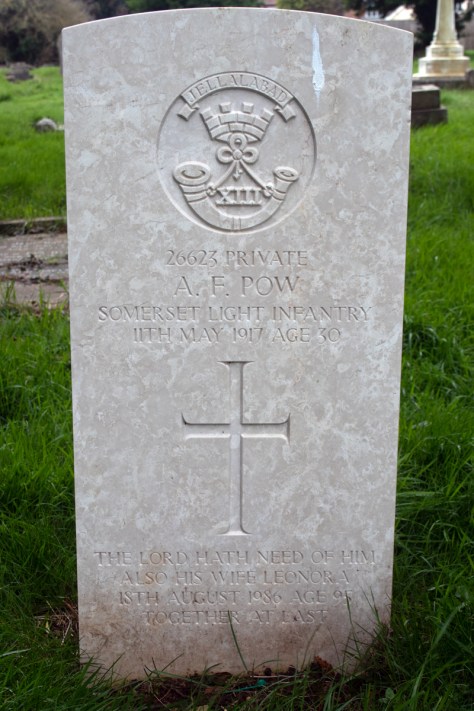
Private Albert Pow

Private Albert Pow

Albert Francis Pow was born in the autumn of 1886, one of five children to Albert and Annie Pow from Somerset. Albert Sr. was a farm labourer, but by the time he left school, Albert Jr. started work as a porter in the Singer sewing machine factory in Bridgwater.

Albert’s father passed away in 1905, at the age of 51, and his son – who was by this time repairing the sewing machines – became head of the household.

He was obviously good at what he did, because, by the time he married in 1913, he was able to support his wife Leonora as branch manager for the Singer store in the town. The young couple soon moved on, as, when war broke out, he was manager of the shop in Barnstaple.

War came calling, and while the date of his enlistment is absent from his records, Private Pow joined the 1st Battalion of the Somerset Light Infantry. Sent to the front, he quickly became ill, suffering from dysentery and trench foot, which led to him being hospitalised for nearly two months.

Returning to his troops, Private Pow’s health remained unsteady, and he soon contracted trench fever. He was evacuated back to England for treatment, and was admitted to the Canadian Red Cross Memorial Hospital in Taplow, Buckinghamshire.

Sadly, Albert was not to recover this time; he died at the hospital on 11th May 1917 as a result of empyema (pleuritis) and an abscess of the axilla (armpit). He was just 30 years old when he died.

Albert Francis Pow lies at rest in the Wembdon Road Cemetery in Bridgwater.


Albert left behind his widow, Leonora and their child Vanessa. Leonora was to be reunited with her late husband; she died in August 1986, and is buried with her beloved.