Tag Archives: family

Private Frank Mayo

Private Frank Mayo

Francis James Stephen Mayo was born on 24th November 1894 in Oldland, a small Gloucestershire village near Bristol. One of eight children, his parents were collier Samuel Mayo and his wife, Diana.

Frank, as he was known, sought a life of adventure from the start. In July 1911, not content with life as a farm labourer, he enlisted in the Royal Navy as a Boy 2nd Class. His service records show that he was 5ft 5ins (1.65m) tall, had light hair, blue eyes and a fair complexion.

Sent to the training ship HMS Impregnable, Boy 2nd Class Mayo’s time there was short. When Samuel found out what his son had done, he paid £10 (the equivalent of around £1250 in today’s money) for his discharge.

Frank went back to farm work, but, with storm clouds brewing on European shores, his time was to come again. On 8th September 1914, just a month after war was declared, he enlisted. His service records show that he had gained an inch (2.5cm) in height since his attempt to join the Royal Navy.

Again, Frank’s attempt to escape what he presumably felt to be a humdrum life were thwarted. His service records confirm that he was discharged on medical grounds because he was deemed not likely to become an efficient sailor.

On Christmas Day 1915, Frank married Martha Sweet, the daughter of a chimney sweep. The couple settled down in Keynsham, not far from either of their families, and had a son, Henry. Frank, by this time, seemed to have given in to the inevitable, and looking for a regular wage, began working at one of the local collieries.

Frank still had a dream to fulfil, though, and with no end to the war in sight, he again enlisted, joining the Training Reserve in June 1917. His records show that he had gained another inch in height, and has a number of tattoos on his right forearm. His records this time show that he had a slight heart problem, and was also suffering from a touch of rheumatism.

Private Mayo was assigned to the 440th Company of the Labour Corps, and seemed, at last, to be fulfilling the role he had wanted to be doing for the last six years. As time went on, however, his health seems to have been failing him and, in the summer of 1918, he contracted pulmonary tuberculosis. He passed away from the condition on 30th August 1918, while at camp, aged just 23 years of age.

Brought back to Gloucestershire for burial, Francis James Stephen Mayo – or Frank – was laid to rest in the graveyard of St Anne’s Church in his home village of Oldland.


Corporal Ernest Jenkins

Corporal Ernest Jenkins

Ernest Gilbert Jenkins was born on 4th April 1888, the tenth of eleven children to Eli and Julia Jenkins. Eli was a dairyman from Dorset, but the family were born an raised in Marksbury, a village in Somerset. When Eli passed away in 1910, he was laid to rest in the nearby town of Keynsham, and this is where Julia and the family moved.

Ernest tried to make his mark by finding a career in the army and enlisted in the Royal Field Artillery on 22nd June 1908. He gave his trade as a electrician for the National Telephone Company and his records noted that he stood 5ft 7ins (1.70m) tall, with good vision and good physical development.

The 1911 census records the widowed Julia and five of her children living on Charlton Road, Keynsham, in a 12-roomed house, with a domestic servant and three visitors. While not noted as such, it would seem that Julia was running a boarding house, but without any further details, this is impossible to confirm.

Ernest may have completed his initial term of service by this point and he was recorded as living with his mother and working as a salesman of cattle feed. Bombardier Jenkins’ military records show uninterrupted service from 1908 to 1917, so it is likely that, at the time of the 1911 census, he was, in fact, on reserve.

When war broke out in 1914, Ernest was called back into duty. By March 1915, he found himself in France, having been promoted to Acting Corporal. He served on the Western Front until June 1916, when he was sent back home.

Corporal Jenkins seems to have been suffering with his health and, in July 1916 was admitted to hospital with pyrexia (fever). Medically evacuated to England for treatment, a heart murmur was also identified, and after treatment, he was relieved of active duty and placed on reserve in January 1917. The heart condition continued, however, and by the end of the year, he was medically discharged from the army.

At this point, Ernest’s trail goes cold. He returned to Bristol and is noted in the 1919 edition of Kelly’s Directory, as living back in Charlton Road with Julia.

The next record for Ernest confirms his passing. He died on 25th July 1919 in a nursing home in Bristol. He was just 31 years of age.

Ernest Gilbert Jenkins was laid to rest in the family plot in Keynsham Cemetery. When Julia passed away in 1929, at the age of 78, she was buried there as well, finally reunited with her husband and son.


Private Robert Cantle

Private Robert Cantle

Robert Cantle’s life is one of hope and of tragedy. There is very little documentation on him, but what there is gives a hint to his life.

The 1911 census recorded him a living on Temple Street in Keynsham, Somerset. The head of the household was 86 year old John Cantle, a retired platelayer for Great Western Railway. His wife, Mary, was 22 years his junior, and they shared the house with their son, stationary cutter Ernest, his wife, Elsie, and their daughter, Madge. Robert was noted as being John and Mary’s adopted son. His age was given as 13, but his place of birth is ‘unknown’.

When war broke out, Robert joined the Wiltshire Regiment. Private Cantle set off for camp in Wiltshire in August 1917, and had been there for just two days when tragedy struck.

There were heavy thunderstorms in the Warminster district on Thursday, and while men of a unit of the Wiltshire Regiment were on the parade ground, three of them were struck by lightning. Pte. Robert Cantle, aged 19 years, whose home is at Keynsham, was killed on the spot, and the other two, Pte. Rowe and Pts Murgatroyd, were severely injured…

Sergeant Major HJ Bennett, of the Wilts Regiment, stated [at the inquest] the deceased lad had only just joined them. About 3pm on Thursday a squad was on the parade ground, when the signal was given to dismiss, as a storm was approaching. Immediately after there was a flash and a crash and it seemed to stagger everybody on the parade ground. Witness was brought to his knees, and when he recovered himself he saw three men, who of whom were struggling, on the ground. Private Cantle was found to be dead, and the other men recovered after being attended by a doctor. The squad consisted of recruits, and none of them were carrying arms.

Major Stocker, medical officer, said the crown of deceased’s cap was ripped off, and the body was burned from head to foot.

The jury returned a verdict of “Death from the effects of lightning.”

Somerset Standard: Friday 17th August 1917

Robert Cantle’s body was brought back to Keynsham for burial: he was laid to rest in the town’s cemetery.


Sapper Albert Headington

Sapper Albert Headington

Albert Edward Headington was born on 5th December 1876 in Keynsham, near Bristol, in Somerset. The ninth of eleven children, his parents were Joseph and Jemima Headington. Joseph was a stonemason and, while he seems not to have had his father’s talents, Albert worked with the same material, becoming a bricklayer’s labourer when he left school.

On 29th May 1899, Albert married Ellen Gray. She was a mason’s daughter from Semley in Wiltshire, and it seems that he was either working there or had some connection with the family through his father’s work. The couple settled down in Keynsham, and went on to have two children, Harold, who was born in 1900, and Edith, who was born in 1912.

By the time of the 1911 census, the family had settled in a small house in the middle of Keynsham. Albert had, by this point, found other employment, and was working for Great Western Railways as a packer.

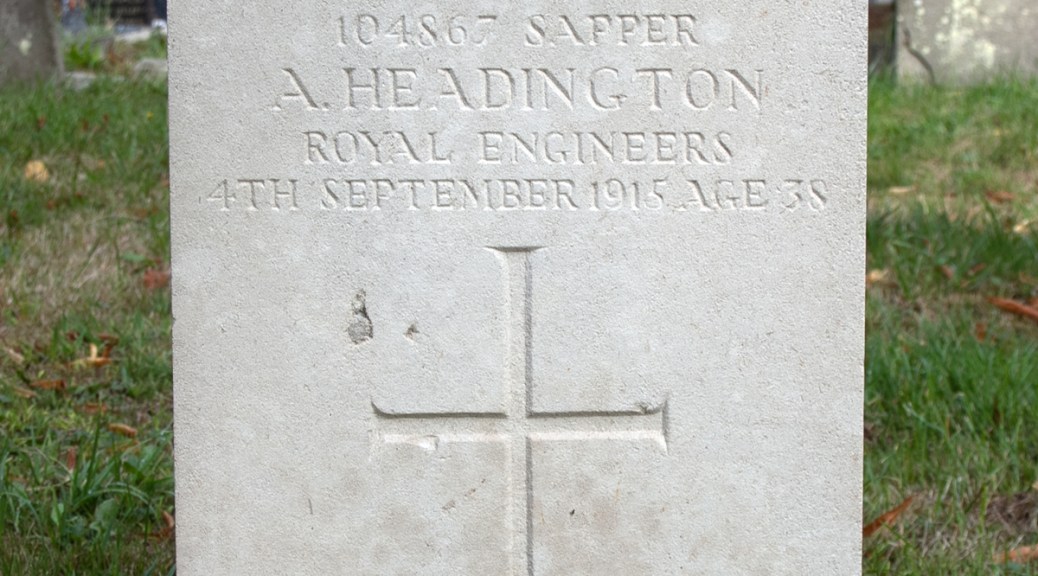
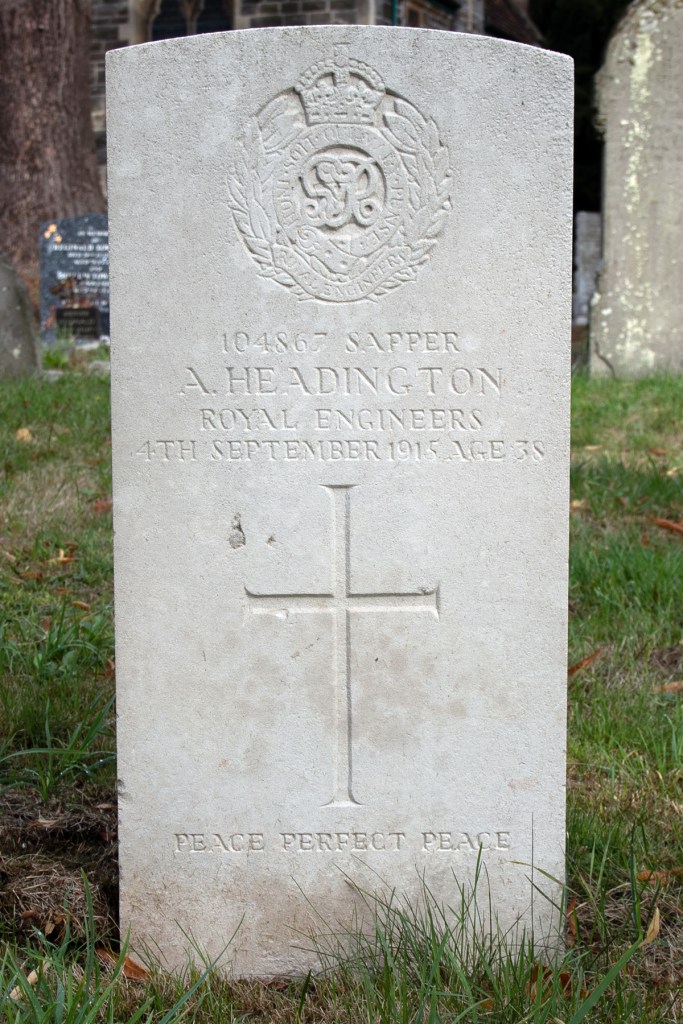
When war broke out, Albert stepped up to play his part. He enlisted on 22nd June 1915, joining the Royal Engineers as a Sapper. Sent for initial training in Chatham, Kent, he returned home on leave at the end of August. Tragically, he had fallen ill by this point, and died at home on 4th September 1915, having contracted cerebrospinal meningitis. He was 38 years of age.

Albert Edward Headington was laid to rest in the quiet cemetery of his home town of Keynsham.


Ellen went on to live a full life. She and Edith emigrated to Canada in 1921, following Harold, who had made the same move a year earlier. They all settled in the town of Welland, Ontario, not far from Niagara Falls.

Both of Albert and Ellen’s children married and had children of their own. Ellen never remarried, and passed away on 4th November 1956, at the age of 80 years old. She was laid to rest in the Holy Trinity Anglican Cemetery in Welland.


Private Ernest Bowden

Private Ernest Bowden

Ernest Frederick Bowden was born on 2nd November 1896 in Ipplepen, Devon. He was one of eleven children – and one of twins – to Frederick and Dora Bowden. Tragically, Dora died when Ernest was just over a year old, leaving Frederick and his older sisters to raise the family as best they could.

When he left school, Ernest found work as a page for a surgeon living in Paignton, before finding other employment as a chauffeur in Bovey Tracey. In his spare time, he was an avid bellringer at his local church.

War was coming to Europe, however, and in November 1915, he enlisted in the Gloucestershire Regiment. His service records noted that he was 19 years of age, and stood just 5ft 1.5ins (1.56m) tall. Assigned to the 14th Battalion, Private Bowden soon found himself on the front line. Arriving in France in July 1916, he spent four months there, during which he contracted tuberculosis and trench foot.

Medically evacuated to Britain for treatment, his conditions proved too severe for him to continue in the army. He was discharged from active service in December 1916.

For some months he had been at the Ivybank Dispensary, Exeter. Complications set in, and he rapidly sank just before reaching his 21st year.

Western Times: Friday 28th September 1917

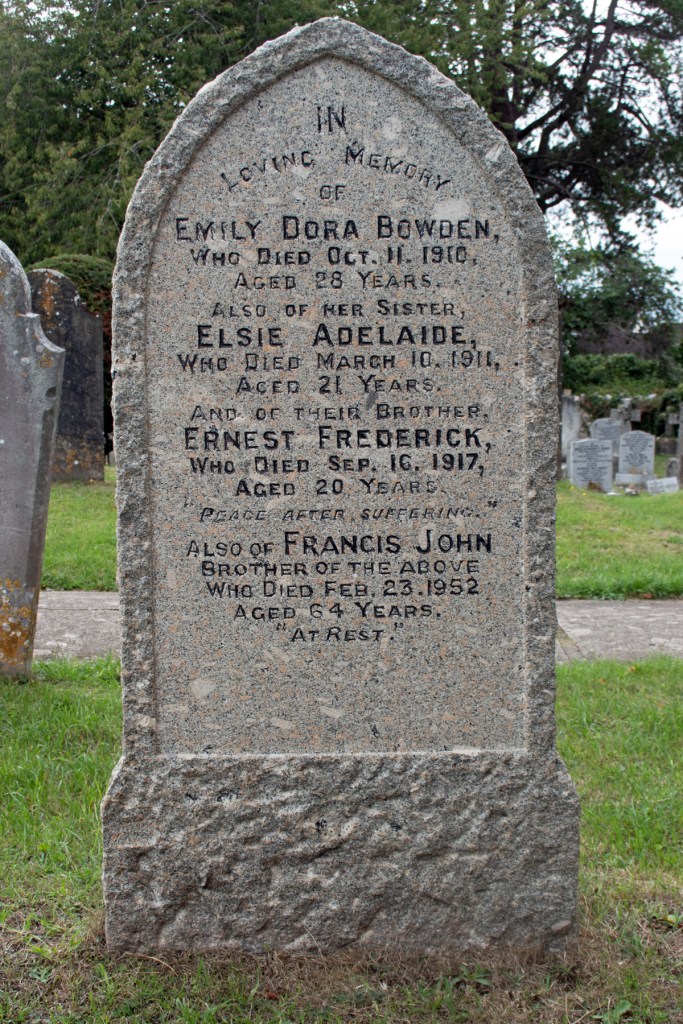
Ernest Frederick Bowden had passed away on 16th September 1917, aged just 20 years old. He was laid to rest in the family grave at St Andrew’s Church, Ipplepen.


Private William Rowlands

Private William Rowlands

William Pierce Rowlands was born the summer of 1891 and was the oldest of three children to Thomas and Ellen Rowlands. Thomas was a slate dresser and quarryman from North Wales, and William was born in Ffestiniog, Gwynedd. By the time his sister Margaret was born, the young family had moved to Llanberis, settling in a small cottage on the outskirts of the village.

When he left school, William found work as a clerk, and this was the work he was carrying out when was broke out. He enlisted on 10th April 1915, joining the 14th (Service) Battalion of the Royal Welch Fusiliers. His service records show that he was 5ft 8ins (1.73m) tall.

Private Rowlands served on home soil for just over seven months, before being sent to France on 30th November 1915. He had been suffering from a cough for a couple of weeks, and this came to a head while he was overseas. He reported sick on 16th December, and was sent back to Britain for treatment a month later.

His condition was identified as pulmonary tuberculosis, aggravated by military service. Private Rowlands was medically discharged from the army on 8th February 1916, and returned home.

At this point, William’s trail goes cold. His condition appears to have worsened, however, and it was from tuberculosis that he was to die. He passed away at home on 18th February 1917, at the age of 25 years old.

William Pierce Rowlands was laid to rest in the quiet graveyard of St Peris Church, in the family home village of Llanberis.


Thomas and Ellen lived until 1932, when the passed away within a couple of months of each other (Thomas in August, Ellen in November). They were reunited with the son, and lie together in the family grave, along with Ellen’s brother, also called William, who had passed away in 1930.


Private Griffith Hughes

Private Griffith Hughes

Griffith Hughes was born in Llanberis, in modern day Gwynedd, in 1893. Sadly, there is little information about his early life, and records mention his mother – Margaret – but no father. The 1901 census records Griffith as living with his grandmother, Ann Hughes.

Ten year later, the two are living in a two-up, two-down cottage – 19 Snowdon Street, Llanberis – with Griffith’s aunt, Ann’s daughter Jane, and her husband, Thomas. Griffith is earning money by now, working as a slate dresser at one of the local quarries.

War was coming to Europe by this point, and Griffith was called upon to play his part. He initially enlisted in the Welch Regiment as a Private, although he seems to have transferred across to the South Wales Borderers during his service.

Private Hughes’ time in the army was spent on home soil, although he earned the Victory and British Medals for his service. He remained in the army through to the end of the war and beyond until, on 15th August 1919, he was medically discharged. He had developed tachycardia, and this was having an impact on his life.

When Griffith left the army, he was based in Lancashire, and was living in the village of Bryn, to the south of Wigan. He remained in the area for the next year, his health sadly deteriorating. Admitted to the cottage hospital in nearby Pemberton, he passed away from his heart condition on 18th September 1920. He was just 27 years old.

Griffith Hughes was brought back to Wales for burial. He was laid to rest in the quiet graveyard of St Peris Church, in his home village of Llanberis.


Petty Officer Albert Smith

Petty Officer Albert Smith

Albert Septamus Smith was born in Maidstone, Kent, on 12th January 1881. The oldest of three children to George and Frances Ditcher, he may has been born before the couple married, and seems to have retained his mother’s maiden name throughout his life.

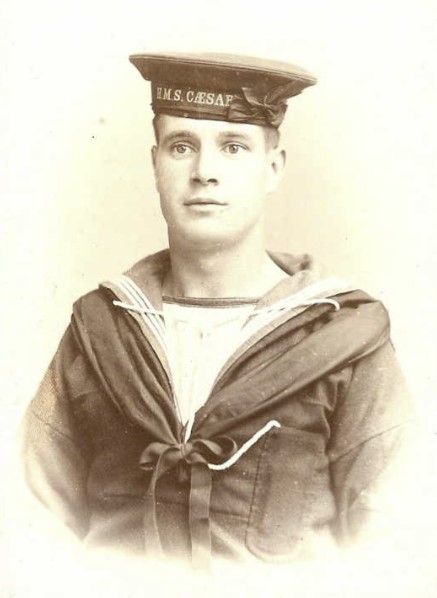
When he left school, Albert sought a life at sea, joining the Royal Navy as a Boy 2nd Class on 12th January 1898, when he was just fifteen. Albert’s naval career was a long and varied one which began on board HMS Impregnable, a training ship. After a month’s training, he was assigned to HMS Lion, where he spent more than a year, gaining a promotion to Boy 1st Class in the process.

In October 1897, Albert transferred to HMS Pembroke, the Royal Naval Dockyard in Chatham, Kent. In the four months that he spent on shore, he turned seventeen and, as a result, came of legal age to formally be enlisted in the navy. Ordinary Seaman Smith signed up for a period of twelve years, and his service records showed that he was 5ft 8ins (1.73m) tall, had brown hair, brown eyes and a dark complexion. He was also noted to have a scar on his right wrist, and a tattoo of a flower and bracelet on the same wrist.

Ordinary Seaman Smith was dedicated to his career. Over the next twelve years he served on board nine different vessels, and rose through the ranks, gaining promotion to Able Seaman (in May 1899), Leading Seaman (January 1903), and Petty Officer 2nd Class (September 1903). He returned to the rank of Leading Seaman, doing so in August 1906, but this seems to have been a deliberate choice, as his service record appears unblemished.

In 1910, Albert’s initial period of service came to an end and he chose not to renew his contract. He had married Ellen Miles on 6th October 1900, and, with four young children, it appears that family had become more important to him. Returning to Maidstone, he found work on the railways, joining the South East and Chatham company as a platelayer. The family home was in Bearsted, a village to the east of Maidstone, now part of its suburbs, and they shared is with Ellen’s sister, Dorothy.

Life was going well for the Smith family, but war was coming to Europe and, with his previous naval experience, Albert was to be called upon again. He was called out of reserve on 2nd August 1914 and, after an initial couple of weeks at HMS Pembroke, Leading Seaman Smith was soon back at sea.

After a couple of years on board the seaplane tenders HMS Engadine and Campania, Albert was promoted to Petty Officer again, and assigned to HMS Sandhurst, a fleet repair ship based at Scapa Flow. He was on board when an explosion in the boiler room killed seventeen seamen on 27th February 1917, although he was not hurt.

It was while Petty Officer Smith was on board HMS Sandhurst that he contracted tuberculosis. He returned to Chatham Dockyard, but the condition was severe enough for him to be medically discharged from active service in February 1918.

Albert returned to civilian life again, and his trail goes cold for a couple of years. His lung complaint continued to haunt him, however, and he passed away from tuberculosis on 4th March 1921. He was 40 years of age.

Albert Septamus Smith was laid to rest in the graveyard of Holy Cross Church in Bearsted, not far from his family home.


Petty Officer Albert Smith
(from ancestry.co.uk)

Rifleman Joseph Collins

Rifleman Joseph Collins

Much of Joseph Collins’ life is destined to remain a mystery. He was born in Northern Ireland on 8th November 1897, and was the son of William and Minnie Collins, who lived near Lurgan, in Armargh.

When war broke out, Joseph enlisted, joining the 16th (Service) Battalion – the 2nd County Down Pioneers – of the Royal Irish Rifles. Formed in Lurgan, the regiment moved from Northern Ireland to Seaford in East Sussex in July 1915. By that October, Rifleman Collins found himself on the Front Line in Northern France.

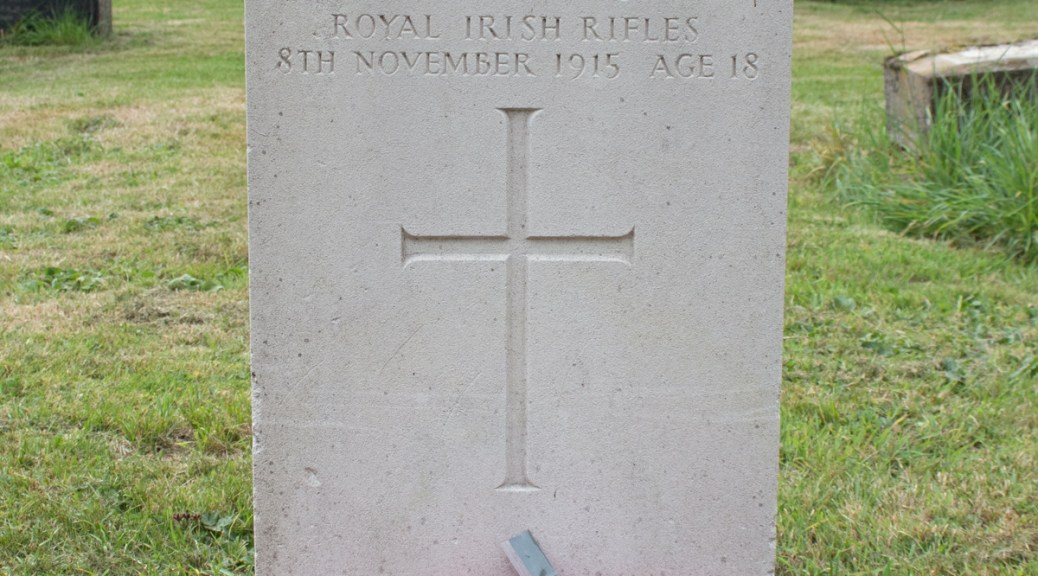
Joseph was invalided on 26th October, and medically evacuated to Britain for treatment. Admitted to the Brynkinalt Hospital in Chirk, Denbighshire, he was operated on, but this was to prove insufficient, and he passed away from his injuries on 8th November 1915 – his eighteenth birthday.

Rifleman Collins was well thought of in his regiment, as the comments in the Lurgan Mail [Saturday 20th November 1915] confirmed. Captain HF Sheppard, who commanded Joseph’s Company, noted “I need hardly say I was shocked, as I thought when he left us that the operation necessary for his complaint was certain to prove successful. I had always been attracted by his cheerful temperament, and I was always keenly interested in him as he was one of the first to join my Company.

Lieutenant E Somerfield noted that Joseph “was a great favourite with the rest of his platoon, and a boy I had great regard for. I can assure you we all feel his loss very keenly.

The most touching comments, however, come from one of Joseph’s colleagues, Rifleman R McKeown: “I am sending you these few lines to let you know I got a letter today which Joe wrote before he died. The nurse found it in his locker and sent it on to me I am sending you a copy of it and the nurse’s letter. I was never so badly struck in my life as when I heard of his death, for his could not have grieved me more has it been my own brother. The day he went away I never got bidding him good-bye, for the morning he went on the sick list I was on parade, and when I came in he was away. The boys in the platoon and company he was in were all greatly grieved at hearing about his death. You have my sincerest sympathy in your trouble. I don’t know how I am ever going to go home – if I ever do – without him. He was like a brother to me.

Unable to bring their son back to Ireland, William and Minnie had to be content with the fact that their son was given a military funeral in the town where he died. Joseph Collins was laid to rest in the graveyard of St Mary’s Church in Chirk.


Sapper James Tod

Sapper James Tod

James Tod was born in the spring of 1891 in Chirk, Denbighshire, and was one of nine children. His parents were builder John Tod, who was from Scotland, and Margaret Tod, who had been born in Llangollen.

John passed away when James was in his teens and, when he left school, James found work as a joiner to help support his mother financially.

When war came to Europe, James was called upon to play his part. Full details of his military service are not available, but he had enlisted by the beginning of 1917. James joined the Royal Engineers as a Sapper, and was assigned to the London Electrical Engineers.

It is unclear whether Sapper Tod served overseas, but he certainly would have been based in the London area, carrying out repair works as needed. The London Electrical Engineers were also pioneers in the use of searchlights to spot enemy aircraft and Zeppelins raiding the capital. A detachment was also sent to France to position and man searchlights on the Western Front, although, again, it is not clear whether James was one of those involved.

It is clear that James was back in Wales at the start of 1917, however, as, on 18th January, he married his sweetheart, Emily Mary Edwards, at the parish church in his home town. Emily was the daughter of a gamekeeper from nearby Pontfadog, but it was in Chirk that the coupler were to make their home.

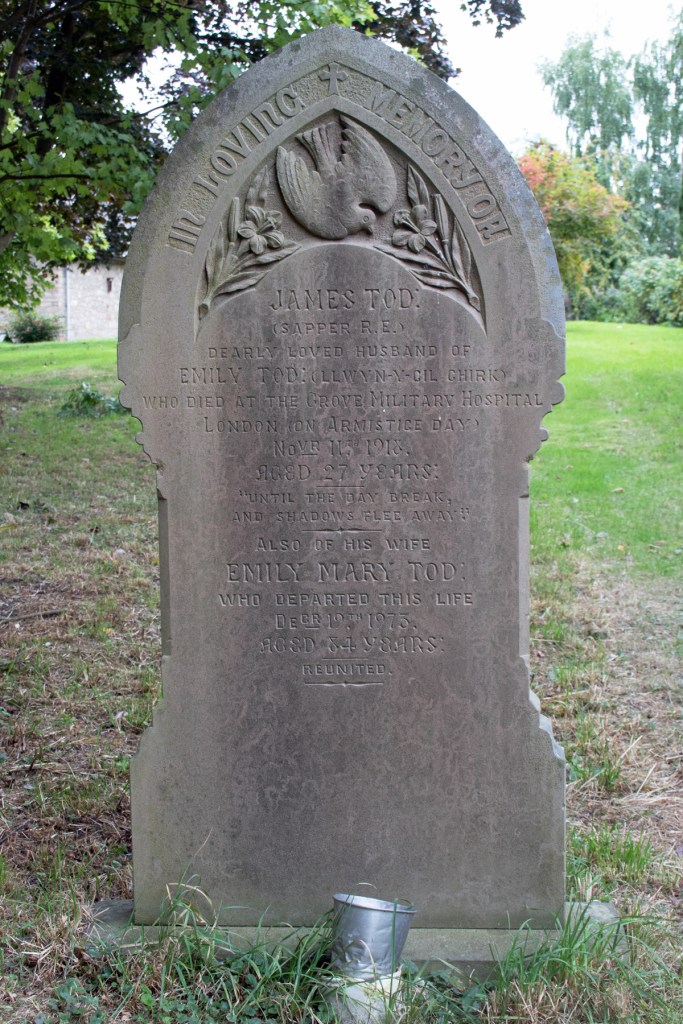
Sapper Tod was soon back on duty, however, and the next evidence available for him is that of his admission to the Grove Military Hospital in Tooting, South London. He had contracted a combination of influenza and pneumonia, and these lung conditions were sadly to get the better of him: he passed away on Armistice Day, the 11th November 1918. He was just 27 years of age.

James Tod was brought back to Wales for burial. He was laid to rest in the family plot in the graveyard of St Mary’s Church in the town.


It seems that James had been in some debt when he passed, as some of his war pension was held over to cover those costs.

Tragically, Emily was five months pregnant when James died. She gave birth to a son, who she named after his father, on 9th March 1919.

Emily never remarried, and, by the time of the 1939 Register for England and Wales, was recorded as the Lodgekeeper for Deer Park Lodge, which was attached to Chirk Castle. She passed away on 19th December 1973, at the age of 84 years old. She was laid to rest with her late husband, a couple reunited at last after more than five decades.

James Jr lived a long life, passing away in the spring of 1999, in his eightieth year.