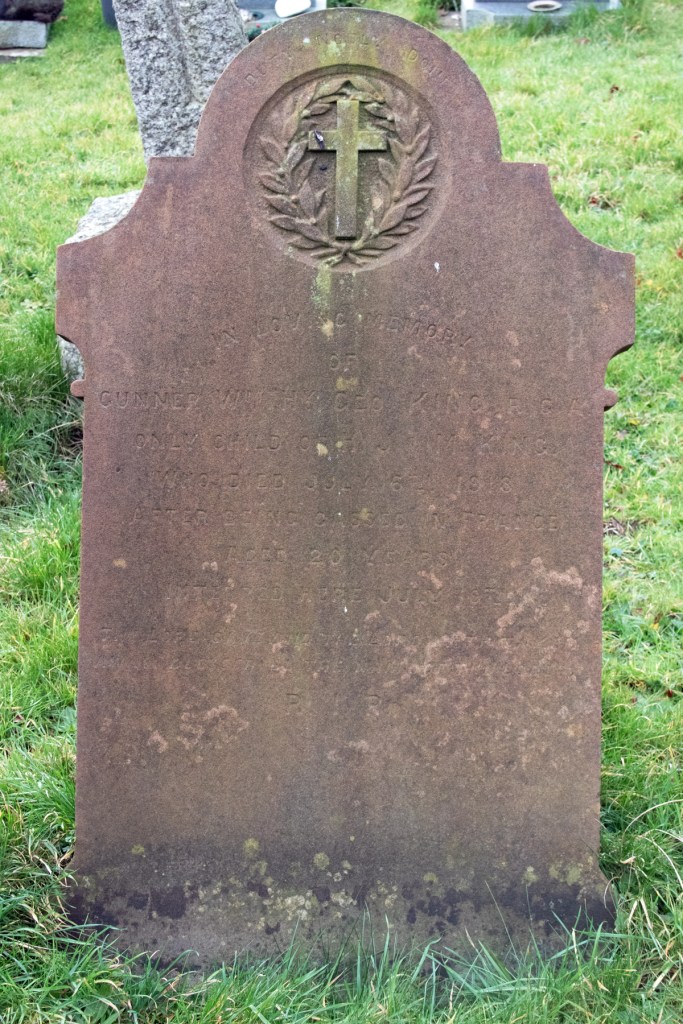
William Henry George King was born in the summer of 1898 and was the only child of Henry and Martha King. Henry was a grocer in the Somerset village of Witham Friary, and this is where William was born and raised.
When he left school, William found work as a draper’s assistant in Wells, but when he turned 18, with war raging across Europe, he gave that up to play his part. He enlisted in the Royal Garrison Artillery in August 1916, and was assigned as a Gunner in the 99th Siege Battery. His service records show that he was 6ft (1.83m) tall and weighed in at 140lbs (63.5kg).
Gunner King received his initial training in Plymouth, but was eventually shipped to France, arriving there in August 1917. He was caught up in a German gas attack at the end of June 1918, and was invalided back to Britain for treatment on 2nd July. He was admitted to the War Hospital in Bradford, but died of a combination of his injuries and the resulting bronchitis on 6th July 1918. He was just 20 years of age.
The body of William Henry George King was brought back to Somerset for burial He was laid to rest in the family plot in the graveyard of St Mary’s Church in his home village of Witham Friary.
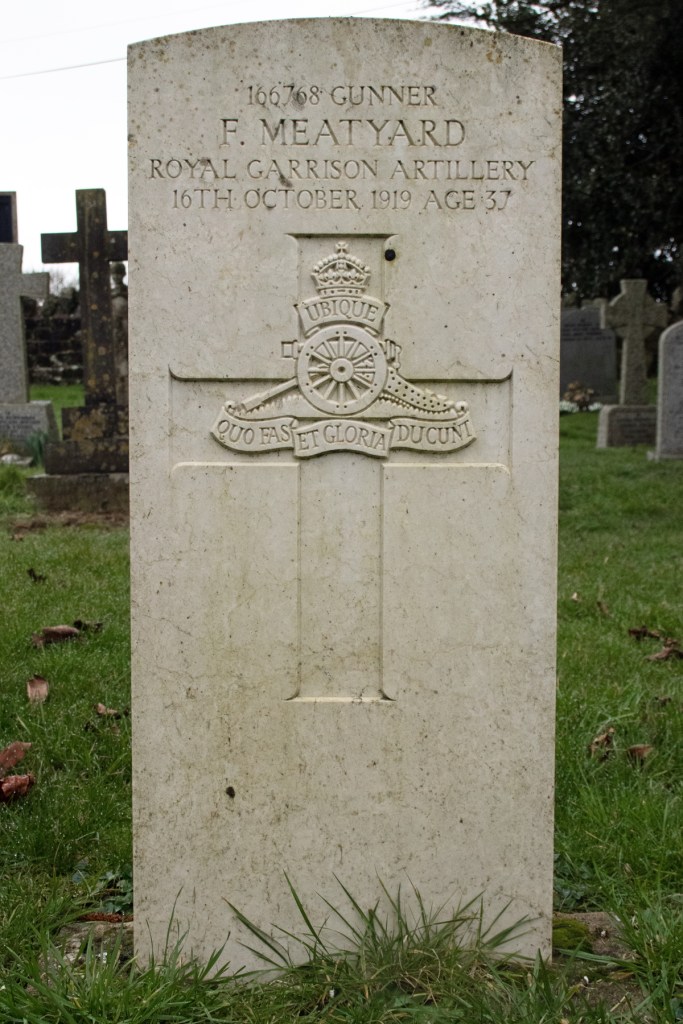
Fred Radford Meatyard was born in Penselwood, Somerset, in September 1882. The son of Henry and Ellen Meatyard, they seem to have been distant in his life. Fred was raised by his paternal grandparents, Henry and Caroline, in nearby Wincanton.
Fred was an intelligent young man. The 1901 census found him boarding with printer and stationer Walter Eaglestone and his family, on Erith High Street, in Kent. He was working as a compositor himself, pulling the type together for his boss to print. This appeared to be a springboard for him, and he soon moved to Oxford finding similar work there.
In 1907 Fred briefly returned to Penselwood, where he married Lily Extence in the parish church. The marriage certificate showed that Fred was living in William Street, Oxford, and was still employed as a compositor, working for the local newspaper, the Oxford Chronicle. His father, Henry, is listed as deceased, and as having been employed as an engineer. Lily was the same age as her new husband, and was the daughter of labourer Francis Extence.
The couple moved back to Oxford, and went on to have three children: Linda (born in 1908), Joan (born 1913) and Frances (born in 1915). The 1911 census record found them living in an end of terrace house in Boulter Street, the River Cherwell flowing past the bottom of their cul-de-sac. Theirs was a five-room house, and they had a boarder, Mancunian William Murphy, who was employed as a vocalist and guitarist.
When war came to Europe, Fred stepped up to play his part. He enlisted on 30th August 1916, but was not formally mobilised into the Royal Field Artillery until the following January. Gunner Meatyard’s service records show that he was a wiry man, 5ft 10ins (1.78m) tall, and weighing 126lbs (57.2kg).
In June 1917, Fred was transferred across to the Royal Garrison Artillery, and was sent to France. Aside from a couple of periods of leave, he remained overseas until the end of the war, and was attached to a couple of the regiment’s Siege Batteries.
When hostilities ceased, Gunner Meatyard finally returned to Britain in the summer of 1919. Based on Salisbury Plain, Wiltshire, while waiting to be demobbed, he fell ill, and was admitted to the Fovant Military Hospital. He was suffering from acute appendicitis, and the condition came on so quickly, that any treatment did not come soon enough. Fred passed away at the hospital on 16th October 1919, at the age of 37 years of age.
Fred Radford Meatyard was brought back to Somerset for burial. He was laid to rest in the quiet graveyard of St Michael’s Church in Penselwood. The newspaper for which he had worked for so long noted that “he was buried with full military honours… Deceased was on the printing staff of the ‘Oxford Chronicle’ for some years… He was a member of the St John’s Ambulance Brigade. Some time ago he returned from the Rhine, having previously fought in France. Much sympathy is felt with the widow and three children, two of whom, it will be remembered, took a prominent part as dancers in the pagent.” [Oxford Chronicle and Reading Gazette: Friday 24th October 1919]
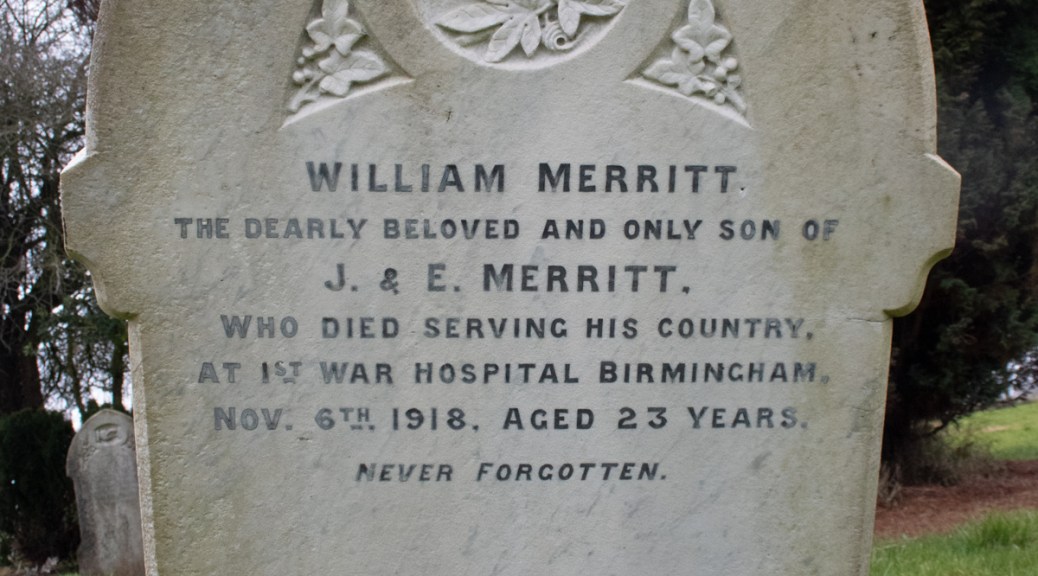
William Merritt was born in the summer of 1895 in Chippenham, Wiltshire. He was the youngest of three children to John and Elizabeth Merritt. John was a blacksmith, and he moved the family to Milborne Port, Somerset, when William was just a boy.
William found work as a shoesmith when he left school, but was one of the first to enlist when war broke out in 1914. He had his medical examination on 17th November, which confirmed that he was 5ft 5ins (1.65m) tall, had good vision and was of good physical development.
Initially assigned to the Dorset Yeomanry, Private Merritt’s trade soon found him taking on the role of Shoeing Smith for the battalion. He was obviously good at what he did, because by May 1915, he had been promoted to the rank of Corporal Shoeing Smith.
William had not enlisted in the army to make and mend shoes, however, and, in March 1916, he transferred to the Royal Garrison Artillery, back with the rank of Gunner. Rather than being sent to the Western Front, however, he found himself billeted at a camp in the West Midlands.
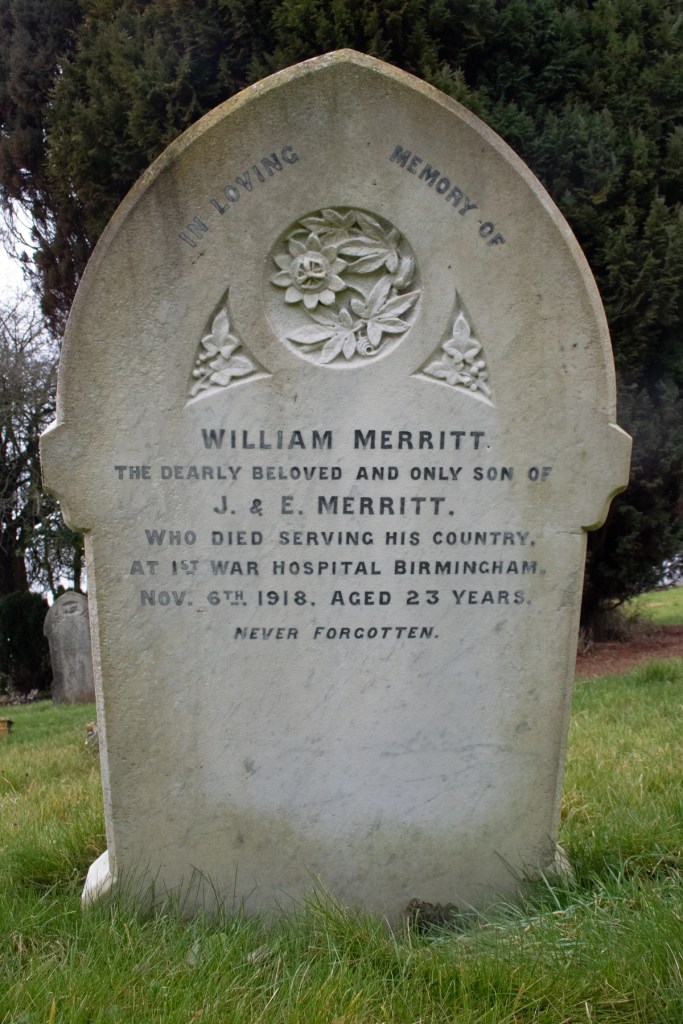
Little further information about Gunner Merritt’s service is available for the next couple of years. The next record for him comes on 5th November 1918, confirming his admission to the Birmingham War Hospital, as he was suffering from influenza and pneumonia. Sadly, his admittance to hospital was to prove too late: he passed away from heart failure the following day. Gunner Merritt was just 23 years of age.
William Merritt’s body was brought back to Somerset for burial. He was laid to rest in the cemetery of the town in which he had plied his trade before the war, Milborne Port.
William’s sparse personal effects were also returned to his parents. The records note that these included: “pair [of] boots, 6 postcards, razor, comb, toothbrush, shaving soap and brush, letter, pair of socks, bell.”
Another bureaucratic error is highlighted in a letter sent from the hospital in which William passed to his regiment’s records office notes that “I have to inform you that the body was forwarded to his Wife for burial…” William was unmarried, and his body was actually returned to his mother, Elizabeth.
Theophilus Walter Burdock was born on 18th June 1871 in Whitminster, Gloucestershire. One of nine children, his parents were painter and decorator Nathaniel Burdock and his wife, Mary.
While he found labouring work when he left school, Theophilus – who went by his middle name, Walter – decided that he wanted bigger and better things and, on 30th December 1889, he enlisted in the Royal Artillery. His service records show that he was 5ft 5ins (1.65m) tall and weighed 115lbs (52kg). The document also records that he has a tattoo of a man, star and crown on his left forearm.
Initially assigned to the 1st Depot 2nd Battery as a Driver, over the next couple of years Walter made solid progress within the regiment. By September 1892, he was promoted to Gunner, within a couple of years he was raised to Bombardier, and by April 1895 he had made the rank of Corporal.
By his last formal year in the ranks, things seemed to take a different turn. On 9th March 1896, Corporal Burdock received a contusion to his face. He was formally transferred to the Army Reserve when his contract of service ended in December 1896, but within eighteen months he re-enlisted.
At this point, however, Corporal Burdock’s conduct began to race downhill. In August 1898 he was tried for an undisclosed reason, and his rank was reduced to Bombardier. Within a couple of months, he was tried for a second crime, and reduced in rank again, back to Gunner.
For a time Walter kept his nose clean, and, in February 1900, he was promoted back to the rank of Bombardier. This was to be only a fleeting move, however, as he reverted back to Gunner less than two months later.
Over the next couple of years, Walter generally kept his head down. On 30th April 1901 he was injured by a kick in the eye, although, again, details are tantalisingly scarce. By April 1902, his contract came to an end and this time he was stood down and formally demobbed.
Civilian life seemed to be something to which Walter was not to be destined. He enlisted again almost immediately, joining the Imperial Yeomanry in May 1902. He lasted less than a year with the regiment, however, having served ten months in South Africa.
In January 1904, was recalled to the Royal Artillery for further service in South Africa. His medical report showed the man he had become in the fifteen years since he had first joined up: he was now 5ft 7ins (1.7m) tall, and weighed 141lbs (64kg).
Private Burdock served six months on home soil, but in July 1904, he was sent to South Africa, having never actually seen any overseas service before. He returned to Britain in September 1905, and was discharged from service, specifically so that he could re-enlist with the Royal Artillery and complete his fourteen years’ service with them.
Gunner Burdock remained with the Royal Artillery until February 1906, presumably as he had finished his fourteen years. Interestingly, his discharge papers noted his conduct as ‘indifferent’.
Walter’s trail goes at this point. His mother, Annie, passed away in Gloucestershire in the spring of 1908. His father, Nathaniel, died Bristol in 1912. The next evidence for their son comes in September 1914, in attestation papers for the Canadian Expeditionary Force.
Walter was, by this point, living in Victoria, British Colombia, and working as a lumberjack. He had been unable to completely leave his army days behind him, and his service records give his year of birth as 1876, five years younger than he actually was at the time.
Those service records give similar physical characteristics to his 1904 papers, and confirm the presence of some additional tattoos: a butterfly and pair of hands with the words true love.
Walter was assigned to the Royal Canadian Horse Artillery, and given the rank of Gunner. He arrived back in Britain in October 1914, but his previous indifference seems to have recurred. He was imprisoned for a week from 21st October for having been absent without leave, and was found to be absent again at reveille on the morning of 30th October.
Yesterday afternoon the body of a man was found floating in the Avon just below Bathampton Weirs, and close to the entrance to the back-water on the Batheaston side of the river.
The body was floating face downwards some yards from the bank, and only the top of the head was visible.
The body was recovered shortly before five o’clock. It appeared to be that of a middle-aged man of medium height. The trousers had something of the appearance of a mechanic’s overall and deceased was wearing a sleeve vest.
The conjecture naturally arises whether the body is that of the missing Canadian soldier Burdock, whose clothes were discovered on the bank at Batheaston on Saturday, October 31st, and of whom nothing has been heard since. Burdock was a member of the Canadian contingent now in training on Salisbury Plain. It is known that the missing soldier had several tattoo marks on his arms… so the question will not long remain in doubt when the body has been brought to the bank.
Bath Chronicle and Weekly Gazette: Saturday 14th November 1914
The body did indeed turn out to be that of Gunner Burdock. An inquest reached a verdict of suicide while temporarily insane. He was 43 years of age.
Theophilus Walter Burdock was laid to rest in the graveyard of St John the Baptist Church in Batheaston. Interestingly, while his next of kin was identified as his brother Frederick Burdock, Walter’s service records add a further dimension to his passing:
A maple tree has since been planted at the head of the grave by Miss Henderson, The Hill, Batheaston, who took a great interest in the case. Miss Henderson also sent a beautiful wreath when deceased was buried.
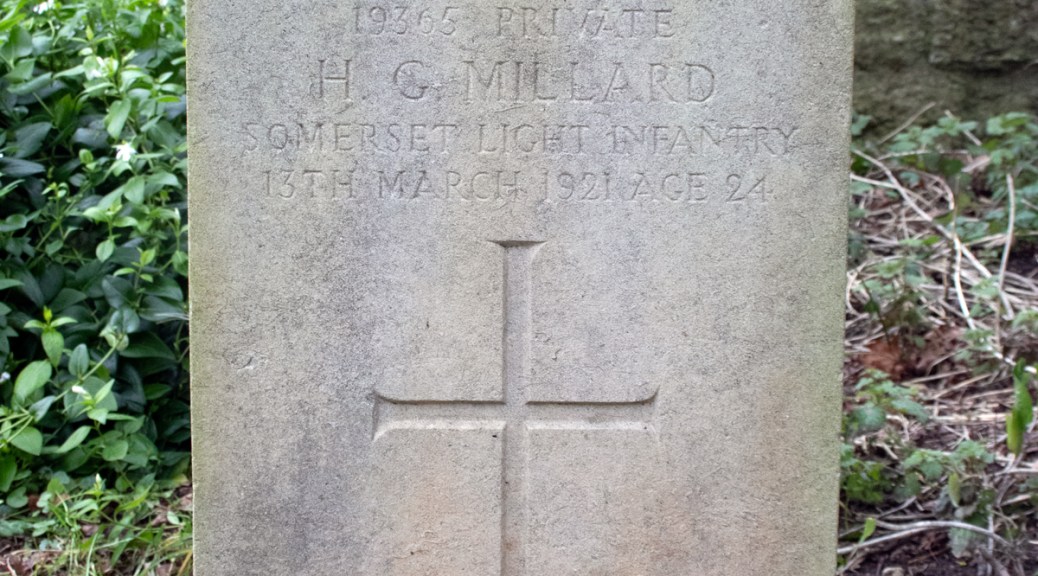
Herbert George Millard was born on 8th February 1897 in Wells, Somerset, and was the second of six children to John and Alice Millard. John was a cowman, and, as Herbert grew, the family moved with his father’s work.
By the time of the 1911 census, the family had set up home at the Castle of Comfort Public House in East Harptree, to the south of Bristol. John, by now, was recorded as being a farmer and inn keeper, while his three oldest sons, Herbert included, were all employed as farm hands.
When the war broke out, Herbert was keen to play his part. He enlisted on 8th February 1915, his eighteenth birthday, and was assigned to the Royal Field Artillery. Initially posted for training in Glasgow, within a couple of months, Gunner Millard had been transferred to the Somerset Light Infantry.
The now Private Millard was sent to France in July 1915, and ended up serving three separate periods on the Front Line: July 1915 to October 1916, May 1917 to August 1917 and March 1918 to June 1918.
At some point during his service, he received gunshot wounds to his chest and ‘upper extremities’. It is unclear when this happened, but it may have been what led to Private Millard’s ultimate discharge from service in August 1918.
At this point Herbert’s trail goes cold. He appears to have returned to Somerset, and was living with his family, who had now moved to Baltonsborough, to the south of Glastonbury. The next record for him is that of his passing: he died on 13th March 1921, aged just 24 years old.
Herbert George Millard was laid to rest in the quiet St Dunstan’s Churchyard in Baltonsborough.
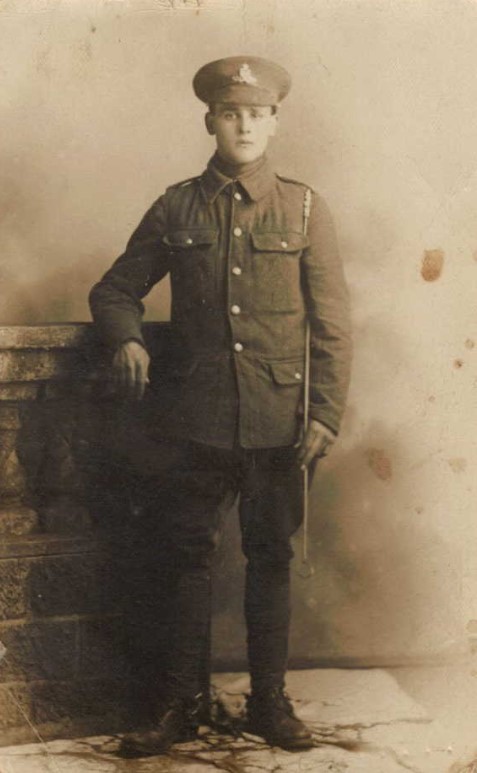
Alan James Howland was born in the spring of 1897 in Plymouth, Devon. One of nine children, his parents were pianist and musician Harman Howland and his Irish wife, Ellen.
The Howland family moved around as, presumably, Harman followed where his work was needed. The 1901 census records them living in Devonport: ten years later they had moved to Barnstaple. Alan, by this time, had left school and was working as an errand boy.
War came to Europe in 1914, and, at some point, Alan stepped up to play his part. Full details of his military service are no longer available, but from what remains it is clear that he enlisted in the Royal Garrison Artillery at some point before the summer of 1917.
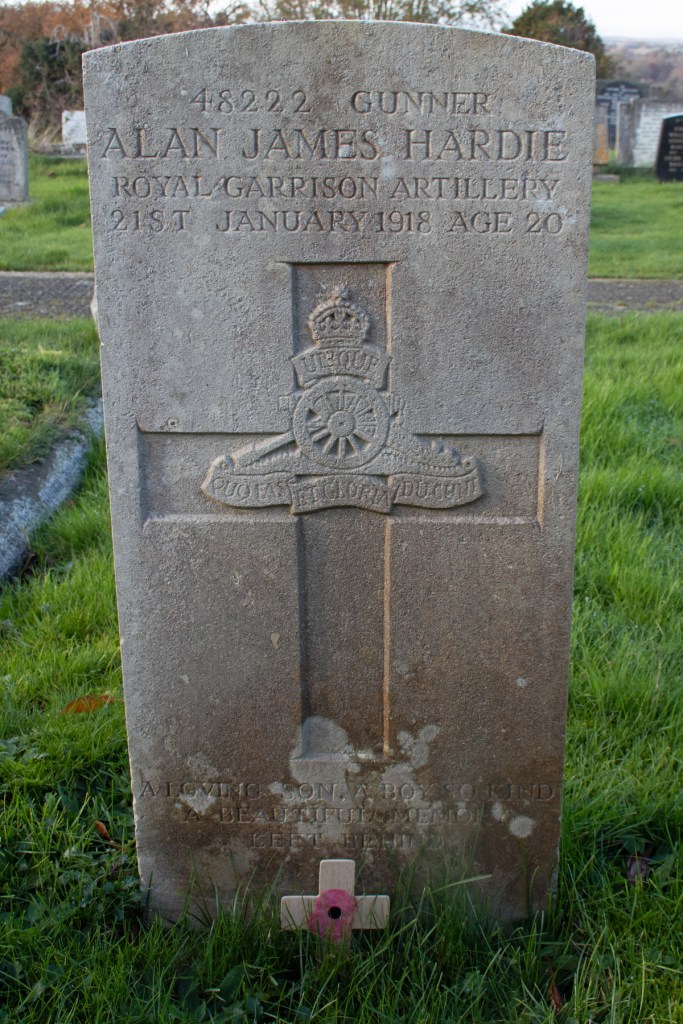
Alan enlisted using his mother’s maiden name of Hardie, and was assigned to the 274th Siege Battery. His troop saw action at the Somme and Arras, and a later newspaper report confirmed that Gunner Hardie saw action overseas:
[He] had been previously wounded but was gassed and entered Leicester Hospital on November 2nd 1917.
Taunton Courier and Western Advertiser: Wednesday 30th January 1918
Gunner Hardie had been admitted to the 5th Northern General Hospital following his injury. He seemed to be improving, but developed pneumonia and the lung condition was to take his life. He passed away on 21st January 1918, at the age of just 20 years old.
Alan James Hardie/Howland was brought back to Somerset for burial. He was laid to rest in the cemetery of the town where his family now lived, Ilminster, Somerset.
Alan’s older brother, William Harman Howland, also fought in the First World War. He enlisted in the 1st Battalion of the Hertfordshire Regiment, also using his mother’s maiden name. Again, details of his service are sparse, and Private Hardie seems to have transferred to the Royal Army Service Corps at some point during his military career.
William passed away on 18th August 1918, while in Germany. The cause of his death is not clear, but he was 28 years old. He was laid to rest in the Ohlsdorfer Cemetery in Hamburg.
James Oscar Stuckey was born in the summer of 1886, in Milford Haven, Pembrokeshire. The second of eight children, his parents were James and Minnie Stuckey. James Sr was a carter from Langport in Somerset, and his work took him across the country. James Jr’s older sister was born in Sandown, on the Isle of Wight, and, when his next sibling was born, the family had moved back to Somerset and were living in the village of Curry Rivel.
By the time of the 1901 census James Sr was working as a warehouseman. James Jr had also left school and found employment as an agricultural labourer.
On 24th March 1913, James married Margaret Beatrice Tilley – who was better known as Beattie. The couple set up home in Curry Rivel, and went on to have two children, Cecil and James.
By this time war was coming to Europe and, in January 1915, James stepped up to play his part for King and Country. He enlisted in the Royal Field Artillery, and was given the rank of Gunner. Over the next couple of years, he served in France and Italy, rising through the ranks to Bombardier and Corporal.
During this time, however, James’ health was being impacted. His troop was gassed while in France, and he was hospitalised a couple of times with bronchitis and tuberculosis, and it was TB that saw him evacuated to Britain for treatment in September 1918.
His condition was such that Corporal Stuckey was medically discharged from the army on 23rd November 1918, as he was no longer fit for duty. He returned to civilian life, and settled back into Curry Rivel.
He was well-known in the district, and being of a jovial disposition, was liked by everyone with whom he came into contact. He was a member of the Curry Rivel Male Friendly Society.
Langport & Somerton Herald: Saturday 11th December 1920
James’ lung conditions were to get the better of him. After a protracted illness, he finally succumbed, breathing his last on 3rd December 1920. He was just 34 years of age.
James Oscar Stuckey was laid to rest in the graveyard of St Andrew’s Church, in Curry Rivel.
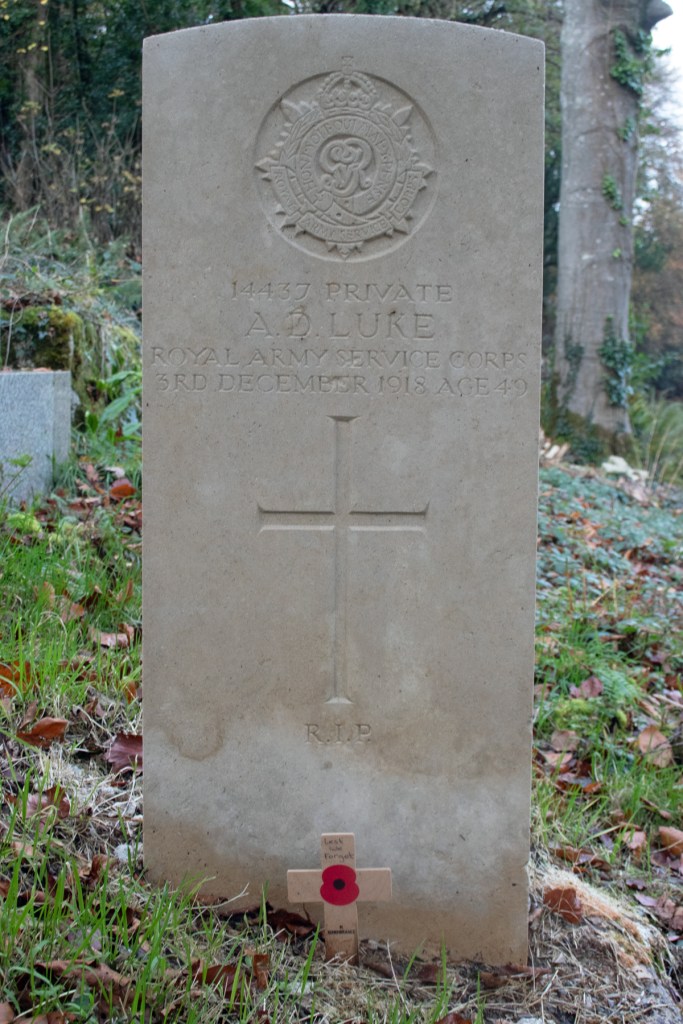
Alfred Docking Luke was born in 1869 in the village of St Breock, near Wadebridge, Cornwall. One of thirteen children, his parents were William and Selina Luke. William was a general labourer, and this is a trade into which Alfred followed.
Alfred wanted bigger and better things, however, and, on 27th September 1893, he enlisted in the Royal Garrison Artillery. Gunner Luke’s service records show that he was 5ft 9ins (1.75m) tall, and weighed 146lbs (66kg). He was noted as having blue eyes, brown hair and a fresh complexion. The record also noted a number of tattoos: a cross and a square and compass on his left forearm, the letters AL on the back of his left hand and rings on his middle and little fingers of the same hand.
Initially enlisting for seven years’ service, Alfred soon found himself sent to India. He served his whole time there, and it appears not to have been without incident. He was noted as having sustained a fractured skull on 2nd October 1896, although there is no further detail on the injury.
When Gunner Luke’s initial term of service came to an end, he elected to remain on active duty and, in the end, remained in India until December 1905, before returning home to be demobbed.
Back in Cornwall, Alfred built his life again. He found more labouring work, this time in a manure store in Wadebridge, and married the recently widowed Bessie Williams. She had two children, and the family set up home together.
A sense of duty, or a love of the army life, remained in Alfred’s heart, however and, when war was declared, he was keen to play his part again. He enlisted in the Royal Army Service Corps in July 1915, and, despite being 45 years old by this point, he soon found himself in Northern France.
Private Luke spent the next three years supporting the lines on the Western Front, but by the autumn of 1918, life was taking its toll on him. On 8th November 1918 he was admitted to a camp hospital, having contracted influenza. Tests for tuberculosis proved negative, although his breathing was laboured, and he was medically evacuated back to Britain for further treatment.
Admitted to St John’s Hospital in Cheltenham, the medical report makes for some grim reading:
Patient on admission had paralysis of soft palate lulateral and ptosis rt. eye. Tongue slightly pointing to the left. Difficulty in articulation due not only to palatal paralysis but also to apparently labial and dysphagia for fluids and solids. Fluids returned through nose. The symptoms, in short, of bulbar paralysis.
Private Luke’s condition worsened. He passed away the day after being admitted, on 3rd December 1918. He was 49 years of age.
Alfred Docking Luke’s body was brought back to Cornwall for burial. He was laid to rest in the peaceful, wooded graveyard of St Breoke’s Church in his home village.
St Breoke’s was the family church, and the Luke family were to be reunited again. Alfred’s mother Selina passed away a month after her son, at the age of 68; his father William followed in May 1919, at the age of 78.
Frederick Walter John Milverton was born on 26th June 1888 in the Somerset village of Rimpton. One of seven children, his parents were farm workers George and Mary Milverton.
When he left school, it was natural for Frederick to follow in his father’s footsteps. The 1901 census recorded him as working as a farm lad in Leigh, Dorset, while in 1911 he was back at the family home, where he was formally employed as a rabbit trapper.
George passed away in 1913 and, with war fast approaching, Frederick remained at home, to help support his mother. But he eventually received his enlistment notice and, on 28th February 1916, he joined the Royal Marine Artillery.
Private Milverton’s service records show that he was 5ft 8ins (1.73m) tall, with dark brown hair, blue eyes and a fresh complexion. After five months’ initial training, Frederick was awarded the rank of Gunner 2nd Class, and assigned to the cruiser HMS Euryalus.
For the next couple of years Gunner Milverton remained on board Euryalus, serving in the Mediterranean, the Middle East, India and Hong Kong. He transferred to HMS Lavatera in March 1918, and saw out the remainder of the war on board.
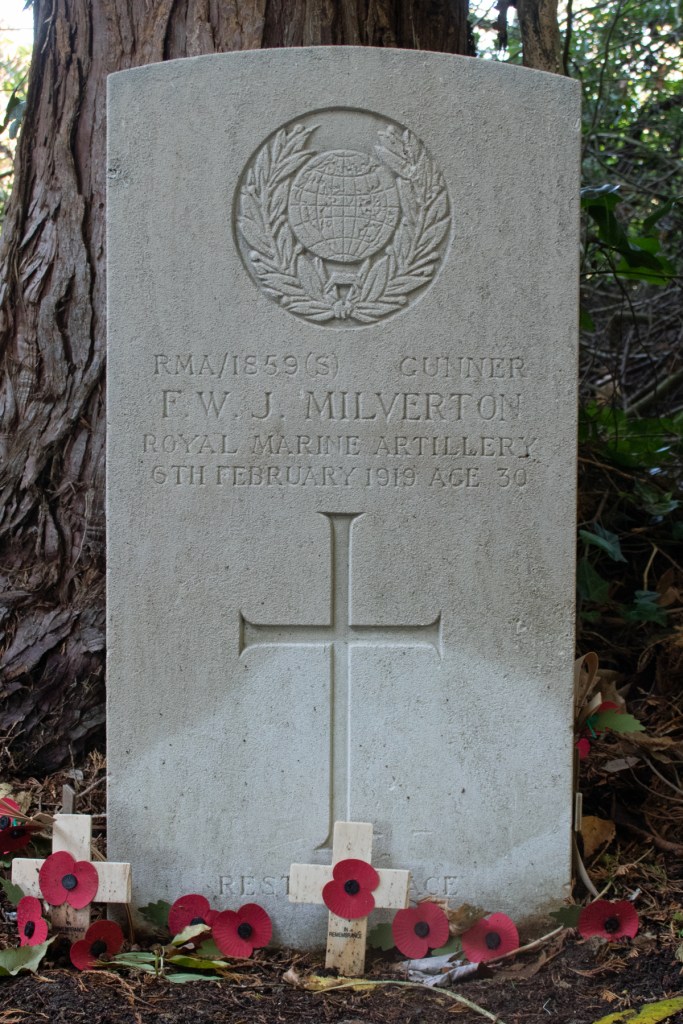
In January 1919 Gunner Milverton returned to home soil, and was assigned to the Royal Marine Artillery Headquarters in Eastney, Hampshire. It was here, however, that he fell ill, and was admitted to the Royal Naval Haslar Hospital with bronchial pneumonia. Tragically the condition was to get the better of him: Frederick passed away on 6th February 1919, at the age of 30 years old.
Frederick Walter John Milverton’s body was brought back to Somerset for burial. He was laid to rest in the quiet graveyard of St Mary’s Church in his home village of Rimpton.
Henry William Brewer was born the spring of 1869 in Bitton, Gloucestershire. His is a common name for the area, and so it is not easy to unpick details of his early life.
On 5th May 1895, Henry married Ann Williams, a carter’s daughter from Keynsham, Somerset. The couple wed in St Thomas’ Church in Widcome, near Bath, and their marriage certificate gives Henry’s trade as a labourer, and his father as Louis Brewer.
The young couple up home in Kingswood, near Bristol, and went on to have three children, Henry, Lucy and Ethel. The 1901 census recorded Henry’s trade as a coal miner and hewer, but noted that he was also a Gunner in the Royal Artillery.
Sadly, Henry’s military records are lost to time, but if he was employed in the army, this would account for the lack of documents relating to his early life. It may be that he had completed his initial term of service by the time he and Ann married, or that he was a volunteer with the Royal Artillery at the time of the census.
Whatever his connection with the army, when war broke out he was called into service. He joined the 30th Company of the Royal Garrison Artillery, and was based in Weymouth, Dorset, as part of Britain’s South Coast defences.
Without military documents, it’s challenging to identify Gunner Brewer’s trail during the war. Sadly, the next documents relate to his passing. He was admitted to a military hospital in Weymouth, suffering from the kidney condition nephritis. This was ultimately to kill him, and he passed away on 28th February 1917, at the age of 48 years old.
Henty William Brewer’s body was brought back to Gloucestershire for burial. He was laid to rest in the graveyard of St Mary’s Church in Bitton.










 Death and Service