Tag Archives: illness

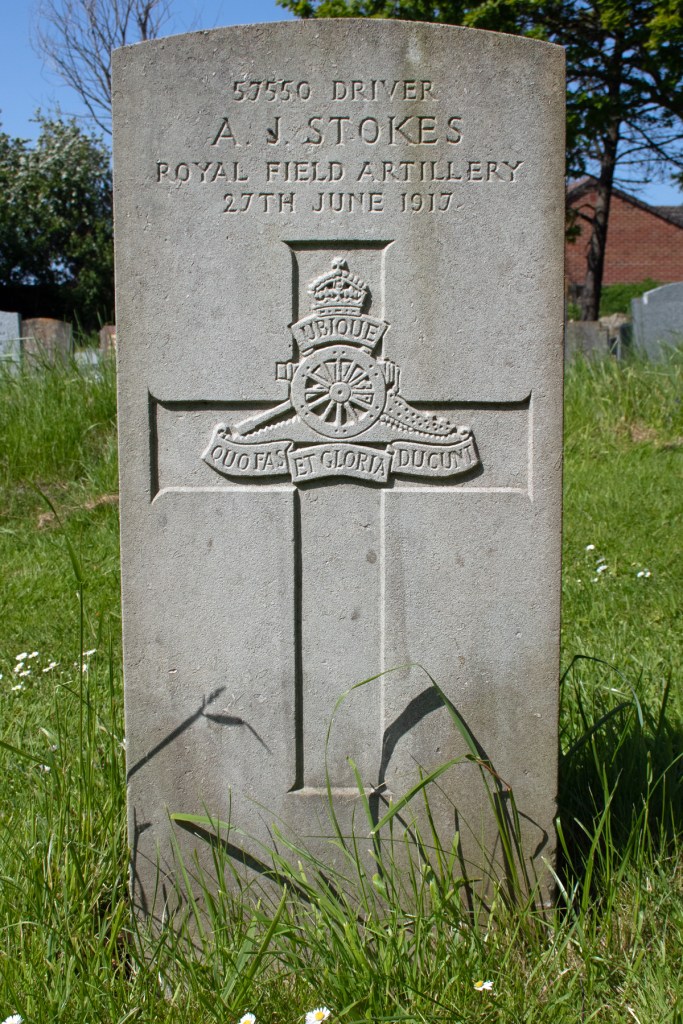
Driver Albert Stokes

Driver Albert Stokes

Albert John Stokes was born in the autumn of 1878, the fourth of seven children to John and Mary Ann Stokes. John was a cord winder from Puriton in Somerset, and it was in the village, in the house next to his parents, that he and Mary Ann raised their young family.

By the 1890s, John had turned his hand to boot making. When he finished his schooling, however, Albert found more manual work, and by the time he got married in 1903, he was working as a quarry labourer.

Albert’s wife was Minnie Nichols, a cooper’s daughter, who lived just up the road from the Stokes family. They married in Bridgwater Registry Office on Christmas Eve 1903. The newlyweds set up home in a small cottage in Puriton, and went on to have six children, although only four survived childhood.

When war came to Europe, Albert was one of the first to join up. He enlisted on 7th December 1914, and was assigned to the Royal Field Artillery as a Driver. His service records give an insight into the man he had become: he was 5ft 7ins (1.7m) tall, weighed in at 136lbs (61.7kg) and was of good physical development.

Driver Stokes spent the next eight months on home soil. He was sent to France on 21st July 1915, and was involved in the fighting at Loos. It was here, that he developed a persistent cough and, by October, he was back on home soil. That winter Albert contracted influenza, which then developed into haemoptysis.

While Driver Stokes did recover, he was admitted to the Voluntary Aid Detachment Hospital in Bishops Stortford in May 1916, having come down with influenza once more. He was transferred to the 1st Eastern General Hospital in Cambridge for a medical assessment, and this led to an eventual discharge from the army in August.

Albert returned to Somerset after leaving the Royal Field Artillery, although his trail does go cold. He was at home when he passed away on 27th June 1917, at the age of 39 years old. The cause of his passing is not recorded, but it is likely to have been as a result of a repeat of the conditions that had led to him leaving the military.

Albert John Stokes was laid to rest in the peaceful graveyard of St Michael’s Church in his home village of Puriton.


Ordinary Seaman Bertie Clark

Ordinary Seaman Bertie Clark

Bertie Baden Clark was born on 5th August 1900 in the hamlet of Dunball, near Puriton in Somerset. The third of seven children, his parents were quarry and cement works labourer George Clark and his wife, Bessie.

When war came to Europe, George stepped up to play his part. Despite being 44 years old, he enlisted in the Royal Army Service Corps on 4th November 1915 and, within a year, was in France. He remained posted at the No. 4 Remount Depot until October 1918.

“On the morning of the 1st October 1918, I left the 26th Squadron 4 Base Remount Depot riding a horse and leading one to exercise about a mile & half from the Squadron while proceeding by the side of the railway line my horse was frightened by the whistle of a railway engine & ran away with me throwing me to the road and stepping on my right ankle.”

Private Clark was initially treated at the No. 2 Canadian General Hospital, but was soon invalided back to Britain and placed on furlough until being formally demobbed from the army early in 1919.

Bertie, meanwhile, could see the excitement of the war passing him by. Determine to play is part before it was too late, he gave up his job as a labourer on 13th July 1918 and enlisted in the Royal Naval Volunteer Reserve.

Given the rank of Ordinary Seaman, his service records confirm that he was 5ft 6in (1.68m) tall (1in, or 2.5cm, taller than his father), with dark brown hair, grey eyes and a fresh complexion. He was noted as having a scar on his right knee.

Bertie was sent to HMS Victory, the Royal Naval Dockyard in Portsmouth, Hampshire, for training. Tragically, this was to be his only posting. He was admitted to the dockyard hospital early in October, suffering from double pneumonia and influenza. The condition was to take his life, and he passed away on 10th October 1918, at the age of just 18 years old.

Bertie Baden Clark’s body was brought back to Somerset for burial. He was laid to rest in the quiet graveyard of St Michael’s Church in Puriton, the funeral attended by his family, including his recently returned father, George.


Private Frederick Chilcott

Private Frederick Chilcott

Frederick Chilcott was born in Bridgwater, Somerset, early in 1867. He was the fifth of thirteen children to labourer and kiln worker Henry Chilcott and his wife, Ellen.

When he finished his schooling, Frederick also found labouring work. He wanted bigger and better things, however, and the opportunity for a career in the army offered him just that. On 14th January 1888 he enlisted in the Royal Artillery. His service records confirm he was 5ft 6ins (1.68m) tall, and weighed 119lbs (54kg). He was noted as having dark brown hair, dark hazel eyes and a fresh complexion. He also had a scar on his forehead and a tattooed dot on his right forearm.

Frederick was initially given the rank of Driver and was assigned to the regiment’s 3rd Brigade Depot. He was sent to India in February 1889, and remained there until November the following year, when his troop returned to Britain.

Back on home soil Frederick’s role changed and he was given the rank of Gunner. On 1st January 1892, he was promoted to Acting Bombardier, but, on his own request, he reverted to his previous rank just three months later. On 15th January 1895, Gunner Chilcott was stood down to reserve status, having completed seven years’ service.

On 16th April 1895, Frederick married Eliza Stockham. She was a labourer’s daughter from the village of Puriton, to the north of Bridgwater, and it was here that the couple settled. Living in a small cottage, they went on to have six children between 1898 and 1911.

Frederick’s time in the army, however, wasn’t quite done. With the Second Boer War breaking out, he was recalled to the now Royal Field Artillery in January 1900. Sent to South Africa, Gunner Chilcott remained overseas for a year and was recognised for his commitment in the campaign.

Frederick returned to Britain on 3rd January 1901, and was finally stood down from the army in March that year, having fulfilled his twelve years’ contract. He returned home to Puriton, his service records noting that his character was ‘very good’.

The 1911 census found Frederick employed as a labourer in the local cement works. He and Eliza living in a small cottage in Puriton with four of the children (their oldest son was with Eliza’s parents, while she was pregnant with their youngest).

Conflict was knocking on England’s shore by this point, and when conflict broke out, Frederick appears to have stepped up to play his part once more. He was 47 years old when war was declared and, as such, would not have been required to enlist. Full details of his service are no longer available, but he had certainly joined the Army Veterinary Corps by the summer of 1917.

Private Chilcott is likely to have remained on home soil, but towards the end of his service was based in Curragh, County Kildare, Ireland. It was while here, on 23rd December 1917, that he suffered an aneurysm, passing away in the town’s military hospital as a result. He was 50 years of age.

Frederick Chilcott’s body was brought back to Somerset for burial. He was laid to rest in the quiet graveyard of St Michael’s Church in his home village, Puriton.


Private Stanley Biffen

Private Stanley Biffen

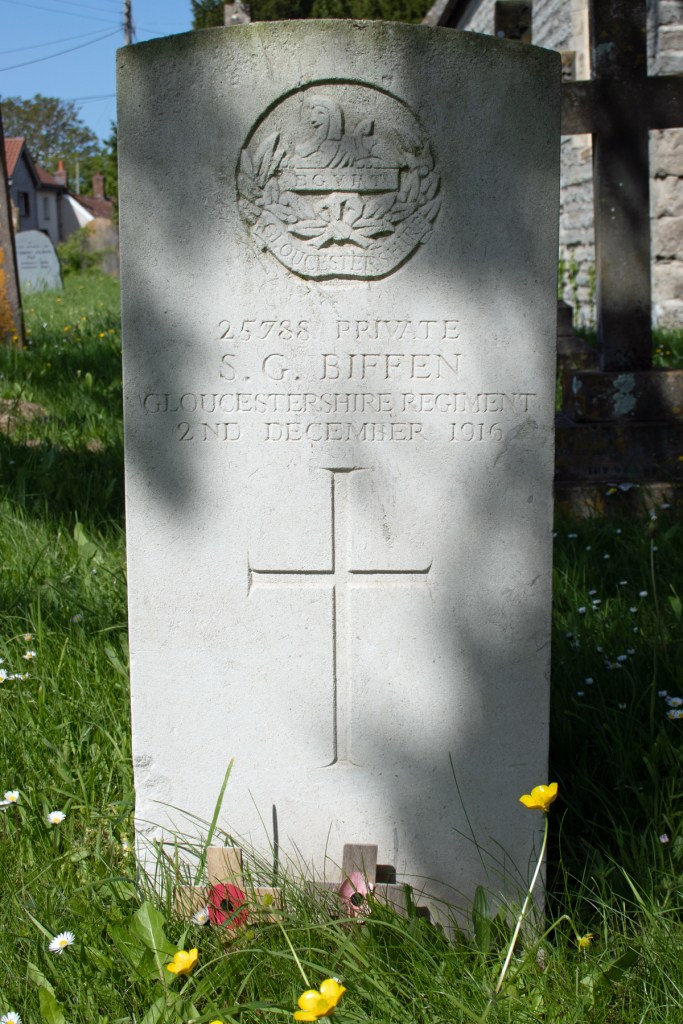
Stanley George Oliver Biffen was born in the autumn of 1894 in the Somerset village of East Huntspill. He was the second child to Oliver and Fanny Biffen, although his older sibling, sister Florence, had passed away at just three months of age.

Oliver was a carter and farm labourer, and the family went where the work was. The 1901 census found them living in Eastover, Bridgwater, Fanny’s widowed father, George, also living there. Ten years later, the four of them had moved to the village of Stawell. Stanley had finished his schooling, and had also taken up farm work.

When war came, Stanley stepped up to play his part. Full details of his service are lost to time, but he had enlisted in the Army by the spring of 1915. He initially joined the 1st Battalion of the Somerset Light Infantry, and by May that year, was in France.

It is not possible to track Private Biffen’s movements during the conflict, but he did transfer across to the Gloucestershire Regiment at some point. Assigned to the 7th (Service) Battalion, his was a troop that served at Gallipoli and in North Africa, although there is no evidence that Stanley fought in there.

The only other concrete evidence available for Private Biffen relates to his passing. By the autumn of 1916, he had been admitted to the 1st Western General Hospital in Fazakerley, Liverpool. He was suffering from phthitis, or tuberculosis, and this was the condition that was to get the better of him. He passed away on 2nd December 1916, at the age of just 22 years old.

The body of Stanley George Oliver Biffen was brought back to Somerset for burial. He was laid to rest in the quiet graveyard of Stawell Church.


Stanley’s parents had now lost both of their children, and this is likely to have taken a toll on them. Fanny passed away in December 1924, at the age of 64 years old. Oliver died just a year later aged 54 years old.


Private Eric Grant

Private Eric Grant

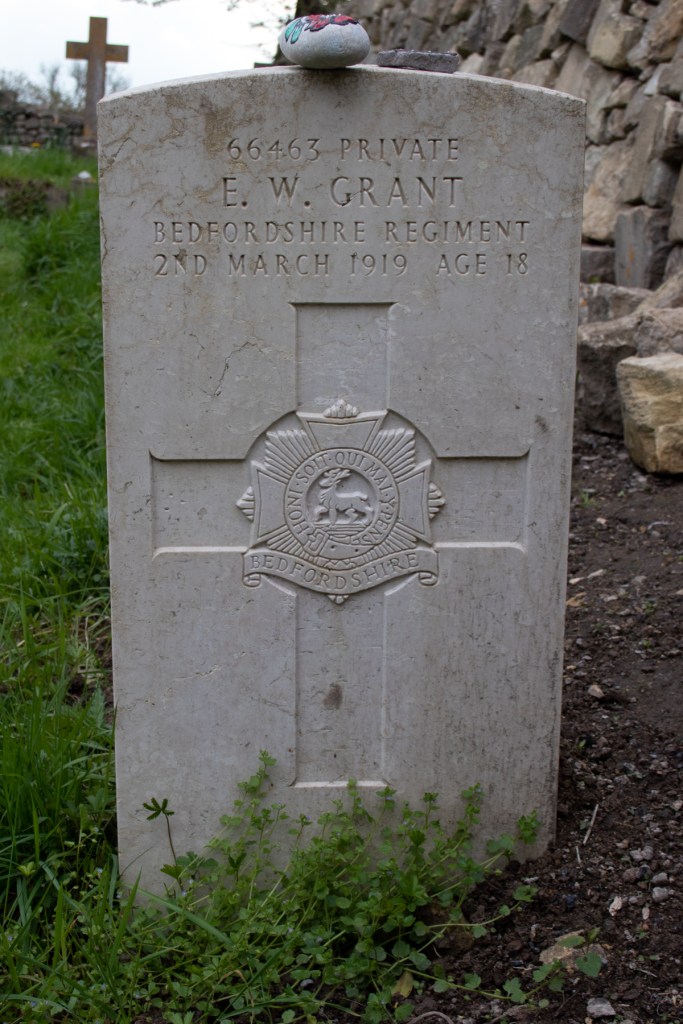
Eric William Grant was born at the start of 1901, the middle of three children to Ernest and Annie Grant. Ernest was a carpenter from Bath, Somerset, and it was here they he and Annie raised their young family.

Little information is available about Eric’s young life. When war came to Europe, his father joined up, enlisting in the Royal Engineers as a Sapper. Keen not to miss out, Eric also signed up, lying about his age to ensure he was accepted.

When he joined in February 1916, Private Grant was assigned to the 52nd (Graduated) Battalion of the Bedfordshire Regiment. Full details of his service are lost to time, but towards the end of the war, Eric was based in East Anglia.

It was here, in early 1919, that Private Grant fell ill. He was admitted to the Norfolk War Hospital, but whatever his condition, it proved fatal. He passed away on 2nd March, aged just 18 years old.

Eric William Grant’s body was brought back to Somerset for burial. He was laid to rest in the peaceful graveyard of St Michael’s Church, Monkton Combe, where the family now living.


Despite her understandable concern at seeing her husband and son go off to war, and for Eric to die because of it, Annie was to be reunited with Ernest. Again, full details of his service are lost, but the 1939 Register found him and Annie living with their daughter and Ernest’s brother in Bathavon, Somerset.

Annie passed away in 1947, at the age of 73. Ernest lived on until 1952, having lived to 76 years old. Both were buried in St Michael’s Churchyard, reunited with their son at last.


Boy Edwin Hiscock

Boy Edwin Hiscock

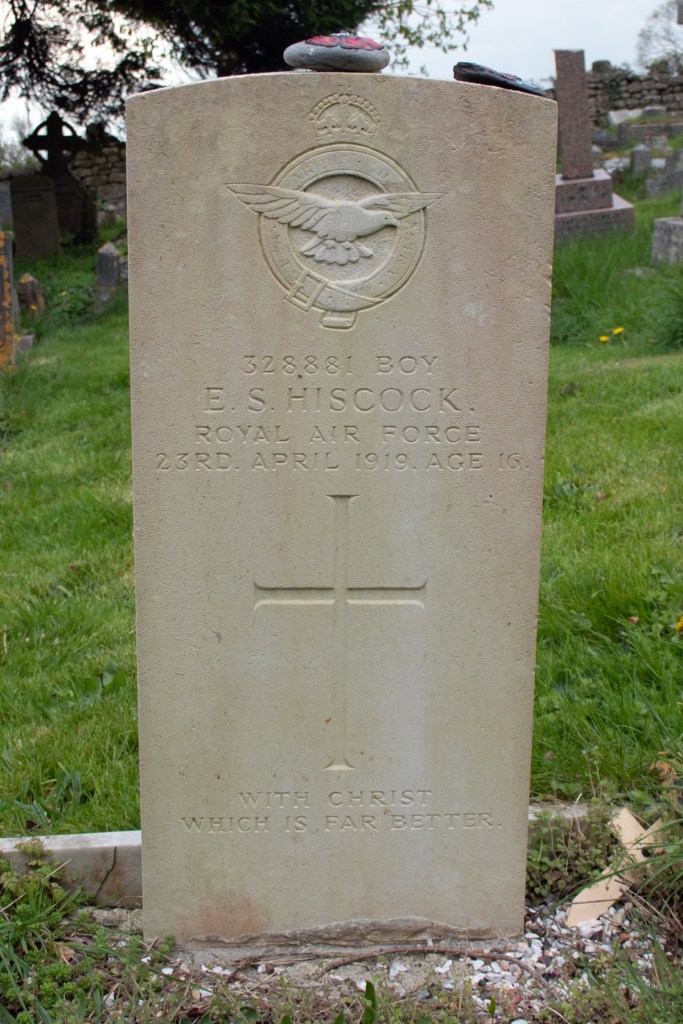
Edwin Sydney Hiscock was born in Corsham, Wiltshire, 11th November 1902. The older of two children, his parents were quarry manager Edwin Hiscock and his wife, Helen.

When he finished his schooling, Edwin Jr found work as a clerk, but as a young teenager, the thrill and excitement of the war going on around him, drew him to a life in the Royal Air Force. He enlisted on 27th March 1919, and was dispatched to the School of Technical Training at Halton Camp near Aylesbury, Buckinghamshire. Boy Hiscock’s service records note that he was 5ft 9ins (1.75m) tall, with dark hair, brown eyes and a fresh complexion.

Edwin’s life in the military was to be cut tragically short. He had lived a cosseted life in rural Somerset – the family having moved to Monkton Combe, near Bath. At the RAF base, he was surrounded by men and women from across the country, and was suddenly exposed to illnesses that he would not have encountered had he remained at home. It is unclear what he contracted but in the months after the First World War, influenza swept Europe, so this is a likely suspect. Edwin passed away at the base on 23rd April 1919, having completed 27 days’ service. He was just 16 years of age.

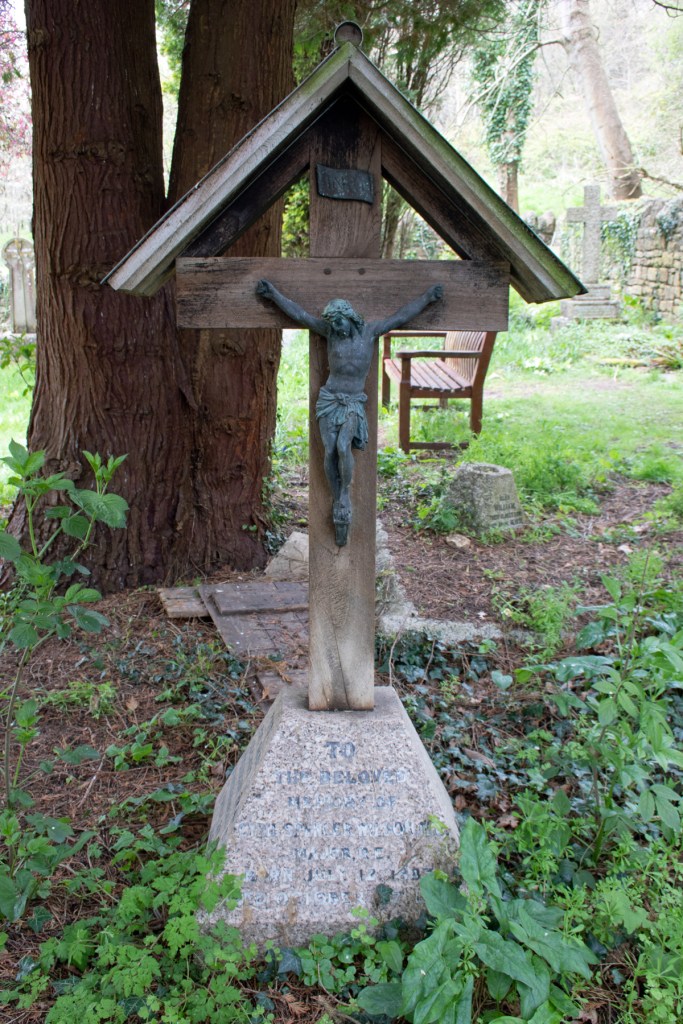
The body of Edwin Sydney Hiscock was brought back to Somerset for burial. He was laid to rest in the peaceful graveyard of St Michael’s Church, Monkton Combe.


Edwin’s headstone includes the epitaph “With Christ which is much better”, a bitter pill to swallow.


Gunner Valentine Wilkinson

Gunner Valentine Wilkinson

Valentine Burnett Wilkinson was born early in 1889 in Combe Down, Somerset. One of eight children, his parents were Harry and Eliza Wilkinson, Harry was from nearby Bath and worked as a gardener, and this is the trade into which Valentine also went when he finished school.

In the spring of 1913, Valentine married Florence Moody. She was the daughter of a stone mason and, at the time of the 1911 census, she was employed as a live-in sewing maid at Monkton Combe Junior School.

Gardening seems to have been a footstep to something bigger for Valentine, and he soon found other employment, as a police constable. He and Florence moved to Street, near Glastonbury, and this is where they were living when war broke out.

Keen to play his part, Valentine enlisted in the Royal Garrison Artillery on 11th December 1915. He was placed on reserve, possibly because of his occupation, and was not formally mobilised until the end of June 1917, just six weeks after Florence had given birth to their first and only child, Joan.

Gunner Wilkinson’s service records note that he was 5ft 11ins (1.8m) tall, and had a scar on his right wrist. He spent five months training, split between No. 3 Depot in Plymouth, Devon, 473 Siege Battery and No. 1 Reinforcing Depot in Bexhill-on-Sea, Sussex. On 3rd November 1917, however, he was sent to France, and was attached to the 234th Siege Battery.

Gunner Wilkinson’s time overseas was to be brief, however. He was caught up in a gas attack in December, and evacuated back to Britain for treatment. His health was now impacted and, during the summer of 1918, he was admitted to hospital having contracted pleurisy. After two months in hospital, Valentine was sent to the Military Convalescent Hospital in Ashton-in-Makerfield, near Wigan.

The war was in its closing stages by this point, and in November 1918 Gunner Wilkinson resumed some of his duties, albeit on home soil. His health was still suffering, and he contracted tuberculosis on the lung and throat. He was formally discharged from the army on 27th February 1919, no longer physically fit to serve.

Valentine returned home to Somerset, and it was here, on 1st April 1919, that his body finally succumbed to the lung conditions that had dogged him for nearly eighteen months. He was just 30 years of age.

Valentine Burnett Wilkinson was laid to rest in the quiet graveyard of St Michael’s Church in the parish of his childhood home, Monkton Combe.


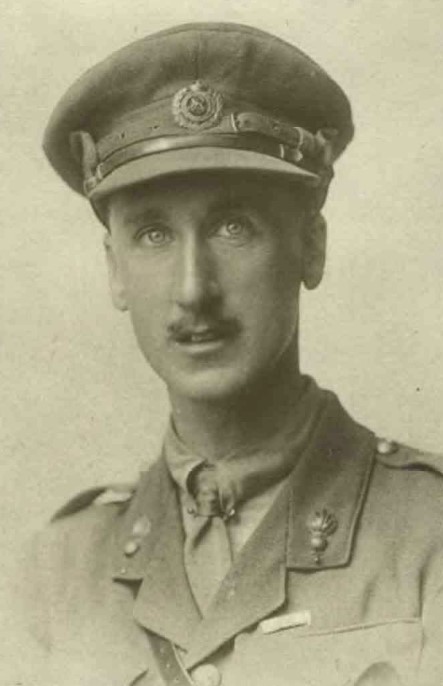
Major Cyril Wilson

Major Cyril Wilson

Cyril Spencer Wilson was born on 12th July 1883 in Charlcombe, Somerset. The youngest of three children, his parents were John and Edith Wilson. John was a solicitor who went on to become President of the Bath Law Society and, because of his standing, Cyril and his siblings had a comfortable upbringing: all three censuses covering his life – in 1891, 1901 and 1911 – all show the family living in a large villa in Charlcombe, with a cook and a housemaid to support them.

[Cyril] was educated at Bath College and Lancing College, and then studied engineering at Bristol University. He then became an articled pupil at the Great Western Railway Works at Swindon. Very interested in, and a keen supporter of, the Territorial movement, he was a Captain of the [Royal Engineers] Wilts Fortress Engineers when war broke out.

Bath Chronicle and Weekly Gazette: Saturday 2nd November 1918

Cyril had begun work for the Great Western Railway in July 1902, and became attached to the Institute of Civil Engineers the following January.

Captain Wilson formally enlisted when war was declared, and was soon sent to France. “He was awarded the Military Cross early in the summer of 1917, after being twice mentioned in despatches for excellent work.[Bath Chronicle and Weekly Gazette: Saturday 2nd November 1918]

Cyril was promoted to Major soon after this, and would go on to serve in France for more than a year more. In February 1918 he married Amy Pounds, the daughter of a bank clerk from East London and the couple exchanged vows in the city.

Major Wilson returned to France, but contracted dysentery that summer. He returned to Britain to recuperate, but came down with pneumonia, and this was to take his life. He died on 27th October 1918, aged 35 years old.

Cyril Spencer Wilson’s body was brought back to Somerset for burial. He was laid to rest in the family plot in St Mary’s Churchyard, Charlcombe.


Major Cyril Wilson
(from ancestry.co.uk)

Ordinary Seaman William Bruton

Ordinary Seaman William Bruton

William Bruton was born on 9th August 1899, the oldest of two children to William and Kate Bruton. William Sr was a grocer from Charlcombe to the north of Bath, Somerset, but it was in the Walcot area of Bath itself that the family settled.

Kate died in November 1904, at the age of just 35 years old, and William Sr raised his children on his own. He married a second time, to Edith Elly in 1910, and the couple went on to have a daughter, Mona, the following year.

William Jr – who was known as Willie, to avoid confusion with his father – was still in school at the time of the 1911 census, but when he left a few years later, he found work as an engine cleaner. War had come to Europe by this point, but to begin with Willie was too young to play his part.

He finally got his chance to enlist towards the end of the conflict, and joined the Royal Navy as an Ordinary Seaman on 18th July 1918. His service document record that Willie was 5ft 11ins (1.8m) tall, with brown hair, hazel eyes and a fresh complexion. He was also noted as having a scar on his upper lip.

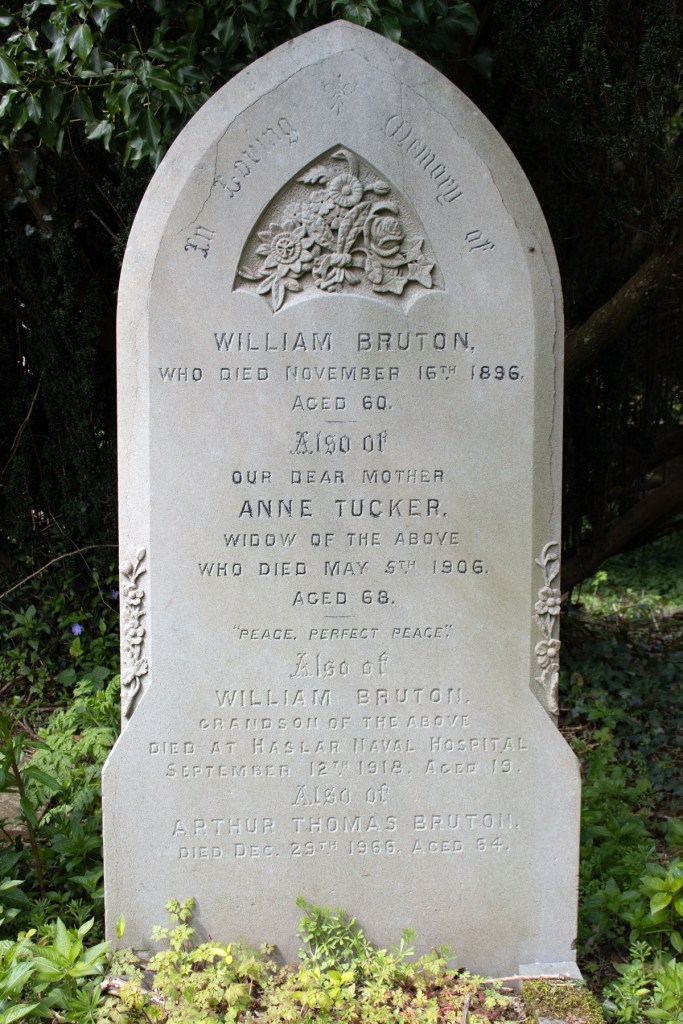
Ordinary Seaman’s first posting was to be HMS Victory, the Royal Naval Dockyard in Portsmouth, and, tragically, this was also to be his last. Within a matter of weeks he had contracted pneumonia, and he passed away from the condition on 12th September 1918. He was just 19 years of age.

William Bruton was brought back to Somerset for burial. He was laid to rest in the family plot in Lansdown Cemetery, overlooking the city of his birth.


Captain Frederick Walker

Captain Frederick Walker

Frederick Murray Walker was born on 29th July 1862 in the village of Terregles, Kircudbrightshire, Scotland. The fifth of eleven children, his parents were Colonel Sir George Gustavus Walker, Member of Parliament for Dumfries & Galloway, and his wife, Anne. Sir George owned the Crawfordton Estate, and this is where Frederick was raised, with a retinue of fourteen staff to help the family.

Following his father’s military career, Frederick felt a draw to serve. On 15th July 1875, he entered the Royal Navy as a Midshipman. He set out to build a dedicated career, visiting most parts of the world in the process.

While Frederick’s initial service took him to the Mediterranean – where he received the Egyptian Medal and Alexandria Clasp – by 1883 he was out in China, but he also spent time in India and South Africa. In 1882 he was promoted to Sub Lieutenant, three years later he rose to the rank of Lieutenant. By 1899, Frederick had become a Commander.

By his own request, Frederick retired from the Royal Navy on 1st August 1909. He was now 47 years old, and had spent 34 years in service and was given the rank of Captain as a mark of his career.

On 19th June 1891, Frederick had married Lucy Scriven in St Saviour’s Church, Paddington, London. They would go on to have seven children, and to begin with, the life of a Naval Captain took Lucy around the coastal ports of Southern England. When Frederick retired, however, the family settled in a large house in Milford-on-Sea, Hampshire, where they were supported by a governess, cook, parlour maid and housemaid.

When war broke out in 1914, Captain Walker stepped up once more to serve his King and Country. He remained in territorial waters and was given successive command of the yachts James, Zaria and Albion III. By 1917, Frederick’s health was beginning to suffer, and he was placed on HMS Victory’s reserve books, ready should Portsmouth’s Royal Naval Dockyard need his service.

Frederick was not to be called to action again. By the time the Armistice was declared Frederick’s condition was worsening. He had developed cancer of the tongue, and it was having a real impact. He was admitted to the Haslar Hospital in Portsmouth, and passed away there on 7th February 1919, at the age of 46 years old.

By this point the family had relocated to Bath, Somerset, and this is where Frederick Murray Walker’s body was brought for burial. He was laid to rest in the prestigious Lansdown Cemetery, overlooking the city.


Captain Frederick Walker
(from ancestry.co.uk)