Tag Archives: illness

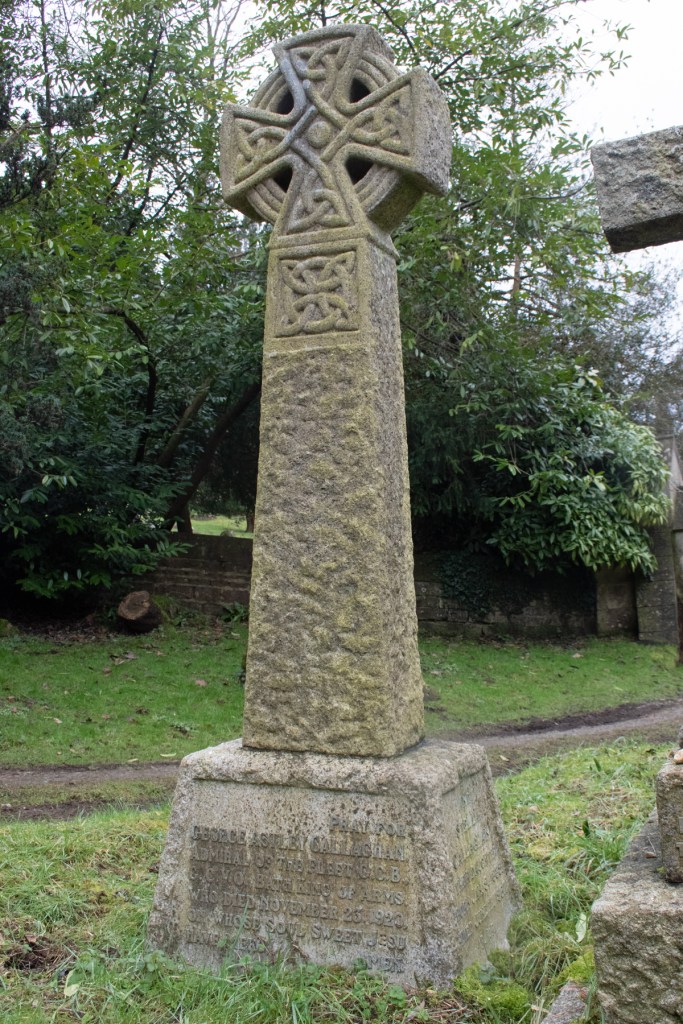
Admiral of the Fleet Sir George Callaghan

Admiral of the Fleet Sir George Callaghan

George Astley Callaghan was born in London on 21st December 1852, the third of six children to Frederic and Georgiana Callaghan. Frederic was born in Ireland and was the son of MP and landowner Daniel Callaghan. He built a career for himself as a magistrate and set up home in Bath, Somerset with Cheltenham-born Georgiana.

The family had means and the 1861 census records them living at a five-storey Georgian house in Catharine Place, Bath, with five live-in servants: a butler, cook, housemaid, nursemaid and nurse.

George enlisted in the Royal Navy in January 1866, and was assigned to the training ship HMS Britannia. From here, his career was to prove meteoric. He was promoted to the rank of Midshipman in October 1867 and by 1870 he was serving in the East Indies. On 15th April 1872 he gained the rank of Sub-Lieutenant, and was promoted to full Lieutenant exactly three years later.

In 1877, Lieutenant Callaghan received a commendation for saving the lives of sailor whose boat had capsized in the Irrawaddy River. George was assigned to HMS Excellent, a gunnery school, in 1880, and formally joined the staff there in 1882. Back on the open seas by 1885, he was promoted to Commander on 31st December 1887 and given control of the battleship HMS Bellerophon. By 1894, George had been promoted again, to the rank of Captain, and took on the additional duties of naval advisor to the War Office.

As the new century dawned, George was mentioned in dispatches for his support during the Boxer Rebellion. Further commands followed, including HMS Edgar and HMS Caesar, both in 1901. He was made Captain of Portsmouth Dockyard and then naval aide-de-camp to the King in 1904. By the following year, he was given the rank of Rear Admiral, became Second-in-Command of the Channel Fleet in 1906, Second-in-Command of the Mediterranean Fleet in 1908. In December that year he was awarded Knight Commander of the Royal Victorian Order for the aid he provided to survivors of the Messina earthquake.

In April 1910, George was knighted and promoted to Vice Admiral, and within eighteen months he was made Commander-in-Chief of the Home Fleet, gaining the rank of Admiral in November 1911.

During this time of military promotion, George had also had his own family. On 2nd February 1876, he had married Edith Grosvenor in St Andrew’s Church, Walcot, Bath. The couple went on to have four children: Dorothy, Cyril, Noël and Stella.

A naval officer’s wife was destined to be a lonely life, and the census records seem to reflect this. In 1881, Edith and Dorothy were visiting a curate and his family in Wiltshire. Ten years later, Edith and her four children were living at the family home in Bathwick, with one visitor and three servants. The 1901 census found Edith, Cyril (who was now a midshipman himself) and Noël living in Devonport with a cook and two other servants. By 1911, Edith had moved again. She was 54 by this point, and based at a house in Havant, Hampshire, with a cook and two maids. All of this time, of course, George was away at sea, performing his duties.

George, by this point, had spent years preparing for the war he knew was coming. However, in July 1914, the First Lord of the Admiralty, Winston Churchill, commanded Sir John Jellicoe to relieve George of his position as Commander-in-Chief of the Home Fleet. Whether Churchill believed that Sir Callaghan was now too old to successfully carry out the duties the advancing conflict would impose upon him is unclear. It must have disappointed the 62-year-old George, however.

His work continued, however: he was appointed First an Principal Naval Aide-de-Camp to the King in September 1914, and became Commander-in-Chief of The Nore in three months later. He was promoted again, to Admiral of the Fleet, in April 1917, but subsequently retired less than a year later.

George’s life over the next couple of years goes a little quiet. Indeed it is only in November 1920 that further information is available.

The death occurred in London yesterday afternoon of Admiral of the Fleet Sir George Callaghan KCB. He had been ill for some months, and the immediate cause of death was an affection of the heart.

The Scotsman: Wednesday 24th November 1920

Sir George’s passing at his London home was reported in most of the press, highlighting his military achievements and decorations. His funeral was held at Westminster Abbey, and he was then laid to rest in the graveyard of St Mary’s Church in Bathwick, not far from his and Edith’s main home.
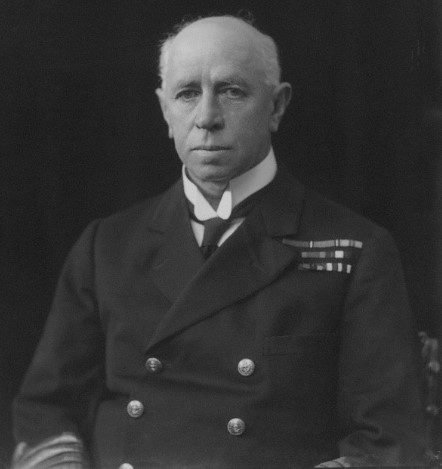

Sir George Callaghan

Petty Officer 1st Class Samuel Bailey

Petty Officer 1st Class Samuel Bailey

Samuel Inkerman Bailey was born in the summer of 1861 in Bath, Somerset. The youngest of five children, his parents were James and Mary Bailey. James was an ostler, or groom, but he died in August 1862, when his son was barely a year old.

Mary was left a widow, with a young family to raise and, as so many women in her position did in Victorian Britain, she remarried. She wed tailor Robert Lankesheer, a widower with four children of his own. The couple went on to have three further children – three half-siblings to Samuel.

While the 1871 census suggests that Robert welcomed Mary’s youngest into the family home, it seems that things were not so comfortable for Samuel. On 22nd May 1878, he enlisted in the Royal Navy, destined for a life at sea. He was only 16 years old at this point – although, interestingly, his service records give his date of birth as 27th March 1862. They also note that he was 5ft 2.5ins (1.59m) tall, with light brown hair, blue-grey eyes and a fair and fresh complexion.

As he was too young to formally enlist, Samuel was given the rank of Boy 2nd Class and sent to HMS Impregnable for training. Just over a year later, he was promoted to Boy 1st Class and, on 10th January 1880 he was given his first posting, on board the sloop HMS Dryad.

It was while Samuel was on board the Dryad that he came of age, and was officially inducted into the Royal Navy. He signed up for ten years service, and was given the rank of Ordinary Seaman 2nd Class. Samuel was certainly a dedicated young man: within three months he was again promoted, this time to Ordinary Seaman. He remained on Dryad until February 1884, by which time he had been promoted again, to Able Seaman.

Samuel ended up serving until 31st March 1900. During his time with the Royal Navy, he continued to distinguish himself, his character being noted as Very Good on each of his service reviews. He served on thirteen vessels, and was promoted through the ranks, to Leading Seaman (in August 1885), Petty Office 2nd Class (in January 1894) and Petty Officer 1st Class (in September 1897).

When he was stood down to the naval reserve, Samuel returned to Somerset. He found a job as a superintendent at the public baths in Bathwick and, on 15th April 1901, he married former housemaid and agricultural labourer’s daughter, Alice Clarke. As Samuel’s house came with his job, the couple set up home there, and went on to have five children: Samuel Jr, Emma, James, Alice and Joseph.

When war broke out, Samuel has been stood down from reserve status for more than two years. This did not stop him from stepping up to play his part again, however, and as Petty Officer 1st Class, he took up a training role at HMS Victory, the Royal Naval Dockyard in Portsmouth. He served for just over fourteen months, before he became ill, passing away from intestinal disease – which an inquest identified as ptomaine poisoning – at the city’s Royal Naval Hospital. He was 54 years of age.

Reporting on his death, the local newspaper recognised his fifteen years’ service at the public baths, as well as picking up on the fact that his unusual middle name was given to him in recognition of the death of his great uncle in the battle of that name during the Crimean War.

The same report outlined his dedicated naval career, although not always being correct with all of the details. It did note, however “two years or more on the Royal Yacht ‘Victoria & Albert,’ when used by Queen Victoria, a testament to the reliance placed in his trustworthiness.” [Bath Chronicle and Weekly Gazette: Saturday 16th October 1915] The then Able Seaman Bailey’s service records do note that he served aboard the Victoria & Albert, from 18th March to 11th May 1885, although whether the Queen sailed on her during this time is not known.

Samuel Inkerman Bailey was brought back to Somerset for burial. He was laid to rest in the Smallcombe Vale Cemetery in Bathwick, the community he had served for so long.


Petty Officer 1st Class Samuel Bailey
(from ancestry.co.uk)

Private William Fey

Private William Fey

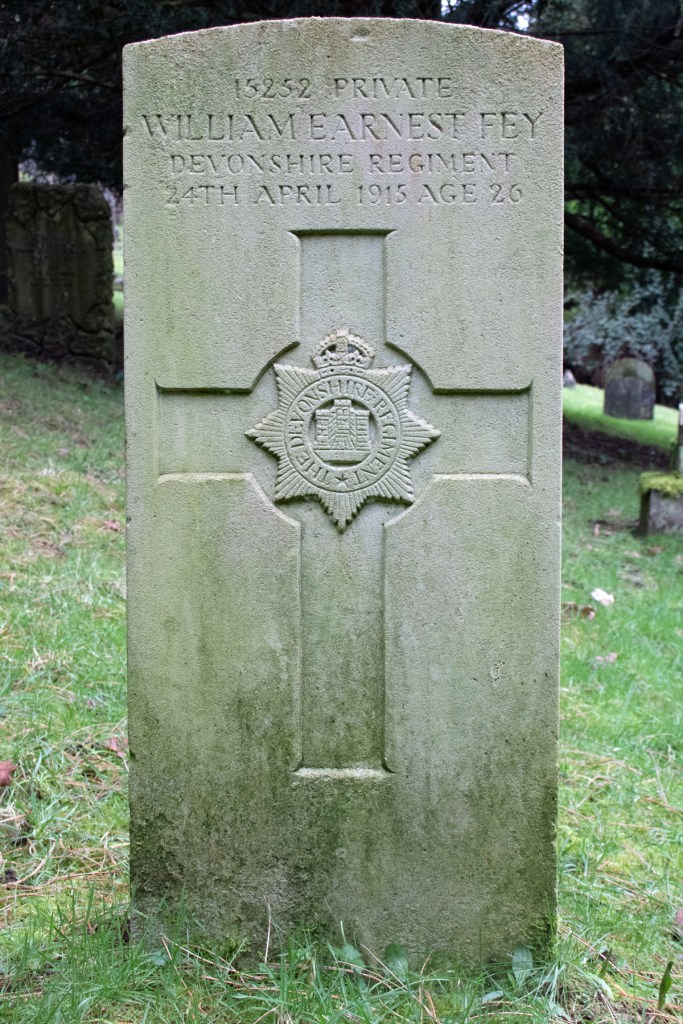
William Ernest Fey was born in Harburton, Devon, in the spring of 1889. The oldest of eight children, his parents were John and Margaret Fey. John was a farm labourer and, when he left school, William also took up work on the farm. By the time of the 1911 census he was listed as a horseman.

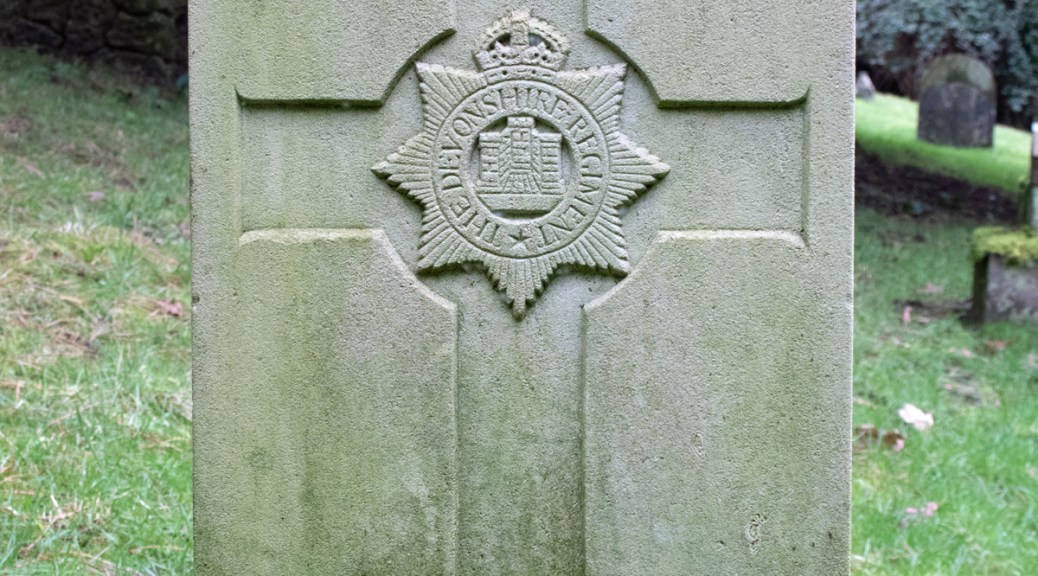
When was came to Europe, William was one of the first to step up and play his part. He enlisted in the Devonshire Regiment in the autumn of 1914, and was assigned as a Private in the 10th (Service) Battalion.

For part of his training, he was billeted in Bath, Somerset, and it was here, in April 1915, that he contracted meningitis. Private Fey was admitted to the city’s Red Cross Hospital, but the condition was to prove too much. He passed away on 24th April 1915, aged just 26 years of age.

Financial restraints may have limited John and Margaret’s ability to bring their boy back to Devon. Instead, William Ernest Fey was laid to rest in the quiet and picturesque Smallcombe Vale Cemetery on the outskirts of the city where he died.


Second Lieutenant Eric Guillebaud

Second Lieutenant Eric Guillebaud

The death occurred on Thursday of Mr Eric Cyril Guillebaud. Deceased was the youngest son of the late Rev. ED Guillebaud, Rector of Yatesbury, near Calne. On the outbreak of war he joined the Army, and was given a commission in the 11th (Service) Battalion of the Worcestershire Regiment. His physical strength not being equal to his patriotic zeal, he broke down under the strain of military duty. He came to rest at Combe Royal, Bathwick Hill, where his brother, Mr H Guillebaud, resides, but on medical advice entered a nursing home. Mr Guillebaud was 22 years of age. He was officially invalided from the Army six weeks ago. Deceased was a nephew of the late Mr Charles Marshall, of The Sycamores, Bathford, and the interment will take place in the churchyard there on Tuesday next.

Bath Chronicle and Weekly Gazette: Saturday 5th June 1915

Little further information is available on the life of Eric Guillebaud. The 1901 census confirms that he was living at The Rectory in Yatesbury, with an extended family: his parents, Reverend Erneste and Mabel Guillebaud; his maternal grandfather, William Marshall; his maternal uncle, Charles; and his cousin, William. The family also employed four servants: a nurse, cook and two housemaids.

There is no information relating to Eric’s military service, although it is clear from his headstone that he reached the rank of Second Lieutenant. His troop – the 11th Battalion of the Worcestershire Regiment – was based on Salisbury Plain and, from subsequent reports, uniforms and equipment were not provided until the spring of 1915: everything up to then was improvised.

The 11th Battalion did not leave for France until September 1915, three months after Eric’s passing: he would not, therefore, have seen any action overseas.

The only other document relating to Second Lieutenant Guillebaud is his probate record. This confirms that he died on 3rd June 1915 at 15 Somerset Place, Bath. His effects – totalling £5041 18s 10d – were left to his brother, Harold, who was listed as a gentleman.

Eric Cyril Guillebaud was 32 years old when he died. He was laid to rest in the graveyard of St Swithun’s Church, Bathford.


Private Percy Gerrish

Private Percy Gerrish

Percy Gerrish was born on 22nd August 1890 in Bath, Somerset. The youngest of three children – all boys – his parents were Alfred and Charlotte Gerrish. Alfred was painter and decorator by trade but, by the time of the 1911 census, the family had moved to Batheaston, and he was employed as a school attendance officer.

Alfred and Charlotte had raised their children well: the same census recorded their oldest son, also called Alfred, was employed as a clerk; their middle son, Reginald, was a printer; Percy, then 20 years old, was working as a draughtsman for an engineering company,

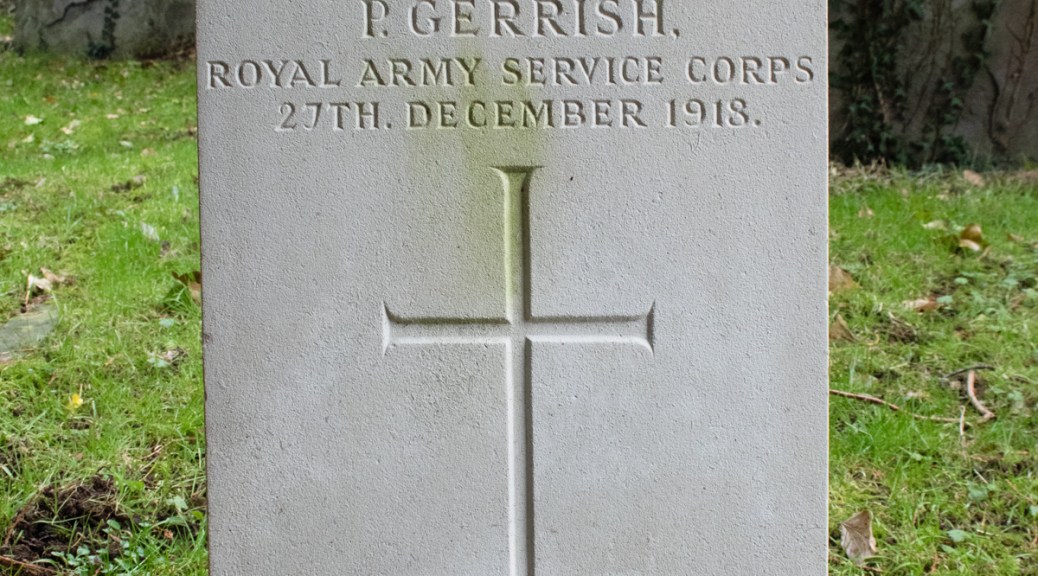
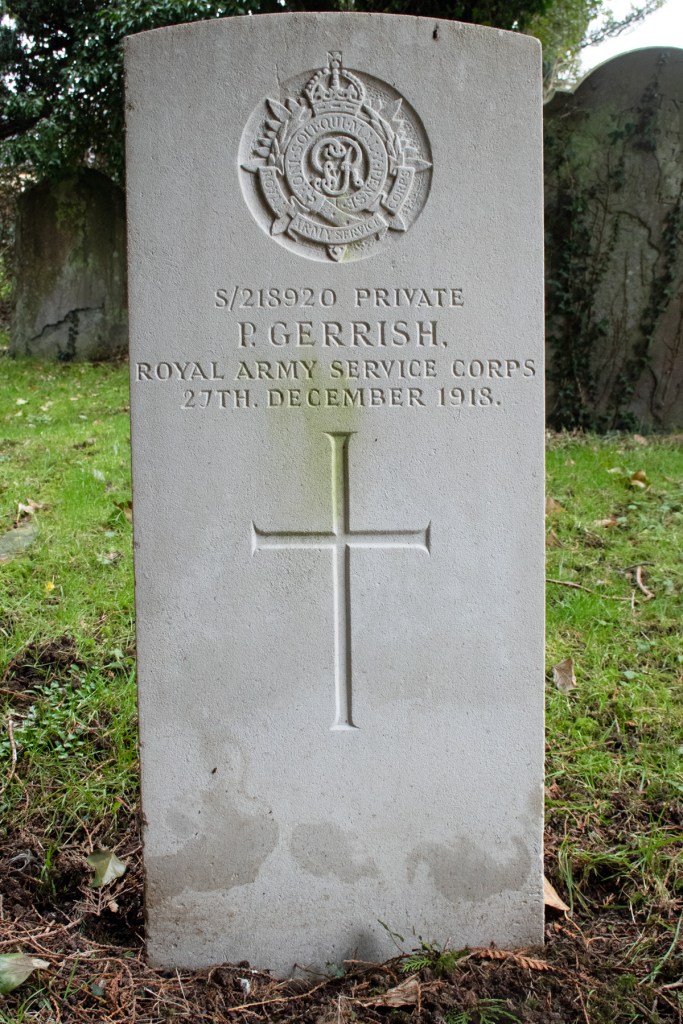
War came to Britain’s shores in 1914, and while he did not join up at once, when the Military Service Act of 1916 came in, Percy found himself conscripted. He enlisted on 24th November 1916 and, while he noted a preference for the Royal Field Artillery or Royal Garrison Artillery, his previous employment made him ideal for work as a clerk in the Army Service Corps.

Private Gerrish’s time in the army was spent on home soil. Full details are not available, but he certainly served in camps around Codford, Wiltshire. This may have been how he met a young woman called Ada Cox, who lived in Bemerton, on the outskirts of Salisbury. On 21st July 1917, the couple married in the new Mrs Gerrish’s local church.

Percy’s army career went well, although during 1918 illness was to dog him. He spent a week in a hospital in Fovant, near Salisbury in June, suffering from influenza, before being readmitted for a month just a week later, having contracted pharyngitis – an inflammation of the pharynx.

By the late summer of 1918, Private Gerrish had been moved to Newport Pagnell, Buckinghamshire. His ongoing health conditions were still an issue, however, and on 23rd October he was admitted to the Tickford Abbey Auxiliary Hospital. He had contracted laryngitis by this point, but, as the weeks in hospital progressed, he was soon also bogged down by tuberculosis.

Sadly, this was to prove Percy’s undoing. He passed away on 27th December 1918, aged just 28 years old.

Percy Gerrish’s body was brought back to Somerset for burial. He was laid to rest in the graveyard of St John the Baptist Church, in a plot next to his father, Alfred, who had died seven months before.


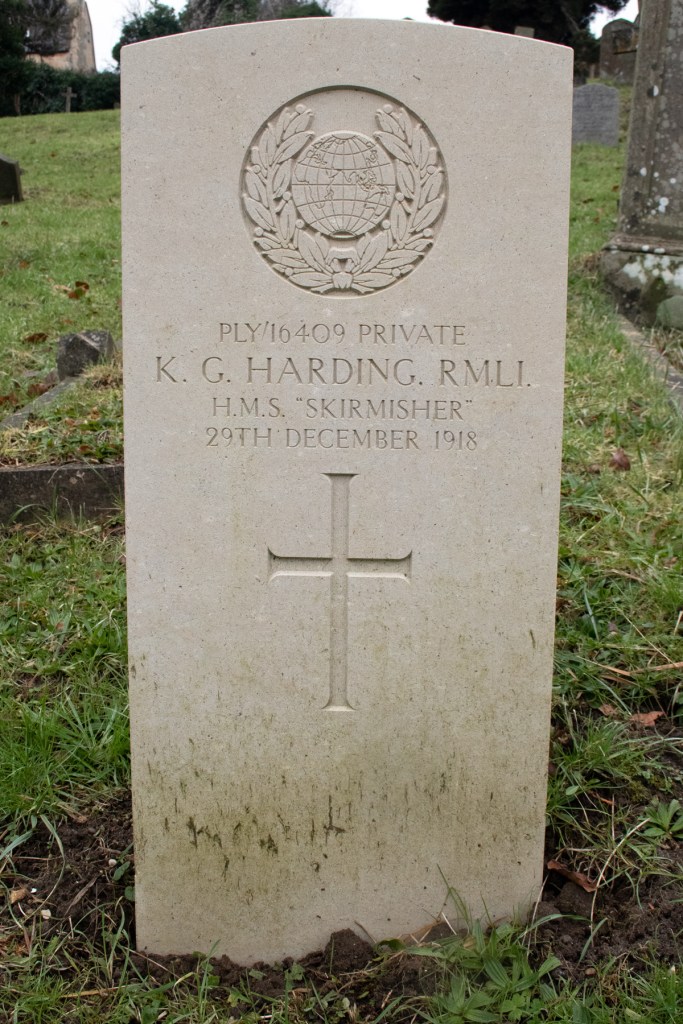
Private Kenneth Harding

Private Kenneth Harding

Kenneth Gordon Harding was born in the autumn of 1896, in the Somerset village of Batheaston. The oldest of nine children, his parents were Lawrence and Fanny Harding. Lawrence was a market gardener when Kenneth was born, but by the time of the 1911 census – and with a growing family to support – he found other employment as a roadman.

When he left school, Kenneth found work as a gardener, but he had his sight set on distant shores. On 25th September 1913 he enlisted in the Royal Marine Light Infantry, determined to see the world. His service records show that he was 5ft 3ins (1.6m) tall, with light hair, blue eyes and a light complexion.

For the duration of his naval career, Private Harding was based out of Plymouth Dockyard, returning there in between each of his voyages. Over the next four years, he served on three different vessels – HMS Heroic, HMS Duke of Edinburgh and HMS Skirmisher. His service records shows that he maintained a satisfactory level of conduct, and that his general character was very good.

By January 1917, Kenneth had fallen ill, and was medically discharged from the army, having contracted tuberculosis. He returned home, but his illness continued to dog him.

On 22nd May 1918, Kenneth’s younger brother, Leonard Harding, who was serving with the Royal Inniskilling Fusiliers, was killed while fighting in France. Private Leonard Harding was just 19 years old. He was laid to rest in the Duhallow ADS Cemetery at Ypres.

With Kenneth’s own health not looking good, his parents must have feared the worst. The worst was to some, sadly, when he breathed his last at home on 29th December 1918. He was just 22 years of age.

Kenneth Gordon Harding was laid to rest in the graveyard of St John the Baptist Church in his home village, Batheaston.


Private Ernest Bailey

Private Ernest Bailey

Ernest Stanley Bailey was born in the autumn of 1900 in the quiet Somerset village of Barton St David. The oldest of three children, his parents were stonemason William Bailey and his wife, Fanny.

Ernest was only 14 years old when war broke out, but his time to serve his King and Country came in the summer of 1918. He enlisted in the Devonshire Regiment and was assigned to the 53rd (Young Soldier) Battalion.

Private Bailey was sent to the Rollestone Camp, near Shrewton in Wiltshire for training. With the war in its closing months, army barracks were still places rife with disease, and Ernest was not to be immune from this. He contracted influenza, which then became pneumonia, and was admitted to the camp hospital. Sadly, the conditions were to prove too much for his young body to bear, and he passed away on 6th November 1918. He was just 18 years of age.

Ernest Stanley Bailey was brought back to Somerset for burial. He was laid to rest in the peaceful graveyard of St David’s Church in his home village, Barton St David.


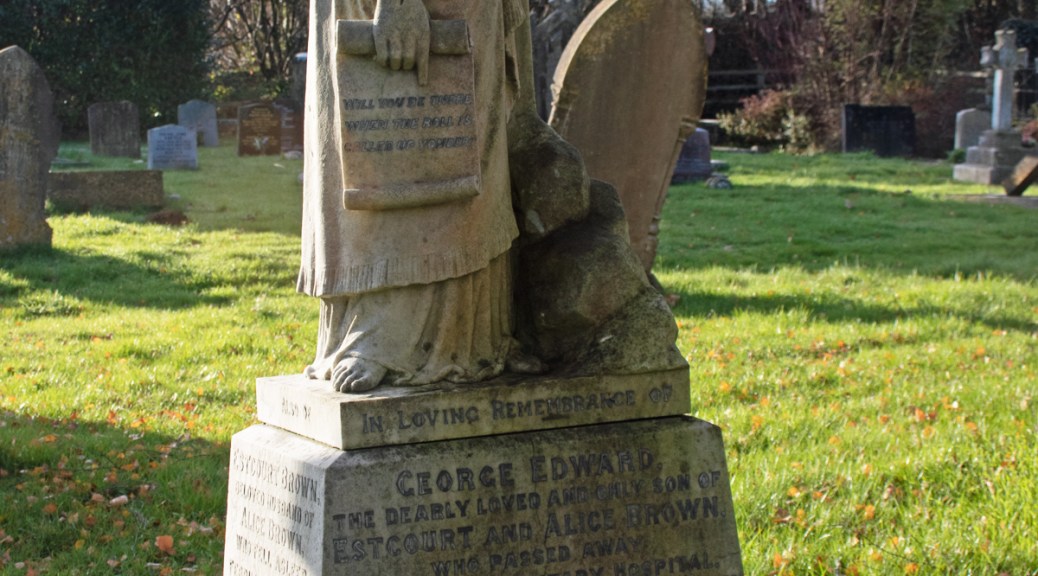
Driver George Brown

Driver George Brown

George Edward Brown was born on 26th June 1898 in South Petherton, Somerset. An only child, his parents were Escourt and Alice Brown. Originally a millstone dresser, by the time of the 1911 census, Escourt had turned his hand to farm work, while Alice made shirts and did housekeeping to bring in a little more money for the family.

George was only 16 years old when war broke out, but he was keen to play his part as soon as he was able to. In the spring of 1917, he enlisted in the Royal Field Artillery, and was assigned to the 105th Company.

Little information remains of Gunner Brown’s military service, but it is evident that he did his training in Norfolk. While here, he came down with appendicitis, and was admitted to the Norfolk War Hospital in Norwich. He was operated on, but sadly died following the procedure. He passed away on 29th June 1917, having just turned 19 years of age.

George Edward Brown’s body was brought back to Somerset for burial. He was laid to rest in the family grave in South Petherton Cemetery. He was reunited with his parents, when they passed away, Escourt in 1924 and Alice some time later.


Private Louis Stevens

Private Louis Stevens

Louis Blake Stevens was born in the spring of 1870 in Pilton, now a suburb of Barnstaple, Devon. One of nine children, his parents were Devon-born sawyer John Stevens and his wife Mary, who was from Swansea.

When he left school, Louis found work in the leather industry, working as a parer and grinder. In the autumn of 1890, he married an Edith Turner, the couple went on to have two children – Edith and Albert – although they seem to have parted company soon after.

On 4th April 1896, Louis married again, this time to a Mary Webber. The couple set up home in Stoke-under-Hamdon (now Stoke-sub-Hamdon), Somerset, and went on to have seven children of their own. By the time of the 1911 census, the family had moved to South Petherton, Somerset, where Louis and Albert were working as a glovers.

Storm clouds were brewing over Europe and, despite his age, Louis was keen to step up and play his part and, on 7th August 1915, he enlisted in the Army Veterinary Corps. His service records confirm he was 42 years old, 5ft 4ins (1.63m) tall, with a dark complexion, dark brown hair and brown eyes.

After some initial training at the Army Veterinary Corps depot, Private Stevens was sent to France. Arriving there on 25th October 1915, he spent the next nine months overseas. During this time, he had issues with his teeth, breaking several on the hard biscuits the army were provided with.

Private Stevens was sent to a camp hospital in Boulogne, where his teeth were extracted, and he was then sent back to Britain to recover. The operation identified epithelioma (a malignant tumour) on his tongue and face, caused by the state of his teeth. He was initially sent to a hospital in Epsom, before being transferred to the Horton City of London War Hospital in Woolwich.

Treatment was ongoing, and, in the end, Private Stevens was finally discharged from the army on medical grounds on 2nd July 1917. The report noted permanent total incapacity, and that treatment was required.

At this point, Louis’ trail goes cold. He returned home to Somerset, and, died there on 23rd January 1918, aged 47 years old. Louis Blake Stevens was laid to rest in South Petherton Cemetery, within walking distance of his widow and family’s home.


Farrier Ernest Rowsell

Farrier Ernest Rowsell

Ernest Rowsell was born in the spring of 1894, in the Somerset town of South Petherton. One of nine children, his parents were John and Bessie Rowsell. Builder and wheelwright John had been married before Bessie, and Ernest had five half-siblings as well.

When Ernest left school, he found work with a blacksmith – presumably, a connection made through his father. In his spare time, he joined the West Somerset Yeomanry, building on his skills and training.

War came to Europe in 1914, and it was a natural progression for Ernest to play his part, He formally joined the regiment he had previously trained with, enlisting on 24th September 1914. Given the rank of Farrier, Ernest was sent to a camp in Minehead for training.

His service records show that he was 5ft 3ins (1.6m) tall, had good vision and was of good physical development. Something came up during the medical examination, however, which was held on 1st February 1915. Farrier Rowsell was deemed medically unfit for army service and discharged.

Ernest returned home, but, whatever the condition was, it was to swiftly get the better of him. He passed away at home on 13th February 1915, at the age of just 21 years old.

Ernest Rowsell was laid to rest in South Petherton Cemetery, a short walk from where his parents lived.