Tag Archives: illness

Lieutenant Frederick Tugwell

Lieutenant Frederick Tugwell

Frederick William Tugwell was born in Cuckfield, West Sussex, in the autumn of 1888. The youngest of three children to John and Mary Tugwell, his father was a tailor in the village.

Little more is known about Frederick’s early life, but, when war broke out, he wad there to play his part. He enlisted in The Queen’s (Royal West Surrey Regiment) and, by July 1916 was in France. Frederick obviously made an impression in the army and rose through the ranks, reaching Lieutenant by the time the Armistice was declared in November 1918.

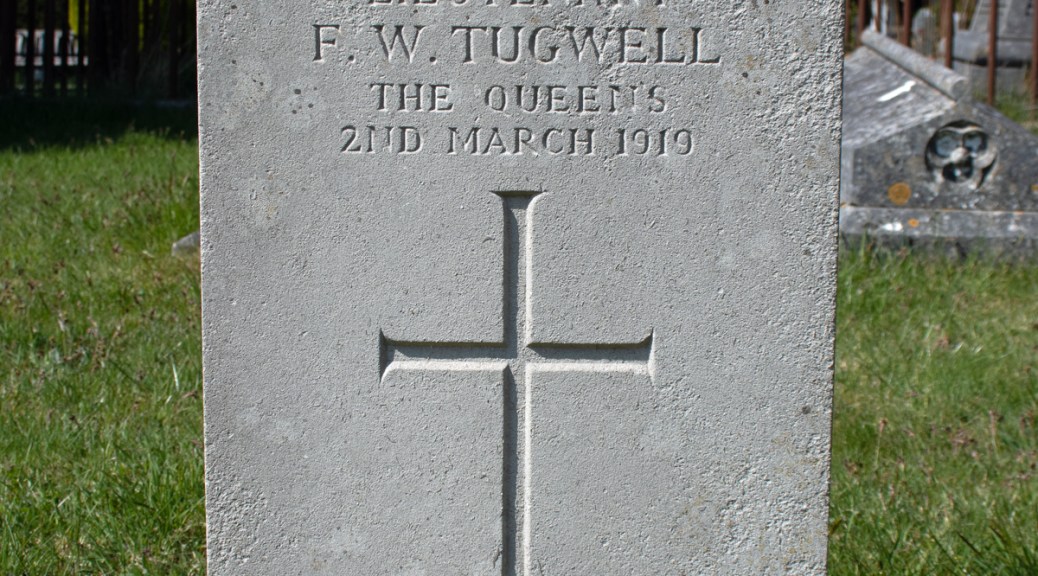
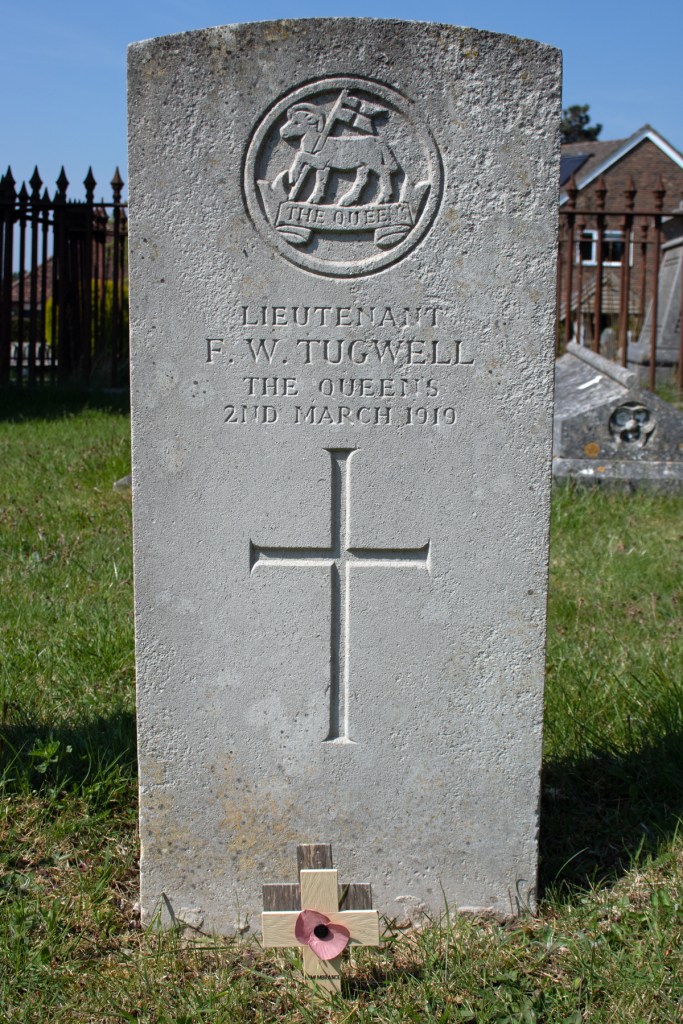
Lieutenant Tugwell remained overseas when the war ended and was based in Cologne. In March 1919, he returned home on leave, staying with his sister, Constance, who lived in Guildford, Surrey. It was here that he fell ill and here that he passed away, breathing his last on 2nd March 1919. He was just 30 years old.

Frederick William Tugwell was brought back to West Sussex for burial – he lies at rest in the cemetery of his home village, Cuckfield.


A mystery surrounds Frederick’s next of kin. His medal record suggests that it was his widow – Mrs FW Tugwell – who applied for that recognition. The address given for her is the same as for Constance. The newspaper report of his death gives no mention of a widow, only that he died at his sister’s home. There is also no clear evidence for Frederick getting married, although this may have been lost to the passage of time. His widow may, of course, have been living with her sister-in-law, but again, this cannot be confirmed either way.
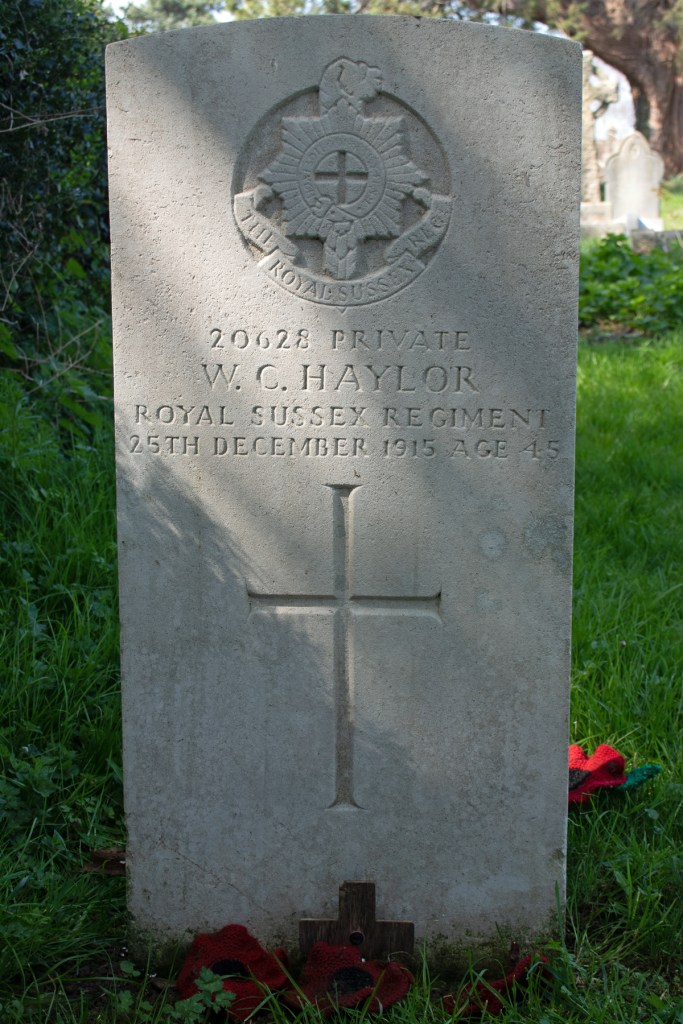
Private William Haylor

Private William Haylor

William Charles Haylor was born in the summer of 1870, in the West Sussex village of Cuckfield. He was one of eight children to agricultural labour Michael Haylor and his wife, Betsy. Michael passed away in 1886 and, with children to raise, his widow took in washing to earn money.

William found work as a farm labourer and, by the time of the 1901 census was living in a cottage at Beech Farm in the village, with his mother, younger sisters, one brother-in-law and six nieces and nephews.

On 25th October 1905, William married Florence Linstead. She was a carter’s daughter from South London, and it is not exactly clear how they met. It seems likely, though, that Florence had taken work on one of the estates in the Cuckfield area. The couple exchanged vows at St Antony’s Church in Florence’s home town, Nunhead, before settling down back in West Sussex.

When war came to Europe, William was keen to play his part. He enlisted in the Royal Sussex Regiment on 9th November 1914 and was assigned to the No.6 Supernumerary Company of the 2nd/4th Battalion. This was a territorial force, set in place for those older volunteers keen to serve King and Country.

Private Haylor’s time in the army was to be brief, however, as at his medical he was found to be medically unfit for military service. No further details are available, but it meant that William had spent just 82 days in the army.

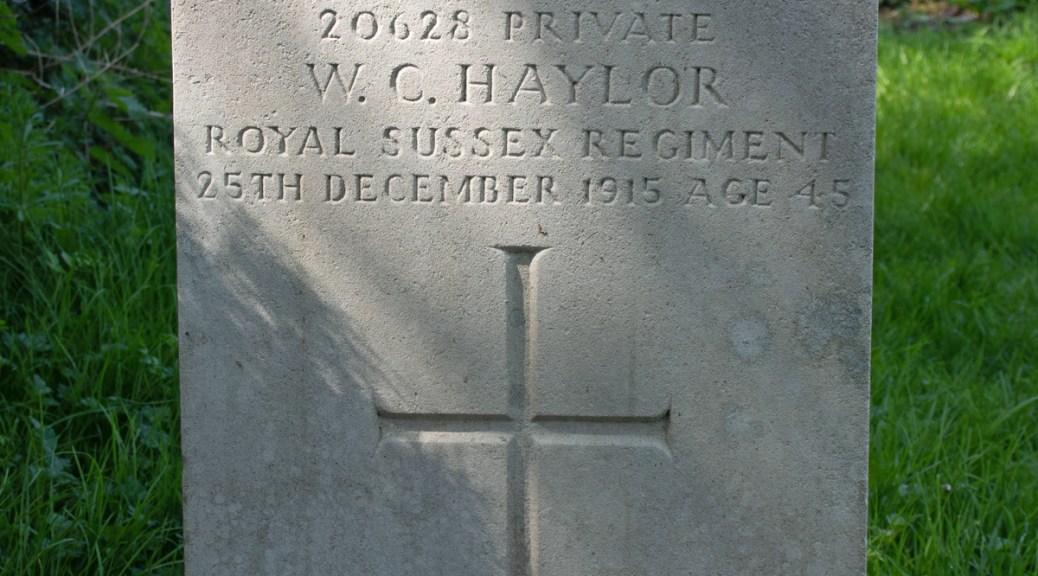
At this point, William’s trail goes cold. He returned home, and presumably continued in his previous line of work. Again, however, the status quo was not to continue for long. He passed away at home, through causes unknown, on Christmas Day, 25th December 1915. He was 45 years of age.

William Charles Haylor was laid to rest in the cemetery in his home village, Cuckfield. He was accorded a military funeral.


Guardsman Sydney Proctor

Guardsman Sydney Proctor

Sydney Francis Proctor was born in the autumn of 1886 in the Hertfordshire town of Bushey. The middle of three children, his parents were George and Annie Proctor. George was a stationary engine driver, and Sydney found work at a local iron foundry – possibly working alongside his father – when he left school.

This was not to be Sydney’s long term career, however, as, by the time of the 1911 census, he had moved to West Sussex and settled in Cuckfield, near Haywards Heath. By this time he was working as a gardener, and was employed at the nearby Borde Hill estate.

It is likely that Sydney had made the move to Sussex a few years earlier, as the same document confirms that he was married to a London-born woman called Florence, who was five years his senior. The couple would go on to have a daughter, Frances, who was born in December 1912.

Sydney’s wartime service is a little sketchy. He enlisted in the Coldstream Guards in November 1914, and was assigned to the 4th Battalion. While full details of his service are not available, Guardsman Proctor certainly served overseas, and may have seen some of the fiercest fighting of the conflict, at Loos, Ypres and the Somme.

Guardsman Proctor survived the conflict, but paid a price. In October 1918, he was medically discharged from military service, as he was suffering from aortic regurgitation – a heart complaint. He returned home to Sussex, but this respite was not to be for long. Sydney passed away on 17th July 1919, at the age of 32 years old.

Sydney Francis Proctor was laid to rest in the cemetery of his adopted home town, Cuckfield.


Private Harry Etherton

Private Harry Etherton

Harry Etherton was born in Ansty, near Cuckfield, West Sussex on 3rd April 1872. The oldest of five children, his parents were Edwin and Louisa Etherton. Edwin was an agricultural labourer, and this was work in which his son followed his father.

On 29th April 1899, Harry married Annie Eliza Pennifold, a labourer’s daughter who was also from Ansty. The couple set up home in Cuckfield, and went on to have five children. Harry was, by this point, working as a road labourer for the local council, and this was a job he was to continue doing until the outbreak of the war.

Harry enlisted in 1915, joining the Royal Sussex Regiment as part of the National Reserve. As Private Etherton, he was then transferred across to the Labour Corps, and was assigned to the 409th Labour Coy. which was based at the Infantry Depot in Lincoln.

It was while Private Etherton was here, in the spring of 1918, that he contracted meningitis, and was admitted to the Northern General Hospital in the city. Sadly, he was to succumb to the disease, passing away on 30th June 1918, at the age of 46 years old.

Harry Etherton’s body was brought back to West Sussex for burial. He was laid to rest in Cuckfield Cemetery, not far from where his widow and children still lived.


Private Frank Bates

Private Frank Bates

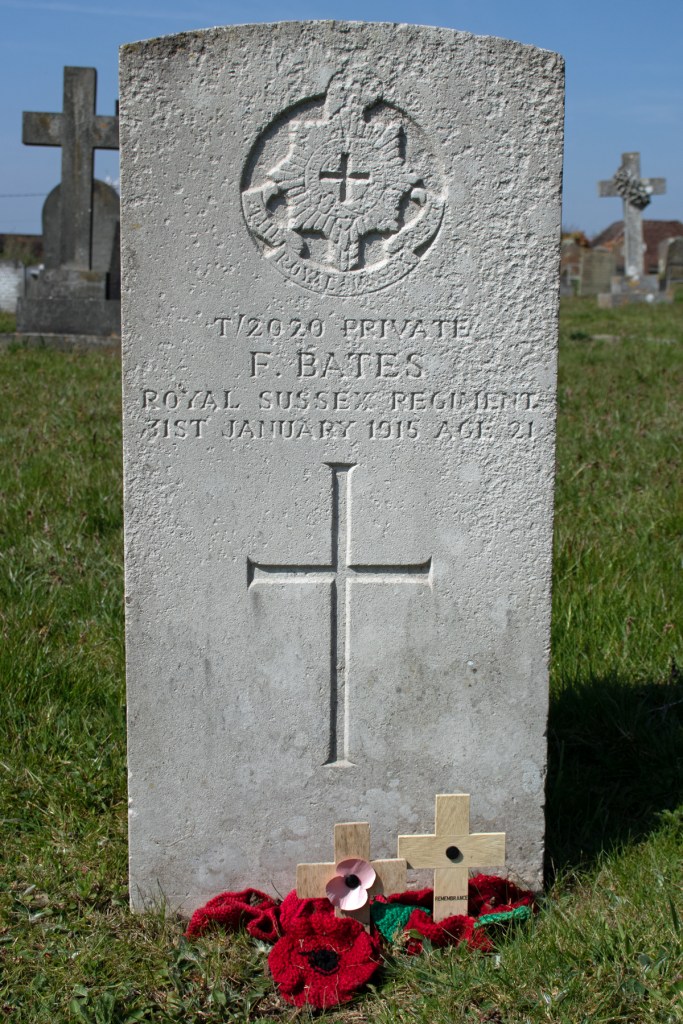
Frank Bates was born on 29th June 1893, in Cuckfield, West Sussex and was the fourth of five children. His parents were tailor William Bates and his wife, Sarah.

Tragedy was to be a constant companion to the Bates family. Frank’s older brother, William, died in November 1907 after a protracted illness, at the tender age of just 19 years old. Four years later, his younger sister, Maggie, also passed away after an illness. She was just 21 years of age.

When he left school, Frank went into the service of the Messel family, who owned the Nyman’s estate close to where Frank and his family lived. When war was declared, however, he was keen to play his part, enlisting soon after hostilities were announced in August 1914.

Private Bates joined the 4th (Home Service) Battalion of the Royal Sussex Regiment and was sent to Newhaven for training. It was while he was here that he fell ill, and, having caught a chill, he returned to Cuckfield to recuperate. Sadly, his condition worsened, and he passed away at his family home on 31st January 1915. He was just 21 years old.

Frank Bates was laid to rest in Cuckfield cemetery, resting not far from his siblings.


Tragedy was to strike one more time for William and Sarah. Frank’s older brother Jack served as a Private in the 2nd/4th Battalion of the London Regiment. In the spring of 1918, he was caught up in that year’s Battles of the Somme, including fighting at St Quentin and Avre.

In May 1918, Private Bates was officially reported as missing, but it was later confirmed that he had died of injuries sustained in the fighting. He passed away on 16th April 1918, at the age of 29 years old.

Jack was laid to rest at the Chauny Communal Cemetery in Picardie, France, and is also commemorated in Cuckfield Cemetery.


Second Lieutenant Francis Wakeford

Second Lieutenant Francis Wakeford

Francis Reginald Steele Wakeford was born in the summer of 1893 in Penarth, Glamorgan. The middle of five children, his parents were Herbert – who was a master printer – and Mary Wakeford. When he left school, Francis became a stockbroking clerk, but when war broke out, he was quick to ensure he played his part.

Initially enlisting in the Royal Engineers, he was attached to the Glamorgan Yeomanry. By the time he was sent to France, however, he had been assigned to the Lancashire Fusiliers.

After eighteen months of fighting, in the spring of 1918, Second Lieutenant Wakeford transferred to the Royal Air Force and gained his wings. “During six months’ flying he had many encounters with enemy airmen, many of whom he brought down, and was also in several bombing raids over Germany.” [Western Mail: Monday 30th December 1918]

When the Armistice was declared, Francis returned to Wales. He has been suffering from an ongoing illness, and this was to be to what he was to succumb. Second Lieutenant Wakeford passed away in Cardiff on Christmas Day, 25th December 1918. He was just 25 years of age.

Francis Reginald Steele Wakeford was laid to rest in the graveyard of St Augustine’s Church in his home town of Penarth.


Second Lieutenant Wakeford (from findagrave.com)

Francis’ grave also commemorates the passing of his only brother, Charles Herbert Stanley Wakeford.

Four years Francis’ senior, Charles had enlisted in the 24th (Pembroke and Glamorgan Yeomanry) Battalion of the Welch Regiment. As the war moved through its final year, Lieutenant Wakeford found himself caught up in the fierce fighting of the Second Battles of the Somme.

Charles was killed on 7th September 1918, aged 28 years old. He was laid to rest in Tincourt British Cemetery, in Picardie, France. He is also commemorated on the family grave in St Augustine’s Church, Penarth.


Private Charles Tucker

Private Charles Tucker

Charles Wilfred Tucker was born in the summer of 1898 in Penarth, Glamorgan. He was the oldest of four children to Wilfred and Elizabeth Tucker, restaurant owners on Windsor Terrace in the centre of the town.

Little information is available about Charles’ early life. When war broke out, he enlisted in the Welch Regiment, before transferring to the Machine Gun Corps at some point during the conflict. In the autumn of 1919, Private Tucker was put on furlough while waiting to be demobbed, and he returned home.

Sadly, it was while here that Charles contracted pneumonia, and it was from the lung condition that he was to pass away. He breathed his last on 30th October 1919, at the age of just 21 years old.

Charles Wilfred Tucker was laid to rest in the family grave in St Augustine’s Churchyard in his home town of Penarth.


Ordinary Seaman William Radford

Ordinary Seaman William Radford

William Richard Radford was born in the spring of 1900 in Cogan, on the outskirts of Penarth, Glamorgan. He was one of eight children to coal trimmer turned dock labourer Richard Radford and his wife, Susan.

Little information is available about William’s life. What is documented is that he enlisted in the Royal Navy, and, by the time he came of age in 1918, he held the rank of Ordinary Seaman. William was serving at HMS Victory, the Royal Naval Dockyard, by the end of the war.

At this point, details of Ordinary Seaman Radford’s life become a little unclear. He seems to have been stepped down to the Marine Mercantile Reserve, returning home in January 1919, when he passed away. His Pension Ledger Card gives the cause of death as a fractured shoulder, while another document states that he died from a sarcoma.

Whatever the cause of his passing, William Richard Radford was laid to rest in the graveyard of St Augustine’s Church in Penarth. He shared his grave with his mother, who had passed away the previous year. Richard Radford was also buried in the same plot when he passed away in 1926.


Lance Corporal Colin Clarke

Lance Corporal Colin Clarke

Colin Lewis Clarke was born in the spring of 1879 in Cardiff, South Wales. He was one of seven children to Bernard and Elizabeth Clarke. Bernard was a carpenter, but after Elizabeth died in 1886, he took over the running of the Windsor Hotel in Penarth.

When he left school, Colin found work as a clerk. Bernard also died in 1908, and the 1911 census records Colin and his brother Thomas living with his sister, Beatrice. They were sharing the house with Beatrice’s second husband, Charles, and her six children from her first marriage in the Cheshire village of Poulton.

Colin’s trail goes tantalisingly cold at this point. When war broke out, he enlisted to play his part, joining the 16th (Transport Workers) Battalion of the York and Lancaster Regiment by the summer of 1916. This troop was a territorial force, and Private – and then Lance Corporal – Clarke was based in the Yorkshire Dales.

At some point during the autumn Colin fell ill, and was admitted to the Military Hospital in Middlesbrough. His condition is unclear, but he was to succumb to it, passing away on 5th November 1916, the age of 37 years old.

Colin Lewis Clarke’s body was brought back to Wales for burial. He was laid to rest in the graveyard of St Augustine’s Church in Penarth, Glamorganshire.


Deck Hand Philemon Richards

Deck Hand Philemon Richards

Philemon Witheridge Richards was born on 9th July 1891 in Porthleven, Cornwall. He was one of at least seven children to George and Ann Richards. George was a sailor, as were he two oldest sons and, by the late 1890s, the family had made the move to Penarth in Glamorganshire.

When he left school, Philemon followed his father and older brothers into sailing. By the time he turned eighteen, George had passed away and Philemon wanted bigger and better things. On 16th July 1909, he enlisted in the Royal Garrison Artillery. His service records show that he stood 5ft 9.5ins (1.76m) tall, had good vision and was of good fitness.

Gunner Richards was posted to No. 6 Company and remained part of the territorial force. On 1st July 1911, after twenty months’ service, he was, at his own request, discharged from the army.

The trail goes cold for a while, and Philemon seems to have returned to a life at sea. This changed, however, when war broke out and, in October 1915, he was drafted into the Royal Naval Reserve as a Deck Hand.

Philemon’s time in service seems to have been shore-based however. After an initial posting to HMS Vivid, the Royal Naval Dockyard in Devonport, he moved to HMS Victory, which was the name given to the dockyard in Portsmouth, Hampshire. He moved on again in the autumn of 1916, by which point he was based at HMS Pembroke, the Royal Navy’s shore-base in Chatham, Kent.

It was here that Deck Hand Richards fell ill. It is unclear what the condition was, but he was admitted to the Military Hospital in Chatham on 20th October 1916. His illness worsened, and he passed away there on 2nd November. He was just 25 years of age.

Philemon Witheridge Richards was brought back to Glamorganshire for burial. He lies at rest in the graveyard of St Augustine’s Church in Penarth.


Philemon’s gravestone is also dedicated to his brother, Thomas Witheridge Richards. Eighteen years Philemon’s senior, Thomas had been a sailor, and, while no records remain, it seems likely that he may also have been called into service during the First World War. He died at home on 4th July 1918, at the age of 45 years old. He was laid to rest in the same plot as his younger brother.