William Michael Shanly was born in Hampstead, Middlesex, in the summer of 1892. The fourth of eight children, of whom three died in infancy, he was the eldest son to Michael and Mathilde Shanly. Michael was the owner of a coffee and refreshment company.
The Shanly family lived at 78 Sumatra Road, Hampstead, but by the time he was nine years old, William had been sent to Sussex, and was boarding at the Xavarians Brothers School in Uckfield.
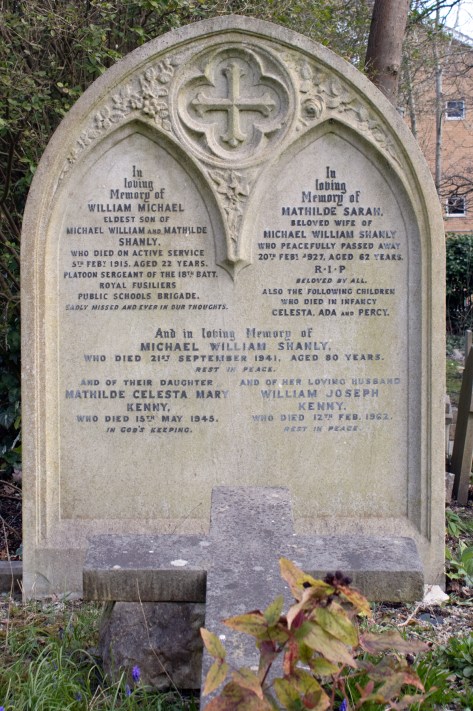
There is little further information available about William’s life. His epitaph on the family headstone suggests that he died on active service and was a Platoon Sergeant of the 18th Battalion of the Royal Fusiliers. His unit was also known as the 1st Public Schools, although exactly what role he held is unclear. His entry on the Commonwealth War Graves Commission Grave Index suggests that he was attached to the 15th (Reserve) Battalion, but his military records no longer exists, so it isn’t possible to confirm either way.
Serjeant Shanly died on 5th February 1915, aged 22 years of age. He had had an operation for appendicitis five days earlier, but had succumbed to peritonitis.
William Michael Shanly was laid to rest in the family plot in Highgate Cemetery, not far from where his grieving family were living.
George Wilson Townsend was born in St Pancras, Middlesex on 13th September 1885. The youngest of three children – although his older brother Joseph had died before George was born – his parents were piano maker Samuel Townsend and his wife, Eliza.
When he finished his schooling, George found work as a clerk for a shipping company. In the summer of 1909 he married Ellen Gibbins: the couple went on to have two children, daughters Kathleen (born in 1910) and Elsie (born in 1912).
The 1911 census found the family in a small cottage at 43 Leighton Road, Kentish Town. George was still working as a shipping clerk, while Ellen was look after baby Kathleen.
When war broke out, George was called upon to play his part. He enlisted on 12th May 1917, and joined the Royal Flying Corps as an Air Mechanic 3rd Class. His service records show that he stood 5ft 9.75ins (1.77m) tall.
When the Royal Air Force was formed in April 1918, George was immediately transferred across. Reclassified as a Clerk 3rd Class, he was quickly promoted to Clerk 1st Class, the skills he had learn in civilian life coming to the fore. Attached to 85 Squadron, then 62 Training Squadron, which was based in Gosport, Hampshire.
By the autumn of 1918, George had returned home, although the circumstances for this are unclear. He may have been on leave or recuperating from an illness. Certainly he passed away from pneumonia while at home on 5th October. He had not long turned 33 years of age.
George Wilson Townsend was laid to rest in Highgate Cemetery, not far from where his family still lived.
Ernest James Dean was born in the autumn of 1898 in St Pancras, Middlesex. The older of two children, he was the only son to Ernest and Caroline Dean. Ernest Sr was a bootmaker, and the family lived at 51 Lismore Road.
Ernest Jr found work as a clerk when he completed his schooling. However, when war broke out, he was keen to play his part. He enlisted on 6th February 1917, joining the Royal Flying Corps as an Air Mechanic 3rd Class. His service record shows that he was 5ft 6ins (1.67m) tall, and he must have proven to be a keen student: within four months he had been promoted to Air Mechanic 2nd Class and was being trained as a wireless operator.
When the Royal Air Force was formed on 1st April 1918, Ernest’s transfer was automatic. It is unclear exactly where Air Mechanic Dean served, but he seems to have been based in Kent by that autumn.
In October, Ernest was admitted to the Lees Court Hospital in Faversham, Kent, having come down with pneumonia. The condition, sadly, was to prove fatal: he passed away on 29th October 1918, at the age of just 20 years old.
The body of Ernest James Dean was taken back to Middlesex for burial, and he was laid to rest in the majestic grounds of Highgate Cemetery.
Albert John Bentley was born in St Pancras, Middlesex, in the spring of 1885. The second of six children, his parents were John and Eleanor (also known as Elizabeth) Bentley. John was a piano maker, and the family lived at 27 Hampshire Street in St Pancras.
When his father died in 1910, Albert had already started to follow in his footsteps. The following year’s census recorded him living with his mother and three younger siblings. Employed as an organ builder, his was one of three wages being brought into the household.
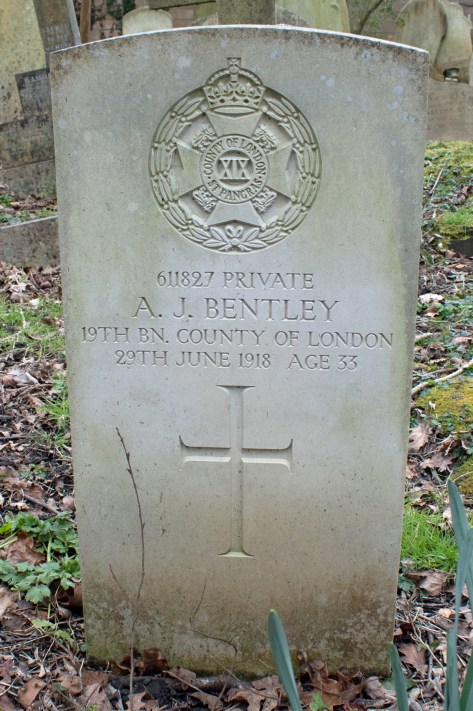
Albert stepped up to play his part when war broke out. Full details of his military service have been lost to time, but it is clear that he enlisted in the London Regiment, and was assigned to the 1st/19th (County of London) Battalion (St Pancras).
It is unclear whether or not Private Bentley spent any time overseas. By the summer of 1918, however, he had fallen ill, and was admitted to a military hospital in Shoreham-by-Sea, Sussex. He succumbed to a combination of influenza and pneumonia on 28th June 1918: he was 33 years of age.
The body of Albert John Bentley was taken back to Middlesex for burial. He was laid to rest in the sweeping grounds of Highgate Cemetery.
Richard Oscar Ford was born in Williamstown, Australia, in July 1891. The oldest of four children – and the only son – his parents were Anthony and Mary Ford. Anthony was a soldier, but Richard chose a different route and took work as a labourer when he completed his schooling.
There is little information available about Richard’s early life, but when war broke out, he stepped up to play his part. He enlisted in the Australian Imperial Force on 9th November 1914.
By this point he was working as a bushman, and his service papers reveal something of the man he had become. Standing 5ft 7ins (1.7m) tall, he weighed 140lbs (63.5kg), Private Ford had auburn hair, blue eyes and a fair complexion.
Assigned to the Light Horse Regiment, Richard left Australia for Europe on in March 1915. His unit arrived on the Gallipoli Peninsula on 15th July, and he would remain there for the next five months.
In December 1915, Richard came down with a bout of influenza, and was medically evacuated to the island of Mudros, then on to Alexandria, Egypt. In January 1916, he was admitted to hospital again, this time suffering from gonorrhoea and, after treatment, he re-joined his unit on 2nd February.
Private Ford’s unit spent that spring training in Egypt, but on 29th May, they set sail for the Western Front. Within a week they had disembarked in the French port of Marseilles and headed north to Etaples.
The next couple of years would prove a little disjointed. Richard switched units in August 1916, and given the rank of Gunner, but within two months his role had changed to Driver. His service records suggest that he managed to avoid injury during the fighting he was involved in, but that did not mean that he avoided hospital completely.
In January 1917 Driver Ford was admitted to the 51st General Hospital with a heart murmur, returning to his unit on 16th March. He had a second spell in hospital in February 1918, having come down with laryngitis.
In July 1918, having spent some time at the 4th Army Corporal School, Richard was reassigned to the 3rd Australian Field Artillery. This move seemed to have been the focus he needed. Initially promoted to Bombardier, within a month he rose to Lance Corporal, and by December 1918 he was a full Sergeant.
After the Armistice was signed, Richard was given three weeks’ leave, which he spent in Britain. By January 1919, however, his health was becoming an issue again, and he was admitted to the military hospital in Fovant, Wiltshire, suffering from influenza. The condition worsened, and Sergeant Ford passed away from bronchopneumonia on 4th February 1919. He was 27 years of age.
Richard Oscar Ford was laid to rest in Highgate Cemetery, Middlesex. While there seems to be no direct connection between the location and the man, his father, Anthony, had been born in Hackney, so it can be assumed that there was a family link to the area.
Frank Ernest Brydgnes Buck was born in Islington, Middlesex, early in 1889, his mother’s name was Rosina, but his father’s details have been lost to time, the 1901 census confirming that she was a widow. The document notes that Frank was the youngest of four children, and the family had taken rooms in a three-storey house on Yerbury Road.
By the summer of 1917, Frank had emigrated to Australia. Settling in the town of Inverell, New South Wales, he took employment as a clerk. However, when war came to Europe, he was called on to play his part, and enlisted in the Australian Imperial Force on 16th July 1917.
Private Buck’s service records confirm that he was 5ft 11.5ins (1.82m) tall and weighed 11st 4lbs (71.7kg). He was recorded as having dark hair, blue eyes and a dark complexion. He had a burn scar on his right forearm, and a third nipple on the right side of his chest.
Frank’s unit departed from Sydney on 31st October 1917, and he spent the next two months on board the SS Euripides. During that time he was promoted to Acting Corporal and, when he disembarked in Devonport, Devon, on 26th December, he marched to the ANZAC camp in Fovant, Wiltshire.
Assigned to the 5th Training Battalion, Frank seems to have taken this unexpected return to Britain as a free ticket home: on 6th February 1918 he went AWOL, and only surrendered back to his unit on 9th April. Help in detention for a day, he forfeited 63 days’ pay, and was demoted to the rank of Private for his actions.
On 13th May, Private Buck was dispatched to France. He was assigned to the 17th Battalion of the Australian Infantry, but his time overseas was not to be a lengthy one. In July he was admitted to the 5th Australian Field Ambulance with gastritis: he was then transferred to the 5th Casualty Clearing Station, then the 3rd General Hospital in Le Treport. Medically evacuated to Britain for treatment, he ended up in Reading War Hospital for ongoing treatment.
Placed on furlough on 16th September, Private Buck went AWOL again on just two weeks later. Arrested on 26th November 1918, he was hauled before a judge at Highgate Police Court: his crimes amounted to being absent without leave, but also stealing three blank cheques and forgery. Pleading guilty, he was sent to Wormwood Scrubs for nine months.
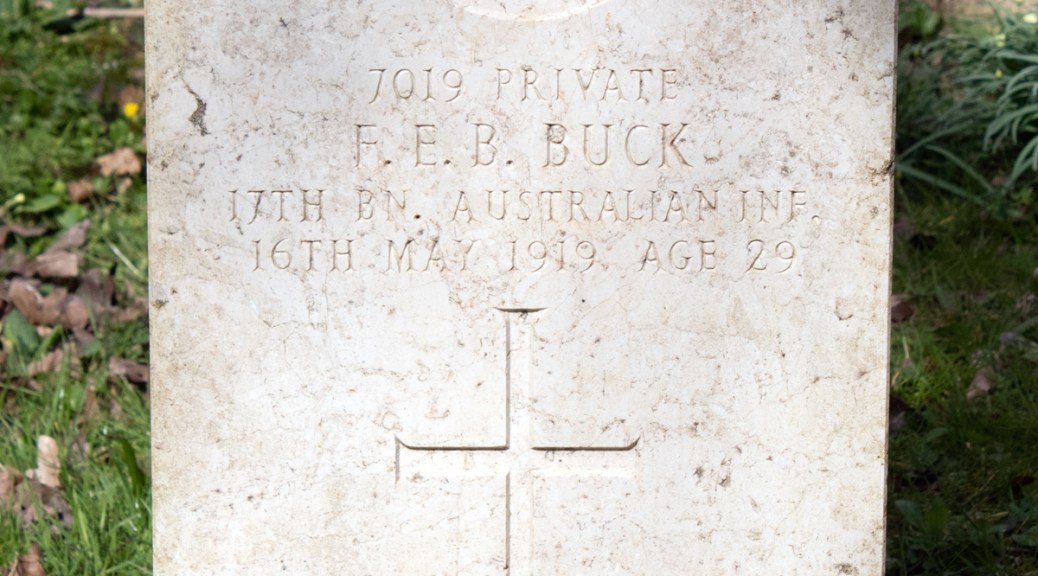
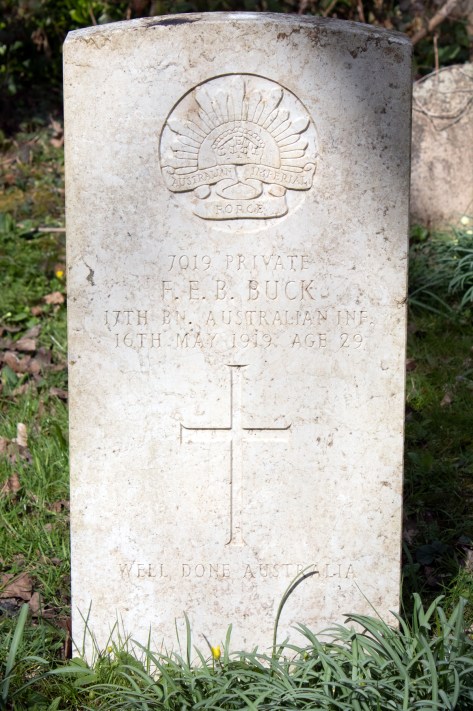
Frank would not end up serving his time, however. He was admitted to the infirmary with a perforated duodenal ulcer, and died from exhaustion on 16th May 1919. He was 29 years of age.
Frank Ernest Brydgnes Buck was laid to rest in Highgate Cemetery.
Robert William Holdsworth was born on 11th February 1880 in Pilmoor, Yorkshire. The third of nine children, his parents were John and Fanny. John was a railway signalman, and, by the time of the 1891 census, the family had moved to Kirby Wiske, near Thirsk.
When he completed his schooling, Robert found work as a blacksmith. Moving away from home, by 1901, he was boarding at the Albion Foundry on New Street in Pocklington. The job, however, was a stepping stone to bigger things, and, on 28th July 1902, he enlisted in the Royal Navy.
Blacksmith’s Mate Holdsworth’s service records show that he was 5ft 6ins (1.68m) tall. He had dark brown hair, brown eyes and a dark complexion. It was also noted that he had a scar on his right elbow.
Robert was initially sent to HMS Pembroke, the Royal Naval Dockyard in Chatham, Kent, for his training. He would spend the next year at the base, and was promoted to Blacksmith proper in April 1903. Over the twelve years of his initial contract, he would serve on board seven ships, returning to Chatham in between assignments. The 1911 census recorded him as being one of 283 crew aboard HMS Patrol, a scout vessel moored in Harwich Harbour, Essex.
In the summer of 1916, Robert married Minnie Eames. Born in Kensal Rise, London, by the time of the nuptials, her family had moved to Gillingham, Kent, where her father James worked as a night watchman. Minnie was working as a shop assistant by this point, and was living with her parents and older brother at 35 Wyles Street.
Back at work, Blacksmith Holdsworth had renewed his contract. His annual reviews noted both very good conduct and superior ability, and he had added another string to his bow – the role of Diver – in the spring of 1912. In April 1913 he was assigned to HMS Astraea, on board which he would spend the next three years. The cruiser patrolled the seas off the eastern coast of Africa, bombarding Dar-es-Salaam in the autumn of 1914.
By the summer of 1916, Blacksmith Holdsworth was back at HMS Pembroke, where he would remain for the rest of the year, barring a couple of months’ on board HMS Royal Arthur. On 2nd December Robert was feeling unwell, and was moved the Hospital Ship Garth Castles. He had suffered a cardiac arrest, but his transfer would prove too late: he died that afternoon, at the age of 36.
The body of Robert William Holdsworth was laid to rest in Woodlands Cemetery, Gillingham, not far from the naval base he had called home, and within walking distance of where his widow still lived.
Blacksmith Robert Holdsworth (from ancestry.co.uk)
The epitaph on Robert’s headstone reads: In loving memory of Robert William Holdsworth, 1st Class Petty Officer (Blacksmith & Diver). There is no evidence in his service records for the PO rank, although this may have been an informal nod to his dual roles.
Frederick Dennington was born in Wrentham, Suffolk, on 18th February 1877. The youngest of eleven children, his parents were William and Eliza Dennington. William was a house painter, and the family lived in a cottage on Southwold Road on the outskirts of the village.
Frederick was not to follow his father’s trade, and when he completed his schooling he found employment as a groom. Working with horses was one thing, but he wanted to make a bigger splash in the world, and so, on 28th April 1892, he joined the Royal Navy.
Too young to formally enlist, Frederick was given the rank of Boy 2nd Class, and was sent to HMS Impregnable, the training ship moored at Queensferry on the Firth of Forth, for his induction. Over the next three years, Boy Dennington would learn the tools of his trade, and spent time on another training vessel – HMS Lion – and at HMS Pembroke, the Royal Naval Dockyard in Chatham, Kent.
In June 1893, Frederick was promoted to Boy 1st Class, and the following January he was assigned to HMS Satellite. She was a composite screw corvette, and would remain his home for the next three years. During this time, he proved he came of age, and was formally inducted into the Royal Navy.
Give the rank of Ordinary Seaman, Frederick’s service papers give an insight into the man he was becoming. Short of stature – he was noted as being 5ft 1.5ins (1.56m) tall – he had dark brown hair, grey eyes and a fair complexion. He was also noted as having tattoos on both of his forearms, and rings tattooed on the fingers of his his right hand.
Ordinary Seaman Dennington seemed to impress his superiors and on 5th December 1895 – just ten months after coming of age – he was promoted to the rank of Able Seaman. His contract had tied him to the navy for twelve years, and during that time, Frederick would serve on five further ships. In between each of his assignments, he returned to Chatham, and this would become his longer-term base.
Frederick’s term of service came up for renewal in February 1907, and he immediately re-enlisted. His papers show that he was now 5ft 8ins (1.72m) tall, and his eyes were more grey-blue than grey. While he remained at the rank of Able Seaman, his character was always noted as being very good, and his ability as superior.
Able Seaman Dennington went on to serve on five ships over the next nine years, including three years of HMS Blenheim, and the same length of time on board HMS Duncan. By the autumn of 1916, with war raging across Europe, Frederick had clocked up 24 years in naval service.
By this point, Frederick was unwell. He was admitted to the Royal Naval Hospital in Chatham, Kent, with a stricture of the urethra. This was to be a condition that that he would succumb to, and he passed away on 9th December 1916, at the age of 39 years old.
The body of Frederick Dennington was laid to rest in Woodlands Cemetery in Gillingham, Kent, not far from the naval base that has become his second home.
Frederick never married. His probate record confirms that his effects – totalling £147 2s (worth £16,350 in today’s money) – was left to his father, William.
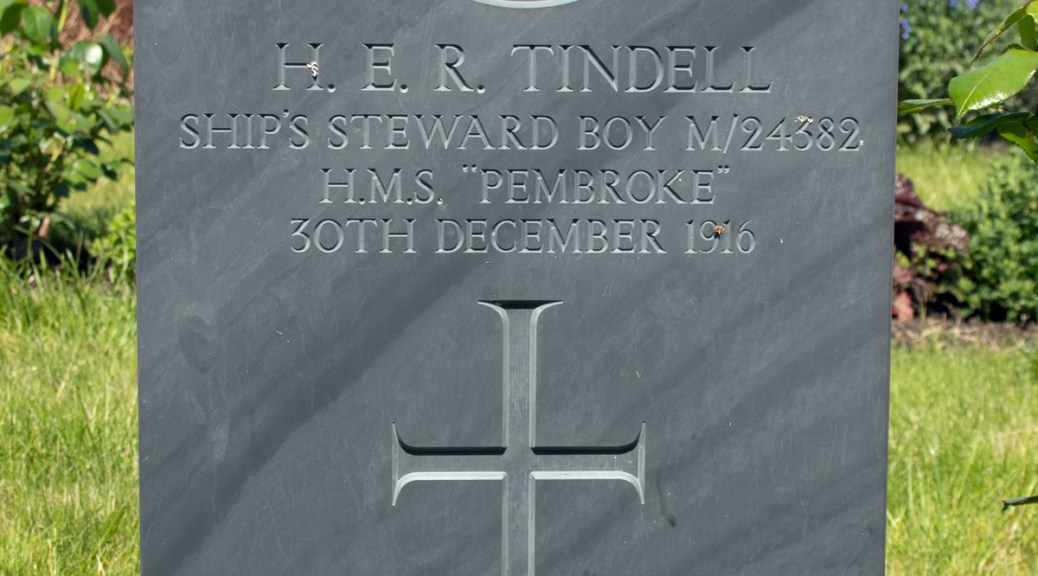
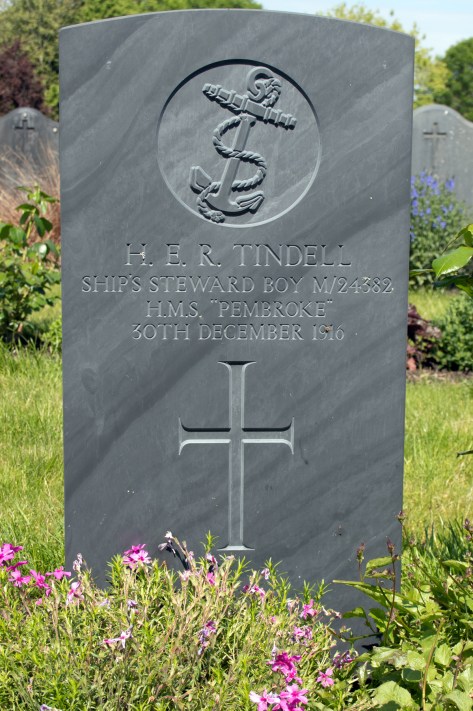
Harold Edward Richard Tindell was born in Sidcup, Kent, on 15th January 1898. The middle of three children, his parents were travelling salesman Lawrence Tindell, and his wife, Alice.
There is little concrete information available about Harold’s life: his family do not appear in the 1911 census, and it is only on his enlistment papers that we get a picture of the young man he had become. He joined the Royal Navy on 28th November 1916, signing up as a Ship’s Steward Assistant.
The document suggests that he had transferred over from the Royal Naval Volunteer Reserve, giving up his job as a clerk to fully serve his country. His papers show that he was 5ft 4.5ins (1.64m) tall, with brown hair, grey eyes and a fresh complexion.
Ship’s Steward Assistant Tindell was sent to HMS Pembroke – the Royal Naval Dockyard in Chatham, Kent – for his training. Tragically, however, his time there was to be brief. He contracted cerebrospinal meningitis, dying from the condition on 30th December 1916: he was eighteen years of age, and had been in the Royal Navy for just 32 days.
Harold Edward Richard Tindell was laid to rest in the military section of Woodlands Cemetery, Gillingham, Kent, not far from the base he had so briefly called home.
Harold’s headstone gives his rank as Ship’s Steward Boy: however, his service papers and the Commonwealth War Graves Commission both confirm the role as Ship’s Steward Assistant.
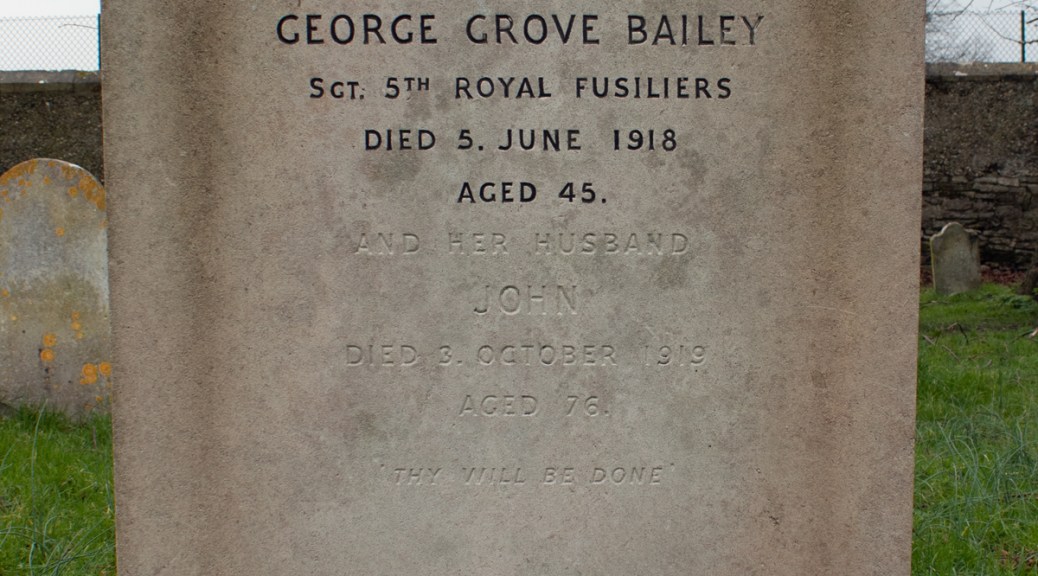
George Grove Bailey was born towards the end of 1873, in the Hampshire town of Lymington. He was the second of two children to John and Emma Bailey. John was a butler, but when Emma died when their youngest boy was just two years old, he seems to have changed career. The 1881 census found the family living at 45 High Street, Lymington, not far from the school and the Church of St Thomas the Apostle.
While he had the support of domestic servant Mary Ann, John was still young and, in 1884, he married again. His new bride was Sarah Woodman, and the couple would go on to have a daughter, Edith, two years later.
George falls off the radar at this point, and it is only from a newspaper report of his funeral in June 1918 that we are able to fill in some of the details:
The funeral took place on Monday afternoon of Sergt. George Bailey, youngest son of Mr John Bailey, of Highfield, Lymington, who passed away in the military hospital at Brighton, following a short illness. The deceased, who was 45 years of age, and was recently married, served in the South African War, and joined up at the commencement of the present war, being for some twelve months in the Fusiliers at the front. He was wounded, and since his return to this country has been acting as sergt.-instructor.
[Hampshire Advertiser: Saturday 15th June 1918]
George’s new wife was Winifred Mary Bailey, but there is little additional information about her. His regiment – the 5th Battalion of the Royal Fusiliers – was based on home soil, and would not have been the unit with which he had served on the Western Front. It’s not possible, therefore, to determine where he fought, or how he was wounded.
George Grove Bailey was buried in the family plot in the graveyard of St Thomas’ Church, Lymington, not far from where his father’s shop had been. John, who had been working as a poor rate collector, died a year after his son, and was laid to rest alongside his wife and youngest child.









 Death and Service