Tag Archives: influenza

Private Sydney Clarke

Private Sydney Clarke

The early life of Sydney Clarke is a challenge to piece together. Born in St George, Queensland, Australia, his birth parents are not recorded, and his military records give his friend and foster mother Mrs Ellen Noud.

What can be determined is that he was working as a stockman when he enlisted in the army in April 1917, and was living in the town of Warwick.

Sydney’s service records give a little more information about the man he was. Aged 27 years and two months old, he was 5ft 3ins (1.6m) tall, and weighed 109lbs (49.4kg). He had black hair, hazel eyes and a dark complexion.

Part of the Australian Imperial Force, Private Clarke left Australia on 31st October 1917. His journey on board the troop ship HMAT Euripides was not without incident, and Sydney was placed in the brig for seven days and docked two days’ pay for “neglecting to obey an order given by a superior officer”. The ship reached Britain in December 1917, and he marched in to the ANZAC base in Codford, Wiltshire, on Boxing Day.

The next six months would prove trying for Sydney’s health. On 9th January 1918, he was admitted to the camp hospital with bronchitis. This developed into pneumonia, and he would remain admitted until 18th May, when he was sent to his unit, the 49th Battalion of the Australian Infantry.

Less than a month later, however, Private Clarke was back in hospital, this time with influenza. This time his health would fail him, though: he passed away from the condition on 23rd June 1918, and the age of 28 years old.

Thousands of miles from home, Sydney Clarke was laid to rest in the newly extended graveyard of St Mary’s Church in Codford, not far from the base in which he had been billeted.


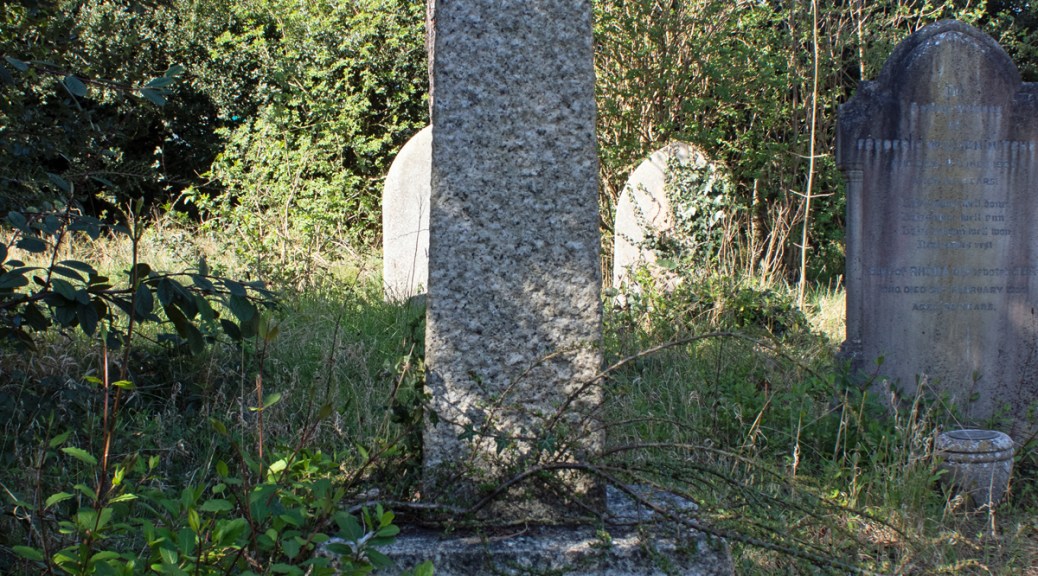
Lieutenant Allan Furlong

Lieutenant Allan Furlong

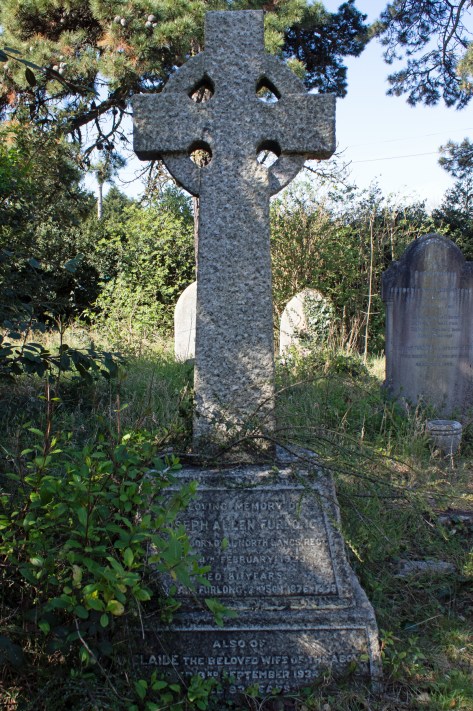
Allan Hyde Furlong was born the autumn of 1874, and was the oldest of seven children to Joseph and Adelaide Furlong. The place of his birth varies depending on which document you’re looking at, with census records suggesting he was born in Pembrokeshire, Wales, or Aldershot, Hampshire. His birth was registered in Eastry, Kent, however, so it is possible that this is where the family were based at the time.

Joseph was an officer in the North Lancashire Regiment, and his work meant the family moved time and time again. Allan’s younger siblings were born in Hampshire, Pembrokeshire and Athlone, Ireland. By the early 1880s, they had settled in Lancashire, the 1891 census recording them as living in the Fulwood Barracks in Preston.

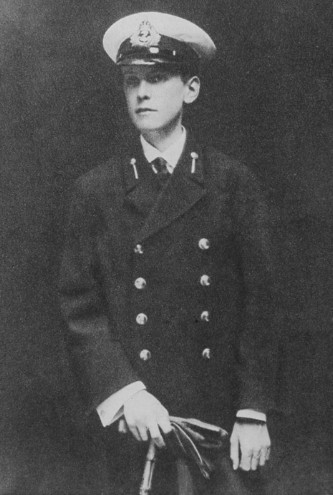
Given his father’s military background, it is not surprising that Allan was drawn to follow suit. He took a different route, however, and enlisted in the Royal Naval Reserve. Midshipman Furlong took a commission on 27th August 1892, and would make a career out of the navy.

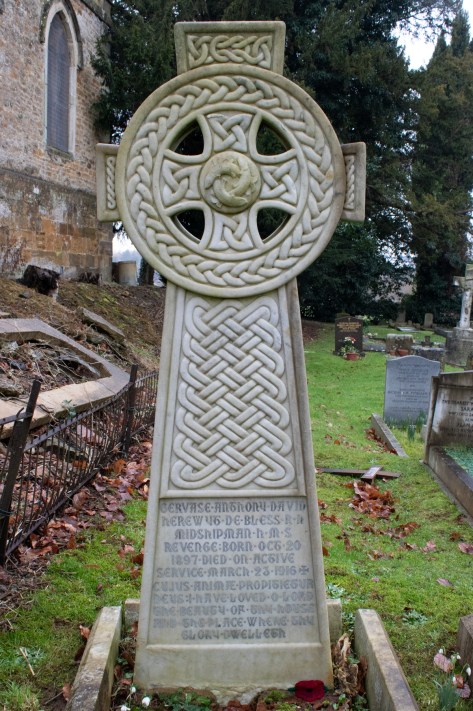
By the time war broke out, Allan was serving on board the SS Burma. In May 1915 he was promoted to Sub Lieutenant, and a further rise in rank – to full Lieutenant – followed in January 1918. He survived the war, and remained at sea through to the start of the new decade.

In March 1920, Lieutenant Furlong was admitted to the Royal Marine Infirmary in Deal, Kent, suffering from a combination of influenza and pneumonia. The conditions would get the better of Allan, and he passed away from them on 14th March 1920: he was 45 years of age.

Joseph and Adelaide were living in Worthing, West Sussex, by this point. Keen to bring their son home, the body of Allan Hyde Furlong was laid to rest in the town’s Broadwater Cemetery.


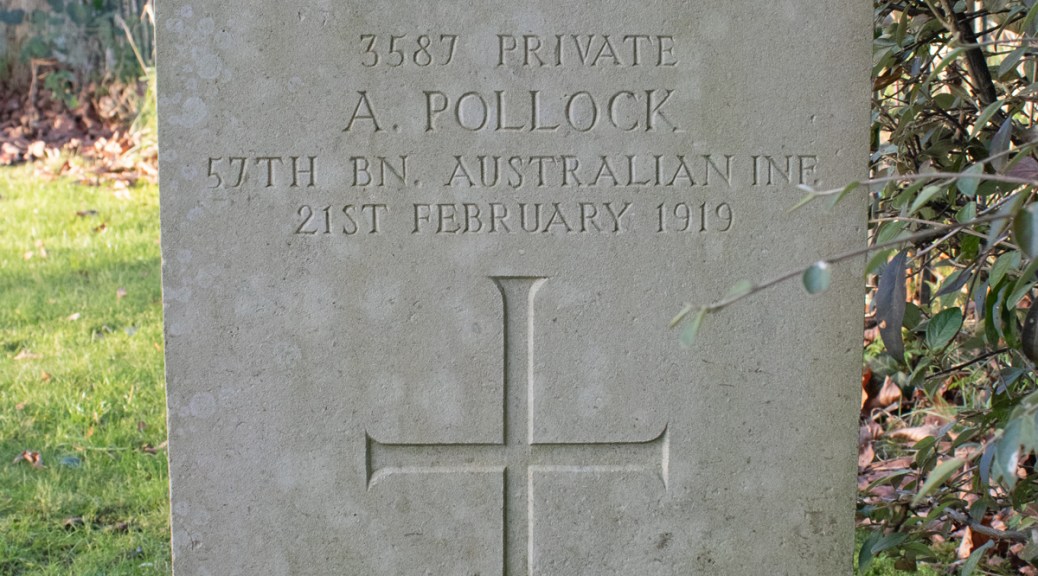
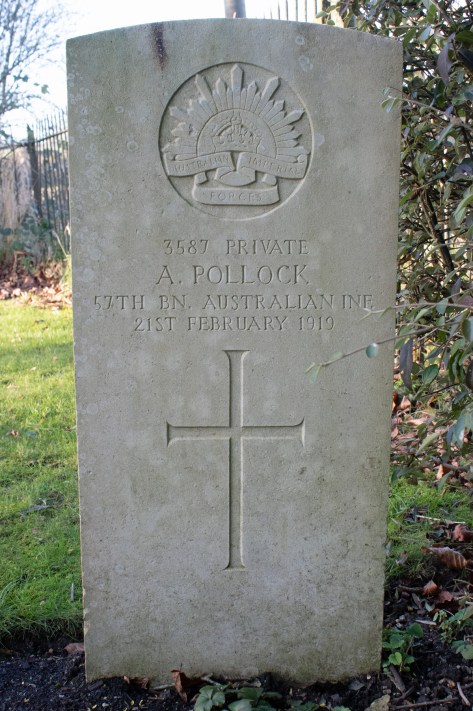
Private Alexander Pollock

Private Alexander Pollock

Alexander Pollock was born on 17th April 1893 in Bendigo, Victoria, Australia. The oldest of eight children, his parents were David and Annie. There is little information about his early life, but when he completed his schooling, he found work as a general labourer.

When war broke out, Alexander – who was better known as Ike – stepped up to play his part. He enlisted in the Australian Imperial Force (AIF) on 12th July 1915, just four months after his father had passed away. Private Pollock’s service records show that he was 5ft 6ins (1.68m) tall and weighed in at 13st 4lbs (84.4kg). He had dark brown hair, blue eyes and a fresh complexion, with a scar on his left bicep.

Private Pollock’s unit – the 57th Battalion – left Australia at the start of 1916, arriving in Egypt towards the end of February. They spent the next couple of months training at the Tell el Kebir camp, to the north of Cairo, before setting off to France, arriving in Marseilles on 23rd June.

Ike’s first taste of battle came within a matter of weeks, when his unit acted as a back-up force during the Battle of Fromelles. Described as the worst day in Australia’s history, the AIF suffered more than 5,000 casualties. The 57th Battalion, held in reserve, did not incur as many losses as other units and, as a result, Private Pollock would have remained entrenched on the Front Line after the worst hit battalions pulled back.

The next few years would see Ike remain on the Western Front. His service papers suggest that he did not see any leave until March 1918, but he was soon back in the action.

After the Armistice was declared, Private Pollock remained in France. He had a second period of leave from 22nd December 1918, spending the festivities in Britain. Back in France on 13th January 1919, he was moved to a training camp in Le Havre. By this point, however, his health was suffering, and he was moved back to Britain weeks after arriving.

Billeted at the ANZAC base in Codford, Wiltshire, Ike came down with influenza and pneumonia. He was admitted to the New Zealand General Hospital not far from the base, but the conditions were to prove fatal. He died on 21st February 1919, at the age of 25 years old.

Thousands of miles from home, and with his mother having also passed the previous year, the body of Alexander ‘Ike’ Pollock was laid to rest in the graveyard extension to St Mary’s Church, Codford.


Private Alexander Pollock
(from findagrave.com)

Private Osborne Robinson

Private Osborne Robinson

Osborne Robinson was born in the autumn of 1891. The middle of three children, he was the only son to Edward and Edith Robinson. Edward was a merchant of foreign products from West Hartlepool, County Durham, and this is where the family were raised.

Edward died in 1905, and this provided a marked change for the Robinsons. Edith moved the family to Richmond, Yorkshire, which is where her widowed mother still lived. The 1911 census recorded a divided family. Osborne’s older sister, Mary, was employed as a housekeeper for a widowed farmer in Thornton Watless, south of Richmond. His younger sister, Elsie, was living with her maternal grandmother and aunt in Richmond.

Edith and Osborne, meanwhile, were living at Swale Farm, Ellerton Abbey, to the west of Richmond. Edith recorded herself as living on private means, while her son was employed as a grazing farmer, presumably connected to the farm they were living on.

Osborne wanted to expand his horizons and, at the beginning of 1914, took the decision to seek a new life overseas. On 30th January, he boarded the SS Norman, bound for Brisbane, Queensland, Australia. Within a matter of months, war had broken out, and Osborne felt he needed to play his part for King and Empire.

On 25th July 1915, while working near Cootamundra, New South Wales, Osborne enlisted, joining the Australian Imperial Force as a Private. His service papers show that at 23 years of age, he was 5ft 5.5ins (1.66m) tall and weighed 140lbs (63.5kg). He had dark brown hair, blue eyes and a dark complexion, presumably from working outside.

Private Robinson left Australia on 5th October 1915, travelling on board HMAT A32 Themistocles for his journey to Europe. His unit – the 1st Australian Pioneer Battalion – spent time in Egypt, before moving on to Marseilles, France, in April 1916. By the autumn Osborne was on the Western Front, and, on 3rd September, during the Battle of Pozières, he was wounded in his left hand.

Initially treated at the 17th Casualty Clearing Station, Private Robinson was stoon transferred to the 1st Southern General Hospital in Birmingham. His injury took close to six weeks to heal, and he returned to an ANZAC base in Wareham, Dorset, towards the end of October.

Osborne spent a good few months on home soil, eventually re-joining his unit in France on 18th October 1917. Over the next year, he served on the Western Front, with two periods of leave – a week in Paris in March 1918 and a fortnight in the UK the following October. The Armistice declared, Private Robinson’s unit returned to its base near Warminster, Wiltshire, in January 1919.

Osborne had fallen ill with influenza by this point and his condition was to worsen to pneumonia. He died at a private address in Warminster on 8th February 1919: he was 28 years of age.

The body of Osborne Robinson was laid to rest in St John’s Churchyard, Warminster. It is unclear why Edith chose not to bring her son home, but the 1921 census recorded her, Mary and Elsie (neither of whom were married) living in the village of Reeth, on the edge of the Yorkshire Dales. All three were noted as being employed with home duties.


Private Albert Bentley

Private Albert Bentley

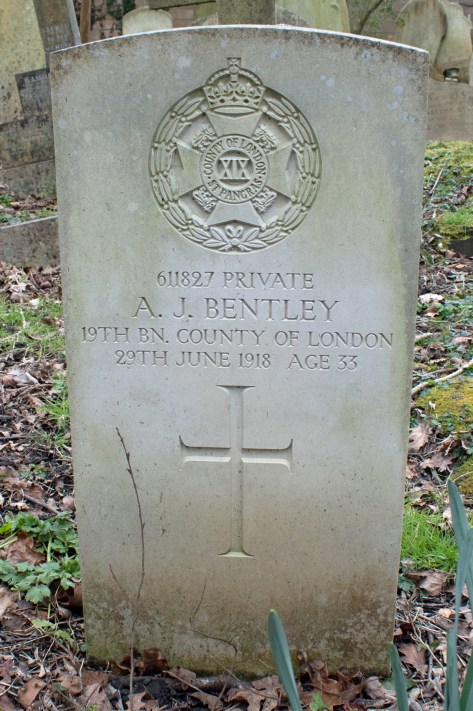
Albert John Bentley was born in St Pancras, Middlesex, in the spring of 1885. The second of six children, his parents were John and Eleanor (also known as Elizabeth) Bentley. John was a piano maker, and the family lived at 27 Hampshire Street in St Pancras.

When his father died in 1910, Albert had already started to follow in his footsteps. The following year’s census recorded him living with his mother and three younger siblings. Employed as an organ builder, his was one of three wages being brought into the household.

Albert stepped up to play his part when war broke out. Full details of his military service have been lost to time, but it is clear that he enlisted in the London Regiment, and was assigned to the 1st/19th (County of London) Battalion (St Pancras).

It is unclear whether or not Private Bentley spent any time overseas. By the summer of 1918, however, he had fallen ill, and was admitted to a military hospital in Shoreham-by-Sea, Sussex. He succumbed to a combination of influenza and pneumonia on 28th June 1918: he was 33 years of age.

The body of Albert John Bentley was taken back to Middlesex for burial. He was laid to rest in the sweeping grounds of Highgate Cemetery.


Serjeant Richard Ford

Serjeant Richard Ford

Richard Oscar Ford was born in Williamstown, Australia, in July 1891. The oldest of four children – and the only son – his parents were Anthony and Mary Ford. Anthony was a soldier, but Richard chose a different route and took work as a labourer when he completed his schooling.

There is little information available about Richard’s early life, but when war broke out, he stepped up to play his part. He enlisted in the Australian Imperial Force on 9th November 1914.

By this point he was working as a bushman, and his service papers reveal something of the man he had become. Standing 5ft 7ins (1.7m) tall, he weighed 140lbs (63.5kg), Private Ford had auburn hair, blue eyes and a fair complexion.

Assigned to the Light Horse Regiment, Richard left Australia for Europe on in March 1915. His unit arrived on the Gallipoli Peninsula on 15th July, and he would remain there for the next five months.

In December 1915, Richard came down with a bout of influenza, and was medically evacuated to the island of Mudros, then on to Alexandria, Egypt. In January 1916, he was admitted to hospital again, this time suffering from gonorrhoea and, after treatment, he re-joined his unit on 2nd February.

Private Ford’s unit spent that spring training in Egypt, but on 29th May, they set sail for the Western Front. Within a week they had disembarked in the French port of Marseilles and headed north to Etaples.

The next couple of years would prove a little disjointed. Richard switched units in August 1916, and given the rank of Gunner, but within two months his role had changed to Driver. His service records suggest that he managed to avoid injury during the fighting he was involved in, but that did not mean that he avoided hospital completely.

In January 1917 Driver Ford was admitted to the 51st General Hospital with a heart murmur, returning to his unit on 16th March. He had a second spell in hospital in February 1918, having come down with laryngitis.

In July 1918, having spent some time at the 4th Army Corporal School, Richard was reassigned to the 3rd Australian Field Artillery. This move seemed to have been the focus he needed. Initially promoted to Bombardier, within a month he rose to Lance Corporal, and by December 1918 he was a full Sergeant.

After the Armistice was signed, Richard was given three weeks’ leave, which he spent in Britain. By January 1919, however, his health was becoming an issue again, and he was admitted to the military hospital in Fovant, Wiltshire, suffering from influenza. The condition worsened, and Sergeant Ford passed away from bronchopneumonia on 4th February 1919. He was 27 years of age.

Richard Oscar Ford was laid to rest in Highgate Cemetery, Middlesex. While there seems to be no direct connection between the location and the man, his father, Anthony, had been born in Hackney, so it can be assumed that there was a family link to the area.


Rifleman Bertram Winterburn

Rifleman Bertram Winterburn

Bertram Winterburn was born in the city of Hutt, on New Zealand’s North Island, on 23rd April 1877. The oldest of eleven children, his parents were Arthur and Ada Winterburn. Arthur was a postmaster from South Island, and it would be here that he and Ada would raise their family.

There is little concrete information about Bertram’s life. The 1913 Post Office Directory records him as working as a labourer, and living in Otaki, a town back on North Island. He seems to have moved wherever the work took him, however, and, by the time war broke out, he was living in Hunterville, 110km (68 miles) further north.

Bertram stepped up to serve the empire when the call came. He enlisted in Trentham on 27th June 1916, and was assigned to the New Zealand Rifle Brigade.

Rifleman Winterburn left from Wellington on board the steam ship Willochra on 16th October 1916. His unit – H Company, 18th Reinforcements – would not arrive in Devonport, Devon, until 29th December. They were then marched to their base at Sling Camp near Bulford, Wiltshire.

The journey from New Zealand, would take its toll on the new recruits, with many falling ill before, or shortly after, they arrived. Bertram would not be immune from this and, at the end of January 1917, he was admitted to the 3rd NZ General Hospital in Codford, suffering from influenza. His condition worsened, developing into bronchitis, and this would take his life. Rifleman Winterburn died on 4th February 1917: he was 39 years of age.

Thousands of miles from his home, Bertram Winterburn was laid to rest in the newly extended graveyard attached to St Mary’s Church in Codford.


Naval Instructor George Carter

Naval Instructor George Carter

George Leslie Lewis Carter was born at the start of 1891 in New Cross, Kent. The oldest of three children, his parents were laundry managers William and Isabel Carter.

The Carters’ work seemed to take them across South London and the 1891 census found them living in Hammersmith. George’s two siblings had been born by this point, one in Gravesend, Kent, the other in Richmond, Surrey.

By 1911, William and Isabel had moved the family to Kingston-upon-Thames, Surrey. That year’s census recorded them as living at 142 London Road, which was noted as being a 12-roomed property. The couple were managing a laundry – possibly living in at the laundry itself. George was recorded as being a university student, while his younger brother Lionel was at school. The family also had a housekeeper, Frances Stoke, living with them.

When George finished his studies, he found employment as an Assistant Paymaster with the Royal Naval Reserve. On 15th February 1916, he married Ada Ritchie. She was a merchant’s daughter from Long Ditton, Surrey, and the couple exchanged vows in her local parish church.

At this point, George’s trail goes cold. He became attached to the Royal Naval College in Dartmouth, Devon – also known as HMS Pomone – and took on the role of Naval Instructor. It is unclear what type of instructing he was doing, but it seems likely to have been connected with the administration or financial part of the Royal Navy.

The funeral of Naval Instructor George Leslie Lewis Carter, Royal Naval College, Dartmouth, who died on Monday from pneumonia following an attack of influenza, took place on Wednesday morning…

The mourners were Mrs Carter (widow), Mrs Carter, Surbiton (mother), Mr Carter (brother), and Mr Jamieson Ritchie, London (brother-in-law)…

[Dartmouth & South Hams Chronicle: Friday 2nd August 1918]

Naval Instructor Carter was 27 years of age when he died on 29th July 1918. The newspaper article’s distinction between Ada and Isabel would suggest that Ada may have been living in Dartmouth at the time as well.

George Leslie Lewis Carter was laid to rest in the graveyard of St Clement’s Church in Dartmouth, Devon.


Corporal Stanley Vinton

Corporal Stanley Vinton

Stanley William Vinton was born on 30th April 1898 in Dartmouth, Devon. The second of eight children, his parents were William and Kate. William was an outfitter’s assistant, and by the time of the 1911 census, the family of ten were living in a four-roomed cottage on South Ford Road.

When he finished his schooling, Stanley was apprenticed to a shipwright. Away from work, he volunteered with the Dartmouth Cadet Company, and was drawn towards an army career. On 25th May 1914, he enlisted, joining the 7th (Cyclist) Battalion of the Devonshire Regiment. His service records show that he gave his age as 17 years and four months old. He was 5ft 6.5ins (1.69m) tall, and weighed 154lbs (69.9kg). Private Vinton was of good physical development and had good eyesight.

Stanley was formally mobilised on 5th August 1914. He remained on home soil for the next three years, primarily because soldiers were unable to fight on the Western Front until they turned 19 years of age. During this time, he appears to have impressed his superiors: in July 1916 he was promoted to Lance Corporal, and just four months later he rose to full Corporal.

In July 1917, Stanley’s chance to see some action arrived, when he was posted to the 2nd Battalion, and sent overseas. This move came with a caveat, however, and he reverted to the rank of Private. It was a challenging time for the regiment, and Stanley quickly found himself in the thick of it at Passchendaele.

On 30th November 1917, after four months on the Western Front, Private Vinton’s luck came to end. Caught up in the fighting, he was wounded in his left thigh by shrapnel and the fingers of his left hand by a gun shot wound. He was medically evacuated to Britain for treatment, and admitted to the Edinburgh War Hospital in Bangour.

Thankfully, the injury to Stanley’s hand was minimal, but his leg took longer to heal, and he remained in hospital for more than two months. When he was discharged, Private Vinton was transferred to the regiment’s command depot in Sutton Coldfield. In March 1918, he was promoted to Corporal, but his injured leg was still causing him discomfort. In the end, he was reassigned to a munitions works in Lowestoft, Suffolk, and this is where he would spend the remainder of the year.

Stanley’s constitution was weakened by this point, and that winter, he contracted influenza. The condition was to prove fatal, and he passed away on 2nd December 1918. He was just 20 years of age.

The body of Stanley William Vinton was taken back to Devon for burial. He was laid to rest in the graveyard of St Clement’s Church, Dartmouth, high above the town’s centre, but within walking distance of his grieving family’s home.


Lance Corporal Thomas Thorne

Lance Corporal Thomas Thorne

Thomas Thorne was born in Tiverton, Devon, in the spring of 1895. The older of two children, he was the only son to Thomas and Louisa Thorne. Thomas Sr was a carriage manufacture for a lace factory, and by the time of the 1911 census, the family of four were living in a small terraced house at 19 John Street in Tiverton.

At this point, Thomas Jr had completed his schooling, and had also found work at the lace factory. War was on the horizon, however, and things were to change.

On 6th December 1915, Thomas Jr made his way to Exeter to enlist. He joined the Devonshire Regiment as a Private, and his service records show that he was 5ft 4.5ins (1.63m) tall and weighed 112lbs (50.8kgs). He was of fair physical development, although there were issues with his teeth and he had a higher than normal heart rate.

Private Thorne was formally mobilised in July 1916. Initially assigned to the 13th (Works) Battalion, he spent his time on home soil. By the following spring, he transferred to the 311th Home Service Labour Company, and seems to have moved from Devon to Hampshire.

Thomas spent the next three years serving in the Labour Corps. By the winter of 1918/19, his health was becoming impacted, and he was admitted to the Shirley Warren Auxiliary Hospital in Southampton, suffering from a combination of influenza and pneumonia. The conditions were to prove fatal, and he passed away on 17th February 1919, aged just 24 years of age.

Thomas Thorne’s body was taken back to Devon for burial. He was laid to rest in Tiverton Cemetery, not far from the family home.


Interestingly, Thomas’ rank differs depending on the document you are looking at. I have used Lance Corporal, as this is what is recorded by the Commonwealth War Graves Commission, although his service papers state he was a Private.