Tag Archives: Kent

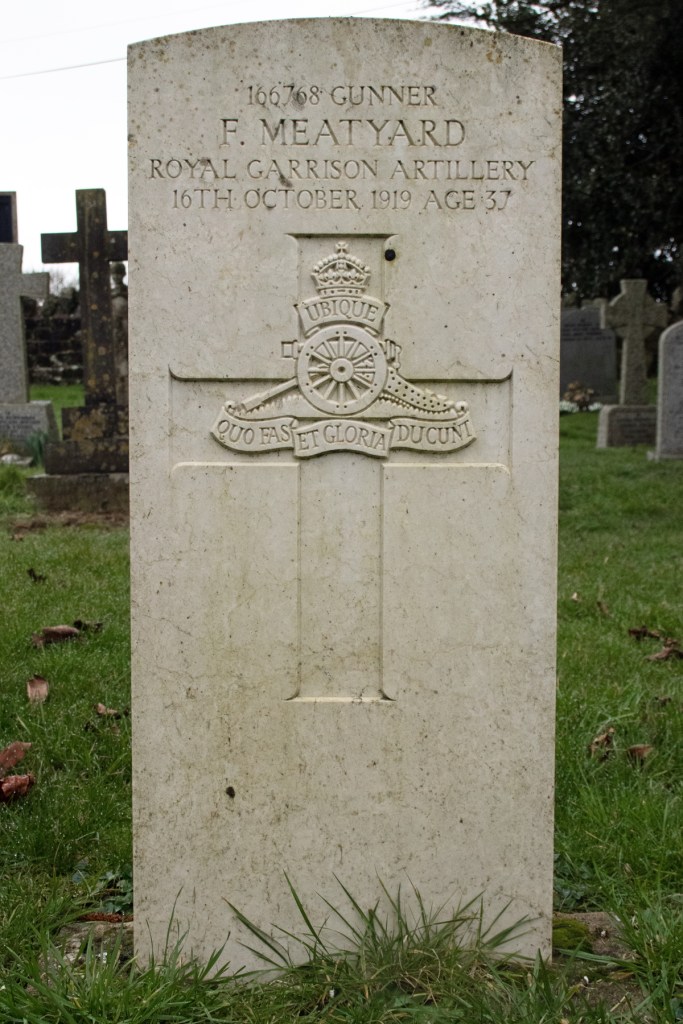
Gunner Fred Meatyard

Gunner Fred Meatyard

Fred Radford Meatyard was born in Penselwood, Somerset, in September 1882. The son of Henry and Ellen Meatyard, they seem to have been distant in his life. Fred was raised by his paternal grandparents, Henry and Caroline, in nearby Wincanton.

Fred was an intelligent young man. The 1901 census found him boarding with printer and stationer Walter Eaglestone and his family, on Erith High Street, in Kent. He was working as a compositor himself, pulling the type together for his boss to print. This appeared to be a springboard for him, and he soon moved to Oxford finding similar work there.

In 1907 Fred briefly returned to Penselwood, where he married Lily Extence in the parish church. The marriage certificate showed that Fred was living in William Street, Oxford, and was still employed as a compositor, working for the local newspaper, the Oxford Chronicle. His father, Henry, is listed as deceased, and as having been employed as an engineer. Lily was the same age as her new husband, and was the daughter of labourer Francis Extence.

The couple moved back to Oxford, and went on to have three children: Linda (born in 1908), Joan (born 1913) and Frances (born in 1915). The 1911 census record found them living in an end of terrace house in Boulter Street, the River Cherwell flowing past the bottom of their cul-de-sac. Theirs was a five-room house, and they had a boarder, Mancunian William Murphy, who was employed as a vocalist and guitarist.

When war came to Europe, Fred stepped up to play his part. He enlisted on 30th August 1916, but was not formally mobilised into the Royal Field Artillery until the following January. Gunner Meatyard’s service records show that he was a wiry man, 5ft 10ins (1.78m) tall, and weighing 126lbs (57.2kg).

In June 1917, Fred was transferred across to the Royal Garrison Artillery, and was sent to France. Aside from a couple of periods of leave, he remained overseas until the end of the war, and was attached to a couple of the regiment’s Siege Batteries.

When hostilities ceased, Gunner Meatyard finally returned to Britain in the summer of 1919. Based on Salisbury Plain, Wiltshire, while waiting to be demobbed, he fell ill, and was admitted to the Fovant Military Hospital. He was suffering from acute appendicitis, and the condition came on so quickly, that any treatment did not come soon enough. Fred passed away at the hospital on 16th October 1919, at the age of 37 years of age.

Fred Radford Meatyard was brought back to Somerset for burial. He was laid to rest in the quiet graveyard of St Michael’s Church in Penselwood. The newspaper for which he had worked for so long noted that “he was buried with full military honours… Deceased was on the printing staff of the ‘Oxford Chronicle’ for some years… He was a member of the St John’s Ambulance Brigade. Some time ago he returned from the Rhine, having previously fought in France. Much sympathy is felt with the widow and three children, two of whom, it will be remembered, took a prominent part as dancers in the pagent.” [Oxford Chronicle and Reading Gazette: Friday 24th October 1919]

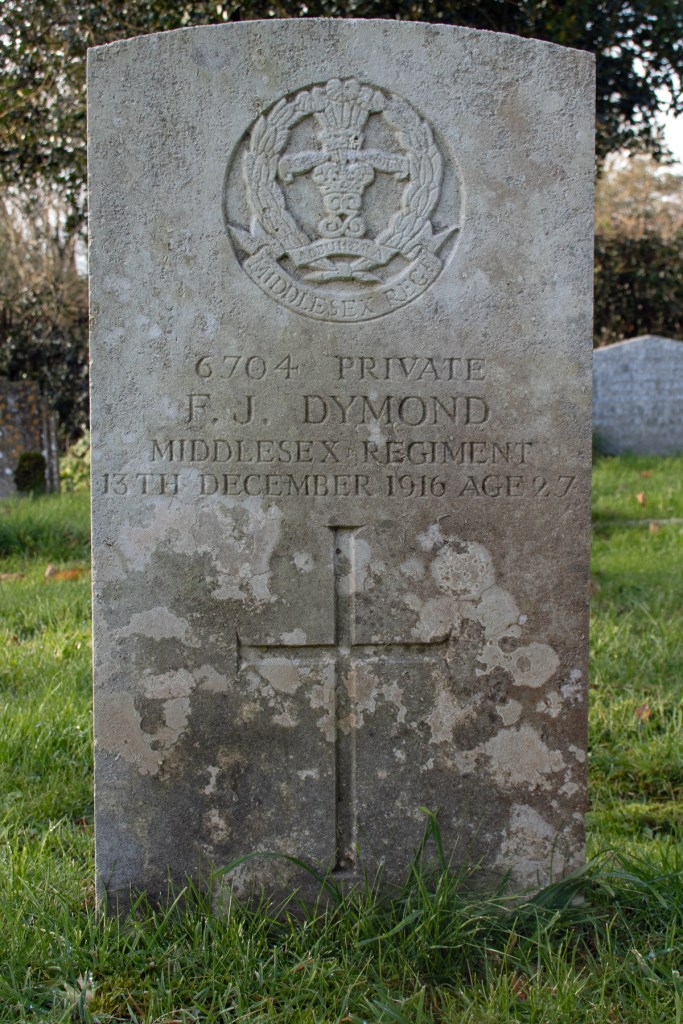
Private Frederick Dymond

Private Frederick Dymond

Frederick John Dymond was born in early 1888 in the Devon village of Dalwood. One of ten children, his parents were farmers Harry and Ellen Dymond. By the time of the 1911 census, the family had moved to Somerset and were running the Crock Street Farm near Ilminster.

When war came to Europe, Frederick was called upon to play his part. Full details of his military service are no longer available, but by the summer of 1916, he had joined the Middlesex Regiment.

Private Dymond was assigned to the 2nd/7th Battalion, which was a territorial force at that point in the conflict, based in Barham, Kent, midway between Dover and Canterbury.

In the autumn of 1916, Private Dymond was taken to the Military Hospital in Canterbury, although the reason for his admission is not clear. Whatever the cause, it was too much for his body to bear: he passed away while in hospital, on 13th December 1916. He was just 28 years of age.

Frederick John Dymond was brought back to Somerset for burial. He was laid to rest in the graveyard of St George’s Church in Hinton St George – presumably because his family had moved to the area.


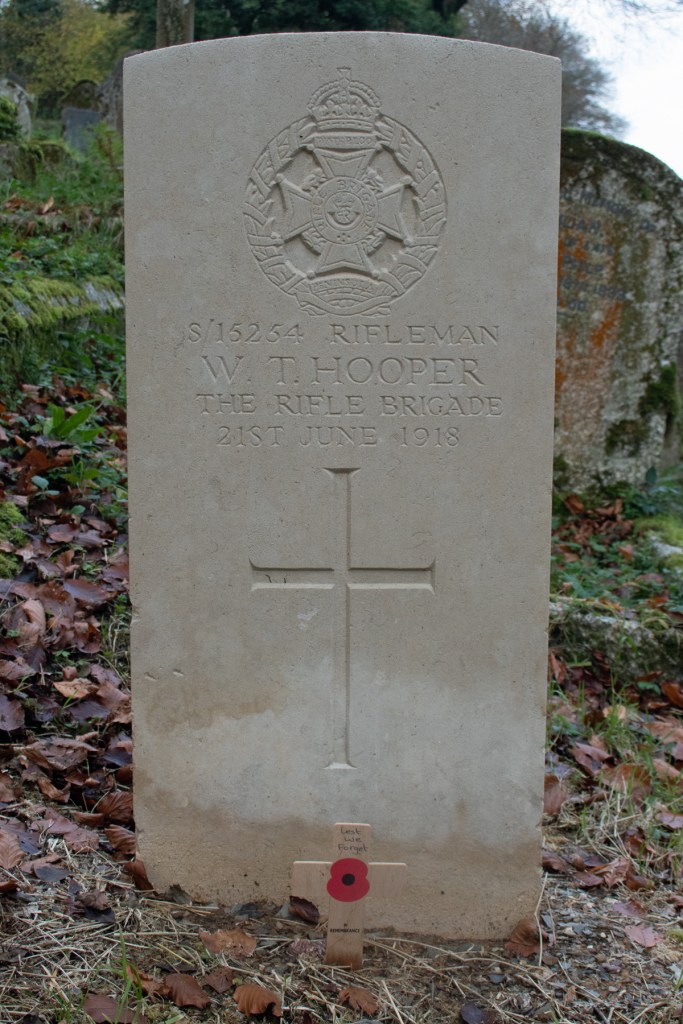
Rifleman William Hooper

Rifleman William Hooper

William Thomas Hooper was born in St Breock, near Wadebridge, Cornwall, in the summer of 1890. One of three children his parents were gardener William Hooper and his wife, Sarah.

When he left school, William Jr found work as a warehouseman and salesman, up in London, but when war broke out, he stepped up to play his part. He enlisted in December 1915, joining the Rifle Brigade, but was not formally mobilised for another couple of months.

Little detail of Rifleman Hooper’s military service survives, but records confirm that he was 5ft 6ins (1.68m) tall, and weighed 124lbs (56.3kg). It also notes that his left testicle had not descended, but that his condition was not severe enough for William to be refused for military service.

Rifleman Hooper’s was initially assigned to the 5th Battalion, based on the Isle of Sheppey, Kent, as part of the Thames & Medway Garrison. By the spring of 1916, however, he had been transferred to the 1st Battalion, and sent to France. He was involved in the Battle of Albert, and returned to the UK in August 1916 .

William appears to have been transferred back to the 5th Battalion and, in the spring of 1917, was hospitalised for three month, suffering from trench foot and rheumatism. By September that year, however, he was back with his unit.

Rifleman Hooper’s service documents become a little confused at this point. One record suggests that he was discharged from the army on 2nd January 1918 as being no longer medically fit for duty, while a second entry confirms that he passed away while on leave pending discharge.

Either way, William was back at home in St Breock when, on 21st June 1918, he passed away from a combination of pericarditis and pericardial effusion. He was just 27 years of age.

William Thomas Hooper was laid to rest in the wooded graveyard of St Breoke’s Church, in his home village.


An entry in the local newspaper confirmed that “Mr and Mrs Hooper and family… and Miss Ive Jones, London” [Cornish Guardian: Friday 18th June 1918] offered their thanks for the sympathy they had been shown in the bereavement. This suggests that, when he passed, William had been courting, his loss felt further.


Seaman James McNichol

Seaman James McNichol

James McNichol was born on 21st December 1884, in Greenock, Renfrewshire. His parents were James and Elizabeth McNichol, but there is little additional information about his early life.

On 22nd May 1908, James enlisted as a Seaman in the Royal Naval Reserve. Again, little information is available, although he appears to have spent most of his career based out of his home town or on the ship Spindrift, based out of Glasgow.

James’ service records do shed some light on him. His height was recorded as 5ft 4ins (1.63m), he had a fair complexion and blue eyes. He also had a tattoo of a tombstone on his right arm and the words True Love on his right.

James had married a woman called Elizabeth at some point, and, while the marriage documents are lost to time, she is noted as his next of kin on his naval death records.

By the summer of 1912, Seaman McNichol was assigned to the battleship HMS Bulwark. The ship patrolled the English Channel at the outbreak of war, but by that autumn of 1914, she had moved to North Kent, guarding the waters around the Isle of Sheppey against potential German invasion.

James was on board Bulwark on the morning of 26th November 1914, when an explosion ripped through the ship and sinking it. More than 740 lives were lost, Seaman McNichol among them. He was just 29 years of age.

James McNichol was laid to rest in a marked grave in Woodlands Cemetery, Gillingham, not far from a mass grave where scores of his colleagues had been buried.


Seaman James McNichol
(from findagrave.com)

Private Thomas Clarke

Private Thomas Clarke

Thomas Clarke was born on 18th July 1893 in the Cheshire town of Altrincham. The second of nine children, his parents were Irish-born couple Thomas and Mary Clarke. Thomas Sr worked in the building trade as a bricklayer, but, by the time of the 1911 census, his older children had found other trades. His oldest child, Nora, was a shop assistant, Thomas Jr was a shorthand typist, while the next two Clarke children worked in the printing industry.

Thomas Jr, however, wanted to see the world and, on 3rd October 1911, he took his first step towards that aim, enlisting in the Royal Marine Light Infantry. His service records note that he was 5ft 6ins (1.68m) tall, had blue eyes, fair hair and a fresh complexion. They also record a scar on his left hand and a tattoo on his right arm.

Private Clarke was first sent for training in Deal, Kent, and his swimming ability tested there on 6th December, presumably in the freezing English Channel. In August 1912 he moved to barracks in Portsmouth, Hampshire. Over the next couple of years, he served on two ships – HMS Prince of Wales and HMS Dido – returning to the Royal Naval Dockyard in Portsmouth after each assignment.

In July 1914, Thomas was assigned to the battleship HMS Bulwark. The ship patrolled the English Channel when he first came on board. By that autumn, however, she had moved to North Kent, guarding the waters around the Isle of Sheppey against potential German invasion.

Thomas was on board Bulwark on the morning of 26th November 1914, when an explosion ripped through the ship and sinking it. More than 740 lives were lost, Private Clarke among them. He was just 21 years of age.

Thomas Clarke was laid to rest in a marked grave in Woodlands Cemetery, Gillingham, not far from a mass grave where scores of his colleagues had been buried.


Note: While Thomas’ surname is spelt Clark on his headstone, all documents relating to him – and the Commonwealth War Graves Commission website – give the correct spelling as Clarke.


Leading Stoker Daniel Johnson

Leading Stoker Daniel Johnson

Daniel Johnson was born in Dingle, County Kerry, Ireland, on Christmas Day 1883, one of nine children to John and Ellen Johnson. John was a general labourer in the town, but while he initially followed suit, his son was destined to see the world.

On 3rd April 1903, Daniel joined the Royal Navy as a Stoker 2nd Class. His service records show that he was 5ft 7ins (1.70m) tall, with auburn hair, grey eyes and a sallow complexion.

Stoker Johnson was initially sent to HMS Vivid – the Royal Naval Dockyard in Devonport – for training. He was given his first posting in December, and was assigned to the battleship HMS Empress of India. She was to be his home for the next fifteen months.

In February 1905, Daniel was moved to another battleship, HMS Hannibal. Over the next eight years, he would go on to serve on six further vessels. His conduct was noted as Very Good throughout his time in the Royal Navy, and this was matched with the promotions he received. In July 1906, while on board HMS Suffolk, he was given the rank of Stoker 1st Class, and four year later, while serving on HMS Commonwealth, he was promoted to Leading Stoker.

In between voyages, Daniel’s base was HMS Vivid, but in February 1913, he was assigned to HMS Victory – the Royal Naval Dockyard in Portsmouth, Hampshire. He had been serving for ten years by this point, and his records hint at the man he had become. His height was now 5ft 10ins (1.78m), his hair recorded as dark brown and his complexion was noted as being fresh.

On 16th April 1913, Daniel seems to have been assigned to the Northern Irish Inniscrone Battalion, remaining with them for some fifteen months. Based at Inniscrone (now Enniscrone, Co. Sligo), this posting seems to have been with the Coastguard, patrolling the western coast of Ireland.

August 1914 saw Leading Stoker Johnson return to the Royal Navy. He was assigned to the battleship HMS Bulwark, which patrolled the English Channel when he first came on board. By that autumn, however, she had moved to North Kent, guarding the waters around the Isle of Sheppey against potential German invasion.

Daniel was on board Bulwark when, on the morning of 26th November 1914, an explosion ripped through the ship, tearing it apart and sinking it. In all 741 souls were lost, Leading Stoker Johnson among them. He was just 30 years of age.

The majority of those who died in the explosion aboard HMS Bulwark were buried in a mass grave in Woodland Cemetery, Gillingham, Kent. Daniel’s body, however, was not recovered until 24th January 1915, some two months after the explosion.

The sixteenth inquest on the victims of the Bulwark disaster was held at Chatham Naval Hospital on Monday. A body clothed in the dress of a patty officer was identified as that of Thomas Henry Treacher, who was a gun-layer. Two stokers were identified by marks on their clothing as Daniel Johnson, of Blackfields, Co. Kerry. and Edward Henry Buckingham of Nunhead, London, and an able seaman’s body proved to be that of John Griffin, of Kilrush, Co. Clare. The jury returned a verdict of accidental death in each case. Twenty-five bodies have now been recovered.

Westerham Herald: Saturday 30th January 1915

Daniel Johnson was laid to rest in a marked grave in Woodlands Cemetery, not far from his fellow servicemen.


Interestingly, the Coastguard station at Enniscrone would feature in history again a few years after Daniel’s death. Based next to the town’s pier, it was manned by up to five guards and was home to them and their families.

The coastguard station at Enniscrone, County Sligo, was raided on Thursday night, and arms and ammunition taken. The streets of Enniscrone were cleared by the Volunteers prior to the raid. One coastguard is stated to have fired several shots at the attackers, but he was eventually overpowered, and the garrison were then marched out. The arms and ammunition were removed to a waiting motor car, and the furniture and personal belongings of the coastguards taken from the building, which was then set fire to and destroyed.

Belfast News-Letter: Saturday 28th August 1920

Able Seaman John Griffin

Able Seaman John Griffin

John Griffin was born on 26th November 1885, one of six children to John and Mary Griffin. John Sr was a shoemaker from Limerick, Ireland, but it was in neighbouring County Clare, in the coastal town of Kilrush, that he and Mary raised their family.

John Jr’s siblings found labouring work when they left school, but he was after bigger and better things. In July 1901 he enlisted in the Royal Navy, set for a life at sea. As he was only fifteen years old at this point, he was not formally enrolled in service, but given the rank of Boy 2nd Class. He was initially posted to the training ship HMS Black Prince, which was based in Queenstown – now Cobh – County Cork.

Boy Griffin spent nine months on board the Black Prince, rising to the rank of Boy 1st Class in the process. In May 1902 he was given his first posting, aboard the battleship HMS Minotaur. After six months he transferred to the frigate HMS Agincourt, before moving again – to HMS Russell – on 18th February 1903.

It was while John was assigned to this battleship that he came of age. On his eighteenth birthday, he was formally enlisted into the Royal Navy for a period of 12 years’ service. He was given the rank of Ordinary Seaman and his records give an indication of the man he had become. They note that he was 5ft 4.5ins (1.64m) tall, with dark brown hair, brown eyes and a fresh complexion.

In April 1904, Ordinary Seaman Griffin was transferred to the battleship HMS Queen. He spent two years on board, gaining a further promotion – to Able Seaman – in September 1905.

Over the next nine years, John served on seven further vessels and, when not at sea, was based primarily at HMS Vivid, the Royal Naval Dockyard in Plymouth/Devonport, Devon. In July 1914, with Europe on the brink of war, he was given another transfer, to the battleship HMS Bulwark. Boarding in Portsmouth, Hampshire, the ship sailed to the North Kent coast, off Sheerness.

Able Seaman Griffin was on board Bulwark when, on the morning of 26th November 1914, an explosion ripped through the ship, tearing it apart and sinking it. In all 741 souls were lost, John among them. He should have been celebrating his 29th birthday.

The majority of those who died in the explosion aboard HMS Bulwark were buried in a mass grave in Woodland Cemetery, Gillingham, Kent. John’s body, however, was not recovered until 24th January 1915, some two months after the explosion.

The sixteenth inquest on the victims of the Bulwark disaster was held at Chatham Naval Hospital on Monday. A body clothed in the dress of a patty officer was identified as that of Thomas Henry Treacher, who was a gun-layer. Two stokers were identified by marks on their clothing as Daniel Johnson, of Blackfields, Co. Kerry. and Edward Henry Buckingham of Nunhead, London, and an able seaman’s body proved to be that of John Griffin, of Kilrush, Co. Clare. The jury returned a verdict of accidental death in each case. Twenty-five bodies have now been recovered.

Westerham Herald: Saturday 30th January 1915

John Griffin was laid to rest in a marked grave in Woodlands Cemetery, not far from his fellow servicemen.


Stoker Anthony Eames

Stoker Anthony Eames

Anthony Eames was born on 29th October 1876 in the village of Newhall, Derbyshire. He was one of four children to James and Mary Eames, although Mary passed away in 1880, not long after Anthony’s younger brother was born. James remarried, and he and his new wife (and possibly his late wife’s sister), Theresa Barlow went on to have twelve children of their own.

James was a coal miner, and while Anthony initially followed in his father’s footsteps, he sought bigger and better things. In September 1896, just short of his twentieth birthday, he joined the Royal Navy as a Stoker 2nd Class. His service records show that he was 5ft 3.5ins (1.61m) tall, had brown hair, grey eyes and a fresh complexion. The document also noted that he had tattoos on both of his arms.

Stoker Eames’ initial posting was at HMS Victory, the Royal Naval Dockyard in Portsmouth, Hampshire. He spend a year there, honing his skill, before being assigned to HMS Powerful in September 1897. Three months later, he was transferred to the cruiser HMS Alacrity and, over the remainder of his twelve years’ service, he worked on eight further vessels, rising to the rank of Stoker 1st Class in the process.

It was during this time that Anthony met and married Frances Pelley, a young woman from Portsmouth. The couple went on to have three children and, when Stoker Eames was stood down from active service at the end of his contract in 1908, the family moved to Sheffield. Anthony found employment in the mines again and the family settled in to a small terraced house in the then village of Darnall.

The sea continued to call to Anthony, though, and, on 8th March 1912, he re-enlisted. For the next couple of years he was based at HMS Victory, but when war broke out he was transferred to the battleship HMS Bulwark.

Stoker Eames was on board Bulwark when, on the morning of 26th November 1914, an explosion ripped through the ship, tearing it apart and sinking it. In all 741 souls were lost, Anthony amongst them. He was 38 years of age.

The majority of those who died in the explosion aboard HMS Bulwark were buried in a mass grave in Woodland Cemetery, Gillingham, Kent. Anthony Eames’s body, however, had been identified, and so he was laid to rest in a marked grave in the cemetery.


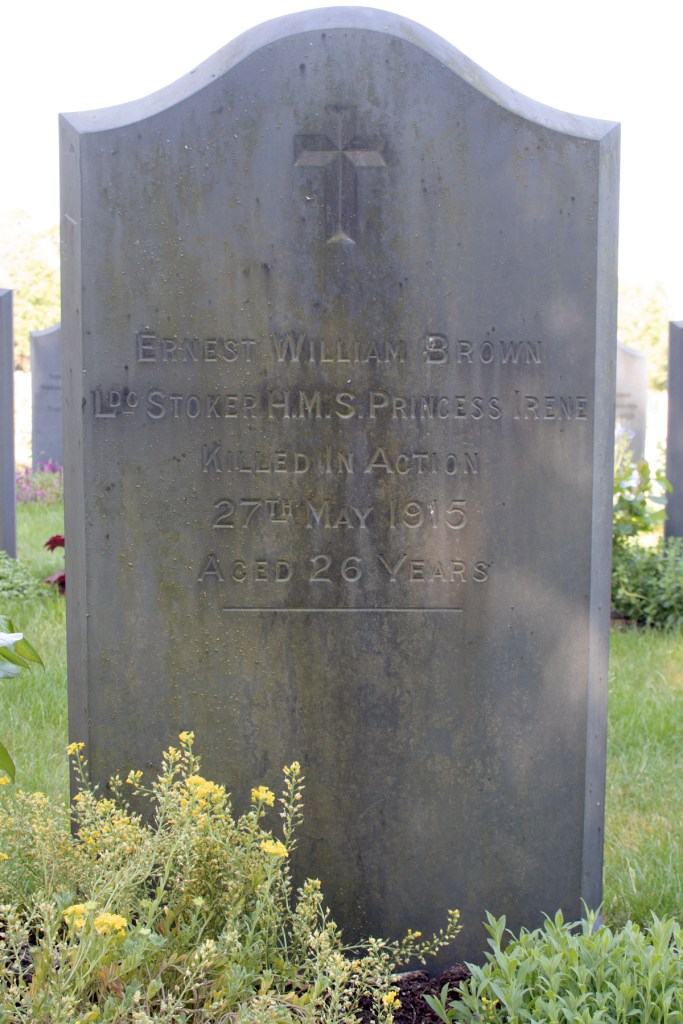
Leading Stoker Ernest Brown

Leading Stoker Ernest Brown

Ernest William Brown was born on 5th April 1889 in Halstead, Essex. One of twelve children, his parents were carpenter Edward and silk weaver Elizabeth Brown.

Ernest initially found work as an errand boy, then as a house painter. He wanted bigger and better things, however, and the Royal Navy offered him that opportunity. He enlisted as a Stoker 2nd Class on 12th March 1908 for a period of twelve years’ service.

Ernest’s early service records are lost to time, but he received a promotion to Stoker 1st Class on 12th March 1909, exactly a year after a joined up. At this point he was assigned to the dreadnought battleship HMS Russell, on board which he served until August 1912.

After a short period at HMS Pembroke, the Royal Naval Dockyard in Chatham, Kent, Stoker 1st Class Brown was transferred to the Apollo-class cruiser HMS Iphigenia. She was to be his home for the next two-and-a-half years, during which time he was promoted again, this time to Leading Stoker.

Returning to HMS Pembroke in March 1915, this was to be his shore base for the next couple of months. On 27th May, Leading Stoker Brown was helping out on the steamer Princess Irene. Tragically, while on board an explosion ripped through the ship, while moored off Sheerness, Kent and he was one of the 352 souls killed. He was just 26 years of age.

Ernest William Brown was laid to rest in the Woodlands Cemetery in Gillingham, Kent. His body having been identified, he was given his own grave, unlike those who were buried in a mass grave nearby.


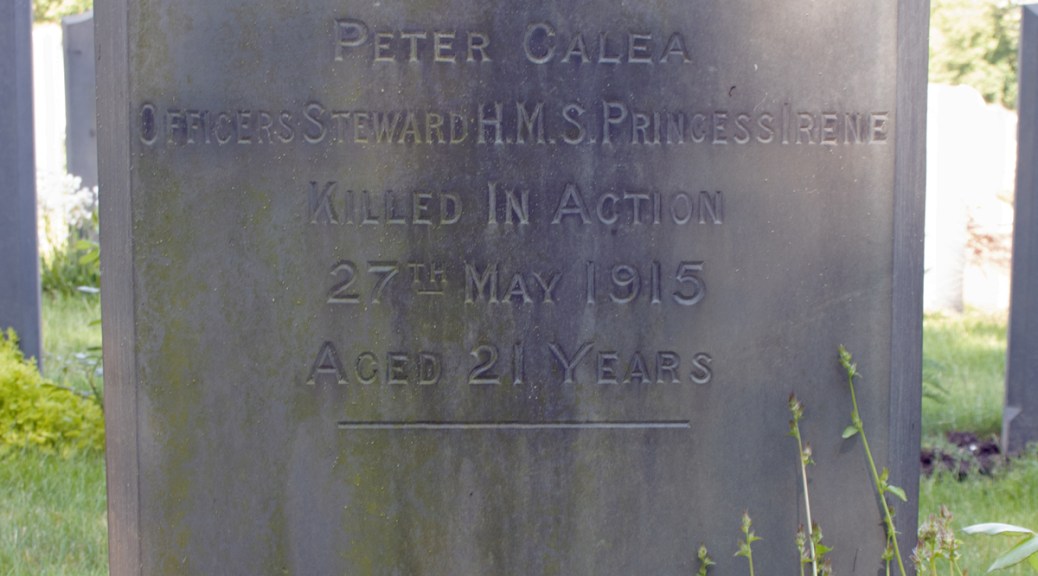
Officers’ Steward Peter Galea

Officers’ Steward Peter Galea

Peter Galea was born in the Maltese town of Senglea on 25th August 1893. His mother’s name was Carmela, but there is little further concrete information about his early life.

What is clear is that Peter found employment by enlisting in the Royal Navy. He joined up on 2nd January 1912 as an Officer’s Steward 3rd Class. His service records show that he was 5ft 9.5ins (1.66m) tall, had brown eyes, black hair and a dark complexion.

Officer’s Steward Galea’s first assignment was on board the dreadnought battleship HMS Orion. He was to spend more than three years on board, although his continuous service was interrupted by three days spent in the cells in May 1913: unfortunately his misdemeanour is not recorded.

In February 1914, Peter was transferred to the Apollo-class cruiser HMS Thetis. She was to be his home for the next year, during which time war was declared across Europe. In March 1915, Officer’s Steward Galea was assigned to another ship, the ocean liner Princess Irene.

Tragically, Peter was on board when, on 27th May 1915, an explosion ripped through the ship, while moored off Sheerness, Kent and he was one of the 352 souls killed. He was just 21 years of age.

Peter Galea was laid to rest in the Woodlands Cemetery in Gillingham, Kent. His body having been identified, he was given his own grave, unlike those who were buried in a mass grave nearby.