Tag Archives: Kent

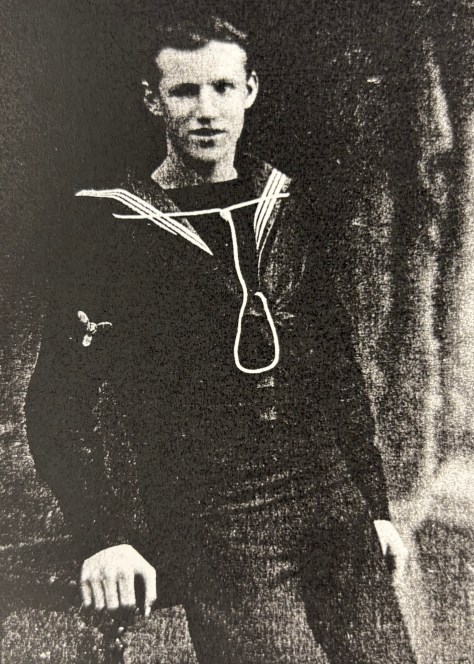
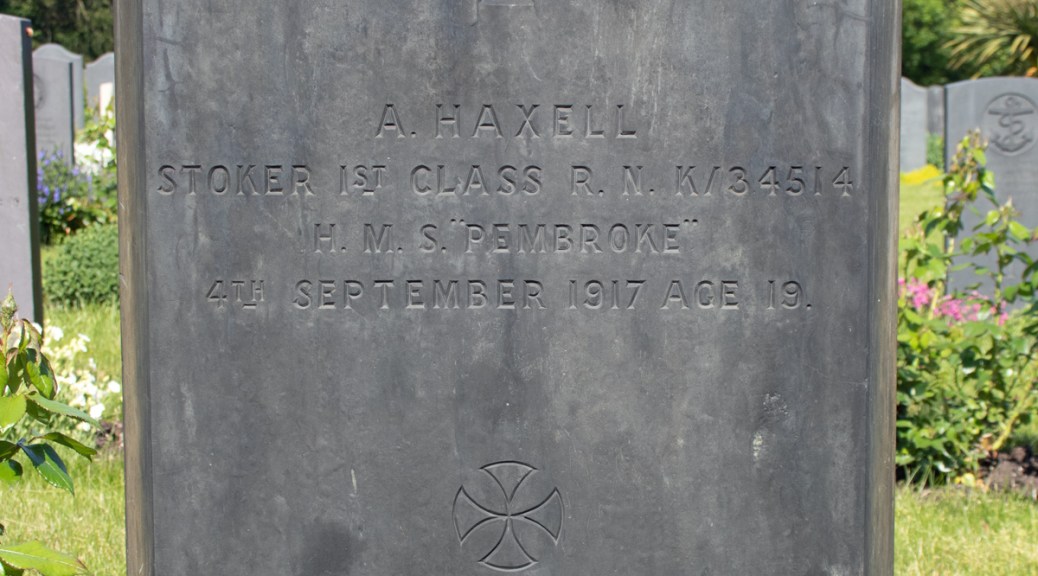
Stoker 1st Class Arthur Haxell

Stoker 1st Class Arthur Haxell

Arthur Frederick Haxell was born on 17th June 1897 and was the third of six children to Frederick and Ellen. Arthur’s father was a labourer from Tilbury in Essex, who raised his family in nearby Romford, where Arthur himself was born.

By the time Arthur was six, the family had moved to Kent; the 1911 census found them living in the then village of Welling. When he left school, he found work at a local mill. War was on the horizon, however, and things were about to change.

Arthur was called up on 22nd June 1916, joining the Royal Navy as a Stoker 2nd Class. His service records show that he was 5ft 4ins (1.62m) tall, had fair hair, blue eyes and a fresh complexion. He was sent to HMS Pembroke – the shore establishment at the Naval Dockyard in Chatham, Kent – and spent three months there being trained.

Stoker Haxell’s first sea commission was on board HMS Dartmouth, a cruiser that served in the Eastern Mediterranean which was involved in the Battle of Otranto Straits in the spring of 1917. He spent nine months on board, and received a promotion to Stoker 1st Class during this time.

By the start of July, however, Arthur was back in Chatham. HMS Pembroke was a busy place that summer, a sunken battleship and an outbreak of fever meaning that its barracks had reached capacity. Rather than being in the normal barracks, Arthur found himself billeted at the nearby Chatham Drill Hall instead.

By this point in the conflict, the German Air Force was doing all it could to minimise the losses it was suffering during its daylight raids. Instead, it trialled night flights and, on 3rd September 1917, Chatham was bombed. The Drill Hall Stoker Haxell was sleeping in received a direct hit; he died from his injuries the following day. He was just 20 years old.

Arthur Frederick Haxell was laid to rest in the Woodlands Cemetery in nearby Gillingham, alongside the other 97 victims of the Chatham Air Raid.
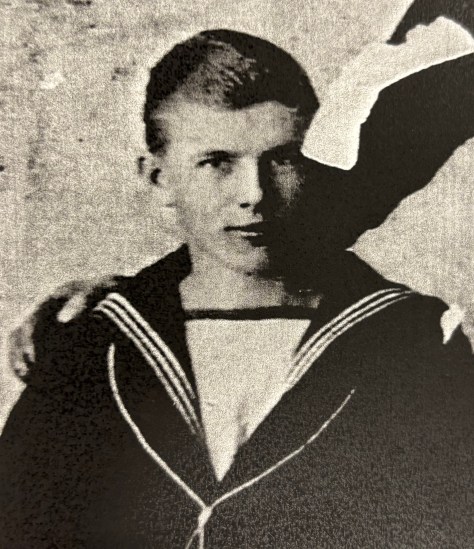

Stoker 1st Class Arthur Haxell
(from Chatham Air Raid, Vol. 2 by Marcus Bedingfield)
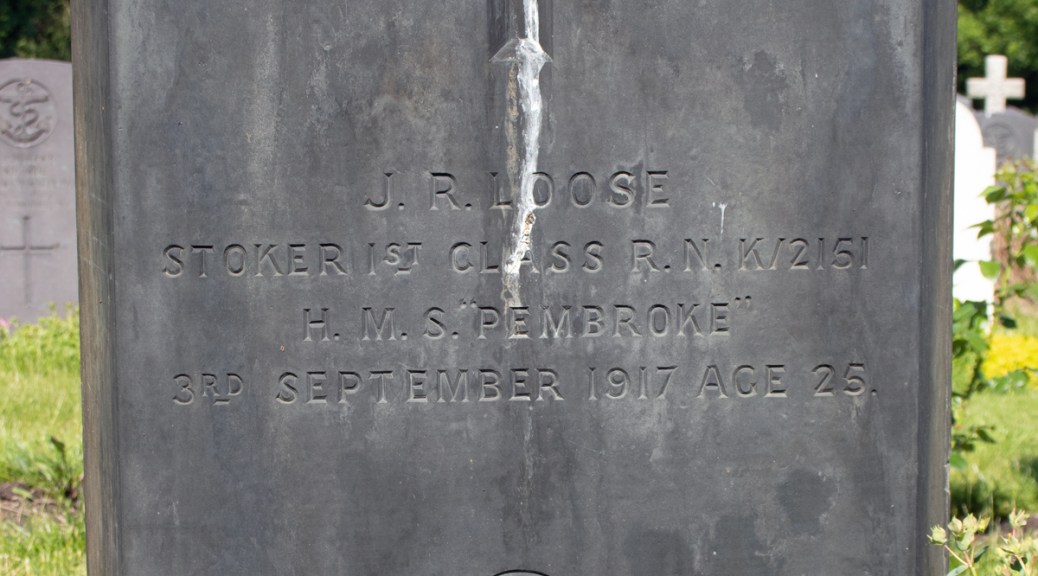
Stoker 1st Class John Loose

Stoker 1st Class John Loose

John Robert Loose was born on 3rd March 1891 in the village of Brancaster on the North Norfolk coast. One of seven children his parents were John and Agnes Loose.

John Loose Sr was a fisherman, as were most of the family’s neighbours and the sea was definitely in his oldest son’s blood. Within days of his eighteenth birthday, he had enlisted in the Royal Navy for a 12 year term. His service records show that he was 5ft 9ins (1.75m) tall, with light brown hair, blue eyes and a fresh complexion.

Stoker 2nd Class Loose’s first assignment was on board HMS Acheron and, over the next year he learnt his trade on board her, HMS Vindictive and HMS Hawke. In June 1910, he was serving on HMS Inflexible, and received a promotion to Stoker 1st Class.

In the lead up to the outbreak of the First World War, John served on five further vessels. In between ocean assignments he was based on board HMS Pembroke, the shore-based establishment based at the Royal Naval Dockyard in Chatham, Kent.

While he seemed diligent and hard working, Stoker Loose was not without his flaws, and had a couple of run-ins with authority. In June 1912 he was detained for 90 days for absence, drunkenness and for striking a Leading Seaman. Eighteen months later he was imprisoned for a further 28 days for being absent beyond his allotted leave.

When hostilities commenced, Stoker Loose was serving on board HMS Bacchante, an armoured cruiser that was part of the Royal Navy’s Mediterranean fleet. He spent a total of eighteen months on board, returning to Chatham in February 1916.

A further lengthy posting followed, as he was assigned to HMS Calliope, a light cruiser that served in the North Sea, and which was involved in the Battle of Jutland later that spring. Again, Stoker Loose’s record was not without blemish: he spend a week in the brig, although there is no confirmation of his misdemeanour this time around.

By August 1917, John was back on dry land in Kent. HMS Pembroke was a busy place that summer, and, with its barracks having reached capacity, Chatham Drill Hall was used as temporary accommodation. This is where John found himself billeted.

The German Air Force, by this point was trying to minimise the losses it was suffering during raids it carried out in daytime. Instead, it trialled night flights and, on 3rd September 1917, Chatham found itself in their flight path. The Drill Hall Stoker Loose was sleeping in received a direct hit, and he was killed. He was just 26 years old.

The 98 victims of the Chatham Air Raid were laid to rest in Woodlands Cemetery, Gillingham, walking distance from the Drill Hall where John Robert Loose had been living.


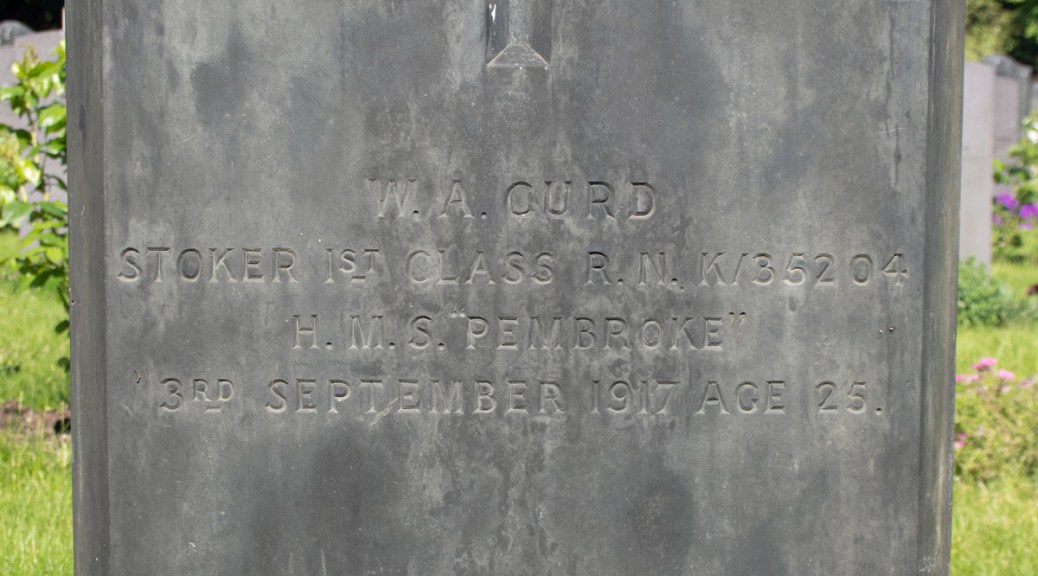
Stoker 1st Class William Curd

Stoker 1st Class William Curd

William Alfred Curd was born on 14th November 1891, the oldest of nine children to William and Emily Curd. William Sr was a carter and labourer on a farm, and his William Jr was to follow suit when he left school. The 1911 census recorded the family as living in Dover, Kent, living in a four-roomed house near the centre of the town.

By this time war was knocking at the door, and, living in Dover, the Curd family were in the front line. William Jr continued his carting work, but was eventually called up in the summer of 1916. He enlisted in the Royal Navy as a Stoker 2nd Class on 31st July and was dispatched to HMS Pembroke – the shore-based establishment at Chatham Dockyard.

William’s enlistment papers show that he was just over 5ft 3ins (1.61m) tall, had brown hair, blue eyes, a fresh complexion and tattoos on both of his forearms.

After three months’ training, Stoker Curd was assigned to HMS Dartmouth, a light cruiser. She served in the Mediterranean and, during his time on board, was involved in the Battle of the Strait of Otranto, off the coasts of Albania and Italy.

At the beginning of July 1917, William returned to Chatham, and was promoted to Stoker 1st Class. HMS Pembroke was a busy place that summer, and its barracks had reached capacity. Chatham Drill Hall was used as temporary accommodation, and this is where Stoker Curd found himself billeted.

By this point in the war, the German Air Force was looking to minimise daytime casualties, and was, instead, trialling night raids; on 3rd September, Chatham found itself in their flight path. The Drill Hall received a direct hit, and Stoker 1st Class Curd was killed, along with close to 100 others. He was just 25 years old.

The victims of the Chatham Air Raid were laid to rest in Woodlands Cemetery, Gillingham, walking distance from the Drill Hall where William Alfred Curd and his colleagues had died.


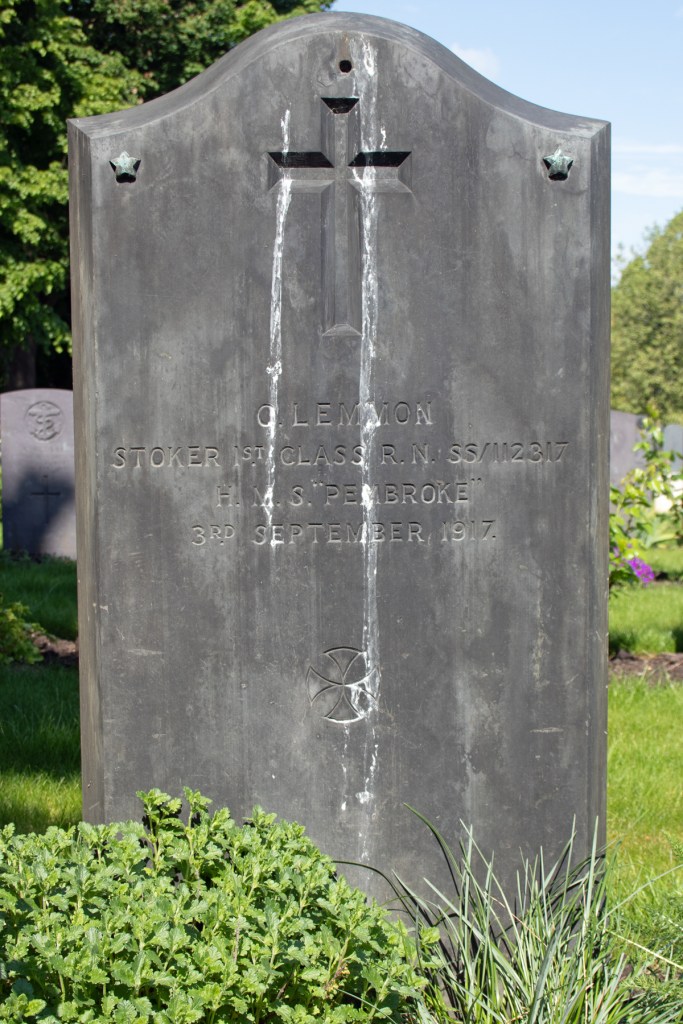
Stoker 1st Class Charles Lemmon

Stoker 1st Class Charles Lemmon

Charles Lemmon was born in Norwich, Norfolk on 12th July 1892. He was one of ten children and the son of bricklayer Henry Lemmon and his wife Sophia.

When Charles left school, he found work as an errand boy; by the time of the 1911 census, he had moved to Cambridge. He was living with John Buol, a Swiss confectioner and pastry chef who had set up a restaurant in the centre of the city, opposite King’s College.

The move from Norfolk to Cambridgeshire must has ignited a yearning for travel, however. Within a year, Charles had enlisted in the Royal Navy, and was taken on as a Stoker 2nd Class. His naval records show that he stood at 5ft 2ins (1.57m) tall, had brown hair, grey eyes and a fair complexion. It was also noted that he had a scar on his left leg.

Stoker Lemmon was set to see the world. After his initial training at HMS Pembroke – the Royal Naval Dockyard in Chatham, Kent – he was assigned to HMS Berwick, an armoured cruiser that sailed between England and the Americas.

The following year, Charles was reassigned to HMS Swiftsure, and received a promotion to Stoker 1st Class. He returned to HMS Pembroke in May 1916, and, after a couple of months on land, boarded HMS Titania, a submarine depot ship that had recently seen action in the Battle of Jutland.

Stoker Lemmon spent just under a year on the Titania, before again returning to Chatham in the spring of 1917. HMS Pembroke was a crowded place that summer, Charles was billeted in temporary accommodation in the dockyard’s Drill Hall.

On 3rd September, the German Air Force was trialling night raids on English locations; Chatham found itself in the line of fire. The Drill Hall received a direct hit, and Stoker 1st Class Lemmon was killed, along with close to 100 other servicemen resting there. He was just 25 years of age.

The servicemen who lost their lives in the Chatham Air Raid, including Charles Lemmon, were laid to rest in the Woodlands Cemetery in nearby Gillingham.


Carpenter’s Crew Roland Mayes

Carpenter’s Crew Roland Mayes

Roland William John Mayes was born on 29th September 1895 in the Norfolk village of Fundenhall. He was the seventh of ten children to Herbert and Anna Mayes, and was the first son. Herbert was a carpenter, and this was a trade his son was to follow him into, finding work at a local piano factory.

By 1914, war was looming, and Roland wanted to put his skills to good use. He enlisted in the Royal Navy on 11th March 1914, joining a carpenter’s crew at HMS Pembroke, the Royal Naval Dockyard in Chatham, Kent. Roland’s service records show that he stood at 5ft 7ins (1.7m) tall, had brown hair, grey eyes and a sallow complexion.

Crewman Mayes’ first sea-bound assignment was aboard HMS Patrol; she was a cruiser that provided defence for the east coast of England. The vessel was badly damaged during the German bombardment of Hartlepool in December that year; Roland remained on board for more than three years.

In August 1917, Crewman Mayes returned to Chatham. HMS Pembroke was a crowded place that summer, additional accommodation was made available in the dockyard’s Drill Hall, and this is where Roland was billeted.

On the night of the 3rd September, the German Air Force was trialling night raids on English locations; Chatham found itself in the direct line of fire. The Drill Hall received a direct hit, and Carpenter’s Crewman Mayes was killed, along with close to 100 other servicemen resting there. He was just 21 years of age.

Along with 97 other victims of the Chatham Air Raid, Roland William John Mayes was laid to rest three days later in the Woodlands Cemetery in nearby Gillingham.


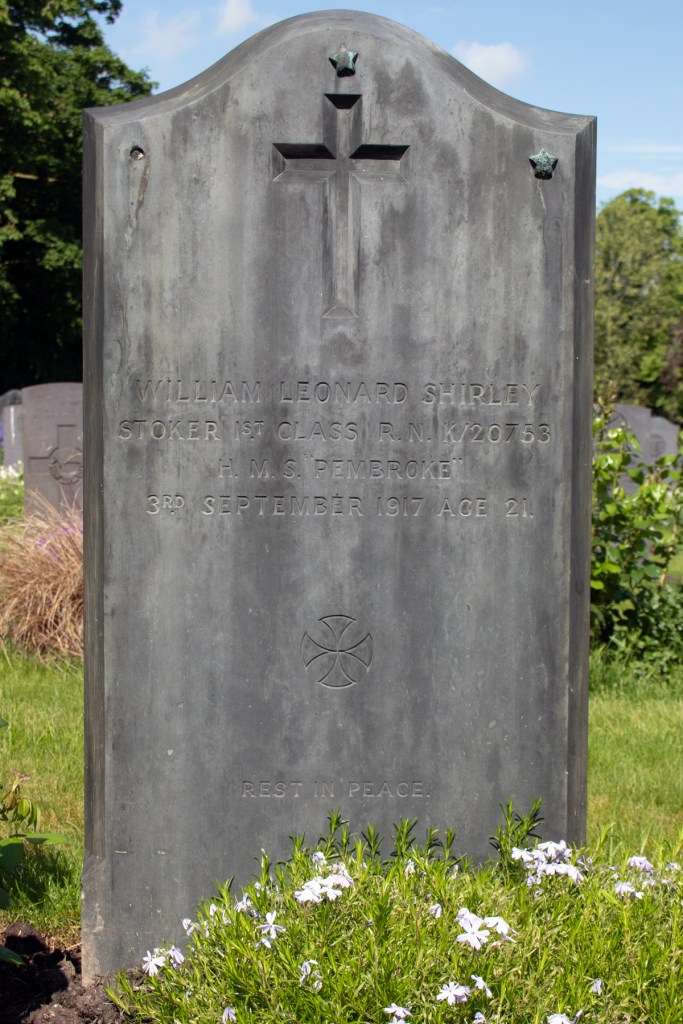
Stoker 1st Class William Shirley

Stoker 1st Class William Shirley

William Leonard Shirley was born in the spring of 1896, the second of six children to Edward and Helen Shirley. Edward was a brewer’s drayman who raised his family in South Croydon, Surrey.

When William left school, he found work as a baker’s delivery boy. War was on the horizon, however, and he was destined for the Royal Navy. His full service details are not available, although it is clear that he had enlisted as a Stoker by 1917.

William seems to have been based at HMS Pembroke – the shore-based establishment at the Royal Naval Dockyard in Chatham, Kent. Again, details are sketchy, but he was definitely there in September 1917.

This was a busy time for HMS Pembroke, and the barracks were using the dockyard’s Drill Hall as temporary additional accommodation for the overflow of servicemen there at the time. Stoker 1st Class Shirley was based there on the night of the 3rd September, when the German Air Force performed their first night raid on England. The Drill Hall received a direct hit, and William, along with nearly 100 others, was killed. He was just 21 years of age.

William Leonard Shirley was laid to rest with the dozens of other victims of the Chatham Air Raid in the Woodlands Cemetery in nearby Gillingham.


Stoker 1st Class William Shirley
(from Chatham Air Raid, Vol. 2 by Marcus Bedingfield)

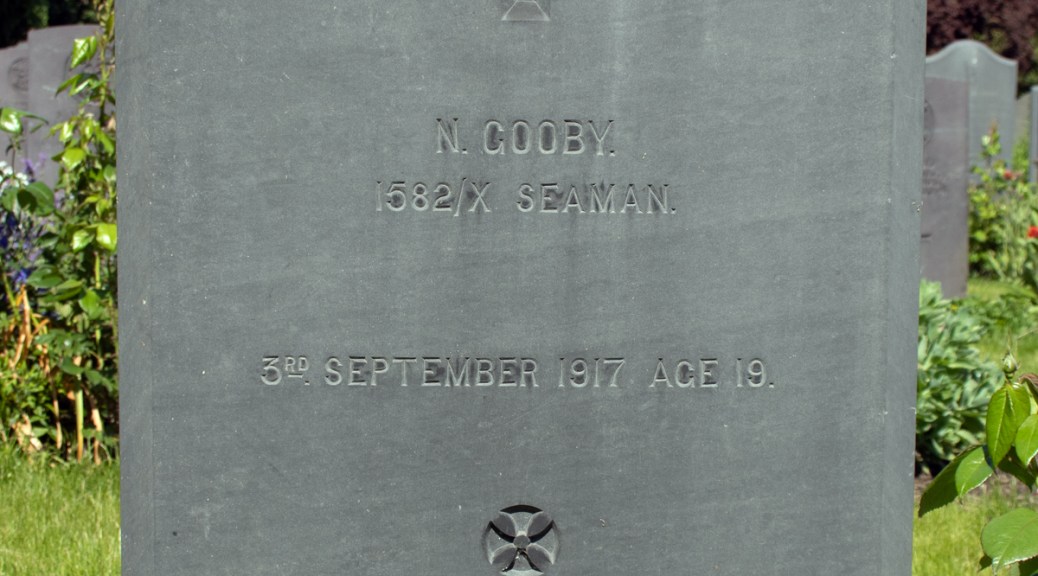
Seaman Nathaniel Gooby

Seaman Nathaniel Gooby

Nathaniel Gooby was born on 28th October 1897, the only son of William Gooby and his third wife, Margaret. Both of William’s previous wives – Tryphena and Amelia – had died before their time, but Nathaniel had six half-siblings, up to forty years older than him.

William was a carpenter, who had been born in England, but had moved to Newfoundland when he was young, and this is where he lived and raised his families.

Sadly, very little documentation remains to evidence Nathaniel’s life. He enlisted as a Seaman in the Royal Naval Reserve, potentially after war was declared (he would have been 16 years old at the outbreak of the conflict). By the summer of 1917 he was based at HMS Pembroke – the Royal Naval Dockyard in Chatham, Kent.

That summer was a busy time for the Dockyard, and temporary accommodation had been set up for the influx of military personnel based there. Seaman Gooby was billeted at Chatham Drill Hall and was sleeping there when the first night air raid was carried out by the German Air Force on 3rd September 1917. The Drill Hall received a direct hit, killing 98 servicemen – Nathaniel included. He was just 19 years of age.

Nathaniel Gooby was laid to rest in the Woodlands Cemetery in nearby Gillingham, along with the other victims of the Chatham Air Raid.

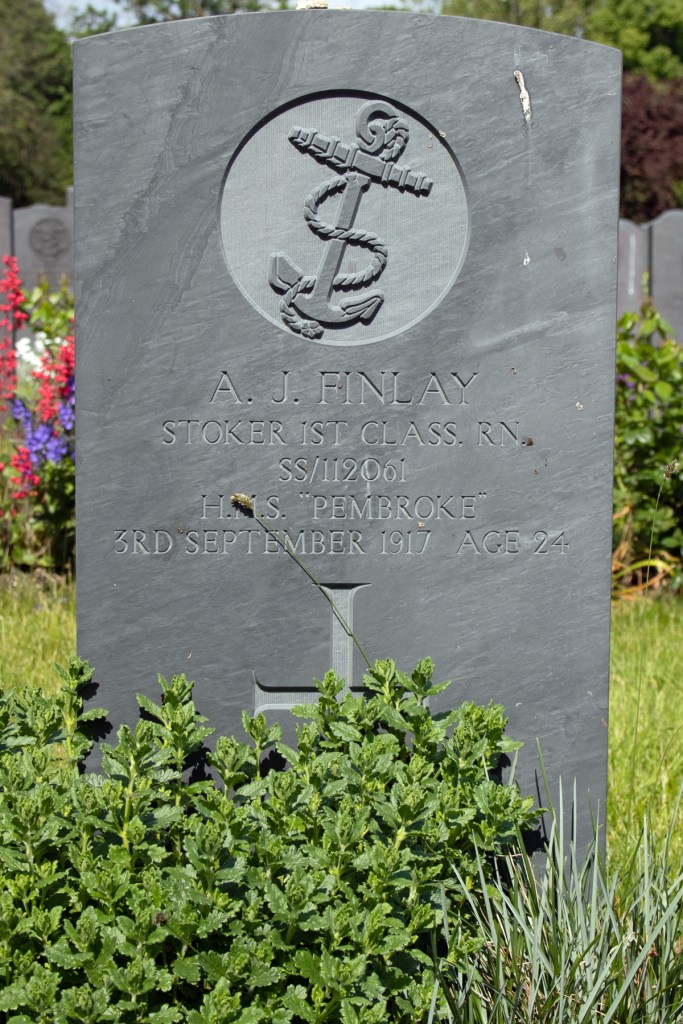
Stoker 1st Class Alfred Finlay

Stoker 1st Class Alfred Finlay

Alfred James Finlay was born in Croydon, Surrey on 7th September 1893. His mother was Emily Finlay, although there is little more information to confirm details of his early life.

He was working as a shop porter when he was drawn to a life at sea and, on 9th April 1912 he enlisted in the Royal Navy as a Stoker 2nd Class. Alfred’s enlistment papers confirm that he was 5ft 5ins (1.66m) tall, had brown hair and brown eyes. While he had a fair complexion, he was also noted to have a scar above his left eye, another on his left thigh, and had a tattoo of a pierced heart on his left arm.

After his initial six months’ training at HMS Pembroke – the shore-based establishment at the Royal Naval Dockyard in Chatham, Kent – he was assigned to the cruiser HMS Lancaster, where he spent a couple of months. He had another few weeks at HMS Pembroke, before being sent to another cruiser, HMS Chatham.

Alfred spent more than three years on Chatham, and was promoted to Stoker 1st Class during his time aboard. Returning once again to Kent, his service from here on in seems to have been mainly shore-based: HMS Pembroke in Chatham; HMS Vivid in Devonport; HMS Victory in Portsmouth.

Stoker Finlay returned to HMS Pembroke in the summer of 1917. It was a busy period for the Naval Dockyard in Chatham, and a lot of the servicemen there – Alfred included – were billeted to temporary accommodation at the nearby Drill Hall. It was here that he was sleeping on the 3rd September, when the German Air Force undertook their first night raid over England. One of the bombers scored a direct hit on the Drill Hall, and Alfred was killed. He was just 24 years old.

Alfred James Finlay was laid to rest, along with the dozens of other victims of the Chatham Air Raid, at the Woodlands Cemetery in nearby Gillingham.

Ordinary Seaman Henry Bird

Ordinary Seaman Henry Bird

Henry David Bird was born on 11th April 1898 in Hoxton, East London. He was the third of eleven children to carter and carman Henry Bird and his wife Florence.

When he left school, Henry Jr found employment as a munitions worker, but shortly before his nineteenth birthday, he was drawn to a more active role. On 8th January 1917, he enlisted in the Royal Navy as an Ordinary Seaman. His enlistment papers show that he was 5ft 4ins (1.63m) tall, with brown eyes, brown hair and a fresh complexion. They also noted that he had a scar on his right index finger.

Henry’s first posting was at HMS Pembroke, the shore-based establishment at the Naval Dockyard in Chatham, Kent. After a couple of months’ training, he was assigned to the cruiser HMS Concord. He served on board for for a few weeks, before returning to Chatham in May.

The summer of 1917 was a busy time for HMS Pembroke; Ordinary Seaman Bird was one of those billeted in the Drill Hall, sleeping there, rather than in the overcrowded barracks in the dockyard itself. It was here that he was sleeping on the 3rd September, when the German Air Force undertook their first night bombing raid. One of the planes scored a direct hit on the Drill Hall, and Henry was killed instantly. He was just 19 years of age.

Henry David Bird was buried in the Woodlands Cemetery in nearby Gillingham, along with the dozens of other servicemen killed in the Chatham Air Raid.


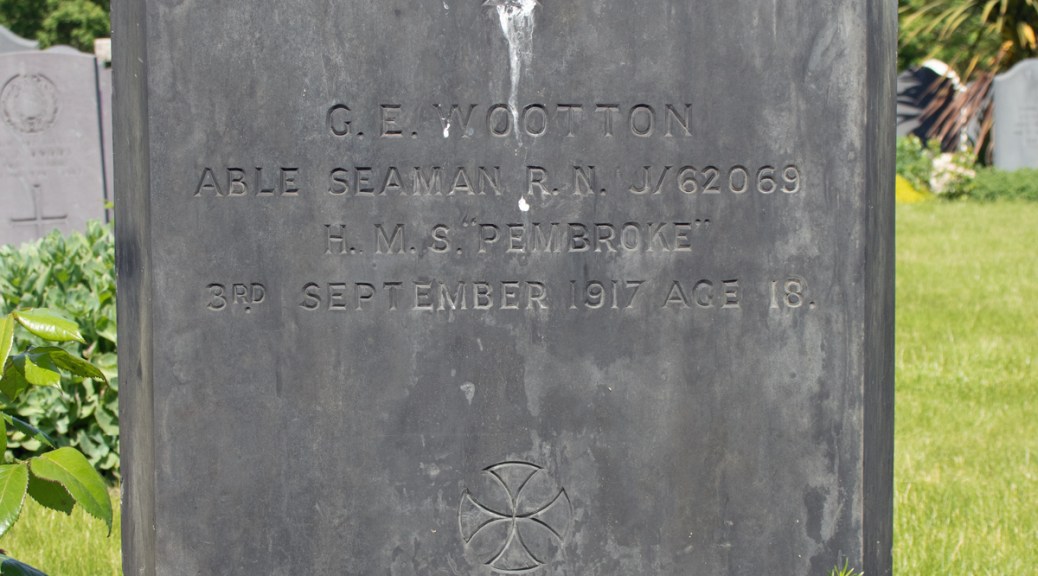
Able Seaman Gregory Wootton

Able Seaman Gregory Wootton

Gregory Ernest Wootton was born on 28th October 1898, the only child of Henry and Isabella Wootton. The family lived in East London, and the year of Gregory’s birth was a challenging one. His parents married that year, and Henry also passed away, leaving Isabella to raise her son on her own.

She was made of stern stuff, however, and moved back in with her father, Joseph, while finding employment as a florist, working with artificial flowers. By 1909, Isabella had remarried, wedding policeman Harry Mee, and moving to South London, where the couple had a child of their own, Gregory’s half-brother, Leonard.

War was edging close to Europe, although Gregory was underage when hostilities broke out. By late 1916, however, this was no longer the case, and he was drawn to the Royal Navy. On 6th November, he gave up his job as a case maker, and enlisted as an Ordinary Seaman. His sign-up papers show that he stood 5ft 4ins (1.62m) tall, had brown hair, brown eyes and a fresh complexion.

Ordinary Seaman Wootton’s first posting was at HMS Pembroke, the shore-based establishment at the Naval Dockyard in Chatham, Kent. After a couple of months, he was moved north, to HMS Ganges, which was a similar training base in Suffolk. While here, he was promoted to Able Seaman.

In June 1917, Gregory was on the move again, returning to Chatham. While here, at a particularly crowded time for the dockyard, he was billeted at the nearby Drill Hall. On the night of the 3rd September, while resting, the first German night raid dropped bombs on Chatham, directly hitting the Drill Hall. Able Seaman Wootton was killed instantly. He was just 18 years of age.

Gregory Ernest Wootton was laid to rest in the Woodlands Cemetery in nearby Gillingham. He was buried with the other 97 victims of the Chatham Air Raid.