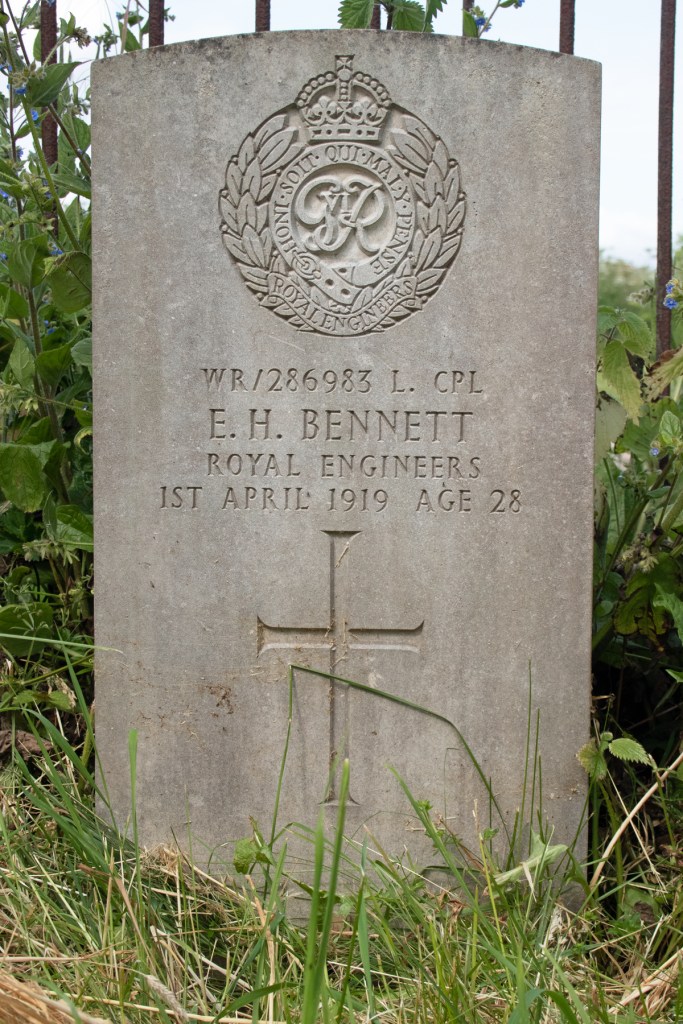
Ernest Harry Bennett was born in the summer of 1890, he third of ten children to Harry and Caroline – or Carrie – Bennett. Harry was a journeyman mason from the Devon village of Chagford, and this is where the Bennett family were raised.
When he finished his education, Ernest found work as a general labourer, and it this work that likely took him across the border to Somerset. He found work as a platelayer for the Great Western Railway in Taunton, and settled in Rowbarton, to the north west of the town.
On 28th September 1912, Ernest married Gertrude Alice Bennett in her local parish church, St George’s in Ruishton. A few months later, the couple had a son, Frederick, and almost exactly two years later, a daughter, Gladys, was born.
By this point, war was raging across Europe, and in July 1915, Ernest received the notice to enlist. Assigned to the Royal Engineers, he was attached to the 53rd Railway Company, probably to make use of his civilian trade. By the end of 1915, Ernest found himself in Egypt, and remained there for the rest of the war.
In July 1918, the now Lance Corporal Bennett was posted to the Railway Operating Division, but continued his service in North Africa. On 8th March 1919, he sailed from Port Said, heading back to Britain to be demobbed.
Returning to Somerset, Ernest fell ill, contracting pneumonia, probably on the journey home. He was admitted to the Taunton Military Hospital, but passed away from the condition just ten days after reaching England’s shores, on 1st April 1919. He was just 28 years of age.
The body of Ernest Harry Bennett was laid to rest in the graveyard extension to St George’s Church in Ruishton, not far from where his widow and children lived.
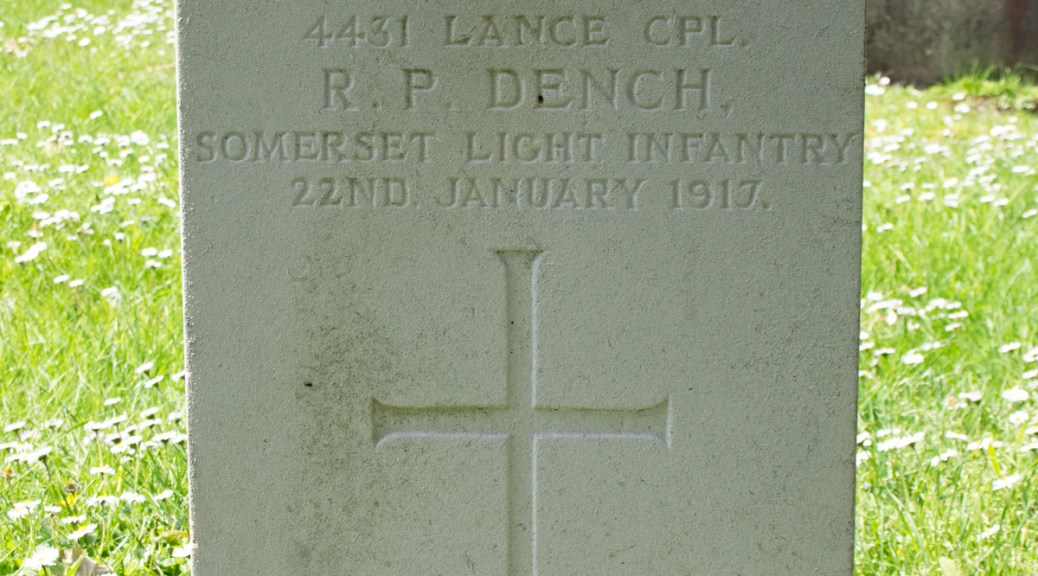
Reginald Percy Dench was born in the spring of 1884 in Twerton, Somerset. He was one of seven children to Henry and Jane – known as Lily – Dench. Henry was a shoe maker turned cloth dyer, but Reginald found work as a stone mason when he finished his schooling.
War came to Europe in 1914, and Reginald stepped up to play his part. His full service details are no longer available, but from what remains it is clear that he had enlisted in the Somerset Light Infantry by the summer of 1916. He was attached to the 5th Battalion, which spent of the conflict in India and Egypt, but there is nothing to confirm that Private Dench served overseas.
Reginald earned a promotion during his military career, and, by the end of 1916 was a Lance Corporal. By this point, however, he had fallen ill, contracting pleurisy. He was, by this point, back in Somerset, and it is likely that he was admitted to the Bath War Hospital. The condition was to get the better of him, and he passed away on 22nd January 1917. He was 32 years of age.
Reginald Percy Dench was laid to rest in Twerton Cemetery, a short walk from the family home in Mill Lane, and close to his two brothers, Edmund and Edward, who had died some twenty years before, while still children.
Tragedy was to strike again for the Dench family when, just six weeks after Reginald’s passing, Henry also died. He was laid in the same cemetery, not far from his sons. When Lily passed away in 1924, she was also buried in Twerton Cemetery, reunited with her family once more.
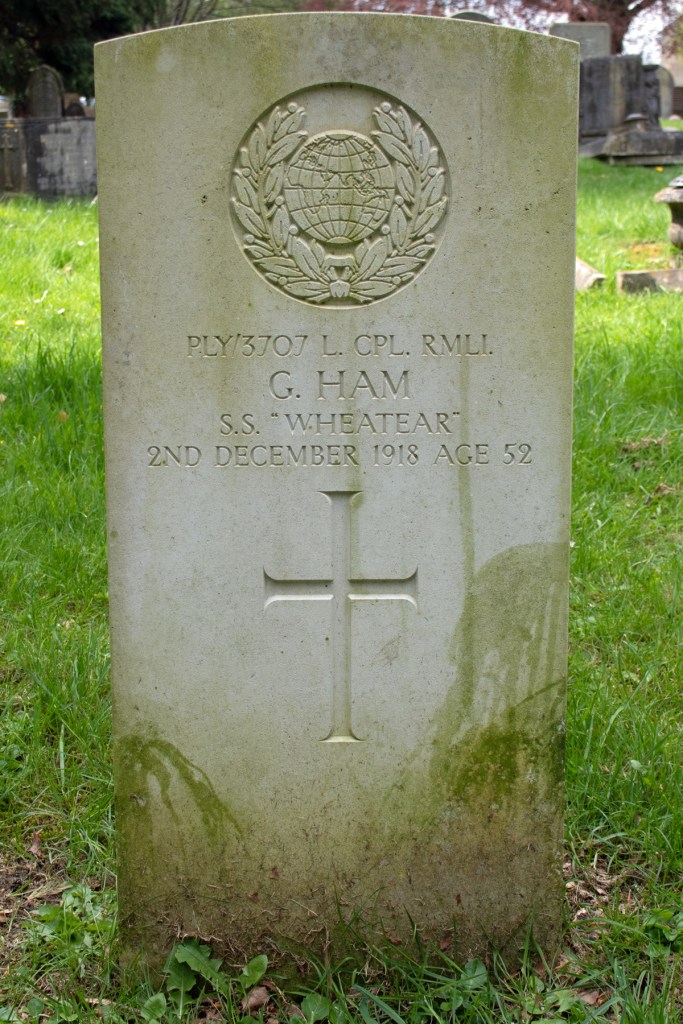
George Ham was born on 19th December 1867 in Twerton, Somerset. His parents were George and Emily Ham, and he was the oldest of their nine children. George Sr was a mason, and initially his first born followed suit, but he was pulled towards something bigger and better and, on 19th January 1886, he enlisted in the Royal Marine Light Infantry.
George’s service records note that he was 5ft 6ins (1.68m) tall, with brown hair, grey eyes and a fresh complexion. He was initially sent to the barracks at Walmer in Kent, and it was from here that Private Ham began a 21 year career in the Royal Marines. Over that time, he served on seven separate ships, and, between voyages, he was based in barracks in Plymouth, Devon. Both his character and ability were consistently noted as being very good.
Private Ham’s career took him around the world and, in 1887, he found himself on the gunboat HMS Banterer, on which he served for three years. His tour of duty included a period of time in Galway, Ireland, and it was here that he met Mary Ann Goode. On 5th July 1889, the couple married in city’s St Nicholas’ Church. The church’s records suggest that the couple went on to have four children – Frederick George; Emily, who died just after her first birthday; Albert; and Katherine.
George’s records from this point become a little disjointed. In October 1890, he returned to his Plymouth base, and the following year’s census recorded him as living in the East Stonehouse Barracks, although his marital status was noted as single.
The next census, in 1901, presents a different picture. George and Mary were, by this time, living in family barracks in East Stonehouse, with two children, (Frederick) George and Albert. Katherine, the couple’s youngest child, was born the following year.
In January 1907, after more than two decades’ service, George was stood down from active service in the Royal Marines. He was placed on reserve status, and took up work as a mason once more. At this point, however, the family seemed to have hit more troubled times, underlined by four separate 1911 census documents.
George, who was 44 by this point, was recorded as being an inmate in the Bath Union Workhouse and Infirmary in Lyncombe, Somerset. Mary and Katherine, meanwhile, were in two rooms in a house in Stonehouse, Devon. Frederick, who was now better known as George, had followed his father into military service, and was a Private in the Royal Marine Light Infantry, serving on HMS Colossus. Albert, who was 13 years old, was one of 946 students boarding at the Royal Hospital School for Sons of Seamen in Greenwich, London.
George spent nine years in the reserves, and, in 1914, was called up again for war service, this time as a Lance Corporal. According to a contemporary newspaper:
[He was] engaged on naval patrol work against submarines off the Canadian coast and elsewhere, and was in charge of a gun on an armed merchant ship. Once the boat he was on was torpedoed, and on another occasion he had a long running fight with a submarine in the Irish Channel. The ship, however, reached Portrush (Ireland), and the inhabitants gave Lance-Corporal Ham a testimonial, and he was also rewarded in other ways, the Cardiff owners of the vessel recognising his skill and gallantry.
Bath Chronicle and Weekly Gazette: Saturday 7th December 1918
Tragedy was to strike in the end, however, and George was to meet a sad end to a distinguished career.
While at Cork [George] fell, either from a boat or the dock, and sustained an injury to the side of his head. It did not appear very serious, and it is understood that he made a trip to Cardiff and back to Londonderry, [where] he became so seriously ill as to necessitate his going to a military hospital in Londonderry. Hemorrhage [sic] of the brain set in, and he died on Monday [2nd December 1918] before his brother, Mr Albert Ham, who had been telegraphed for, could reach him.
Bath Chronicle and Weekly Gazette: Saturday 7th December 1918
Lance Corporal George Ham was days short of his 51st birthday when he died. His body was brought back to Somerset for burial, and he was laid to rest in Twerton Cemetery. The newspaper report give no indication as to whether Mary or their children were in attendance and, in fact, does not mention his wife and family at all.
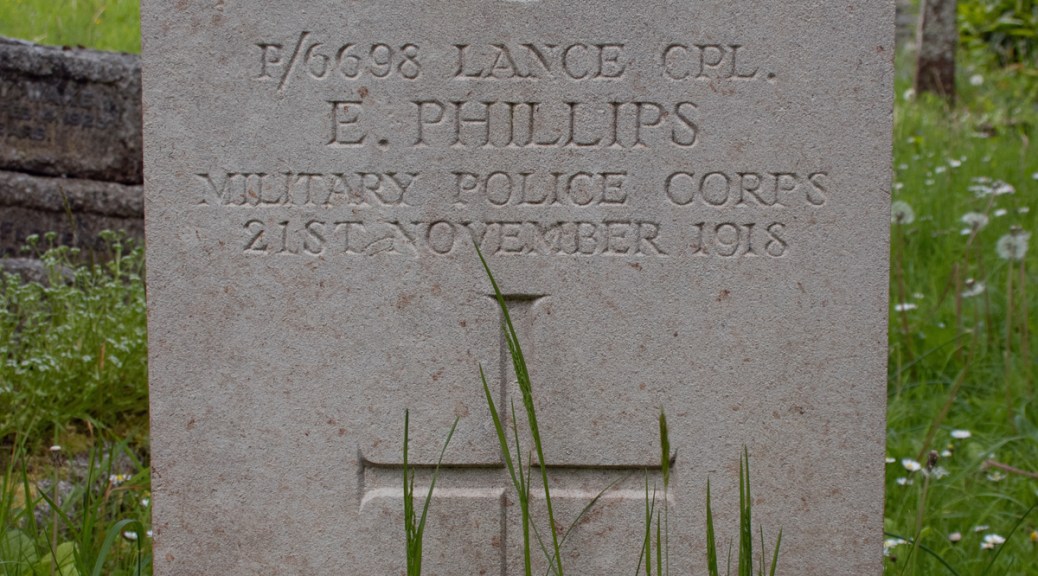
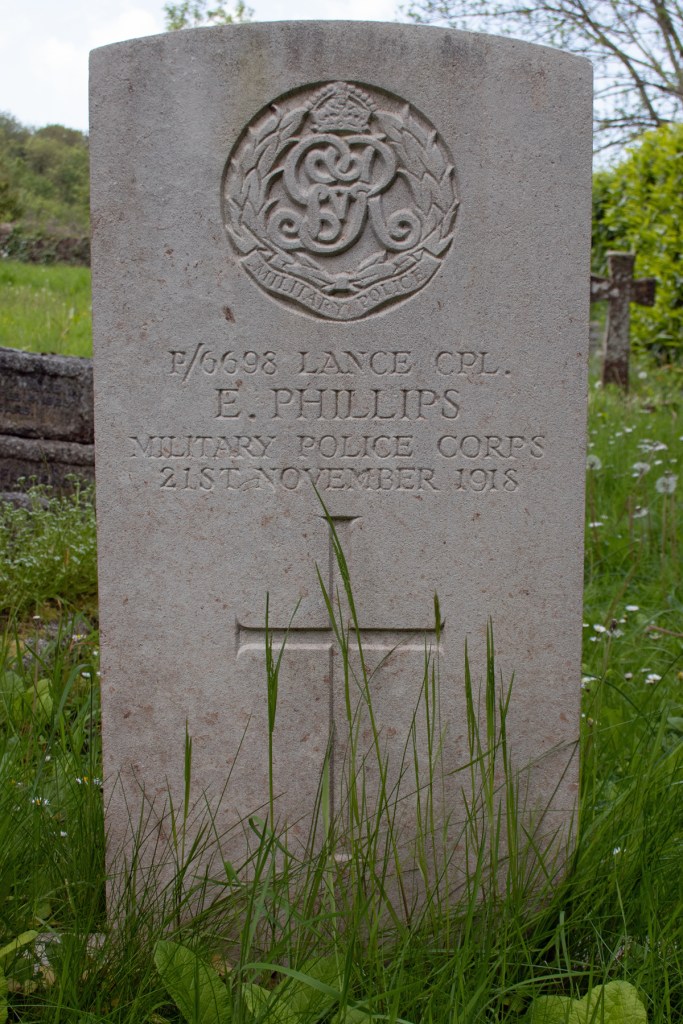
Ernest Algernon Phillips was born at the start of 1879 in the Somerset village of Winscombe. One of nine children, his parents were Arthur and Elizabeth Phillips. Arthur was a gardener, and Ernest followed suit when he finished his schooling.
By the time of the 1911 census, he was boarding with his younger sister Rose and her family – brother-in-law Leonard and nephew Leslie. Just a couple of weeks later, on 11th May 1911, Ernest married Winifred Carey. She was a coachman’s daughter from Winscombe, and the couple set up home in a cottage on the outskirts of the village.
When war broke out, Ernest felt a need to play his part. He enlisted in Bristol on 8th December 1915, but was not formally mobilised until the following June. Initially assigned to the Devonshire Regiment, he was transferred to the Worcestershire Regiment and attached to the 6th Battalion.
Private Phillips’ troop was based on home soil, and he was barracked in the garrison in Harwich, Essex, for the next six months. On 31st January 1917, he was transferred to the Military Police Corps, and given the rank of Acting Lance Corporal. Full details of his service from this point on are lost to time, but it is clear that he remained on home soil until the end of the war.
By November 1918, Ernest had fallen ill. He was admitted to the Queen Alexandra Military Hospital in London on 20th November, suffering from pneumonia. Within a matter of hours, while this seemed to have cleared, his pulse was ‘rapid, irregular and compressible.’ He was medicated, but did not respond to treatment, and passed away the following day. His death was noted as apparently being caused by clots of blood in the heart, but, at the request of his family, no postmortem examination was carried out. He was 39 years of age.
Ernest Algernon Phillips was brought back to Somerset for burial. He was laid to rest in the quiet graveyard of St James the Great Church in Winscombe.
John Burge Parker was born in the spring of 1887, the second of eight children to George and Ann Parker. The family were raised in Huntspill, Somerset, where George was employed as a labourer in the local railway works.
When he finished his schooling, John found work on a farm and this is how he was employed when, on 30th April 1907, he married Alice Jane Grove in the parish church in Pawlett. The sleepiness of the area is underlined by the fact that this was both the only wedding to take part in the church that year, and for more than a year. John and Alice went on to have three children, Audrey, who was born in 1907, Elsie, who came along two years later, and Clifford, born in 1915.
With a growing family to support, John sought out more of a career. Indeed, by the time of the 1911 census, he was employed as a police constable, and the Parkers had moved to Bristol. When war came to Europe, however, John stepped up to play his part.
John enlisted on 17th November 1915, joining the Railway Troops Depot of the Royal Engineers. His service records show the kind of figure he must have cut in the police, and he was noted as being 6ft 1in (1.85m) tall, weighing 176lbs (79.8kg). Initially give the rank of Private, he was promoted to Lance Corporal in May 1916, just four months after being officially mobilised.
In October 1916, Lance Corporal Parker’s troop set sail from Southampton, their final destination being Alexandria in Egypt. He spent more than two years in North Africa, wand was promoted to full Corporal during this time.
John returned to Britain early in 1919. In February, John was visiting his brother in Highbridge, Somerset, and, on the evening of the 6th, he left to visit his father in Huntspill. He set off to Highbridge Station first, with the intention of checking the train times to return to Bristol, but that was the last time he was seen alive.
A painful sensation was created in Highbridge and neighbourhood… when it became known than on the previous evening.. the mutilated body of a soldier was found on the Great Western Railway metals, about a quarter of a mile below the Highbridge Station… The body was subsequently identified as that of John Parker… a corporal in the Royal Engineers, whose home it at Bristol and who leaves a wife and three children.
Central Somerset Gazette: Friday 14th February 1919
Nothing untoward was confirmed in the accident that killed John on the night of the 6th February 1919, and at the inquest the jury reached the conclusion that he had died through a tragic accident. He was 32 years of age.
The newspaper report gave more insight into the character of Corporal Parker: “He was a splendid specimen of manhood, standing over 6ft, and of proportionately fine physique… [He] was of a most genial temperament [and] was held in the highest respect both in the Highbridge district and at Bristol.”
The body of John Burge Parker was laid to rest in the quiet graveyard of St Peter’s Church in his home village of Huntspill.
Frederick William Reid was born in January 1876 in Liverpool, Lancashire. Little information is available for his early life, and his trail only really becomes traceable when he joined the Royal Irish Regiment at the age of 16 years old.
Frederick’s service records confirm that his mother was called Elizabeth, who lived in Bedminster, near Bristol. He was already volunteering for the regiment when he enlisted, and was working as a musician when he joined up. His papers confirm that he was 5ft 4ins (1.63m) tall, and weighed 112lbs (60.8kg). He had brown hair, hazel eyes and a fresh complexion.
Frederick was given the rank of Drummer when he joined up and was attached to the Royal Irish Regiment’s 3rd Depot. He spent more than seven years on home soil, rising to the rank of Corporal in May 1898. The following January he reverted to the rank of Private at his own request, but his superiors obviously saw something in him, and he was supported in a new role – Lance Corporal – just a month later.
In October 1899, however, Frederick’s life was to take a new turn, when he was sent to India with his troop.
Corporal Reid was based in Lahore, and had found the life that he was seeking. Over the next forty months, he successfully took on a variety of clerical roles. He was promoted to Lance Sergeant in October 1901 and given oversight of the Officers’ Room.
In March 1903, Frederick returned to Britain. With the move came a further promotion, to the rank of full Sergeant, again, overseeing the Officer’s Room. He seems to have been based in Gloucestershire by this point, as, on 18th November 1903, he married Isabella Jane Parke at a Registry Office in Bristol. There is no further record for the young couple, however, so the new Mrs Reid is destined to remain a mystery.
Frederick was destined to return to India, and in January 1905, that is exactly what he did. His regiment returned to Lahore, and he was given the role of Clerk Steward at one of the Lawrence Memorial Asylum. The name is misleading, as the asylums were a series of four military-style boarding schools across India. Sergeant Reid’s records do not confirm which of the four he was attached to, but it would have been Sanawar, Mount Abu, Lovedale or Ghora Gali.
Given his military background, it seems that the role of clerk was something Frederick settled into quite happily. He was recalled back to army service in November 1909, and, within seven months, he requested a discharge from the army. This was granted, as he had, by this point, completed more than eighteen years’ service.
Frederick remained in India, however, and on 28th September 1913, he married Elizabeth Marshall in Lahore. They had two children, Florence, who was born in Quetta on 2nd September 1914, and Lily, who was born on 1st January 1916 in Lahore.
War had come to the world by this point, and in spite of his age – he was 39 by now – Frederick felt it only right to step up and play his part again. On 28th October 1914, he enlisted again, and was assigned to the 1st Battalion of the Duke of Wellington’s (West Riding Regiment). His new medical noted that he was 5ft 7ins (1.7m) tall, and weighed in at 9st (57.2kg). His complexion was recorded as pale, while he had a number of tattoos on his left forearm: the crossed swords, harp and crown of the Royal Irish Regiment, along with the initials VR.
While part of the West Riding Regiment, Sergeant Reid was attached to the 3rd Mule Corps of the Indian Supply & Transport Corps. He was involved in arranging provisions for the various battalions who needed them.
By March 1916, his battalion had been sent to Salonika, and it was here that Frederick contracted tuberculosis. Medically evacuated to Britain, he was admitted to the Southwark Military Hospital. He was confirmed as no longer being medically fit for army service and was discharged on 16th August 1916. His medical report noted that he “is anxious to have sanatorium treatment, but is not an insured man, owing to having been stationed in India.”
On his discharge, Frederick moved to Weston-super-Mare, Somerset, which is where his mother was by now living. His wife and children also came to live in England and, the family settled in Pawlett, near Bridgwater.
After leaving the army, Frederick’s trail goes cold. The next confirmation of his life is that of his passing. He died on 12th October 1919, presumably from his lung condition. He was 43 years of age.
Frederick William Reid, who had been born in Liverpool, who had had two separate careers in the army, and who had lived and married in India, was laid to rest in the peaceful graveyard of St John the Baptist’s Church in Pawlett, Somerset.
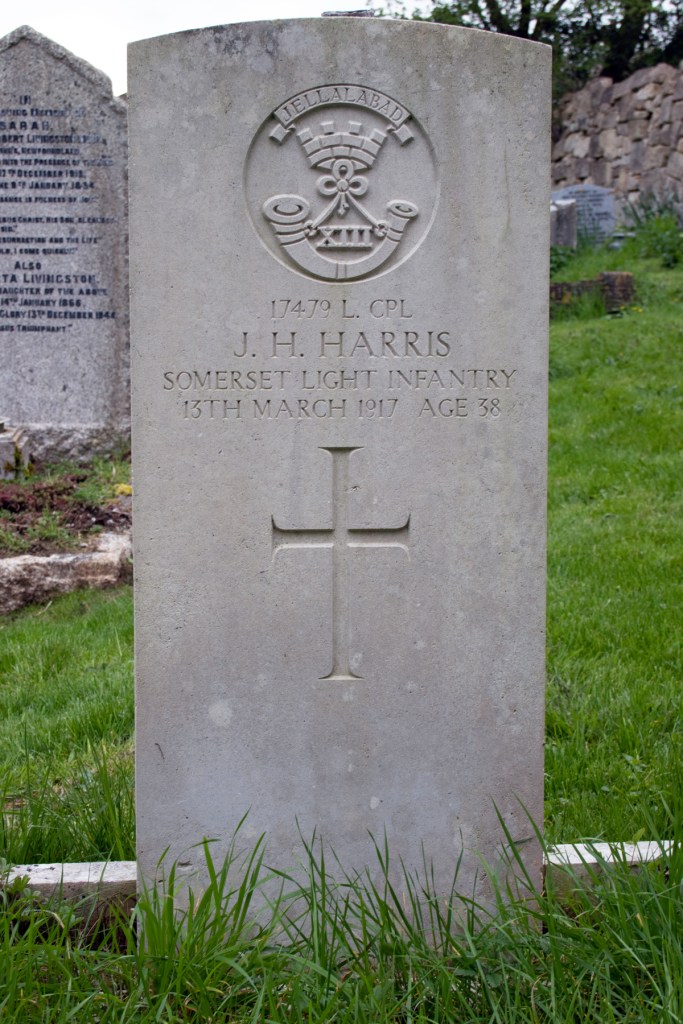
John Henry Harris was born at the turn of 1879, the oldest of eight children to John and Florence Harris. John Sr was a mason’s labourer from Somerset, and his and Florence’s three oldest children were born in Bishop’s Hull, near Taunton. By 1890, however, the family had moved to Monkton Combe, on the outskirts of Bath, presumably to follow John Sr’s work, and this is where they settled.
When John Jr completed his schooling, he followed in his father’s trade and when the 1901 census return was completed, he was employed as a mason’s labourer, while his father had moved into carpentry.
Florence died in April 1901, and six years later, John Sr remarried. His new wife was Ann Gibbs, and the couple went on to have three children, new half-siblings to John Jr.
In the autumn of 1905, John Jr married in Eliza Mundy, a cowman’s daughter from Monkton Combe. The couple settled in a small cottage on Mill Lane, and had a son, Frank, who was born in 1907. By this point, John had found new employment as a gardener to the local vicar, Reverend Pitcairn.
When war came to European shores, John quickly stepped up to enlist. He joined the 7th Battalion of the Somerset Light Infantry and arrived in France in July 1915 after his training.
Private Harris was wounded during the opening weeks of the Battle of the Somme, but recovered and returned to the Front Line. He was promoted to the rank of Lance Corporal, but in March 1917 he was wounded again. “A piece of his steel helmet was driven into his head at the temple, and little hope of his recovery was entertained from the first.” [Bath Chronicle and Weekly Gazette: Saturday 24th March 1917]
Medically evacuated to Britain, Private Harris was admitted to a hospital in Stockport, Cheshire. His “wife (who has been dangerously ill in hospital), Mr John Harris (his father) and a sister proceeded to Stockport, but, unfortunately, did not arrive until shortly after death had occurred.” [Bath Chronicle and Weekly Gazette: Saturday 24th March 1917]
Private Harris passed away on 13th March 1917, at the age of 38 years of age.
John Henry Harris’ body was brought back to Monkton Combe for burial and he was laid to rest in the peaceful graveyard of St Michael’s Church, his funeral being officiated over by his former employer, Reverend Pitcairn.
Eliza went on to marry again, wedding Walter Giggs in 1921. The couple went on to have a daughter, Margery, who was born two years later. Eliza lived on until 1949, when she died at the age of 69 years old. She was also laid to rest in St Michael’s Churchyard.
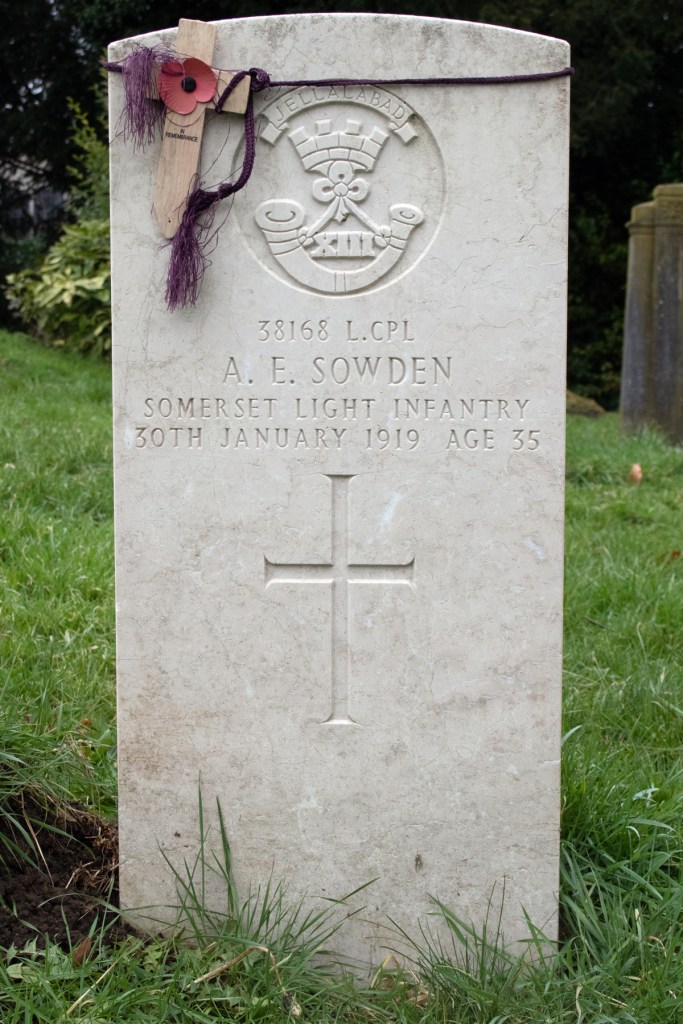
Alfred Edward Sowden was born in the autumn of 1883, in Bath, Somerset. He was the youngest of seven children to Robert and Mary Sowden. Robert had died by the time of the 1891 census, and Mary turned to charring to bring in money for the family.
In the summer of 1904, Alfred married Harriet Sumsion, a baker’s daughter also from Bath. The couple set up home in a small cottage on the main road to Bristol, and had a son, William, who was born the following year. Alfred was working as a house painter by this point, and the young family had a lodger, William Gabb, who was a local chef.
When war came to Britain’s shores, Alfred stepped up to play his part. He may have had some previous military experience, because he joined the Somerset Light Infantry as a Lance Corporal. Assigned to the 2nd/4th Battalion, by August 1915, he was on his way to India. His troop remained there for two years, before moving to Egypt in the autumn of 1917, then on to France the following June.
With the end of the conflict, the Empire’s forces were slowly demobbed. While he was waiting to be stood down, Lance Corporal Sowden fell ill. He developed influenza and septic pneumonia, and the combination was to prove fatal. He passed away on 30th January 1919, at the age of 35 years old.
Alfred Edward Sowden’s body was brought back to Bath for burial, where he was laid to rest in the city’s St James’ Cemetery.
Alfred’s widow had had a tragic few years. Her father, Walter, had passed away in February 1916, and her mother died just three months after Alfred.
Harriet never remarried after her husband’s passing. She remained in the family home for the rest of her life and, by the time of the 1939 Register, had a boarder, billiard marker James Jones. She was close to family, however, as her brother William lived just three doors away.
Harriet died in September 1941 at the age of just 56. She was laid to rest near her husband, reunited after 22 years.
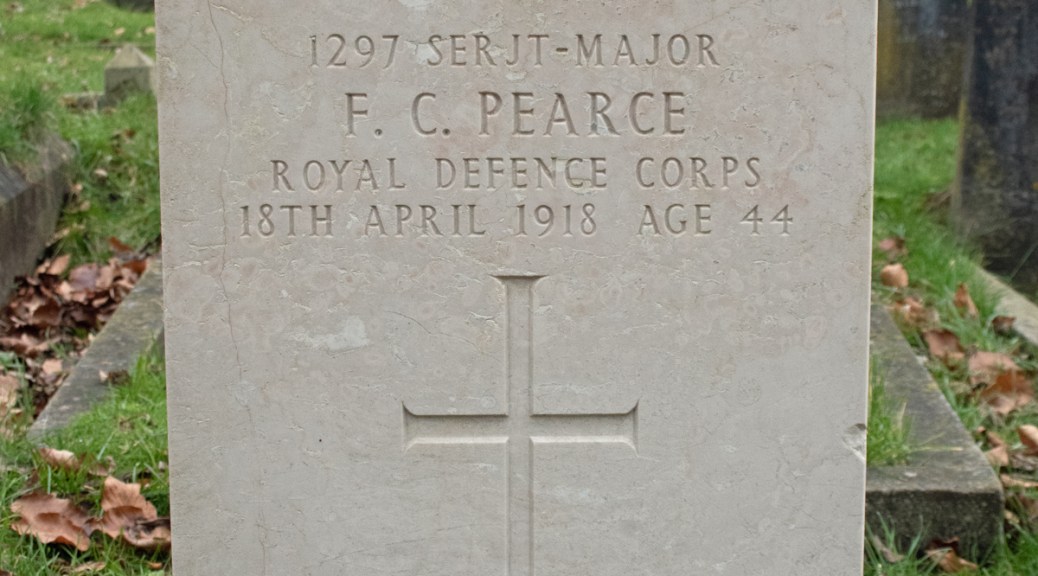
Frederick Charles Pearce was born in the spring of 1873 in the Gloucestershire town of Thornbury. The youngest of six children, his parents were Thomas and Elizabeth Pearce. Thomas was an agricultural labourer and, when he finished school, Frederick found work as a ‘rural messenger’.
This was only a step towards the career that Frederick sought, however, and on 12th July 1892, he enlisted in the Gloucestershire Regiment a a Private. His service records show that he was 5ft 5ins (1.65m) tall and weighed 128lbs (58kg). He was noted as having a fresh complexion, blue eyes and brown hair.
Private Pearce spent twelve years in the army, serving in Malta, Egypt, India and Ceylon (Sri Lanka). He had two stints in South Africa, including the 1899-1900 campaign, during which he was wounded in his chest in the battle at Farquhar’s Farm.
By the time he was discharged on 11th July 1904, he had risen through the ranks to Sergeant, his service records noting that his conduct had been “very good” (in capitals and underlined).
Thomas had died in 1896, and Frederick’s widowed brother William moved back in with his mother to help support her. Frederick also returned to Gloucestershire and, on 30th March 1905, he married Mary Rugman in the parish church in Olveston. The couple may have been childhood sweethearts, as the Pearces and Rugmans were Thornbury neighbours.
The marriage certificate noted Frederick as a groom, and it is likely that he was able to turn his hand to any role after his army career. The couple had a son Leslie, who was born in 1909, and, with the new responsibility of fatherhood, Frederick sought a more permanent career.
The 1911 census found the family living in Somerset, where Frederick was employed as a gardener at the Kingswood Reformatory School. This was a boarding school on an estate to the north of Bath, set in 57 acres of grounds, and again it seems likely that his military career stood him in good stead for such a prestigious role.
When war came to Europe, Frederick felt the pull of his military career once more. While his age did not compel it, on 20th November 1914, he re-enlisted in the Gloucester Regiment. He was enlisted with his previous rank, but within a year has been promoted to Acting Colour Sergeant.
In the spring of 1916, the Royal Defence Corps was formed, and, given his experience and age, Frederick was transferred across to the new regiment. Colour Sergeant Pearce was based in London and, over the next eighteen months served in four troops: 109, 149 and 150 Protection Companies and the 10th City of London Volunteers’ Regiment.
Frederick’s age and the demands of his role were beginning to take their toll by this point, and by the end of 1917, he had developed nephritis, or inflamed kidneys. The condition was severe enough to warrant his discharge from service, and the now Sergeant Major Pearce’s military career came to an end on 17th January 1918.
Frederick returned home to Bath, to the bosom of his family. He and Mary three children by this point, Violet and Freddie being two younger siblings to Leslie. Tragically for the Pearces, however, the family life was not to to last for long: Frederick’s condition was to get the better of him just three months later. He passed away on 18th April 1918, at the age of 44 years old.
Frederick Charles Pearce was laid to rest in St James’ Cemetery in Bath; a man of duty resting at last.
Tragedy was to strike again for poor Mary, when just six months later her youngest child, Freddie, also passed away. Details of his death are vague, but he was buried with his father, the two Fredericks reunited too soon.
Francis William Ball was born in the spring of 1893 in the village of Wrington, Somerset and was one of ten children to Joseph and Mary Jane Ball. Joseph was a general labourer while Mary Jane took in washing to earn a little more money for the family.
Little information is available about Francis’ early life. The family travelled the county when he was growing up, and, according to the 1911 census, they were living in Walcot, a suburb of Bath. The same census notes that Francis was apprenticed, although crucially the trade he was learning is missing from the document.
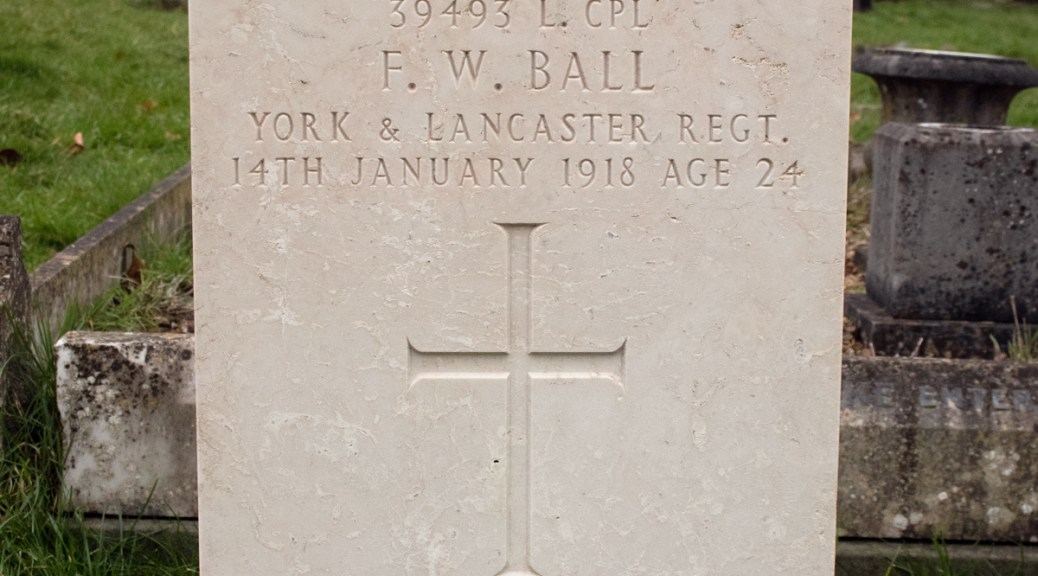
When war came to Europe, he enlisted in the Yorkshire & Lancashire Regiment as a Private. Francis’ service records are lost to time, but he would have enlisted by the summer of 1917, and during his time in the army, he was promoted to Lance Corporal. He was attached to the 2nd/4th Battalion, who served in France, most notably at Arras and Cambrai.
At some point late in 1917, or early in 1918, Lance Corporal Ball was injured and medical evacuated to Britain for treatment. He was admitted to the 2nd Western General Hospital in Manchester, but his wounds were to prove too severe. He passed away on 14th January 1918, at the -age of just 24 years old.
Francis William Ball’s body was brought back to Somerset for burial. He was laid to rest in the St James Cemetery, Bath.









 Death and Service