The early life of James Payne is a challenge to piece together. The first document that can be properly attributed to him is his marriage certificate from 27th May 1901.
This confirms that he was 21 years old, and working as a labourer. His father’s details are noticeable by their absence. The document also gives his wife’s name, Kate Bessie Warr, and information about her father – labourer Sydney Warr. James was also working as a labour at this point, and the two of them were living in Pulham, Dorset.
By the time of the 1911 census, the newlyweds had moved to the village of Yetminster. James was working as domestic gardener, and the couple had two children – Cyril and Louis. James’ place of birth is given just as Somerset, further clouding his past.
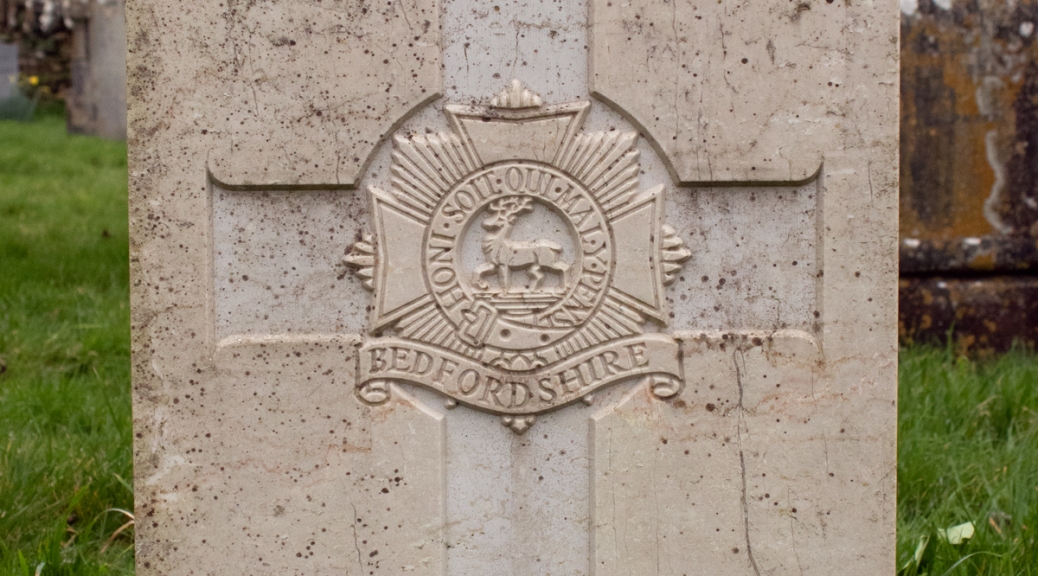
When war came to Europe, James stepped up to play his part. Full details of his time in the army are lost to time, but documents suggest that he had enlisted by October 1917 at the latest. Private Payne joined the Bedfordshire Regiment, and was attached to the 1st Battalion. His unit service on the Western Front throughout the conflict, although there is no evidence that James spent any times overseas himself.
Piecing the sparse number of documents together suggest that in March 1918, James was admitted to the 3rd Western General Hospital in Cardiff, Glamorganshire. He was suffering from nephritis and pneumonia, but it is unclear whether he was serving in Wales at the time, or was taken there for treatment. Either way, his condition was to prove too severe. Private Payne passed away on 20th March 1918: he was 38 years old.
James Payne’s body was taken back to Dorset for burial. He was laid to rest in the peaceful graveyard of St Andrew’s Church in his adopted home of Yetminster.
Albert Gillard Biss was born in Highbridge, Somerset, on 3rd July 1888. The middle of five children, he was the oldest surviving son of Richard and Rosanna Biss. Richard was a tin worker twelve years older than his wife and when he died, in September 1907, Rosanna was left to raise her family alone.
By the time of the 1911 census, Rosanna was living in a five-roomed cottage in Highbridge. Albert and his two younger brothers were living with her, and all three were working as building labourers to bring in money for the family. They also had a boarder, 87-year-old widow Henrietta Crandon, to bring in a little extra each month.
Albert was also saving up for other things. On 15th November 1911, he married Ada Alice Vincent. The couple went on to have three children – Albert Jr, Richard and Irene – before Ada’s untimely death in August 1915, just five weeks after Irene’s birth. At this point Albert had enlisted in the army, and it seems that his sister, Sarah, took on responsibility for her nephews and niece.
Albert was working as a telegraphist for the Post Office when he signed up. He had previously volunteered for the 3rd Somersets, but was assigned to the Royal Engineers when he enlisted. His service records show that he joined up in Weston-super-Mare, was 27 years and three months old, and stood 5ft 10.5ins (1.79m) tall.
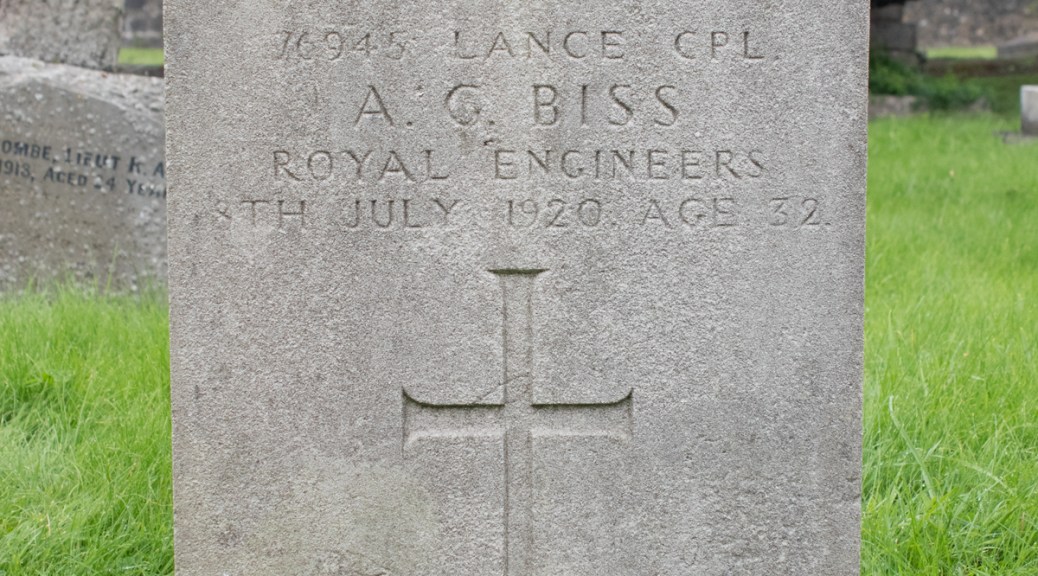
Sapper Biss initially served on home soil, but was subsequently moved to the Base Signal Depot as part of the East Africa Expeditionary Force. He was promoted to Lance Corporal in April 1918, but over the next twelve months his health began to deteriorate.
On 6th April 1919, Albert was medically discharged from the army, suffering from a combination of malaria, epileptic fits and tuberculosis. He returned home to Somerset, and moved back in with Rosina. His sister Sarah was living in London by this point, and it is not clear whether Albert’s children came back to Highbridge or not.
Over the next year Albert’s health went from bad to worse. On 8th July 1920 he finally succumbed to a combination of pulmonary tuberculosis, acute nephritis, meningitis and uraemia. He had just turned 32 years of age.
Albert Gillard Biss was laid to rest in the sweeping grounds of Highbridge Cemetery.
After Albert’s death, his two sons fell under the guardianship of their aunt Sarah. Responsibility for Irene, however, was given to an Ebenezer and Eliza Monks, who lived in Clapham Common, London. The 1938 Electoral Register found Irene, who went by the name Monks-Biss, still living with here adopted family.
George Bartraham was born in the autumn of 1868 in the Somerset village of Sampford Brett. One of seven children, his parents were George and Sarah Bartraham. George Sr was a farm labourer and, while his son initially followed suit, he sought a life of adventure in the wilder world.
George Jr had found work as a tailor, and was apprenticed to a Charles Taylor, who lived in the village. That bigger and better life was niggling away, however, and, on 11th June 1888, he enlisted in the Royal Engineers. His service records show that he was 5ft 5.5ins (1.66m) tall, with black hair, dark eyes and a fair complexion. Sapper Bartraham was also noted as having a scar on his left foot.
George initially signed up for seven years’ service, with an additional 5 years on reserve status once that was completed. The 1891 census recorded him as being based at Fort Blockhorse in Alverstoke, Hampshire. Early in 1894, he married Mary Bowden, in Portsmouth: the couple would go on to have two children, George and Albert. The following year, Sapper Bartraham opted to remain on full service with the Royal Engineers, partially, it is fair to assume, as the pay would be better to support his family than on reserve.
By 1901, George had been moved to barracks in Pembroke Docks, Wales. Mary and the children remained in Hampshire, living with her parents in Unicorn Street, close to the town’s naval base. Wales was not to be the last stop for George, however, and in October 1902, he was sent to Ceylon, where he remained for the next three years.
During his time in the army, George did not sit on his laurels. He received a certificate as a master tailor, became skilled in submarine mining, and also received a qualification in signalling. He was promoted to Lance Corporal in 1899, and full Corporal four years later.
George returned to Britain in January 1906, and seems to have returned to a base in Hampshire. It was here, on 28th December 1908, that an altercation led to him being convicted of assault. He was charged with ‘unlawfully and maliciously wounding one Albert Edward Bartraham, by stabbing him with a pair of scissors, at Aldershot… and counts for assault occasioning actual bodily harm and common assault’ [Calendar of Prisoners, 1868-1929]
Albert was George’s older brother, and he was convicted to six months’ hard labour for the assault. Corporal Bartraham returned to base on 6th June 1909, and was discharged a few days later, having completed 21 years’ service in the Royal Engineers.
The next census record, taken in 1911, found a family divided by work or circumstance. Mary and the children remained firmly ensconced in Portsmouth with her parents, while George was living in Aldershot, where he was employed as a tailor. His employer is noted as being the Government, so it seems likely that he was still connected to the army camp there.
When war came to Europe, George was called upon to play his part once more. Promoted to the rank of Serjeant, he was attached to the 136th Fortress Company of the Royal Engineers. He arrived in Egypt in June 1915, although it is unclear how long he remained overseas.
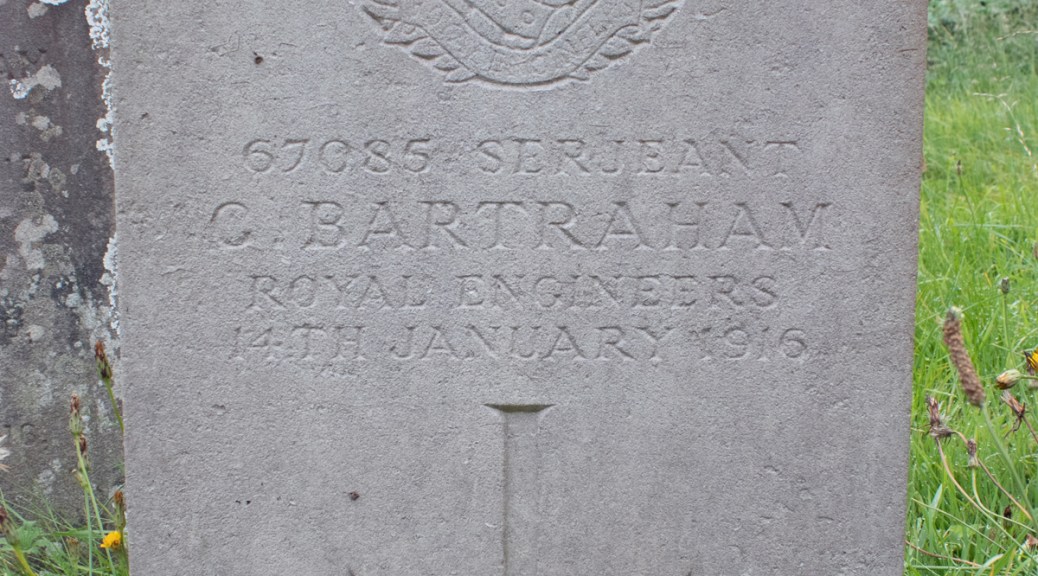
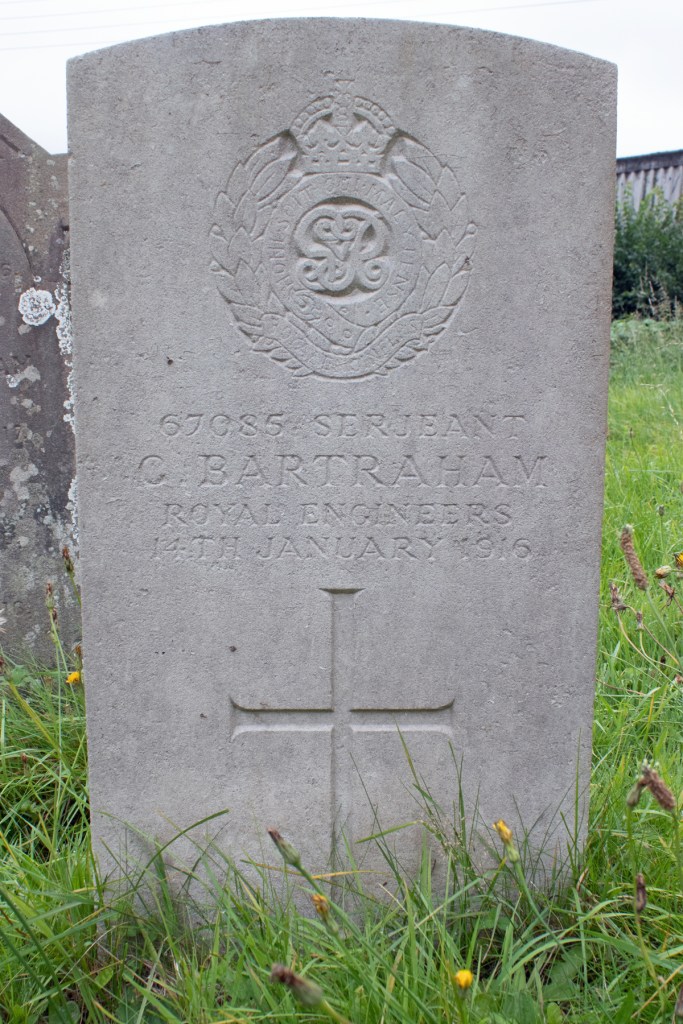
By the start of 1916, Serjeant Bartraham was back in Britain, primarily because of ill health. He had come down with nephritis, or inflamed kidneys. Admitted to hospital in South London, he died from the condition on 14th January 1916, at the age of 47 years old.
Brought back to Somerset, George Bartraham was laid to rest in the peaceful graveyard of St George’s Church in the village of his birth, Sampford Brett.
This was a time of tragedy for the Bartraham family.
George’s father, George, had died around the same time as his son, and was buried near him.
George and Mary’s son, George, had enlisted in the Hampshire Regiment when war was declared and, by the summer of 1916, was based in Iraq. He died on 23rd September 1916, through causes unclear, and was laid to rest in Baghdad War Cemetery.
Three generations of Bartrahams, all called George, had passed away within nine months.
In the summer of 1917, Sarah Bartraham also passed away. She was laid to rest with her husband and son in St George’s Churchyard.
George Watts was born in the autumn of 1892, one of ten children to James and Caroline. The family were raised in Ottery St Mary, Devon, but by the time of the 1911 census, they had moved to Williton, Somerset, where James was running the Railway Hotel. At this point George is noted as being a grocer’s assistant.
Little further information is available for George. He courted a Withycombe farm labourer’s daughter called Ellen Gould, and the couple had a son together in 1917, but there is no evidence that the couple got married.
When war broke out, George stepped up to play his part. He listed in the Somerset Light Infantry and, while his service record has been lost to time, other evidence confirms that he had joined the 2nd/5th Battalion long before the conflict finished. Private Watts’ troop spent the conflict in India, although there is no evidence that he left Britain’s shores.
The next record for George shows that he was admitted to a military hospital in Devonport, Devon, suffering from nephritis, a form of kidney disease. Sadly, he was to succumb to the condition, and passed away on 22nd November 1919, at the age of 27 years old.
George Watts was taken back to Somerset for burial. He was laid to rest in the peaceful graveyard of St Decuman’s Church in Watchet, not far from where his family still lived.
Thomas Wood was born in Bristol, Gloucestershire, in the summer of 1862. The third of ten children, he was the oldest son to Thomas and Emma Wood. Thomas Sr was a cabinet maker, but his son was not to follow in his father’s footsteps, seeking a life of adventure instead.
Thomas enlisted in the army and, while documents relating to his early life are not readily available, the 1891 census recorded him as being billeted at the Cambridge Barracks in Portsmouth, Hampshire. A member of the Royal Artillery, he seems to have been enlisted for a while, as he had risen to the rank of Corporal.
In 1894, Thomas married Leah Barrett, who was born in Oxfordshire. The army life underscored where the family would settle. They had four children and, according to their ages, the Woods were in Liverpool by 1895, Gosport, Hampshire, in 1896 and Cork in Ireland by 1899. The 1901 census found the family living in Wicklow, with Thomas having now achieved the rank of Company Sergeant Major.
Ten years later, and Thomas had stepped away from the army life. Now 48 years of age, he and Leah had been married for 17 years. The couple had settled in the Worle, on the outskirts of Weston-super-Mare, Somerset, where Thomas had set himself up as a butcher, with Leah assisting him.
War came to Europe in 1914, and it seems that Thomas felt drawn to play his part once more. He joined the Royal Defence Corps as a Serjeant when it was formed in the spring of 1916, and was assigned to the regiment’s 263rd Company.
Little information is available about Serjeant Wood’s army service, but by the autumn he had been admitted to the Shell Shock Hospital (now the Maudsley Hospital) in Denmark Hill, London. His entry to the hospital, however, was actually due to kidney disease, and this was what would claim his life. Thomas died from a combination of nephritis and uraemia on 21st November 1916. He was 54 years of age.
Thomas Wood was brought back to Somerset for burial. He was laid to rest in the graveyard of St Martin’s Church in Worle.
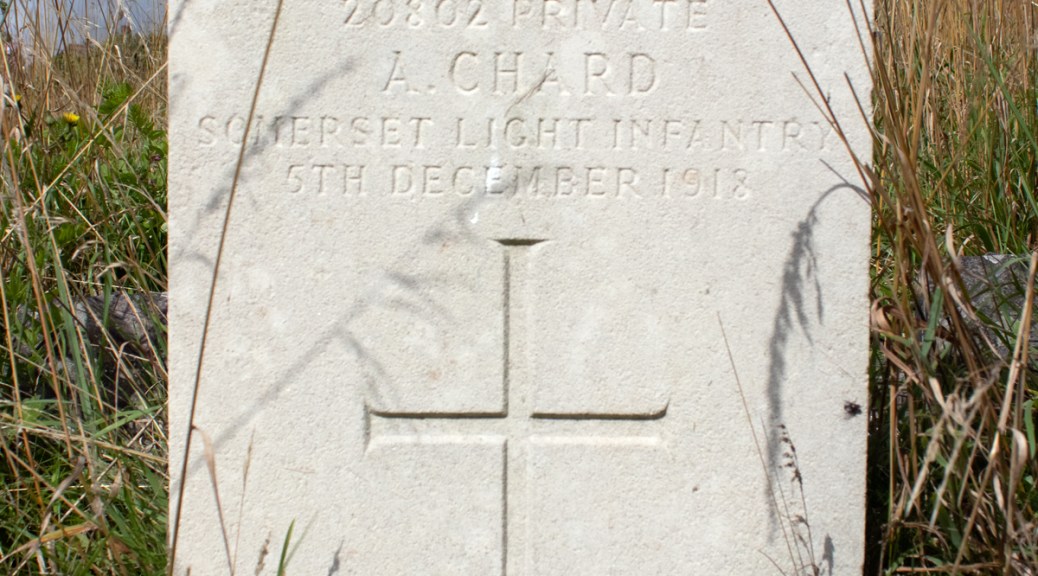
Arthur Chard was born in the spring of 1893, one of eight children to Isaac and Eliza Chard. Isaac was a labourer at the colour works in Winford, Somerset, and this is where the family were born and raised.
When Arthur finished his schooling, he found work as a farm labourer and, by the time of the 1911 census, he was living with his maternal uncle and family in the village, where he was employed as a farm lad.
As war came to Europe, Arthur stepped up to serve his country. He enlisted on 16th November 1915, joining the Somerset Light Infantry. His service records show that he was 5ft 3ins (1.6m) tall and weighed 113lbs (51.3kg).
Private Chard was formally mobilised in January 1916, and was sent to France in September, having completed his training. By May of 1917, he seems to have been back in Britain, and was transferred to the Labour Corps. There appears to have been some health issue behind this, as, on 11th August he was admitted to Henham Hall Auxiliary Hospital in Suffolk, suffering from ‘debility’. Having been moved to another hospital after a couple of weeks, he was finally discharged back to his unit on 20th September 1917.
Arthur joined the 626 Agricultural Company, which was based in Taunton. By July 1918, he had moved to another of the Somerset troops, 593 Agricultural Company. His health was still suffering, however, and he was soon admitted to Taunton Military Hospital. Private Chard passed away from nephritis on 5th December 1918. He was 25 years of age.
Arthur Chard’s body was taken back to Winford for burial. He was laid to rest in the village’s parish church, St Mary & St Peter’s.
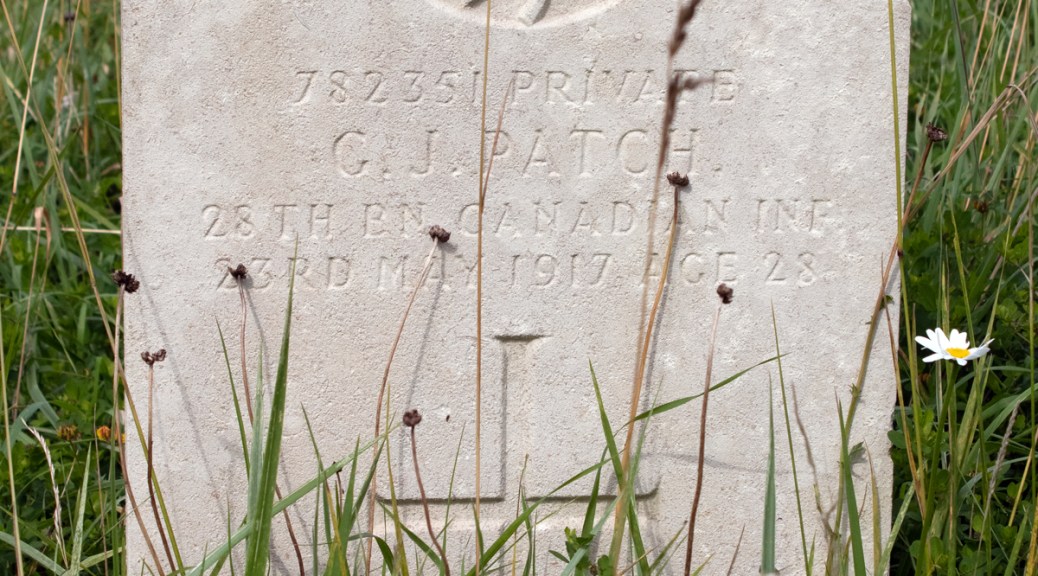
Gilbert John Patch was born in Winford, Somerset, on 3rd July 1888. The third of seven children, his parents were haulier Robert Patch and his wife Ann.
Gilbert followed his father into carting work, but the opportunity of a bigger and better life presented itself. In the spring of 1913, he emigrated to Canada, to find land and work as a farmer. He settled in the hamlet of Caron, Saskatchewan with a friend from home, Percy Worle.
Gilbert’s time overseas was not to be a length one, however. When Europe went to war, the empire was called upon and, on 1st April 1916, Gilbert enlisted in the Canadian Expeditionary Force. His service records show that he was 5ft 8ins (1.72m) tall, with blue eyes, fair hair and a medium complexion.
After his training, Private Patch arrived in France on 28th December 1916, and was assigned to the 28th Battalion of the Canadian Infantry – the same troop as his friend, Percy. During the Capture of Hill 70 in May 1917, Percy was killed and Gilbert himself was badly injured, receiving shrapnel wounds to his head, left arm and right leg.
Private Patch was medically evacuated to Britain for treatment. He was admitted to the Clopton House War Hospital in Stratford-upon-Avon, and while his wounds were treated, within a couple of weeks, he was dangerously ill with a kidney infection. The combination proved too much for his body to take, and Gilbert died on 23rd May 1917. He was 28 years of age.
Gilbert John Patch’s body was brought back to Somerset for burial. He was laid to rest in the graveyard of the local parish church, St Mary & St Peter’s, in his home village of Winford.
John Maguire was born in Dublin, Ireland, in 1874. There is scant information about his life, and his name is too common to be able to narrow down details of his family.
The only documentation that links to his life is that of his army service. He was working as a labourer when he enlisted in the Royal Army Medical Corps on 27th April 1918. His service records confirm he was 5ft 7ins (1.7m) tall, with blue eyes, grey hair and a sallow complexion. Interestingly, he reported that he did not have any next-of-kin.
Private Maguire seemed to serve on home soil, and was primarily based in Lancashire. It was while here in the January of 1919 that he fell ill with nephritis – kidney disease – and was admitted to the hospital on Adelaide Street, Blackpool.
His condition was such that it led to John’s discharge from military service on medical grounds. On 23rd February he was moved to the 2nd Southern General Hospital in Bristol, and two days later he left army life. John was transferred to the War Hospital in Bath a couple of weeks later, and it was here that he passed away on 16th April 1919. He was 45 years of age.
An addition to John’s initial service records noted that a next-of-kin had been confirmed, and so Mary Prestige, who was living in Bedminster, to the south of Bristol, was informer of her friend’s death.
Respecting the Irishman’s religion, John Maguire was laid to rest in the Roman Catholic Cemetery in Bath, the city in which he died.
John’s friend, Mary Prestige, is also destined to remain a mystery. There are no records of her at the address John’s service records provide – Pipe Cottage, North Street, Bedminster.
There are two census records for Somerset for a Mary Prestige: 1901 records a Durham-born 18 year old Mary working as one of a number of laundry maids at the Marlborough Hill House of Refuge in Bristol.
The 1911 census records the same Mary Prestige visiting a William and Amelia Hockerday in Yatton, Somerset. It is impossible to confirm, however, whether this is the woman John notified the army as his next of kin.
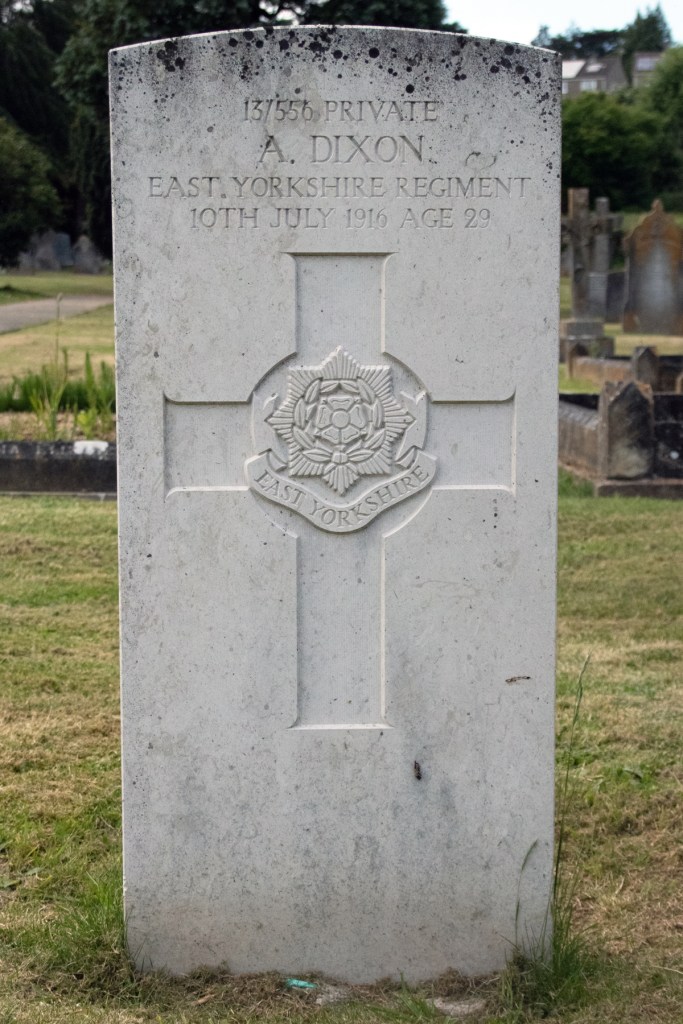
Alonsa Dixon was born in Kingston-upon-Hull, Yorkshire, in 1887, the oldest of seven children to Alonsa and Caroline Dixon. Alonsa Sr was a billiard marker, who raised his family in a small house near the city centre.
Alonsa Jr found work as an errand boy for a grocer when he left school, but went on to find work as a jobbing gardener. By the time of the 1911 census, he had moved out of home, and was boarding with cab driver George Gill and his family.
In April 1912, he married Edith Alice Gill. Trixie, as she was also known, was George’s daughter, and it seems likely that romance blossomed after Alonsa moved in. The couple went on to have a son, also called Alonsa, who was born the following year.
War was coming to Europe, and Alonsa was in one of the first waves of men to volunteer for King and Country. He enlisted in the East Yorkshire Regiment, and was assigned to the 13th Battalion. His service records show that he was 5ft 7.5ins (1.71m) tall, and weighed 144lbs (65.3kg). He was noted as being of good physical development.
Initially serving on home soil, Private Dixon was eventually dispatched overseas, arriving in Egypt in December 1915. Having spent just under three months in North Africa, he was moved to France in March the following year.
Alonsa had some health issues by this point, and was suffering from Bright’s Disease, or nephritis (inflammation of the kidneys). He was treated in a field hospital in Abbeville, but subsequently medically evacuated back to England for further care.
Private Dixon was admitted to the Monastery Hospital in Wincanton, Somerset in April 1916, but his condition proved too severe, and he passed away on 10th July 1916. He was just 29 years of age.
Alonsa Dixon was laid to rest in the cemetery of the town in which he passed away, Wincanton.
Harry Ashford was born in Sidford, Devon, on 2nd June 1880, the oldest of seven children to Samuel and Fanny Ashford. Samuel was a mason and Fanny worked as a lace worker managing this at the same time as raising her children. The family left Devon in the late 1880s, settling instead in Chard, Somerset.
After initially working as an errand boy, when Harry finished school he found employment as a house painter. He had met lace worker Ada Hancock by this point, and the couple married in Chard’s Methodist Church on 4th May 1901. The couple set up home in the same road as Harry’s parents, and went on to have a daughter, Nora, the following year.
By this point, storm clouds were brewing over Europe, however, and Harry felt the need to play his part. On 22nd September 1915, at the age of 35, he enlisted in the Royal Army Medical Corps. His service record shows that he stood 5ft 6ins (1.68m) tall and was of good physical development.
Private Ashford served on the Home Front, and was based at the Tweseldown Camp near Farnham, Surrey. He served there for a little over a year before he contracted nephritis – inflamed kidneys – and was admitted to hospital. Sadly, the condition proved too severe, and he died on 31st October 1916 from a cerebral haemorrhage. He was 37 years of age.
Harry Ashford’s body was brought back to Somerset for burial. He was laid to rest in the cemetery of his adopted home town, Chard.
Both of Harry’s parents passed away not long after he died – Samuel in 1919 and Fanny in 1920. Ada never remarried, and lived a reasonable life, passing away in Nottinghamshire in the autumn of 1932, at the age of 53 years old.










 Death and Service