Charles Archibald Walters was born in 1896, and was one of nine children to Arthur and Minnie. Arthur was a painter in the shipyards, and the 1901 census found the family living in a small cottage at 29 Cambrian Terrace in Neyland, Pembrokeshire.
By 1911, Charles had finished his schooling, and had found labouring work on a local farm. He was still living at home, however, and the family has moved to 46 Cambrian Road, overlooking the shipyard where Arthur still worked, and the Westward Pill and Cleddau Ddu rivers beyond.
When war came to Europe, Charles was called upon to play his part. Details of his military service are sketchy, but it is clear that he enlisted in the Royal Garrison Artillery, and was assigned to the Pembrokeshire Territorial Force.
Gunner Walters survived the war, but was suffering from nephritis. He was medically discharged from the army on 12th May 1919, and returned to the family home.
By this point Arthur had moved the family to Goodwick, near Fishguard, by this point, as he had taken up a job in the town as a painter for Great Western Railways.
Charles’ condition would ultimately get the better of him. He passed away on 4th April 1920: he was just 24 years of age.
Charles Archibald Walters was laid to rest in Llanwnda Cemetery, not far from where his family now lived.
The 1921 census found that two of Charles’ brother were also working for Great Western Railways, Frederick as a porter, and William as a boiler sealer in their engineering works (presumably the same place as Arthur).
Minnie died the following year, Arthur passing in 1924. Both were buried with their son, Charles, and they are remembered on his Commonwealth War Grave.
James Barrington was born in Westminster, Middlesex, on 1st June 1890. One of twelve children, his parents were Alfred and Hetty Barrington. Alfred worked in a soap factory, and the family seemed to move around: the 1891 census found them living in rooms at 3 Charles Buildings, St Martin-in-the Fields, while a decade later there were at 6 Lyric Place in Kennington, Surrey.
With so many mouths to feed, Alfred and Hetty were keen to get their children to work. The 1911 census found James working as a cowman on a farm in Mathry, Pembrokeshire, which must have come as a huge culture shock.
James soon settled in, however, and, on 9th November 1912, he married Elizabeth Thomas, the daughter of a labourer from nearby. The couple had a daughter, Hilda, who was born the following February.
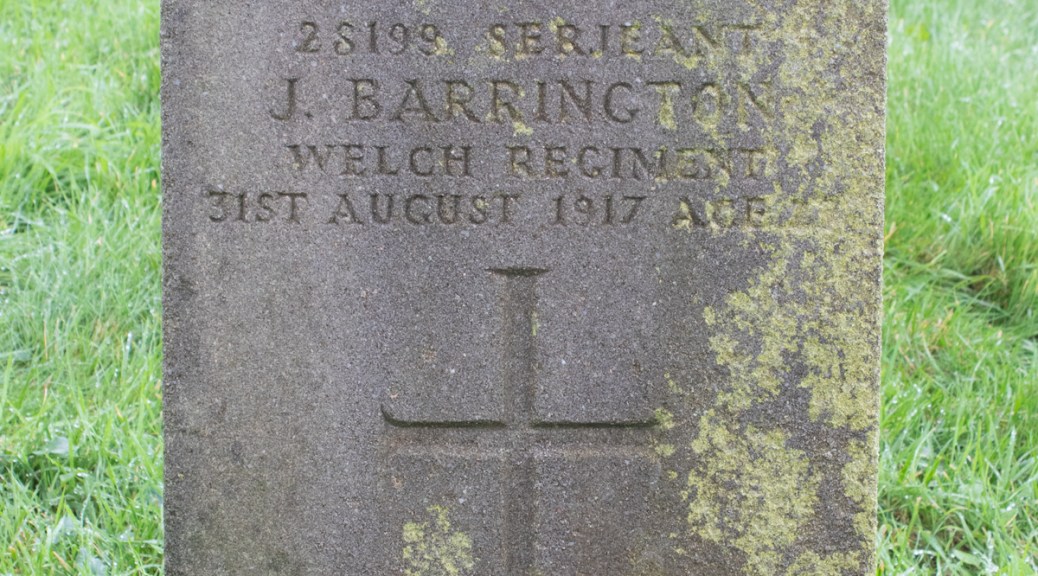
When war broke out, James was called upon to play his part. There is little concrete information about his service, but he was assigned to the Welch Regiment, as was attached to the 18th (Service) Battalion (2nd Glamorgan). He had attained the rank of Sergeant by the summer of 1917.
Sergeant Barrington’s unit fought in some of the key battles of the early stages of the conflict, including the Battle of the Ancre in 1916, and the German retreat to the Hindenburg Line the following spring. It was during fighting on the Western Front that summer, though, that he was wounded, and medically evacuated to Britain for treatment.
James was admitted to a hospital in London, but his wounds would prove too severe: he passed away on 31st August 1917, at the age of 27 years old.
The body of James Barrington was taken back to Wales for burial. He was laid to rest in Mathry Church Cemetery, not far from where his widow still lived.
James Harries Morse was born in the autumn of 1895 in Llanwnda, Pembrokeshire. One of eleven children, his parents were agricultural labourer William Morse and his wife, Ann.
James’ schooling was completed early, and he was soon found work to keep him occupied. The 1911 census recorded him as being a cattle boy for the James family, living in on a farm not far from his family home.
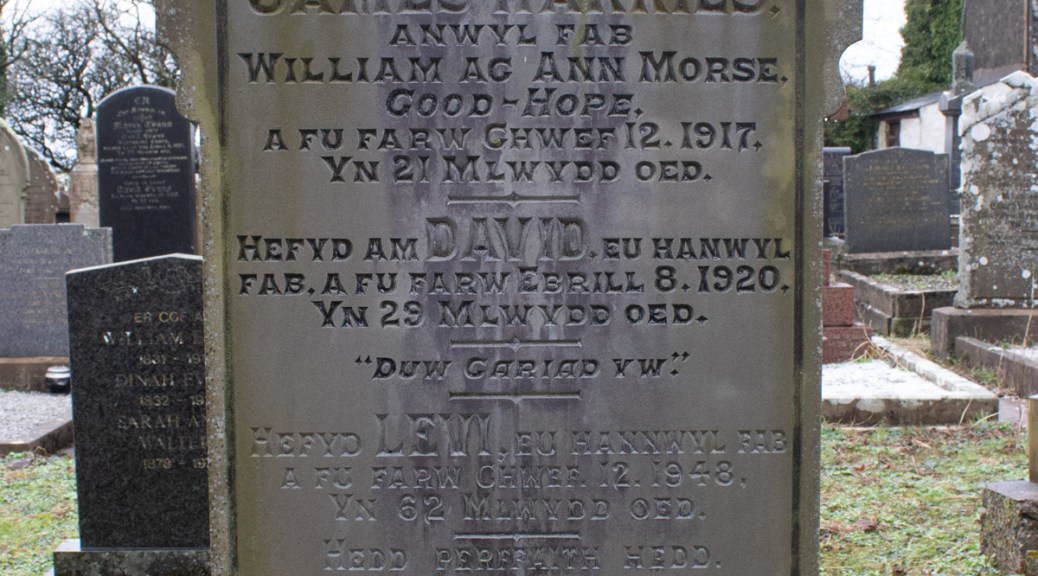
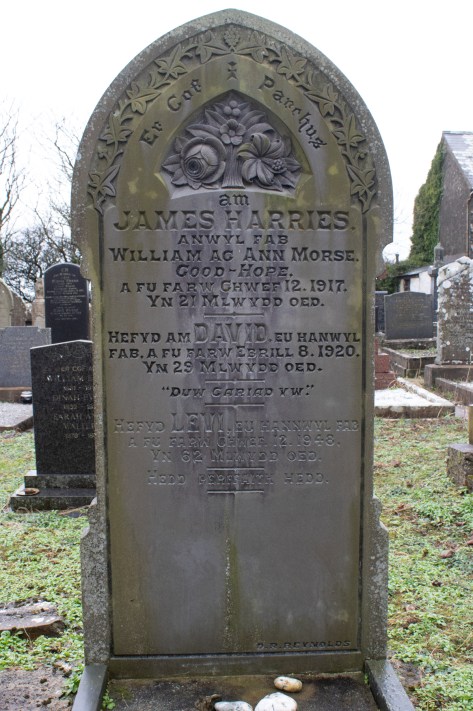
When war broke out, James was keen to play his part. Details of his military service have been lost to time, but it is clear that he enlisted as a Private in the Welch Regiment, and was assigned to the 3rd (Reserve) Battalion. It’s not possible to identify where or for how long he served, and the only other documents available relate to his passing.
James Harries Morse died of disease on 12th February 1917: he was just 21 years of age. His body was taken back to Pembrokeshire for burial, and he was laid to rest in the family plot in Pencaer (Harmony) Baptist Burial Ground, not far from his parents’ home.
Arthur William Charles was born in Llanrhian, Pembrokeshire, in the summer of 1896. The middle of eleven children, his parents were Joseph and Phoebe Charles.
The 1901 census recorded Joseph as being a butcher and innkeeper in the village, but by the time of the next poll, the family were split. Joseph and Phoebe were now noted as being farmers, living with five of their children plus two servants at Henllys Farm. Arthur, meanwhile, was living with two of his sisters on his brother Thomas’ farm in Mathry. At 14 years of age, he was noted as being a farmer’s son, working on a farm.
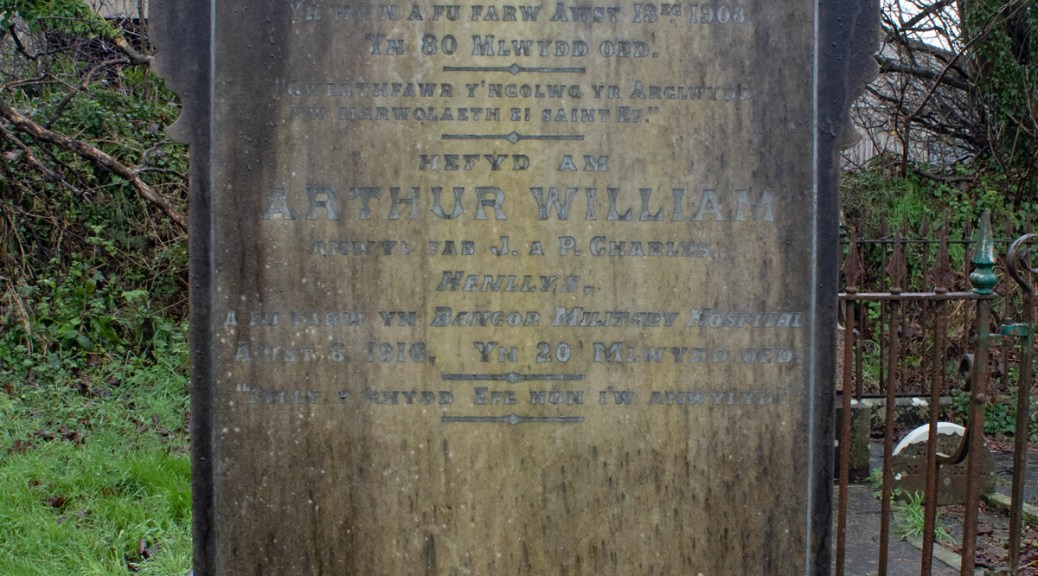
When war broke out, Arthur was called upon to play his part. His service papers are long since lost, but he had enlisted in the Welch Regiment by the spring of 1916. Assigned to the 20th (3rd Rhondda) (Reserve) Battalion, he was sent to Bangor, Gwynedd, for training.
Tragically, however, Private Charles’ time there was not to be a lengthy one. He contracted cerebrospinal meningitis, and passed away on 6th August 1916: he was 20 years of age.
The body of Arthur William Charles was taken back to Pembrokeshire for burial. He was laid to rest in the Mathry Congregational Churchyard in Rehoboth.
Gwyn Lewis Thomas was born in Llanrhian, Pembrokeshire, in 1894, and was the youngest of five children to George and Jane Thomas. George was a farmer, and by the time of the 1911 census, his son had been sent to work with another farmer, William Miles, in Mathry, four miles to the east.
When war broke out, Gwyn stepped up to serve his country. He enlisted in the Royal Engineers as a Sapper and, while little information about his service, it is clear that he was sent to France on 23rd August 1915. By the end of the conflict, he had achieved the rank of Corporal, and when the Armistice was declared, he returned home to Wales.
The only other documents connected to Corporal Thomas are those relating to his passing. He died from disease on 2nd March 1920, at the age of 25 years old. His death was registered in Haverfordwest, Pembrokeshire, which would suggest that he either passed there, or that that was the registry office to his home.
Gwyn Lewis Thomas was laid to rest in Mathry Congregational Chapelyard in Rehoboth, midway between his parents’ farm and that of his former employer. His headstone is inscribed with the words Bu farw o effaith y Rhyfel Mawrth (He died from the effects of the Great War).
In the peaceful Congregational Chapelyard of Berea, St Davids, Pembrokeshire, is a headstone dedicated to Willie Howells, grandson of Benjamin and Mary. The inscription – in Welsh – confirms that he died on 26th November 1918, at the age of 23.
The 1901 census records the couple living at Rhos y Gorse with four of their eleven children and two of their grandchildren, including William. There is no documentation to confirm which of their children was his parent.
Tragically, Willie’s military records are also lost to time. The Commonwealth War Graves Commission give his name as Private BW Howells. They suggest that his first regiment was the South Wales Borderers, and that he transferred to the Northern Command Labour Centre of the Labour Corps. His service numbers for both units draw a blank, however.
The life of Willie Howells is destined to remain a mystery, one of the many whose stories were buried with them.
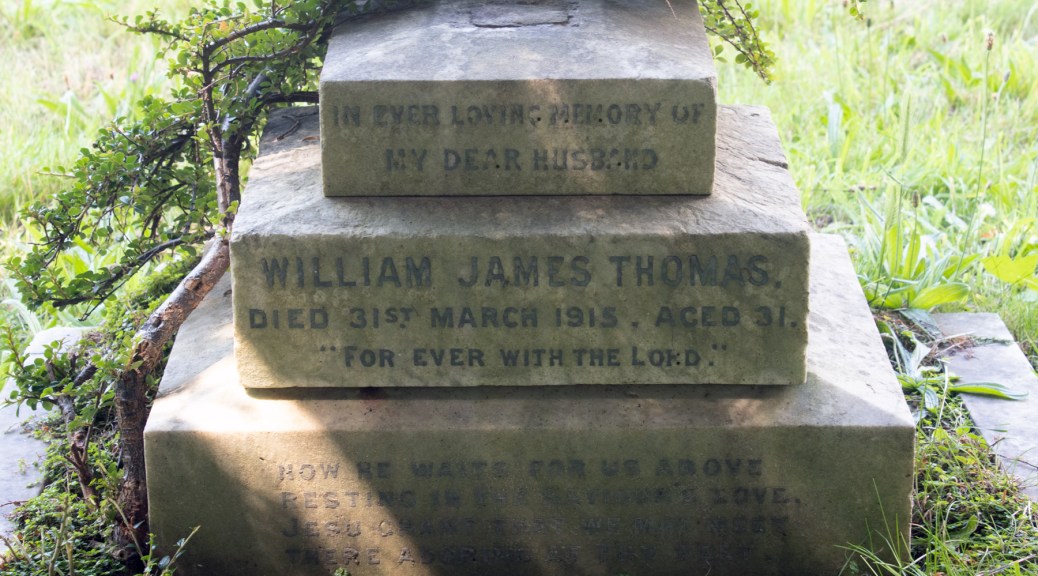
William James Thomas was born in Manordeifi, Pembrokeshire, in 1894. The older to two children his parents were Benjamin and Ellen Thomas. Benjamin was a groom, and, at the time of the 1891 census, the family were living at Cilwendeg Lodge at the entrance to the Welsh estate.
The family moved to Aberporth on the Cardigan coast by the 1901 census. Benjamin had become a farmer, and William, now 17 years of age, was helping out.
Something changed dramatically for William, however, and by 1914, he was living in the West Sussex village of Ferring, some 200 miles (320km) from his birthplace. By this point he was working as a motor driver and, on 25h March, he married Winifred May Knight at St Mary’s Church in Goring-by-Sea.
William stepped up to serve his country when war broke out, enlisting on 18th February 1915. His service records show that he was 5ft 4ins (1.63m) tall, and weighed 138lbs (62.6kg). He was noted as having a mole on his right cheek, and that several teeth were missing. The document confirms his marriage to Winifred, but also gives details of a child, Evelyne Winifred, who had been born in 1905: there is nothing to confirm whether she was his, or was born to Winifred before the couple met.
Private Thomas was assigned to the Army Service Corps Mechanical Transport Division, and sent to nearby Worthing for his training. His time in the army was to be tragically brief, as within a fortnight he had been admitted to the town’s Red Cross Hospital, suffering from cerebrospinal fever.
On 23rd March, William was transferred to Worthing Civil Infections Hospital, but any treatment he was receiving was to prove ineffective. He passed away on 31st March 1915, at the age of 31 years old.
The body of William James Thomas was laid to rest in the graveyard of St Mary’s Church, Goring, where just over a year before he and Winifred had been married.
Richard Avary Arthur Young Jordan was born on 24th May 1866 in Cashel, Tipperary, Ireland. His father, Richard Jordan, died a week after his son’s birth, leaving his mother, Annabella, to raise him.
The 1871 census records mother and son living in Woolwich, London, with Annabella’s widowed mother, Grace. They were obviously a well-connected family, with Grace living as an annuitant, or pensioner, one son a Surgeon Major in the army and another as a Colonel in a different regiment. Annabella herself was recorded as a landowner, and the family had support with a cook and housemaid living in.
Surrounded by army servicemen as he was, it is no surprise that a military career called to Richard. He enlisted on 10th November 1886, joining the King’s Shropshire Light Infantry as a Lieutenant. Assigned to the 1st Battalion, his service records confirm that he had attended Burney’s Gosport School – a military academy – and was 5ft 7.5ins (1.71m) tall.
Richard was sent to Egypt just before Christmas that year, and over the next five years, he served both there and in Malta. On 11th May 1889 he attained the rank of Captain and, in December 1891 he was sent further afield, to Hong Kong.
After three years in the Far East, returned to Britain, and spent the majority of 1895 back on home soil. His travels were not at an end, however, and by the end of the year, Captain Jordan found himself in India. He spent three-and-a-half years in the sub continent, returning to the UK in May 1899.
At this point, details of Richard’s life get a little sketchy. He seems to have settled in Pembroke Dock, South Wales, and, on 18th April 1904, he married Ella Mary Caroline Grove. She was eight years his junior, and the daughter of a late Lieutenant in the Highland Light Infantry. The couple married at St George’s Church, Hanover Square, London.
Richard’s trail goes gold again, for a couple of years. He retired from the army on 8th August 1906, after nearly twenty years’ service. By the time of the 1911 census, he and Ella had set up home in Heywood House, on the outskirts of Tenby, Pembrokeshire, with two servants – Beatrice and Edith – as two live-in staff.
War came to Europe in the summer of 1914, and Richard seemed to keen to play his part once again. He enlisted again in August 1915, and was assigned the rank of Major in his former regiment. While it is not possible to determine Major Jordan’s complete service at this time, he definitely arrived in France the following month. If he remained in France, it is likely that he saw fighting at the Somme in 1916, Cambrai in 1917 and at Lys and on the Hindenburg Line in 1918.
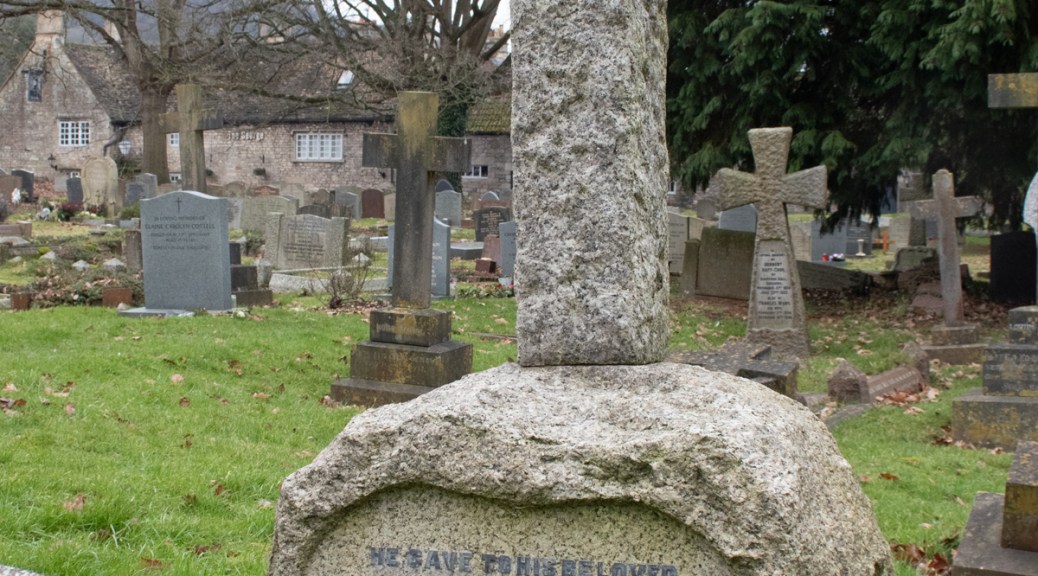
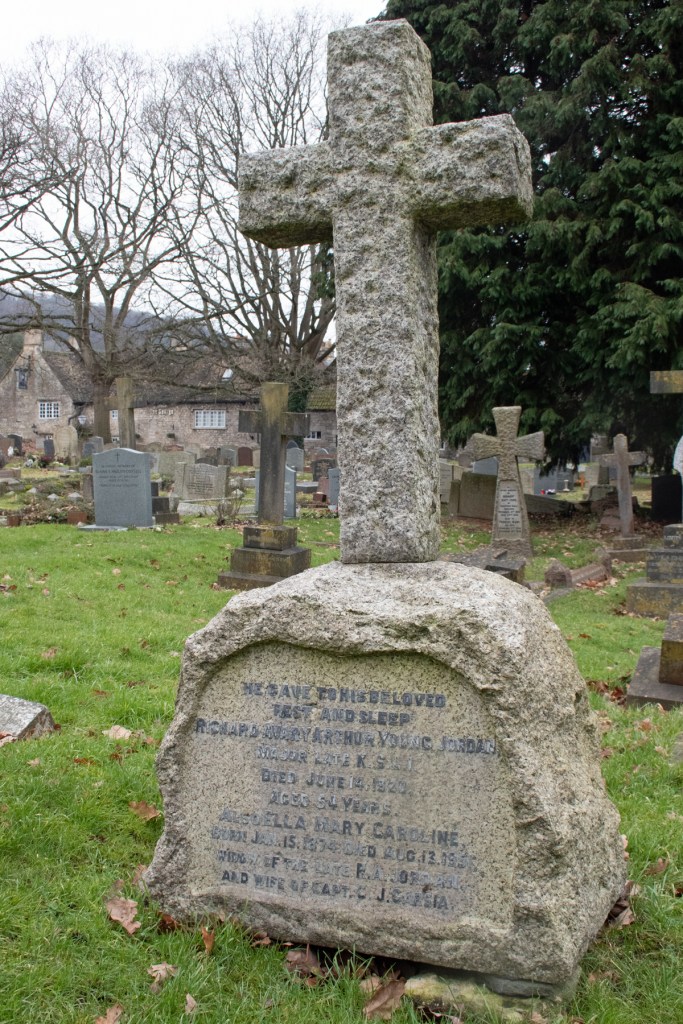
Again, Major Jordan’s post-war life remains tantalisingly elusive. By the summer of 1920, he and Ella were living at Holcombe Lodge in Bathampton, on the outskirts of Bath. It was here on 14th June, that Richard passed away. He was 54 years of age.
Despite all his travelling, it seems that Ella was comfortable living in Bathampton, and this is where she laid her late husband to rest. Richard Avary Arthur Young Jordan was buried in the graveyard of St Nicholas’ Church in the village.
The widowed Ella married again, to Captain Clare Garsia, on 9th October 1921. She remained in Bathampton, and lived to the age of 77, passing away on 13th August 1951. She was laid to rest in the same plot as her late husband.
When Captain Garsia died the following year, he was also buried in St Nicholas’ Churchyard, in a neighbouring plot to his beloved Ella.
James Oscar Stuckey was born in the summer of 1886, in Milford Haven, Pembrokeshire. The second of eight children, his parents were James and Minnie Stuckey. James Sr was a carter from Langport in Somerset, and his work took him across the country. James Jr’s older sister was born in Sandown, on the Isle of Wight, and, when his next sibling was born, the family had moved back to Somerset and were living in the village of Curry Rivel.
By the time of the 1901 census James Sr was working as a warehouseman. James Jr had also left school and found employment as an agricultural labourer.
On 24th March 1913, James married Margaret Beatrice Tilley – who was better known as Beattie. The couple set up home in Curry Rivel, and went on to have two children, Cecil and James.
By this time war was coming to Europe and, in January 1915, James stepped up to play his part for King and Country. He enlisted in the Royal Field Artillery, and was given the rank of Gunner. Over the next couple of years, he served in France and Italy, rising through the ranks to Bombardier and Corporal.
During this time, however, James’ health was being impacted. His troop was gassed while in France, and he was hospitalised a couple of times with bronchitis and tuberculosis, and it was TB that saw him evacuated to Britain for treatment in September 1918.
His condition was such that Corporal Stuckey was medically discharged from the army on 23rd November 1918, as he was no longer fit for duty. He returned to civilian life, and settled back into Curry Rivel.
He was well-known in the district, and being of a jovial disposition, was liked by everyone with whom he came into contact. He was a member of the Curry Rivel Male Friendly Society.
Langport & Somerton Herald: Saturday 11th December 1920
James’ lung conditions were to get the better of him. After a protracted illness, he finally succumbed, breathing his last on 3rd December 1920. He was just 34 years of age.
James Oscar Stuckey was laid to rest in the graveyard of St Andrew’s Church, in Curry Rivel.
Richard Eldon Bush was born on 16th June 1891 in Keynsham, Somerset. The second of four children (all of whom were boys), his parents were Philip and Maria Bush. Philip was a solicitor, and with that status came opportunity for his children.
The 1911 census recorded the Bush family living in Keynsham with two servants – cook Clara Jones and parlour maid Laura Day. The two older boys – Richard and his older brother, Whittington, were both listed as Cambridge undergraduates, while his two young brothers were boarding at a private school in Repton, Yorkshire.
Richard had aspirations for a good life. In March 1914, he set sail for a life in Canada, looking to take up architecture in the colony. His time overseas wasn’t to be long, though, and, when war broke out in Europe, he returned home.
Full details of Richard’s military service are not available, but he joined the Royal Naval Air Service and, on 20th August 1915, he gained his wings. Richard rose to the rank of Flight Lieutenant, but tragedy was ahead.
On 24th April 1917, he was piloting a scout seaplane around the harbour in Fishguard, Pembrokeshire.
[He] failed to clear some overhead wires, and the seaplane swerved against the cliff with considerable violence, smashing the machine, which the petrol set alight, and crashed to the earth. When liberated from the blazing machine Lieutenant Bush rolled and extinguished his burning clothes.
Somerset Guardian and Radstock Observer: Friday 27th April 1917
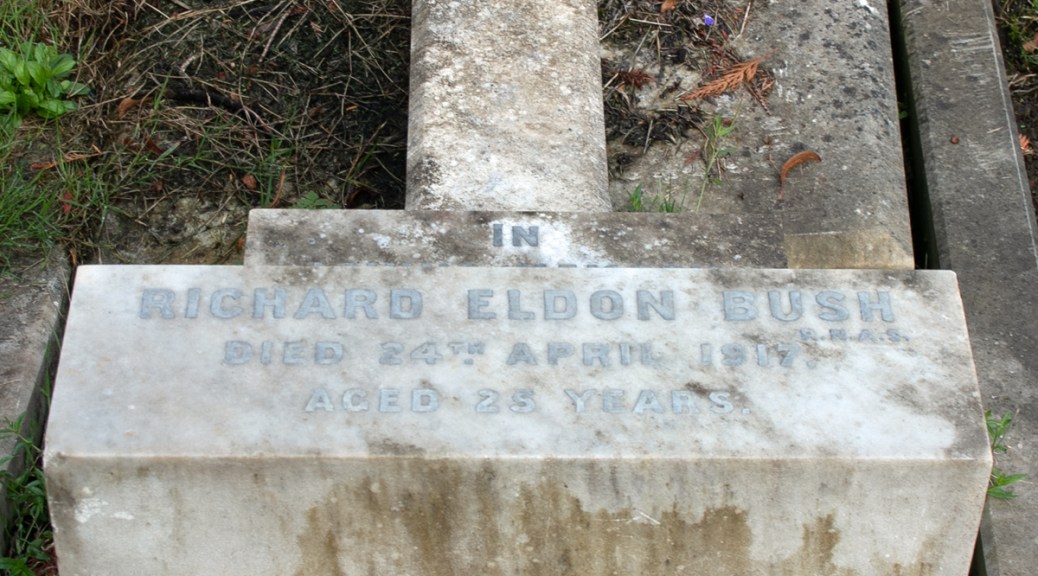
Sadly, Flight Lieutenant Bush’s injuries proved too severe. He passed away a couple of days later, on 24th April 1917, at the age of 25 years old.
Brought back to Somerset for burial, Richard Eldon Bush was laid to rest in the cemetery of his home town, Keynsham.
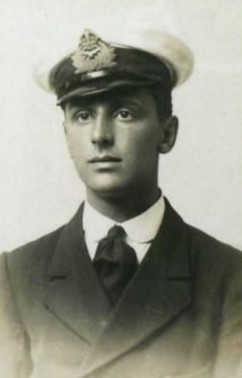
Flight Lieutenant Richard Bush (from astreetnearyou.org)
The same newspaper report noted that Richard’s brother Graham was an officer in the Royal Flying Corps. He had also been badly injured in a flying accident, but was, according to the report, “flying again now.“










 Death and Service