Tag Archives: pneumonia

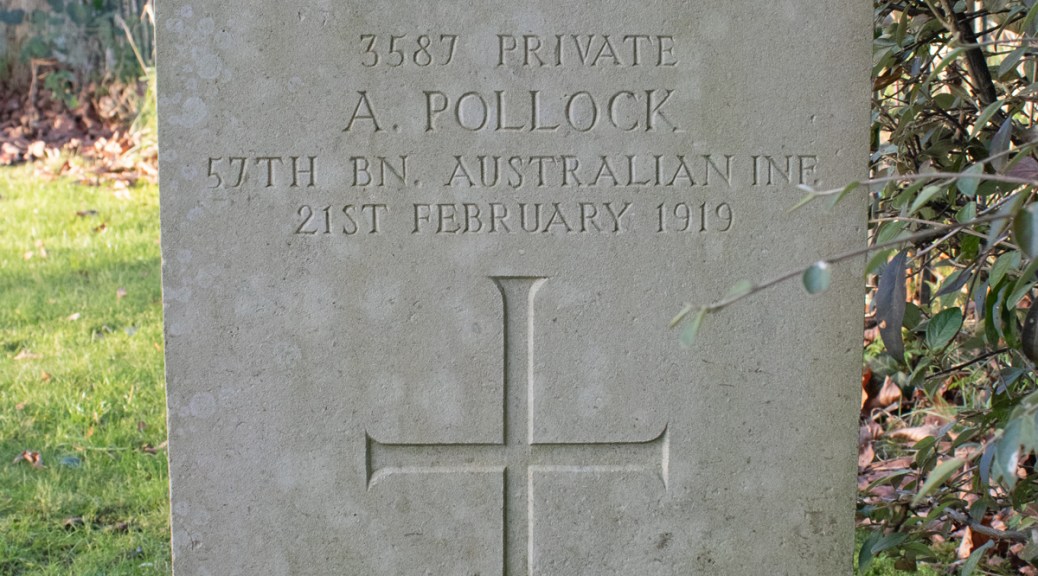
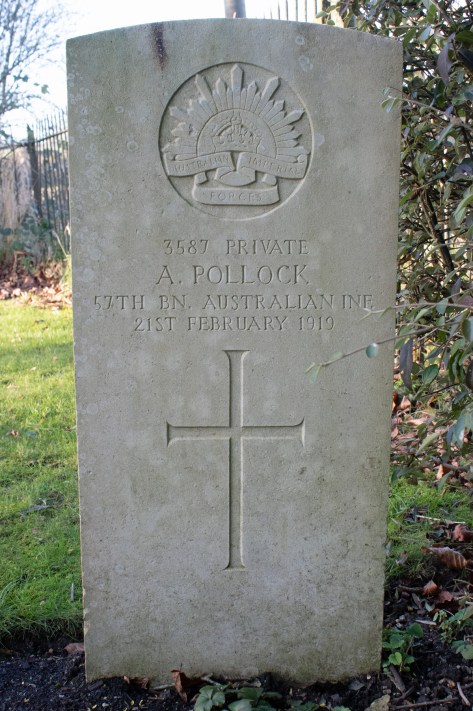
Private Alexander Pollock

Private Alexander Pollock

Alexander Pollock was born on 17th April 1893 in Bendigo, Victoria, Australia. The oldest of eight children, his parents were David and Annie. There is little information about his early life, but when he completed his schooling, he found work as a general labourer.

When war broke out, Alexander – who was better known as Ike – stepped up to play his part. He enlisted in the Australian Imperial Force (AIF) on 12th July 1915, just four months after his father had passed away. Private Pollock’s service records show that he was 5ft 6ins (1.68m) tall and weighed in at 13st 4lbs (84.4kg). He had dark brown hair, blue eyes and a fresh complexion, with a scar on his left bicep.

Private Pollock’s unit – the 57th Battalion – left Australia at the start of 1916, arriving in Egypt towards the end of February. They spent the next couple of months training at the Tell el Kebir camp, to the north of Cairo, before setting off to France, arriving in Marseilles on 23rd June.

Ike’s first taste of battle came within a matter of weeks, when his unit acted as a back-up force during the Battle of Fromelles. Described as the worst day in Australia’s history, the AIF suffered more than 5,000 casualties. The 57th Battalion, held in reserve, did not incur as many losses as other units and, as a result, Private Pollock would have remained entrenched on the Front Line after the worst hit battalions pulled back.

The next few years would see Ike remain on the Western Front. His service papers suggest that he did not see any leave until March 1918, but he was soon back in the action.

After the Armistice was declared, Private Pollock remained in France. He had a second period of leave from 22nd December 1918, spending the festivities in Britain. Back in France on 13th January 1919, he was moved to a training camp in Le Havre. By this point, however, his health was suffering, and he was moved back to Britain weeks after arriving.

Billeted at the ANZAC base in Codford, Wiltshire, Ike came down with influenza and pneumonia. He was admitted to the New Zealand General Hospital not far from the base, but the conditions were to prove fatal. He died on 21st February 1919, at the age of 25 years old.

Thousands of miles from home, and with his mother having also passed the previous year, the body of Alexander ‘Ike’ Pollock was laid to rest in the graveyard extension to St Mary’s Church, Codford.


Private Alexander Pollock
(from findagrave.com)

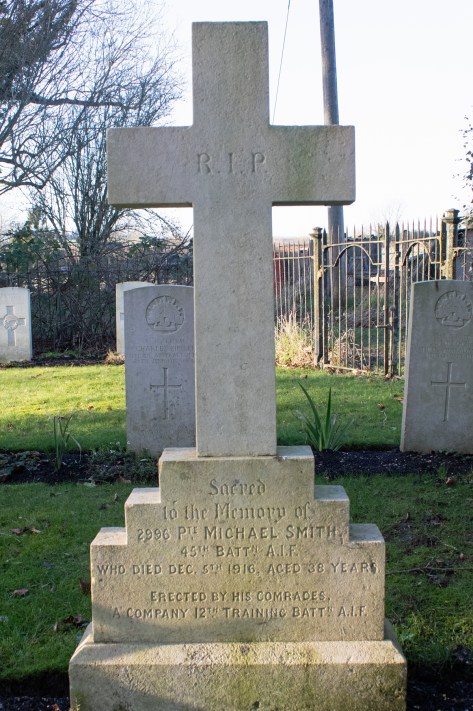
Private Michael Smith

Private Michael Smith

Michael Smith was born in Melbourne, Australia, in the spring of 1878. Details of his early life are scarce, but he seems to have been one of five children to Michael and Mary Smith.

Michael Jr married Lucy Mungovan, twelve years his senior, on 7th August 1915. By this point he had moved to Sydney and was working as a cook. The couple had had a son, William, in 1903, and the wedding seems to have been a way of formalising their relationship in anticipation of the coming war.

Michael Jr enlisted in the Australian Imperial Force on 13th July 1916. His service records show that, at 38 years of age, he was 5ft 3.5ins (1.61m) tall and weighed 125lbs (56.7kg). A Roman Catholic, he had brown hair, although he was balding, blue eyes and a fresh brown complexion. He was also noted as having two scars: one on the back of his right shoulder, the other on the back of his right thigh.

Assigned to the 45th Battalion of the Australian Infantry, Private Smith’s unit left Sydney on 7th October 1916 for its seven week voyage to Britain. The A40 Ceramic troop ship reached Plymouth, Devon, on 21st November, and Michael was marched to the ANZAC base in Codford, Wiltshire the same day.

The voyage took its toll on the soldiers, and Private Smith was not to be immune. Within a fortnight he had been admitted to the Military Hospital in Sutton Veny, five miles to the north west. He was suffering from pneumonia, but it was to prove too late. He passed away on 5th December 1916 – the day he arrived at the hospital – at the age of 38.

Thousands of miles from home, the body of Michael Smith was laid to rest in the extension to St Mary’s Churchyard in Codford, Wiltshire.


The shock of her husband’s death was to prove too much for Lucy. She passed away on 16th January 1918, at the age of 52.


Private Thomas Osborne

Private Thomas Osborne

Thomas Ernest Osborne was born in the spring of 1884 in the New South Wales town of Cardiff. One of twelve children, his parents were Bartholomew and Hannah Osborne.

Little information is available about Thomas’ early life, but he found employment as a miner when he completed his schooling. In 1903 he married Florence McLean: they settled in Wollongong, to the south of Sydney, and had six children.

When war broke out, Thomas stepped up to play his part, and he enlisted in the Australian Imperial Force on 12th June 1916. His service records show that he was 5ft 7.5ins (1.71m) tall, and weighed 168lbs (76.2kg). He had brown hair, brown eyes and a fair complexion. He was also noted has having two vaccination marks on his left arm, and an inch-long scar on his lower lip.

Private Osborne boarded the A40 Ceramic troop ship on 3rd October 1916. It took nearly two months to make the trip from Sydney to Britain, and his unit – the 45th Battalion of the Australian Infantry – finally disembarked in Plymouth, Devon, on 21st November. From here, he marched into the ANZAC base in Codford, Wiltshire.

The voyage from Australia took its toll on a significant number of troops, and Thomas’ health was also impacted. He was admitted to the military hospital in Sutton Veny – just a few miles from base – suffering from pneumonia. The condition was to prove fatal: Private Osborne died on 10th December 1916, at the age of 33 years old.

The body of Thomas Ernest Osborne was laid to rest in the newly extended graveyard of St Mary’s Church, Codford.


Thomas’ effects were sent to his widow, although she was still chasing their return some nine months after his passing. They consisted of “diary, pocket book (leather), wristlet watch and strap, pipe, writing tablet, soap dish, jack knife, pencil, letters, postcards, photos, Testament, money belt, 2 keys, small penknife, ring.”

Florence married again on 16th February 1918, to a Victor Johnson. Thomas’ papers show that communications about her late husband continued, however. On 27th July 1921, an urgent missive was sent to Florence regarding the erection of a permanent headstone for his grave. There is no evidence of any response, and it seems likely that the now Mrs Johnson was unable to cover the cost. Thomas’ grave marker was eventually erected by his army colleagues.


Thomas’ youngest sibling, Reuben, also fought in the First World War. Eleven years younger than his brother, Private R Osborne was attached to the 35th Battalion of the Australian Infantry. By the spring of 1917 his unit was firmly entrenched on the Western Front. Rueben was killed on 7th June, and is commemorated on the Menin Gate at Ypres.


Private Richard Ryan

Private Richard Ryan

Richard Charles Gladstone Ryan was born in Talia, South Australia, on 31st March 1895. The son of Richard and Margaret Ryan, he was the older of two chidren.

There is little information available about Richard Jr’s early life. When he finished his schooling, he found work as a farm hand, and this was the trade he was following when war broke out. In his spare time, he was a member of the Elliston Rifle Club, and, on receiving the call to serve his King and Empire, he stepped up to play his part.

Private Ryan’s service papers show that he enlisted in the Australian Imperial Force on 13th March 1916. The document shows that he was 5ft 4.75 (1.64m) tall, and weighed 143lbs (64.9kg). A Roman Catholic, Richard had auburn hair, brown eyes and a medium complexion.

Richard ‘s unit – the 50th Battalion of the Australian Infantry – left Adelaide on 21st September 1916. The ship he was on, the A73 Commonwealth, would take nearly two months to reach Britain, and he disembarked in Plymouth, Devon, on 14th November. From there, he was marched to the ANZAC base in Codford, Wiltshire.

Soon after arriving, Private Ryan became unwell. He had contracted pneumonia, and was admitted to the No. 3 New Zealand General Hospital in Codford on 13th December 1916. His condition quickly worsened, and he passed away just three days later. He was 21 years of age.

The body of Richard Charles Gladstone Ryan was laid to rest in the newly extended graveyard of St Mary’s Church in Codford.


Stoker 1st Class John Claxton

Stoker 1st Class John Claxton

John Arthur William Claxton was born at the start of 1883 in Mile End, Middlesex. He was the only child to John and Louisa Claxton. John Sr was a brewer’s drayman, and, when Louisa died in the 1890s, He was left to raise his son.

When he completed his schooling, John Jr found work as a joiner’s apprentice. On 4th February 1907, he married Maud Wilson, a labourer’s daughter from Stepney. The couple went on to have two children: Louisa was born in 1907, and John the following year.

At this point, John’s trail goes cold. His marriage certificate confirms he was employed as a carpenter, and he definitely enlisted in the Royal Navy at some point, but whether this was as a direct result of the outbreak of war is unclear.

Stoker 1st Class Claxton’s service records have been lost to time. The only other document relating to him is his Pension Ledger Index Card. This confirms that he died from asthma and pneumonia on 30th December 1917: he was 34 years of age.

John Arthur William Claxton is likely to have died at either the Royal Naval Dockyard in Chatham – otherwise known as HMS Pembroke – or the Royal Naval Hospital in the town, as his body was buried in Woodlands Cemetery, Gillingham, not far from the base.


Reverend Joseph Dathan

Reverend Joseph Dathan

Much regret has been felt… at the death of Rev. JD Dathan MA, chaplain to the Royal Marines, at the age of 50 years. His death was due to pneumonia, caused by catching a chill while doing temporary duty… at the [Royal Naval Hospital, Chatham, Kent]. The eldest son of Captain JC Dathan RN, the deceased gentleman was educated at Christ’s Hospital and Cambridge, where he obtained the degree of MA. He entered the Royal Navy as a chaplain in 1896, and served on the China Station during the Boxer riots. For five years he was chaplain of Bermuda Dockyard and Hospital. He also served commissions in HMS Monmouth, Goliath and Russell. He was posted to the Royal Marine Barracks in July 1914, but on the outbreak of war he was appointed to HMS Formidable, and was transferred from the ship a week before she was lost. He was subsequently sent tot he Dardanelles for service in the Implacable at the first landing in April 1915. Later he joined the Italian Fleet, and was subsequently recalled to the Royal Marine Barracks. Three of the deceased officer’s brothers – Paymr.-in-Chief Ellis Dathan, Com. Hartley Dathan, and Eng.-Com. William Dathan – are serving in the Royal Navy.

[Naval & Military Record and Royal Dockyards Gazette: Wednesday 16th January 1918]

Joseph Duncan Dathan was born in 1866 in Halifax, Nova Scotia. The second of seven children, his parents were Joseph and Emma Dathan.

By the time of the 1891 census, the Dathan family had moved back to Britain. Joseph Sr and Emma were living in Portsea, Hampshire, while the younger Joseph was studying at Christ’s Hospital. The next return, taken in 1901, found him having taken up a role as curate at St John’s Church in Ipswich, Suffolk. He was, by this point, living on Foxhall Road on the western edge of the town.

On 25th February 1904, Joseph married Alicia Cane. The daughter of a vicar, she lived in Ipswich, and the couple married in the local parish church. By this point, Joseph was based in Portsmouth, Hampshire, and this is where the young couple set up home. Alicia gave birth to their first child, John, that November. The couple’s second son, Joseph, was born in 1906 and their third, daughter Alicia, was born in Bermuda while the family were stationed out there with Reverend Dathan’s work.

Joseph’s connection to the navy continued much as the newspaper reported. He died from pneumonia on 7th January 1918: he was 51 years of age.

Reverend Joseph Duncan Dathan was laid to rest in the naval section of Woodlands Cemetery in Gillingham, Kent, a place he would have known well, given its proximity to the Royal Naval Dockyard in Chatham, Kent, where he had been based.


Corporal Tom Morse

Serjeant Tom Morse

Thomas Morse was born in St Nicholas, Pembrokeshire, in the summer of 1885. One of thirteen children, his parents were Thomas and Mary Morse. Thomas Sr was an agricultural labourer, but when he completed his schooling, his son found work as a mason and, by the time of the 1911 census, he was boarding with his older sister Maria and her family.

When war broke out, Thomas Jr – who was better known as Tom – stepped up to play his part. Full details about his service have been lost to time, but it is clear that he enlisted in the Royal Army Service Corps. It is unclear whether he spent any time overseas, but towards the end of the war, he found himself based in Essex in the Mechanical Transport Division.

In the autumn of 1918, Tom, who had risen to the rank of Acting Corporal, fell ill. He came down with pneumonia, and was admitted to Colchester Hospital. The condition would prove fatal, and he passed away on 26th October 1918: he was 33 years of age.

The body of Thomas “Tom” Morse was brought back to Pembrokeshire for burial. He was laid to rest in the Hermon Baptist Burial Ground in Fishguard.


Intriguingly, the Commonwealth War Graves Commission have Tom’s rank as Serjeant. What remains of his service papers, however, all suggest he was an Acting Corporal.

Equally intriguing are the details of Tom’s dependents. His entry on the Army Register of Soldiers’ Effects gives his father, Thomas Sr, as his beneficiary. His Dependents’ Pension Record, however, gives his mother, Mary, and Miss M Nicholas, who is listed as the guardian of his illegitimate child. There no further information on them.


Private Edwin Beattie

Private Edwin Beattie

Edwin Beattie was born on 14th March 1894, in the town of Coomera, Queensland, Australia. He was the youngest of three children to John and Mary Beattie.

There is little information available about Edwin’s early life, but when he completed his schooling, he took up farm work. When war broke out, he was keen to play his part, and enlisted in the Australian Imperial Force on 28th March 1916.

Private Beattie’s service records show that he was 5ft 9.5ins (1.65m) tall, and weighed 136lbs (61.7kg). A Methodist, he was recorded as having brown hair, blue eyes and a medium complexion. He also had a birthmark on the small of his back, and scars on both knees.

Edwin was assigned to the 44th Battalion of the Australian Infantry. His After training, his unit boarded the SS Seang Choon in Brisbane, and set off on the ten month voyage to Britain, arriving in Devonport, Devon, on the 9th December 1916.

During the voyage, Private Beattie had fallen ill, and, on disembarking, he was taken to the local hospital for treatment. By 23rd December, he was moved to the Military Hospital connected to the ANZAC camp in Codford, Wiltshire. His condition – pneumonia – worsened over the coming days, and Edwin would eventually succumb. As a new year began, he breathed his last, passing away on 1st January 1917, at the age of just 22 years of age.

Thousand of miles from home, Edwin Beattie was laid to rest in the newly extended graveyard of St Mary’s Church, Codford.


Private Edwin Beattie
(from findagrave.com)

Private Lawrence Kinane

Private Lawrence Kinane

Lawrence Kinane was born in Tipperary, Ireland, in 1896. One of eight children, his parents were Daniel and Catherine Kinane. Daniel was a farmer and, when Catherine died when Lawrence was just 10 years old, he was left to raise the support the family on his own.

At this point, the family’s trail goes cold, and it later picked up in an unexpected way. Daniel and some of the children seem to have emigrated to the United States, and he died in Brooklyn in March 1914. Lawrence, meanwhile, seems to have gone further, seeking a new life in Australia. A cousin, Mary Mulcahey, was living with her husband in Warwick, Queensland, and, by the time war broke out, he had moved to Brisbane.

Lawrence was working as a labourer when, on 10th June 1916, he enlisted in the Australian Imperial Force. His service papers show that he was 5ft 11ins (1.8m) tall and weighed 147lbs (66.7kg). A Roman Catholic, he had dark brown hair, grey eyes and a medium complexion. Under Distinctive Marks, he was recorded as having a large patch of scars on his left side, about 7ins (18cm) above his buttock.

Private Kinane’s unit – the 49th Battalion of the Australian Infantry – set sail from Brisbane on the 19th September 1916. His ship – the SS Seang Choon – would take ten weeks to reach its destination – Devonport, Devon, and Lawrence finally arrived at the ANZAC base in Codford, Wiltshire in mid-December.

The lengthy sea voyage had taken its toll on a lot of the soldiers being transported, and Private Kinane was not to be immune. Within weeks of arriving, he came down with pneumonia, and was admitted to the No. 3 New Zealand General Hospital in nearby Sutton Veny on 31st December. Lawrence’s condition worsened, and he finally succumbed to it on 6th January 1917. He was just 20 years of age.

Thousands of miles from Australia, and with no family close by, the body of Lawrence Kinane was instead laid to rest in the graveyard of St Mary’s Church in Codford, not far from the base that had been his home for just a few short weeks.


Private Lawrence Kinane
(from findagrave.com)

Driver David McGregor

Driver David McGregor

David Edward McGregor was born in Bega, New South Wales, Australia, in the summer of 1880. One of fourteen children, his parents were John and Isabella McGregor.

There is little information about David’s early life, but when he completed his schooling, he found work in a dairy, eventually becoming employed as a cheesemaker.

When war broke out, David stepped up to serve his King and Empire, enlisting in the Australian Imperial Force as a Driver on 7th July 1916. His service records show that he was 5ft 10.5ins (1.79m) tall and weighed in at 168lbs (76.2kg). A Presbyterian, he was noted as having black hair, brown eyes and a medium complexion.

Driver McGregor’s unit – the 15th Battalion of the Australian Infantry – set sail from Brisbane on the SS Boonah on 21st October 1916. Their journey would take ten weeks, arriving in Devonport, Devon, on 10th January 1917. From here David was marched in to the ANZAC camp at Codford, Wiltshire.

The lengthy sea voyage had taken its toll on a lot of the troops, and David was not to be immune. He came down with pneumonia and, after initially being treated in the camp hospital, he was admitted to the military hospital in Codford in a moribund condition. Driver Brooks’ move was to prove too little, too late, and he passed away on 23rd January 1917, just a day after being admitted. He was 36 years of age.

David Edward McGregor was laid to rest in the ANZAC extension to St Mary’s Churchyard in Codford, Wiltshire, not far from the base he had so briefly called home.