Charles Wilfred Tucker was born in the summer of 1898 in Penarth, Glamorgan. He was the oldest of four children to Wilfred and Elizabeth Tucker, restaurant owners on Windsor Terrace in the centre of the town.
Little information is available about Charles’ early life. When war broke out, he enlisted in the Welch Regiment, before transferring to the Machine Gun Corps at some point during the conflict. In the autumn of 1919, Private Tucker was put on furlough while waiting to be demobbed, and he returned home.
Sadly, it was while here that Charles contracted pneumonia, and it was from the lung condition that he was to pass away. He breathed his last on 30th October 1919, at the age of just 21 years old.
Charles Wilfred Tucker was laid to rest in the family grave in St Augustine’s Churchyard in his home town of Penarth.
Walter Wigginton was born in the Leicestershire village of Illston-on-the-Hill in the summer of 1880. The second of seven children, his father John was a grazier, managing cows over a six-acre pasture. His mother, Rebecca, who was also born in Leicestershire, raised the family and managed the home.
Walter turned his hand to carpentry, and, by the time of the 1901 census, he was boarding with a widow in Frimley, Surrey, employed for his woodworking skills. By 1905, his journeyman life had taken him to the Somerset village of Trull. It was here that he met and married Annie Oaten, and here that the couple settled down to raise their family. They had two children, Dorothy, born in 1906, and Winifred, who was born two years later.
War was closing in on Europe and, by the summer of 1916, Walter had joined up to play his part. Initially assigned to the 65th Training Reserve Battalion, he had not long transferred across to the Royal Engineers as a Sapper when he fell ill.
Sapper Wigginton was admitted to the Kinmel Park Military Hospital near Abergele on the North Wales coast, suffering from bronchial pneumonia. Sadly, this lung condition was to get the better of him, and he passed away at the hospital on 29th December 1916, at the age of 36 years old.
Walter Wigginton’s body was brought back to Somerset for burial. He was laid to rest in the graveyard of All Saints’ Church in Trull, where his widow and children still lived.
Cyril Robert Pratt was born on 31st October 1899 in the Somerset village of Halse. The younger of two children, his parents were local baker Robert Pratt and his wife, Elizabeth.
Little information about Cyril’s early life remains. He enlisted in the army not long after his eighteenth birthday, joining the Royal Warwickshire Regiment as a Private in November 1917. He was sent to Salisbury Plain for training, and was barracked in Larkhill, just north of Stonehenge.
Sadly, this seems to have been Private Pratt’s undoing. As with numerous other soldiers at the time, being billeted in cramped quarters with other men from across the country meant that disease was quick to spread. During his first winter at the camp, Cyril contracted pneumonia, and was admitted to the local Fargo Hospital. The lung condition was to get the better of him, and he passed away on 28th February 1918, at the age of just 18 years old.
Cyril Robert Pratt was brought back to Somerset for burial. He was laid to rest in the graveyard of St James’ Church in his home village, Halse.
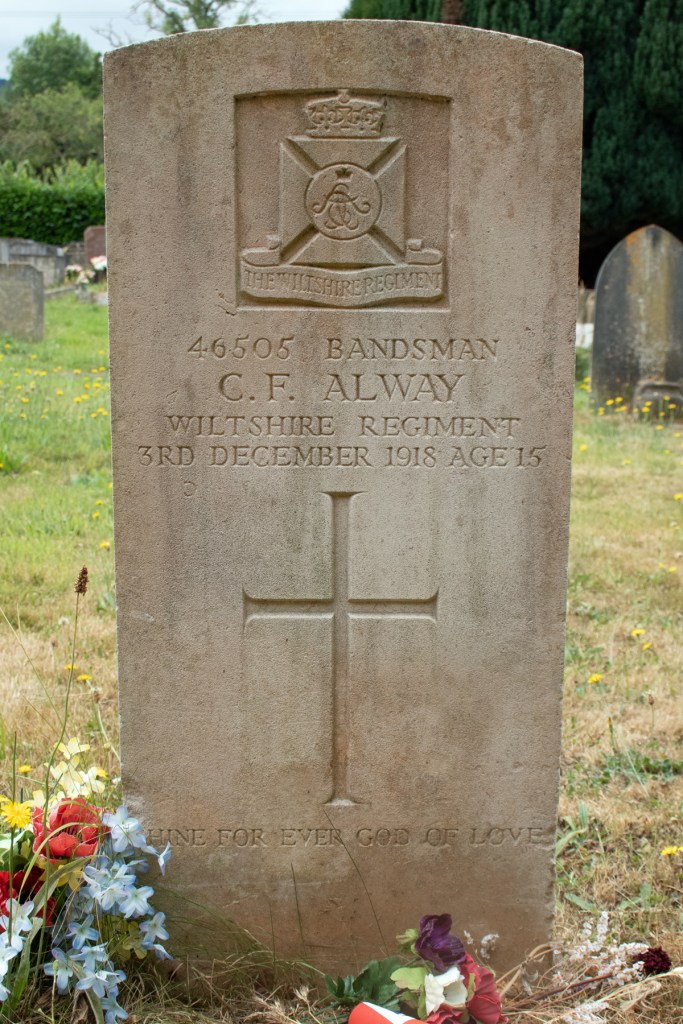
Clifford Frederick Alway was born on 2nd February 1903 in Wellington, Somerset. He was the fifth of fourteen children to Samuel and Ann Alway. Samuel was a farm labourer and butcher and, when war broke out, he stepped up to play his part, enlisting as a Driver in the Royal Field Artillery.
Clifford also seemed keen to be involved, and it can only be assumed that one or both of his older brothers – William (born 1898) and Wyndham (born 1901) – had joined up. By the summer of 1918, Clifford enlisted in the Wiltshire Regiment. It seems likely, given that he was only fifteen years old, that he had lied about his age, as so many young men did.
He joined the 3rd (Reserve) Battalion of the Wiltshire Regiment as a Bandsman. This was a territorial force, and Clifford was posted to Kent, as part of the Thames and Medway Garrison.
It was here, where it was billeted in crowded barracks, that Bandsman Alway contracted influenza and pneumonia. Admitted to hospital in Aylesford, the conditions proved too much for his system, and he passed away on 3rd December 1918. Tragically, Clifford was just 15 years of age.
Clifford Frederick Alway was brought back to Somerset for burial. He was laid to rest in Wellington Cemetery, not far from where his family still lived.
Samuel survived the war, spending more than three years in France – he was overseas when his son passed away, and so was unable to attend the funeral.
John Charles Connett was born at the end of 1870 in Holway, on the outskirts of Taunton, Somerset. He was one of seven children to Charles and Thursa Connett. Charles was a farm labourer and, in John’s early years, Thursa worked from home as a glover to bring in a little extra money for the growing family.
In 1897, John married a woman called Annie; the couple settled down in a small cottage near the centre of Wellington, Somerset. John found work as a coachman, and the couple went on to have one child, a daughter called Ethel, in 1900.
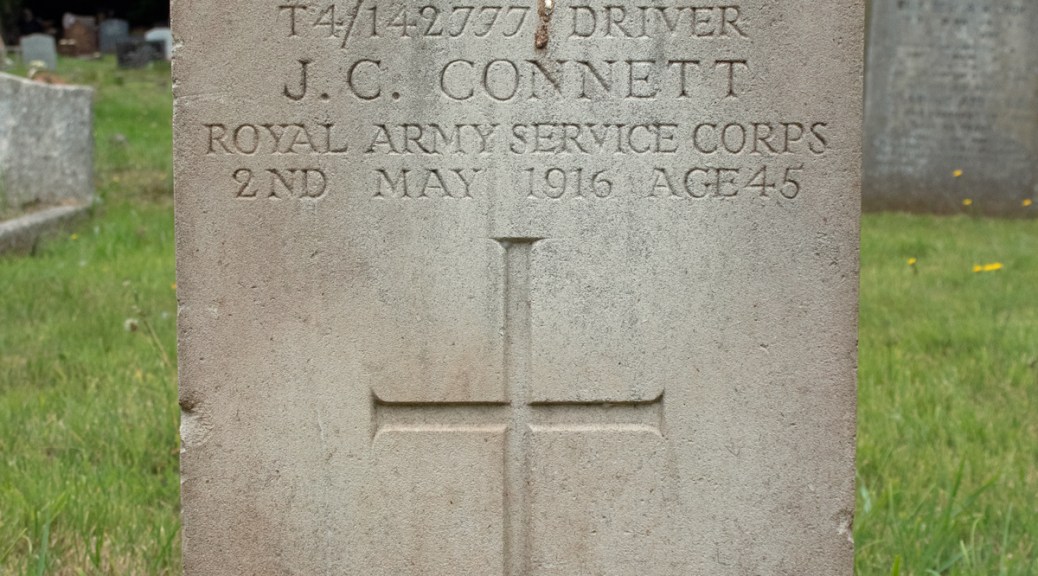
When war came to Europe, John was keen to play his part, even though he had turned 43 by the time hostilities were declared. He enlisted, joining the Royal Army Service Corps by November 1915, and was assigned to the 663rd Company.
Driver Connett’s time in the army was to be tragically short, however. He is recorded as passing away at home on 2nd May 1916, having contracted bronchitis and pneumonia while on active service. He was 45 years old.
John Charles Connett was laid to rest in Wellington Cemetery, within walking distance of where his widow and daughter still lived.
Details of John George Spry’s life remain tantalisingly out of reach. He was born in around 1874 in the Devon village of Woolfardisworthy, and was one of eight children to John and Ann Spry. John Sr was a general labourer who died in 1891. By this point the family were living at 14 Honestone Lane, Bideford, and John Jr was working as a stone mason.
John married Emily Langford. She was a blacksmith’s daughter from Taunton, Somerset, but the couple set up home in nearby Wellington, before moving to Twerton, Bath. The went on to have three children: Ivy, Ruby and Frederick. Interestingly, Ivy seems to have been taken in by Emily’s mother, Emma, while Ruby and Frederick remained with their parents.
The 1911 census found Emily, Ruby and Frederick living with John’s mother in Bideford. Ivy was in Wellington with Emma, but John is missing from the records.
When war broke out, John joined up. He enlisted in the Royal Engineers, and was assigned the rank of Sapper. Dates for his service – and where that service was carried out – are lost to time, but by the autumn of 1918, John was based in barracks in Fovant, Wiltshire.
By this time, Sapper Spry had fallen ill. Suffering from influenza and bronchial pneumonia, he was to succumb to the lung diseases, as so many other returning servicemen did. John passed away on 28th November 1918, aged 45 years of age.
John George Spry was brought back to Somerset for burial. He was laid to rest in Wellington Cemetery, not far from where his widow had relocated.
What became of the Spry family after John’s death is unclear. Emily cannot be tracked down in the 1921 census, nor can her middle child, Ruby.
Ivy was boarding at 55 Harrow Road, Paddington, Middlesex, where she was working as a Lieutenant in the Salvation Army. Frederick, meanwhile, had found work as a steersman on a steamroller, and, according to the census, was living with his maternal uncle, Charles, in Bideford.
The 1939 Register picks up Emily once more, living in a small end-of-terrace cottage on the outskirts of Wellington. Now 70 years of age, she was noted as being incapacitated, no doubt being tended to by Ruby, who was also living there, employed as a puttee machinist.
Thomas Salter – better known as Tom – was born on 5th June 1877, in the Devon village of Uffculme. He was the only child to John and Selina Salter. John was seventeen years older than his wife and, by the time his son was born, was 57 years old. Selina had been married before and widowed, and had had five children of her own.
When he left school, Tom found work as a butcher’s assistant at the Uffculme’s Commercial Hotel (now the Ostler Inn on Commercial Road). Food was not destined to be his career, however. By the time of the 1901 census, he had moved from Devon to Gloucestershire, and found employment as a labourer in the engine works at Knowle, Bristol.
His landlady was an Elizabeth Bobbett, who had been born in Trull, near Taunton, and this connection may have pre-destined what was to come. In the spring of 1908, Tom married Florence Taylor, a labourer’s daughter from Wellington, Somerset, five miles (8km) from his landlady’s home village.
Tom and Florence settled in Wellington, close to the centre of the town. They had four children – Harold (born in 1909), Evelyn (1912), Irene (1914) and Edna (1916). Tom found work as a packer at the Fox Bros. woollen mill in nearby Tonedale.
War was coming to Europe by this point and, in January 1917, Tom enlisted. Private Salter joined the 11th Battalion of the Somerset Light Infantry: this was a territorial troop, and Tom found himself based in Yeovil.
There is little concrete information about Private Salter’s military life. All that can be confirmed is that within a couple of months of joining up, he had been admitted to hospital, suffering from bronchial pneumonia. Sadly, he was not to recover from the lung condition: he passed away on 10th May 1917, at the age of 37 years old.
Tom Salter was brought back to Wellington for burial. He was laid to rest in the town’s cemetery.
Sadly, much of John Harris’ life is lost to time. Born in Liverpool in around 1896, he was one of at least eight children, but, with a name as common as his, there is little to identify who his parents were.
What information remains available, comes from contemporary newspaper reports of his funeral:
Acting Bombardier Harris, of the 13th Battery, 2/3rd West Lancashire, died from double pneumonia at The Mount Hospital [in Faversham, Kent] last Saturday. He was 20 years of age, belonged to Liverpool, and had been in the Brigade about ten months. Deceased had been ill for about a fortnight. Several of the men at The Mount attended the funeral, and one of the nurses there accompanied the deceased’s sister.
Faversham News: Saturday 25th March 1916
From this it is possible to determine that John enlisted in the 2nd/3rd West Lancashire Artillery of the Royal Field Artillery in May 1915. His was a territorial force that was, by the spring of 1916, based in Kent.
It would seem that Acting Bombardier Harris’ parents had passed on by the time that he died at The Mount. His siblings – brothers Alfred and Edward, sisters Edith, Clara, Louise, Alice, Kate and Elizabeth – were all based in Lancashire.
John Harris, therefore, was buried in the town where he passed away, and was laid to rest in Faversham Borough Cemetery.
Christian Belsey was born on 12th February 1884 in the village of Preston, Kent. He was one of fourteen children to Joseph and Jane Belsey. Joseph was a farm labourer, and Christian followed suit on leaving school.
He wanted bigger and better things, however, and after his older brother Charles had sought out a life in the Royal Navy, he followed suit. Christian enlisted on 28th June 1904; his service records show that he was 6ft (1.83m) tall, had brown hair, brown eyes and a fresh complexion.
Stoker 2nd Class Belsey was based out of HMS Pembroke, the Royal aval Dockyard in Chatham, Kent, and this is where he returned to in between voyages. His first posting was on board the destroyer HMS Acheron, on board which he spent six months.
Over the twelve years of his initial service he was assigned to six different ships, rising through the ranks to Stoker 1st Class (in 1906), Leading Stoker (1911) and Stoker Petty Officer (1912).
When war broke out in August 1914, Christian was back in Chatham; he was soon assigned to HMS Laertes, a destroyer based out of Harwich, which patrolled the North Sea. She was involved in the attempt to head off the German attack on Yarmouth and Lowestoft in April 1916, during which, two of Christian’s colleagues, Stoker Ernest Clarke and Stoker Petty Officer Stephen Pritchard, were awarded the Distinguished Service Medal for their bravery under fire.
After three years on board Laertes, Christian was transferred to HMS Redgauntlet. He served on board for eighteen months until, in October 1918, he fell ill.
Admitted to a hospital in Samford, near Ipswich, Suffolk, Stoker Petty Officer Belsey was suffering from pneumonia. Sadly, the lung condition was to get the better of him, and he passed away on 25th October 1918, at the age of 34 years old,
Christian Belsey was brought back to Kent for burial. He was laid to rest in Faversham Borough Cemetery.
William John Owen was born in the spring of 1900, and was one of thirteen children to Henry and Emma Owen. Henry was an oyster dredger turned coal porter from Faversham in Kent, and this is where the family were born and raised.
There is little concrete information about William’s life, but it is clear that, by April 1918, he had joined the Royal Garrison Artillery, and was assigned to the 2/1st Kent Heavy Battery. Signaller Owen was sent to Larkhill Camp in Wiltshire for training.
The only further information is that William was admitted to the Fargo Military Hospital on Salisbury Plain, suffering from pneumonia. Sadly the lung condition was to get the better of him: he passed away on 11nd October 1918, aged just 18 years old.
William John Owen was brought back to Kent for burial. He was laid to rest in Faversham Borough Cemetery, just a few minutes’ walk from his family home.