Tag Archives: Private

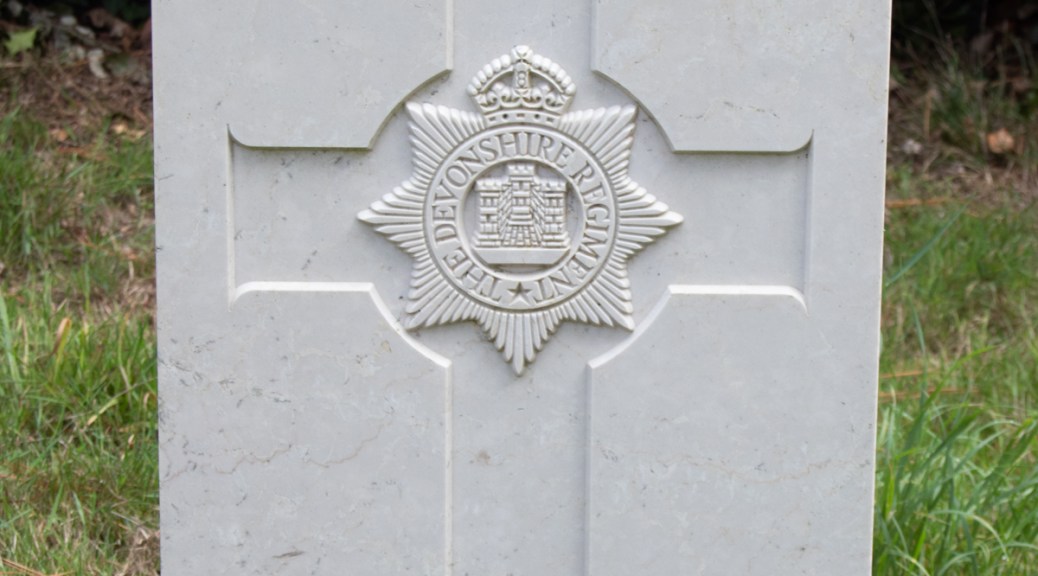
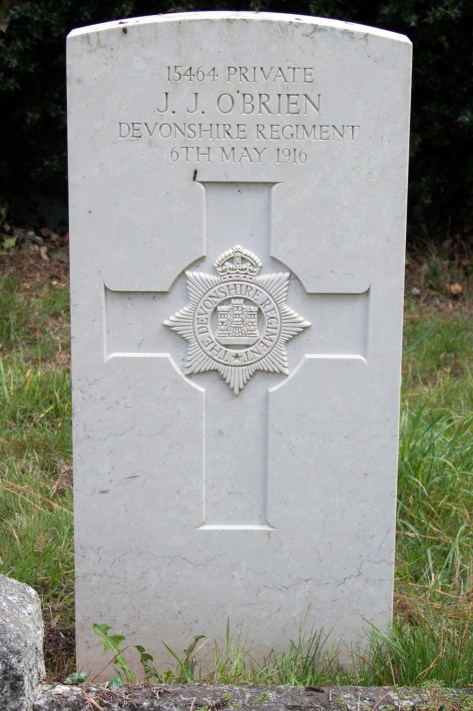
Private Jeremiah O’Brien

Private Jeremiah O’Brien

Jeremiah Joseph O’Brien was born in Paignton, Devon, in 1888. The fifth of seven children, his parents were James and Susan O’Brien. James was a general labourer, and his son followed suit when he completed his schooling.

The is little more information available about Jeremiah’s early life, and it is only in the papers for his military service that we pick him up again. These confirm that he was working as a labourer when he volunteered for the Devonshire Regiment on 20th January 1915.

The documents confirm that Jeremiah was living at 4 Well Street, Paignton, when he joined up, and that he was just over 5ft 5ins (1.65m) tall. Assigned to the 3rd (Reserve) Battalion, he remained on home soil, his unit being used to defend Plymouth, Devon.

Private O’Brien’s time in the army was not to be a lengthy one. He came down with haemoptysis, a condition he had initially suffered from in childhood. He was declared unfit for military service, and was discharged from the army on 4th March 1916.

Jeremiah appears to have returned home at this point and succumbed to the lung condition on 6th May 1916. He was 29 years of age.

Jeremiah Joseph O’Brien was laid to rest in Paignton Cemetery, overlooking his home town and the sea.


Private Michael O’Hara

Private Michael O’Hara

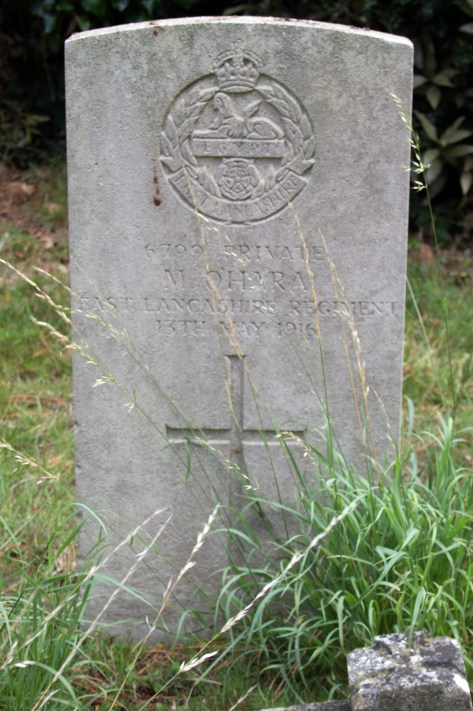
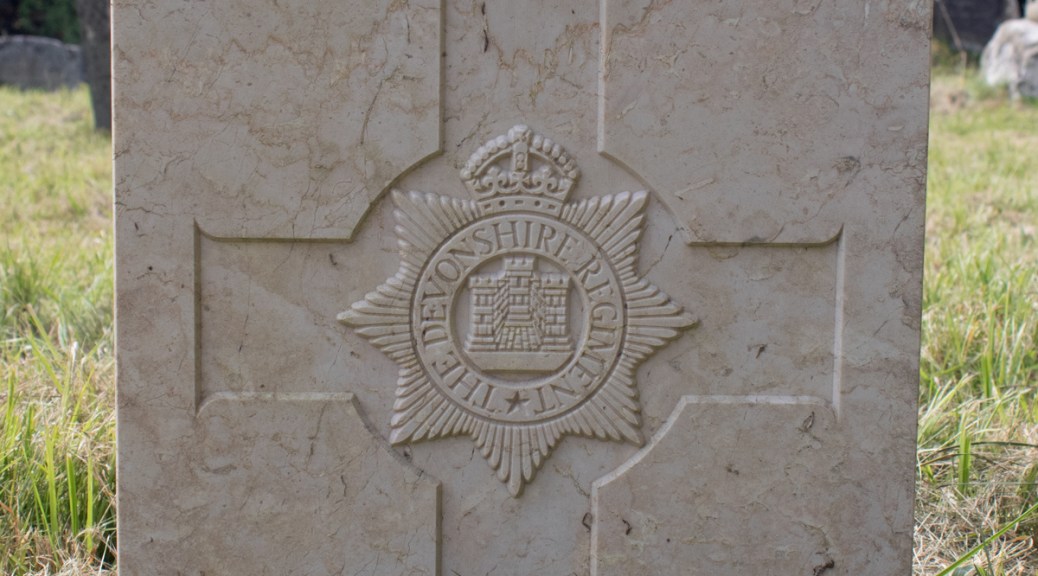
In Paignton Cemetery, Devon, is a headstone dedicated to Private Michael O’Hara of the East Lancashire Regiment. There is little concrete information available about Michael, and a lot of what exists is contradictory.

The British Army Register of Soldiers’ Effects states Private O’Hara was attached to the regiment’s 7th Battalion, and confirms that his next-of-kin was his sister, Margaret Barrus.

An entry in the 1881 census suggests that Michael and Margaret’s parents may have been William and Mary O’Hara. The family were living in rooms a 5 Shed Street in Habergham Eaves, Lancashire, and 14-year-old Michael, who had been born in Bacup, was working as a mule spinner in a local cotton mill.

At this point the Michael’s story becomes vague again, and subsequent census returns throw up too many inconsistencies to corroborate a definite path for his life.

When war came to Europe, Michael stepped up to play his part. Again, full service details have been lost, but it is evident that he was sent to France on 17th July 1915. By the following spring Private O’Hara was back on British soil again, and had been admitted to the American Women’s Hospital at Oldway House in Paignton, Devon. The reason he was there is unclear, but it was to prove fatal: Michael passed away on 13th May 1916. Based on the 1881 census, he would have been around 49 years of age.

The body of Michael O’Hara was laid to rest in Paignton Cemetery, much of his life story buried there with him.


Serjeant Samuel Dymond

Serjeant Samuel Dymond

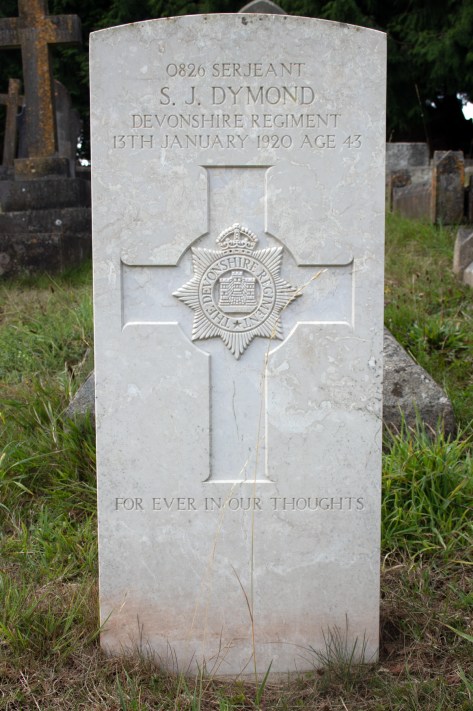
Samuel John Dymond was born in Broadhempston, Devon, in 1878. The son of Samuel and Jane Dymond, his childhood appears to have been disjointed: the 1881 census found him living with his uncle and aunt, while a decade later he was under his grandmother’s roof.

This background may have driven him to a more stable life and, on 22nd May 1896, he enlisted in the army. Joining the Devonshire Regiment, his service records show that he was 5ft 5.5ins (1.66m) tall and weighed 126lbs (57.2kg). He had fair hair, grey eyes, a fresh complexion and two scars on his right kneecap.

Private Dymond spent the first couple of years on home soil. In February 1898, however, he journeyed overseas, serving in the East Indies and South Africa, for which he was awarded the South Africa Medal, with a clasp for the defence of Ladysmith. By January 1902, Samuel was on the move again, and he spent the next two years in India.

At the beginning of 1904, Samuel returned to Britain. He remained on home soil until his contract came to an end on 21st May 1912.

Away from the army life, love beckoned. Samuel married Alice Reynolds on 9th October 1904 in the parish church at Marldon, Devon. The couple went on to have three children: Dorothy, Annie and Albert.

By the time of the 1911 census, Samuel was working as a labourer, and the family were living at Vine Cottage on Church Street, Paignton, Devon.

When war broke out, Samuel was called into service once more but, frustratingly, it is at this point that his trail goes cold. Returning to the Devonshire Regiment, he was certainly in France by 11th December 1914. Later on in the war he transferred across to the regimental depot, but whether this was on home soil of overseas is unclear.

The next record for Samuel is that of his passing. He died in a military hospital in Devonport on 13th January 1920, the British Record of Soldiers’ Effects only at that point confirming that he had reached the rank of Serjeant. He was 42 years of age.

Samuel John Diamond was laid to rest in Paignton Cemetery, overlooking the town that had become his home.


Private Thomas Legg

Private Thomas Legg

Thomas John Gladstone Legg was born in Dunster, Somerset, on 30th July 1898. The fourth of six children, his parents were John and Louisa Legg. John was a baker, and the family lived on West Street in the village.

By 1911, the Leggs had moved south, settling in Winsford, on the outskirts of Exmoor. Thomas was still in school, but his two older brothers were helping their father with the bakery business, and they had taken in a boarder – road worker John Jeffrey – to help bring in a bit of additional income.

When war broke out, Thomas stepped up to play his part. There is little information available about his military service, but it is clear that he had enlisted in the Devonshire Regiment by the spring of 1918.

Private Legg was assigned to the 15th Battalion, although he soon transferred to the 474th Agricultural Company of the Labour Corps.

The profound sympathy of parishioners goes out to Mr and Mrs J Legg… who have sustained a double bereavement. On October 22nd their daughter, Miss Ivy Marion Legg, aged 23, succumbed to pneumonia. Their son, Pte J Legg, came home from training to attend his sister’s funeral, and he was attacked by pneumonia and died in a few days. Amid general tokens of respect and sympathy, the interments were made in Highbray Churchyard. Both father and mother have been seriously ill, but are now recovering. There are still several critical cases of complications following influenza in the parish.

[North Devon Journal: Thursday 14th November 1918]

Thomas passed away on 2nd November 1918: he was 20 years of age. He was laid to rest alongside his sister in All Saints’ Churchyard, High Bray.


Private Willie Howells

Private Willie Howells

In the peaceful Congregational Chapelyard of Berea, St Davids, Pembrokeshire, is a headstone dedicated to Willie Howells, grandson of Benjamin and Mary. The inscription – in Welsh – confirms that he died on 26th November 1918, at the age of 23.

The 1901 census records the couple living at Rhos y Gorse with four of their eleven children and two of their grandchildren, including William. There is no documentation to confirm which of their children was his parent.

Tragically, Willie’s military records are also lost to time. The Commonwealth War Graves Commission give his name as Private BW Howells. They suggest that his first regiment was the South Wales Borderers, and that he transferred to the Northern Command Labour Centre of the Labour Corps. His service numbers for both units draw a blank, however.

The life of Willie Howells is destined to remain a mystery, one of the many whose stories were buried with them.


Private William Hasley

Private William Hasley

William George Hasley was born on 14th June 1897. He was the oldest of three children to William and Sarah Hasley. William Sr, a former soldier, worked as a commissionaire, and the family lived at 11 Coach & Horses Yard, St James, Westminster.

Things had changed by 1900, and William Sr was employed as an engineer’s labourer. The family had moved to Dorset, setting up home in the village of Bourton, and their daughter, Susan, was born there at the turn of the century. Susan Sr came from just up the road in Zeals, Wiltshire, and it is likely that she was staying there when her youngest child, Sidney, was born in 1902.

By the time of the 1911 census, the family of five were living at Beach Cottage, Bourton. William Sr was drawing his army pension, but still employed at the engineering foundry; his eldest son, while still at school, was also listed as a news boy, possibly selling the periodicals to villagers.

War came to Europe in the summer of 1914, and William Jr was quick to step up and play his part. Giving up his job as an engineer’s fitter, enlisted on 1st September 1914, and joined the Somerset Light Infantry. His service records show that he stood 5ft 8.5ins (1.74m) tall, and weighed 124lbs (56.3kg). Private Hasley was noted as having brown hair, brown eyes and a sallow complexion. He also had a scar on the tip of the middle finger of his left hand.

Assigned to the 3rd (Reserve) Battalion, Private Hasley’s unit moved to Devonport, Devon, at the start of 1915. It was here that he contracted tuberculosis, which would ultimately lead to his medical discharge from the army in July. He served just 308 days.

At this point, William’s trail goes cold. It is likely that he returned to Bourton, although he had regular check-ups by the army inspection board. He was deemed totally incapacitated by the illness on 3rd January 1917.

William George Hasley’s lung condition would seal his fate. He passed away on 23rd March 1917: he was just 19 years of age. He was laid to rest in Bourton Cemetery.


Private Samuel Harris

Private Samuel Harris

Samuel John Harris was born in the spring of 1895, and was the oldest of three children to Samuel and Annie Harris. Samuel Sr was a cabinet maker from South Molton, Devon, and this was the village in which he and Annie raised their family.

The 1901 census found the Harrises taking rooms at 24 North Street, a house they shared with two other families. Move forward, and they were living four doors down the road at No. 28, a smaller cottage, but one they had to themselves.

Samuel Jr, at this point, was sixteen years old, but had completed his schooling and was working as a hotel waiter. His younger brother, Albert, had also started work, and was employed as an apprentice coach builder. Samuel Sr, meanwhile, was continuing with his cabinet making.

When war broke out, Samuel Jr was one of the first to enlist. While full details of his time in the army have been lost, it is clear that he joined the Devonshire Regiment, and he was initially attached to the 1st/6th Battalion.

Pte. SJ Harris proceeded to India and Mesopotamia with the Territorials. The hardships of campaigning and the trying climate in Mesopotamia proved too much for his constitution.

[Western Times: Friday 9th November 1917]

Samuel returned to Britain, and was admitted to the military hospital in Sutton Veny, Wiltshire. He passed away on 29th October 1917, from a combination of tuberculosis and a cyst in his back. He was 22 years of age.

Despite the apparent weakness in his constitution, the Western Times reported on his youth in South Molton:

The young man was very popular among his comrades in arms, and at Sutton Veny a general favourite. Prior to th war he was a familiar figure at football matches, having played for various teams at [South Molton] and in the district.

[Western Times: Friday 9th November 1917]

The body of Samuel John Harris was brought back to Devon for burial. He was laid to rest in the South Molton Cemetery, just a sort walk from his grieving family’s home.


Private George Whiteway

Private George Whiteway

George William John Whiteway was born in Paignton, Devon, on 4th February 1893. The youngest of three children, and the only son, his parents were William and Sarah Whiteway.

William was a journeyman painter, and from at least when his son was born, the family lived in a small terraced house, 9 Tower Road, on the outskirts of the town centre.

By the time of the 1911 census, George had completed his schooling, and was working as an apprentice painter. It is unclear whether this was under his father’s tutelage, as he gave his employment as verger and caretaker of the local parish church.

When war broke out, George stepped up to play his part. He enlisted in Torquay on 1st December 1915, and his service records note that he was of good physical development, stood 5ft 6.25ins (1.68m), and weighed 126lbs (57.2kg). He was also recorded as having light brown hair, brown eyes and a fair complexion.

Initially assigned to the Duke of Cornwall’s Light Infantry, Private Whiteway was transferred to the London Regiment and attached to the 3rd/21st Battalion. By the summer of 1916 George had transferred to the 1st/21st (County of London) Battalion, also known as the First Surrey Rifles. On 15th June his unit was sent to France, and he soon found himself in fighting on the Somme.

Private Whiteway’s time in France was to be a brief one. Caught up in the Battle of Flers-Courcelette, he was wounded in the back and neck, and, after initial treatment on site, he was medically evacuated to Britain.

It is unclear where George was first admitted, but by February 1917, he was being tended to in the Voluntary Aid Detachment Hospital in his home town, Paignton. He remained there for a couple of month, before being released back to duty.

Private Whiteway’s time fighting was over. He was transferred to the 619th Home Service Employment Company of the Labour Corps, and would spend the next year in and around Winchester, Hampshire. It is evident, however, that George’s health had been impacted. By March 1918 he was in hospital again, this time close to his army base. Suffering from a combination of peritonitis and tuberculosis, the contagious nature of the latter condition would lead to his dismissal from military service, and he was formally stood down on 29th April 1918.

At this point, George’s trail goes cold. It seems likely that he returned home, as his death was recorded in Totnes, Devon. He breathed his last on 25th August 1918: he was 25 years of age.

George William John Whiteway was laid to rest in Paignton Cemetery, a short walk from his family home.


Private Alfred Ribbans

Private Alfred Ribbans

Alfred Ribbans was born in Belvedere, Kent, in the summer of 1889. The sixth of nine children, his parents were Arthur and Sarah Ribbans. William was an iron turner from Ipswich, Suffolk, while his wife had been born in Jersey, Channel Islands. It is unclear how the couple met, but by the 1891 census the family were at No. 8 Coastguard Cottages in Erith.

When he finished his schooling, Alfred followed in his father’s stead, finding employment as a fitter and turner. By the autumn of 1908, he found an opportunity to turn this work into a career, and enlisted in the Royal Army Ordnance Corps. His service records show that, at 19 years of age, he was 5ft 7ins (1.71m) tall, and weighed 132lbs (59.9kg). He had a fair complexion with brown hair and brown eyes. He was also noted as having a scar on his left eyebrow, another on the right side of his upper lip, and two noticeable moles: one on the left side of his navel and the other on the right side of his neck.

Private Ribbans’ initial term of service was for three years. He served on home soil, and when his contract came to an end on 27th October 1911, he was stood down to reserve status. When war broke out he was mobilised again, and by 14th August 1914, he found himself in France. It is unclear exactly where he served, but his time overseas was not to be a lengthy one.

By April 1915 Alfred was back on home soil, suffering from tuberculosis. The contagious nature of the condition meant he was no longer suited to the crowded barracks and billets of the Western Front, and so Private Ribbans was medically discharged from the army.

Alfred returned home to Kent, and, when he recovered, to his job as a fitter. On 3rd July 1916 he married dressmaker Armenia Tuckerman in the parish church in Erith. At the time, the couple were living at 9 Stanmore Road, but soon moved to Totnes in Devon, presumably to help with Alfred’s now-failing health.

The following January, Armenia gave birth to a daughter, Armenia Joy, but the young family’s happiness was to be short-lived: Alfred succumbed to his lung condition on 20th March 1917. He was 27 years of age.

Alfred Ribbans was laid to rest in Paignton Cemetery, Devon.


Private Alfred Ribbans
(from ancestry.co.uk)

Private Alfred Darch

Private Alfred Darch

Alfred James Darch was born early in 1884, the second of seven children to James and Emily Darch. James was a postman and labourer from Somerset, but the family were brought up in Devon village of Clayhidon.

By the time of the 1901 census, the family had moved over the border to Wellington. Alfred had completed his schooling, and was working as a showmaker’s assistant. He committed himself to the role, and by 1911 was a shoemaker in his own right. By this point he was one of two of the Darch children to still be living with his parents: the family were settled at 22 Eight Acres Lane in Wellington.

When war broke out, Alfred stepped up to play his part. On 19th October 1916 he enlisted, joining the Army Medical Corps. His service records show that he was 5ft 4ins (1.63m) tall. They also suggested that his right leg was slightly shorter than his left, following an old dislocation. Private Darch had also had an operation for appendicitis five years previously.

Alfred was sent to Codford, Wiltshire, where the No. 3 New Zealand General Hospital was located. His time there was to be tragically short, however. On 17th November he was admitted himself, suffering with some breathing complications. The medical report noted that he was “vaccinated a fortnight ago. Bad, sore, inflamed arm. Reported sick eight days later with general malaise, slightly sore throat, slight headache – some cough. He had one anti-typhoid inoculation 2 or 3 days before vaccination… Has had no [previous] chest trouble… Face flushed. Temp 104.8. Pulse 100. Tongue white in centre, red at sides. Breath extremely foul. Voice hoarse. Breathing quiet. Not distressed.”

Over the nest week, Private Darch’s health deteriorated. Pleurisy was suggested, but when he passed away, at 5:45am on 24th November 1916, the diagnosis was pneumonia. He was 32 years of age.

Alfred James Darch was laid to rest in the extension to St Marys Church, Codford, not far from the base to which he had been sent just weeks before.