Tag Archives: Royal Fusiliers

Lieutenant Alexander Spurway

Lieutenant Alexander Spurway

Alexander Popham Spurway was born on 8th April 1891 in Newbury, Berkshire. He was the second of six children to Edward and Gertrude Spurway. Edward was a clergyman, and the family moved to Heathfield in Somerset when Alexander was a small boy. Education was key to Edward and, the 1901 census records show Alexander as being a boarder at the Portmore School in Weymouth, Dorset.

Reverend Spurway set the family up well in Heathfield: by the time of the next census in 1911, the family were living in the village rectory, with five members of staff.

Alexander, meanwhile, had taken a different route, entering the Royal Naval College at Osborne on the Isle of Wight in January 1904. He was a keen sportsman and, while there, he represented the college at both cricket and football.

In September 1908, he passed out from the college as a Midshipman, and served on HMS Canopus in the Mediterranean. His career continued, and he was made Sub-Lieutenant in December 1911, and Lieutenant two years later.

Reverend Spurway died at home in February 1914 and, by the time war broke out, Lieutenant Spurway was assigned to HMS Achilles. He remained on board the cruiser for the next two years and it was during this time that he developed diabetes: something that was to prove an ongoing issue for him.

Returning home in the autumn of 1915, the condition was to prove too much, and he passed away on 29th November 1915, at the age of 24 years old.

Alexander Popham Spurway was laid to rest in the graveyard of his late father’s church, St John the Baptist in Heathfield.


Lieutenant Spurway (from findagrave.com)

Sadly, Alexander was not the only member of the Spurway family to lose their life as a result of the war.

Richard Popham Spurway, Alexander’s older brother, was a 2nd Lieutenant in the Somerset Light Infantry, and was attached to the Hampshire Regiment, when it was moved to Gallipoli in 1915. He was killed on 13th August 1915, and is commemorated on the Helles Memorial at Canakkale, Turkey.

Alexander’s younger brother, George Vyvyan Spurway, joined the Royal Fusiliers, before transferring to the Machine Gun Corps. He had arrived in France in September 1916, and was killed while fighting on the Western Front on 28th March 1918. He was laid to rest at Arras and is commemorated on the memorial there.


Private Frederick Harris

Private Frederick Harris

Frederick Jacob Harris was born in Wadeford, near Chard in Somerset, on 28th August 1887. The fourth of eleven children, his parents were William and Grace Harris. William was an agricultural labourer and carter, but the busy lace and weaving industry in the area is what provided Frederick and his siblings with work when they finished school.

It may have been through his work in the factory that Frederick met Alice Dowell: she was the daughter of a lace hand from Chard. The couple married on 20th October 1906, and settled in a house near the centre of the town. They went on to have four children, two boys and two girls.

War was closing in on Europe by this point, although there is little specific information about Frederick’s service. He initially joined the Somerset Light Infantry, although he soon made the move to the Royal Fusiliers. He received the Victory and British Medals, as did everyone else who served in the Great War, but there is no confirmation of whether he saw action overseas or not.

However and wherever Private Harris served, he survived the conflict, and was demobbed on 25th May 1919. His discharge record suggests that, at the point of being released from duty, he had no injuries or disabilities, and nothing that could be attributed to his time in the army.

Frederick appears to have returned to Chard, and spent the next six months adjusting to civilian life. However, something changed, as, on 10th December 1919, he passed away at home. No cause of death is evident, and nothing in the contemporary local media suggests that he died of anything other than natural causes. Whatever led to his passing, he was taken early, as he was only 32 years of age.

Frederick Jacob Harris was laid to rest in Chard Cemetery.


Private Albert Sparrow

Private Albert Sparrow

Albert Edward Sparrow was born in Frome, Somerset, in March 1880. One of four children, his parents were Albert and Louisa Sparrow. Albert Sr was a labourer at an iron foundry, and the family were raised close to the centre of the town.

When he left school, Albert Jr found work as a labourer. However, after his father passed away in 1895, he sought longer term prospects. On 11th November 1898 he enlisted in the Royal Fusiliers as a Private for a period of twelve years. His service records show that he stood 5ft 6in (1.67m) tall, weighed 115lbs (52.2kg), had brown eyes, curly brown hair and a sallow complexion.

During his time in the army, Private Sparrow served in Gibraltar, South Africa and Burma. He returned home in March 1903, was placed on reserve in November 1906, and then ended his contract four years later.

At this point, Albert’s trail goes cold. However, when war was declared, he was keen to play his part. He re-enlisted on 27th August 1914, and was assigned to the Somerset Light Infantry. Assigned to the 6th (Service) Battalion, he was sent to France in December that year.

In July 1916, while fighting at the Somme, he was hurt when he received a gunshot wound to his right buttock. The injury proved enough for him to be medically evacuated back to England, and he spent the next five months recovering, and then working, on home soil.

In December 1916, Private Sparrow was sent back out to France. Six months later, he contracted bronchitis and was again evacuated back to England. He was admitted to the Royal Infirmary in Liverpool and, after a month there, he was moved to the Plas Tudno Nursing Home in Llandudno to recover.

Albert’s condition meant that he could not continue in military service, and he was discharged from the army on 18th December 1917. He returned home to Somerset, but his lung condition proved too much; he passed away on 19th January 1918, at the age of 37 years old.

Albert Edward Sparrow was laid to rest in the graveyard of Holy Trinity Church in his home town of Frome.


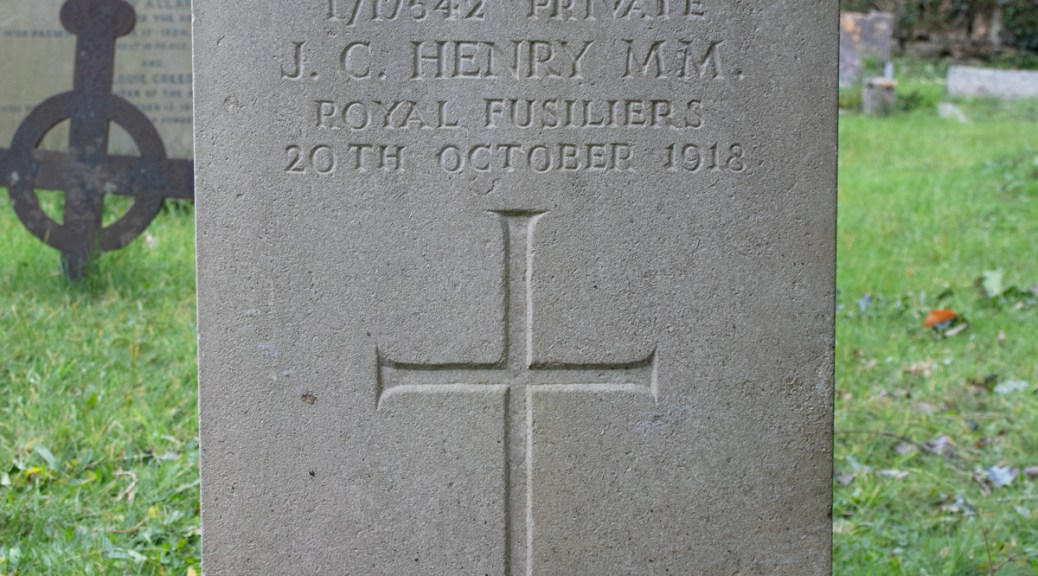
Private Joseph Henry

Private Joseph Henry

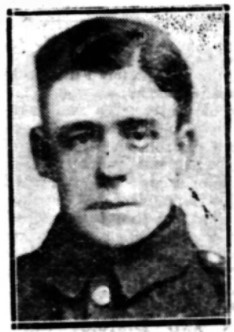
A lot of Joseph Charles Henry’s life is lost to time, and the majority of the information available about him comes from the newspaper report of his funeral.

The funeral with military honours of Private Joseph Charles Henry, Military Medallist, took place at Holy Trinity Church on Saturday afternoon. The case was a very sad one.

Deceased was a gunner in the Royal Field Artillery, and it was there that he won the Military Medal, in June of last year, but had been transferred to the Royal Fusiliers, and posted to the 30th London Regiment.

He was formerly employed as a miner in Lancashire, and married Lucy, daughter of Edward Reddick, of Coleford [Somerset]. In the clear out of the miners for the urgent needs at home he received his discharge on the 20th October, having ten days previously been handed the medal awarded him at the close of last year for bringing in wounded under heavy fire in June. He was very ill when he returned home on Sunday… and became rapidly worse, passing away on Wednesday. He was about 23 years of age.

His wife and two children were also lying seriously ill, and but for the kindness of friends and of the Salvation Army captain, it might have been even more distressing…

There is sad sequel to the death, Mrs Cullen, sister of Mrs Henry, having been bereaved in like manner by the death of her husband within the week.

Somerset Standard: Friday 1st November 1918

There are no documents to specifically connect Joseph to Lancashire, nor to give insight into his family. He died at home, from a combination of acute pneumonia, delirium and heart failure.

Joseph Charles Henry was laid to rest in the graveyard of Holy Trinity Church in Frome, Somerset.


Private Joseph Henry (from britishnewspaperarchive.co.uk)

For Joseph’s widow, Lucy, this was further heartbreak to suffer. The two children mentioned in the article were, in fact, Joseph’s stepchildren; Lucy’s first husband, Charles Futcher, had died at Ypres in January 1916.


Corporal Richard Cadenaci

Corporal Richard Cadenaci

Richard Edward Cadenaci was born in Sutton, Surrey, in around 1886. His father, who was also called Richard Edward Cadenaci, was a house painter and, with his wife Maria, had thirteen or fourteen children, of whom Richard Jr was the middle one.

Documentation on the Cadenaci family is scarce. On 5th April 1896, when Richard Jr was 10, he and three siblings were baptised together.

By the turn of the century, the family were living on Merton High Street, in Wimbledon. Richard Sr and Maria were there with their youngest five children.

Richard Jr seemed keen on a life of adventure – the 1911 census lists him as a Private in the 3rd Battalion of the Royal Fusiliers, and that he was based in Mauritius. His full military service records are not available, but it is likely that his term of service with the army was extended as war loomed.

Private Cadenaci was sent to France in January 1915 and, during his time in the Great War, he received the Victory and British Medals and the 1915 Star. At some point during the conflict he was transferred across to the Labour Corps, though the move came with a promotion to Corporal. Again, there is little further information about his service, but records suggest that he was discharged from the army – possibly through health reasons – on 20th September 1918.

Here, Richard’s trail goes cold. He died on 23rd March 1920, just eighteen months after the end of this military service, at the age of 32. There is no record of the cause of his passing and nothing to connect him to the town in which he was buried, Worthing, West Sussex.

It is possible that Corporal Cadenaci left the army for medical reasons, and his move out of London was for cleaner air, but this is only presumption on my part, and there is nothing to confirm this either way.

Richard Edward Cadenaci lies at rest in the Broadwater Cemetery in Worthing.


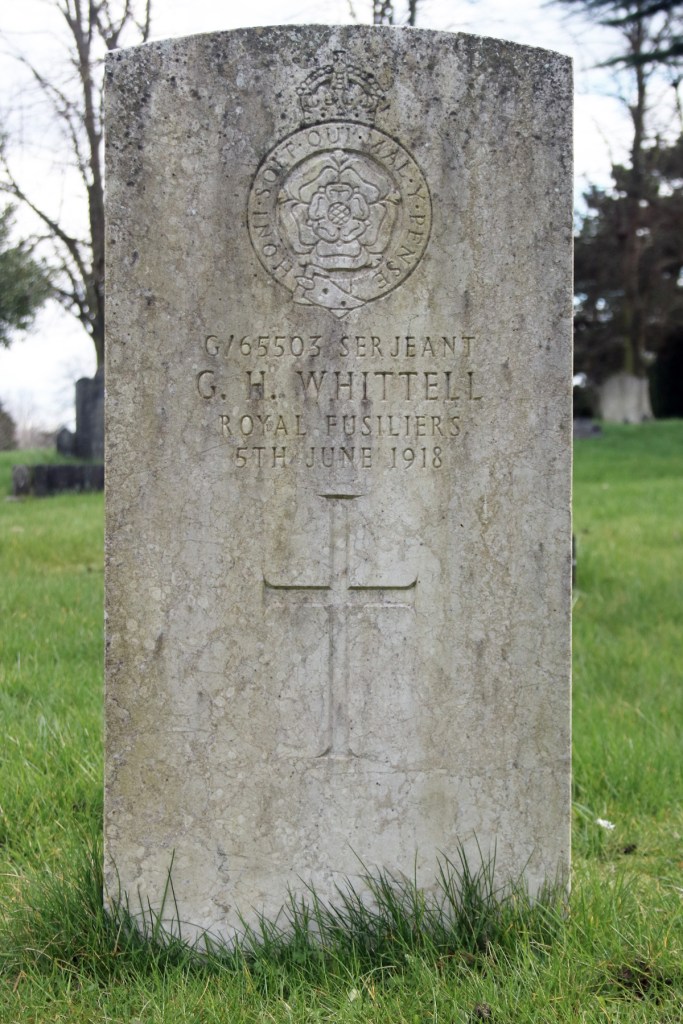
Serjeant George Whittell

Serjeant George Whittell

George Henry Whittell was born in the spring of 1891, the son of engine fitter William and his wife, Florence. George was the oldest of two children, both boys, but sadly lost his mother in 1897, at just six years old.

William remarried two years after her death, and, with his new wife, Frances, he had two further children, Gladys and Leslie.

By the time of the 1911 census, the family were living in Gillingham, Kent, and George and his brother Frederick were both working as boiler makers in the largest employer in the area, the naval dockyard in Chatham. War was on the horizon, and William was also working there as a torpedo fitter.

In 1915, George married Minnie Baker; they went on to have a son, Ronald, who was born in the September of that year.

I have not been able to track down all of George’s military records; he enlisted in the Royal Fusiliers, and was assigned to the 10th (Service) Battalion. While his date of enlistment is not recorded, his troop set off for France at the end of July 1915. If George had been involved from that point, he would have departed shortly after his marriage, and would have been at the Front when his son was born.

Little is known of Serjeant Whittell’s service; he was wounded in May or June 1918, and was repatriated to England for treatment. Admitted to the Western General Hospital in Manchester, he sadly did not recover from his wounds, and passed away on 5th June 1918. He was 27 years old.

George Henry Whittell lies at rest in the Woodlands Cemetery in his home town of Gillingham, Kent.