Francis Thomas Crocker was born on 5th February 1895 to Job and Irene Crocker. One of eleven children, the family were born and raised in the small Newfoundland town of Trout River.
Sadly, there is little documentation about Francis’ life. What is clear, however, is that, when war broke out, he volunteered for the Royal Naval Reserve.
By 1917, Seaman Crocker was based at HMS Pembroke, the Royal Naval Dockyard in Chatham, Kent. The base was overly busy that summer, and Frances was billeted in temporary accommodation in the town’s Drill Hall.
On the 3rd September 1917, the first night air raid carried out by the German Air Force scored a direct hit on the barracks and Drill hall; Seaman Crocker was killed instantly. He was just 21 years old.
Francis Thomas Crocker was laid to rest, along with the other victims of the Chatham Air Raid, in the Woodlands Cemetery, Gillingham, some 2500 miles (4000km) from his Canadian home.
George Wilfred Simpson was born early in 1882, the second of seven children to Robert and Mary Simpson. Robert was a shipbuilder from Yorkshire, and the family were raised in Thornaby, on the River Tees near Middlesbrough.
Details of George’s early life are a bit patchy, but when he left school he found work as a warehouseman. He met Florence Unwin, who was born in Stockton-upon-Tees, and they married in the spring of 1906. They young couple set up home in the town and went on to have four children, all boys.
When the war came to Europe, George wanted to do his part. His full service records are not available, but he enlisted in the Royal Naval Reserve as a Stoker at some point during the conflict. By the summer of 1917, he was based at HMS Pembroke, the Royal Naval Dockyard in Chatham, Kent.
The base was a particularly busy place at that point in the war and additional accommodation was desperately needed. Stoker Simpson found himself billeted at Chatham Drill Hall, away from the main barracks.
On the night of 3rd September 1917, Chatham suddenly found itself in the firing line, as the German Air Force launched a bombing raid. One of the bombs landed squarely on the Drill Hall, and Stoker Simpson was killed. He was just 35 years old.
Ninety-eight servicemen perished during the Chatham Air Raid that night. They were buried in a mass funeral at the Woodlands Cemetery in nearby Gillingham. This, too, is where George Wilfred Simpson was laid to rest.
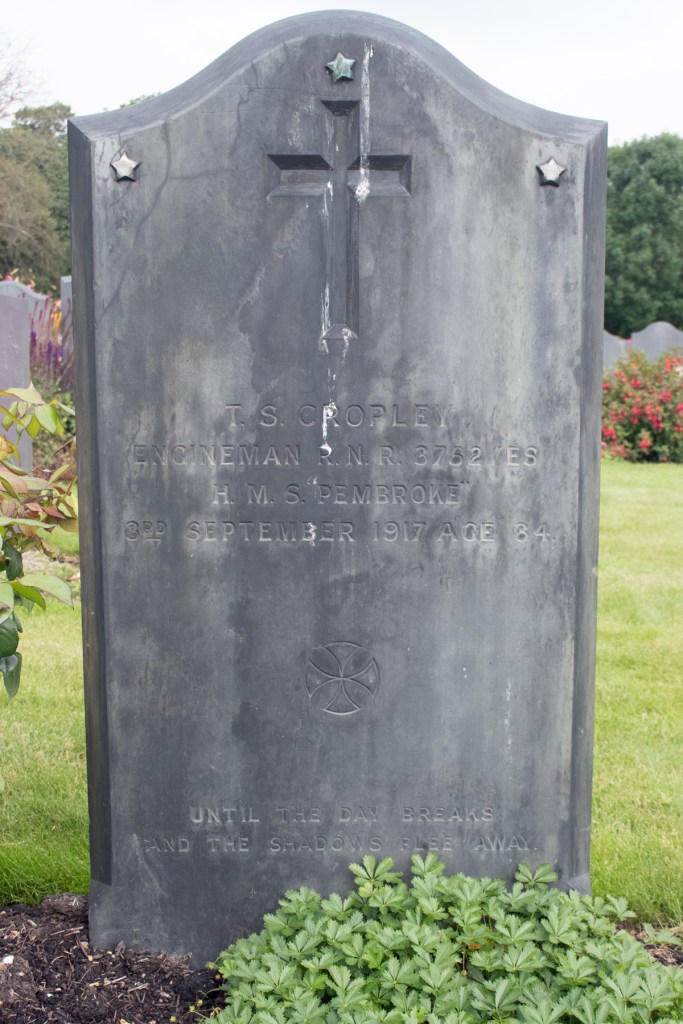
Thomas Samuel Cropley was born on 16th November 1882 in the Suffolk village of Mutford. The fifth of eight children, his parents were Robert and Hannah Cropley. Given Mutford’s proximity to the Hundred River Hundred and the coastal town of Lowestoft, it is little surprise that Thomas’ father was a ropemaker. Hannah was also employed, the 1901 census recording her as a monthly nurse – helping women during the month after childbirth.
Thomas’ location to the coast made fishing an ideal choice of work for him, and when he left school he followed his three older brothers into the trade. Indeed, he listed his trade as a deep sea fisherman on his marriage records.
As a young man, he had met bricklayer’s daughter Edith Tuttle, and they tied the knot on 29th May 1906. The couple set up home in Factory Street, Lowestoft, and went on to have seven children.
Sadly, little information on Thomas’ wartime service remains documented. His knowledge of boats and the sea made the navy an obvious option for him, and he enlisted in the Royal Naval Reserve.
Engineman Cropley was assigned to HMS Pembroke – this Royal Naval Dockyard at Chatham in Kent. While it is likely that he served on ships as well, this is certainly the base to which he returned.
Thomas found himself based here in the summer of 1917, which was a particularly busy place at that point in the war. Additional accommodation was desperately needed and he found himself billeted at Chatham Drill Hall, away from the main barracks.
By 1917, the German Air Force had suffered huge losses during the daylight bombing raids it had been undertaking. It was imperative for them to minimise these losses, and so a new tactic – night time raids – was employed.
The first trial of this approach was on the night of 3rd September 1917, and Chatham suddenly found itself in the firing line, startlingly unready and fundamentally unprotected. One of the German bombers landed a direct hit on the Drill Hall, and Engineman Cropley was killed. He was just 34 years old.
Ninety-eight servicemen perished during the Chatham Air Raid that night. They were buried in a mass funeral at the Woodlands Cemetery in nearby Gillingham. This, too, is where Thomas Samuel Cropley was laid to rest.
The lives of Thomas’ family outlines a lot about living conditions in the late nineteenth and early twentieth centuries, with a large number of his relatives dying young.
His father was 68 when he died in 1916; Hannah had passed away fourteen years before, when she was 56 years old. Of his siblings, two did not survive childhood, one died their 20s, one was aged 40, while three reached their late sixties.
Thomas’ widow died in 1921, at the age of 35; their two youngest children died before their first birthdays. Of the other five, one was 31 when he died, while the others lived much longer – one was in their mid-70s, two in their eighties, and the oldest reached her hundredth birthday. A varied legacy indeed.
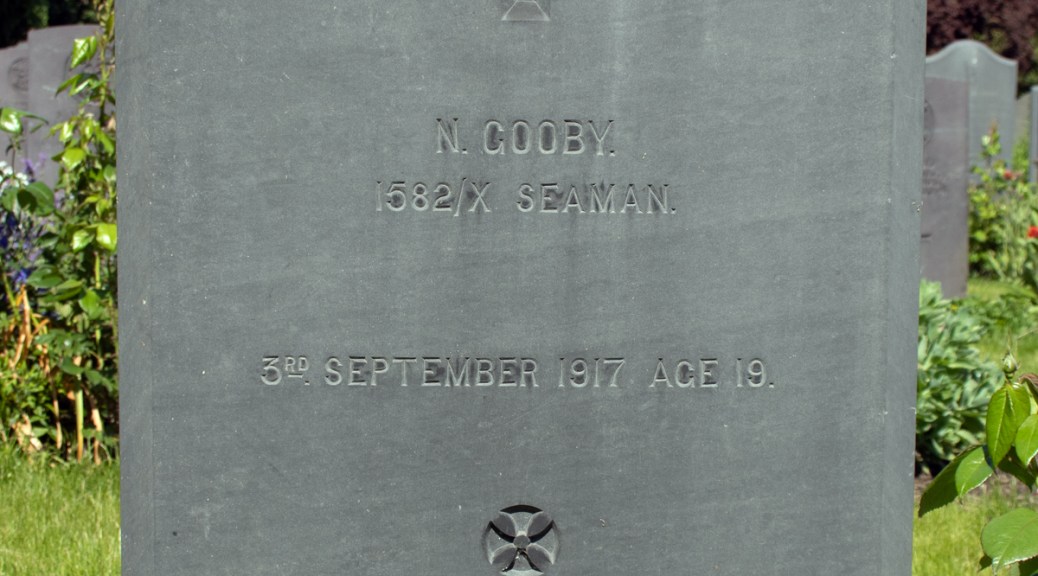
Nathaniel Gooby was born on 28th October 1897, the only son of William Gooby and his third wife, Margaret. Both of William’s previous wives – Tryphena and Amelia – had died before their time, but Nathaniel had six half-siblings, up to forty years older than him.
William was a carpenter, who had been born in England, but had moved to Newfoundland when he was young, and this is where he lived and raised his families.
Sadly, very little documentation remains to evidence Nathaniel’s life. He enlisted as a Seaman in the Royal Naval Reserve, potentially after war was declared (he would have been 16 years old at the outbreak of the conflict). By the summer of 1917 he was based at HMS Pembroke – the Royal Naval Dockyard in Chatham, Kent.
That summer was a busy time for the Dockyard, and temporary accommodation had been set up for the influx of military personnel based there. Seaman Gooby was billeted at Chatham Drill Hall and was sleeping there when the first night air raid was carried out by the German Air Force on 3rd September 1917. The Drill Hall received a direct hit, killing 98 servicemen – Nathaniel included. He was just 19 years of age.
Nathaniel Gooby was laid to rest in the Woodlands Cemetery in nearby Gillingham, along with the other victims of the Chatham Air Raid.
John McNish was born in the Staffordshire city of Wolverhampton on 26th June 1897. The oldest of six children, his parents were railway porter James McNish and his wife Mary Ann.
Sadly there is little documentation to evidence John’s early life. When he left school, he seemed to have joined his father in becoming a porter and, when war broke out, he joined the Royal Navy, given the rank of Ordinary Seaman in the Royal Naval Volunteer Reserve. He was based at HMS Pembroke, the shore-based establishment at Chatham Naval Dockyard in Kent.
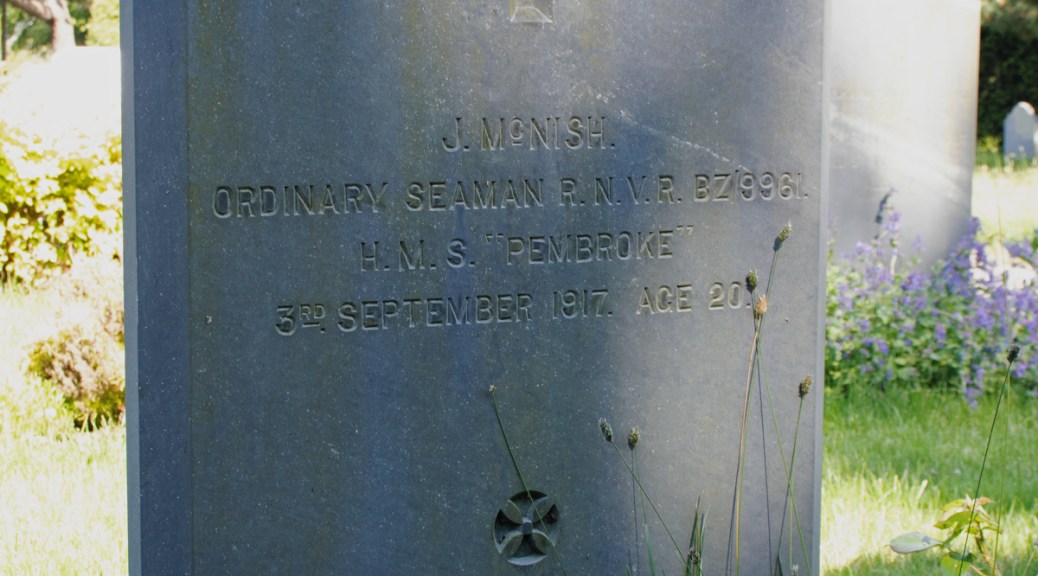
In the summer of 1917 HMS Pembroke was becoming crowded and John was billeted at the Chatham Drill Hall. On the night of 3rd September, the building took a direct hit from a German bomber. Ordinary Seaman McNish, along with 97 others, was killed instantly. He was just 20 years old.
John McNish was buried in the nearby Woodlands Cemetery in Gillingham, along with dozens of others who perished that night.
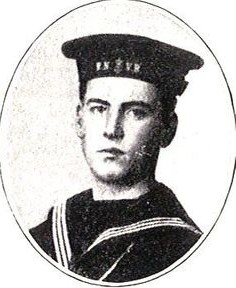
Ordinary Seaman John McNish (from findagrave.com)
Full details of the night raid on Chatham Drill Hall can be found here.
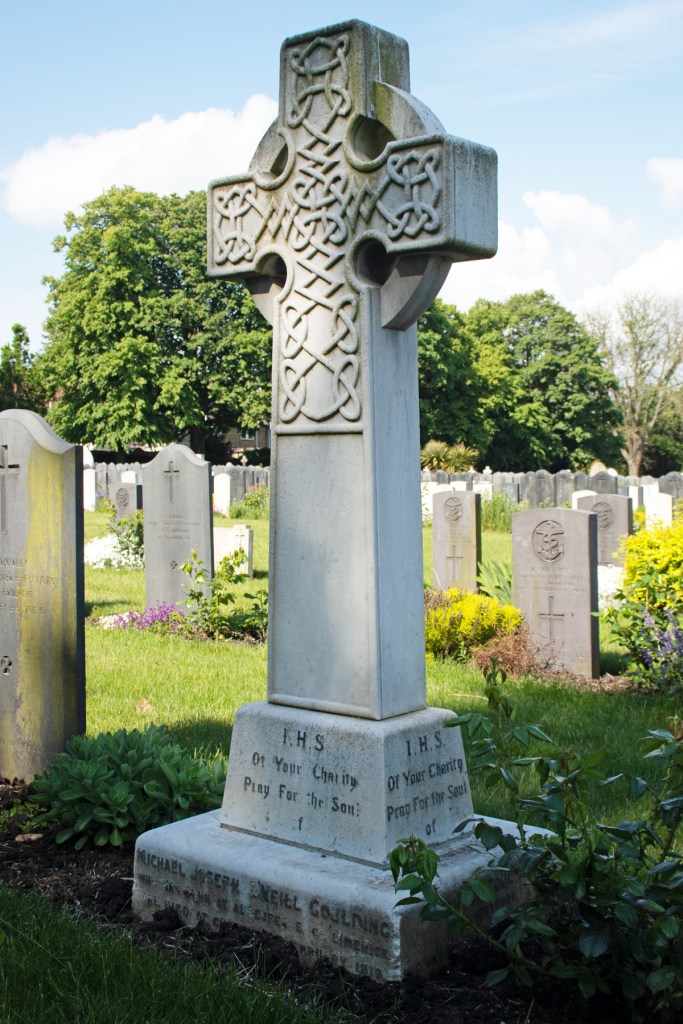
Michael Joseph O’Neill Goulding was born on 5th May 1884, the oldest of six children to Michael and Ellen Goulding (née O’Neill). Michael Sr worked for the inland revenue and his job took him around most parts of the British Isles.
Michael Jr had been born in Limerick – both of his parents came from Ireland – but his subsequent three siblings (Patrick, Margaret and William) had all been born in Scotland. His second youngest sibling, Lily, was born in County Durham, the youngest back in Scotland, while, by the time of the 1901 census, the whole family were living in Forest Gate, East London.
The census also shows that Michael Jr, having left school, was working at Customs House (presumably where his father was employed), as a boy copyist on tea accounts. The inland revenue at that time was a career for life; by the next census in 1911, the family had moved to Hertford, where Michael Sr was a customs and excise supervisor, and Michael Jr was an assistant clerk at the same place of employment.
War was on its way, but Michael seems not to have enlisted immediately. While specific dates for his joining up are not available, it appears that he was still working for the Inland Revenue when he got married in Shoreditch, in April 1917. His wife was called Bridget Mary Gough (known as Bryde), and she had also been born in Ireland. The couple went on to have a daughter, Ellen (or Eileen), the following year.
By this time, Michael had definitely enlisted. He joined the Royal Naval Volunteer Reserve, and was based at HMS Pembroke, the shore-based establishment in Chatham, Kent. This was the location for the Navy’s main accounting base, so it is likely that he was employed for financial, rather than his military, skills.
Able Seaman Goulding served through to the end of the war and beyond, and it was while he was based in Kent that he became unwell. Admitted to the Royal Naval Hospital in Chatham, he succumbed to a combination of bronchitis and pneumonia on 22nd February 1919. He was 34 years of age.
Michael Joseph O’Neill Goulding was laid to rest in the Woodlands Cemetery in nearby Gillingham. His family were still in Hertford, while his widow and daughter moved back to Ireland.
Michael Joseph O’Neill Goulding (courtesy of ancestry.co.uk)
William Alfred Stanley is one of those names that seems destined to be lost to the annuls of time. Little documentation exists for his early life, but what there is gives some hints at a determined young man.
William was born in London to an Annie Stanley, who lived in the Kentish Town area of the city. At some point, he emigrated to Canada as, according to his wartime enlistment papers, he joined up in Ontario.
William enlisted in the Canadian Expeditionary Force on 5th November 1915, and was initially assigned to the 44th Battalion of the Canadian Infantry. His troop embarked for England in July 1916, and, on his arrival he was transferred to the 98th Battalion.
It was at this point that things too an unusual turn. With a few months, Private Stanley was again transferred, this time to the 19th Battalion, and then again to the 4th Reserve Battalion from where he was discharged from the Canadian Infantry in February 1917 for being underage.
At this point, William seems to have been undeterred.
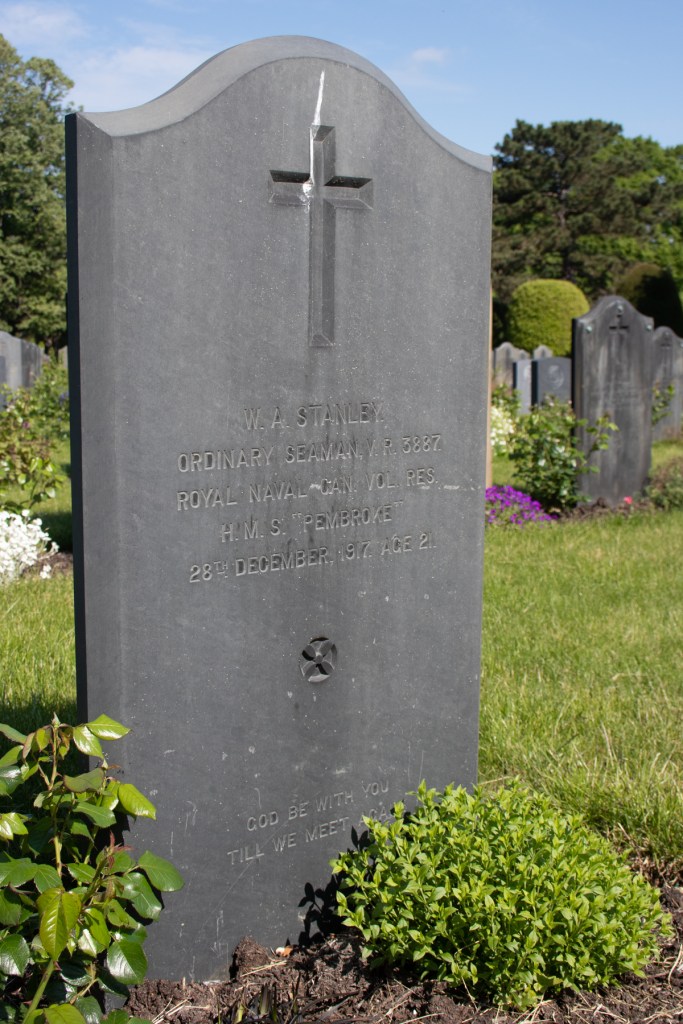
The next record for him – in fact the memorial to him – is his headstone. This confirms that he had enlisted in the Royal Naval Canadian Voluntary Reserve as an Ordinary Seaman. He was based at HMS Pembroke, the shore establishment at Chatham Dockyard, but there is no other information for him.
Ordinary Seaman Stanley died on 28th December 1917, at the age of 21. (His previous military discharge might suggest that he was, in fact, younger than this, but that is conjecture on my part.) There is no record of a cause of death and nothing in contemporary newspapers to suggest anything out of the ordinary.
William Alfred Stanley was laid to rest in the Woodlands Cemetery in Gillingham, Kent, not far from the Naval Dockyard where he had been based.
Cecil Henry Bowyer was born in October 1900, the oldest of four children to Harry and Bessie Bowyer. Harry was a carter and, at the time of the 1901 census, the family lived in a small house in the middle of Bridgwater, with Harry’s sister, Bessie’s mother and an additional boarder.
Bessie was keen to earn her way, becoming a musical instrument dealer, while her husband moved on to work as a foreman for a coal merchant. By this time, the family had moved round the corner from their former home, and Harry and Bessie lived there with Cecil, his younger siblings Leslie, Henry and Doris, and another boarder.
Harry found himself before the Bankruptcy Court in 1913. By this time, he was carrying on business as a gramophone and cycle agent, as well as his carter business. Bad debts and living expenses were his downfall, however, and he found himself with a deficiency of £83 15s 5d. The examination was declared closed, according to the Wells Journal, but no outcome was reported.
War was looming, and the family did their bit. Harry joined up, enlisting in the Royal Engineers as a sapper. He was shipped to Salonica, Greece, where he served for much of the war.
Cecil, however, chose the seafaring route. He had to wait until he came of age before enlisting, however, and so it was late September 1918 before he joined the Royal Naval Voluntary Reserve. He started his training at the training base in Crystal Palace, but was only there for a couple of weeks before he fell ill.
Contracting pneumonia, Ordinary Seaman Bowyer was admitted to hospital, but sadly this took him quickly, and he passed away on 11th October 1918 He had just turned 18 years old.
Cecil Henry Bowyer was brought back to Bridgwater to be buried; he lies at rest in the Wembdon Road Cemetery there.
Alfred Charles Walters was born in March 1900, one of six children to Alfred and Sarah Walters from Bridgwater, Somerset. Alfred Sr was a labourer in a brickyard, and the family lived in the centre of the town.
When war broke out, Alfred seemed very eager to be involved. Lying about his age (giving his date of birth as 26th August 1898), he enlisted in the Royal Naval Reserve. Training in Portsmouth – on HMS Victory II, HMS Excellent and HMS President III – he was assigned to the SS Tanfield.
The steamer was heading out of London en route for Bombay and Karachi in April 1918, and was making its way west through the English Channel. On 15th April, it was located and tracked by the German U-Boat UB74, under the command of Ernst Steindorff. The German fired a torpedo, which hit and crippled Able Seaman Walters’ ship. Thankfully, there was no loss of life, and the Tanfield managed to limp back to port.
Little else remains of Able Seaman Walters’ military life. In February 1919, he was admitted to the Dreadnought Seaman’s Hospital in Greenwich, suffering from influenza and bronchial pneumonia. Sadly, he succumbed to the disease, passing away on 20th February 1919. He was just 18 years old (although his military record and gravestone give him as 19).
Alfred Charles Walters lies at peace in the Wembdon Road Cemetery in his home town of Bridgwater, Somerset.
Donald Burgess was born in 1901 in the village of Queen Camel in Somerset. His father, Frank Luther Burgess was the local schoolmaster, and he and his wife Frances has four children, all sons.
By the time of the 1911 census, Donald and his three brothers – Claud, Wilfred and William – were all at school, and Frank was, by now, the village headmaster.
Donald seems to have volunteered as soon as his age allowed. He joined the Royal Naval Voluntary Reserve in September 1918, and was stationed at HMS Victory in Crystal Palace. He was training to become a wireless operator, but his time there seems to have been cut cruelly short.
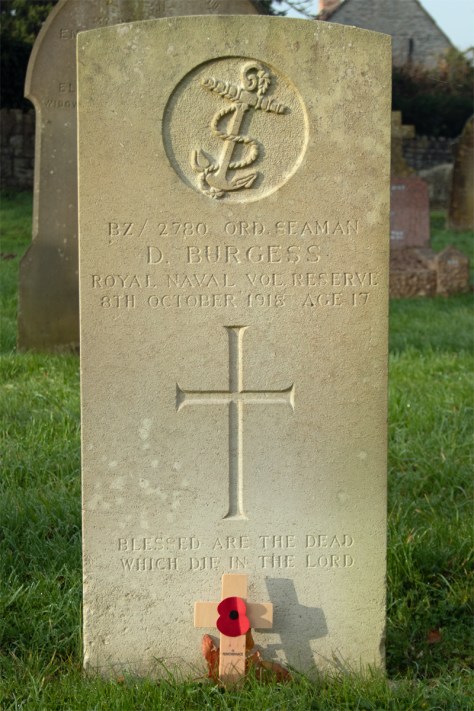
Ordinary Seaman Burgess contracted pneumonia and was admitted to the 4th London General Hospital in nearby Camberwell. Sadly, he succumbed to the condition and passed away on 8th October 1918, after just a few weeks’ service. He was just 17 years of age.
Donald Burgess lies at rest in sight of his father’s school, in the graveyard of St Barnabas Church.










 Death and Service