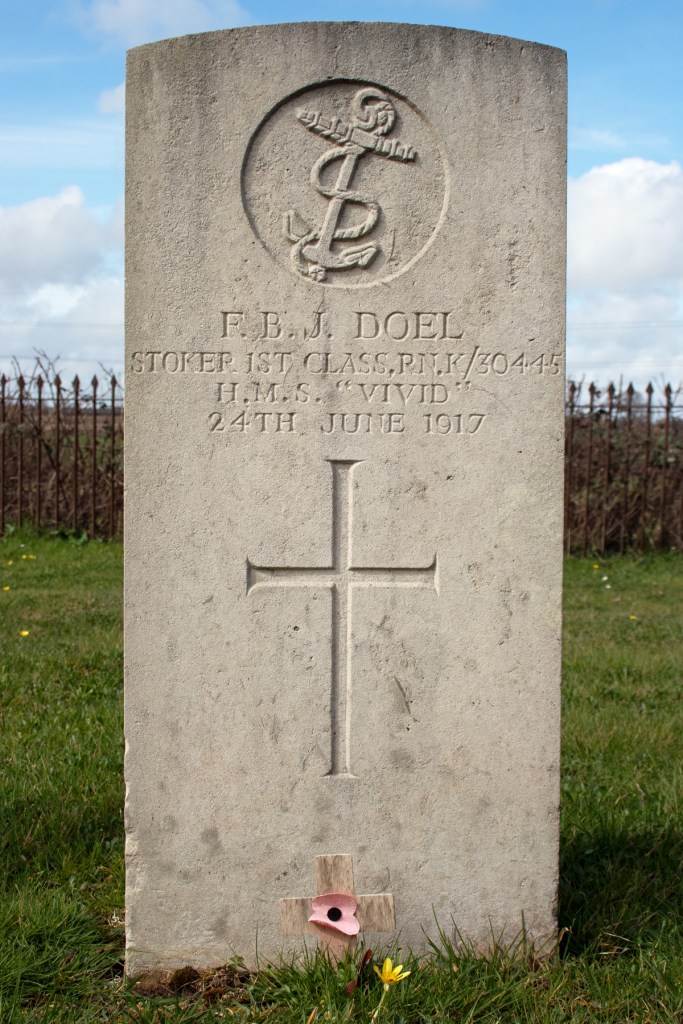
Francis Benjamin John Doel was born in Glastonbury, Somerset, on 26th August 1897. The oldest of five children, his parents were Frederick and Alice Doel. Frederick was a mason’s labourer and, by the time of the 1911 census, the family had set up home in the village of Berkley, on the outskirts of Frome. Intriguingly, the census clearly gives Francis’ middle name as Crossman, although no other record confirms this.
When war broke out, Francis had left school, and was employed as a labourer in a brass foundry. By the start of 1916, however, he stepped up to serve his King and Country, and enlisted in the Royal Navy. His service records give his height as 5ft 3.5ins (1.61m) and note that he had brown hair, grey eyes and a fresh complexion.
Francis was assigned the role of Stoker 2nd Class, and was sent to HMS Vivid – the Royal Naval Dockyard in Devonport – for training. Within a matter of weeks, he was given his first posting, on board the cruiser HMS Dublin, although he only remained there for a month.
After having returned to HMS Vivid for a few weeks, Francis was assigned to another cruiser, HMS Essex. He appears to have been good at his job, and in November 1916 was promoted to Stoker 1st Class.
Stoker Doel returned to HMS Vivid in May 1917, preparing for his Leading Stoker exams. They were not to be, however, as on 24th June, he died, having ‘accidentally drowned’. No further information is available on his death, and the newspaper report of his funeral only notes that he “…met his death on Sunday week. His body was landed from his vessel, and was brought home for burial…” [Somerset Standard: Friday 6th July 1917]. He was just 19 years of age.
Francis Benjamin John Doel was brought back to Berkley for burial. He was laid to rest in the village’s church cemetery.
Albert Aven was born on 18th December 1896 in the Somerset hamlet of Rodden. One of eleven children, his parents were Alfred and Elizabeth Aven. Alfred was a farm labourer, and farming was certainly something that his sons went into when they finished school.
When war came to Europe’s shores, however, Albert was keen to play his part. On 29th November 1915, he enlisted in the Royal Navy as a Stoker 2nd Class. His service records show that he was 5ft 5.5ins (1.66m) tall, with brown hair, blue eyes and a fresh complexion.
The record also suggests that he lied about his age, giving his year of birth as 1895. It is likely that Albert would have done this because there was a minimum age requirement, although, as he was already over that minimum age, it wouldn’t have made that much difference anyway.
Stoker 2nd Class Aven’s first posting was to HMS Pembroke, the Royal Naval Dockyard in Chatham, Kent, where he spent a couple of months undergoing training. At the end of January 1916, he was moved to HMS Gibraltar, an old cruiser, which patrolled the waters around the Shetland Isles.
After six months on board, and following a further month in Chatham Dockyard, Stoker Aven was assigned to HMS Test. She was a destroyer that patrolled the waters of the Humber Estuary, and Albert spent the next sixteen month with her. During this time, he was promoted to Stoker 1st Class, but the Test was also to be the last ship he served on.
On 8th November 1918, Stoker 1st Class Aven was ashore at the naval base in Hull, when he fell into a dry dock, dying instantly. Little additional information is available – and indeed contemporary newspapers are silent on the matter – but his service records report “Death caused by accidental fall into dry dock at Hull. Verdict of accidental death returned at inquest.” He was just 21 years of age.
Albert Aven’s body was brought home to Somerset for burial. He was laid to rest in the tranquil graveyard of All Saints’ Church in Rodden.
William Henry Dyer was born on 26th March 1895, in Bath, Somerset. He was the only child of William and Elizabeth Dyer. Elizabeth had had a son prior to her marriage to William Sr, and so William Jr had a half-brother, Sidney.
Elizabeth tragically passed away in December when her youngest was only a toddler. William Sr went on to marry again, to a Sarah Chivers. The couple went on to have a family of their own, giving William Jr and Sidney a further five half-siblings.
William Sr was a carman and, when his son left school, he also found carting work, the 1911 census recording him as being a milk carrier. He wanted bigger and better things, however, and, on 8th April 1913, a fortnight after his eighteenth birthday, he joined the Royal Navy.
William’s service records show that he was working as a van guard on the railway at the time of his enlistment. He was 5ft 7ins (1.7m) tall, with light hair, grey eyes and a fresh complexion. He joined as a Stoker 2nd Class, and was initially assigned to HMS Vivid, the Royal Naval Dockyard in Devonport.
After six months’ training, William was assigned to the dreadnought battleship HMS Ajax. She became his home for the next four years, patrolling the North Sea during the conflict and, in June 1916, was involved in the Battle of Jutland. During his time on board, William rose through the ranks, becoming Stoker 1st Class in August 1914, Leading Stoker in August 1916 and Petty Officer Stoker in October 1917.
In January 1918, William returned to HMS Vivid for a few weeks He was then given a new posting, on board HMS Sandhurst, based at Scapa Flow in the Orkneys. Petty Officer Stoker Dyer was to spend the next ten months here, albeit with a short break that autumn.
It was during this period of leave that William married Lily Sarah Bethia Durbin. She was the daughter of a miner, and the couple married in Clutton, Somerset. Their time together was to be brief, however, as William soon returned to Scotland.
It was while Petty Officer Stoker Dyer was back at HMS Sandhurst that he developed pneumonia. Sadly, the condition was to get the better of him. He passed away on board on 27th November 1918, at the age of just 23 years old.
William Henry Dyer’s body was brought back to Somerset for burial. He was laid to rest in St James’ Cemetery in Bath.
Lily had been a wife for just a matter of weeks, and was now left a widow. In 1926 she remarried, to baker and confectioner Albert Farmer. The couple lived a long and happy life, celebrating their 59th wedding anniversary before Albert died in 1985. Lily lived on, passing away in January 1997, at the ripe of age of 98 years old.
William Charles Green was born on 27th December 1897, one of five children – and the only son – to William and Mary Green. The family’s backstory is a bit hard to decipher.
William Sr was born in the Bath Union Workhouse in 1869 and the only details of his parentage comes in his marriage certificate, which suggests that his father was also called William Green, who was deceased. The same document records the groom as being a miner, and that he and Mary were living in Widcombe, Bath.
The Greens do not appear on the 1901 census – or at least that census record for them is lost to time. The next census return, in 1911, does have the family recorded as living in three room in St George’s Place, Widcombe. This particular census was the first to put the onus on the resident to complete the form, and, in William Green Sr’s case, this has led to a handful of anomalies in the record.
William Sr notes his trade as “going out with commercial travellers and hotel work also”. He confirms that he was “Somerset-born”, but suggests that Mary was born in “South Wells” (a spelling error, which should be South Wales), even though her birth and marriage certificate confirm she came from Bath.
The Greens certainly spent some time in Wales – their eldest daughter was born in Merthyr Tydfil, while William Sr was working as a miner there. By the time of William Jr’s birth, however, the family seem to have returned to England – he is recorded as coming from Bath.
William was 13 years old at the time of the 1911 census, and still at school. When he left education, he found work at a fishmonger, but with war closing in on Europe by this point, he was keen to serve his King and Country.
On 7th May 1915, William enlisted in the Royal Navy and, as he was just under age, he was given the rank of Boy 2nd Class. His service records note that he was 5ft 1in (1.55m) tall, with brown hair, blue eyes and a fresh complexion. Intriguingly the records give the place of his birth as Aberdare, Glamorganshire, but whether it is this document or the 1911 census that is incorrect is impossible to confirm.
Boy Green was initially sent to HMS Impregnable, the training establishment based in Devonport, Devon. He spent four months there and, on the day he was promoted to Boy 1st Class, he was assigned to HMS Defiance, the navy’s Torpedo School, off the Plymouth coast. In October 1915 he was assigned to HMS Fox, and remained on board for the next three years.
Fox was a cruiser that patrolled the seas from the East Indies to Egypt and the Red Sea. While on board, William came of age, and was formally enrolled in the Royal Navy as an Ordinary Seaman. With a character that was classed very good, even if his ability was noted as satisfactory, within eighteen months he was promoted again, to Able Seaman.
In August 1918, William was assigned to HMS Mantis, a river gunboat that patrolled the Tigris around Baghdad. He remained on board until the end of the year, when he was assigned to HMS Vivid, the Royal Naval Dockyard in Plymouth.
Over the next fifteen months, Able Seaman Green’s time was split between Plymouth and HMS Columbine, the naval base at Port Edgar on the Firth of Forth. It was when he was back in Devon, early in 1920, however, that he fell ill.
Able Seaman Green had contracted influenza, which had developed into pneumonia, and it was the combination of lung conditions that was to ultimately take his life. He passed away at the naval base on 5th March 1920, at the age of just 22 years old.
William Charles Green’s body was brought back to Somerset for burial. He was laid to rest in St James Cemetery, Bath, to be reunited with his parents when William Sr died in 1938 and Mary passed away in 1959.
Tom Mounter was born on 24th March 1890 in the quiet Somerset village of Kingsbury Episcopi. He was one of ten children to Robert and Ellen Mounter. Robert was a farm labourer, while Ellen earned a little more money for the family by stripping withy – or willow – branches for use in a variety of ways, such as basket weaving.
When Tom left school, he followed his father into agricultural work, employed to grow and manage the withy fields. In April 1911, he married Ellen Talbot, a farm labourer’s daughter from the village. The couple went on to have three children, Frederick, Martha and Horatio.
When war came to Europe, Tom stepped up to play his part. On 14th December 1916, he joined the Royal Navy, along with four others from the village.
Tom’s service records show that he was 5ft 6ins (1.68m) tall, with brown hair, blue eyes and a fresh complexion. Stoker 2nd Class Mounter was initially sent to HMS Vivid, the Royal Naval Dockyard in Devonport, for training, before being assigned to the cruiser HMS Ariadne on 31st March 1917.
The Ariadne had been converted into a minelayer that year, and worked in the English Channel. On 26th July 1917, she was torpedoed by the German submarine UC-65, and sunk, with the loss of all 38 hands, including Stoker Mounter. He was just 27 years of age.
Tom Mounter’s body was brought back to Somerset for burial. He was laid to rest in the peaceful Kingsbury Episcopi Cemetery, next to George Bonning, who had enlisted on the same day as him, and who had died six months before.
The local newspaper, when reporting on Stoker Mounter’s funeral, noted that he was “the seventeenth Kingsbury Episcopi man who has died for his King and country. It is stated that he had a strong presentiment that he would be killed.” [Langport & Somerton Herald: Saturday 4th August 1917]
Stoker 2nd Class Tom Mounter (from findagrave.com)
George Thomas Bonning – whose forenames seem to have been interchangeable – was born on 9th August 1887 in the Somerset village of Kingsbury Episcopi. His parents were farm workers James and Elizabeth Bonning, and George also entered farm work when he finished school.
In 1909, George marred Olive Harvey, the daughter of another agricultural labourer from the village. The couple set up home together in the village, and went on to have a daughter, Lilian, the following year. It was around the time of their daughter’s birth that George’s mother passed away, happiness and sadness in a short space of time for the young family.
By 1911, George was employed as a carter in a factory, presumably a financial step up from his previous employment on the farm. The money was still not a great deal, however, and Olive was also working, machining gloves at home for the local factory.
War came to Europe, and on 14th December 1916, George enlisted in the Royal Navy, along with four other men from the village, including friend and neighbour Tom Mounter. His service records show that he was 5th 11.5ins (1.82m) tall, with black hair, hazel eyes and a fresh complexion.
Stoker 2nd Class Bonning was sent to HMS Vivid, the Royal Naval Dockyard in Devonport, for training, and it was here that he contracted a chill. Tragically, this developed into pneumonia, and he died in the barracks on 20th January 1917. He was 29 years of age, and had been in service for just 37 days.
George Thomas Bonning’s body was brought back to Somerset for burial. He was laid to rest in the peaceful Kingsbury Episcopi Cemetery.
Olive never remarried after losing her husband. She remained in the village, raising Lilian and finding occasional employment to help pay the bills. She passed away on 26th March 1968, at the age of 79, and was laid to rest with George, husband and wife reunited after more than fifty years.
Harry Ernest Macklin was born in the Frome area of Somerset in the autumn of 1893. The oldest of four children, his parents were Henry and Elizabeth Macklin. Henry Sr was a groom who travelled with work, and by the time of the 1901 census, the family were living in East Adderbury, Oxfordshire, which is where the third of the four siblings, Evelyn, was born.
Harry Jr seems to have been known as Ernest, probably to avoid confusion with his father. When he left school, he found work as a page. The family had moved again by 1902, to Witham Friary, to the south east of Frome. Harry Sr was now working as a farm labourer, while Minnie, his and Elizabeth’s second child, was employed as a house maid. The two younger children – Evelyn and George – were both at school, while Elizabeth’s widowed father, also called George, was visiting his daughter and their family.
Ernest changed jobs, becoming a gardener – possibly a euphemistic way of saying he had followed his father into agricultural labouring – but when war was declared he found the need to play his part. On 15th February 1915 he joined the Royal Navy as an Officer’s Steward 3rd Class, possibly drawing on his experience as a page.
For some reason, Ernest’s service records give his date of birth as 18th October 1894: they also confirm he was 5th 7.5ins (1.71m) tall, had dark brown hair, brown eyes and a fresh complexion. They also note that he had a scar on his left thigh.
Officer’s Steward 3rd Class Macklin’s first posting was HMS Victory, the Royal Naval Dockyard in Portsmouth, Hampshire. This is where he received his training and, on 10th August 1915, he was given his first posting, on board the Chilean-built HMS Canada.
The ship sailed to Scapa Flow, following the North Sea Coast. When it reached Newcastle-upon-Tyne, however, Ernest was disembarked, and admitted to the Armstrong College Hospital, suffering from an ear infection. Tragically his condition turned septic, and he died of blood poisoning on 23rd September 1915, having served just 43 days at sea. Officer’s Steward 3rd Class Macklin was just 22 years of age.
Harry Ernest Macklin’s body was brought back to Somerset for burial. He was laid to rest in the quiet graveyard of St Mary’s Church in Witham Friary. “He was a promising young fellow, liked by all who knew him, and he was a member of the Witham Church Choir from boyhood.” [Somerset Standard : Friday 1st October 1915]
Victor Jordan was born on 20th November 1893 in Beeston Regis on the north Norfolk coast. The second of four children, his parents were school teachers Albert and Melletta Jordan.
By the time of the 1911 census, the family had moved from one coast to another, setting up home in Bognor Regis, Sussex. Albert had given up teaching, and had become an insurance agent for Prudential. Victor had left school and found work as a wheelwright, while his older sister, Emily, had taken up where her father had left off, teaching in an elementary school, The family of six was expanded by the inclusion of Albert’s mother, Emily, who had moved in with them.
By 1914, war was on the horizon, and Victor sought out a career beyond wheel work. On 21st May he enlisted in the Royal Navy as a Stoker 2nd Class. His service records show that he was 5ft 6ins (1.78m) tall, had light brown hair, blue eyes and a fair complexion.
Stoker Jordan was initially sent to HMS Victory, the Royal Naval Dockyard in Portsmouth, Hampshire, for training. After an initial six-month period, he was assigned to the battleship HMS Indomitable, on board which he was to serve for the next four years.
During his time on board, Victor proved to be a disciplined and determined worker. He was promoted to Stoker 1st Class in July 1915, and reached the rank of Leading Stoker in the summer of 1918. HMS Indomitable was involved in some of the key naval battles of the First World War – including Dogger Bank and Jutland – and Victor would have been on the forefront of maintaining the vessel’s power.
By October 1918, Leading Stoker Jordan was back on dry land, and was based once again in Portsmouth. As the war came to a close, however, he became unwell, and was admitted to Haslar Naval Hospital in nearby Gosport, suffering from acute tonsillitis.
Tragically, the condition was to get the better of him: Leading Stoker Jordan died of heart failure on 8th December 1918, having not long turned 25 years old.
Victor Jordan’s family were, by now, living in the Somerset hamlet of Brewham, and this is where his body was brought for burial: he was laid to rest in the peaceful graveyard of St John the Baptist’s Church.
Leading Stoker Victor Jordan (from findagrave.com)
Scandal was set to rock the grieving family. Albert, who was now teaching again, was charged with indecently assaulting a nine-year-old girl three times over the winter of 1918/19. He denied the accusation and a jury found him not guilty after only a few minutes’ deliberation.
Albert and Melletta seem to have found it impossible to remain in the quiet corner of Somerset, and moved to Essex. The couple took up new teaching posts, Albert eventually becoming the headmaster of Doddinghurst Church of England School, near Brentwood, while his wife worked as a school mistress for one of the classes.
Melletta died in February 1931, and at this point, Albert came back to Somerset to live with his daughter and her family in Cheddar. He was 75 years old when he passed away at Emily’s family home – called Melletta after her mother – and was laid to rest in St Andrew’s Churchyard, Cheddar.
Henry George Butcher was born on 29th September 1900, the middle of five children to Henry and Sarah Butcher. Henry Sr was a labourer in a nursery and the family were born and raised in his and Sarah’s home village of Merriott, Somerset.
Henry Jr followed his father into agricultural labouring when he finished school. When war was declared, he was too young to enlist and, seeing his older friends head off to glory, he must have been desperate to play a part before it was all over.
Henry’s chance finally came when, on 2nd September 1918, he joined the Royal Navy. His service records show that he was 5ft 2.5in (1.59m) tall, had brown hair, blue eyes and a fresh complexion. As he was under-age when he enlisted, he was given the rank of Boy 2nd Class, and sent off to HMS Powerful, a training ship in Devonport.
Naval and army barracks were crowded places, and brought together boys and men from all over the country in a way that had never happened before. The cramped nature of the billets meant that disease would run rampant once it took hold, and it could prove fatal. In the last week of September 1918, seventeen boys from HMS Powerful died from a combination of influenza and pneumonia and, on Friday 27th, Boy 2nd Class Butcher was to join that list. He was two days from his eighteenth birthday, and had been in the Royal Navy for just 25 days.
Henry George Butcher’s body was brought back to Somerset for burial. He was laid to rest in the graveyard of All Saints’ Church in his home village of Merriott.
William Stringer was born in Warlingham, Surrey, on 4th December 1885, and was one of nine children to Stephen and Jane Stringer. Stephen was a carter, but is seems that William wanted an escape.
On 18th April 1901, he enlisted in the Royal Navy and, because of his age, he was granted the rank of Boy 2nd Class. He was initially sent to HMS Impregnable, the school ship, and remained there for just over a year, during which his hard work paid off and he was promoted to Boy 1st Class.
His basic training complete, and after a short stint at HMS Vivid, the Royal Naval Dockyard at Devonport, he was assigned to HMS Collingwood. Over the next couple of years, William served on a couple more vessels and, in 1903, when he came of age, he was formally inducted into the navy, and given the rank of Ordinary Seaman.
William’s service records show that he was 5ft 4ins (1.63m) tall, had auburn hair, brown eyes and a fresh complexion. For distinguishing marks, he was noted as having two dots on his left forearm and scars on his legs.
Now that he was tied to a twelve year contract, Ordinary Seaman Stringer’s seems to have viewed his life in a different light. His ‘very good’ conduct quickly changed to ‘fair’ and, at the end of 1904, he spent two separate stints in the cells, presumably because of his attitude or behaviour.
This shock to the system seems to have been what William needed, however, as in 1905, he took to the new role, and his ratings improved once more. Over the next couple of years, he served on HMS Montagu and HMS Diamond, returning to Devonport in between voyages. In January 1907 he was promoted again, this time to Able Seaman, but, as with the previous promotion, things began to go downhill again.
In March, he spent two weeks in Diamond’s brig, a punishment that was repeated in September. The following month Able Seaman Stringer’s service records not his character as ‘indifferent’ and, the following month he was discharged from the Royal Navy, having refused to work for 42 days.
It was while he was serving on board HMS Diamond that William met Lena Cropp, who was presumably working in one of the ports on the South Coast. She was the daughter of labourer Jesse Cropp and his wife, Philadelphia. When Jesse died in 1897, Philadelphia married bricklayer James Smith, who had boarded with the family for a number of years.
William and Lena had a son, Joseph, on Christmas Day 1907. Now removed from the Navy, William moved his young family back to Surrey, where he found work as a cowman, and Lena took in laundry to bring in an extra income. The couple went on to marry in 1911, and went on to have two further children – Elsie, who was born in 1912, but who died when just a toddler; and Gladys, who was born in the summer of 1918.
When war closed in on Europe, something of a sense of duty must have pulled on William. He enlisted in the summer of 1915, joining the East Surrey Regiment. He seems to have quickly transferred across to the Labour Corps, and arrived in France on 15th July.
It is unclear for how long Private Stringer served in France, but at some point he returned to Britain. In October 1918, he was admitted to the War Hospital in Bath, suffering from stomach problems. His health was to prove his undoing, and he passed away from a biliary calculi peritonitis on 8th October 1918, at the age of 34 years of age.
Finances may have been tight for Lena, as William was buried in the city where he died, rather than being brought back to Surrey, where she was living. Because of this, it is unlikely that he ever met his daughter, who had been born just two months before.
William Stringer was laid to rest in the Roman Catholic Cemetery in Bath.
William’s Pension Ledger notes Lena as his widow, but only mentions one child – Joseph – as a dependent. The document also records him as an illegitimate stepchild, as he had been born a couple of years before the couple married.
The record notes that it, while Joseph’s legitimacy meant he was not eligible for a share of his William’s pension, it had been decided that the basic rate should be provided while he remained in Lena’s care.