Frederick Charles Hill was born on 13th June 1882 in the Devon village of Marldon. One of seven children, his parents were William and Elizabeth Hill. William was a carpenter, and the 1891 census found the family living or boarding at the Royal Oak Inn.
When he finished his schooling, Frederick found work as a gardener. However, he sought a bigger and better life and, on 21st April 1897, he joined the Royal Navy. His service record suggests that he lied about his age to do so, giving his year of birth as 1881,
Frederick was below the age to formally enlist in the navy, and was given the rank of Boy 2nd Class. He was sent to HMS Impregnable, the training base in Devonport, Devon, spending the next eighteen months there. Promoted to Boy 1st Class in February 1898, he was given his first posting, on board HMS Agincourt, later that year.
In the autumn of 1898, Frederick was assigned to the cruiser HMS Leander. The following summer, and based on the date of birth he had previously provided, he came of age, and was formally inducted into the Royal Navy. His service records show that he was 5ft 2ins (1.57m) tall, with red hair, grey eyes and a fresh complexion. Hs was also noted as having a scar on his forehead.
The now Ordinary Seaman Hill remained on board HMS Leander for more than two years. He proved a worthwhile member of crew, and was promoted to Able Seaman in May 1900. He left Leander in January 1901, and was billeted at HMS Vivid, the Royal Naval Dockyard in Plymouth, Devon, which would become his base when not at sea.
Frederick’s contract was for twelve years, and during that time he would serve on four vessels. His dedication to the navy was evident by his promotions – he made Leading Seaman in October 1904, Petty Officer 2nd Class in October 1906, and Petty Officer 1st Class in March 1911. When his term of service ended, he immediately re-enlisted, and, at his annual reviews, was regularly noted for his very good character and superior ability. His career kept going from strength to strength, and, in 1914, he was promoted to Chief Petty Officer.
He was sent to Antwerp in September [1914] with the Royal Naval Division, and in 1916 went to the Dardanelles, there gaining his commission for bravery. After the evacuation he was sent to France and won the MC in the Ancre drive in 1916. In February 1918 he was sent for six months’ rest to England. Lieut. Hill volunteered to go to France again in November the same year, and contracted heart disease, from which he died. He returned to England early in June [1919], and, being on sick leave, went to Paignton Hospital, where his death occurred.
[Brixham Western Guardian: Thursday 7th August 1919]
Frederick Charles Hill was 37 years of age when he died on 2nd August 1919. His body was laid to rest in the family plot in St John the Baptist’s Church, Marldon.
Frederick’s headstone records his rank as Lieutenant Commander. However, Commonwealth War Grave Commission documents suggest his rank was Lieutenant.
William Watts was born on 24th October 1872 in the Devon village of Stockfleming. Details of his early life are unclear, but his later marriage record gives his father’s name as Richard.
The first confirmation of William’s life was his military service records. He left his job as a farmer’s lad and joined the Royal Navy on 3rd January 1888 and, being just 15 years old at the time, he was given the rank of Boy 2nd Class.
William was sent to HMS Impregnable, the navy’s training base in Devonport, Devon, for his initial induction. He remained there for the next eighteen months, and was promoted Boy 1st Class during that time. In October 1889, he was given his first posting, on board the sloop HMS Pylades. She would be his home for more than three years, during which time he came of age.
Now formally inducted into the Royal Navy, William was given the rank of Ordinary Seaman. His service papers show that he was 5ft 1ins (1.55m) tall, with dark hair, hazel eyes and a fair complexion.
Over the twelve years of his initial contract Ordinary Seaman Watts made a career for himself. By the end of that time, he had served on five further ships, returning to HMS Vivid, the Royal Naval Dockyard in Devonport, in between voyages. He was proving his mettle as well, and was promoted to Able Seaman on 1st November 1893.
When, in March 1901, his contract came up for renewal, William immediately re-enlisted. His service record shows that he had grown to 5ft 4ins (1.65m) tall, and now sported a tattoo of a star on his left wrist. He spent another thirteen years in the Royal Navy, but transferred to the Coastguard, serving in Weymouth in Dorset, and Brixham and Dartmouth in Devon.
On 15th September 1903, William married Olief Lawrence. The daughter of a labourer from Fontwell Magna, Dorset, the couple married in her local parish church. They would settle in Brixham, and have one son, William, who was born in October 1907.
When war broke out, William was called up on to play his part. Pensioned off just two months previously, he now returned to sea, joining the battleship HMS Goliath as an Able Seaman. His health was failing him by this point, however, and on 18th December 1914, he was invalided out of naval service.
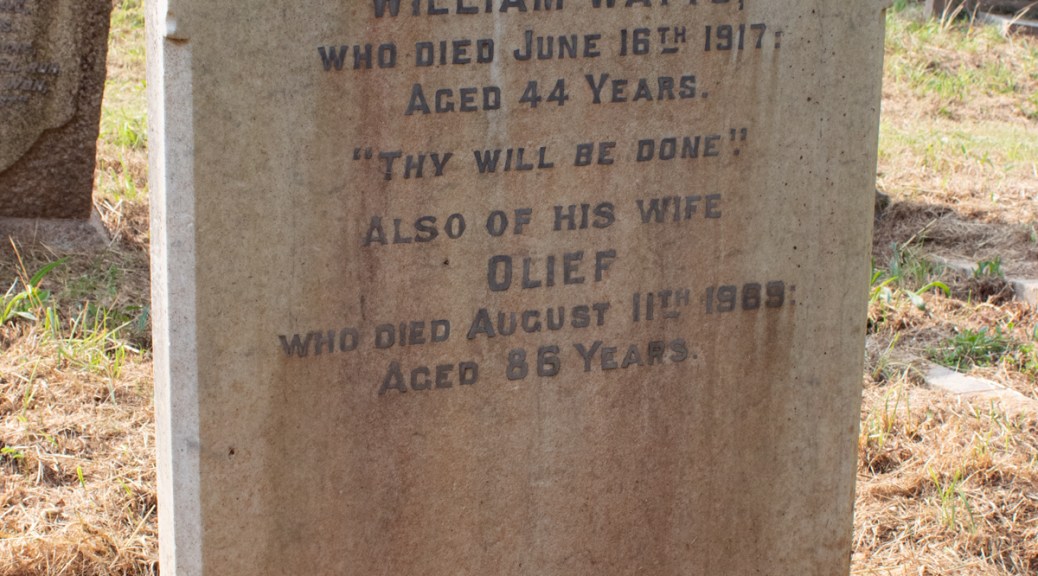
At this point, William’s trail goes cold. It is clear that he and Olief moved to Marldon, to the west of Paignton, and he took up the role of landlord of the Ship Inn (now Ye Olde Smokey House). His health still seemed to be impacted, however, and it would eventually get the better of him. He died on 16th June 1917, at the age of 44 years of age.
The body of William Watts was laid to rest in the graveyard of St John the Baptist Church in Marldon, the village which he had come to call home.
Stanley James Isaiah Westaway was born on 2nd March 1898 in the Devon village of Marldon. One of twelve children, his parents were builder’s labourer George Westaway and his wife, Eliza.
Being a large family, Stanley may have felt the need to make his mark on the world. When war broke out, he found that opportunity and, on 10th April 1916, he enlisted in the Royal Navy.
Taking on the role of Stoker 2nd Class, Stanley was sent to HMS Vivid, the Royal Naval Dockyard in Devonport, for his training. His service papers show that he was 5ft 3ins (1.6m) tall, with dark brown hair, brown eyes, and a fresh complexion.
Stoker Westaway’s first posting was aboard HMS Berwick, a cruiser that patrolled the English Channel. He remained there for eighteen months, and, during this time, he gained a promotion to Stoker 1st Class. In November 1917, he returned to his shore base, and remained there through to the following spring.
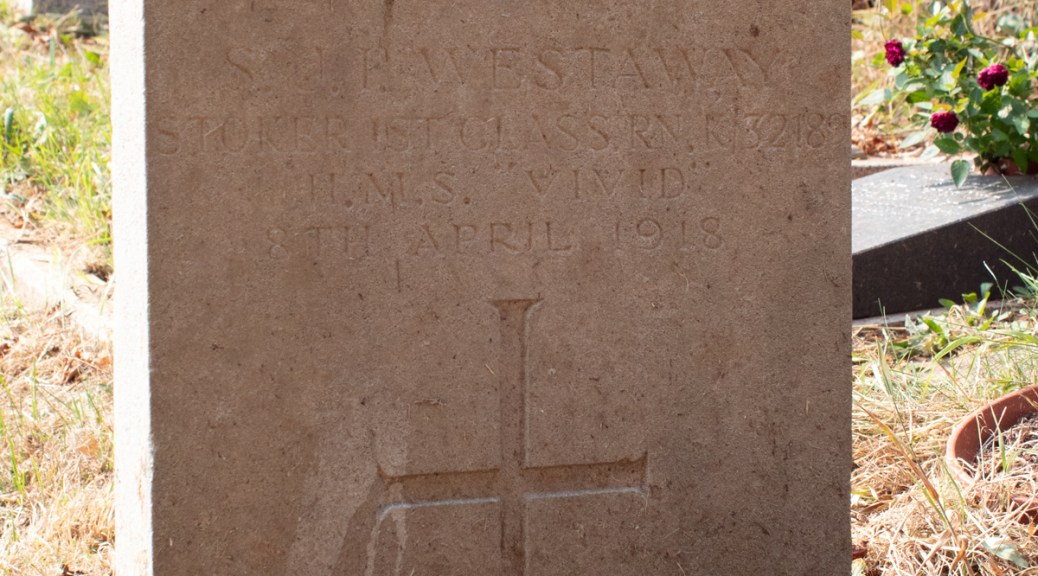
In early 1918, Stanley fell ill. As he was at sea at the time, he was sent to the closest Royal Naval Hospital in Pembroke Dock, Pembrokeshire. His condition worsened and the condition was to prove fatal: he passed away on 8th April 1918, at the age of 19 years of age.
The body of Stanley James Isaiah Westaway was taken back to Devon for burial. He was laid to rest in the graveyard of St John the Baptist’s Church in his home village.
Charles William Harris was born in Wingham, near Canterbury, Kent, on 19th July 1879. The fourth of eleven children, his parents were Charles and Kate Harris. Charles Sr was a carpenter and builder, and his son was to follow in his stead.
By the time of the 1901 census, however, Charles Jr had stepped out on his own. He had moved to London, and was boarding with the Hurley family, in rooms at 408 Bethnal Green Road, Middlesex.
On 1th June 1902, Charles Jr, now a plumber, married Esther Danton. An engine driver’s daughter from Kent, she was four years her new husband’s senior. The couple set up home at 5 Leatherdale Street in Mile End, and had two children: daughter Lilian was born in 1905, with son George following three years later.
When war broke out, Charles was called upon to play his part. He enlisted in the Royal Naval Air Service as an Air Mechanic, and was quickly promoted to Leading Mechanic. His service records show that, when he joined up on 15th June 1916, he was 5ft 7.5ins (1.71m) tall, with light brown hair, blue eyes and a fresh complexion.
Leading Mechanic Harris would be based out of HMS President, the umbrella name for the Royal Navy’s London bases. He spent time working at Wormwood Scrubs, and, in February 1917, was moved to Kingsnorth, Kent.
What happened next is summed up in a simple statement on Charles’ service papers: “26th May 1917 Accidentally killed by explosion of gas holder.” There is no further information, and nothing in the media about the incident. Leading Mechanic Harris was 37 years of age.
The body of Charles William Harris was taken to the Woodlands Cemetery, Gillingham, Kent. He was laid to rest in the naval section of the burial ground.
Tragedy was to strike again just two years later, when Charles and Esther’s daughter also passed away:
Much sympathy and respect were shown at Holy Trinity Church, Springfield, when the funeral of Lily Harris, the fourteen-year-old daughter of Mrs and the late Mr CW Harris took place. Deceased’s father, who was chauffeur to the Bishop of Chelmsford, lost his life in the war while serving with the RNAS, and this fact added to the regret felt by the parishioners at the further sad loss sustained by his widow, who is now left with only one little boy. The funeral procession included a large number of the scholars of the Springfield Day and Sunday Schools, with Mr R Coward of the day school, and practically every child carried a floral tribute. There was also a large attendance of neighbours and friends, including children, assembled at the church. The Bishop of Chelmsford officiated… [and] gave a touching address to the church, speaking particularly to the children; and his lordship also performed the last sad rites at the graveside.
[Essex Newsman: Saturday 29th November 1919]
There is no evidence of any connection between Charles and the Bishop of Chelmsford: as far as the records show, he was never a chauffeur, working as a builder, plumber and gas fitter before enlisting.
Edwin Charles Hocking was born in Newton Abbot, Devon, on 28th January 1873. The youngest of four children, his parents were Richard and Harriet Hocking. Richard was an engine driver, and he was to die less than a year after his youngest boy’s birth:
Mr Deputy-Coroner Square and a jury of twenty-two to-day brought to a conclusion the inquest on the death of the engine driver Richard Hocking. The evidence of numerous witnesses went to show that the accident, which occurred on the morning of the 2nd inst., between Menheniot and St Germans stations occurred in consequence of the guards of two trains being called Dick. The morning was very dark, and at Menheniot there was standing at the station an up and a down goods, and a second down goods was on its way from St Germans, but this was unknown to the up goods. The porter Pratt at Menheniot gave the order to the guard (Wills) of the down train to start, saying “All right, Dick.” The driver of the up train (Scantlebury) was also called Dick, and when he heard the words he said “Is it right for me?” and Pratt, not seeing Scantlebury, and thinking Wills asked the question, repeated “It’s all right, Dick.” Scantlebury through it was meant for him, and gave the order to the deceased, “Right away.” Pratt, who had gone to let out the down train, hearing the starting whistle of the up train, rushed back to the platform waving his hand “danger” light. This attracted the attention of Scantlebury, the head guard, and he missed his van in consequence. Pratt said, “Wherever are you going?” Scantlebury replied, “Right away isn’t it?” Pratt said “God bless the man, who gave you ‘right’? The up goods is ten minutes off St Germans.” Scantlebury cried out “Oh! my God! Oh! my God!” Together they shouted and waved the danger light, but were unable to attract the drivers of either of the two engines attached to the train. The trains came into collision at full speed about two miles away. The deceased and the other driver were at great fault in leaving Menheniot, notwithstanding the order of the guard, for the signal was against them, and they did not observe the rules of the Company. They should not have gone on without hearing the second whistle of the guard, and after starting they should have satisfied themselves that they had the head guard in the train by seeing his lamp. Richard Scantlebury, the head guard, after being cautioned that he need not say anything to criminate himself, gave evidence that when Pratt said “All right Dick” he certainly thought it referred to him, especially as his train had nothing to do at Menheniot.
The jury deliberated for half-an-hour, and then returned a verdict of “Accidental death,” exonerating Pratt and Scantlebury from all blame. The appended a recommendation to the South Devon and Cornwall Railways to provide for a strict observance of their bye-laws for the use of some definite word for the up and down trains, and Christian names never to be used in such cases; that there be communication between the driver and guard on luggage trains as well as passenger trains, and that there be to men at least at each station on duty.
[Western Times: Wednesday 17th December 1873]
Harriet was just 28 years old when her husband died. With four children to raise, she married again – to John Staple – and went on to have four children with him too.
John also passed away in the spring of 1885, and the 1891 census found Harriet and six of her children living at 43 Richmond Terrace, to the west of the centre of Truro, Cornwall. Harriet was working as a washer woman, while Edwin, who was 18 by this point, was employed as a plumber’s assistant.
It is clear that Edwin wanted a better life for himself and in the spring of 1896, he took the skills that he learnt and signed up to the Royal Navy. His service papers show that he was 5ft 5ins (1.64m) tall with dark brown hair, grey eyes and a fresh complexion. He was also noted as having a tattoo on his left forearm.
Edwin took the rank of Plumber’s Mate, and spent the first two years split between two shore establishments – HMS Vivid and HMS Pembroke, the Royal Naval Dockyards in Devonport, Devon, and Chatham, Kent. He had enlisted for a twelve-year term and, over that time, he would serve on five ships, returning to Chatham in between assignments.
Plumber’s Mate Hocking consistently received very good reviews at his annual appraisals and, when his initial contract came to an end in May 1908, he immediately re-enlisted. He had a family to support by this point, having married Fanny Sears in Camberwell, Surrey, on 16th March 1902. A bricklayer’s daughter, she moved to Gillingham, Kent, to be close to Chatham Dockyard. The couple went on to have five children: Henry, Raymond, Doris, Elsie and Percival.
Back at sea, Edwin’s career continued with some consistency. His annual appraisals noted not on a character that was very good, but an excellent ability. Nevertheless, it would only be in the spring of 1916 that he would gain a promotion to full Plumber. Notwithstanding his general character, Edwin seems to have been a flawed character: in 1909 he applied for a discharge to the Royal Naval Reserve, but this was not approved as he had been found to be “carrying on a business as [a] bookmaker.” Instead, he was to be sent “to sea forthwith and warned that unless his betting practices [were] not stopped his discharge will have to be considered.”
By the summer of 1916, Plumber Hocking was eight years into his second term of service, and had served on five further ships. HMS Pembroke remained his shore base, and it was here that he attained his increased rank.
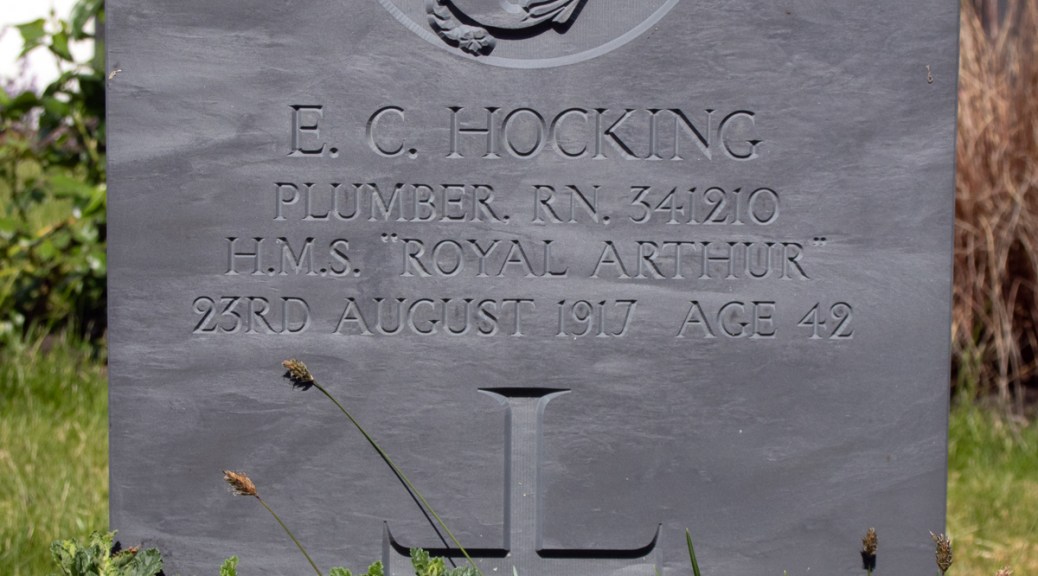
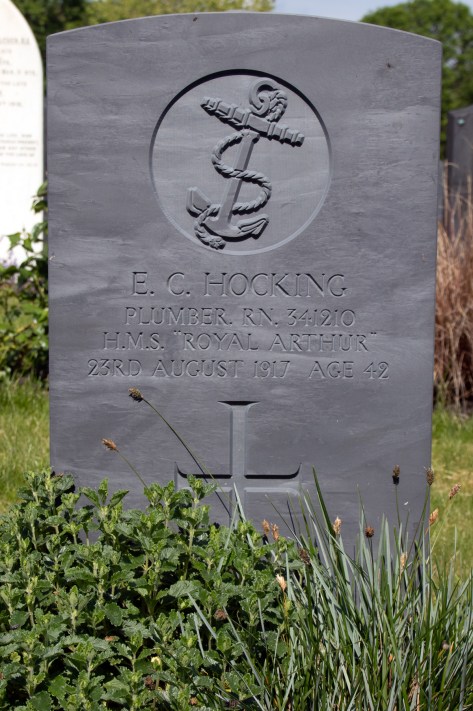
In October 1916, Edwin was given what would be his final assignment, on board the armoured cruiser HMS Royal Arthur. Based at Scapa Flow in the Orkneys, she was employed as a depot ship for submarines. Plumber Hocking spent ten months on board, before illness hit. Coming down with gastroenteritis following food poisoning, he was transferred back to Kent, and admitted to the Royal Naval Hospital in Chatham. The condition was to prove his undoing, and he passed away on 23rd August 1917: he was 44 years of age.
The body of Edwin Charles Hocking was laid to rest in the naval section of Woodlands Cemetery, Gillingham, a short distance from his grieving family’s home in King Edward Road.
Richard Henry Jenkins was born on 7th April 1878 in Soho, Middlesex. The youngest of seven children, his parents were glazier George Jenkins and his wife, Emma. The 1881 census found the family living in rooms at 2 Church Street, but they disappear from both of the next two census returns.
The next document for Richard is his service record. He gave up his job as a labourer to join the Royal Navy as a Stoker 2nd Class, on 27th November 1905. His papers note that he was 5ft 5.5ins (1.66m) tall, with dark brown hair, grey eyes and a fresh complexion.
Stoker Jenkins was sent to HMS Acheron, a torpedo boat, for his training. Over the term of his five-year contract, he would spend time on three further vessels, but it was HMS Pembroke, the Royal Naval Dockyard in Chatham, Kent, that would become his on-shore home. Promoted to Stoker 1st Class in Mary 1907, he was stood down to reserve status then his contract ended in 1910.
By this point, Richard was married. He exchanged vows with widow Mary Ann Bunyon, on 11th April 1909. The same age as her husband, she had a son, Edward, from her previous marriage, and the couple set up home in Clerkenwell. The 1911 census found them living in rooms at 3 Roberts Place. They shared their home with their first child and Mary’s mother and sister.
When war broke out, Richard was called upon to play his part once more. Sent back to HMS Pembroke on 2nd August 1914, he seems to have spent the next couple of years on shore. His papers note that he was wounded on 26th June 1915, but no further information is available.
On 15th May 1917, Stoker 1st Class Jenkins was assigned to the monitor ship HMS Roberts. She has spent time in the Mediterranean, but by the time Richard joined her crew, she was put to use as a guard ship off the Norfolk coast.
A case of very determined suicide was inquired into at the Royal Naval Hospital, Gillingham, on Saturday last, by Mr CB Harris (County Coroner) and a jury. It appeared from the evidence that Richard Henry Jenkins, a stoker petty officer [sic], of the Royal Fleet Reserve, had been depressed and in a morose state of mind for some days, reference being made in a letter to an alleged unpleasantness at his home. On October 4th, when the vessel was at sea, Jenkins cut his throat with a savage slash of his own razor, and them jumped through a port-hole. The Coroner remarked that it was extraordinary that the man should have had sufficient strength to get through the port-hole after inflicting such a severe wound upon himself. A verdict of suicide during temporary insanity was returned.
[Sheerness Guardian and East Kent Advertiser: Saturday 13th October 1917]
Richard Henry Jenkins was 39 years of age when he took his life. His body was laid to rest in Woodlands Cemetery, Gillingham, Kent, not far from HMS Pembroke.
There is no further information about the alleged unpleasantness at home. The 1921 census recorded Mary living in Clerkenwell with their two children and her mother.
Stoker 1st Class Richard Jenkins (from ancestry.co.uk)
Edward Thomas Stewart was born on 7th September 1880 in the Kent village of Sturry. The middle of three children, his parents were farm labourer James Stewart and his wife, Frances.
When he finished his schooling, Edward found work as a coachman, but he sought a life of adventure and, on 24th July 1899, he enlisted in the Royal Navy as a Stoker 2nd Class. His service records show that he was 5ft 7.5ins (1.71m) tall, with light brown hair, grey eyes and a fresh complexion.
Stoker Stewart was sent to HMS Pembroke, the Royal Naval Dockyard in Chatham, Kent, for his training, and remained there for the next eight months. He was then given his first assignment, on board the battleship HMS Sans Pareil. She became his home for the next year, during which time he was promoted to full Stoker.
Edward’s initial term of contract was for twelve years, and over that time he would serve on nine different vessels. Between voyages his shore home remained Pembroke, and he spent more than two years based there. By the summer of 1911, Edward had been promoted three times – to Stoker 1st Class in July 1906, Leading Stoker in March 1908, and Stoker Petty Officer in March 1910.
When his contract came to an end, Edward immediately re-enlisted. By this point, his records show that he had grown to 5ft 10.5ins (1.79m) tall, and had a scar on his nose.
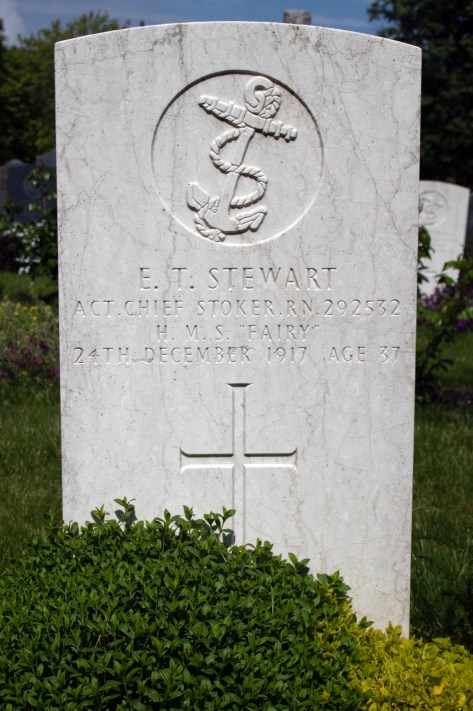
In the autumn of 1912, Stoker Petty Officer Stewart was assigned to the troop ship HMS Tyne. She would become the ship on board which he would spend the longest part of his career, not disembarking until 31st May 1917. He transferred to HMS Fairy, a destroyer, and with the move came a promotion to Acting Chief Stoker.
Attached to the Grand Fleet, Fairy was engaged in convoy work off the east coast. Edward’s time on board would not be a lengthy one, however. On 24th December 1917, he fell overboard, and was killed. He was 37 years of age. There is little additional information about the incident, although his service papers note that “no blame was attributable to anyone.”
Edward Thomas Stewart’s body was recovered, and brought back to Kent for burial. He was laid to rest in the naval section of Woodlands Cemetery, Gillingham, not far from the base he had called home for so long.
Henry Weller was born on 13th January 1877 in the village of Ashurst Wood, Sussex. The second of four children, his parents were John and Mary Weller. John was a farm labourer, and the 1881 census found the family living in a cottage on Brooklands Farm in East Grinstead.
Times look to have been tough for the Weller family. By the time of the next census, John, Mary and three of their children were lodging with Hartfield family. Henry, meanwhile, was living in Deptford, Kent, with James and Susannah Weller. He was noted as being a ‘cousin’, although his exact relationship is unclear. James’ nephew Joseph Weller, was also living with them. Just fourteen years of age, Henry was working as a general labourer, and the family were living at 21 Adolphus Street.
Labouring was an irregular way to being in money, and so Henry sought out a more regular career. On 18th November 1896 he signed up to the Royal Navy as a Stoker 2nd Class. His service records show that he was 5ft 4.5ins (1.64m) tall, with brown hair, brown eyes and a fresh complexion. He was also noted as having the letters HW tattooed on his left forearm, and shaking hands on his upper left arm.
Stoker Weller was sent to HMS Pembroke, the Royal Naval Dockyard in Chatham, Kent, for his training. He spent the next nine months split between there and HMS Wildfire – Sheerness Dockyard – learning his trade.
On 8th June 1897, Henry was assigned to the battleship HMS Victorious. Promoted to Stoker 1st Class three months after boarding, she would remain his home for the next three years. After a month aboard another battleship – HMS Revenge – he returned to Chatham.
Love blossomed and, on 8th July 1900, Henry married Alice Beldham, a dock worker’s daughter. The couple exchanged vows at All Saints’ Church, Rotherhithe, Kent, and moved in with Alice’s widowed father, George, at 12 Osprey Street. They went on to have three children: Henry, Harold and Ivy.
Newly settled, Henry seems to have voiced a preference to remain closer to home and, for the next couple of years he would remain based at HMS Pembroke. Alice relocated, and the family set up home at 51 King Edward Road, Gillingham, Kent. Close to the River Medway, the Wellers’ neighbours were all based at the docks, and, during her husband’s future absences, it is likely that Alice felt a sense of community.
After leaving HMS Pembroke, Henry was attached to the cruiser HMS Bacchante. Promoted to Leading Stoker 2nd Class, over the next six years, he would serve on three more ships, spending six-month stints back in Chatham in between assignments. In July 1903 he was promoted to Leading Stoker 1st Class, although he reverted to 2nd Class nine months later. Promoted again in June 1905, he took the rank of Stoker Petty Officer a year later.
Henry’s initial term of service came to an end in November 1908. He immediately re-enlisted, and remained in service until the spring of 1918.
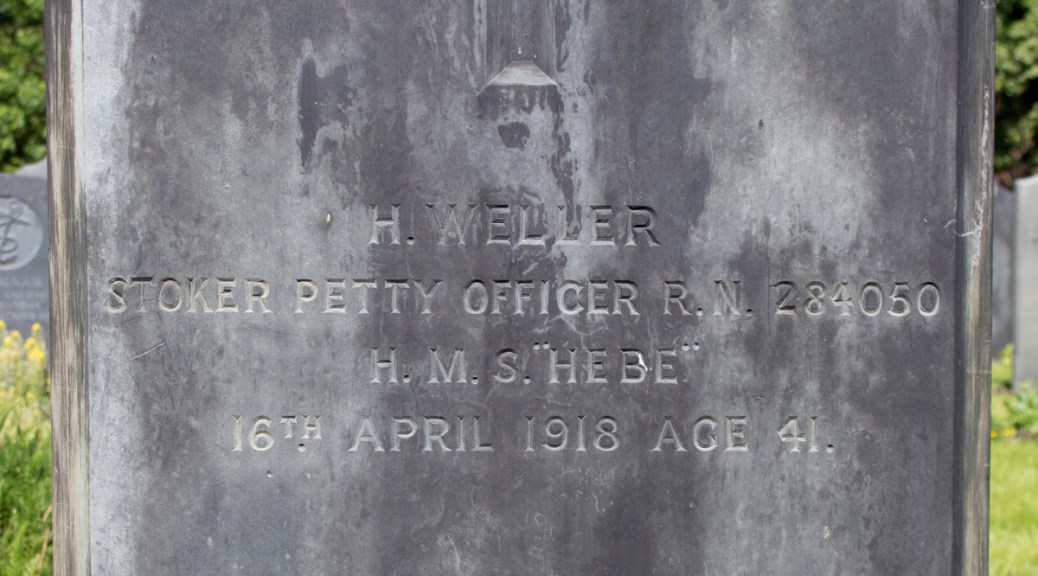
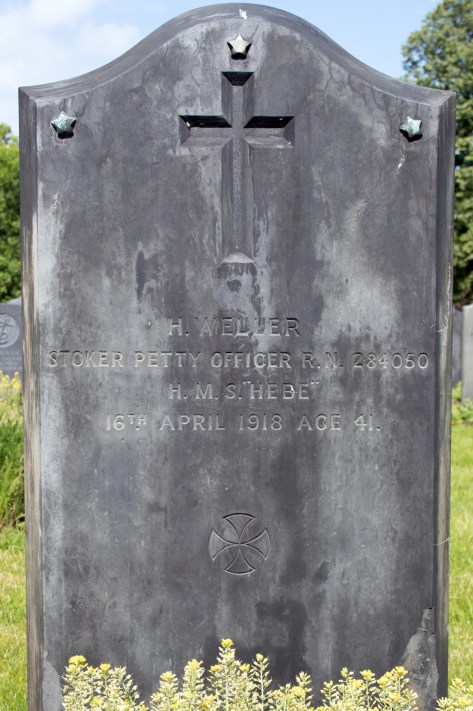
By this point Stoker Petty Officer Weller had been assigned to the torpedo gunboat HMS Hebe for more than thirty months. Patrolling the North Sea coast, on 12th April, she moored at the Alexandra Dock in Hull, Yorkshire. A later inquest outlined what happened next:
Joseph Taylor, a chief petty officer, said that about 11:55pm… [Henry] and he were going from the town to their ship… Witness struck a match to light his pipe. [Henry] walked on for about two yards, and then disappeared. Witness raised the alarm, and went tot he bottom of the dry dock, into which he found [Henry] had fallen, a distance of about 50 feet. They did not know the docks, has they had only come in that morning… If he (witness) had not struck the match they would both have gone over.
[Hull Daily Mail: Wednesday 17th April 1918]
Alive, but severely concussed, Stoker Petty Officer Weller was quickly taken to a local hospital. He was operated on, but his injuries were too severe. Henry passed away on 16th April 1918: he was 41 years of age.
The body of Henry Weller was taken back to Kent for burial. He was laid to rest in Woodlands Cemetery, Gillingham, a short walk from where Alice and their children were still living.
Henry Johnson Tregillis was born on Christmas Day 1890 and was one of six children to Edward and Emma. Edward was a journeyman baker from Westminster, Middlesex, but the family were raised in Woolwich, Kent.
When Henry finished his schooling, he found work as a general labourer, but as he got older, he sought a more reliable trade. On 15th September 1909 he enlisted in the Royal Navy as a Stoker 2nd Class. His service papers show that he was 5ft 9ins (1.65m) tall, with light brown hair, blue eyes and a fresh complexion. He was also noted as having a number of tattoos: a soldier and rifle on his left forearm, a girl on his left upper arm, Buffalo Bill on his right upper arm, the words In loving memory of my dear father and his mother’s name, Emma, on his right forearm.
Stoker Tregillis was sent to HMS Pembroke, the Royal Naval Dockyard in Chatham, Kent, for his induction. In March 1910 he was assigned to the battleship HMS Lord Nelson. He would spend the next five years attached to Lord Nelson and, while he was promoted to Stoker 1st Class, his time on board was not without incident. He spent two separate periods in the cells – totally 21 days – for unrecorded demeanours.
Henry left HMS Lord Nelson in July 1915, and over the next couple of years he served on two more ships, before becoming shore based – first at HMS Victory, the Royal Naval Dockyard in Portsmouth, Hampshire, then back at HMS Pembroke again. His annual review were mediocre, ranging from fair to very good, and he spend three more periods of time in the brig: 7 days in October 1915, 28 days in April/May 1916 and 14 days in June 1916.
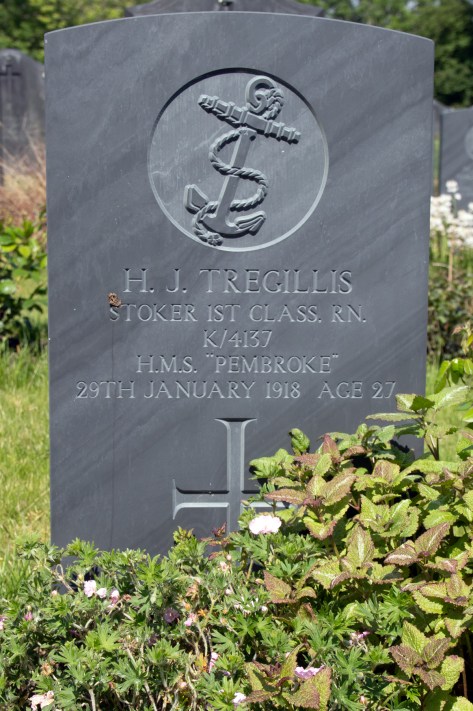
By the start of 1918, Stoker 1st Class Tregillis had been at Chatham Dockyard for six months. That winter he came down with pleurisy, and was admitted to the town’s Royal Naval Hospital. The condition would prove fatal, and he breathed his last on 29th January 1918: he was 27 years of age.
The body of Henry Johnson Tregillis was laid to rest in the naval section of Woodlands Cemetery, Gillingham, walking distance from the dockyard that had become home.
John Arthur William Claxton was born at the start of 1883 in Mile End, Middlesex. He was the only child to John and Louisa Claxton. John Sr was a brewer’s drayman, and, when Louisa died in the 1890s, He was left to raise his son.
When he completed his schooling, John Jr found work as a joiner’s apprentice. On 4th February 1907, he married Maud Wilson, a labourer’s daughter from Stepney. The couple went on to have two children: Louisa was born in 1907, and John the following year.
At this point, John’s trail goes cold. His marriage certificate confirms he was employed as a carpenter, and he definitely enlisted in the Royal Navy at some point, but whether this was as a direct result of the outbreak of war is unclear.
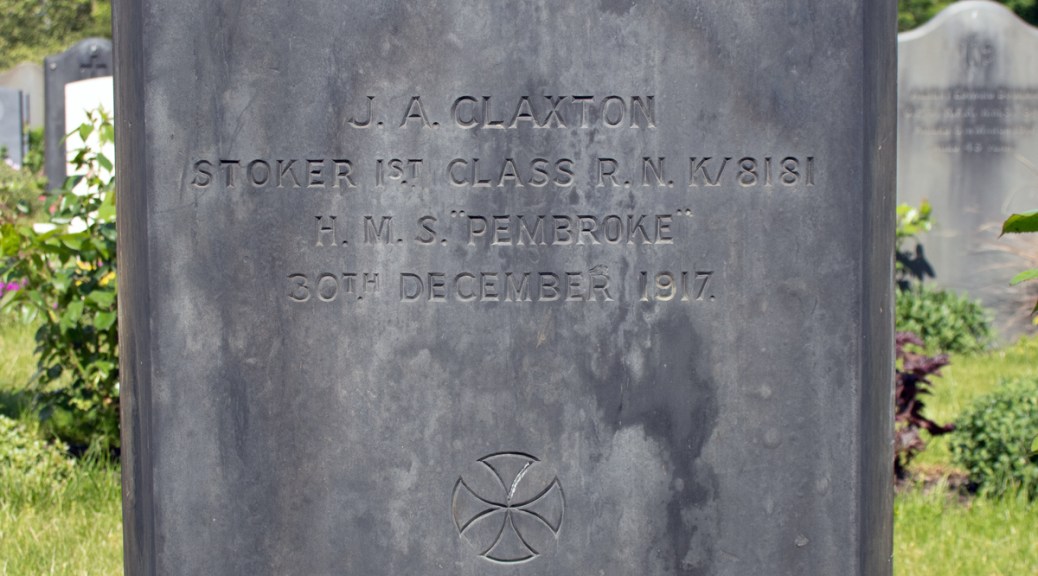
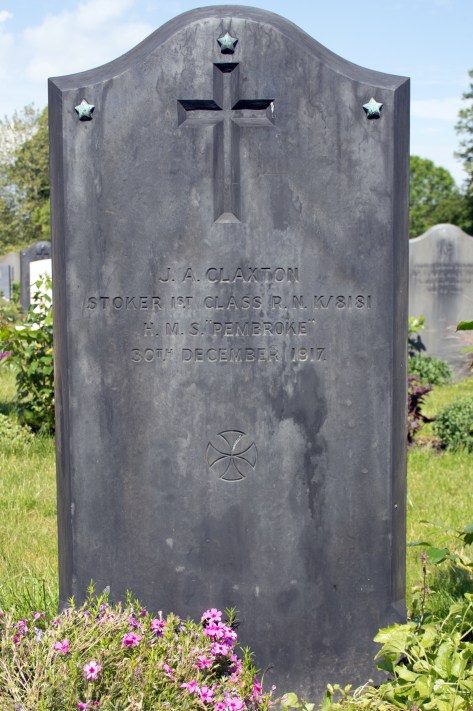
Stoker 1st Class Claxton’s service records have been lost to time. The only other document relating to him is his Pension Ledger Index Card. This confirms that he died from asthma and pneumonia on 30th December 1917: he was 34 years of age.
John Arthur William Claxton is likely to have died at either the Royal Naval Dockyard in Chatham – otherwise known as HMS Pembroke – or the Royal Naval Hospital in the town, as his body was buried in Woodlands Cemetery, Gillingham, not far from the base.









 Death and Service