Cuthbert Kean was born on 2nd October 1862, the eldest of four children to John and Jane Kean. John was a tailor from Manchester, who brought his young family up in the town of Crook, County Durham.
Cuthbert followed in his father’s footsteps and, by the time of the 1891 census – when he was 26 years old – was lodging in central Edinburgh, and was working as a tailor.
There is little more information available on Cuthbert’s early years. When war broke out, he enlisted in the Royal Navy, joining up on 26th October 1914. His papers show that he stood 5ft 2ins (1.57m) tall, had a fair complexion and grey eyes.
By 1917, having turned 55, he was transferred to the Royal Naval Reserve, and worked as a Trimmer – an alternative title for a Stoker. He had served on a number of vessels, joining HMS Firefly towards the end of the war.
Early in 1919, Trimmer Kean was admitted to the Royal Naval Hospital in Chatham, Kent, suffering from a sarcoma of the neck. Sadly, he was to succumb to this, and he passed away on 4th March 1919. He was 58 years old. His records give his next of kin as his sister Mary, who was living in Durham.
Cuthbert Kean was laid to rest in the Woodlands Cemetery in Gillingham, Kent.
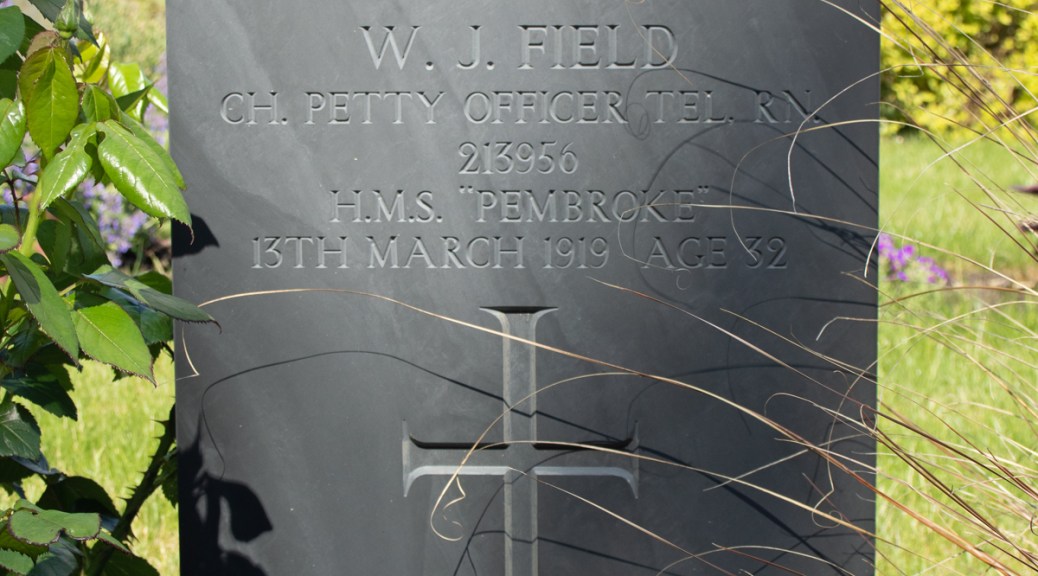
William John Field was born on 8th October 1885 in Boston, Lincolnshire. The eldest of four children, his parents were Charles and Ellen. Charles was a boatman for the coastguard; his job, by the time of the 1891 census, had taken the family to the village of Dawdon on the County Durham coastline.
Given his father’s job, it is not unsurprising that William was destined for a life at sea. As soon as he left school in the spring of 1901, he joined the Royal Navy and was sent to HMS Ganges, the shore-based training establishment in Suffolk. Being underage, he was initially assigned the role of Boy, moving, after a year, to HMS Pembroke, also known as the Naval Dockyard in Chatham, Kent.
By November 1902 Boy Field was moved to HMS Venerable, a ship that was to be his home for the next three years. During this time, William came of age, and was formally enrolled in the Royal Navy as a Signalman. He evidently worked hard on the Venerable, rising through the ranks to Qualified Signalman and Leading Signalman.
In June 1905, William was moved to HMS Leviathan, where he was again promoted, to Second Yeoman of Signals, before again being assigned to Chatham Naval Dockyard six months later.
While based in Kent, William met Nelly Watt, the daughter of a labourer at the dockyard. The couple married in 1906, and went on to have four children.
Over the next few years, the now Petty Officer Telegraphist Field spent an almost equal amount of time at sea and on shore. War was coming and when his initial term of service came to an end in October 1915, he immediately renewed his contract through to the end of the hostilities.
All of William’s time was now spent on land, primarily at HMS Pembroke, but also at HMS Actaeon in Portsmouth, HMS Victory VI at Crystal Palace, London and HMS Bacchante in Aberdeen.
While Chief Petty Officer Telegraphist Field’s naval service records are quite detailed, his passing is anything but. The war over, he moved back to Chatham Dockyard in January 1919. At some point he was admitted to the Royal Naval Hospital in the town, and died from ‘disease’ on 13th March that year. He was just 33 years of age.
William John Field was laid to rest in the Woodlands Cemetery in nearby Gillingham.
A sad aside to the story is that, at the time of he husband’s death, Nellie was pregnant with the couple’s fourth child. John William Field was born on 16th October 1919, destined never to know his father.
Michael Joseph O’Neill Goulding was born on 5th May 1884, the oldest of six children to Michael and Ellen Goulding (née O’Neill). Michael Sr worked for the inland revenue and his job took him around most parts of the British Isles.
Michael Jr had been born in Limerick – both of his parents came from Ireland – but his subsequent three siblings (Patrick, Margaret and William) had all been born in Scotland. His second youngest sibling, Lily, was born in County Durham, the youngest back in Scotland, while, by the time of the 1901 census, the whole family were living in Forest Gate, East London.
The census also shows that Michael Jr, having left school, was working at Customs House (presumably where his father was employed), as a boy copyist on tea accounts. The inland revenue at that time was a career for life; by the next census in 1911, the family had moved to Hertford, where Michael Sr was a customs and excise supervisor, and Michael Jr was an assistant clerk at the same place of employment.
War was on its way, but Michael seems not to have enlisted immediately. While specific dates for his joining up are not available, it appears that he was still working for the Inland Revenue when he got married in Shoreditch, in April 1917. His wife was called Bridget Mary Gough (known as Bryde), and she had also been born in Ireland. The couple went on to have a daughter, Ellen (or Eileen), the following year.
By this time, Michael had definitely enlisted. He joined the Royal Naval Volunteer Reserve, and was based at HMS Pembroke, the shore-based establishment in Chatham, Kent. This was the location for the Navy’s main accounting base, so it is likely that he was employed for financial, rather than his military, skills.
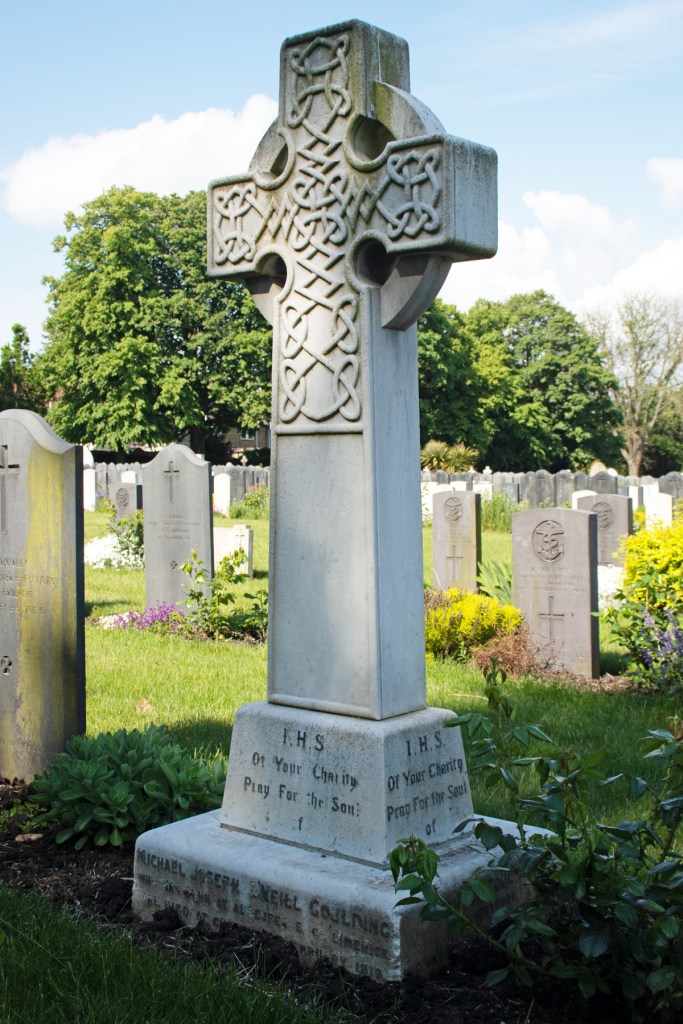
Able Seaman Goulding served through to the end of the war and beyond, and it was while he was based in Kent that he became unwell. Admitted to the Royal Naval Hospital in Chatham, he succumbed to a combination of bronchitis and pneumonia on 22nd February 1919. He was 34 years of age.
Michael Joseph O’Neill Goulding was laid to rest in the Woodlands Cemetery in nearby Gillingham. His family were still in Hertford, while his widow and daughter moved back to Ireland.
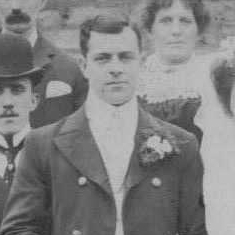
Michael Joseph O’Neill Goulding (courtesy of ancestry.co.uk)
There are some lives that just don’t want to be discovered, that just hide tantalisingly out of reach. James Davidson’s was one of those lives.
The main two research websites I use – cwgc.org and findagrave.com – only have his initial and surname, which is understandable, as this is what is inscribed on his headstone. Unfortunately, that doesn’t act as a good base on which to carry out further research.
HMS Gunner was the wartime moniker for Granton Harbour, near Edinburgh. A naval history website managed to identify Chief Artificer Davidson’s first name – James – but again, with no other information to go on, this is still too common a name – particularly in Scotland – to narrow down any real results.
Sadly, then, the story behind James Davidson is destined to remain a mystery. All that can be confirmed for certain is that he passed away on 23rd January 1919, though the cause of his passing is lost to time, as is his age.
James Davidson lies at rest in the Woodlands Cemetery in Gillingham, Kent.
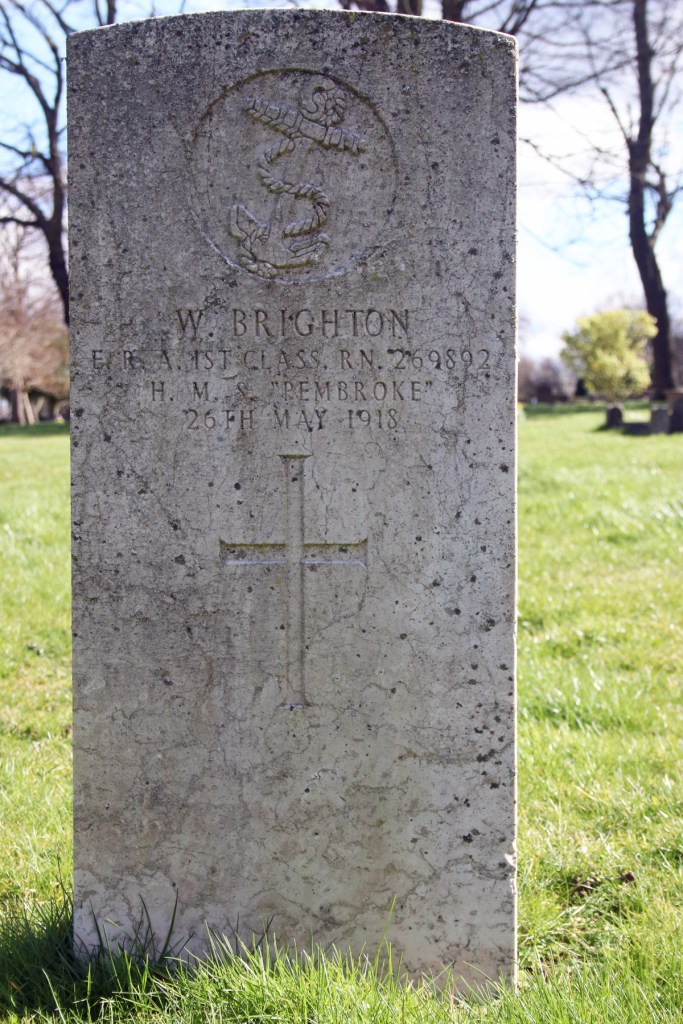
William Brighton was born on 13th August 1877 in Peterborough, Northamptonshire. Sadly, details of his early life are lost to time, so his parents’ names, and details of any siblings are a mystery.
William chose a military life early on; he enlisted in the Royal Navy in October 1899 for twelve years’ service. Working as an Engine Room Artificer, he was an engine fitter and repairer on a number of vessels in his time, including the battleship HMS Repulse and the cruisers HMS Andromache and Scylla.
William married Lily Franklin in the autumn of 1904, and the couple went on to have three children; Mona, Lily and John. With William away at sea a lot of the time, Lily set up home in Gillingham, Kent, close to the shore facility – HMS Pembroke – where her husband was based.
The uncertainty around potential conflict meant that William extended his service when it initially came to an end in November 1911. He continued to serve on a number of vessels during the war and was based on a ship off the Scottish coast when he fell ill in May 1918.
William was transferred to the US Hospital in Strathpeffer, near Inverness, suffering from an abdominal aneurysm. Sadly the treatment did not work, and he passed away on 26th May 1918. He was 40 years old.
William Brighton lies at rest in the Woodlands Cemetery in Gillingham, Kent.
Henry McCahearty was born in Glasgow in October 1864, one of four children to Henry and Bridget McCaherty. Sadly, few records remain, but it seems that Henry Sr, who had been born in Northern Ireland, was a soldier.
Henry falls off the radar quite quickly; from later records we can determine that he worked as a skilled labourer at the Naval Dockyard in Chatham, although it is not certain what particular skills he had.
He married Alice Radford on 3rd September 1901 in Walmer, on the Kent coast, although the couple subsequently moved to Gillingham. They went on to have four children – Reginald, James, Leonard and Alfred.
Henry was 49 when war broke out. While over the initial recruitment age, he did enlist – becoming a Private in the Royal Marine Light Infantry – although it is not certain exactly when he joined up.
Sadly Private McCahearty’s passing is also a mystery. There is nothing in the newspapers of the time to suggest anything out of the ordinary, so I can only assume that he died as a result of one of the illnesses that were rife at the time. Either way, he died on 14th November 1916, at the age of 51.
Henry McCahearty lies at rest in the Woodlands Cemetery in Gilingham, Kent.
Sidney Joseph Turner was born in 1888, the oldest of four children to Sidney and Matilda Turner from Bridgwater in Somerset. Sidney Sr was a carter, while his son became a labourer in a local cement works. Sadly, Sidney Sr died in 1903, when Sidney Jr was 15, leaving Matilda with three other children, one of whom was only 18 months old.
Sidney Jr travelled to get work, and had moved to South Wales to work as a miner by 1909. Here he married Rose Shattock, who was born in Bristol, although within a couple of years the young couple had moved back to Somerset.
Sidney and Rose had a son, also called Sidney, although sadly he died when he was only a couple of months old. Tragically for Sidney, the records seem to suggest that Rose may have died in childbirth, or shortly after, as her passing was registered in the same quarter as her son’s birth.
By this time, Sidney was living in Bailey Street, Bridgwater, a short distance from some railway sidings. This might have driven some determination in him as, by the following year, he was listed as an engine driver. In December 1913 he married his second wife, Bessie Sharman. She was the daughter of a mariner, who had become a machinist in a shirt factory by the time of their marriage. The couple went on to have a son, also called Sidney, in April 1914.
When war broke out, Sidney enlisted in the Highland Light Infantry, initially in the 12th (Service) Battalion. They landed in France in July 1915 and were there for the remainder of the war. At some point, Lance Corporal Turner transferred to the 53rd (Young Soldier) Battalion. Very much a training brigade, it seems that Sidney’s experience of the front line may have proved useful for the upcoming recruits.
Lance Corporal Turner was demobbed on 21st March 1919; his pension record shows that, during the course of his service, he had fractured his tibia and had contracted bronchitis. The 1921 census found Sidney back in Bridgwater. He was listed as being a gas engine driver for John Board & Co., although he was, at that point, out of work. He, Bessie and Sidney Jr were living at 1 Price’s Buildings.
Sidney’s health conditions were to prove his downfall, as, within a months of the census return, he had succumbed to pulmonary tuberculosis and exhaustion. He died on 2nd July 1921, aged just 32 years old.
Sidney Joseph Turner lies at rest in St John’s Cemetery in his home town of Bridgwater, Somerset.
Francis George Smith was born in Glasgow in 1890. Records are scattered, but some of the pieces pull together to give an outline of his life.
The son of William and Mary Smith, Francis was the fourth of six children. His tombstone confirms that William had worked as an optician, but passed away when Francis was a young man.
Francis was an electrical engineer, and had assisted Mary in her business in Glasgow before signing up.
Private Smith enlisted early on in the war, “on February 24th of this year [1915], when he left his native city for London, where he joined the motor transport section of the Army Service Corps” [Wells Journal, Friday 12th March 1915].
Billeted in Wells, he had been assigned to the 133 Mechanical Transport Company. Within weeks of moving there, however, it seems that Francis fell ill. Sadly, his was a life cut too short, and he passed away from pneumonia on 6th March 1915, aged just 25 years old.
Francis George Smith lies at rest in the cemetery in Wells.
Wilfrid David Baker was born in 1889 in Upchurch, Kent. One of ten children, to Charles and Margaret Baker, he followed his father into the brickmaking industry.
When the Great War came, Wilfrid signed up, enlisting in the Royal Navy in March 1917, as Stoker 2nd Class. During his training in Woolwich, he was promoted to Stoker 1st Class, before being assigned to the HMS Columbine naval base in Scotland.
During his work there, Stoker Baker came down with influenza and was transferred to the HMHS Garth Castle hospital ship. Wilfrid’s illness developed into pneumonia, and he passed away on 20th October 1918. He was 29 years of age.
Stoker 1st Class Wilfrid Baker is buried in the churchyard of St Mary the Virgin in his home village, Upchurch.