Harry Etherton was born in Ansty, near Cuckfield, West Sussex on 3rd April 1872. The oldest of five children, his parents were Edwin and Louisa Etherton. Edwin was an agricultural labourer, and this was work in which his son followed his father.
On 29th April 1899, Harry married Annie Eliza Pennifold, a labourer’s daughter who was also from Ansty. The couple set up home in Cuckfield, and went on to have five children. Harry was, by this point, working as a road labourer for the local council, and this was a job he was to continue doing until the outbreak of the war.
Harry enlisted in 1915, joining the Royal Sussex Regiment as part of the National Reserve. As Private Etherton, he was then transferred across to the Labour Corps, and was assigned to the 409th Labour Coy. which was based at the Infantry Depot in Lincoln.
It was while Private Etherton was here, in the spring of 1918, that he contracted meningitis, and was admitted to the Northern General Hospital in the city. Sadly, he was to succumb to the disease, passing away on 30th June 1918, at the age of 46 years old.
Harry Etherton’s body was brought back to West Sussex for burial. He was laid to rest in Cuckfield Cemetery, not far from where his widow and children still lived.
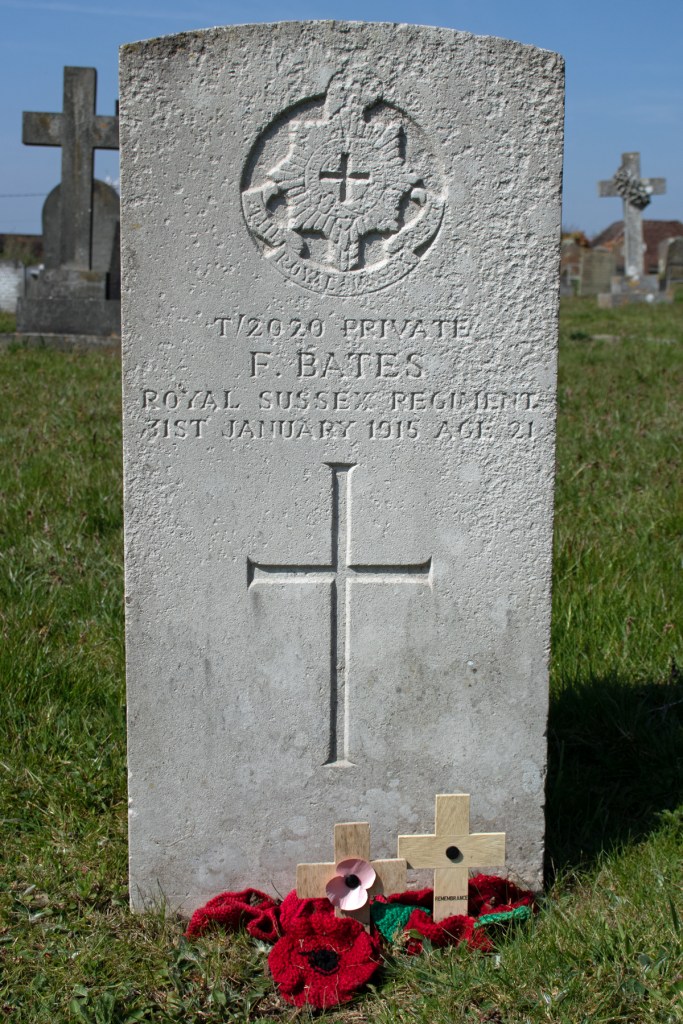
Frank Bates was born on 29th June 1893, in Cuckfield, West Sussex and was the fourth of five children. His parents were tailor William Bates and his wife, Sarah.
Tragedy was to be a constant companion to the Bates family. Frank’s older brother, William, died in November 1907 after a protracted illness, at the tender age of just 19 years old. Four years later, his younger sister, Maggie, also passed away after an illness. She was just 21 years of age.
When he left school, Frank went into the service of the Messel family, who owned the Nyman’s estate close to where Frank and his family lived. When war was declared, however, he was keen to play his part, enlisting soon after hostilities were announced in August 1914.
Private Bates joined the 4th (Home Service) Battalion of the Royal Sussex Regiment and was sent to Newhaven for training. It was while he was here that he fell ill, and, having caught a chill, he returned to Cuckfield to recuperate. Sadly, his condition worsened, and he passed away at his family home on 31st January 1915. He was just 21 years old.
Frank Bates was laid to rest in Cuckfield cemetery, resting not far from his siblings.
Tragedy was to strike one more time for William and Sarah. Frank’s older brother Jack served as a Private in the 2nd/4th Battalion of the London Regiment. In the spring of 1918, he was caught up in that year’s Battles of the Somme, including fighting at St Quentin and Avre.
In May 1918, Private Bates was officially reported as missing, but it was later confirmed that he had died of injuries sustained in the fighting. He passed away on 16th April 1918, at the age of 29 years old.
Jack was laid to rest at the Chauny Communal Cemetery in Picardie, France, and is also commemorated in Cuckfield Cemetery.
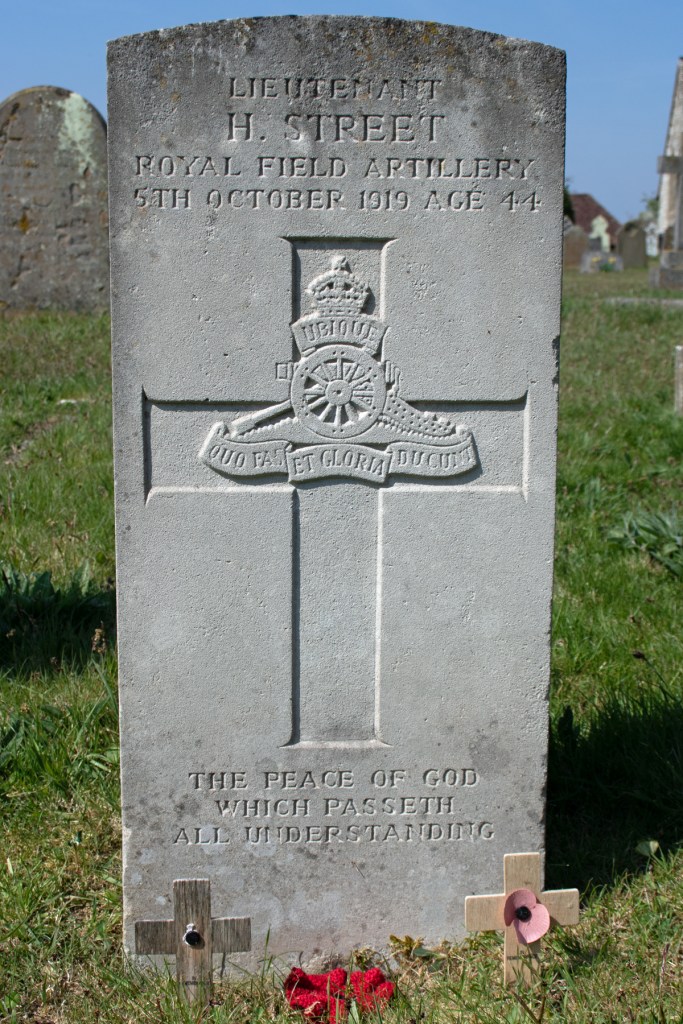
Henry Street – known as Harry – was born on 22nd April 1875 in Oxted, Surrey and was one of thirteen children to Jacob and Emma. Jacob was an agricultural labourer, and this is work Harry initially went into when he left school.
However, it seems that Harry was after more of a career, and looks to have enlisted in the Royal Field Artillery by 1895. His trail goes cold for a while, and it can be assumed that he served abroad, although exact details of his career are lost to time.
By 1906, Harry was back in England, and, on 15th October he married Janette Street at St Peter’s Church in Tandridge, Surrey. The marriage record confirms that Harry was a soldier, while his new wife was the daughter of a labourer. Janette was three years Harry’s junior, and there does not seem to be any close family connection, in spite of their shared surname.
Again, information on Harry’s life at this point is sparse. When war was declared, he was either still serving with the Royal Field Artillery, or was called back in to duty. By December 1914, he had been promoted to Lieutenant: this was to be a rank he would continue to hold until the end of the conflict. He certainly served abroad, and was awarded the Long Service and Good Conduct Medals, in addition to the Victory and British Medals. He was also given the French Medaille Militaire, although reasons for this award are lost to time.
Lieutenant Street survived the war, and by the autumn of 1919, he was living at Bright Farm in Cuckfield, West Sussex. It was here, too, that he passed away, through causes unknown. He died on 5th October 1919, at the age of 44 years old.
Harry Street was laid to rest in Cuckfield Cemetery, in the shadow of the village’s Holy Trinity Church.
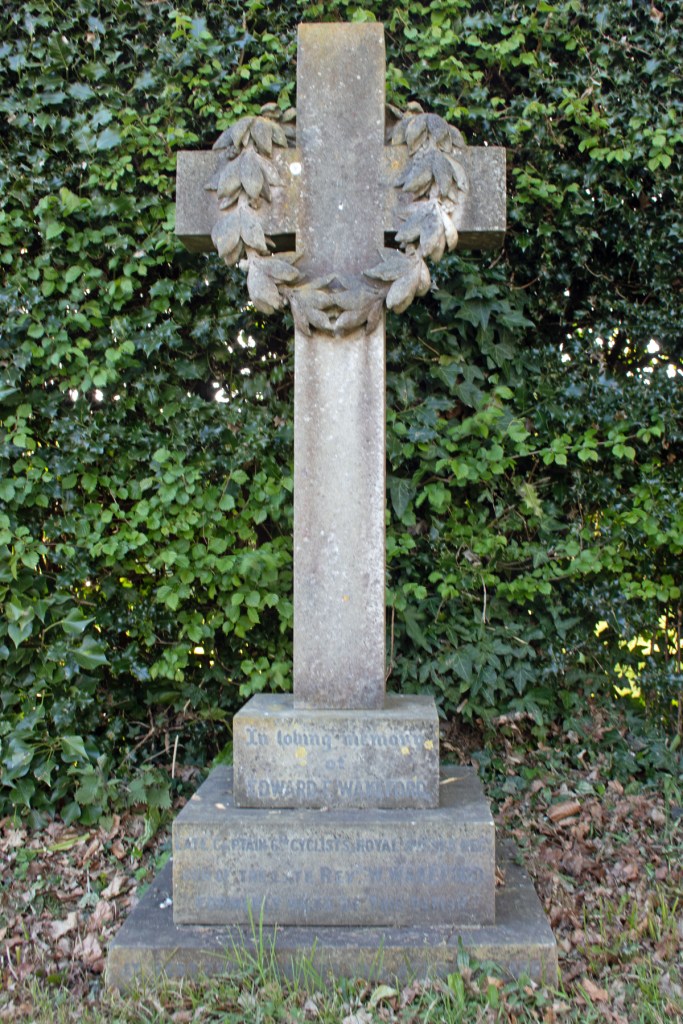
Edward Francis Wakeford was born in Rottingdean, near Brighton, Sussex, in February 1881. He was the younger of two children to curate William Wakeford and his wife, Eliza.
The family home was always a busy one; the 1881 census records one visitor, four boarders and a servant. Ten years later, confirms one boarder and two servants.
By 1901, William had taken up a post in St Peter’s Church, Henfield. This seems to have been a step up: helping look after the family and a visitor were four servants – a gardener, a cook, a housemaid and a kitchenmaid.
In March 1907, Edward married Annie West Thornton; she was the daughter of a well-to-do family – the census records show that her father, William West Thornton, lived by private means, while Annie was sent to Surrey to attend a boarding school.
Edward and Annie couple set up home on the Sussex coast, and, when William passed away in 1912, were soon also living by private means. They went on to have three children: two girls, Olive and Iris, and a boy, who they named William after both of their fathers.
War was coming to Europe by this point. While full details of Edwards military service are not available, he appears to have given a commission in the Royal Sussex Regiment. Initially serving as a Lieutenant, but October 1914, he was promoted to Captain.
Edward was assigned to the 6th (Cyclist) Battalion, and served in East Anglia. It seems that he fell ill while there, and was admitted to the Norfolk and Norwich Military Hospital, suffering with appendicitis. Sadly the condition proved too much, and Captain Wakeford passed away following the operation. He died on 23rd February 1915, not long after his 34th birthday.
Edward Francis Wakeford’s body was brought back to Sussex. He was laid to rest in Henfield Cemetery, not far from the church where his father had served for so long.
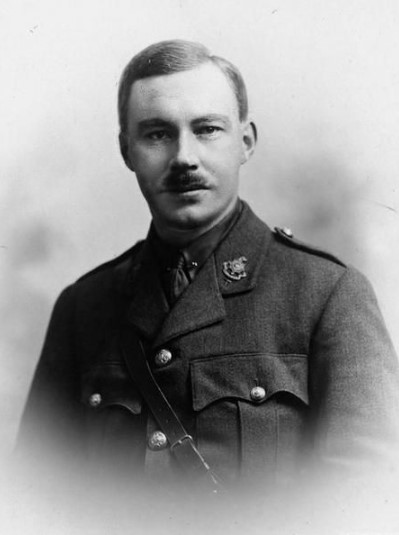
Captain Edward Wakeford (from findagrave.com)
The now widowed Annie wed again, marrying Reverend John Gurney in October 1917. Tragedy was to strike again, though, when she passed away just a year later, on 20th October 1918. She was laid to rest Henfield Cemetery, in the plot next to her late husband, Edward.
John Gurney went on to live a full live. He never married again, and settled in Buxted, near Uckfield. He passed away in November 1956, at the age of 76 years old. He was also laid to rest in Henfield Cemetery, where he was buried in the same plot as Annie.
Edward and Annie’s children also went on to have full lives, despite the early loss of their parents.
Olive never married, and passed away in Nottingham in 1986, aged 78 years old.
Iris married in Liverpool in 1934, and went on to have two children. When the marriage failed in the 1940s, she got wed again in 1949. She passed away in Cheltenham in 1965, at the age of 54.
William got married in 1940, at which point he was serving as a Lieutenant in the 1st King’s Shropshire Light Infantry. He saw action in Italy towards the end of the war, and was awarded a Military Cross for his service. When peace came to Europe again, he and his wife settled into a normal life, before emigrating to Australia. William passed away in May 1967, at the age of 54 years old.
William Reeves was born in the summer of 1896, one of eleven children to James and Ruth Reeves. James was a house painter from Henfield in West Sussex, and it was there that he and Ruth raised their growing family.
When war came to Europe, William was keen to play his part. He enlisted as a Gunner in the Royal Garrison Artillery, and, by October 1915, was in France.
Little information survives about Gunner Reeves’ military service, but by the time he was demobbed, he had earned the Victory and British Medals, the 1915 Star and the Silver War Badge. The latter award was given to those servicemen who had been honourably discharged from service due to wounds or sickness.
William returned to Sussex, but to a quieter home, James having passed away in the spring of 1916. William was also suffering with his health. He had contracted tuberculosis while in the army, and this is the condition to which he finally succumbed. He passed away on 16th December 1919, aged just 23 years old.
William Reeves was laid to rest in Henfield Cemetery, within walking distance of his family home.
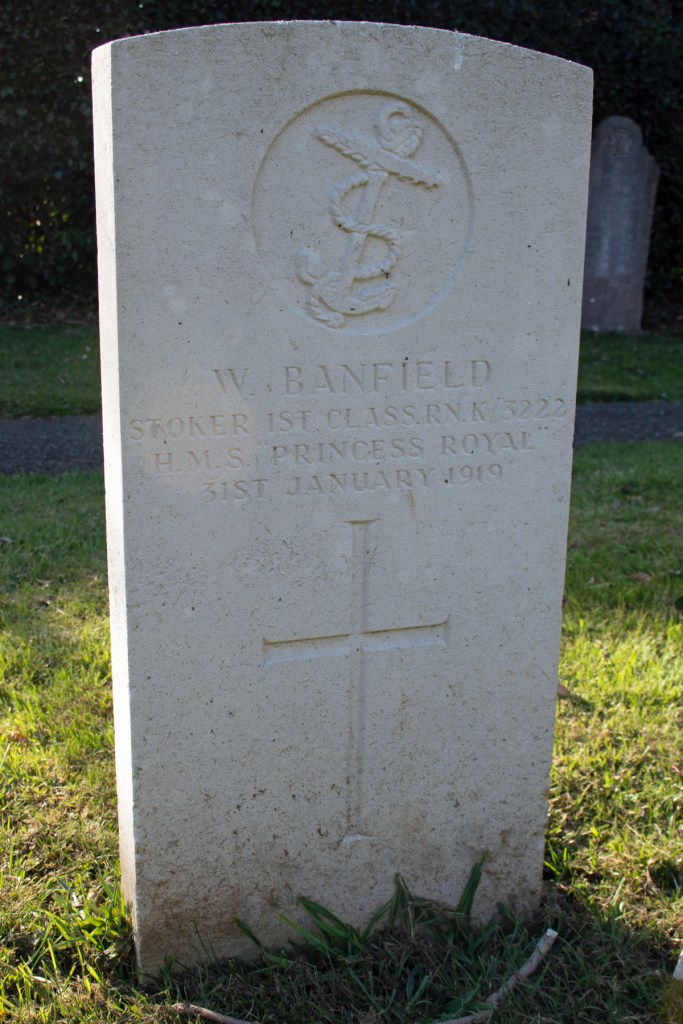
William Banfield was born on 7th November 1890, in Henfield, near Horsham, West Sussex. He was the second youngest of seven children to George and Ellen Benfield. George was a carpenter, and this was a trade his two sons – William and his older brother, George – were initially both to follow as well.
William had a longing for the sea, however, and, on 11th June 1909, he enlisted in the Royal Navy as a Stoker 2nd Class. His service records show that he was 5ft 7.5ins (1.71m) tall, had brown hair, blue eyes and a fair complexion.
Stoker Banfield was based out of HMS Victory, the Royal Naval Dockyard in Portsmouth, Hampshire, but, over the eventual decade of his service, he spent no more than seven months ashore. Instead, he served on a total of nine ships. This included the battleship HMS Exmouth where, during the eighteen months he spent on board, he was promoted to Stoker 1st Class, and also spent 14 days in the brig, for reasons undisclosed.
On 27th September 1915, William was assigned to HMS Princess Royal. He served aboard for nearly three and a half years, patrolling the North Sea, coming under fire during the Battle of Jutland, and providing support during the Second Battle of Heligoland Bight.
Towards the end of January, Stoker 1st Class Benfield fell ill, and was admitted to the Edinburgh City Hospital. Suffering from encephalitis, sadly the condition proved too much for his system to bear and he passed away at the hospital on 31st January 1919. He was 28 years of age.
William Banfield was brought back to Sussex for burial. He was laid to rest in the cemetery of his home town, Henfield.
William’s older brother, George, was also to fall victim to the First World War. He had enlisted in the Royal Navy three years before his younger sibling, and also served as a Stoker 2nd Class (subsequently being promoted to Stoker 1st Class in 1907).
George was also based out of HMS Victory, and, in April 1911, was stood down to the Royal Naval Reserve, having completed an initial five years’ service.
When war broke out, George was called back into service, and was assigned to HMS Good Hope, travelling from English shores to Nova Scotia, before heading to South America and into the Pacific.
Caught up in the Battle of Coronel on 1st November 1914, the Good Hope was sunk by the German cruiser SMS Scharnhost. All souls on board – all 926 of them – were lost; this included Stoker 1st Class George Banfield. He was only 27 years of age.
James Joseph Wing was born in Tonbridge, Kent, in the summer of 1876 and was the oldest of six children to Henry and Frances Wing. Henry was a labourer, but when he finished school, James found work as an errand boy for the post office.
This was not a long-term career, however, and by the time of the 1901 census, when James was 25, he was labouring for the railway. His mother had died in 1897, and Henry remarried, to a woman called Frances Stapley.
In the spring of 1902, James also married, to Sussex-born Mary Ann Goacher. The couple wed in Steyning, near Worthing, but settled in Henfield. James seemed to be picking up work where he could – the census of 1911 recorded him as a coal porter, but by the time he enlisted, in June 1916, he gave his trade as a gardener.
James joined the Royal Garrison Artillery as a Gunner, and was initially assigned to the No. 1 Depot in Newhaven. Full details of his service are unclear, but he transferred to No. 2 Depot in Gosport, Hampshire, in the summer of 1918.
Gunner Wing had only been in Gosport for a couple of months, when he was admitted to the 5th Southern General Hospital in nearby Fratton. At 12:15pm on 4th December 1918, he passed away, a post mortem revealing he had succumbed to a cerebral tumour. He was 42 years of age.
James Joseph Wing was brought back to Sussex for burial. He was buried in the cemetery in his adopted home town of Henfield.
Bert Burridge was born in the spring of 1893, one of nine children to Charles and Elizabeth. Charles was a journeyman shoemaker from Crediton in Devon, and this is where Bert was born. By the time of the 1901 census, however, the family had moved south to Newton Abbot.
When Bert left school, he found work as a carriage cleaner for the railways; he soon moved out, and boarded with a family in Kingsbridge, in the south of the county.
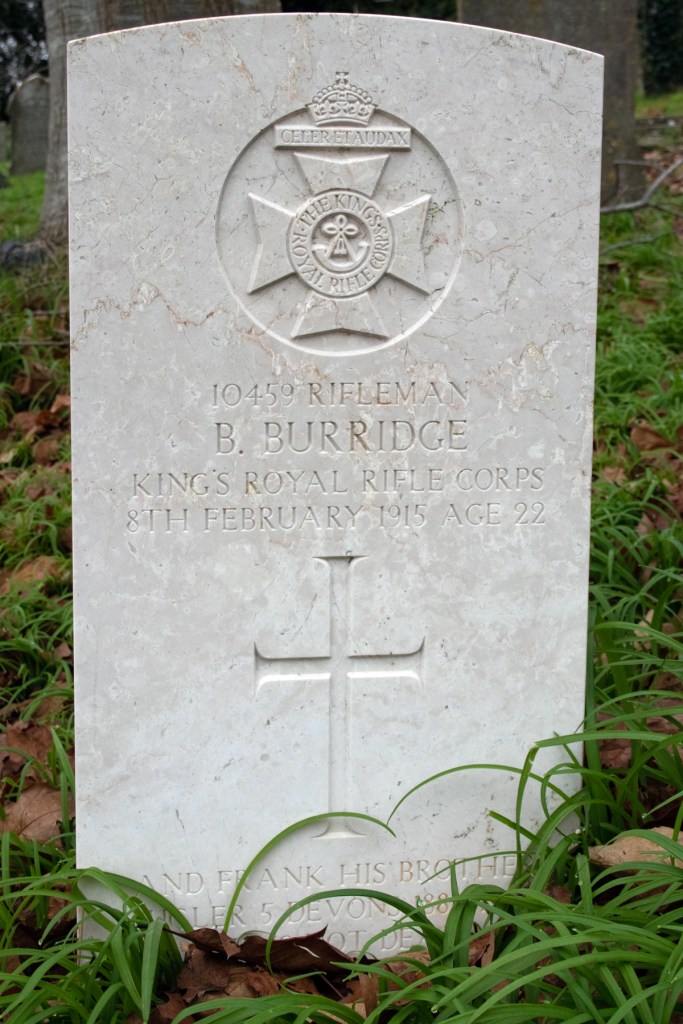
War was coming to England’s shores, however, and Bert was keen to play his part. He enlisted in the 4th Battalion of the King’s Royal Rifle Corps as a Rifleman on 16th January 1912. His service records show that he stood 5ft 4ins (1.63m) tall, and weighed 121lbs (55kg). He had a fresh complexion, grey eyes, dark brown hair, and a tattoo on right wrist of two crossed hands.
When war broke out, Rifleman Burridge was sent to France and was caught up in the fighting early on. After three months at the front, during the winter of 1914, he contracted frostbite, and was medically evacuated back to England. He was admitted to the 2nd Eastern General Hospital in Brighton, but died of injuries on 9th February 1915. He was just 22 years of age.
Bert Burridge’s body was brought back to Devon for burial. He was laid to rest in the graveyard of St Mary’s Church in Wolborough, on the outskirts of Newton Abbot.
Bert’s headstone also includes a commemoration to his older brother, Frank. Seven years older than Bert, he had enlisted in the Devonshire Regiment as a Bugler when quite young. He passed away in the autumn of 1906, aged just 20, but further details are unclear.
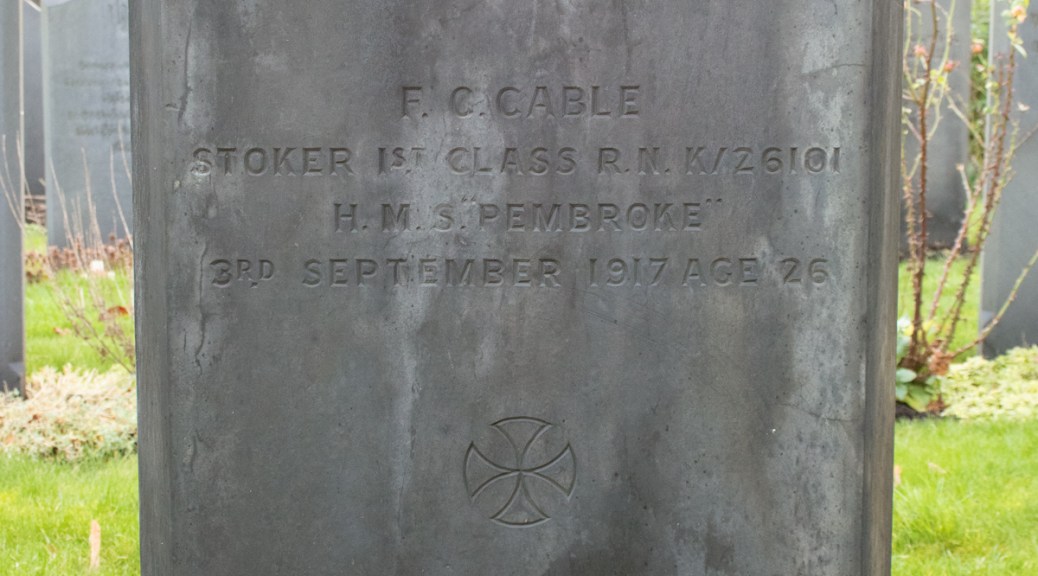
Frederick Charles Cable was born on 22nd November 1890 in Eastbourne, West Sussex. He was the younger of three children to John and Louisa Cable, and the family lived on one floor of a three-storey house in the middle of the town.
When Frederick was born, John was working as a billiard marker, but it seems that this was a poor way to scratch together a living for a young father. The 1901 census found the family in London, where John had been born, and where he was not employed as a hotel waiter.
Sadly, the new set-up was not to last long: John died in 1905, leaving Louisa to raise her boys on her own. The next census record, in 1911, records the two of them living a five-room terraced house in East Finchley. They were not alone, however, as they were sharing it with a widow – Elizbeth Hickinbottom – and her 34-year old son, George.
A year later, George and Louisa married, and went on to have a daughter, also called Louisa. Frederick, meanwhile, was to find love of his own, and, in the spring of 1914, while working as a milkman, he married Dorothy Ada Laurence. They would go on to have a son, who they named after his father, a year later.
By this point, war was raging in Europe, and Frederick was called to do his duty in May 1915. His records show that he was 5ft 7ins (1.70m) tall, had dark brown hair, brown eyes and a dark complexion and was given the rank of Stoker 2nd Class.
Over the next couple of years, Frederick served on two ships – HMS Actaeon and HMS Weymouth – and it was on board the latter that he was promoted to Stoker 1st Class in April 1916. The majority of his time, however, was spent on shore-based establishments: HMS Victory in Hampshire and HMS Pembroke in Kent.
The Royal Naval Dockyard in Chatham (HMS Pembroke) was where he spent most of his time, and was where he returned to in the summer of 1917. It was a particularly busy place at that point in the war and temporary accommodation was set up. Frederick found himself billeted at The Drill Hall, away from the main barracks.
On the night of 3rd September 1917, Chatham suddenly found itself in the firing line, as the German Air Force launched a bombing raid. One of the bombs landed squarely on the Drill Hall, and Stoker Cable was killed instantly. He was just 26 years old.
Ninety-eight servicemen perished during the Chatham Air Raid that night. They were buried in a mass funeral at the Woodlands Cemetery in nearby Gillingham. This, too, is where Frederick Charles Cable was laid to rest.
Frederick’s brother John Cable also fought in the First World War. He served as a Sergeant in the 21st Battalion Middlesex Regiment and was killed at the Battle of St Quentin on 25th March 1918. He was 28 years old and left a widow and three children. #
Serjeant John Cable is commemorated on the Arras Memorial in Northern France.
John Walker Lake was born in Eastbourne, East Sussex, in the spring of 1892, the only child of estate manager and auctioneer Percy Lake and his wife Elizabeth.
John’s mother passed away in 1900, when he was only eight years old, and details of his early life are hard to come by. However, by the time of the 1911 census, he had left school and enrolled in a mining college in Guston, near Dover, Kent.
When war broke out, John was quick to enlist. He joined the London Regiment on 18th September 1914, and was assigned to the 2nd/23rd Battalion. His service records show that he stood 5ft 8ins (1.72m) tall, had light hair, blue eyes and a fair complexion.
Private Lake was not to remain in the army for long. Within weeks of joining, he contracted tuberculosis and, on 22nd February 1915, after just 158 days, he was discharged from service as being no longer medically fit for duty.
At this point, John’s trail goes cold. He initially returned to live with his father in Eastbourne. By the autumn of 1918, however, he was in Weston-super-Mare, Somerset, probably for health reasons.
The tuberculosis got the better of John Walker Lake, however; he passed away on 20th October 1918, at the age of 26 years old. He was laid to rest in the Milton Road Cemetery in Weston-super-Mare.










 Death and Service